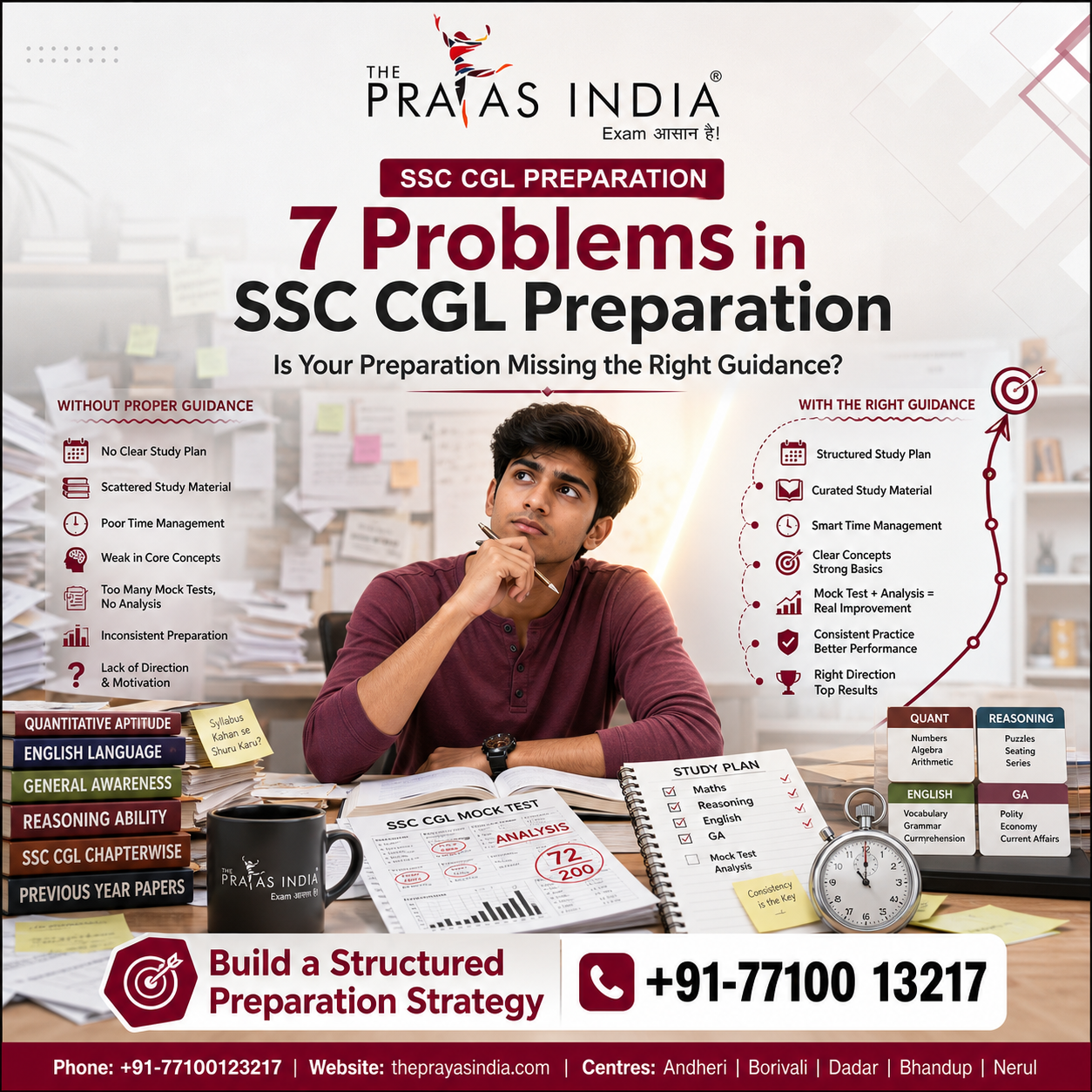
SSC CGL Preparation: How Many Hours Study Every Day?
One of the first questions that comes to almost every SSC CGL aspirant’s mind is simple: “How many hours should I study every day?”
Some students search for a fixed number such as 8 hours, 10 hours or even 12 hours. Others compare their routine with toppers and feel that studying for only a few hours means they are not doing enough. Working professionals often wonder whether they can realistically prepare alongside a job, while college students may struggle to balance classes, assignments and SSC CGL preparation.
The truth is that there is no single number of study hours that guarantees effective SSC CGL preparation.
The more important question is:
How much focused, structured and productive preparation can you consistently complete every day?
SSC CGL preparation involves multiple areas, regular practice, revision, mock tests, previous-year questions and performance analysis. The examination framework also requires candidates to work under time pressure. For example, the recent SSC CGL Tier-I scheme has separate sectional timers, making it important to develop both knowledge and speed rather than simply accumulating study hours.
Therefore, a student studying six focused hours with a clear plan may accomplish more than someone who spends ten hours at a desk but frequently switches between resources, watches videos without practising questions or postpones revision.
This article explains how many hours different types of aspirants can realistically target, how to divide those hours across subjects, how to increase study time gradually and how to build a sustainable SSC CGL preparation routine.
Is There a Fixed Number of Hours for SSC CGL Preparation?
No.
A fixed number such as “study 8 hours every day” can be misleading because every aspirant starts from a different position.
Consider two students.
The first student is a full-time aspirant who has completed the basic syllabus and is now focusing on mocks, revision and speed.
The second student is a college student who has only recently started preparing and is still learning basic concepts in Quantitative Aptitude and English.
It would not make sense to give both students exactly the same study target.
Similarly, a working professional who spends eight or nine hours at work cannot realistically follow the same timetable as someone who has the entire day available for preparation.
The right approach is to determine your study requirement based on:
- Your current preparation level
- Time available every day
- Strength and weakness in individual subjects
- Distance from the examination
- Previous preparation
- Mock-test performance
- Revision requirements
- Your ability to maintain consistency
The objective should be to create a routine that you can follow for months, not a timetable that looks impressive for three days.
What Actually Counts as “Study Hours”?
This is an important distinction.
If you sit at a desk for eight hours but spend two hours checking your phone, one hour deciding which lecture to watch, another hour changing resources and considerable time passively watching videos, those eight hours do not represent eight hours of effective preparation.
A more useful calculation is productive study time.
Productive study may include:
- Learning a new concept
- Solving practice questions
- Attempting previous-year questions
- Revising formulas
- Reading and revising General Awareness
- Practising English
- Taking sectional tests
- Attempting mock tests
- Analysing mock-test mistakes
- Revising an error notebook
- Improving speed and accuracy
For SSC CGL, practice is particularly important because knowing a concept and being able to apply it quickly under exam conditions are two different skills.
Therefore, don’t measure your preparation only by the number of hours sitting at your desk.
Measure it by what you accomplished during those hours.
A Better Formula for SSC CGL Preparation
Instead of asking:
“How many hours should I study?”
ask:
“What should I accomplish during my available study time?”
A productive daily plan can include:
Concept Learning + Question Practice + Revision + Timed Practice + Analysis
For example, a student may spend:
- 90 minutes on Quantitative Aptitude
- 75 minutes on Reasoning
- 60 minutes on English
- 60 minutes on General Awareness
- 45 minutes on revision or previous-year questions
- 30 minutes analysing mistakes
The exact duration is not important. The balance is.
As preparation progresses, the ratio can change. Early preparation may require more concept learning, while later stages may require more revision, sectional tests, mocks and analysis.
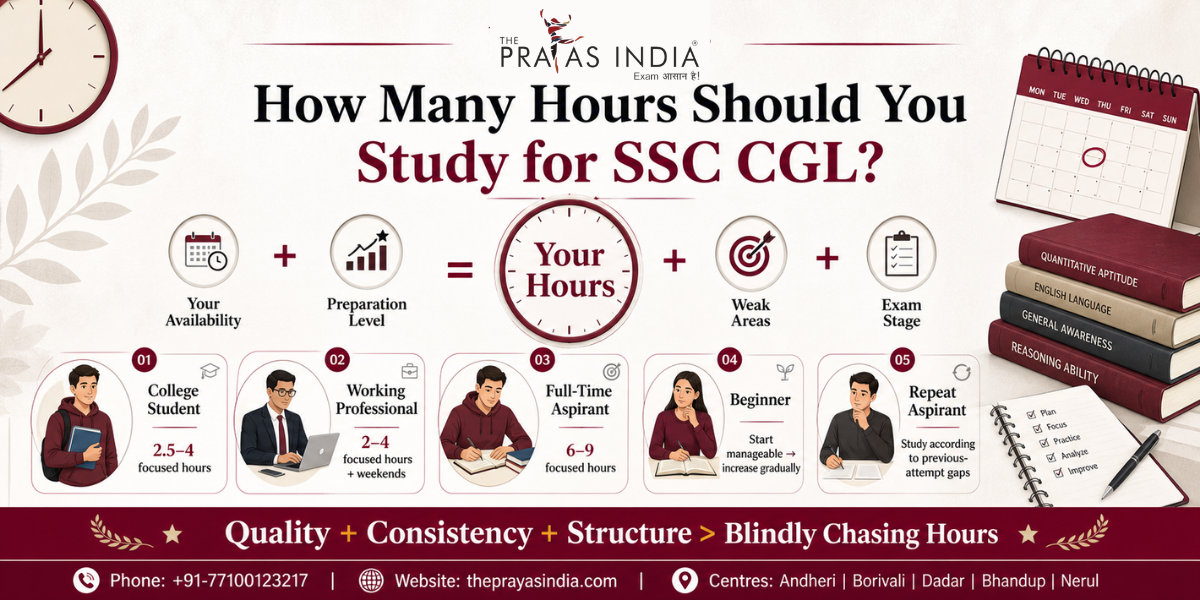
How Many Hours Should Different SSC CGL Aspirants Study?
The most practical answer depends on your category of aspirant.
Let’s look at five common groups.
1. College Students Preparing for SSC CGL
College students have one major advantage: they can start building their SSC CGL foundation before entering full-time exam preparation.
However, college schedules can be unpredictable. Classes, assignments, practicals, examinations and commuting may affect the amount of time available.
For a college student, 2.5 to 4 focused hours on regular days can be a useful starting range, provided the routine is consistent.
During weekends or holidays, the student may be able to extend preparation time.
The important thing is not to sacrifice college responsibilities simply to chase a large number of SSC CGL study hours.
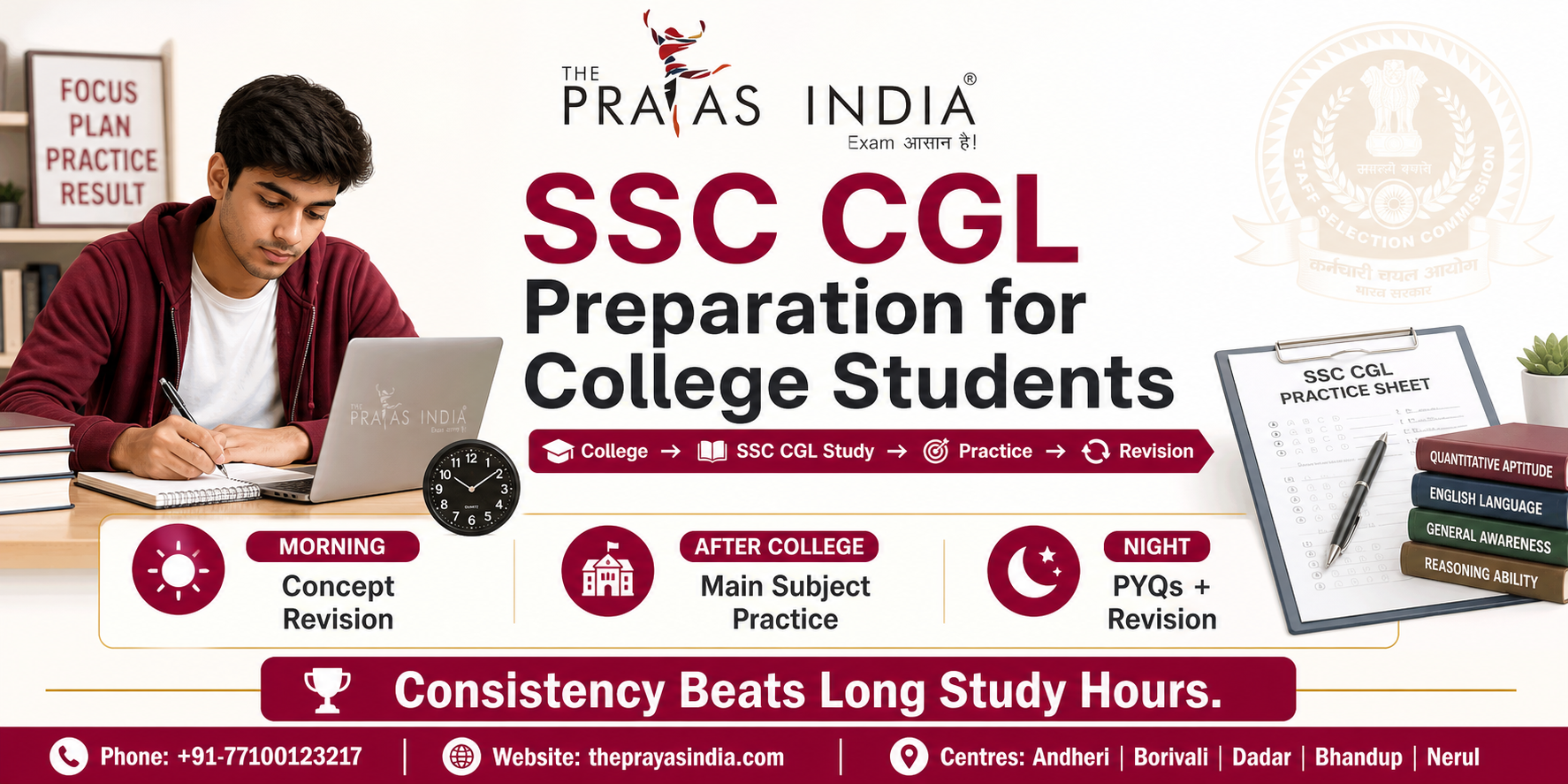
A Possible College-Student Routine
Morning: 60–90 minutes
Use this time for Quant formulas, English vocabulary, grammar revision or short reasoning practice.
After College: 90 minutes
Focus on the main subject of the day.
Evening/Night: 45–60 minutes
Solve PYQs, revise mistakes or attempt a short sectional test.
This creates a sustainable preparation cycle without requiring the student to spend the entire day studying.
What College Students Should Focus On
If you are starting early, use the available time to build fundamentals.
Focus on:
- Arithmetic basics
- Algebra fundamentals
- English grammar
- Vocabulary
- Reasoning concepts
- Basic General Awareness
- Previous-year questions
The objective is to reach the later stage with strong fundamentals rather than beginning everything from zero when the exam becomes closer.
2. Working Professionals Preparing for SSC CGL
Working professionals face a different challenge.
The problem is usually not lack of motivation. It is limited and fragmented time.
After commuting and completing work responsibilities, studying for six or eight hours may be unrealistic.
Instead of trying to imitate a full-time aspirant, build your preparation around the time you can consistently protect.
For many working professionals, 2 to 4 focused hours on weekdays, combined with longer weekend sessions, can create a sustainable preparation structure.
The exact target should depend on your work schedule and current preparation level.
A Practical Working-Professional Routine
Before Work — 60 to 90 minutes
Use this for high-focus activities such as Quant practice, English or reasoning.
Commute/Breaks — 20 to 30 minutes
Use only for light revision where practical:
- Vocabulary
- Current affairs notes
- Formula revision
- Error-log review
After Work — 60 to 90 minutes
Complete your main practice session.
Weekend — 4 to 6 focused hours
Use weekends for:
- Sectional tests
- Mock tests
- PYQs
- Weak-topic practice
- Detailed analysis
This approach is more sustainable than forcing yourself to study until midnight every day and then losing consistency after a week.
The Biggest Advantage of a Working Professional
A working professional often develops strong time discipline because preparation has to fit into a limited schedule.
The key is to remove unnecessary activities from the preparation process.
You should know exactly what you will study before the session begins.
3. Full-Time SSC CGL Aspirants
Full-time aspirants have more available hours, but that does not mean they should automatically study for 12–14 hours every day.
In fact, one of the biggest mistakes full-time aspirants make is confusing availability of time with requirement of study time.
A practical target for many full-time aspirants may be around 6 to 9 productive hours, depending on their stage of preparation.
The focus should be on output.
A full-time aspirant can divide the day into focused blocks rather than sitting continuously at a desk.
Example Structure
Session 1 — 2 hours
Quantitative Aptitude concepts + practice
Session 2 — 90 minutes
English
Session 3 — 90 minutes
Reasoning
Session 4 — 60–75 minutes
General Awareness
Session 5 — 90 minutes
PYQs / sectional test / mock
Session 6 — 45 minutes
Error analysis + revision
Between sessions, take short breaks.
The goal is to protect concentration rather than maximize the number written on your timetable.
The Full-Time Aspirant’s Biggest Risk
The biggest danger is often overplanning.
A student may create a timetable with 12 hours of study every day but complete only six hours.
Then guilt begins.
The student changes the timetable.
Another timetable is created.
Another resource is added.
Eventually, the student spends more time managing preparation than actually preparing.
A realistic timetable is better than an ambitious timetable that repeatedly fails.
4. Beginners Starting SSC CGL Preparation From Zero
Beginners should not compare themselves with students who have already completed the syllabus.
If you are starting from zero, your first goal is to create a strong foundation.
This may initially require 3 to 5 focused hours per day, depending on your availability.
The number can increase gradually.
Beginner Stage 1: Understand
Learn the fundamentals.
Beginner Stage 2: Practise
Solve basic and moderate questions.
Beginner Stage 3: Apply
Move toward previous-year questions.
Beginner Stage 4: Time
Introduce timed sets.
Beginner Stage 5: Test
Start sectional tests and gradually move to full mocks.
A beginner should therefore avoid jumping directly into difficult mocks every day.
The preparation should progress in stages.
What Beginners Should Study First
A beginner can start with:
Quantitative Aptitude
Build arithmetic fundamentals before rushing toward advanced questions.
Reasoning
Learn the basic question types and understand the logic behind them.
English
Develop grammar fundamentals, vocabulary and reading comprehension skills.
General Awareness
Create a manageable system for static GK, current affairs and revision.
The goal is to build a base strong enough to support later speed-building.
5. Repeat Aspirants
Repeat aspirants have a different requirement.
They already know what SSC CGL preparation feels like.
The biggest question is not:
“How many hours did I study last time?”
It is:
“What prevented my previous preparation from producing the required result?”
If you were already studying for six hours a day but your mock performance remained weak, simply increasing the number to eight hours may not solve the problem.
You need an attempt audit.
Ask:
- Were my concepts incomplete?
- Did I revise enough?
- Was my Quant speed low?
- Did I make too many careless mistakes?
- Was English accuracy inconsistent?
- Did I ignore General Awareness?
- Did I take enough mocks?
- Did I analyse my mocks properly?
- Did I follow a realistic study plan?
- Did I spend too much time on low-value resources?
For repeat aspirants, quality of correction is often more important than simply increasing study hours.
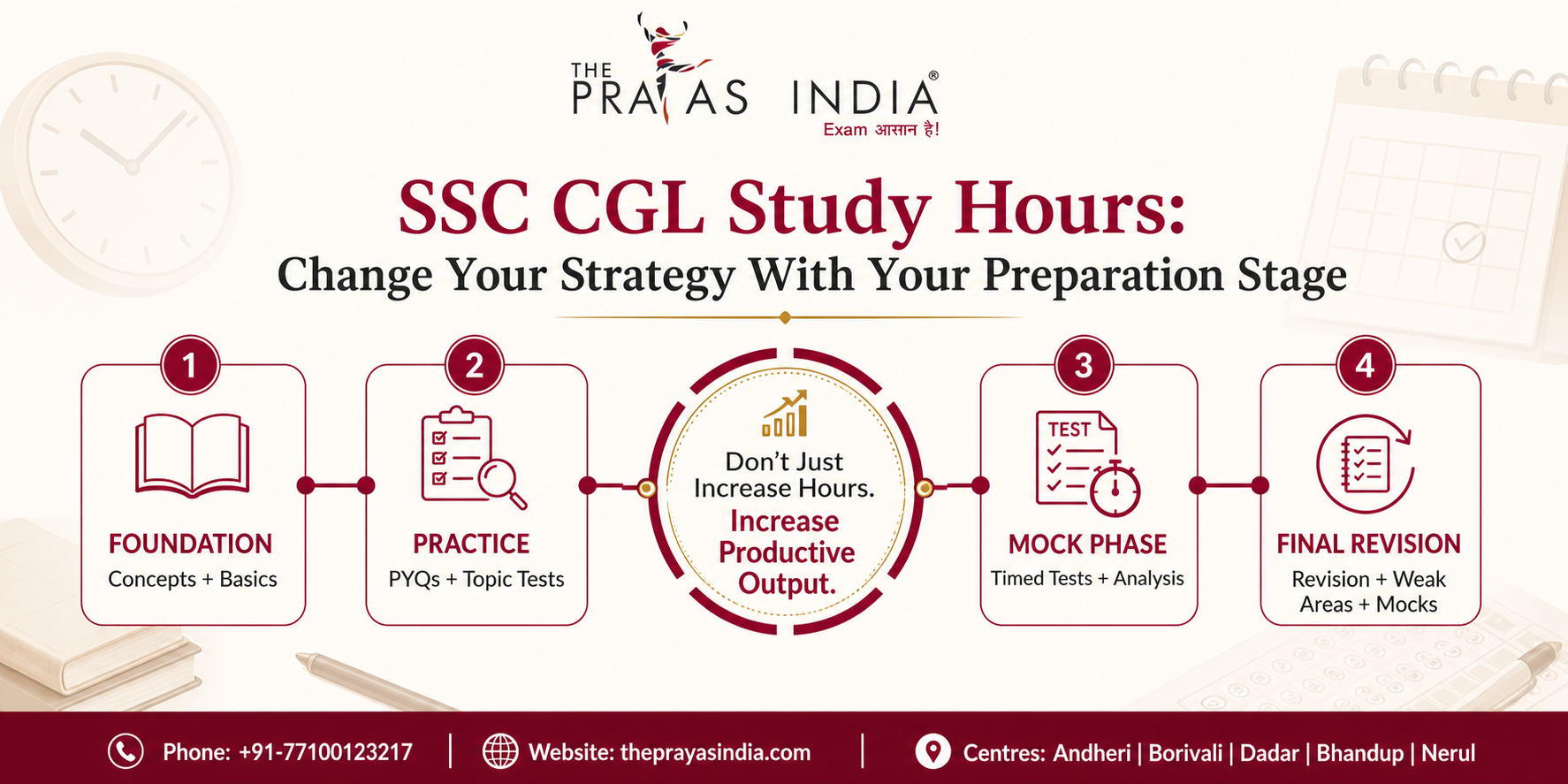
How Many Hours Should You Study at Different Preparation Stages?
Your daily study requirement should also change according to the stage of preparation.
A student who is six months away from the examination may need a different routine from someone entering the final revision phase.
Stage 1: Foundation Building
At this stage, focus primarily on concepts.
A student may spend around 3–5 focused hours depending on availability.
The important tasks are:
- Understanding concepts
- Building formulas
- Learning question types
- Creating basic notes
- Starting PYQs
- Identifying weak areas
Don’t worry too much about maximum speed yet.
Stage 2: Syllabus Completion + Practice
Once the foundation is stronger, increase the proportion of question practice.
A full-time aspirant might move toward 5–7 focused hours, while working professionals and college students can maintain smaller but consistent schedules.
Focus on:
- Topic-wise practice
- PYQs
- Mixed question sets
- Revision
- Timed practice
Stage 3: Mock-Test Phase
As you move toward the test-focused stage, your preparation should become increasingly exam-oriented.
Your study day may include:
Learn → Practise → Test → Analyse → Revise
Mock analysis becomes particularly important.
Do not assume that taking more mocks automatically means better preparation.
A mock without analysis is an incomplete learning exercise.
Stage 4: Final Revision
During the final phase, the objective changes.
You should not attempt to learn everything from the beginning again.
Focus on:
- Revision
- PYQs
- Formulas
- Error logs
- Important facts
- Weak topics
- Sectional tests
- Full-length mocks
- Time management
The number of study hours matters less than the quality of revision.
The 4-Hour Rule, 6-Hour Rule and 8-Hour Rule: Do They Really Matter?
You may have seen students recommending fixed rules such as:
4 hours for beginners
6 hours for serious preparation
8 hours for full-time aspirants
These numbers can be used as rough planning references, but they should not become rigid rules.
For example, a student who has strong fundamentals may accomplish more in four focused hours than another student who spends eight hours passively studying.
Similarly, a working professional may need to make two or three highly focused hours count because that is the realistic time available.
The better question is:
Are your available hours producing measurable improvement?
If your mock scores, accuracy, solving speed and retention are improving, your preparation system is working.
If you are studying for long hours but seeing no meaningful improvement, the problem may be the strategy rather than the number of hours.
How to Divide Your Daily SSC CGL Study Hours
A balanced routine should generally give regular attention to all major areas.
For example, a full-time aspirant with six productive hours might structure the day around:
| Area | Approximate Focus |
|---|---|
| Quantitative Aptitude | 1.5–2 hours |
| English | 1–1.25 hours |
| Reasoning | 1–1.25 hours |
| General Awareness | 45–60 minutes |
| PYQs / Test / Analysis | 45–60 minutes |
These are not compulsory allocations.
If Quant is your weakest subject, you may temporarily devote more time to it.
If your Quant fundamentals are strong but English accuracy is weak, shift some preparation time accordingly.
Your timetable should reflect your performance data, not simply a generic schedule.
The Most Important Rule: Protect Your Best Hours
Not all hours of the day are equally productive.
Some students concentrate best in the morning.
Others become more productive at night.
Use your highest-energy period for difficult work.
For example:
High-energy hours: Quant / Reasoning
Moderate-energy hours: English practice
Lower-energy hours: GK revision / vocabulary / formula review
This simple adjustment can improve the quality of your study without increasing total hours.
How to Increase Your Study Hours Without Burning Out
If you currently study for two hours a day, don’t suddenly create a 10-hour timetable.
Instead:
Week 1
Target 2.5–3 focused hours.
Week 2
Move toward 3–3.5 hours.
Week 3
Add another focused block.
Week 4
Review your productivity and adjust.
The exact progression will differ from student to student.
The important principle is gradual expansion.
Your brain needs time to adapt to longer periods of concentrated work.
Study Hours vs Study Output
Consider two aspirants.
Aspirant A
Studies 9 hours.
- Watches many lectures
- Changes resources frequently
- Solves few questions
- Does little revision
- Avoids mock analysis
Aspirant B
Studies 6 hours.
- Follows one structured plan
- Solves PYQs
- Revises regularly
- Takes timed tests
- Analyses mistakes
- Tracks weak topics
The second student may have fewer study hours but a more productive preparation system.
This is why study quality + consistency + structured planning should remain at the centre of SSC CGL preparation.
What Should You Do During a 60-Minute Study Session?
A study hour should have a defined purpose.
For example:
10 minutes: Revise formulas
35 minutes: Solve questions
10 minutes: Check mistakes
5 minutes: Record weak areas
This is much more effective than sitting down with a vague goal such as:
“I will study Quant for one hour.”
A specific target creates accountability.
Set Daily Targets, Not Just Hour Targets
Instead of writing:
“Study 6 hours.”
write:
Quant: 40 questions + error analysis
Reasoning: 30 questions
English: 2 grammar topics + practice
GA: One revision block
Test: One timed sectional test
This makes your preparation measurable.
You can still track study hours, but output should be equally important.
How PYQs Should Fit Into Your Daily Schedule
Previous-year questions should not be postponed until the end.
PYQs help you understand:
- Question styles
- Difficulty levels
- Frequently tested concepts
- Common traps
- Time requirements
- Your own weaknesses
The SSC itself provides examination-related resources and maintains the official examination portal, so aspirants should rely on the latest Commission notifications and official material for the applicable examination cycle.
For daily preparation, you can include a small PYQ block even while completing the syllabus.
How Mock Tests Change the Number of Hours You Need
As mock tests become part of your preparation, some of your study time should shift from learning to analysis.
For example, if you spend one hour taking a test and only five minutes checking the result, you have lost a major learning opportunity.
A proper analysis can include:
- Questions you got wrong
- Questions you guessed
- Questions that took too long
- Questions you should have attempted
- Questions you should have skipped
- Repeated mistakes
- Topics requiring revision
This is where coaching, test series and mentorship can be particularly useful for students who struggle to diagnose their own preparation.
Don’t Let Other Students Decide Your Study Hours
Social media can create unrealistic expectations.
You may see someone claiming:
“I studied 12 hours every day.”
Another student may say:
“I studied 10 hours and cleared.”
These statements do not tell you enough.
You don’t know:
- Their starting level
- Their previous preparation
- Their study quality
- Their resources
- Their revision cycle
- Their mock performance
- Their personal schedule
Your timetable should be built around your preparation requirements.
Signs That You Are Studying Enough
You may be on the right track if:
- Your syllabus coverage is progressing.
- Your accuracy is improving.
- Your solving speed is improving.
- You remember previously studied concepts.
- Your mock scores are becoming more stable.
- Your repeated mistakes are decreasing.
- You are completing regular revision.
- You can maintain your routine consistently.
Notice that none of these indicators says:
“You studied exactly eight hours.”
That is because hours alone cannot measure preparation quality.
Signs That You Need to Change Your Strategy
You should reconsider your preparation system if:
- You study for long hours but solve very few questions.
- Your mock scores remain stagnant.
- You repeatedly make the same mistakes.
- You keep changing study resources.
- You have no revision schedule.
- You avoid timed practice.
- You don’t analyse tests.
- You cannot remember what you studied a week ago.
- Your timetable repeatedly collapses.
- You spend more time planning than executing.
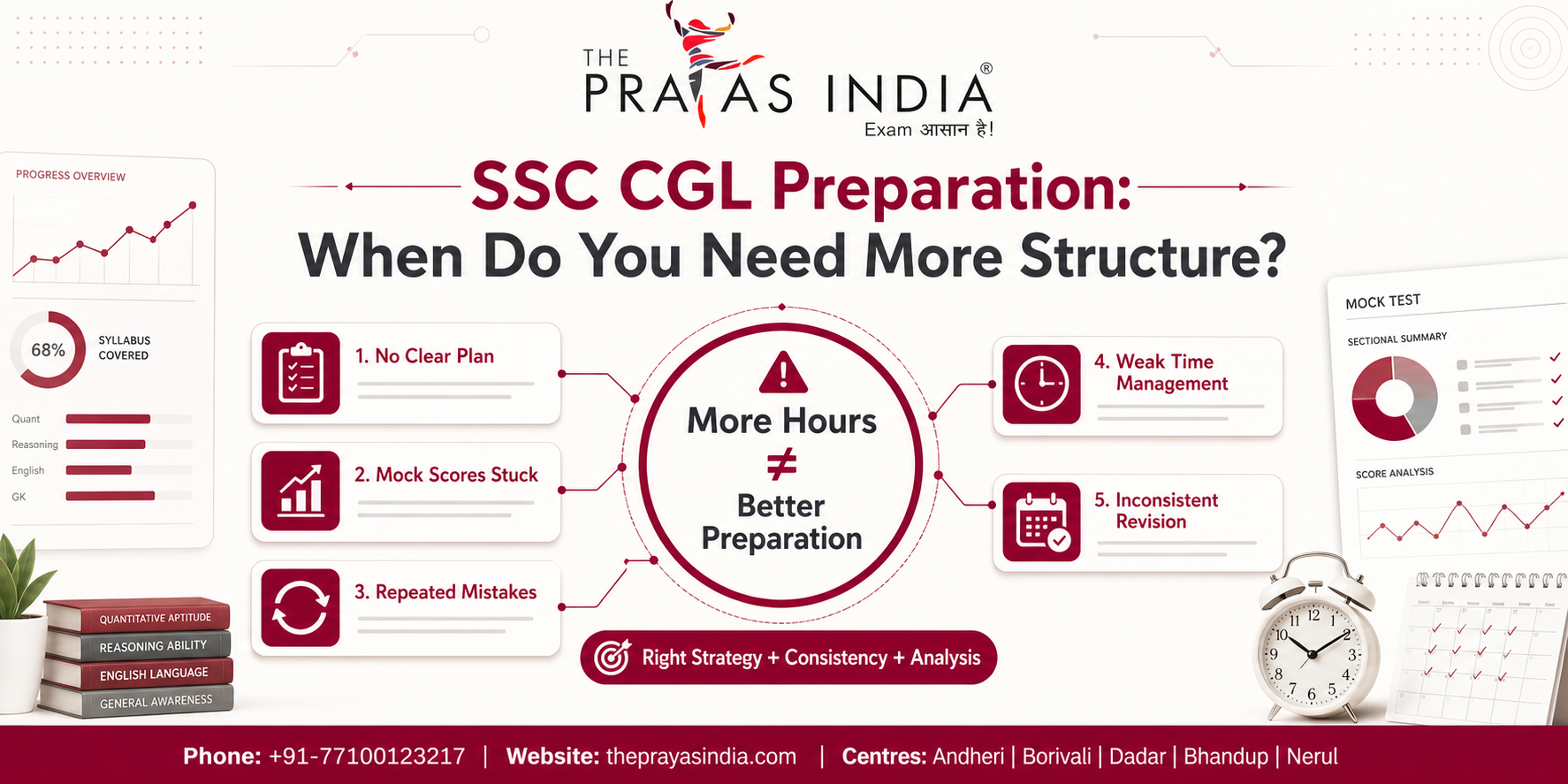
These are signs that the solution may be better structure, not simply more hours.
Why Structured Guidance Can Matter for SSC CGL Aspirants
SSC CGL preparation involves several moving parts.
A student has to manage:
Concepts + Practice + PYQs + Revision + Tests + Analysis + Time Management
Managing all of this independently is possible, but it requires discipline and a clear strategy.
Some students benefit from structured guidance because it can provide:
- A defined study sequence
- Faculty support
- Topic-wise practice
- Doubt resolution
- Regular tests
- Performance analysis
- Revision planning
- Accountability
- Guidance on weak areas
The purpose of joining coaching should not simply be to attend classes.
A useful preparation programme should help you understand what to study, when to study it, how to practise it and how to evaluate your progress.
When Should a Student Consider SSC CGL Coaching?
Coaching can be worth exploring if you find yourself repeatedly facing problems such as:
“I don’t know where to start.”
“I keep changing my timetable.”
“My mock scores aren’t improving.”
“I understand the concepts but cannot solve questions quickly.”
“I don’t know how to analyse my mistakes.”
“I need regular accountability.”
“I am preparing for the first time and need a structured roadmap.”
“I have already attempted SSC CGL but want to change my preparation strategy.”
In such situations, speaking with an academic team and understanding the available course structure can help you decide whether structured coaching is appropriate for your preparation.
A Practical Daily Timetable for Different Aspirants
Here is a practical framework you can adapt.
| Aspirant Type | Practical Daily Focus | Main Priority |
|---|---|---|
| College Student | 2.5–4 focused hours | Build fundamentals |
| Working Professional | 2–4 focused hours + weekends | Consistency |
| Full-Time Aspirant | 6–9 focused hours | Complete preparation cycle |
| Beginner | 3–5 hours initially | Concepts + practice |
| Repeat Aspirant | Based on previous-attempt gaps | Targeted improvement |
These are planning ranges, not mandatory rules.
If you can effectively study only three hours, make those three hours highly productive.
If you have eight hours available, don’t automatically fill every minute. Use the additional time for practice, revision, tests and analysis only when they add value.
A Simple SSC CGL Study-Hour Calculator
You can use a simple approach to determine your own target.
Step 1: Calculate Your Available Time
Remove:
- Sleep
- College/work
- Commuting
- Meals
- Essential responsibilities
- Personal recovery time
Step 2: Identify Your Preparation Stage
Are you:
Starting → Learning → Practising → Testing → Revising?
Step 3: Identify Your Weakest Area
Look at your recent practice or mock performance.
Step 4: Allocate More Time Where Improvement Is Needed
Don’t divide every subject equally if your performance is not equal.
Step 5: Review Every Week
Ask:
What improved this week?
What remained weak?
Where did I waste time?
What should change next week?
This creates a dynamic preparation system instead of a rigid timetable.
The 3-Part Rule for Every SSC CGL Study Day
Regardless of whether you study for three hours or eight hours, try to include three components:
Learn
Understand something new or revise a concept.
Practise
Solve questions based on it.
Analyse
Identify what went wrong and what needs improvement.
This creates a complete learning loop.
Learn → Practise → Analyse → Improve
Final Takeaway: Study Smarter, Not Just Longer
There is no magic number of hours that guarantees SSC CGL success.
A college student, working professional, full-time aspirant, beginner and repeat aspirant will naturally require different preparation schedules.
What matters is whether your available study time is producing progress.
If you study for three focused hours and complete meaningful practice, revision and analysis, those hours have value.
If you study for eight hours without a clear plan, the additional time may not automatically improve your preparation.
The ideal SSC CGL routine should therefore be built around:
Focused Study + Consistent Practice + PYQs + Revision + Mock Tests + Performance Analysis
As your preparation progresses, your study priorities should change. Beginners need more concept building. Intermediate aspirants need more practice and timed sets. Advanced aspirants need more mocks, revision and analysis. Repeat aspirants need to focus particularly on the gaps that affected their previous performance.
And if you find yourself spending more time deciding what to study than actually studying, or if your mock scores are not improving despite long hours, structured guidance may be worth exploring.
The right preparation system should help you use your available time more effectively rather than simply asking you to study longer.
For SSC CGL aspirants, the goal should not be to win a competition over study hours. The goal should be to build the strongest preparation possible with the time you genuinely have
SSC CGL Preparation – Frequently Asked Questions
How many hours should I study for SSC CGL every day?
There is no fixed number of hours that works for every aspirant. Your target should depend on your preparation level, available time, subject-wise weaknesses and examination stage. Focused and consistent study is more important than blindly chasing a high number of hours.
Is 4 hours of study enough for SSC CGL?
Four focused hours can be useful, especially for college students, working professionals or aspirants building their preparation gradually. The effectiveness of those hours depends on what you accomplish through concepts, practice, revision, PYQs and tests.
Should full-time SSC CGL aspirants study 10 to 12 hours daily?
Not necessarily. Full-time aspirants have more available time, but productive study is more important than a rigid hour target. A structured routine of focused sessions, practice, revision, mocks and analysis can be more useful than unnecessarily extending study hours.
How many hours should a working professional study for SSC CGL?
A working professional can build a sustainable routine around available time, often using focused weekday sessions and longer weekend practice. The exact target should depend on work commitments and current preparation level.
How many hours should college students study for SSC CGL?
College students can begin with a manageable daily routine and gradually increase it when required. Consistent preparation of around a few focused hours can help build strong fundamentals without compromising regular college responsibilities.
Should beginners study more hours because they are starting from zero?
Beginners should focus first on building strong fundamentals. It is usually better to begin with a realistic schedule and increase study time gradually rather than immediately adopting an exhausting timetable.
What should repeat SSC CGL aspirants focus on?
Repeat aspirants should analyse their previous preparation and identify specific gaps in concepts, revision, speed, accuracy, General Awareness, mock performance or time management. Simply increasing study hours may not solve the actual problem.
Is studying for long hours enough to clear SSC CGL?
No. SSC CGL preparation requires effective learning, regular practice, revision, previous-year questions, timed tests and performance analysis. Study hours are useful only when they produce meaningful preparation progress.
How can I know whether my SSC CGL preparation is improving?
Track indicators such as accuracy, solving speed, syllabus coverage, revision quality, mock-test performance and repeated mistakes. Improvement in these areas is a more useful measure than simply counting daily study hours.
Can coaching help me create a better SSC CGL study plan?
Structured coaching can help provide a defined preparation sequence, classes, practice, tests, doubt support, performance analysis and guidance. Students can enquire about the available SSC CGL course structure and decide whether guided preparation suits their requirements.
Not Sure How Many Hours You Should Study for SSC CGL?
Your preparation needs more than a long timetable. Get the right structure for concepts, practice, revision, mock tests and performance analysis so that your available study time is used effectively.
Whether you are a beginner, college student, working professional, full-time aspirant or repeat candidate, enquire with The Prayas India to understand the available SSC CGL classes, batches and preparation support.
📍 Centres: Andheri | Borivali | Dadar | Nerul | Bhandup
Enquire today to understand the right SSC CGL preparation plan for your current level and available study time.