Bank Exam Preparation: How to Bring Structure to Study Plan
Bank exam preparation can look simple from the outside: study Quantitative Aptitude, Reasoning, English, General Awareness, take mock tests and revise. But once students actually begin preparing, the process can quickly become overwhelming. There are multiple exams, several sections, hundreds of topics, current affairs to follow, previous-year questions to solve, mock tests to analyse and constantly changing preparation priorities.
The problem, in many cases, is not a lack of effort. It is a lack of structure.
A student may study for six hours and still feel that nothing important was completed. Another student may spend an entire week watching lectures but barely solve questions. Someone else may attempt mock tests regularly but never analyse mistakes. Some aspirants keep switching between books, teachers, YouTube videos and test series, creating the feeling of being busy without creating measurable improvement.
A structured study plan changes this situation. Instead of asking, “What should I study today?”, you begin each day knowing what to learn, what to practise, what to revise and how to measure your progress.
This becomes especially important because banking recruitment is not limited to a single examination. The IBPS 2026–27 calendar includes examinations such as PO/MT, Customer Service Associate (CSA) and RRB recruitment, with different stages and timelines across the year. For example, the calendar lists IBPS CSA Prelims for October 10–11, 2026, RRB Officer Scale I Prelims for November 21–22, 2026, and RRB Office Assistant Prelims for December 6, 12 and 13, 2026. The calendar is tentative, and candidates should always verify the detailed notification for their specific examination.
The right approach, therefore, is not to study everything simultaneously. It is to build a preparation system.
Why Bank Exam Preparation Starts Feeling Overwhelming
The first reason is the sheer number of things students think they need to do. A typical aspirant may have Quantitative Aptitude, Reasoning Ability and English as core preparation areas, while also tracking Current Affairs, Banking Awareness, static General Awareness, mock tests and previous-year questions.
Then comes the pressure of speed.
Banking exams require candidates to solve questions efficiently within limited examination time. This means that simply understanding a topic is not enough. You must eventually develop the ability to recognise question types, select appropriate questions, calculate efficiently and avoid unnecessary time loss.
This creates a common cycle:
More syllabus → more resources → more confusion → less practice → poor mock performance → more resources.
Breaking this cycle is one of the most important steps in banking preparation.
The solution is to reduce the number of moving parts and follow a clear sequence.
Step 1: Decide Your Primary Bank Exam Target
Before creating a timetable, decide which examinations you are preparing for.
Banking aspirants may target examinations such as:
- IBPS PO
- IBPS CSA
- SBI PO
- SBI Clerk
- IBPS RRB Officer Scale I
- IBPS RRB Office Assistant
- RBI Assistant
- RBI Grade B
- NABARD Grade A
- Other public-sector and banking recruitment examinations
Not every examination has exactly the same structure, selection process or preparation requirements. SBI publishes its recruitment information through its official Careers section, while IBPS publishes its examination calendars and individual notifications separately. Candidates should therefore use the official notification as the final reference for eligibility, pattern, dates and selection stages.
If you are targeting multiple exams, identify the common preparation base first.
For example, Quant, Reasoning and English preparation can form a strong foundation for several banking examinations. Exam-specific components can then be added according to the relevant notification.
This prevents you from creating five completely separate study plans.

Step 2: Stop Treating the Entire Syllabus as One Giant Task
One of the biggest psychological mistakes students make is looking at the entire syllabus at once.
Instead of thinking:
“I have hundreds of topics left.”
Break preparation into smaller units.
For Quant, for example, you can divide the preparation into arithmetic, simplification, approximation, number-based concepts, algebra, data interpretation and other relevant areas.
Reasoning can similarly be divided into:
- Inequality
- Syllogism
- Coding-decoding
- Blood relations
- Direction sense
- Series
- Seating arrangement
- Puzzles
- Input-output
- Logical reasoning
English can be organised around grammar, vocabulary, reading comprehension, cloze tests, error detection and other question types relevant to the target exam.
The exact distribution should follow the latest notification and previous-year question trends for the examination you are targeting.
The important point is that you should never treat the syllabus as one giant object.
A topic becomes manageable when you convert it into a measurable task.
Instead of writing:
“Study Quant.”
write:
“Complete percentages concept + 40 practice questions + error review.”
That is a study task you can actually finish.
Step 3: Build Your Preparation Around Four Activities
A strong bank-exam study plan should not consist only of lectures.
Every study cycle should contain four broad activities:
1. Learn
Understand the concept, formula, method or question type.
2. Practise
Solve questions without depending on the teacher or solution.
3. Revise
Return to concepts and mistakes before they are forgotten.
4. Test
Use sectional tests and full-length mocks to evaluate actual performance.
This can be represented as:
Learn → Practise → Revise → Test → Analyse → Improve
The analysis stage is particularly important.
Suppose you score poorly in a mock. Simply taking another mock may not solve the problem.
You need to ask:
- Which questions were conceptually wrong?
- Which questions were calculation errors?
- Which questions consumed too much time?
- Which questions should have been skipped?
- Which topics repeatedly cause mistakes?
- Was the problem knowledge, speed, accuracy or question selection?
Your next study session should be influenced by these answers.
Step 4: Divide Your Day Into Study Blocks
A common mistake is creating a timetable such as:
8:00–10:00 Quant
10:00–12:00 Reasoning
12:00–2:00 English
2:00–4:00 Current Affairs
It looks organised, but it may not be practical.
A better system is to assign each block a specific purpose.
For example:
| Aspirant Type | Practical Daily Focus | Main Priority |
|---|---|---|
| College Student | 2.5–4 focused hours | Build fundamentals |
| Working Professional | 2–4 focused hours + weekends | Consistency |
| Full-Time Aspirant | 6–9 focused hours | Complete preparation cycle |
| Beginner | 3–5 hours initially | Concepts + practice |
| Repeat Aspirant | Based on previous-attempt gaps | Targeted improvement |
The exact number of hours can vary depending on whether you are a college student, working professional, full-time aspirant or repeater.
The key is to protect your productive study time.
Three focused hours can be more valuable than six distracted hours.
Step 5: Create a Weekly Structure, Not Just a Daily Timetable
A daily timetable tells you what to do today.
A weekly structure tells you whether you are actually progressing.
Your week should have different types of work.
Monday to Thursday: Build and Practise
Use these days primarily for concept learning and topic-wise practice.
Friday: Consolidate
Revise important concepts, formulas, vocabulary and previously attempted questions.
Saturday: Timed Practice
Attempt sectional tests or mixed timed sets.
Sunday: Mock + Analysis
Take a full-length mock where appropriate and spend enough time analysing it.
This prevents preparation from becoming a continuous cycle of learning without evaluation.
Step 6: Keep a “Weak Area List”
Do not rely on memory to identify your weaknesses.
Maintain a simple document or notebook containing three categories:
Strong
Topics where you are consistently accurate and reasonably fast.
Improving
Topics where you understand the concept but still make occasional mistakes or take too much time.
Weak
Topics where your conceptual understanding, accuracy or question selection is consistently poor.
Your weekly plan should give more attention to the weak and improving categories, while maintaining the strong ones through revision and testing.
This is much more efficient than giving every topic equal time.
Step 7: Use Previous-Year Questions as a Direction Tool
Students sometimes use previous-year questions only after completing the syllabus.
That is not necessary.
Previous-year questions can help you understand:
- Which concepts are repeatedly tested
- What level of difficulty you may encounter
- Which question types deserve greater attention
- How questions are framed
- Where you are making mistakes
- Whether your preparation is becoming exam-oriented
PYQs should not replace conceptual learning, but they can help you connect preparation with the actual examination.
This is particularly useful when the syllabus feels too large. Instead of trying to master everything equally, you can prioritise concepts that are relevant to your target examination.
Step 8: Make Mock Tests Part of Your Preparation System
A mock test should not be treated as a monthly event.
It should gradually become a regular part of your preparation.
However, there is an important distinction:
Taking a mock is not the same as learning from a mock.
If you score 62 and immediately take another mock, you may score 64 without understanding why.
Instead, analyse the first test.
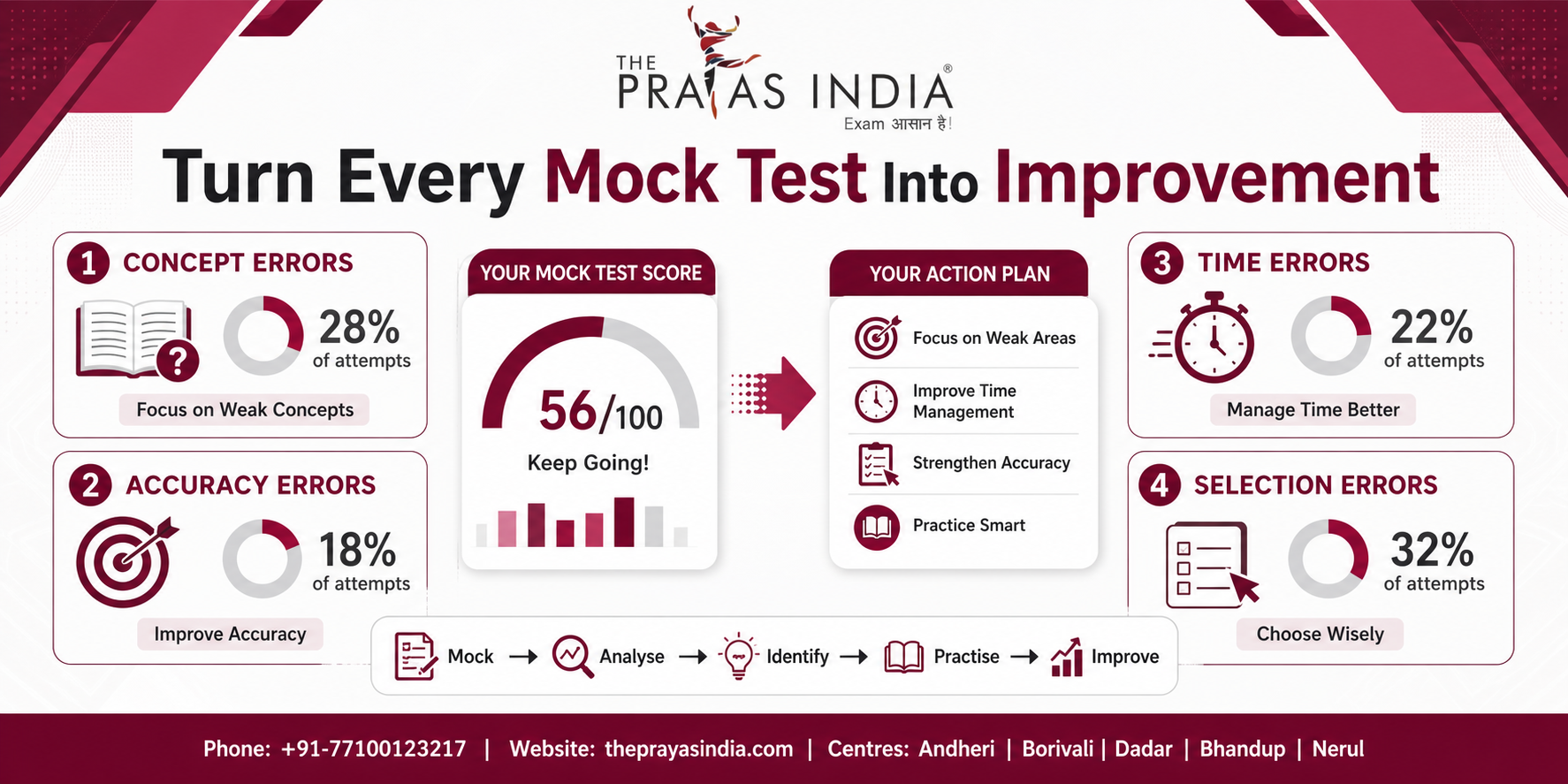
Create four categories:
| Category | What to Identify |
|---|---|
| Concept Errors | Topics you do not understand |
| Accuracy Errors | Questions you knew but got wrong |
| Time Errors | Questions that consumed excessive time |
| Selection Errors | Questions you should have skipped |
This turns every mock into a diagnostic tool.
The Prayas India’s banking preparation and test programs similarly emphasise mock tests, sectional tests, performance analysis, mentorship and structured practice as components of preparation.
Step 9: Separate Learning Problems From Performance Problems
This distinction can completely change your preparation strategy.
Suppose you are unable to solve a percentage question because you do not understand the concept.
That is a learning problem.
Suppose you understand the concept but take three minutes to solve a basic question.
That is a speed problem.
Suppose you solve it correctly when practising but make mistakes in a mock.
That may be an execution or pressure problem.
Suppose you spend five minutes on one puzzle and then cannot attempt easier questions.
That is a question-selection problem.
All four require different solutions.
This is why simply increasing study hours does not always improve performance.
You need to identify what kind of problem you actually have.
Step 10: Don’t Study Every Subject Every Day
Many aspirants believe that touching every subject every day is necessary.
It can work for some students, but it is not mandatory.
A more practical approach is to create subject rotation.
For example:
Monday: Quant + English + Current Affairs
Tuesday: Reasoning + Quant + Banking Awareness
Wednesday: English + Reasoning + Current Affairs
Thursday: Quant + Reasoning + English
Friday: Weak-topic revision + GA
Saturday: Sectional tests + revision
Sunday: Mock + analysis
The exact arrangement should depend on your exam, preparation stage and weaknesses.
The purpose is to ensure that every major area receives consistent attention without making each day unnecessarily crowded.
Step 11: Create a Current Affairs System
General Awareness and Banking Awareness can become overwhelming because students often try to consume everything.
Reading multiple newspapers, Telegram channels, apps, PDFs, videos and monthly magazines simultaneously can create information overload.
Instead, choose a limited and reliable preparation system.
Divide your revision into:
- Banking and financial awareness
- Important national and international events
- Government schemes and appointments
- Economic and financial developments
- Important reports and indices
- Banking-related updates
- Exam-relevant static awareness
The objective is not to collect the maximum amount of information.
It is to remember and revise relevant information effectively.
Create short revision notes and revisit them repeatedly.
Step 12: Build an Error Notebook
One of the simplest ways to bring structure to preparation is to maintain an error notebook.
Whenever you make an important mistake, record:
Question → Mistake → Reason → Correct Method → Future Action
For example:
Question: Percentage-based arithmetic
Mistake: Used the wrong base value
Reason: Read the question too quickly
Correct Method: Identify the reference quantity before calculating
Future Action: Practise 15 similar questions
After several weeks, this notebook becomes a personalised revision resource.
You are no longer revising only from textbooks.
You are revising from your own preparation history.
Step 13: Follow the Right Order for Speed Improvement
Many beginners make the mistake of trying to solve everything quickly from the beginning.
Speed should come after understanding.
A better progression is:
Concept → Accuracy → Familiarity → Speed → Exam Strategy
If you cannot solve a question correctly without a timer, a shortcut will not magically solve the problem.
First understand the method.
Then practise enough questions to recognise the pattern.
Then introduce time limits.
Finally, learn when to attempt and when to skip.
This approach is especially important in Quant and Reasoning, where speed improvement depends heavily on repeated exposure to question types.
Step 14: Stop Changing Resources Every Few Days
Resource-hopping is one of the hidden reasons students feel overwhelmed.
One teacher explains a topic.
Another teacher provides a different shortcut.
A third source gives another set of notes.
Then you download another PDF.
Eventually, you have five resources for one topic and no clear revision system.
Instead, follow a primary resource + practice resource + test resource model.
For each subject, decide:
- One primary learning source
- One reliable question bank/material
- One test series
- One revision system
Once your resources are sufficient, stop collecting and start practising.
Step 15: Know When Self-Study Needs More Structure
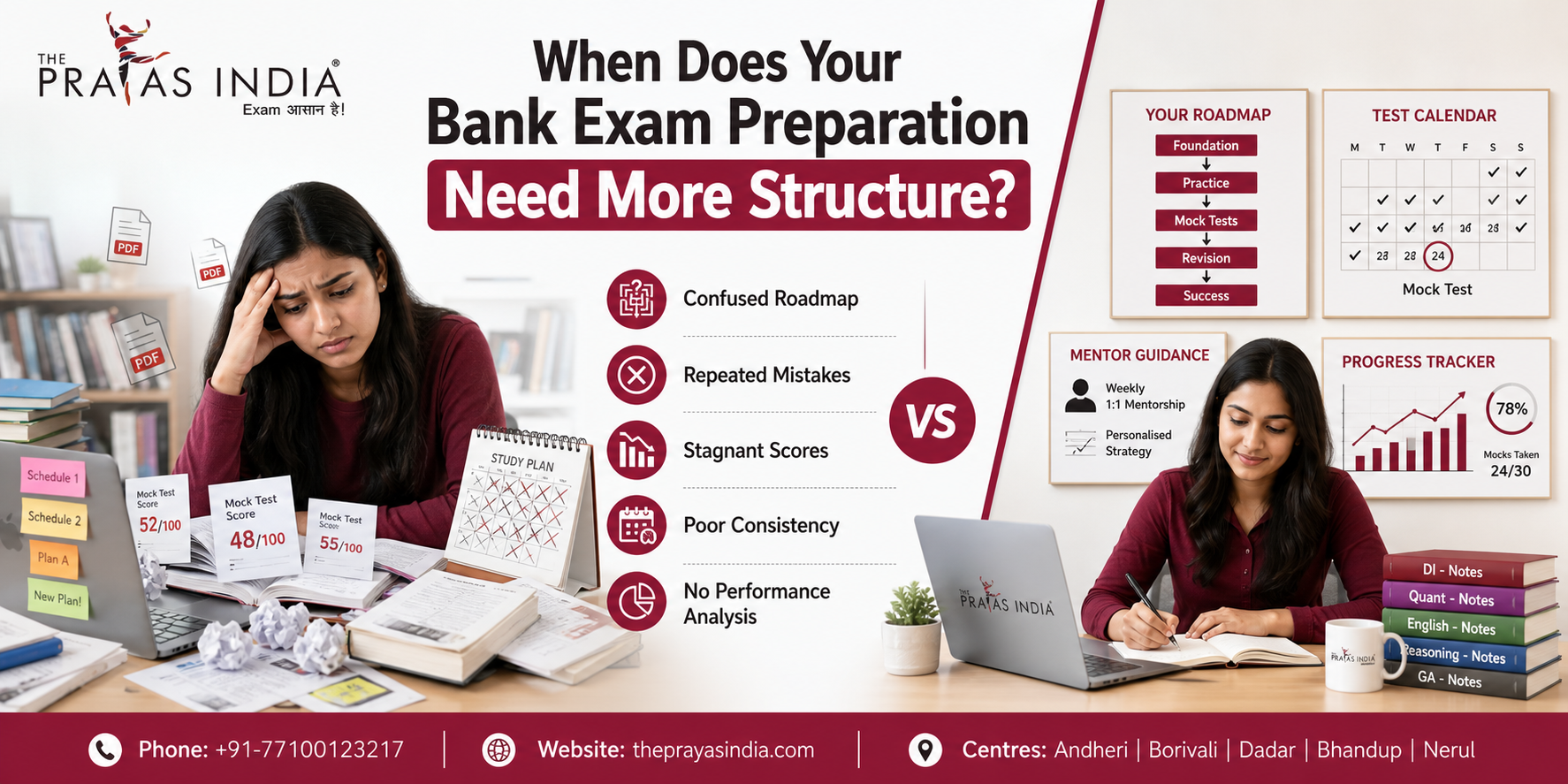
Self-study can work very well when you are able to maintain discipline, select resources carefully, analyse performance and follow your own timetable.
But some students repeatedly face problems such as:
- They do not know where to begin.
- They cannot identify their weak areas.
- They keep postponing tests.
- They struggle with difficult concepts.
- Their mock scores remain stagnant.
- They cannot maintain consistency.
- They study for long hours but see little measurable improvement.
- They keep changing preparation sources.
- They need regular doubt resolution.
- They find it difficult to create a realistic study roadmap.
In such cases, structured coaching or mentorship can become useful.
The purpose of coaching should not simply be to provide lectures. A useful preparation system should help students understand concepts, practise systematically, test regularly, analyse performance and correct their strategy.
The Prayas India’s bank-exam program currently describes coverage across exams such as IBPS PO & Clerk, SBI PO & Clerk, IBPS RRB, RBI and NABARD-related preparation, along with study material, mock tests, doubt resolution, performance analysis, mentorship and online/offline learning options.
Step 16: Build a 30-Day Preparation Cycle
If your preparation currently feels chaotic, do not try to redesign your entire year in one day.
Start with a 30-day cycle.
Week 1: Diagnose
Identify:
- Strong topics
- Weak topics
- Pending syllabus
- Current mock level
- Speed issues
- Accuracy issues
Week 2: Strengthen
Focus on weak fundamentals and high-priority topics.
Week 3: Practise
Increase topic-wise and sectional practice.
Week 4: Test and Refine
Take mocks, analyse them and modify the next cycle based on your performance.
At the end of every month, ask:
What improved?
What remained weak?
What should change next month?
That is how preparation becomes a process rather than a collection of study sessions.
A Practical Daily Bank Exam Study Framework
A student with around four focused study hours could structure the day like this:
| Activity | Approx. Focus |
|---|---|
| Quant/Reasoning Concept | 60 min |
| Topic-wise Practice | 60 min |
| English | 45 min |
| Current Affairs/Banking Awareness | 30 min |
| Timed Practice | 30 min |
| Revision/Error Analysis | 15 min |
This is only a framework, not a universal timetable.
A working professional may divide the same work across morning and evening sessions. A full-time aspirant may use longer blocks. A beginner may initially spend more time learning concepts, while a candidate closer to the examination may need greater emphasis on mocks, speed and revision.
The important thing is that your timetable should reflect your preparation stage.
The 5-Part Rule for a Structured Bank Exam Plan
If your current preparation feels overwhelming, simplify it using five questions:
1. What am I preparing for?
Define your target examination.
2. What do I need to learn?
Break the syllabus into manageable topics.
3. What do I need to practise?
Use topic-wise questions, PYQs and sectional practice.
4. How am I performing?
Use timed tests and mock tests.
5. What should I improve next?
Analyse mistakes and modify your study plan.
This creates a continuous loop:
Plan → Learn → Practise → Test → Analyse → Improve
Once this loop becomes habitual, preparation becomes far less chaotic.
What a Structured Bank Exam Preparation System Should Provide
A serious preparation system should answer more than just “What chapter should I study?”
It should help you understand:
- What to study first
- What to postpone
- How much practice is sufficient
- When to begin sectional tests
- When to start full-length mocks
- How to analyse scores
- How to improve speed
- How to maintain accuracy
- How to revise
- How to handle weak areas
- How to adapt the plan when performance changes
This is where mentorship can make a practical difference.
The Prayas India describes its banking preparation approach around structured learning, expert faculty, study material, regular testing, performance analysis, doubt resolution and personalised mentorship.
For students who are struggling to create this system independently, enquiring about a structured banking preparation program can help them understand the available batch format, course coverage, test support, mentorship and learning options before deciding whether coaching fits their preparation needs.
Your Study Plan Should Be Measurable
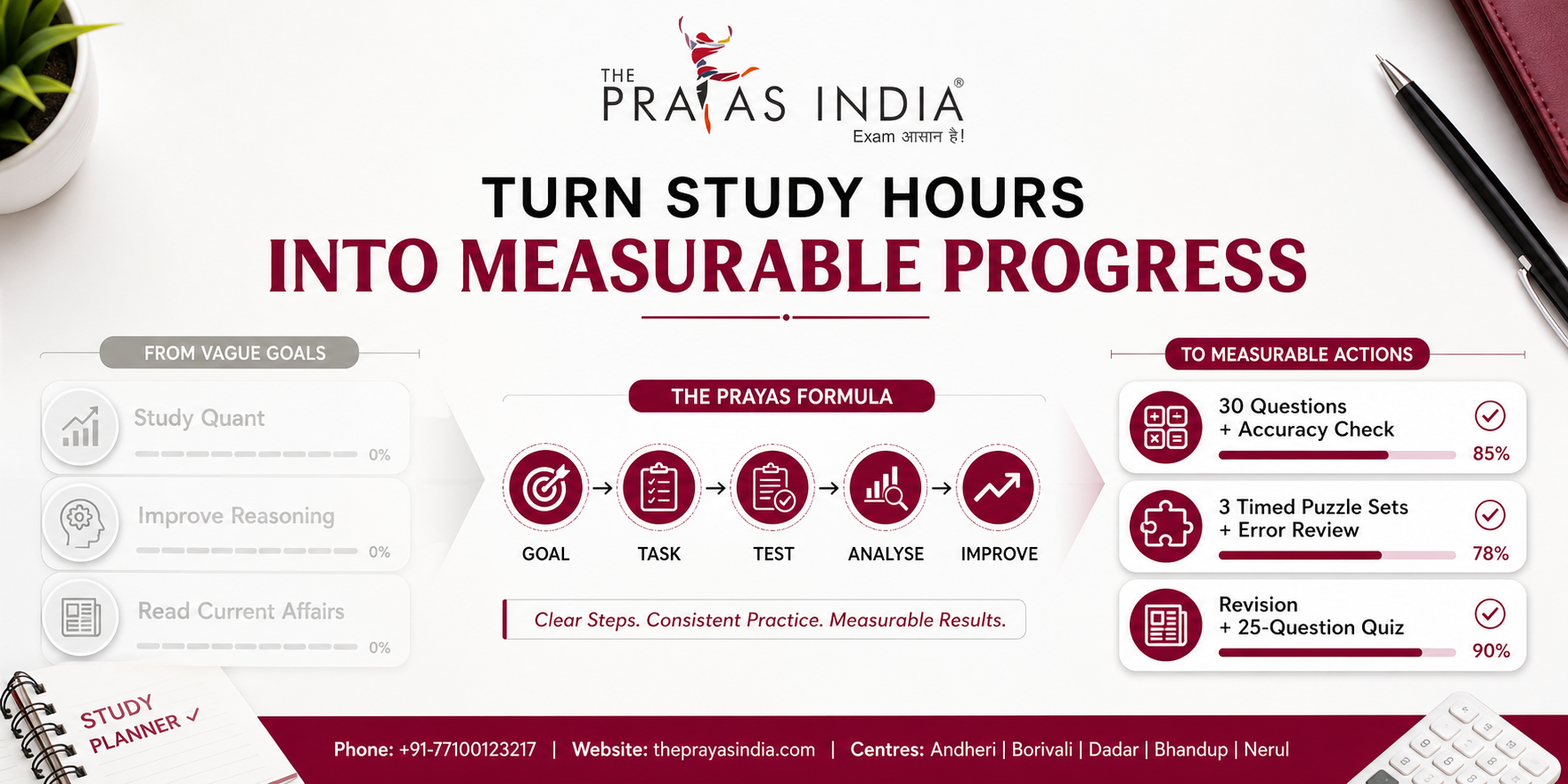
Avoid writing goals such as:
“Study hard today.”
Instead write:
“Complete 30 arithmetic questions with at least 85% accuracy.”
Avoid:
“Improve Reasoning.”
Write:
“Practise 3 seating-arrangement sets and analyse every error.”
Avoid:
“Do Current Affairs.”
Write:
“Revise this week’s banking and financial awareness notes and attempt a 25-question quiz.”
The more measurable your targets become, the easier it is to identify progress.
How to Know That Your New Study Plan Is Working
A structured study plan does not necessarily mean your mock score will increase dramatically every week.
Look for smaller signs of progress.
You may notice that:
- You make fewer repeated mistakes.
- Your calculation time decreases.
- You recognise familiar question patterns faster.
- You know which questions to skip.
- Your revision becomes easier.
- Your mock analysis becomes more specific.
- Your weak-topic list becomes shorter.
- Your accuracy becomes more stable.
- You spend less time deciding what to study.
These are meaningful indicators that the preparation system is becoming stronger.
Eventually, these improvements should translate into better test performance.
Common Mistakes That Destroy Study-Plan Structure
Studying Without a Target
If you do not know which examination or stage you are preparing for, your preparation can become unnecessarily broad.
Watching Too Many Lectures
Learning without solving questions creates the illusion of progress.
Ignoring Revision
A topic completed once is not necessarily a topic mastered.
Taking Mocks Without Analysis
A mock score tells you where you stand; analysis tells you what to do next.
Chasing Speed Too Early
Accuracy and conceptual clarity should come before aggressive time-saving techniques.
Collecting Too Many Resources
More PDFs do not automatically mean better preparation.
Copying Someone Else’s Timetable
A college student, working professional and full-time aspirant cannot necessarily follow the same routine.
Ignoring Weak Areas
Repeatedly practising your strongest topics feels comfortable but may not address your actual preparation gaps.
How to Make Bank Exam Preparation Less Overwhelming
You do not need to solve the entire preparation problem at once.
Start with one target exam.
Then divide the syllabus.
Then create weekly targets.
Then practise.
Then test.
Then analyse.
Then adjust.
If you are consistently struggling to maintain this cycle on your own, structured guidance can reduce the time spent figuring out what to study, how to practise and how to measure improvement.
The Prayas India offers bank-exam preparation through online and offline modes, with structured syllabus coverage, practice, mock tests, performance analysis, doubt support and mentorship. Students can enquire about the current course structure and batch options before choosing the format that suits their preparation.
Final Takeaway
Bank exam preparation feels overwhelming when everything appears equally important.
Your goal is not to study everything at once.
Your goal is to create a system where every day has a purpose and every week produces measurable progress.
Remember the framework:
Choose → Plan → Learn → Practise → Revise → Test → Analyse → Improve
If your preparation currently feels scattered, take a step back and rebuild the structure instead of simply increasing your study hours.
And if you are finding it difficult to create or maintain that structure yourself, consider speaking with a banking-exam counsellor or mentor to understand whether a guided preparation program, regular testing and personalised support would be useful for you.
The right study plan is not the one that looks impressive on paper.
It is the one you can follow consistently, measure honestly and improve continuously.
Frequently Asked Questions
1. Why does bank exam preparation feel so overwhelming?
Bank preparation involves multiple subjects, extensive practice, current affairs, mock tests, revision and time management. Without a clear sequence, students often keep switching between tasks and resources. A structured plan breaks the preparation into manageable daily and weekly targets.
2. How should a beginner start preparing for bank exams?
Start by selecting your target examination, understanding its syllabus and pattern from the official notification, assessing your current level and building fundamentals in Quantitative Aptitude, Reasoning and English. Add General Awareness and banking-related preparation according to the examination requirements.
3. Should I prepare for IBPS and SBI exams together?
Many aspirants prepare for multiple banking examinations using a common foundation because several core areas overlap. However, the exact pattern, eligibility and selection process can differ, so exam-specific preparation should be added according to the relevant official notification.
4. How many hours should I study for bank exams?
There is no universal number of hours that guarantees success. Your study time should depend on your current level, available schedule, preparation stage and target examination. Focused and consistent study is more useful than simply counting hours.
5. When should I start taking mock tests?
You can use topic-wise and sectional tests during the learning stage and gradually introduce full-length mocks as your syllabus coverage and exam readiness improve. The important part is to analyse each test and use the findings to modify your preparation.
6. What should I do if my mock-test scores are not improving?
Do not simply increase the number of mocks. Analyse whether your problem is conceptual understanding, accuracy, calculation speed, time management or question selection. Then create targeted practice around the identified weakness.
7. Is coaching necessary for bank exam preparation?
Not every aspirant requires coaching. Self-study can work when you can create and follow a reliable plan, select resources, practise consistently and analyse your performance. Coaching or mentorship can be useful when you need structured guidance, regular testing, doubt support or personalised performance tracking.
8. How can I stop wasting time on too many study resources?
Follow a simple resource system: one primary learning source, one reliable practice source and one test series. Once you have sufficient material, focus on solving, revision and analysis rather than continuously collecting new resources.
9. How important is mock-test analysis?
Mock analysis is extremely useful because it helps identify recurring mistakes, time-management problems, accuracy issues and poor question selection. The purpose of a mock is not only to produce a score but also to generate an actionable improvement plan.
10. Can The Prayas India help me create a structured bank exam preparation plan?
The Prayas India offers banking-exam preparation programs with structured learning, practice, mock tests, performance analysis, doubt resolution and mentorship. Students can enquire about the current course structure, learning mode and batch details to determine whether the program fits their preparation needs.
Bring Structure to Your Bank Exam Preparation
If your preparation feels scattered, you do not always need more study material. You may need a clear roadmap, regular practice, mock-test analysis, doubt support and consistent guidance.
Enquire about The Prayas India Bank Exams Preparation Program and explore the available online and offline learning options.
💬 WhatsApp: +91 7710013217