RRB NTPC Mock Scores Not Improving? Here’s What You May Be Doing Wrong
You have completed several chapters. You are solving questions every day. You are taking RRB NTPC mock tests regularly. Yet, when you look at your mock scores, there is hardly any improvement.
One mock gives you 62 marks. The next gives 64. Then 60. After another few tests, you are still somewhere around the same range.
At this point, many aspirants make the same mistake: they conclude that they simply need to study more.
So, they increase their study hours. They solve more questions. They take more mocks. They download more PDFs and join more test groups.
But the score still does not move significantly.
If this sounds familiar, the problem may not be the amount of effort you are putting in. The problem may be how you are converting that effort into improvement.
An RRB NTPC mock test is not supposed to be just a score-generating activity. It is a diagnostic tool. It should tell you what is stopping you from performing better and what you need to change before your next test.
This becomes particularly important because RRB NTPC CBT-1 has 100 questions to be attempted within 90 minutes, with questions from General Awareness, Mathematics and General Intelligence & Reasoning, along with negative marking of one-third mark for every incorrect answer. CBT-2 has 120 questions in 90 minutes, also with one-third negative marking.
That means your preparation needs to develop more than knowledge. You also need accuracy, speed, question selection and exam-taking discipline.
Your Mock Score Is a Symptom, Not the Complete Diagnosis
The first thing you see after submitting a mock is your score.
But your score alone cannot tell you why you performed the way you did.
Imagine two students both scoring 65.
Student A attempted 78 questions, made 13 mistakes and left several questions because of time pressure.
Student B attempted 70 questions, made only a few errors but lacked sufficient attempts because of slow calculation.
Both students have the same score, but their problems are completely different.
Student A needs to work on accuracy and question selection.
Student B may need to work on speed and calculation efficiency.
This is why looking only at the final score can lead to the wrong preparation strategy.
After every serious mock, you should track at least:
- Total score
- Questions attempted
- Correct answers
- Incorrect answers
- Unattempted questions
- Accuracy
- Time spent
- Section-wise performance
- Repeated mistakes
- Questions that consumed excessive time
Once you start tracking these indicators across multiple tests, your mock scores become much more informative.
Mistake #1: Taking More Mocks Instead of Analysing Existing Ones
This is probably one of the most common reasons scores remain stagnant.
An aspirant takes a mock.
Checks the score.
Looks at the solutions.
Feels disappointed.
Then immediately starts another mock.
After ten tests, the student proudly says, “I have completed ten mocks.”
But the same mistakes are appearing in the eleventh test.
The issue is not the number of tests.
The issue is the feedback loop.
A useful cycle is:
Mock → Analyse → Identify Problem → Practise → Re-test
The mock is only the beginning.
If you got a Mathematics question wrong because you did not understand the concept, you need concept revision.
If you knew the concept but made a calculation error, you need accuracy practice.
If you solved the question correctly but took too long, you need timed practice.
If you spent four minutes on a difficult puzzle and missed three easier questions afterward, you have a question-selection problem.
These require different solutions.
How to Analyse an RRB NTPC Mock Properly
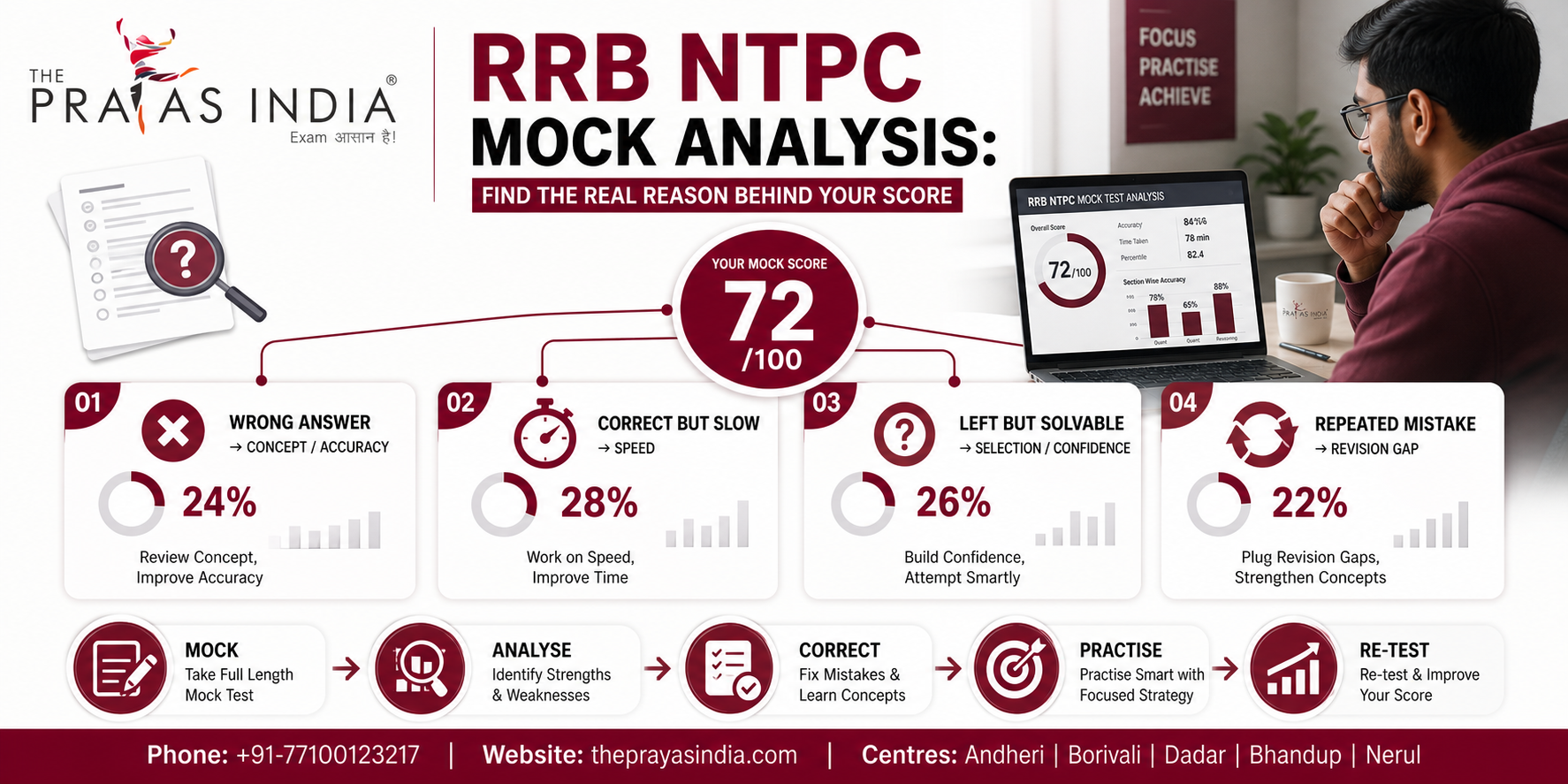
After completing a mock, divide your questions into four broad categories:
| Category | What It Means | What You Should Do |
|---|---|---|
| Wrong | Concept or accuracy problem | Identify the exact reason |
| Correct but Slow | Approach is inefficient | Practise timed sets |
| Left but Solvable | Confidence/selection issue | Reattempt without time pressure |
| Not Attemptable | Knowledge gap | Learn and revise the topic |
Then create a fifth category:
Repeated Mistakes
These deserve special attention.
If you made the same type of mistake three times across four mocks, it is no longer an isolated mistake.
It has become a preparation pattern.
Your next study plan should address it.
Mistake #2: Assuming Every Wrong Answer Is a Knowledge Gap
A wrong answer does not always mean that you do not know the topic.
There are several possible reasons behind an incorrect answer.
You may have:
- Forgotten a formula.
- Misread the question.
- Made a calculation error.
- Selected the wrong method.
- Rushed because of time pressure.
- Changed a correct answer unnecessarily.
- Guessed without sufficient confidence.
- Confused two similar concepts.
This distinction matters because each problem requires a different correction.
If you classify every wrong answer as “I don’t know this topic,” you may spend hours relearning concepts you already understand.
Instead, ask:
Why exactly did I get this question wrong?
That one question can significantly improve the quality of your mock analysis.
Mistake #3: Chasing Attempts Instead of Accuracy
Another common problem is becoming obsessed with the number of questions attempted.
An aspirant may think:
“I attempted only 72 questions. I need to attempt 85.”
So in the next mock, the student tries to increase attempts aggressively.
But if those additional attempts come with several incorrect answers, the score may not improve.
Because RRB NTPC uses negative marking, increasing attempts without maintaining accuracy can work against your score. The official CEN specifies a deduction of one-third mark for each wrong answer in both CBT stages.
Therefore, your goal should not simply be:
More Attempts
It should be:
Better Attempts
That means identifying questions that are worth attempting, solving them accurately and moving away from questions that are consuming disproportionate time.
Mistake #4: Spending Too Much Time on One Difficult Question
A mock test is not a classroom exercise.
In practice, you may spend five minutes understanding a difficult question because you want to learn it.
During the examination, that same behaviour can cost you several easier questions.
This is why mock analysis should include a category called:
“Correct but Too Slow”
A correct answer can still reveal a problem.
Suppose you correctly solve a Mathematics question but take three minutes.
If a similar question can be solved in one minute with a better method, you have identified an improvement opportunity.
Likewise, if a reasoning puzzle consumes too much time, you need to evaluate whether:
- You should have attempted it later.
- You should have skipped it.
- You need more practice with that puzzle type.
- Your approach is inefficient.
The objective is not to solve every difficult question.
The objective is to use your examination time intelligently.
Mistake #5: Ignoring the Section Where You Are Losing Marks
Overall scores can hide section-wise problems.
Suppose your mock performance looks like this:
Mathematics: Strong accuracy, moderate speed
Reasoning: Good attempts, low accuracy
General Awareness: Low attempts, knowledge gaps
If you simply decide to “take more mocks,” nothing specific is being corrected.
Instead, your next week should look different.
Mathematics may require timed practice.
Reasoning may require accuracy-focused practice.
General Awareness may require systematic revision.
This is the advantage of section-wise performance analysis.
Your study plan should respond to your data.
Mistake #6: Repeating the Same Study Plan Even When the Data Says It Isn’t Working
This is an important point for aspirants who have been preparing for several months.
If your mock score has remained almost unchanged across multiple tests, continuing with exactly the same preparation routine may not solve the problem.
You need to investigate the plateau.
Ask:
- Are the same mistakes repeating?
- Are my weak topics actually being revised?
- Am I solving questions without analysing them?
- Am I taking too many mocks?
- Am I taking too few mocks?
- Is my accuracy falling as attempts increase?
- Am I spending too much time on difficult questions?
- Is General Awareness being revised systematically?
- Am I practising under time limits?
- Do I actually know what my weakest areas are?
A score plateau should trigger analysis, not panic.
Mistake #7: Using Mock Tests Only to Measure Preparation
A mock test should not merely answer:
“What is my score?”
It should answer:
“What should I do next?”
This is the biggest difference between passive testing and strategic testing.
For example:
Mock Result
Score: 68
Analysis
- 6 mistakes from calculation errors
- 4 questions lost because of time
- 5 GA questions were not known
- 3 easy reasoning questions were left
- 2 repeated mistakes from previous mocks
Next Action
- Calculation drill
- Timed Mathematics set
- GA revision
- Reasoning question-selection practice
- Revision of error notebook
Now the mock has produced an action plan.
That is how testing contributes to improvement.
Mistake #8: Not Maintaining an Error Notebook
If you analyse a mock today and forget the mistakes tomorrow, the analysis has limited long-term value.
Create an error notebook with columns such as:
| Question/Topic | Mistake | Reason | Correct Approach | Action |
|---|---|---|---|---|
| Percentage | Wrong method | Concept confusion | Revise base-value concept | 20 questions |
| Coding | Wrong option | Rushed | Read conditions carefully | 2 timed sets |
| GA | Forgotten fact | Revision gap | Add to notes | Revise weekly |
| Puzzle | Too slow | Inefficient approach | Learn alternate method | Timed practice |
Over time, this becomes one of the most personalised resources in your preparation.
Instead of revising everything equally, you can revise what repeatedly causes you to lose marks.
Mistake #9: Taking Mocks at the Wrong Stage of Preparation
Mock tests are useful throughout preparation, but the type and frequency of testing should evolve.
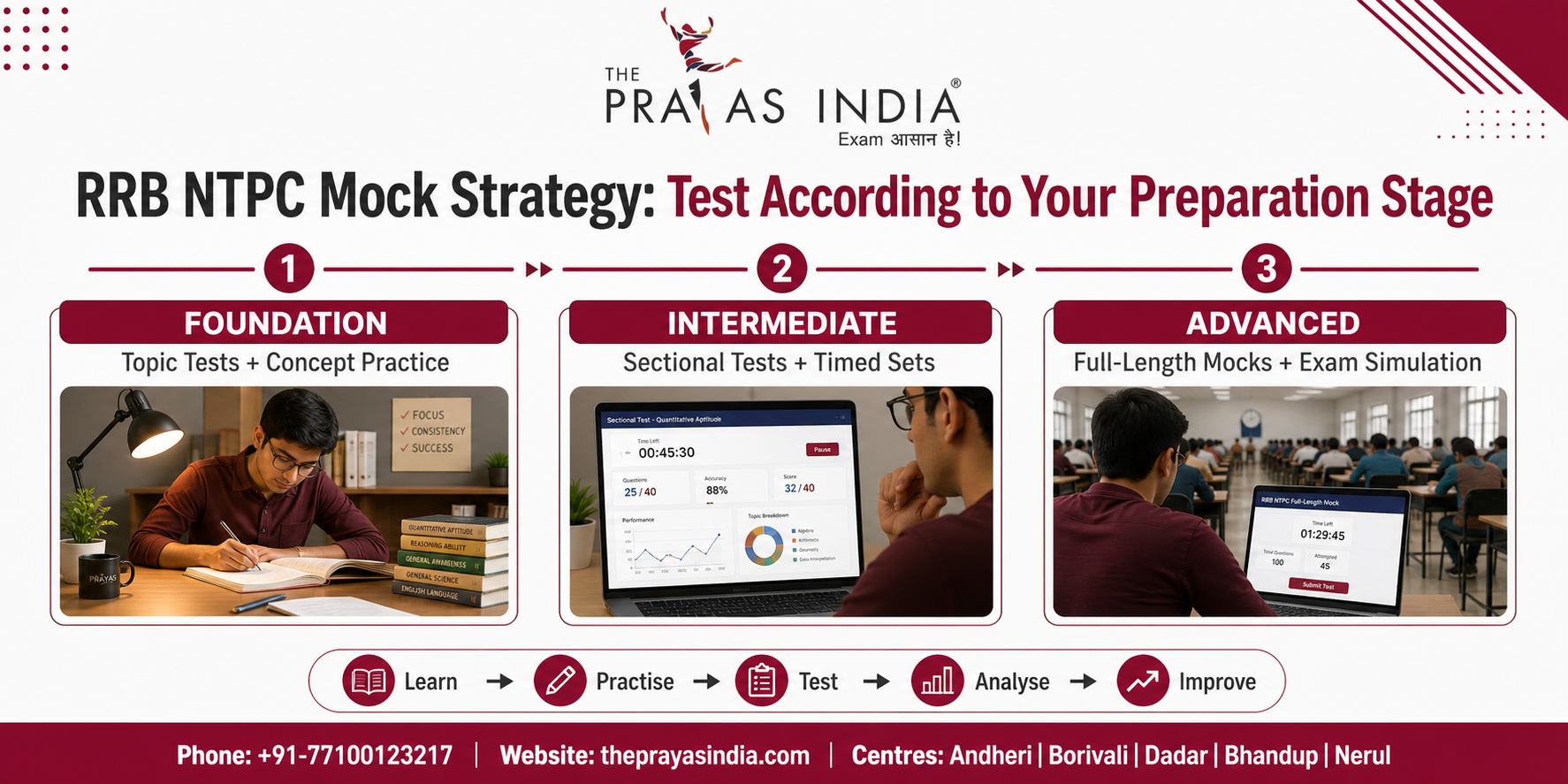
Foundation Stage
Focus more on:
- Topic-wise tests
- Concept practice
- Basic accuracy
- Previous-year questions
Intermediate Stage
Increase:
- Sectional tests
- Mixed-topic practice
- Timed sets
- Detailed analysis
Advanced Stage
Increase emphasis on:
- Full-length mocks
- Exam-like conditions
- Time management
- Question selection
- Repeated error correction
- Performance tracking
The exact mock schedule should depend on your preparation level and target examination timeline.
Taking a full-length mock every day while your fundamentals are incomplete may not be the most efficient use of your time.
Similarly, avoiding full-length mocks until the very end can leave you underprepared for the demands of the actual test.
The goal is progressive testing.
Mistake #10: Studying More Instead of Studying Differently
This is perhaps the most important lesson.
If you are already studying five or six hours every day and your mock scores are stagnant, simply increasing your study time to eight or nine hours may not address the actual problem.
You may need to change what happens inside those hours.
For example:
Instead of solving 100 random questions, solve 50 targeted questions from your weak area and analyse them.
Instead of taking three mocks without review, take one serious mock and spend adequate time analysing it.
Instead of watching another lecture on a familiar topic, attempt questions under time pressure.
Instead of downloading another PDF, revise your existing notes.
Instead of worrying about your score, identify the specific reason behind the score.
More preparation is not always the answer. Better-directed preparation can be.
A Simple RRB NTPC Mock Score Improvement Framework
Use this six-step system after every important mock.
Step 1: Record
Write down your score, attempts, accuracy and section-wise performance.
Step 2: Classify
Divide mistakes into:
Concept → Accuracy → Speed → Selection → Revision
Step 3: Identify
Find the two or three biggest problems responsible for lost marks.
Step 4: Correct
Revise the relevant concept or method.
Step 5: Practise
Solve targeted questions related to that weakness.
Step 6: Re-test
Check whether the same problem appears in your next test.
This creates a measurable cycle:
Test → Diagnose → Correct → Practise → Re-test
What If Your Score Is Not Improving Even After Several Mocks?
If you have taken multiple mocks and your score is consistently stuck, do not immediately assume that you are not capable of improving.
First, examine the pattern.
If your score is stagnant because of repeated conceptual gaps, you need targeted learning.
If your concepts are strong but speed is low, you need timed practice.
If attempts are high but accuracy is poor, you need better question selection and accuracy control.
If accuracy is good but attempts are low, you may need speed improvement.
If General Awareness is consistently weak, you may need a more structured revision system.
If you cannot identify the reason yourself, this is where external feedback can become useful.
A mentor or experienced faculty member can sometimes identify patterns that an aspirant may overlook while self-analysing.
The Prayas India’s RRB NTPC-focused preparation content highlights structured learning, mock tests, performance analysis, revision and mentorship as components of exam preparation. Its RRB NTPC coaching offering also describes regular mock tests, study material, sectional tests, full-length tests and performance analysis.
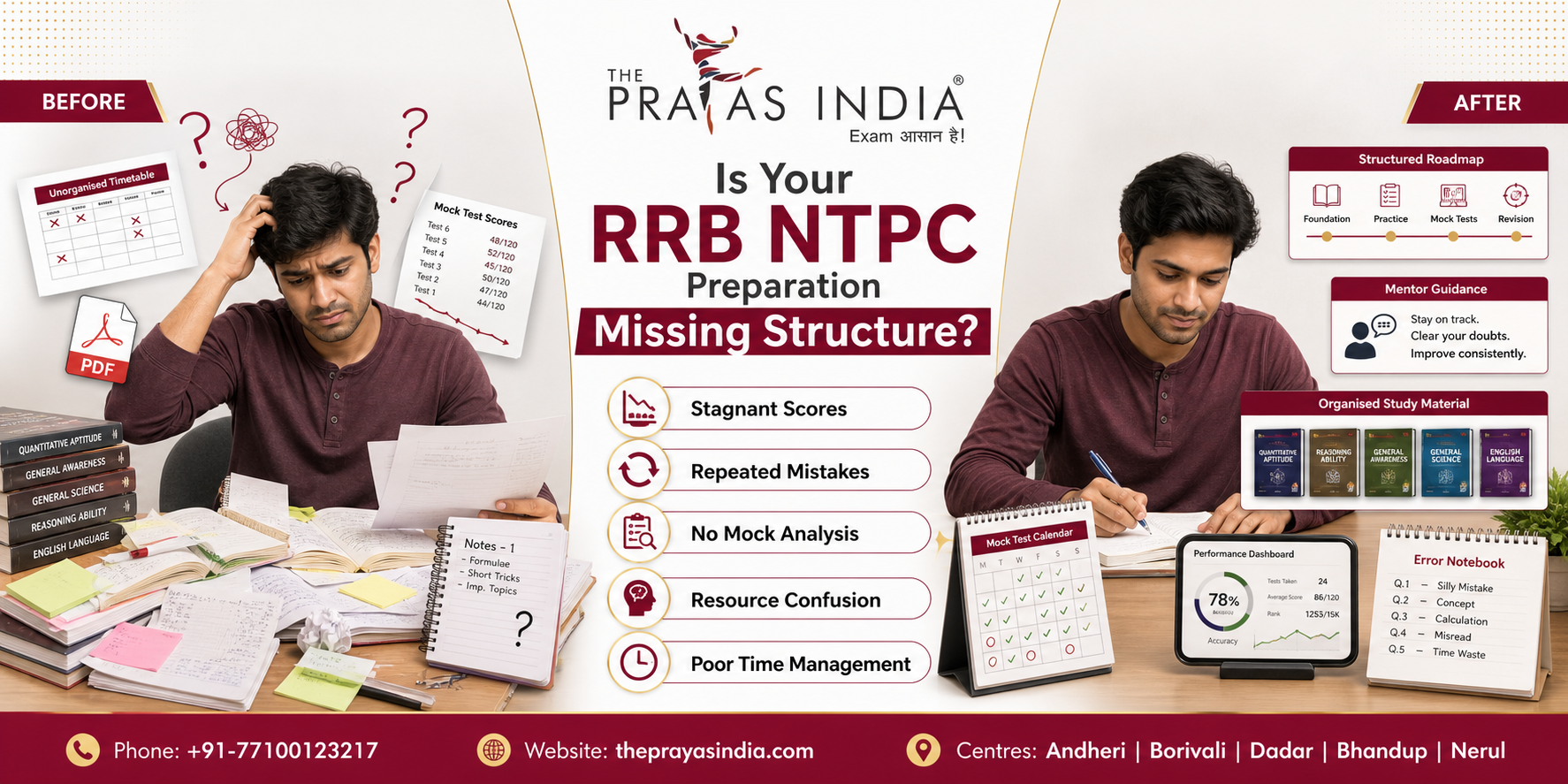
When Should You Consider RRB NTPC Coaching?
Coaching is not automatically necessary for every aspirant.
Self-study can work when you can independently:
- Understand the syllabus
- Select reliable resources
- Build a realistic timetable
- Maintain consistency
- Identify weak topics
- Analyse mock performance
- Resolve doubts
- Track improvement
- Adapt your strategy
However, structured coaching or mentorship may be worth considering when you repeatedly experience problems such as:
“I don’t know what to study next.”
“My mock scores are stuck.”
“I take mocks but don’t know how to analyse them.”
“I keep making the same mistakes.”
“I have too many resources but no proper plan.”
“I understand concepts but cannot perform under time pressure.”
“I need regular guidance and accountability.”
In such situations, the value of a coaching program should be evaluated not merely by the number of lectures it provides, but by the complete preparation system around those lectures.
Look for:
- Structured syllabus coverage
- Quality study material
- Topic-wise practice
- Previous-year questions
- Sectional tests
- Full-length mocks
- Performance analysis
- Doubt resolution
- Mentorship
- Revision support
- Exam strategy
The Prayas India’s current RRB NTPC preparation and test-series information highlights these kinds of components, including full-length mocks, topic-wise tests, exam simulation, performance analysis and practice.
How to Make Your Next 5 Mocks More Useful
Instead of looking only at the final scores, create a simple tracker.
| Mock | Score | Accuracy | Main Problem | Action Before Next Mock |
|---|---|---|---|---|
| Mock 1 | 62 | 78% | Calculation errors | Quant accuracy drill |
| Mock 2 | 64 | 81% | Slow reasoning | Timed reasoning sets |
| Mock 3 | 65 | 83% | GA revision | GA revision cycle |
| Mock 4 | 68 | 85% | Question selection | Attempt strategy |
| Mock 5 | — | — | Evaluate trend | Compare all indicators |
The numbers here are only an example.
Your actual objective is to create a record that answers:
What changed between Mock 1 and Mock 5?
If your score rises, identify why.
If your score does not rise but accuracy improves, identify what is still limiting your attempts.
If your attempts increase but accuracy falls, correct that imbalance.
If the same error keeps returning, stop treating it as a random mistake.
This approach turns mock tests into a continuous improvement system.
Don’t Compare Your Mock Score With Everyone Else
Another reason students become demotivated is comparing their mock score with other aspirants.
Someone posts a score of 85.
Another student posts 92.
You score 64.
The immediate thought is:
“I am far behind.”
But another student’s mock score tells you very little about your own preparation unless you know the test difficulty, attempt strategy, accuracy and preparation stage.
Your most useful comparison is often:
Your current performance vs your previous performance.
Track whether:
- Accuracy is improving.
- Repeated mistakes are declining.
- Time management is becoming better.
- Easy questions are being identified faster.
- Your weak areas are becoming stronger.
- Your test-taking strategy is becoming more disciplined.
That is much more actionable than chasing somebody else’s score.
RRB NTPC Mock Analysis Checklist
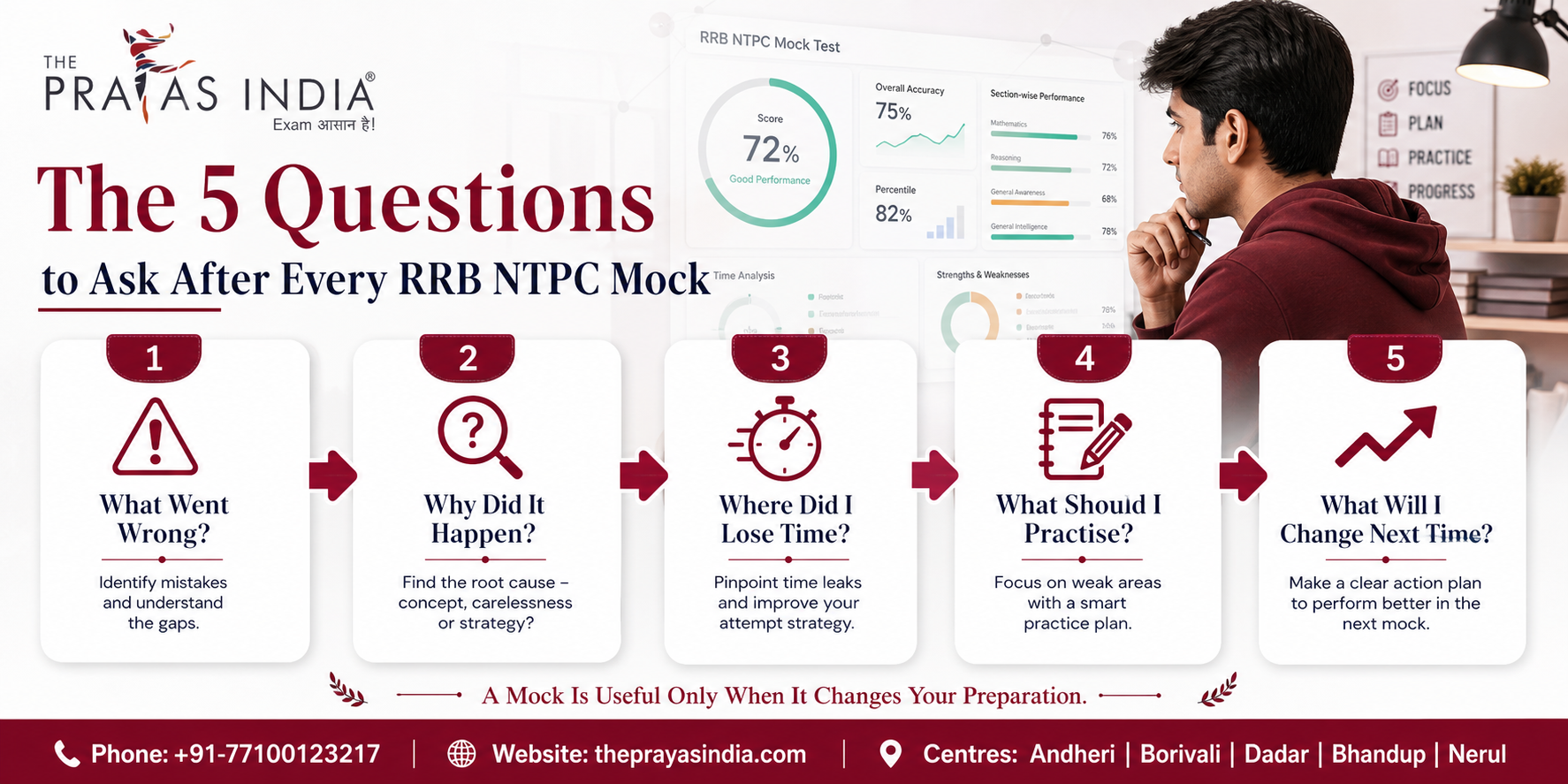
After every important mock, ask yourself:
Performance
- What was my score?
- How many questions did I attempt?
- What was my accuracy?
- Which section was strongest?
- Which section was weakest?
Mistakes
- Which mistakes were conceptual?
- Which were careless?
- Which were due to poor reading?
- Which came from guessing?
- Which mistakes have I made before?
Time
- Which questions took too long?
- Which section consumed excessive time?
- Did I spend too long on difficult questions?
- Did I leave easy questions because of poor time management?
Improvement
- What are my top three weaknesses?
- What will I practise before the next mock?
- What will I revise?
- What will I change in my attempt strategy?
If you cannot answer these questions after a mock, you probably have not extracted its full value.
The Real Goal Is Not a Higher Mock Score — It Is Better Performance
A mock score is important, but it should be treated as one part of your performance picture.
The real goal is to build a preparation system in which:
Your mistakes decrease.
Your accuracy improves.
Your speed becomes more consistent.
Your question selection becomes smarter.
Your weak areas become smaller.
Your revision becomes more targeted.
And eventually, these improvements should reflect in your test scores.
RRB NTPC preparation should therefore move through a continuous cycle:
Learn → Practise → Test → Analyse → Correct → Re-test
If you only learn and practise, you may remain uncertain about your actual performance.
If you only take mocks, you may keep repeating the same weaknesses.
If you analyse but do not act on the analysis, nothing changes.
The improvement happens when test results influence your next preparation cycle.
Final Takeaway
If your RRB NTPC mock scores are not improving, don’t immediately conclude that you need to study for more hours.
First ask whether you are studying in the right direction.
Maybe your concepts are weak.
Maybe your accuracy is holding you back.
Maybe you are attempting too many questions.
Maybe you are spending too much time on difficult questions.
Maybe your General Awareness revision is inconsistent.
Maybe you are taking mocks but not analysing them properly.
Or perhaps you know exactly what your weaknesses are but are struggling to create a systematic plan to correct them.
The solution is to turn every mock into an action plan.
Mock → Analyse → Identify → Practise → Improve
And if you repeatedly find yourself stuck at the same score despite consistent effort, structured guidance, regular performance analysis and mentorship may be worth exploring.
A good preparation system should not simply tell you to “study harder.”
It should help you understand what to study, how to practise, how to test yourself and what to change when the results do not improve.
That is the difference between simply taking mock tests and actually learning from them.
Frequently Asked Questions: RRB NTPC Mock Scores Not Improving?
1. Why are my RRB NTPC mock scores not improving?
Stagnant mock scores can result from several factors, including weak concepts, low accuracy, slow solving speed, poor question selection, insufficient revision or ineffective mock analysis. The first step is to identify the specific reason rather than simply increasing study hours.
2. Should I take more mock tests if my score is not improving?
Taking more mocks is not always the solution. If previous tests are not being analysed properly, additional mocks may simply repeat the same mistakes. Focus on the cycle of mock, analysis, targeted practice and re-testing.
3. How should I analyse an RRB NTPC mock test?
Record your score, attempts, accuracy and section-wise performance. Then classify errors into conceptual mistakes, accuracy errors, slow questions, selection mistakes and revision gaps. Use this analysis to create targeted practice for the next test.
4. Is accuracy more important than attempts in RRB NTPC?
Both accuracy and attempts matter. Because the official RRB NTPC examination pattern includes negative marking, increasing attempts without controlling incorrect answers can reduce the benefit of higher attempts. The objective should be to make efficient and accurate attempts.
5. What should I do if I make the same mistakes in every mock?
Record those mistakes in an error notebook and identify the underlying reason. Revise the relevant concept, practise similar questions and deliberately check that area in your next mock. Repeated mistakes should become a priority in your study plan.
6. Why do I know the answer but still take too much time?
This usually indicates a speed or approach problem rather than a basic knowledge problem. Timed topic-wise sets, alternative solving methods and repeated practice can help improve solving efficiency.
7. When should I start taking full-length RRB NTPC mocks?
The timing depends on your preparation stage. Topic-wise and sectional tests are useful while building fundamentals, while full-length mocks become increasingly important once you have sufficient syllabus coverage and need to practise complete exam simulations.
8. Can coaching help if my RRB NTPC mock scores are stuck?
Structured coaching or mentorship can be useful when you struggle to identify your weaknesses, analyse mocks, maintain a study plan or resolve recurring doubts. The usefulness of a program depends on the quality of its teaching, practice, testing, analysis and mentorship support.
9. Should I compare my RRB NTPC mock scores with other students?
It is generally more useful to track your own performance trend. Compare your attempts, accuracy, mistakes, time management and scores across multiple tests instead of relying only on another student’s score.
10. How can The Prayas India help with RRB NTPC preparation?
The Prayas India offers RRB NTPC-focused preparation support including study material, topic-wise practice, sectional tests, full-length mock tests and performance analysis. Students who need a more structured preparation system can enquire about the available course and mentorship options.
Mock Scores Stuck? Bring Structure to Your RRB NTPC Preparation
If you are taking mock tests but your scores are not improving, you may need more than additional practice. Identify your weak areas, improve your strategy and follow a structured preparation system with regular testing and performance analysis.
Enquire about The Prayas India RRB NTPC preparation program and explore the available classes, mock tests, study material and mentorship support.