RRB Exam Preparation Strategy for Beginners in Nerul | The Prayas India
Preparing for a Railway Recruitment Board (RRB) examination for the first time can feel challenging. Candidates often have questions about the syllabus, study materials, daily timetable, mock tests and how to begin without feeling overwhelmed.
A clear preparation strategy can make the process more manageable. Instead of studying every subject randomly, beginners should understand their target examination, build strong fundamentals, practise questions regularly and review their progress.
For students looking for RRB exam preparation in Nerul, this guide explains how to get started, organise a study routine and make better use of preparation resources.
Identify Your Target RRB Examination
Before starting your preparation, identify the railway recruitment examination that matches your interests and eligibility. Different RRB recruitments have different post requirements, exam stages and subject expectations.
Depending on the current recruitment cycle, you may be considering:
- RRB NTPC: Recruitment for notified non-technical posts.
- RRB Group D: Recruitment for notified Level 1 posts.
- RRB ALP: Assistant Loco Pilot recruitment.
- RRB Technician: Recruitment for notified technical posts.
- RRB JE: Junior Engineer recruitment.
Do not assume that the same preparation plan applies to every examination. Check the latest official notification for eligibility, syllabus, exam pattern, selection stages and dates before selecting your study resources.
Understand the Syllabus and Exam Pattern
Once you have identified your target exam, download and review the relevant official notification. Make a list of subjects and topics that you need to cover.
Depending on the examination, areas may include Mathematics, General Intelligence and Reasoning, General Awareness, General Science or technical subjects. The exact requirements vary by post and recruitment notification.
Divide the syllabus into three groups:
- Comfortable topics: Subjects you can already solve with reasonable confidence.
- Topics to improve: Areas where you understand the basics but need more practice.
- New or difficult topics: Concepts that require step-by-step learning.
This simple classification helps you plan your time according to your actual needs rather than spending too long on topics you already know.
Build Strong Fundamentals First
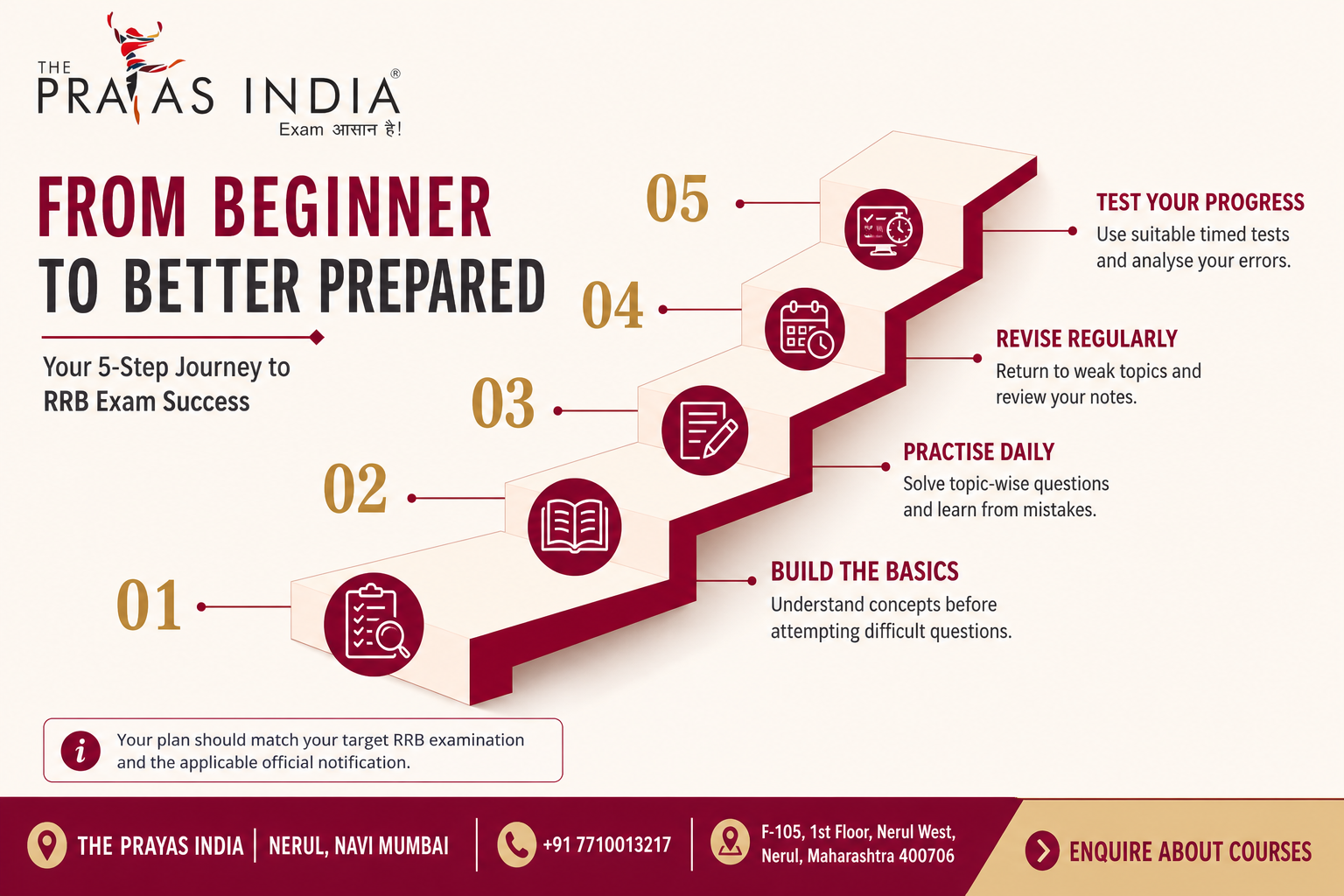
Beginners sometimes start with difficult questions or shortcuts before understanding the underlying concepts. This can lead to confusion and repeated mistakes.
Start with basic concepts and gradually increase the difficulty of your practice.
For Mathematics, revise relevant arithmetic fundamentals and practise calculations regularly. For Reasoning, learn common question types and understand the logic behind each solution. For General Awareness and General Science, follow the topics prescribed for your particular examination.
After learning a topic, solve a small set of questions without looking at the solutions. Review every mistake and note why the correct method works.
Tip: Consistent practice of manageable question sets is often more useful than attempting large numbers of questions without reviewing your errors.
Follow a Realistic Daily Study Timetable
A practical timetable should fit your current routine. If you attend college or work, start with a schedule you can maintain instead of copying an unrealistic study plan.
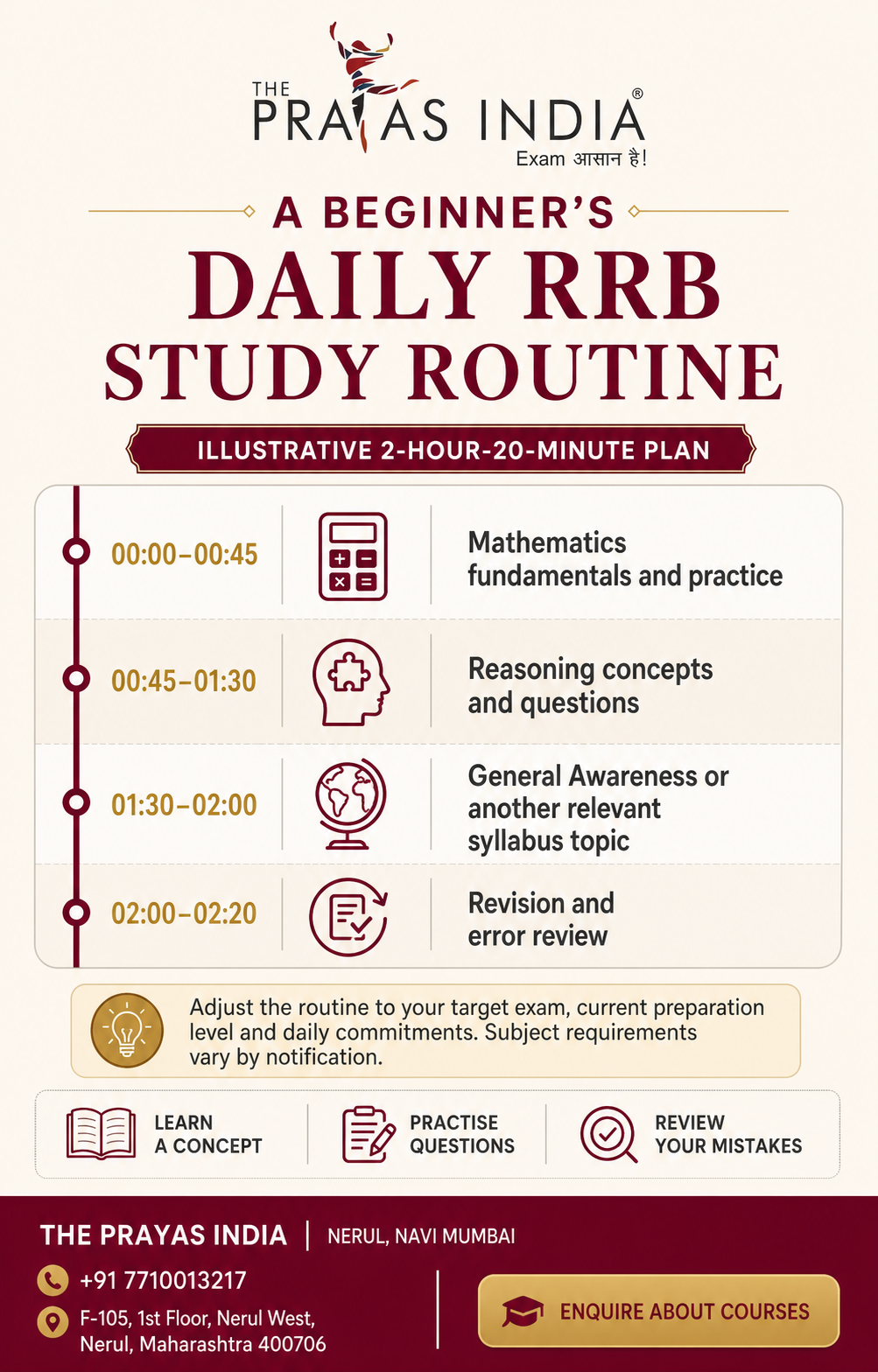
Here is an illustrative daily routine for a beginner. Adjust it according to your target examination and personal commitments.
| Study activity | Suggested time |
|---|---|
| Mathematics fundamentals and practice | 45 minutes |
| Reasoning concepts and questions | 45 minutes |
| General Awareness or other syllabus topics | 30 minutes |
| Revision and error review | 20 minutes |
| Total | 2 hours 20 minutes |
This is only a sample routine, not a fixed requirement. Some candidates may need more time, especially if their target exam includes additional subjects or technical content.
Set weekly goals as well. For example, aim to complete a defined topic, solve a practice set and revise previously studied material by the end of the week.
Practise Questions After Every Topic
Reading notes can help you understand concepts, but question practice shows whether you can apply them.
After completing a topic:
- Solve basic questions to check your understanding.
- Attempt a set of exam-style questions.
- Review incorrect and unanswered questions.
- Revisit the relevant concept.
- Solve a fresh set to check your improvement.
Use previous-year question papers where relevant to your examination. They can help you become familiar with the style of questions asked in earlier recruitment cycles, but they should not replace the current official syllabus.
Keep a separate notebook or digital record of common mistakes, useful methods and topics that require further revision.
Use Mock Tests at the Right Stage
Mock tests are useful for understanding time management and checking your preparation progress. However, beginners do not need to start with full-length tests before learning the basic concepts.
A sensible progression is:
- Initial stage: Practise topic-wise questions.
- Building stage: Take short tests covering several topics.
- Revision stage: Add full-length mock tests where appropriate for the exam.
- Review stage: Analyse mistakes and revise weak areas.
After each test, look beyond the total score. Check whether errors occurred because of a concept gap, calculation mistake, misreading or poor time management.
Record recurring mistakes and use them to plan your next revision session.
Make General Awareness and Current Affairs Part of Your Routine
General Awareness can cover a range of topics, depending on the target RRB examination. Avoid leaving this area entirely until the final weeks of preparation.
Create a manageable routine using reliable study resources. Revise static topics relevant to your syllabus and follow current affairs according to the exam’s requirements.
Short, regular revision sessions can help you revisit information more frequently. Use brief notes or question-based revision to identify facts and concepts you have forgotten.
Check the official notification and syllabus before deciding how much time to allocate to each area.
Create a Weekly Revision and Progress Plan
Without revision, it can become difficult to remember topics studied earlier. Reserve time each week to review concepts and solve questions from previous study sessions.
At the end of the week, ask yourself:
- Which topics did I complete?
- Which questions did I get wrong repeatedly?
- Have my calculation or reasoning mistakes reduced?
- Which subjects need more practice next week?
- Did I follow my planned study routine?
Use your answers to adjust the next week’s schedule. A timetable should guide your preparation, not become a source of unnecessary pressure.
Avoid Common Mistakes Made by Beginners
New aspirants can lose time by switching between too many resources or following study schedules that are difficult to maintain.
Try to avoid these common mistakes:
- Preparing without identifying the target examination.
- Using an outdated syllabus or relying on unverified exam information.
- Collecting too many books and study materials.
- Memorising shortcuts without understanding concepts.
- Taking mock tests without reviewing mistakes.
- Ignoring revision and weak topics.
- Comparing your progress constantly with other candidates.
- Depending on claims of guaranteed selection or guaranteed scores.
Choose a manageable set of resources, follow a consistent plan and verify important recruitment details through official RRB notifications.
Consider Railway Exam Coaching in Nerul
Some beginners prefer to prepare independently, while others benefit from a structured learning environment, scheduled classes and guidance with difficult topics. The right choice depends on your learning style, available time, budget and preparation needs.
If you are exploring railway exam coaching in Nerul, compare teaching methods, syllabus coverage, study materials, practice tests, doubt-solving arrangements, batch timings and fees before enrolling.
The Prayas India – Nerul Branch
Aspirants can contact The Prayas India in Nerul to enquire about currently available programmes and courses and confirm whether any option matches their target RRB examination.
- Address: F-105, 1st Floor, Nerul West, Nerul, Maharashtra 400706
- Phone
- Google Maps
- Website
Ask the branch about current course options, batch schedules, fees, study resources and the support provided. Confirm all relevant details before making an enrolment decision.
A Simple Four-Week Starting Plan
If you are unsure how to begin, use this flexible four-week framework as a starting point. Adjust the topics to match your official syllabus.
Week 1: Understand and organise
Identify your target examination, review the official syllabus, collect suitable study resources and assess your current strengths.
Week 2: Learn the basics
Start with foundational concepts and solve topic-wise questions. Maintain a record of difficult areas.
Week 3: Practise and revise
Continue learning new topics while revisiting earlier material. Add short practice tests and review the mistakes you make.
Week 4: Assess your progress
Attempt suitable timed tests, analyse your performance and create a revised plan for the next month.
This framework is intended to help beginners establish a routine; it is not a guarantee of exam readiness within four weeks.
Final Thoughts
A good RRB exam preparation strategy begins with understanding your target examination and building a realistic study routine. Strong fundamentals, regular question practice, revision and careful mock-test analysis can help you identify what to improve as you prepare.
If you are based in Nerul or nearby areas of Navi Mumbai, compare self-study and coaching options according to your needs. Ask clear questions, verify course details and select a preparation approach that you can follow consistently.
Want to explore railway exam preparation options in Nerul? Contact The Prayas India to enquire about currently available programmes, batch timings and course details.
Frequently Asked Questions
1. How should beginners start RRB exam preparation?
Start by identifying your target RRB examination and reviewing its official syllabus and eligibility criteria. Build your fundamentals, follow a realistic timetable, practise topic-wise questions and revise regularly.
2. How many hours should a beginner study daily for RRB exams?
Your daily study time depends on your current level, target examination and other commitments. You can begin with a manageable routine of around two hours and increase it when necessary, ensuring enough time for practice and revision.
3. Which subjects should I study for RRB exams?
Depending on the examination, subjects may include Mathematics, General Intelligence and Reasoning, General Awareness, General Science or technical subjects. Always follow the syllabus in the official notification for your target recruitment.
4. Are mock tests useful for RRB exam beginners?
Yes. Beginners can start with topic-wise tests and gradually progress to timed and full-length mock tests where appropriate. Reviewing incorrect answers helps identify weak areas and plan further revision.
5. How can I find railway exam coaching in Nerul?
Compare coaching options by checking faculty, teaching methods, syllabus coverage, study materials, mock tests, batch timings and fees. Contact the centre directly to confirm which programmes are currently available.
6. How can I contact The Prayas India in Nerul?
Visit F-105, 1st Floor, Nerul West, Nerul, Maharashtra 400706, or call +91 7710013217. You can also contact the branch on WhatsApp to enquire about currently available programmes and course details.
Start Your RRB Exam Preparation in Nerul
Enquire with The Prayas India about currently available programmes, batch timings, fees and study support.
The Prayas India
F-105, 1st Floor, Nerul West, Nerul, Maharashtra 400706
Phone: +91 7710013217