SBI Clerk Preparation Tips for Beginners in Nerul | The Prayas India
Preparing for the SBI Clerk examination for the first time can feel challenging, especially when you are unsure how to divide your time between Quantitative Aptitude, Reasoning Ability, English and other relevant subjects. A clear study plan can help you organise your preparation and build confidence through regular practice.
For candidates exploring SBI Clerk preparation in Nerul, the first step is to understand the exam requirements, assess your current level and follow a routine that you can maintain consistently.
This guide covers practical preparation tips, subject-wise strategies, a sample timetable, mock-test methods and ways to evaluate coaching options in Nerul and Navi Mumbai.
Understand the SBI Clerk Examination
Before starting your preparation, read the latest official SBI Junior Associate recruitment notification. Check the eligibility criteria, application dates, exam pattern, syllabus and selection process for the recruitment cycle you are targeting.
SBI Clerk recruitment commonly involves Preliminary and Main examinations, with other requirements as specified in the applicable notification. The subjects, marking rules and applicable language requirements should always be confirmed from the official recruitment information.
Avoid relying entirely on old videos, outdated notes or coaching advertisements. A clear understanding of the current notification helps you choose the right study resources and avoid preparing topics that are not relevant to your exam.
Start with a Simple Preparation Plan
Beginners often try to study every subject at once, which can make preparation confusing. Instead, divide your syllabus into manageable topics and set realistic weekly goals.
Start by identifying:
- Topics you already understand.
- Topics that need more practice.
- Topics you have not studied before.
- The amount of time you can study each day.
Begin with foundational concepts, then gradually move towards exam-style questions. Keep your plan flexible enough to accommodate revision and the subjects you find difficult.
A practical plan should help you maintain consistency rather than make you feel that you are always behind schedule.
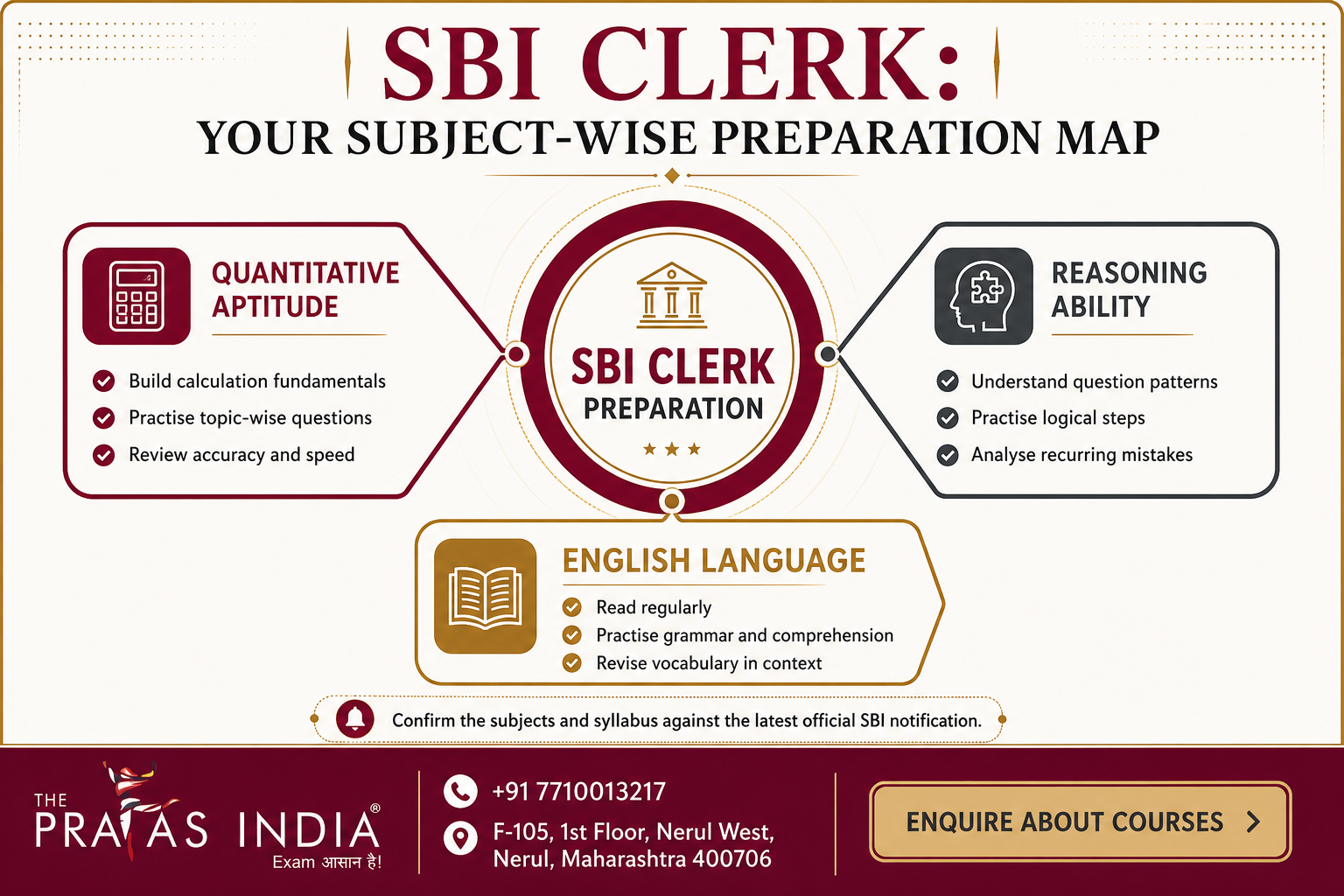
Improve Quantitative Aptitude Step by Step
Quantitative Aptitude requires conceptual understanding, calculation practice and familiarity with different question types. Beginners should build their fundamentals before focusing heavily on shortcuts or speed.
Start by revising relevant arithmetic concepts and practising calculations. Depending on the current syllabus, your preparation may include topics such as percentages, ratios, averages, profit and loss, interest, time and work, and data interpretation.
Use this approach:
- Learn one concept at a time.
- Work through a few solved examples.
- Practise basic questions without checking the solution.
- Review mistakes and identify the reason.
- Attempt a timed practice set after understanding the topic.
Do not measure your progress only by the number of questions you solve. Accuracy and understanding matter, especially when you are learning a topic for the first time.
Build a Strong Reasoning Ability Strategy
Reasoning questions test your ability to identify patterns, follow logical relationships and reach conclusions. Regular practice can help you become familiar with different question formats.
Start with question types that match your current syllabus and learning level. These may include series, coding-decoding, inequalities, syllogisms, direction-based questions and seating arrangements.
For each question, understand why the correct answer works. When you make a mistake, write down whether it happened because you misunderstood a condition, missed a relationship or rushed through the question.
As your understanding improves, gradually introduce more complex sets and practise solving them within a reasonable time.
Improve English Language Skills Daily
English preparation benefits from regular exposure and practice. Instead of studying grammar only occasionally, include a short English session in your daily routine.
Focus on areas relevant to the current examination, which may include reading comprehension, grammar, vocabulary, sentence correction and other question types specified in the syllabus.
Try these habits:
- Read a short English passage regularly.
- Learn new words in context.
- Revise grammar rules and practise related questions.
- Review why an answer is correct or incorrect.
- Keep a list of recurring errors.
Avoid memorising long vocabulary lists without revising them. Short, regular revision sessions can make it easier to retain what you learn.
Follow a Realistic Daily Study Timetable
A daily timetable can help you balance subjects and avoid spending all your preparation time on one area. Choose study hours that fit your college, work or family commitments.
Here is an illustrative routine for a beginner:
| Study activity | Suggested time |
|---|---|
| Quantitative Aptitude | 40 minutes |
| Reasoning Ability | 40 minutes |
| English Language | 30 minutes |
| Revision and error review | 20 minutes |
| Total | 2 hours 10 minutes |
This is a sample schedule, not an official requirement. Adjust it according to your preparation level, the time available and the current examination syllabus. You may need additional time for mock tests, General or Banking Awareness, or other requirements relevant to the Main examination.
Set weekly goals as well. For example, complete selected topics, practise a defined set of questions and revise the areas where you made the most mistakes.
Practise Mock Tests and Previous-Year Questions
Mock tests can help you become familiar with timed practice and assess your progress. However, beginners should first learn the basic concepts and practise topic-wise questions before relying heavily on full-length tests.
A useful progression is:
- Beginning: Practise individual topics without strict time pressure.
- Developing: Attempt short, timed question sets.
- Revision: Introduce suitable section-wise and full-length mock tests.
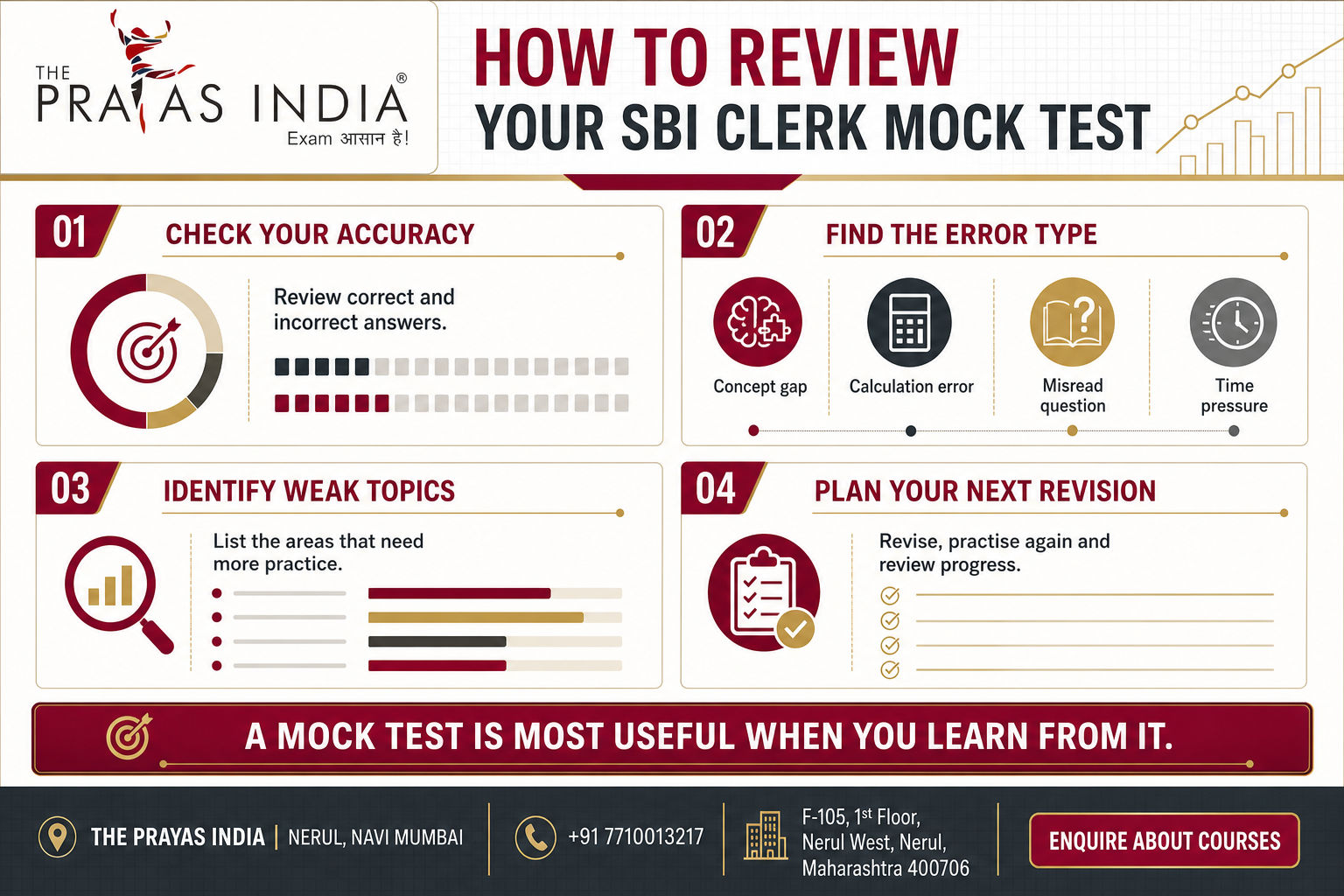
- Review: Analyse errors and revise weak areas before taking the next test.
When reviewing a test, check whether your mistakes came from a concept gap, a calculation error, a misread question or poor time management.
Previous-year question papers can help you understand the style of earlier questions. Use them alongside the latest official syllabus rather than assuming that future questions will be identical.
Make a Revision and Mistake Notebook
Revision helps you revisit concepts before they fade from memory. Maintain a small notebook or digital document with important formulas, grammar rules, reasoning approaches and recurring errors.
After each practice session, record:
- The topic you found difficult.
- The type of mistake you made.
- The correct method or explanation.
- The date when you plan to review it again.
Set aside time every week to revisit this record. Reattempting questions you previously answered incorrectly can help you check whether you have understood the underlying concept.
Avoid Common Mistakes During SBI Clerk Preparation
Beginners can lose valuable study time by constantly changing resources or focusing on speed before developing accuracy.
Try to avoid these common mistakes:
- Starting without reading the latest official notification.
- Studying without a manageable timetable.
- Ignoring one subject because another feels easier.
- Memorising shortcuts without understanding concepts.
- Taking mock tests without analysing the results.
- Skipping revision.
- Using too many books and online resources at once.
- Believing claims that guarantee selection or a particular score.
Choose a manageable set of reliable resources and focus on using them consistently.
Consider SBI Clerk Coaching in Nerul
Some candidates prefer self-study, while others find structured classes helpful for maintaining a routine, understanding difficult concepts and receiving guidance. The right choice depends on your learning style, budget, schedule and preparation needs.
If you are considering bank exam coaching in Nerul or Navi Mumbai, compare the teaching approach, syllabus coverage, practice tests, doubt-solving support, batch timings and fees before enrolling.
The Prayas India — Nerul Branch
Candidates can contact The Prayas India to enquire about currently available programmes and courses and confirm whether any option suits their banking exam preparation requirements.
- Address: F-105, 1st Floor, Nerul West, Nerul, Maharashtra 400706
- Phone
- Google Maps
- Website
Ask about current course options, batch timings, fees, study resources and available support. Confirm the details directly with the branch before enrolling.
A Simple Four-Week Starting Framework
If you are completely new to SBI Clerk preparation, use this flexible four-week framework to establish a routine.
Week 1 — Understand the examination
Read the current official notification, review the syllabus and identify your strong and weak subjects.
Week 2 — Build the fundamentals
Start with basic concepts in Quantitative Aptitude, Reasoning Ability and English. Practise questions after each topic.
Week 3 — Practise and revise
Continue learning while reviewing earlier topics. Start short timed practice sets and maintain your mistake notebook.
Week 4 — Review your progress
Attempt suitable practice tests, analyse your mistakes and prepare the next month’s study plan based on your results.
This is a starting framework, not a guarantee that you will complete the syllabus or become exam-ready within four weeks.
Final Thoughts
A successful preparation routine starts with understanding the examination, building strong fundamentals and practising consistently. Beginners should focus on accuracy before speed, review mistakes regularly and adjust their timetable as they progress.
If you are based in Nerul or nearby Navi Mumbai, compare self-study and coaching options according to your requirements. Choose a preparation method that fits your schedule and helps you study consistently.
Looking for banking exam preparation options in Nerul? Contact The Prayas India to enquire about currently available programmes, batch timings and course details.
Frequently Asked Questions
1. How should beginners start SBI Clerk preparation?
Start by reviewing the latest official SBI recruitment notification and syllabus. Build your fundamentals in Quantitative Aptitude, Reasoning Ability and English, then follow a realistic study timetable with regular practice and revision.
2. How many hours should I study daily for SBI Clerk?
Your study time depends on your current preparation level and daily commitments. Beginners can start with a manageable routine of around two hours and adjust it as needed to include practice, revision and mock tests.
3. Which subjects should I prepare for SBI Clerk?
Preparation commonly covers English Language, Numerical Ability or Quantitative Aptitude, and Reasoning Ability, with additional subjects such as General or Financial Awareness and Computer Aptitude relevant to the applicable Main examination pattern. Confirm the current pattern in the official SBI notification.
4. Are mock tests important for SBI Clerk preparation?
Yes. Mock tests help you practise under time limits and identify weak topics. Review your incorrect answers after each test and use the findings to plan your revision.
5. How can I find SBI Clerk coaching in Nerul?
Compare teaching methods, syllabus coverage, study material, practice tests, batch timings and fees. Contact coaching centres directly to confirm their currently available programmes and whether they meet your preparation needs.
6. How can I contact The Prayas India in Nerul?
Visit F-105, 1st Floor, Nerul West, Nerul, Maharashtra 400706, call +91 7710013217, or contact the branch through WhatsApp to enquire about currently available programmes and course details.
Explore Bank Exam Preparation in Nerul
Contact The Prayas India to enquire about currently available programmes, batch timings, fees and study support.
The Prayas India
F-105, 1st Floor, Nerul West, Nerul, Maharashtra 400706
Phone: +91 7710013217