How to Crack Bank Exams on Your First Attempt: A Complete Preparation Strategy
Cracking a bank exam on your first attempt is a goal shared by thousands of banking aspirants. Whether you are preparing for IBPS PO, IBPS Clerk, SBI PO or SBI Clerk, your first attempt can be a valuable opportunity to demonstrate your preparation, subject knowledge and time-management skills.
However, clearing a banking examination requires more than studying for long hours or completing a large number of practice questions. You need to understand the examination pattern, build strong fundamentals, practise under timed conditions and identify your mistakes before the actual examination.
Many candidates spend months preparing but struggle because they follow an unstructured routine, ignore weaker subjects or begin taking mock tests too late. A well-planned strategy can help you avoid these common problems.
For aspirants in Andheri and nearby areas of Mumbai, having a consistent study routine is equally important when balancing preparation with college, work or other responsibilities. The Prayas India – Andheri is one local option to explore if you are looking for structured guidance for banking examinations.
This article explains how to prepare strategically, manage your daily study hours, improve accuracy and approach your first bank exam attempt with confidence.
Understand the Bank Exam You Want to Crack
Before starting preparation, decide which banking examination you want to target. Different recruitment examinations have different selection stages, question patterns and subject requirements.
Some popular banking examinations for graduates include:
| Examination | Recruiting organisation | Broad career opportunity |
|---|---|---|
| IBPS PO | Participating public-sector banks | Probationary Officer |
| IBPS Clerk | Participating public-sector banks | Clerical-level positions |
| SBI PO | State Bank of India | Probationary Officer |
| SBI Clerk | State Bank of India | Junior Associate |
| RBI Grade B | Reserve Bank of India | Officer-level positions |
Your preparation should be based on the specific examination you intend to take. Do not assume that every banking exam has an identical syllabus or selection process.
Check these details before beginning
- Educational qualification and eligibility conditions.
- Age limit and applicable relaxations.
- Preliminary and Mains examination patterns.
- Number of sections and sectional time limits, where applicable.
- Negative-marking rules.
- Descriptive examination or interview requirements, if applicable.
- Official notification and application schedule.
Important: Always refer to the latest official notification. Recruitment rules, vacancies, examination stages and eligibility conditions can change between recruitment cycles.
Understand the Complete Exam Pattern and Syllabus
One of the first steps towards cracking a bank exam is understanding what you will be tested on.
Most major banking recruitment examinations assess a combination of numerical ability, logical reasoning and English language skills. Mains examinations may also include General or Banking Awareness, Computer Aptitude or other components, depending on the examination.
Quantitative Aptitude
This section evaluates your numerical understanding, calculation ability and problem-solving speed.
Important topics include:
- Simplification and approximation
- Number series
- Percentage
- Ratio and proportion
- Average
- Profit and loss
- Simple and compound interest
- Time and work
- Time, speed and distance
- Mixture and allegation
- Data interpretation
Reasoning Ability
Reasoning tests your ability to interpret information, identify patterns and solve logical problems.
Important topics include:
- Seating arrangements
- Puzzles
- Syllogism
- Inequality
- Blood relations
- Direction and distance
- Coding-decoding
- Alphanumeric series
- Order and ranking
- Input-output
English Language
English preparation requires regular reading, grammar practice and comprehension skills.
Important topics include:
- Reading comprehension
- Error detection
- Sentence improvement
- Cloze test
- Para jumbles
- Fill in the blanks
- Vocabulary
- Phrase replacement
- Grammar
General and Banking Awareness
This section is particularly important in the Mains examinations of several banking recruitments.
Focus on:
- Current national and international events
- Banking and financial awareness
- Reserve Bank of India developments
- Government schemes
- Important appointments
- Reports and indices
- Awards and sports
- Economic developments
Computer Aptitude
Where included in the examination, revise fundamental computer concepts such as:
- Computer hardware and software
- Operating systems
- Internet and networking basics
- MS Office fundamentals
- Computer terminology
- Cybersecurity basics
Preparation tip: Download or review the official syllabus and create a checklist. Mark each topic as not started, in progress or completed. This will help you identify gaps in your preparation.
Build Strong Fundamentals Before Practising Advanced Questions
A common mistake among first-time banking aspirants is jumping directly into difficult questions without understanding the basic concepts.
For example, attempting complex data interpretation questions without understanding percentages, averages and ratios can make problem-solving unnecessarily difficult.
Start with fundamental concepts in every subject.
How to strengthen your basics
In Quantitative Aptitude: Understand calculation methods, fractions, percentages, ratios and arithmetic concepts before moving towards advanced questions.
In Reasoning: Begin with basic logical topics and gradually practise puzzles and seating arrangements.
In English: Strengthen grammar, sentence structure and vocabulary. Read regularly to improve comprehension.
In General Awareness: Build a daily reading and revision habit instead of collecting large amounts of information at the last minute.
A strong foundation makes it easier to understand unfamiliar question formats and reduces dependence on memorised shortcuts.
Follow a Smart Daily Study Timetable
You do not need to study for an unrealistic number of hours to prepare effectively. Your timetable should provide sufficient time for learning, practice, revision and mock-test analysis.
A full-time aspirant can consider a routine of approximately five to six focused hours daily, while working candidates can adjust the duration according to their availability.
Suggested six-hour daily timetable
| Subject or activity | Suggested time |
|---|---|
| Quantitative Aptitude | 90 minutes |
| Reasoning Ability | 75 minutes |
| English Language | 60 minutes |
| General and Banking Awareness | 60 minutes |
| Practice questions or sectional test | 45 minutes |
| Revision and error analysis | 30 minutes |
| Total | 6 hours |
This is a sample timetable, not a compulsory requirement. Adjust the time allocation according to your strengths, weaknesses and examination stage.
Make every study session purposeful
Instead of writing “Study Reasoning” in your timetable, create a specific target:
- Complete one seating arrangement concept.
- Solve 25 related questions.
- Review incorrect answers.
- Record the mistakes that need revision.
Small, measurable targets make it easier to monitor your progress.
Practise Previous-Year Questions Regularly
Previous-year question papers are valuable because they help you understand the actual examination style.
They can show you:
- Common question formats.
- Frequently tested concepts.
- Relative difficulty levels.
- The type of calculations required.
- How questions are distributed across sections.
How to use previous-year papers effectively
- Complete a topic and solve related previous-year questions.
- Identify question types that take too much time.
- Practise questions under timed conditions.
- Compare your accuracy across different topics.
- Revisit concepts behind incorrect answers.
Do not simply memorise answers from previous papers. Understand the approach used to solve each question.
Take Mock Tests and Analyse Every Mistake
Mock tests are an essential part of banking exam preparation. They help you practise under time pressure and understand how effectively you can apply your knowledge.
However, attempting mock tests without analysing the results can limit their usefulness.
What should you analyse after every mock test?
Accuracy: How many questions did you answer correctly?
Speed: Which questions took longer than expected?
Question selection: Did you spend too much time on difficult questions?
Weak topics: Which concepts repeatedly caused mistakes?
Sectional performance: Which section needs more attention?
Maintain a simple performance record after every test.
| Mock test | Accuracy | Main problem | Improvement target |
|---|---|---|---|
| Test 1 | Record your score | Calculation errors | Revise arithmetic |
| Test 2 | Record your score | Slow puzzles | Practise timed sets |
| Test 3 | Record your score | Reading comprehension | Improve reading practice |
| Test 4 | Record your score | General awareness gaps | Revise current affairs |
The entries are examples of how to track performance. Record your actual results rather than using a fixed target score for every test.
When should you start taking mock tests?
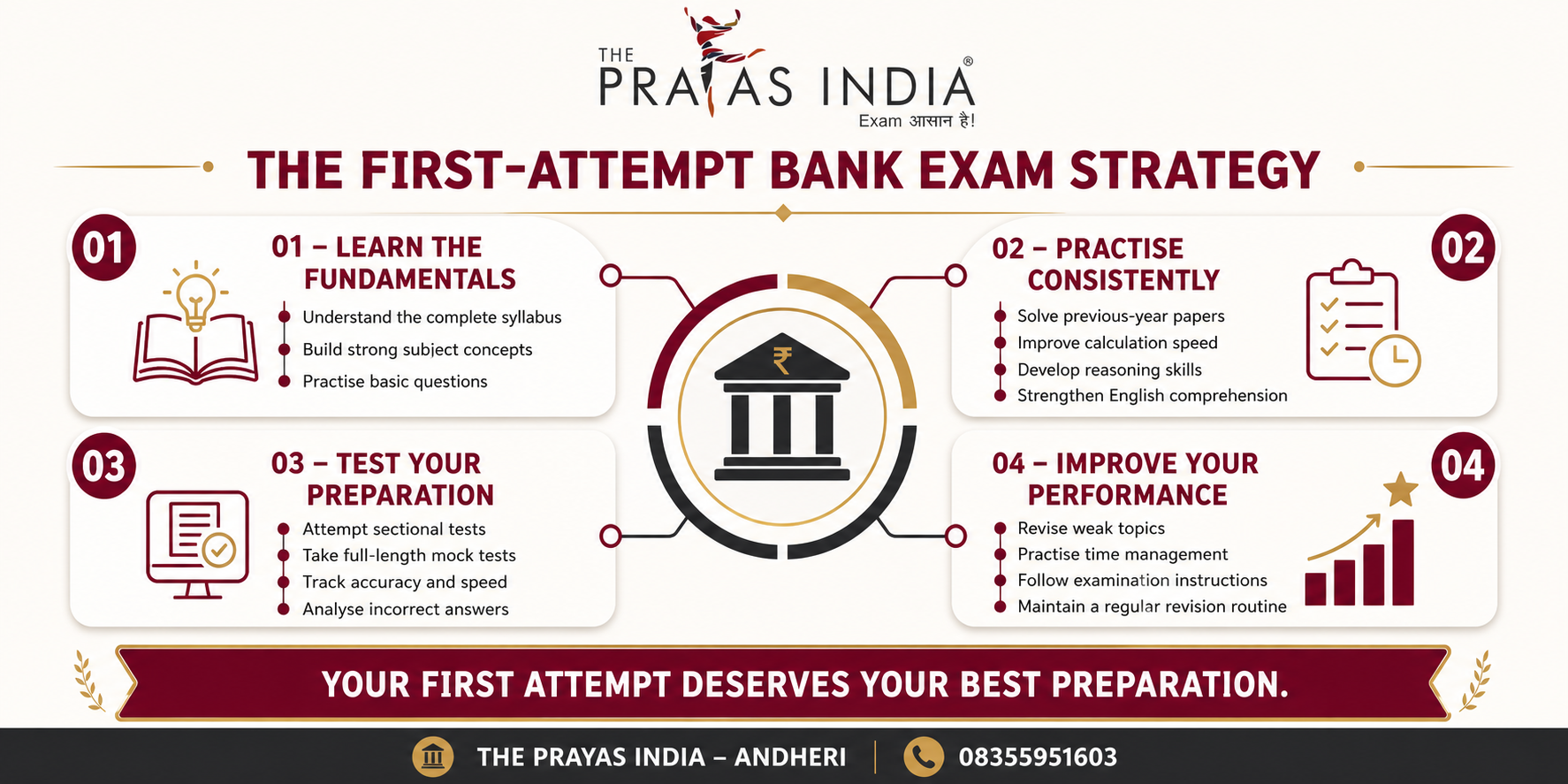
- Foundation stage: Begin with topic-wise tests.
- Practice stage: Introduce sectional tests.
- Advanced stage: Attempt full-length mocks regularly.
- Final revision stage: Focus on test analysis, weak areas and examination-specific practice.
A mock test should help you identify what to improve next. It should not become a routine activity that you complete without reviewing your performance.
Improve Speed and Accuracy Together
Banking examinations often have strict time limits. Knowing how to solve a question is not enough; you must also solve it efficiently.
But increasing speed without maintaining accuracy can be counterproductive, particularly in examinations with negative marking.
Practical ways to improve speed
- Practise basic calculations daily.
- Memorise commonly used squares, cubes and percentage equivalents.
- Improve mental calculation skills.
- Solve topic-wise questions with a timer.
- Learn different approaches to familiar question types.
- Avoid spending too much time on one difficult question.
Practical ways to improve accuracy
- Read the complete question carefully.
- Avoid making assumptions.
- Recheck calculations when time permits.
- Practise the concepts behind incorrect answers.
- Learn when to skip a question.
- Understand the negative-marking rules of your target examination.
Remember: Speed should develop from better understanding and regular practice, not from rushing through questions.
Prepare General and Banking Awareness Every Day
Many candidates concentrate heavily on Quantitative Aptitude and Reasoning during the early preparation stage and postpone General Awareness.
This can create unnecessary pressure closer to the examination.
Develop a daily current-affairs routine from the beginning.
What should you study?
- Important national developments.
- International events.
- Banking and financial news.
- RBI announcements and updates.
- Government schemes.
- Economic developments.
- Reports and indices.
- Important appointments and awards.
How to retain current affairs
- Make short notes.
- Revise information weekly.
- Prepare monthly revision summaries.
- Practise relevant objective questions.
- Revisit important banking and financial developments.
Avoid collecting excessive notes from multiple sources. Choose a reliable source and revise it consistently.
Follow a Preparation Roadmap for Your First Attempt
A structured roadmap helps you move from basic learning to examination-level practice.
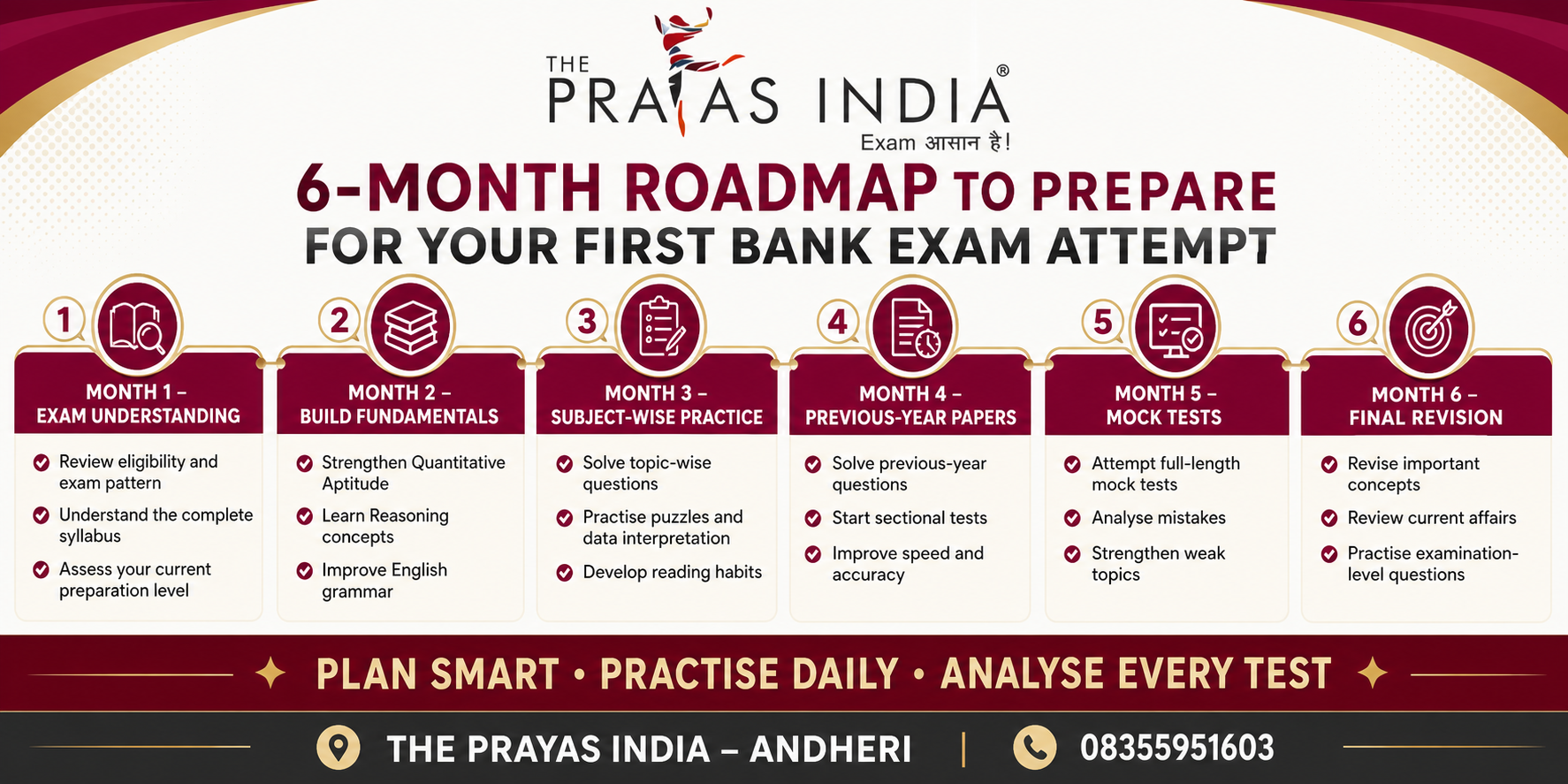
The following six-month plan is a suggested framework. Candidates with different starting levels or shorter preparation windows should adjust it accordingly.
Suggested six-month preparation schedule
| Month | Preparation priority | Main objective |
|---|---|---|
| Month 1 | Exam pattern and fundamentals | Build a strong starting base |
| Month 2 | Core subject concepts | Improve understanding |
| Month 3 | Topic-wise practice | Strengthen question-solving ability |
| Month 4 | Previous-year papers and sectional tests | Improve exam familiarity |
| Month 5 | Full-length mock tests | Develop time management |
| Month 6 | Revision and final practice | Consolidate preparation |
Do not treat this timeline as a guarantee that every candidate will be examination-ready in six months. Your progress depends on your starting level, available study time and the specific recruitment examination.
Develop a Smart Examination-Day Strategy
Your preparation should include learning how to approach the actual examination.
A candidate may understand every subject but still lose marks through poor time management or unsuitable question selection.
Before attempting a question
- Read the question carefully.
- Identify what information is being asked.
- Estimate the time required.
- Decide whether the question is worth attempting immediately.
During the examination
- Avoid spending too much time on one difficult question.
- Maintain a balanced approach across sections.
- Follow the examination’s sectional time limits.
- Keep accuracy in mind while managing speed.
- Review answers where the examination interface and remaining time permit.
Understand the marking scheme
Some banking examinations use negative marking for incorrect objective answers. The exact rules can differ, so check the official notification and instructions.
Do not attempt questions randomly. Make informed decisions based on your understanding and the applicable marking scheme.
Common Mistakes That Can Affect Your First Attempt
Even hardworking candidates can make avoidable mistakes during preparation.
Preparing without selecting a target examination
IBPS PO, IBPS Clerk, SBI PO and SBI Clerk may share some topics, but their patterns and selection stages are not identical. Choose a primary target and prepare according to its requirements.
Ignoring weaker subjects
Spending most of your time on your strongest subject can create gaps elsewhere. Evaluate your performance regularly and adjust your timetable.
Depending only on shortcuts
Calculation tricks and reasoning shortcuts can save time, but they are useful only when you understand the underlying concepts.
Avoiding mock tests
Waiting until the entire syllabus is complete before attempting any test can delay your understanding of examination-level questions. Begin with topic-wise tests and progress gradually.
Taking too many mock tests without analysis
More tests do not automatically mean better preparation. Review your mistakes and use the results to improve.
Ignoring current affairs
Postponing General Awareness preparation can create a large revision burden. Study and revise regularly.
Comparing your preparation with other candidates
Different candidates have different educational backgrounds, strengths and available study hours. Track your own progress instead of copying someone else’s timetable.
How Coaching Can Support Your First Bank Exam Attempt in Andheri
Self-study is an important part of bank exam preparation. However, some candidates benefit from a structured learning environment, especially when they need help with concepts, practice schedules or regular performance evaluation.
A suitable coaching programme may provide:
- Planned subject-wise learning.
- Guidance on important examination topics.
- Regular question-solving practice.
- Doubt clarification.
- Mock-test-based preparation.
- A more organised study routine.
For aspirants in Andheri West, Andheri East, Lokhandwala, Oshiwara, Jogeshwari and nearby areas of Mumbai, The Prayas India – Andheri is a local option to explore for banking exam preparation.
Before enrolling, check the available courses, syllabus coverage, batch timings, teaching approach and practice support. Select a programme that matches your target examination and personal learning requirements.
Final Checklist Before Your First Bank Exam Attempt
Use this checklist to review your preparation before the examination.
- Have you checked the latest official notification?
- Do you understand the complete exam pattern?
- Have you covered the relevant syllabus?
- Are your basic concepts clear?
- Have you practised previous-year papers?
- Are you attempting sectional and full-length mock tests?
- Do you analyse your mistakes after every test?
- Are you revising current affairs regularly?
- Have you improved your time management?
- Do you understand the negative-marking rules?
- Have you checked the examination instructions and required documents?
This final review can help you identify preparation gaps and organise your remaining study time.
Conclusion: Make Your First Bank Exam Attempt Count
Cracking a bank exam on your first attempt requires a focused strategy, regular practice and the willingness to learn from mistakes. Begin by selecting your target examination and understanding its syllabus. Strengthen your fundamentals in Quantitative Aptitude, Reasoning and English, while maintaining a consistent General Awareness routine.
Once your concepts are clear, solve previous-year questions, attempt mock tests and analyse your performance. Improve speed without sacrificing accuracy, revise regularly and follow a timetable that you can maintain.
Most importantly, remember that a first attempt should be approached with preparation rather than pressure. No study plan can guarantee selection, but a well-organised strategy can help you make better use of your time and preparation.
If you are exploring structured banking exam preparation in Mumbai, consider contacting The Prayas India – Andheri to understand the available courses and batch details.
Prepare with a plan. Practise with consistency. Approach your first attempt with confidence.
Frequently Asked Questions
1. Can I crack a bank exam on my first attempt?
Yes, it is possible to clear a bank exam on your first attempt with focused preparation, strong subject fundamentals, regular practice and proper time management. However, selection depends on your performance, the examination’s difficulty and the recruitment process.
2. How many hours should I study daily to crack bank exams?
Many full-time aspirants can begin with approximately five to six focused study hours daily. Beginners may need a different schedule, while working candidates can prepare with shorter, consistent sessions. The right duration depends on your preparation level and available time.
3. Which subjects should I prepare for IBPS PO and SBI PO?
Preparation generally includes Quantitative Aptitude, Reasoning Ability, English Language and General or Banking Awareness. Depending on the examination and stage, additional components such as Computer Aptitude, descriptive writing or an interview may apply. Check the latest official notification for the exact pattern.
4. Are mock tests important for first-attempt bank exam preparation?
Yes. Mock tests help you practise under timed conditions, understand question patterns and identify weak areas. Analysing incorrect answers, slow-solving questions and time-management problems after each test is equally important.
5. How can I improve speed and accuracy in bank exams?
Build strong fundamentals, practise calculations regularly, solve topic-wise questions and attempt timed tests. Review mistakes after every test and learn when to skip questions that may consume too much time.
6. Can I prepare for IBPS and SBI exams together?
Yes. These examinations share several preparation areas, including Quantitative Aptitude, Reasoning and English. However, you should study the individual examination patterns, selection stages and specific requirements before planning your preparation.
7. Is coaching necessary to crack a bank exam on the first attempt?
Coaching is not compulsory. Candidates can prepare through self-study and reliable learning resources. However, structured classes, guided practice, doubt clarification and regular testing may help aspirants who need additional academic support.
Prepare Strategically for Your First Bank Exam Attempt
Looking for structured guidance for IBPS PO, IBPS Clerk, SBI PO or SBI Clerk? Connect with The Prayas India – Andheri to enquire about available courses and batch details.
THE PRAYAS INDIA – ANDHERI
Office 803, Time Chambers, Swami Vivekanand Road, near Paneri, Andheri West, Mumbai, Maharashtra 400058.
Phone: 08355951603