The Smart Way to Analyse SSC Mock Tests | Best SSC Coaching in Mumbai | The Prayas India
A Mock Test Doesn’t Measure Your Potential. It Reveals What You Must Improve Before the Real Examination.
Every serious SSC aspirant understands the importance of mock tests. Whether you are preparing for SSC CGL, SSC CHSL, SSC MTS, SSC CPO, or Selection Post, mock tests have become an essential part of the preparation process. They help you become familiar with the exam pattern, improve speed, and prepare you for the pressure of solving questions within a limited time.
However, there is one important question that many aspirants never ask themselves.
Are your mock tests actually improving your performance, or are they simply becoming another daily routine?
Many students proudly say they have attempted twenty, thirty, or even fifty mock tests. Yet when they compare their scores over several weeks, the improvement is often very small. Some continue scoring within the same range despite investing significant time and effort.
The reason is surprisingly simple.
Most aspirants spend hours attempting mock tests but very little time understanding what those tests are trying to teach them.
A mock test is not merely a score-generating activity.
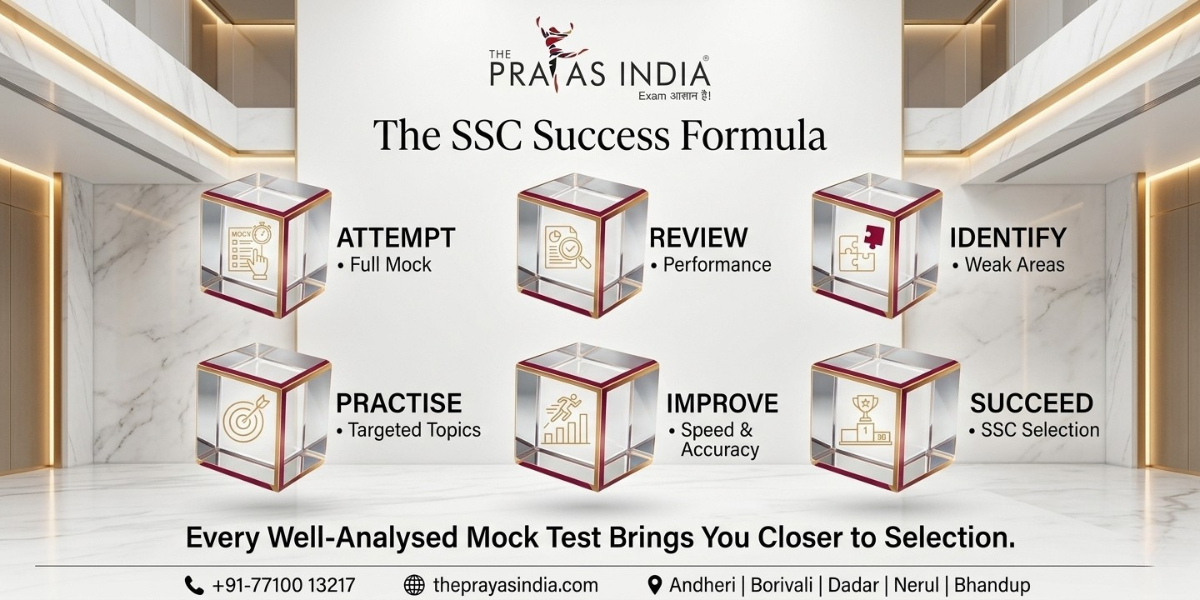
It is a detailed performance report that identifies your strengths, weaknesses, decision-making ability, time management, and examination temperament. When analysed properly, every mock test becomes a roadmap for improving the next one.
The objective is not to collect more mock scores.
The objective is to make every new mock better than the previous one.
Why Attempting More Mock Tests Does Not Always Increase Your SSC Score
A common misconception among SSC aspirants is that attempting a higher number of mock tests automatically guarantees better performance in the actual examination.
Practice certainly matters.
But practice without analysis often results in repeating the same mistakes.
Consider two aspirants preparing for SSC CGL.
Both attempt three mock tests every week.
The first student checks the score, looks at a few incorrect answers, and immediately starts preparing for the next mock.
The second student spends time identifying why mistakes occurred, reviews weak topics, analyses question selection, studies time allocation, and modifies the preparation plan before attempting another mock.
After several weeks, both students may have attempted the same number of mock tests.
Their improvement, however, is unlikely to be the same.
The second student has transformed every mock test into a learning opportunity, while the first has simply accumulated more scores.
Quality of review almost always produces better results than quantity of attempts.
Stop Looking Only at Your Final Score
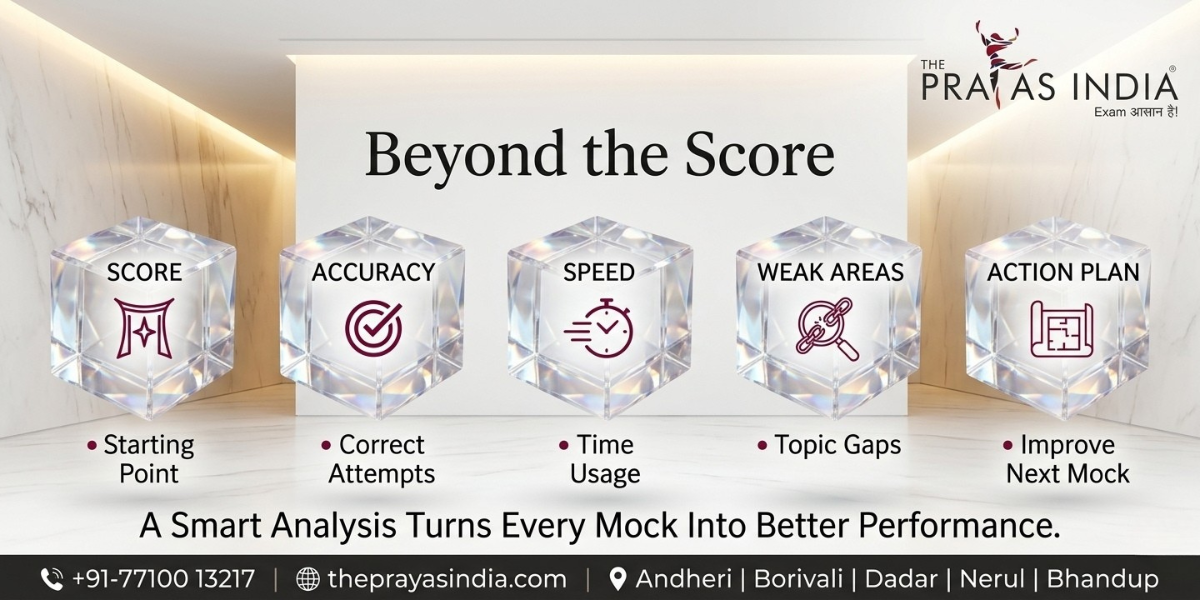
The first number every aspirant notices after completing a mock test is the overall score.
Although the score is important, it rarely explains why you performed well or poorly.
For example, imagine that you scored 132 marks in one mock test.
Without further analysis, that number tells you very little.
Questions you should actually be asking include:
- Which section contributed the highest marks?
- Which subject reduced the overall score?
- How many questions were left unattempted?
- Were incorrect answers caused by conceptual mistakes or careless errors?
- Did time management affect your performance?
- Could better question selection have improved your score?
When these questions remain unanswered, improvement becomes largely based on guesswork.
Every SSC mock test contains valuable information that goes far beyond the final marks.
Learning to interpret that information is one of the most important skills an aspirant can develop.
Think Like a Performance Analyst, Not Just a Test Taker
Professional athletes rarely evaluate their performance by looking only at the final result of a match.
They review recordings, identify recurring mistakes, analyse movement patterns, and make adjustments before the next competition.
SSC preparation follows a similar principle.
Instead of asking only, “How many marks did I score?”
Begin asking:
- Which topics consistently reduce my accuracy?
- Which questions consume unnecessary time?
- Which section should I attempt first?
- Which question types should I skip initially?
- Where am I losing marks every week?
These observations gradually transform preparation from random practice into strategic improvement.
Aspirants who analyse their own performance objectively usually improve faster because every mock test becomes a source of reliable feedback.
Every Mock Test Should Change Your Next Study Plan
One of the biggest opportunities that many aspirants miss is using mock tests to plan their upcoming study sessions.
Suppose your latest mock reveals:
- Weak performance in Geometry.
- Low accuracy in English Grammar.
- Slow solving speed in General Intelligence.
- Repeated mistakes in Percentage and Profit & Loss.
Your next few study sessions should naturally focus on improving these specific areas.
Instead of studying randomly, your preparation becomes targeted.
This approach ensures that every mock directly influences future improvement.
Over several weeks, these small adjustments produce significant improvements in both confidence and examination performance.
Expert Guidance Makes Mock Analysis More Effective
Analysing a mock test independently certainly improves preparation, but experienced mentors often notice patterns that students overlook. Many aspirants focus only on incorrect answers while ignoring deeper issues such as inefficient question selection, inconsistent time allocation, recurring error trends, or examination temperament. Addressing these areas systematically often leads to faster and more sustainable score improvement.
At The Prayas India, SSC mock tests are followed by structured performance reviews, detailed faculty feedback, personalised mentoring, and focused improvement plans. Students learn how to interpret mock data correctly, strengthen weak areas, and build effective examination strategies instead of simply attempting more tests. This organised approach helps aspirants convert every mock into meaningful progress towards SSC success.
Create a Performance Review System Instead of Simply Checking Your Marks
The Real Purpose of an SSC Mock Test Is to Help You Make Better Decisions in the Next One.
Many SSC aspirants finish a mock test, look at the overall score, compare it with the previous attempt, and immediately begin another practice session. Although this routine creates the feeling of continuous preparation, it often fails to produce consistent improvement because the most valuable part of the mock test is skipped.
A mock test should never be treated as an isolated event.
It should become the starting point for your next phase of preparation.
Every score contains useful information about your strengths, recurring mistakes, speed, and examination behaviour. The challenge is learning how to organise this information so that it leads to measurable improvement instead of remaining just another number on the screen.
Rather than asking only whether your score increased or decreased, develop a structured review system that evaluates every important aspect of your performance.
When this process becomes a habit, every mock contributes directly to your final selection.
Evaluate the Quality of Your Attempts, Not Just the Number of Attempts
Many students proudly mention the number of questions they attempted during a mock test.
While attempts are important, they do not always indicate good performance.
Imagine two candidates attempting the same SSC CGL mock.
The first candidate attempts 95 questions but makes a large number of avoidable mistakes because of hurried decision-making.
The second candidate attempts 88 questions, remains selective, and maintains excellent accuracy.
Despite attempting fewer questions, the second aspirant is likely to achieve a better final score.
This is why every mock should include an evaluation of attempt quality.
Ask yourself:
- Were my attempts based on confidence or guesswork?
- Did I attempt difficult questions too early?
- Which questions should I have skipped initially?
- Did negative marking reduce my overall score?
- Were my guesses calculated or random?
Improving the quality of attempts often produces greater score improvement than simply increasing the number of questions attempted.
Study How You Used Your Time Throughout the Examination
Time management in SSC examinations is not only about solving questions quickly.
It is about distributing available time wisely across different sections.
Many aspirants unknowingly spend excessive time on one difficult reasoning puzzle or a lengthy mathematics question. By the time they move to the remaining sections, several easier questions remain unanswered.
A productive mock analysis should therefore include a review of your time allocation.
Consider the following observations after every mock:
- Which section consumed the most time?
- Which questions interrupted your flow?
- Did you spend too long solving one difficult problem?
- Which section could have been completed faster?
- Were easy questions left because of poor time management?
These observations help you refine your examination strategy before the next mock rather than repeating the same pattern.
Identify Topics That Consistently Reduce Your Score
A single mistake in a topic is rarely a serious concern.
Repeated mistakes in the same topic deserve immediate attention.
Many aspirants continue practising randomly without recognising these recurring patterns.
For example, after reviewing several mock tests, you may notice:
- Percentage questions frequently reduce your score.
- Geometry accuracy remains inconsistent.
- Reading Comprehension takes longer than expected.
- Coding-Decoding questions are solved correctly but slowly.
- Static General Awareness produces repeated errors.
Instead of dividing your study time equally across every chapter, allocate additional attention to topics that repeatedly appear in your mistake pattern.
Targeted improvement produces much faster progress than random revision.
Separate Conceptual Errors from Careless Errors
Every incorrect answer has a reason.
Understanding that reason is more valuable than simply reading the correct solution.
Generally, mistakes fall into two broad categories.
Conceptual Errors
These occur when:
- A formula is forgotten.
- A concept is misunderstood.
- A reasoning approach is incorrect.
- A grammar rule is applied incorrectly.
Conceptual errors require revision and additional practice.
Careless Errors
These include:
- Reading the question incorrectly.
- Selecting the wrong option accidentally.
- Calculation mistakes.
- Ignoring keywords like “NOT,” “EXCEPT,” or “ONLY.”
- Marking the incorrect answer despite solving correctly.
Careless mistakes require greater concentration rather than additional theory.
Learning to distinguish between these two categories allows you to choose the correct improvement strategy.
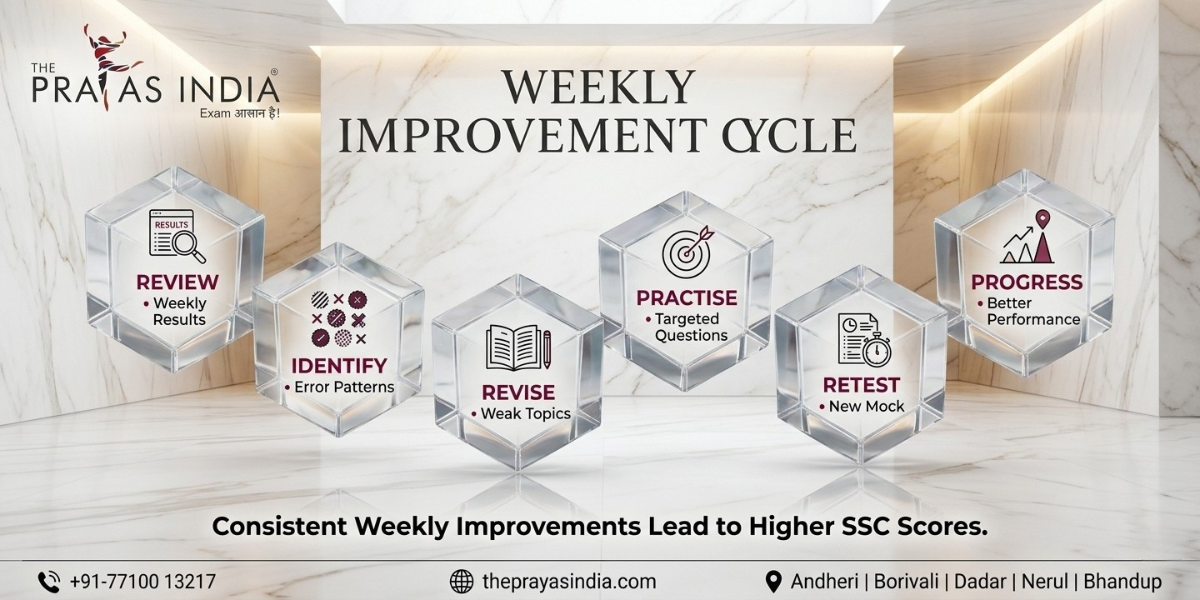
Transform Every Mock into a Weekly Improvement Plan
A mock test becomes truly valuable only when it influences your preparation for the following week.
Instead of creating a random study schedule, allow your latest mock to decide what deserves greater attention.
For example, if your review reveals:
- Low accuracy in General Intelligence,
- Weak arithmetic calculations,
- Poor vocabulary retention,
- Slow speed in Data Interpretation,
your next week’s preparation should naturally focus on these specific weaknesses.
This creates a continuous improvement cycle where every mock shapes the next stage of preparation.
Over time, your study sessions become increasingly efficient because they are guided by actual performance rather than assumptions.
Structured Performance Reviews Accelerate Improvement
Many aspirants know that they made mistakes but struggle to identify why those mistakes keep recurring. Without a systematic review process, students often continue practising the same way and expect different results. A structured performance review helps convert raw scores into meaningful preparation strategies by highlighting specific areas that require attention.
At The Prayas India, SSC mock tests are followed by comprehensive performance reviews, personalised faculty feedback, detailed error analysis, and targeted improvement plans. Students learn how to evaluate accuracy, optimise time allocation, strengthen weak topics, and improve examination strategy in a structured manner. This approach ensures that every mock contributes directly to better performance in the next one.

Turn Weekly Mock Test Data into Continuous Score Improvement
The Highest-Scoring SSC Aspirants Don’t Improve Because They Attempt More Mock Tests. They Improve Because They Learn More from Every Week of Preparation.
After analysing individual mock tests, the next step is to identify long-term performance trends. Looking at one mock in isolation can highlight immediate mistakes, but comparing multiple mock tests reveals patterns that are impossible to notice in a single attempt.
For example, one poor performance in Quantitative Aptitude may simply be an off day. However, if your scores in Quantitative Aptitude continue to decline across four consecutive mock tests, that indicates a genuine preparation gap that needs immediate attention.
Similarly, one excellent score should not create overconfidence.
The objective is to build a preparation system where improvement remains steady from one week to the next.
Instead of measuring success by individual mock scores, successful SSC aspirants monitor how their performance evolves over time.
Look for Performance Trends Instead of Isolated Mistakes
Every mock test produces valuable information.
When several mock tests are compared together, that information becomes even more meaningful.
Rather than asking,
“What went wrong in today’s mock?”
Begin asking,
“What has been happening repeatedly over the last four or five mock tests?”
This change in perspective helps you identify long-term patterns.
For example:
- Accuracy in English improves every week.
- General Awareness scores remain inconsistent.
- Quantitative Aptitude improves after revision sessions.
- Reasoning accuracy drops whenever speed increases too aggressively.
- Negative marking continues to affect the overall score.
Patterns like these provide clear direction for future preparation.
Instead of guessing what to study next, you begin responding to evidence collected from your own performance.
Measure Progress Through Key Performance Indicators
Improvement becomes easier when it is measured systematically.
Rather than evaluating only the total marks, review a few important performance indicators after every week of preparation.
Some useful indicators include:
Accuracy Rate
Ask yourself:
- Is the percentage of correct answers increasing?
- Are careless mistakes reducing?
Attempt Quality
Review whether:
- Easy questions are being identified quickly.
- Difficult questions are consuming unnecessary time.
- Guesswork has reduced.
Section-wise Stability
Observe:
- Which section consistently produces good scores?
- Which section fluctuates the most?
- Which subject requires immediate revision?
Speed Development
Compare:
- Number of questions completed within time.
- Time spent on each section.
- Improvement in calculation speed.
Tracking these indicators provides a much clearer picture than simply comparing final scores.
Create a Weekly Revision Cycle Based on Mock Performance
One of the biggest mistakes SSC aspirants make is revising topics according to a fixed timetable without considering recent performance.
A more effective method is to let your mock tests decide what deserves revision.
For example:
If weekly mock analysis shows repeated mistakes in:
- Percentage
- Profit and Loss
- Geometry
- One-Word Substitution
- Seating Arrangement
then those topics should automatically become part of your revision schedule for the following week.
This approach ensures that revision remains dynamic.
Instead of spending equal time on every chapter, you concentrate on areas that genuinely require improvement.
The result is better retention and more efficient preparation.
Use Strong Areas to Increase Overall Scores
Mock analysis should not focus only on weaknesses.
Your strongest sections also deserve attention.
Many aspirants spend so much time correcting weak areas that they unintentionally neglect the subjects where they already perform well.
This often leads to stable weak sections but declining strong sections.
A balanced preparation strategy should therefore include two objectives:
- Improve weaker topics gradually.
- Preserve strengths through regular revision and practice.
For example:
If you consistently score well in Reasoning Ability, continue solving quality reasoning questions every week.
This ensures that your strongest section remains a dependable source of marks in the actual examination.
A balanced scorecard is always more reliable than excellence in one section and poor performance in another.
Small Weekly Improvements Produce Big Results
Many aspirants expect dramatic score improvements after every mock test.
In reality, competitive examination preparation rarely progresses that way.
One week may improve accuracy.
The following week may improve speed.
Another week may reduce careless mistakes.
Individually, these changes appear small.
Combined over several weeks, they significantly improve examination performance.
This gradual improvement is exactly how successful SSC candidates build confidence before the actual examination.
Instead of chasing unrealistic score jumps, aim for continuous progress.
A two- or three-mark improvement every week eventually becomes a substantial increase by exam day.
Regular Expert Feedback Helps You Improve Faster
Although self-analysis is essential, expert guidance often accelerates improvement by identifying trends that aspirants may overlook. Experienced mentors can recognise recurring behavioural patterns, inefficient examination strategies, and hidden weaknesses that are difficult to detect through self-review alone. Timely feedback allows students to correct these issues before they become permanent habits.
At The Prayas India, SSC aspirants receive structured performance reviews, personalised mentoring, section-wise improvement strategies, detailed mock discussions, and continuous academic support. Instead of preparing through trial and error, students follow a systematic improvement process designed to maximise performance in every successive mock test.
Your Next SSC Mock Test Should Never Be the Same as Your Previous One
If Every Mock Test Ends with the Same Preparation Strategy, Your Score Is Unlikely to Change.
The purpose of an SSC mock test is not to prove how much you already know. Its real purpose is to reveal where your preparation can become stronger before the actual examination. Every mock test provides evidence about your strengths, weaknesses, speed, accuracy, and examination temperament. Aspirants who learn to interpret this evidence consistently make better decisions in the following weeks of preparation.
Many candidates become disappointed when one mock test produces a lower score than expected. Others become overconfident after one excellent performance. Neither reaction is helpful.
What matters is the direction of your improvement.
If your accuracy is increasing, your careless mistakes are reducing, your time allocation is becoming more efficient, and your weak topics are gradually improving, then your preparation is moving in the right direction—even if every mock score is not dramatically higher than the previous one.
Remember, the SSC examination rewards consistency over occasional brilliance.
Every carefully analysed mock test brings you one step closer to achieving your target score.
Frequently Asked Questions About SSC Mock Test Analysis
When should I start analysing SSC mock tests seriously?
From your very first mock test.
Many aspirants believe detailed analysis is necessary only after completing the syllabus. In reality, analysing every mock from the beginning helps identify weak concepts early, allowing you to improve throughout your preparation instead of waiting until the final weeks.
How much time should I spend reviewing one mock test?
Ideally, the review should take at least as much time as the mock itself.
If you spend one hour attempting a mock and only ten minutes reviewing it, you miss most of the learning opportunity. Careful analysis of mistakes, time management, and question selection is where genuine improvement begins.
Should I review questions that I answered correctly?
Yes.
Correct answers also provide useful insights.
Reviewing them helps you identify efficient solving techniques, recognise your strongest topics, and understand which question types should remain part of your scoring strategy during the actual examination.
How many SSC mock tests should I attempt before the examination?
There is no universal number.
Aspirants should focus on attempting enough quality mock tests while ensuring that every one is followed by detailed analysis. Twenty thoroughly reviewed mock tests usually provide greater value than forty mock tests that receive little or no analysis.
Can mock analysis improve my score even if my concepts are already strong?
Absolutely.
Many aspirants lose marks because of poor time allocation, avoidable mistakes, or inefficient question selection rather than conceptual weakness. Structured mock analysis improves these areas and often leads to significant score improvement without requiring extensive additional study.
SSC Performance Improvement Checklist
Use this checklist after every mock test to ensure that your preparation continues moving in the right direction.
Performance Review
✓ Recorded overall score.
✓ Compared performance with previous mocks.
✓ Identified strongest and weakest section.
Accuracy Review
✓ Checked incorrect answers carefully.
✓ Distinguished conceptual mistakes from careless mistakes.
✓ Reviewed negative marking.
Time Management
✓ Evaluated time spent in every section.
✓ Identified questions that consumed unnecessary time.
✓ Improved question selection strategy.
Revision Planning
✓ Listed weak topics for revision.
✓ Planned targeted practice sessions.
✓ Updated personal revision notes.
Next Mock Preparation
✓ Implemented improvements before the next mock.
✓ Avoided unnecessary changes to study resources.
✓ Focused on steady weekly improvement.
Following this checklist after every mock helps transform routine practice into structured preparation.
Why Expert Mentorship Makes Every Mock More Valuable
While self-analysis improves awareness, experienced mentors often identify deeper performance patterns that students miss. Issues such as inconsistent section sequencing, recurring time-management problems, ineffective question selection, or hidden conceptual gaps may not be immediately obvious during independent review. Timely guidance helps aspirants address these challenges before they affect examination performance.
At The Prayas India, SSC mock tests are integrated into a comprehensive preparation system that includes detailed performance analysis, personalised mentoring, faculty-led review sessions, targeted practice recommendations, and continuous academic support. This structured approach ensures that every mock test contributes directly to measurable improvement rather than simply producing another score.
Admission Scorecard
Improving SSC mock test scores is not simply about attempting more practice papers. It requires a structured preparation system where every mock is followed by careful analysis, expert guidance, targeted revision, and continuous performance improvement. This is where the right coaching environment can make a meaningful difference.
At The Prayas India, SSC aspirants benefit from a comprehensive preparation framework designed to maximise performance in competitive examinations.
Why Choose The Prayas India for SSC Preparation?
- Experienced SSC faculty with exam-focused teaching
- Comprehensive classroom and online coaching programmes
- Regular full-length SSC mock tests
- Detailed mock performance analysis
- Personalised mentoring and doubt-solving sessions
- Section-wise strategy improvement
- Speed and accuracy enhancement techniques
- Performance tracking with continuous feedback
- Structured revision plans before the examination
- Supportive academic environment focused on final selection
Whether you are preparing for SSC CGL, CHSL, CPO, MTS, or other SSC examinations, expert mentorship and a disciplined preparation strategy can significantly improve your confidence and overall performance.
Conclusion
SSC mock tests become truly valuable only when they lead to meaningful changes in your preparation. Instead of viewing them as simple scorecards, treat them as detailed performance reports that reveal what needs attention before the actual examination. Every analysed mistake, every refined strategy, and every targeted revision session contributes to gradual but consistent improvement.
The aspirants who achieve success are not necessarily those who attempt the highest number of mock tests. They are the ones who learn something new from every mock and apply those lessons consistently throughout their preparation. Stay disciplined, trust your preparation process, and allow every mock test to guide you towards your goal of securing a position in your preferred SSC examination.
Contact Us
📞 Call: +91-77100 13217
🌐 Website: https://theprayasindia.com