
How Many CAT Mock Tests Should You Attempt Before the Exam? | Best CAT Coaching in Mumbai | The Prayas India
A Practical Mock-Test Strategy for CAT Aspirants | Best CAT Coaching in Mumbai – The Prayas India
CAT preparation often reaches a point where studying more chapters is no longer the biggest challenge. You may have completed most of the syllabus, solved hundreds of questions and practised sectional exercises, but there is still one question that determines how effectively you can convert that preparation into a high CAT percentile:
How well can you perform inside the actual CAT examination environment?
This is where mock tests become extremely important.
A CAT mock test is not simply another question paper. It is an opportunity to test your speed, accuracy, question selection, time management, concentration and exam temperament under conditions similar to the actual examination.
But there is another question that creates confusion among aspirants:
How many CAT mock tests should I attempt before the exam?
Some students believe that taking 40–50 mocks is the secret to a 99+ percentile. Others take only 5–10 mocks because they are worried that excessive testing will take time away from syllabus preparation.
Neither approach is necessarily correct.
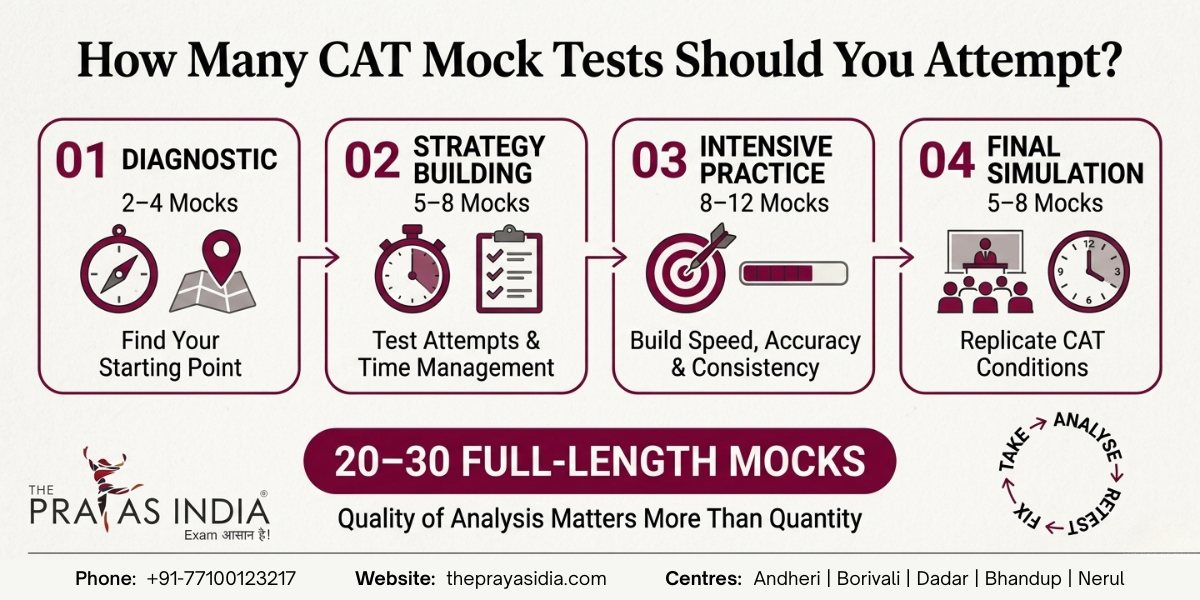
For most serious aspirants, around 20–30 well-planned full-length CAT mocks can be a useful target, provided they are supported by sectional tests, topic-wise practice and, most importantly, detailed analysis.
The number itself, however, is not the real objective.
The real objective is to make every mock help you become a better CAT test-taker.
If you are also considering structured guidance for CAT preparation, choosing the Best CAT Coaching in Mumbai can help you build this process systematically instead of taking mocks randomly and judging your preparation only by percentile.
CAT Preparation Does Not End With Syllabus Completion
One of the biggest misconceptions about CAT preparation is that finishing the syllabus means you are ready for the examination.
It doesn’t.
Suppose two students have completed the same Quant topics.
Both know arithmetic, algebra, geometry, numbers and modern mathematics. Both have solved a similar number of practice questions.
Yet, during a CAT mock:
- Student A identifies the easy questions quickly.
- Student B spends too much time on difficult questions.
- Student A knows when to leave a question.
- Student B keeps trying to force a solution.
- Student A maintains accuracy under time pressure.
- Student B makes avoidable mistakes.
- Student A changes strategy when a DILR set looks unproductive.
- Student B continues with the same set for 15–20 minutes.
Both students may have similar conceptual knowledge.
But their test-taking ability is different.
And CAT rewards not only what you know, but also how effectively you use what you know within a limited time.
That is why mock tests become increasingly important as you move towards the examination.
What Exactly Does a CAT Mock Test Teach You?
A good mock test can reveal things that ordinary practice sessions often hide.
When you solve questions chapter by chapter, you generally know what topic you are dealing with.
In the actual CAT, you don’t get that comfort.
You see a question and have to make several decisions almost immediately:
Should I attempt this?
Can I solve it quickly?
Is there a better question nearby?
Am I spending too much time here?
Should I leave this and return later?
These decisions are a major part of CAT preparation.
A mock test allows you to practise these decisions repeatedly.
A CAT mock can help you understand:
- Your natural solving speed
- Your accuracy under pressure
- Your strongest topics
- Your weakest topics
- Your ideal attempt strategy
- Your question-selection ability
- Your time-management problems
- Your tendency to make silly mistakes
- Your performance under pressure
- Your section-wise strengths and weaknesses
- Your ability to recover after a difficult question or section
This is why a mock should not be treated as a simple score-generating exercise.
It should be treated as a diagnostic tool.
So, How Many CAT Mock Tests Should You Attempt?
There is no magical number.
You will find students who take 50 mocks and still struggle to achieve their target percentile. You will also find students who take considerably fewer mocks but analyse them deeply and improve rapidly.
However, if you want a practical target for CAT preparation, 20–30 full-length mocks can be a strong range for many aspirants.
This should not be interpreted as:
“I have to complete exactly 30 mocks.”
Instead, think of it as a preparation framework.
A practical distribution could look like this:
| Preparation Stage | Suggested Full-Length Mocks | Main Objective |
|---|---|---|
| Initial/Diagnostic Stage | 2–4 | Understand your baseline |
| Strategy-Building Stage | 5–8 | Experiment with attempts & time |
| Intensive Practice | 8–12 | Improve consistency |
| Final Revision Stage | 5–8 | Simulate CAT conditions |
| Total | 20–30 | Build exam readiness |
The exact number can change depending on your preparation level.
An aspirant starting early may have enough time to complete more tests.
Someone beginning preparation later may need to prioritise quality over quantity.
The important thing is that your mock frequency should increase as your preparation becomes more mature.
Why 20–30 Mocks Can Be More Useful Than 50 Random Mocks
Imagine two CAT aspirants.
Aspirant A
Takes 40 mocks.
After every test:
- Checks percentile
- Looks at the score
- Feels happy or disappointed
- Starts the next mock
Aspirant B
Takes 25 mocks.
After every test:
- Reviews every incorrect question
- Checks questions that took too long
- Identifies easy questions that were missed
- Studies the reason behind mistakes
- Updates an error log
- Revises weak concepts
- Practises similar questions
- Changes strategy for the next mock
Who is more likely to improve?
In most cases, Aspirant B.
Because the second student is not simply accumulating tests.
They are accumulating learning from tests.
This distinction is extremely important.
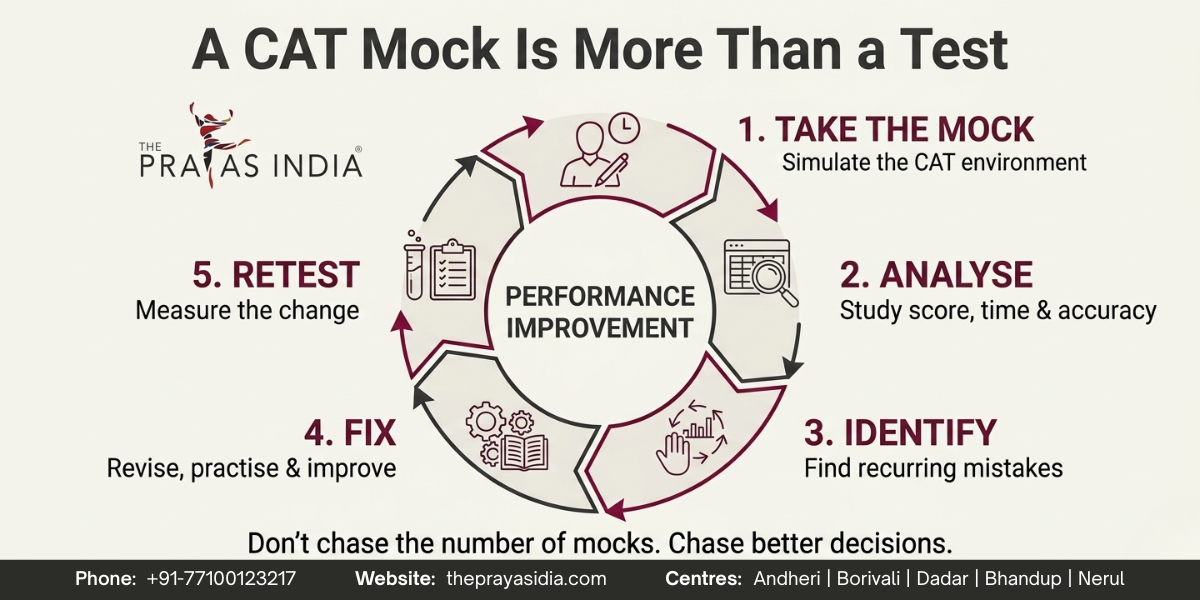
The right cycle is:
Mock → Analysis → Diagnosis → Correction → Practice → Retest
Not:
Mock → Score → Mock → Score → Mock → Score
The 4 Stages of CAT Mock-Test Preparation
Instead of randomly deciding how many tests to take every month, divide your mock preparation into stages.
This makes your preparation easier to manage and gives every test a specific purpose.
Stage 1: The Diagnostic Mock
Your first few mocks should answer a simple question:
“Where do I stand right now?”
Don’t worry if the first mock gives you a disappointing percentile.
In fact, an initial low score can be useful.
It tells you where the gaps are.
For example, your first mock might reveal:
VARC
- Good reading speed
- Poor accuracy in inference questions
DILR
- Good calculation ability
- Weak set selection
QA
- Strong arithmetic
- Weak algebra
- Slow calculations
This information is extremely valuable.
Without taking a mock, you may assume that your preparation is balanced.
The mock may tell you otherwise.
Your first mock is not a judgement.
It is a baseline.
Don’t make the mistake of comparing your first mock score with someone else’s final mock score.
Your objective at this stage is simply to understand your current position.
What Should You Analyse After Your First Mock?
Don’t stop at the overall percentile.
Record:
Overall Performance
- Total score
- Overall percentile
- Number of attempts
- Number of correct answers
- Number of incorrect answers
Section-Wise Performance
- VARC score
- DILR score
- QA score
- Sectional accuracy
- Sectional attempts
Time Management
- Time spent on each section
- Questions consuming excessive time
- Sections where you rushed towards the end
Question Selection
- Easy questions you missed
- Difficult questions you unnecessarily attempted
- Questions you should have skipped
This gives you a much clearer picture of your actual performance.
Stage 2: Building Your CAT Exam Strategy
Once you have taken your initial diagnostic mocks and developed reasonable conceptual familiarity, your next objective should be to build your examination strategy.
This is where you begin experimenting.
You may initially believe that attempting more questions is always better.
A mock may prove otherwise.
For example:
Strategy A
Attempt 18 questions in Quant
Accuracy: 72%
Strategy B
Attempt 14 questions in Quant
Accuracy: 90%
Depending on the questions and scoring, the second strategy may produce a much better result.
This is why CAT preparation cannot be reduced to:
“How many questions did you attempt?”
The more important question is:
“How many valuable questions did you attempt correctly?”
Don’t Copy Someone Else’s Mock Strategy
One of the biggest mistakes CAT aspirants make is blindly copying strategies from toppers, YouTube videos or social media.
You may hear:
“I attempted 20 questions in VARC.”
Or:
“I solved four DILR sets.”
Or:
“I attempted 18 questions in QA.”
That does not mean you should do the same.
Your ideal number of attempts depends on:
- Your accuracy
- Your speed
- Question difficulty
- Your strengths
- Your weaknesses
- Your risk-taking ability
- Your ability to identify easy questions
A good CAT strategy is personalised through repeated testing.
Mocks help you discover that strategy.
Stage 3: Turning Mocks Into Performance Training
Once you have taken around 6–10 full-length mocks, you should start seeing patterns.
Maybe you consistently:
- Start DILR with the wrong set
- Spend too long on difficult Quant questions
- Attempt VARC questions without sufficient evidence
- Make calculation mistakes in QA
- Lose concentration during the second half of a section
- Leave easy questions because of poor scanning
These are not isolated mistakes anymore.
They are patterns.
And patterns can be corrected.
At this stage, your mock preparation should become more targeted.
Instead of simply taking another test, ask:
“What specific problem am I trying to fix in the next mock?”
For example:
Mock 8 Goal: Improve DILR set selection.
Mock 9 Goal: Reduce unnecessary Quant time.
Mock 10 Goal: Improve VARC accuracy.
Mock 11 Goal: Maintain accuracy while increasing attempts.
This makes your mock preparation far more productive.
Stage 4: Full CAT Simulation
The final stage should focus on creating familiarity with the actual exam environment.
At this point, mocks should no longer be experiments every time.
Your basic strategy should already be established.
Now you need to test:
- Consistency
- Mental stamina
- Time discipline
- Accuracy
- Sectional execution
- Question selection
- Pressure management
Try to take your full-length mocks under conditions that closely resemble the actual examination.
That means:
Fixed time + Full duration + No distractions + No unnecessary breaks + Proper post-test analysis
The closer your mock environment is to the real examination, the less unfamiliar the actual CAT environment will feel.
The Final 60 Days: Your Mock Strategy Changes
The last two months should not look like the first two months of preparation.
Early in your CAT journey, the emphasis is largely on:
Learning → Understanding → Practising
As you approach the exam, the emphasis gradually changes to:
Testing → Analysing → Refining → Repeating
This is why the frequency of full-length mocks generally increases towards the end of preparation.
However, increasing frequency does not mean taking a mock every single day.
If you take a mock every day but don’t have enough time to analyse it, you may actually reduce the value of your preparation.
A Better Weekly Mock Routine
For a serious CAT aspirant in the final phase, a week could look something like this:
Monday
Concept revision + topic practice
Tuesday
Sectional tests + weak-area practice
Wednesday
Full-length CAT mock
Thursday
Detailed mock analysis
Friday
Error correction + targeted practice
Saturday
Sectional tests + revision
Sunday
Full-length mock or strategic revision
This is only a sample framework.
Your actual schedule should depend on your preparation level and available study time.
The important principle is:
A mock should create work for the next few days.
If your mock doesn’t tell you what to work on next, you probably haven’t analysed it deeply enough.
The Biggest Mistake: Treating Every Mock the Same
Not every mock has the same purpose.
Your first mock and your 25th mock should not be interpreted in exactly the same way.
Early mocks answer:
“What are my weaknesses?”
Middle-stage mocks answer:
“Which strategy works best for me?”
Later mocks answer:
“Can I execute my strategy consistently?”
Final mocks answer:
“Can I perform under realistic CAT conditions?”
This distinction can completely change how you look at mock tests.
A low score in your first diagnostic test may be useful.
A low score in your 20th mock may require a different kind of analysis.
The context matters.
Don’t Let One Bad Mock Destroy Your Confidence
CAT mock scores fluctuate.
This is normal.
One mock may have:
- A difficult DILR section
- Unfamiliar RC passages
- A Quant section that doesn’t suit your strengths
- A question distribution different from your expectations
You may therefore score significantly lower than your previous test.
That does not automatically mean your preparation has deteriorated.
Similarly, one unusually high score doesn’t mean you have permanently reached that level.
Instead of focusing on one score, look at your performance across multiple mocks.
Track the trend.
For example:
| Mock | Percentile |
|---|---|
| Mock 1 | 76 |
| Mock 5 | 82 |
| Mock 10 | 87 |
| Mock 15 | 91 |
| Mock 20 | 94 |
This upward movement is more meaningful than obsessing over whether Mock 20 gave you 93 or 94 percentile.
Your Mock Score Should Answer One Question
After every mock, ask:
“What will I do differently next time?”
If you don’t have a clear answer, the mock hasn’t completed its purpose.
Perhaps the answer is:
- I will leave lengthy Quant questions earlier.
- I will spend less time on the first DILR set.
- I will attempt fewer doubtful VARC questions.
- I will scan all Quant questions before committing.
- I will avoid guessing when I don’t have enough evidence.
- I will improve calculation speed.
- I will revise arithmetic before the next mock.
These small changes accumulate.
And over 15–20 mocks, they can make a significant difference to your performance.
Where CAT Coaching Becomes Valuable
Self-study can certainly be a major part of CAT preparation.
But one challenge many aspirants face is knowing what to do with the information generated by their mocks.
You may know that your DILR score is low.
But do you know why?
Is it:
- Conceptual weakness?
- Poor set selection?
- Slow calculations?
- Difficulty understanding the set?
- Spending too much time before moving on?
Similarly, if your Quant score is stagnant, simply taking more mocks may not solve the problem.
You may need targeted intervention.
This is where structured CAT coaching in Mumbai can make a difference.
The right coaching environment should not simply give you access to mock tests.
It should help you understand:
What your score means → Why you are losing marks → What you should fix → How you should practise → Whether the correction is working.
That is the difference between having a mock-test library and having a mock-test strategy.
How to Analyse CAT Mocks and Turn Them Into Score Improvement
Part 1 established an important point: 20–30 full-length CAT mocks can be a useful target, but the number of mocks alone does not determine your preparation quality.
The real advantage comes from what you do after submitting the mock.
A two-hour mock can potentially give you another two to three hours of useful preparation—if you analyse it properly.
Unfortunately, this is where many aspirants lose the opportunity.
They finish a mock, look at the percentile, compare it with their previous score, perhaps check a few solutions, and move on.
That approach makes mocks a testing activity.
A better approach makes them a learning activity.
Why CAT Mock Analysis Matters More Than Mock Count
Imagine that you repeatedly make the same mistake in Quant.
You know that calculation mistakes are hurting your score. You take another mock, make the same mistakes, take another one, and repeat the process.
After ten mocks, you have technically gained ten-test experience.
But you have not necessarily improved the underlying problem.
Now imagine a different approach.
After Mock 1, you notice that calculation errors are costing you 6–8 marks.
You identify the exact type of errors.
You practise those calculations for several days.
You take another mock.
The errors reduce.
You analyse the remaining mistakes.
You practise again.
Now the mock has actually changed your preparation.
That is the difference between taking mocks and using mocks.
The 4-Category CAT Mock Analysis Method
One of the simplest ways to analyse a mock is to divide your attempted and unattempted questions into four categories.
This gives you a much clearer picture than simply looking at the final score.
Category 1: Correct and Comfortable
These are questions you:
- Understood quickly
- Solved using the right approach
- Completed within reasonable time
- Answered correctly
These questions indicate areas where your preparation is working.
You don’t need to spend excessive time here.
However, continue maintaining these strengths.
The question to ask:
Can I maintain this accuracy under greater pressure?
Category 2: Correct but Too Slow
This category is extremely important.
Suppose you solved a Quant question correctly but spent four minutes on it.
The answer is correct.
Your score reflects that.
But the performance may still be inefficient.
Why?
Because those four minutes could potentially have been used on another question.
This becomes particularly important in CAT, where time is a limited resource.
A question doesn’t have to be wrong to be a problem.
Sometimes a correct answer obtained inefficiently is also a signal that your strategy needs improvement.
Ask yourself:
- Did I use the shortest approach?
- Could I have recognised the question type faster?
- Did I spend too much time on calculations?
- Did I continue solving after the question became unnecessarily lengthy?
- Could I have skipped it initially and returned later?
Over several mocks, these observations can help you identify questions that are technically within your capability but not necessarily worth your time during the exam.
Category 3: Wrong but Solvable
This is perhaps the highest-value category for score improvement.
These are questions where you had enough knowledge to solve the problem but still got the answer wrong.
For example:
- You misunderstood the question
- You made a calculation error
- You selected the wrong option
- You used the wrong formula
- You made an assumption that wasn’t justified
- You rushed through the final step
- You misread a condition
- You made an avoidable approximation
These aren’t necessarily knowledge gaps.
They are execution problems.
And execution problems can often be improved faster than completely new conceptual areas.
Category 4: Wrong and Conceptually Weak
These questions reveal genuine preparation gaps.
For example, you encounter an algebra question and realise that you don’t remember the underlying concept.
Or you face a geometry problem and don’t know which theorem or approach is applicable.
In such cases, simply looking at the solution is not enough.
You need to go back to the concept.
The correct process is:
Identify Concept Gap → Revise Concept → Solve Basic Questions → Solve CAT-Level Questions → Retest
Don’t turn every wrong answer into a long revision session.
First determine why the question went wrong.
The Question You Should Ask After Every Wrong Answer
Don’t simply ask:
“Why did I get this wrong?”
Ask a more specific question:
“What type of mistake was this?”
Was it:
Conceptual?
Calculation-based?
Reading-based?
Selection-based?
Time-management related?
Carelessness?
This classification is important because every type of mistake requires a different solution.
CAT Error Log: Your Most Underrated Preparation Tool
If you are taking 20–30 mocks, you will generate a large amount of information.
But information becomes useful only when you organise it.
This is why maintaining a CAT error log can be extremely useful.
It can be a simple notebook, spreadsheet or digital document.
You don’t need an elaborate system.
Create columns such as:
| Mock | Section | Topic | Mistake / Reason | Correct Approach | Action |
|---|---|---|---|---|---|
| 4 | QA | Arithmetic | Wrong Calculation | Recheck units | Practise |
| 5 | DILR | Arrangement | Wrong Set selection | Scan first | Improve selection |
| 6 | VARC | RC | Wrong Inference | Eliminate options | Practise RC |
| 7 | QA | Algebra | Slow Approach | Alternate method | Revise |
After 8–10 mocks, this log becomes extremely valuable.
You may discover that your mistakes aren’t random at all.
Perhaps 40% of your Quant errors come from just two topics.
Perhaps most of your VARC mistakes come from inference questions.
Perhaps your DILR problem is not solving ability but poor set selection.
Now you know exactly where to work.
Don’t Analyse Only the Questions You Got Wrong
This is another common mistake.
Aspirants often analyse:
Wrong → Solution → Understand → Move On
But that’s incomplete.
You should also analyse:
Questions you guessed correctly
A lucky correct answer should not be treated as a genuine strength.
If you guessed correctly, mark it.
Questions you skipped but could have solved
These may represent missed scoring opportunities.
Questions you solved correctly but took too long
These reveal efficiency issues.
Questions you changed from correct to incorrect
These can reveal decision-making problems.
Therefore, your analysis should go beyond wrong answers.
The “Missed Easy Question” Check
After every mock, perform one particularly important review:
How many easy or moderate questions did I leave?
This can be more useful than simply asking how many difficult questions you failed to solve.
Suppose your mock had:
- 8 easy QA questions
- You attempted 5
- You got all 5 correct
- You left 3
Your accuracy looks excellent.
But you may have lost potential marks because your scanning or question selection wasn’t efficient enough.
This is why attempt quality and attempt quantity need to be analysed together.
Section-Wise Mock Analysis: VARC
VARC often creates a different kind of challenge.
A student may know English well and still struggle to achieve a high VARC score.
Why?
Because CAT VARC is not simply testing vocabulary or grammar.
Reading comprehension requires:
- Interpretation
- Inference
- Understanding the author’s argument
- Identifying the central idea
- Distinguishing strong and weak options
- Avoiding assumptions
Your VARC mock analysis should therefore include more than accuracy.
Track Your RC Performance
For every RC passage, note:
- Time taken
- Questions attempted
- Questions correct
- Questions incorrect
- Questions left
- Type of questions causing mistakes
After several mocks, you may identify patterns.
For example:
Main Idea: Strong
Direct Questions: Strong
Inference: Weak
Tone: Average
Application: Weak
This is far more useful than simply writing:
“VARC = 82 percentile.”
Don’t Ignore Passage Selection
Another important VARC skill is deciding which passage to attempt first.
Suppose four RC passages appear.
You don’t necessarily have to start with the first one.
You need to quickly evaluate factors such as:
- Passage length
- Familiarity
- Complexity
- Density of information
- Question difficulty
- Reading comfort
Your mock tests should help you understand which types of passages work best for you.
This is something that cannot be developed entirely through untimed practice.
VARC Analysis Questions
After every mock, ask:
Reading
- Did I understand the passage correctly?
- Did I read too slowly?
- Did I lose concentration?
Questions
- Which question types caused errors?
- Did I eliminate options properly?
- Did I choose an option because it sounded right?
Strategy
- Was my passage order effective?
- Did I spend too much time on one passage?
- Did I attempt too many doubtful questions?
This level of analysis can gradually improve your VARC decision-making.
Section-Wise Mock Analysis: DILR
DILR requires a different mindset.
Many students assume their DILR performance depends entirely on solving ability.
But set selection can have a major impact.
Imagine you have four sets.
You spend 18 minutes on Set 1 and solve only one question.
Later, you realise Set 3 was significantly more approachable and could have given you four questions.
The problem wasn’t necessarily your DILR knowledge.
The problem was your decision-making.
This is exactly why DILR mocks should be analysed from two angles:
Can I solve the set?
and
Should I have selected this set?
The second question is often overlooked.
Build a DILR Set-Selection Record
After every mock, record:
| Set | Difficulty | Time Spent | Questions Solved | Outcome |
|---|---|---|---|---|
| Set 1 | Easy | 12 min | 4/4 | Good |
| Set 2 | Difficult | 18 min | 1/4 | Poor |
| Set 3 | Moderate | 10 min | 3/4 | Good |
| Set 4 | Difficult | 5 min | 0/4 | Correctly skipped |
After multiple mocks, you’ll begin to understand your own selection behaviour.
That is valuable CAT preparation.
DILR Analysis Should Focus on Decision-Making
Ask yourself:
- Did I scan all sets before committing?
- Did I identify the easiest set correctly?
- Did I leave an unproductive set quickly enough?
- Did I spend too much time setting up the arrangement?
- Was the set actually difficult, or did I approach it incorrectly?
- Could I have solved more questions if I had changed sets earlier?
Your objective is not necessarily to solve every set.
Your objective is to maximise marks from the available sets.
Section-Wise Mock Analysis: Quantitative Aptitude
QA analysis should focus on three major areas:
Concept
Did you know how to approach the question?
Speed
Could you solve it quickly enough?
Selection
Was it worth attempting?
A student may be conceptually strong but still underperform because they spend too much time on questions that don’t offer enough return.
For example:
You spend 5 minutes solving one difficult algebra question.
During that time, you could potentially have attempted two easier arithmetic questions.
This is where mock analysis teaches you something that topic-wise practice cannot:
CAT is not a chapter-completion competition.
It is a decision-making examination.
Create a QA Topic-Wise Performance Map
After several mocks, categorise your performance.
Arithmetic
- Percentage
- Profit & Loss
- Ratio
- Averages
- Time & Work
- Time, Speed & Distance
Algebra
- Equations
- Inequalities
- Functions
- Quadratic equations
- Progressions
Geometry
- Triangles
- Circles
- Coordinate geometry
- Mensuration
Number System
- Divisibility
- Factors
- Remainders
- Units digit
You don’t need to treat every topic equally.
If your mock analysis shows that Arithmetic consistently produces high accuracy, maintain it.
If Algebra repeatedly creates errors, allocate targeted revision time.
The 3 Numbers You Should Track After Every Mock
Instead of tracking dozens of metrics, start with three core numbers:
1. Accuracy
How many questions did you get right among those you attempted?
2. Attempts
How many questions did you actually attempt?
3. Productive Time
How much of your time was spent on questions that contributed positively to your score?
Together, these numbers provide a more useful picture than percentile alone.
A student with high accuracy but very low attempts may need to improve speed and selection.
A student with high attempts but poor accuracy may need to control risk and improve question selection.
A student with both reasonable attempts and accuracy but poor scores in one section may have a specific sectional weakness.
Don’t Make the Percentile Your Only Goal
Percentile is obviously important.
Ultimately, CAT is a competitive examination and your percentile matters for admissions.
But during preparation, percentile should be treated as an outcome, not the only metric you monitor.
Suppose your percentile stays at around 90 for three mocks.
At first glance, you may think:
“I am not improving.”
But suppose your analysis shows:
- Accuracy improved from 70% to 82%
- Silly mistakes decreased
- DILR selection improved
- QA time reduced
- VARC attempts became more controlled
These are positive changes.
Your score may catch up as these improvements compound.
This is why you need to track leading indicators, not only the final percentile.
When Should You Take Sectional Tests?
Full-length mocks aren’t the only tests you need.
Sectional tests can be extremely useful between full-length mocks.
They allow you to isolate a specific problem.
For example, if your VARC performance is inconsistent, taking another full mock may not be the most efficient solution.
Instead, you can take several VARC sectionals and analyse:
- RC selection
- Reading speed
- Accuracy
- Question-type performance
The same principle applies to DILR and QA.
Full-Length Mocks vs Sectional Tests
| Test Type | Main Purpose |
|---|---|
| Topic Test | Build conceptual mastery |
| Sectional Test | Improve section-specific performance |
| Full-Length Mock | Test complete exam strategy |
| Previous CAT Paper | Understand real exam patterns |
| Revision Test | Check retention |
A strong CAT preparation plan uses all of these at the appropriate stage.
Don’t expect full-length mocks to fix every conceptual weakness.
That’s not their primary purpose.
A Practical Testing Ratio
As your preparation progresses, your testing mix can gradually change.
Early Stage
More focus on:
Topic Practice + Sectionals
Middle Stage
A balance of:
Topic Practice + Sectionals + Full Mocks
Final Stage
More emphasis on:
Full Mocks + Sectionals + Error Revision
The closer you get to CAT, the more important complete exam simulation becomes.
How Much Time Should You Spend Analysing a CAT Mock?
There is no fixed rule.
But during the learning phase, spending at least as much time analysing the mock as taking it is a useful benchmark.
If your test lasts two hours, don’t expect meaningful analysis to take 15 minutes.
A detailed review might take two hours or more.
You should ideally review:
- Incorrect questions
- Guessed questions
- Time-consuming questions
- Easy questions you missed
- Questions you should have skipped
- Sectional strategy
- Time allocation
- Recurring mistakes
The purpose is not to solve every question from the mock again.
The purpose is to understand what the mock is telling you about your preparation.
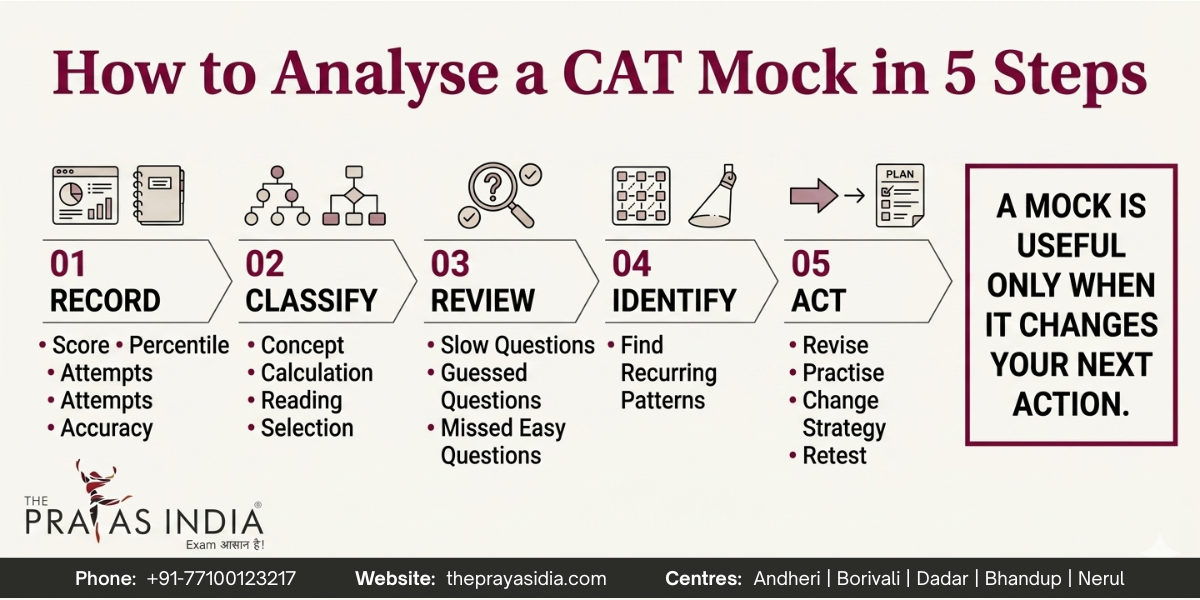
A Simple 5-Step Mock Analysis Process
After submitting a CAT mock, follow this sequence.
Step 1: Record Your Performance
Write down:
Score + Percentile + Attempts + Accuracy + Sectional Scores
Do this immediately.
Step 2: Analyse Incorrect Questions
Classify every major mistake.
Concept / Calculation / Reading / Selection / Time
Step 3: Analyse Slow Questions
Find questions where you spent significantly more time than they deserved.
Step 4: Identify Missed Opportunities
Check easy and moderate questions you could have attempted.
Step 5: Create Your Next Action Plan
Write down 3–5 specific actions for the next preparation cycle.
This final step is crucial.
Don’t create a list of 25 things.
Pick the most important issues.
Common CAT Mock-Test Mistakes to Avoid
Even students who take a good number of mocks can make these mistakes.
1. Taking Mocks Without Analysing Them
This is the biggest one.
If you don’t analyse, you are missing the primary learning opportunity.
2. Taking a Mock Every Day
More isn’t always better.
If daily mocks leave no time for:
- Revision
- Concept correction
- Error analysis
- Targeted practice
then your mock frequency is too high.
3. Obsessing Over Percentile
A single mock does not define your CAT potential.
Look at the trend.
4. Comparing Your Mock Scores With Others
Different test series can have different difficulty levels.
Your preparation should be measured primarily against your own performance trend.
5. Ignoring Sectional Performance
A strong overall score doesn’t automatically mean your preparation is balanced.
Track VARC, DILR and QA independently.
6. Solving Every Difficult Question After the Mock
You don’t need to master every difficult question immediately.
Prioritise:
- Solvable mistakes
- Recurring mistakes
- Important weak concepts
- Questions that expose strategic errors
The Real Purpose of 20–30 CAT Mocks
By the time you complete 20–30 serious mocks, you should ideally know much more than your average percentile.
You should know:
Your Strengths
Which topics and question types consistently give you marks?
Your Weaknesses
Where are you repeatedly losing marks?
Your Attempt Strategy
How many questions can you realistically attempt with good accuracy?
Your Sectional Strategy
Which section needs the most attention?
Your Time Management
Where do you waste time?
Your Decision-Making
When should you attempt, skip or move on?
Your Error Patterns
Which mistakes keep returning?
Your Exam Temperament
How do you respond when a section becomes unexpectedly difficult?
That is the real value of repeated mock testing.
Choosing the Right CAT Coaching in Mumbai
For students searching for the Best CAT Coaching in Mumbai, mock-test quality should be one of the factors they evaluate.
But don’t stop at asking:
“How many mocks are included?”
Ask better questions:
- Are the mocks aligned with the CAT pattern?
- Are there sectional tests?
- Is detailed performance analysis available?
- Can students identify topic-wise weaknesses?
- Is there guidance on test-taking strategy?
- Are doubts addressed?
- Is there mentor support?
- Does the institute help students interpret mock performance?
- Is there a structured schedule leading up to CAT?
A large test library sounds impressive.
But what matters is whether the system helps you convert test performance into improvement.
This is an important distinction when comparing CAT coaching institutes in Mumbai.
How The Prayas India Fits Into This Preparation Approach
For an aspirant, joining a CAT coaching institute should not simply mean attending classes and completing study material.
The preparation should work as a connected system:
Learn the Concept
↓
Practise the Concept
↓
Take a Sectional
↓
Take a Full-Length Mock
↓
Analyse Performance
↓
Identify Weaknesses
↓
Work on the Weakness
↓
Retest
This is the kind of structured preparation that can make mock tests meaningful.
For students looking for CAT coaching in Mumbai, The Prayas India can be positioned not merely as a place to access study resources, but as a preparation ecosystem where concept building, practice, testing and performance improvement work together.
Key Takeaway
The biggest lesson from CAT mock preparation is simple:
Your mock score tells you where you are. Your mock analysis tells you how to move forward.
Taking 20–30 mocks can provide extensive exam exposure, but only if you use the information generated by those tests.
Don’t ask only:
“What percentile did I get?”
Also ask:
“Where did I lose marks?”
“Which mistakes are repeating?”
“Which questions did I miss?”
“Where did I waste time?”
“What will I change before my next mock?”
That is how mock tests gradually transform from practice papers into a personal CAT performance-improvement system.
Final 60-Day CAT Mock Strategy, Exam Simulation & Choosing the Right Coaching
By now, you should have a clear understanding of one important principle:
CAT mock tests are not meant to measure your preparation only. They are meant to improve it.
The first few mocks help you understand where you stand. The next set helps you develop your strategy. Later mocks help you refine your speed, accuracy and decision-making.
But the final phase is different.
As CAT gets closer, your objective should gradually move from learning how to take the test to executing your strategy consistently under pressure.
This is where your mock-test plan can make a major difference.
How Many Mocks Should You Take in the Last 60 Days?
There is no need to take a full-length mock every day.
A practical target for the final 60 days can be around 10–15 full-length mocks, depending on your preparation level and the time you can dedicate to analysis.
The important point is that these should be accompanied by:
- Sectional tests
- Error-log revision
- Topic-wise practice
- Previous CAT questions
- Concept revision
- Detailed mock analysis
A student who takes 12 mocks and analyses every one carefully can potentially benefit more than someone who takes 25 mocks without correcting recurring mistakes.
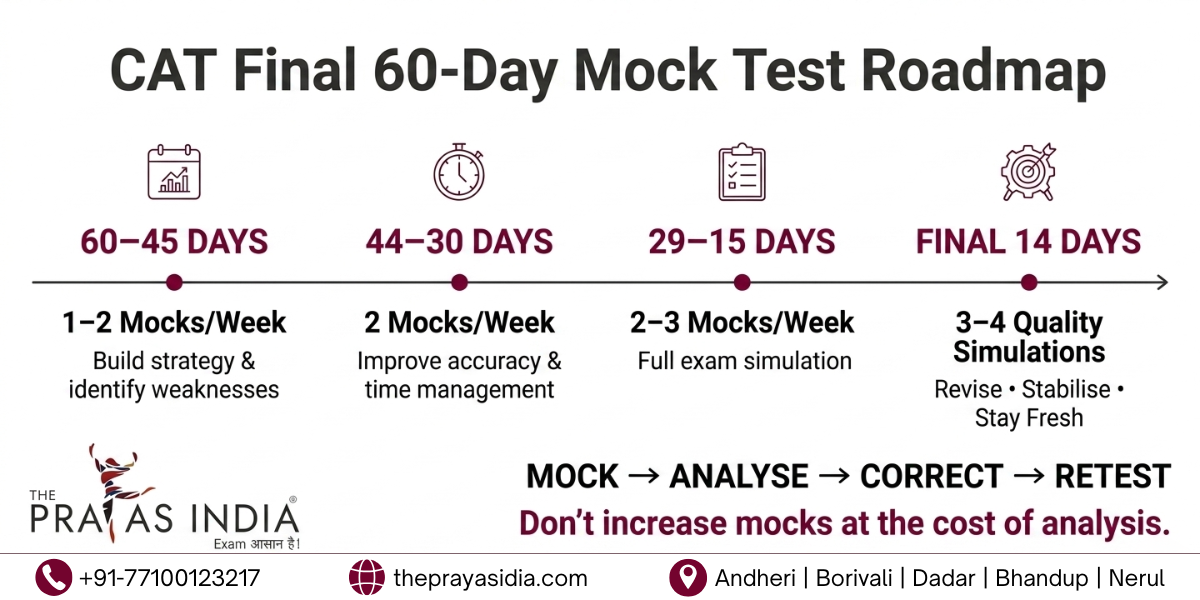
A possible final-60-day structure:
Days 60–45: 1–2 mocks per week
Days 44–30: 2 mocks per week
Days 29–15: 2–3 mocks per week
Final 14 days: 3–4 carefully selected simulations + revision
This is a framework rather than a rigid rule.
If your mock analysis is taking substantial time, reduce the number rather than sacrificing analysis.
The Final 60 Days Should Have One Clear Objective
At this stage, you should not keep changing everything.
You should be asking:
“What can I improve without disturbing what is already working?”
For example, if your VARC strategy has been consistently producing good results, don’t completely change it because of one bad mock.
If your DILR selection strategy is working, continue refining it.
If your Quant attempts are stable but accuracy needs improvement, focus on accuracy rather than suddenly trying to double your attempts.
The final phase should be about refinement, not experimentation without evidence.
A Practical 60-Day CAT Mock Plan
Days 60–45: Build Stability
At around two months before CAT, you should have enough preparation to start taking full-length tests regularly.
Target:
1–2 full-length mocks per week
Your focus should be:
- Finding your ideal attempts
- Testing section order and question selection
- Identifying weak areas
- Reducing silly mistakes
- Improving time management
Don’t worry if your scores fluctuate.
At this stage, you’re still building consistency.
Days 44–30: Increase Testing Intensity
As you enter the next phase, increase the frequency.
Target:
2 full-length mocks per week
Between these mocks, spend time on:
- Mock analysis
- Error correction
- Weak-topic revision
- Sectional practice
- Previous CAT questions
The objective is to make measurable improvements between tests.
If Mock 12 exposes a weakness, Mock 13 should give you an opportunity to test whether you fixed it.
Days 29–15: Shift Towards Exam Simulation
This is the phase where your mocks should start feeling like actual CAT attempts.
Target:
2–3 full-length mocks per week
But don’t simply increase the number.
Increase the seriousness of the simulation.
Take your mocks:
- At a fixed time
- At a proper desk
- Without your phone
- Without interruptions
- Without unnecessary breaks
- With the complete test duration
- Under realistic exam conditions
Your brain should gradually become comfortable with sitting through the entire examination and making decisions under pressure.
Final 14 Days: Don’t Overdo It
The last two weeks are not the time to prove that you can take five mocks in seven days.
Your preparation should become more controlled.
Target:
3–4 high-quality full-length simulations, depending on your readiness.
The remaining time should go towards:
- Error-log revision
- Formula revision
- Important concepts
- Previous mistakes
- Sectional practice
- Reading
- Mental preparation
- Sleep and routine
A mock taken one day before CAT is not automatically more useful than a mock taken three days before CAT.
Your goal is to enter the examination with a fresh mind and a tested strategy.
Should You Take a Mock Every Day?
For most students, no.
A full-length mock takes roughly two hours, but its real preparation cost is much higher.
You also need time for:
- Reviewing answers
- Analysing mistakes
- Revising concepts
- Practising weak areas
- Recovering mentally
- Preparing for the next test
If you take a mock every day, you may end up with a situation where your entire preparation becomes:
Test → Test → Test → Test
without enough time for improvement.
Remember:
A mock measures performance.
Practice changes performance.
You need both.
What Should You Do Between Two CAT Mocks?
The days between two mocks are where much of your improvement happens.
Suppose you took a mock on Wednesday.
Don’t immediately take another full mock on Thursday.
Instead, use Thursday for analysis.
Thursday
Deep Mock Analysis
Identify:
- Incorrect questions
- Slow questions
- Missed easy questions
- Conceptual gaps
- Strategy problems
Friday
Weakness Correction
Revise the concepts behind recurring mistakes.
Saturday
Targeted Practice
Solve questions specifically related to those weaknesses.
Sunday
Sectional Test / Full Mock
Test whether your correction is working.
This creates a closed improvement loop.
The “3 Mistakes Rule”
After each mock, identify the three most important mistakes that cost you marks.
Don’t create an endless list.
For example:
Mock 15
Mistake 1: Spent too long on DILR Set 2.
Mistake 2: Made three calculation errors in QA.
Mistake 3: Attempted two doubtful VARC questions.
Your next preparation cycle should directly address these three problems.
Then take another mock.
If those mistakes reduce, you’ve made progress.
What If Your Mock Score Suddenly Drops?
This happens.
And it can be psychologically difficult.
Suppose your recent scores were:
92 → 94 → 95 → 90
You may immediately think:
“My preparation is going backwards.”
Not necessarily.
Before changing your entire strategy, analyse the test.
Ask:
- Was the mock significantly harder?
- Did one section perform unusually poorly?
- Were your mistakes conceptual or careless?
- Did you mismanage time?
- Did you make poor set selections?
- Was your score affected by a small number of mistakes?
One low mock should not force a complete strategy change.
Look for patterns across multiple tests.
What If Your Mock Score Suddenly Increases?
The same principle applies here.
Suppose you jump from 91 percentile to 97 percentile.
Celebrate the improvement, but don’t assume the new score is automatically your permanent level.
Analyse what happened.
Did:
- Your accuracy improve?
- You select better DILR sets?
- The paper suit your strengths?
- You attempt fewer risky questions?
- Your time management improve?
If you can identify the reason behind the improvement, you can try to reproduce it.
Your Average Mock Performance Matters More
Instead of obsessing over your highest mock percentile, track your recent average or trend.
For example:
| Mock | Percentile |
|---|---|
| 16 | 91 |
| 17 | 93 |
| 18 | 90 |
| 19 | 94 |
| 20 | 95 |
Your average performance is more meaningful than simply saying:
“My highest score is 95.”
The goal is to make your performance stable.
In the actual CAT, you get one paper.
You don’t get five attempts and choose your best one.
Therefore, consistency matters.
The Importance of Previous CAT Questions
Mock tests should not completely replace previous CAT questions.
Actual CAT questions help you understand the examination’s real language, reasoning style and difficulty patterns.
Use previous-year questions to complement your mock preparation.
A good sequence can be:
Concept → Topic Practice → Previous CAT Questions → Sectional → Full Mock
This gives you multiple layers of preparation.
Don’t Forget Sectional Cut-Offs
A strong overall score is important, but aspirants should also pay attention to sectional performance.
It is possible to perform strongly in two sections and struggle badly in the third.
Your mock analysis should therefore track:
VARC
Score + Percentile + Accuracy
DILR
Score + Percentile + Set Selection
QA
Score + Percentile + Attempts
Don’t allow a consistently weak section to remain hidden behind a strong overall score.
How Coaching Can Make Mock Preparation More Structured
For an aspirant preparing independently, one of the biggest challenges is knowing whether a problem should be solved through:
- More practice
- Concept revision
- Strategy correction
- Time management
- Better question selection
- Mentorship
Sometimes students react to every bad mock by simply studying more.
But more study is not always the answer.
If your concept is strong but your question selection is poor, another three hours of theory may not solve the problem.
If your DILR knowledge is adequate but you keep choosing the wrong sets, you need strategic practice.
If your VARC accuracy is good but your attempts are too low, your problem may be speed and confidence rather than comprehension.
This is where structured guidance can save valuable preparation time.
What to Look for in the Best CAT Coaching in Mumbai
If you are comparing CAT coaching institutes, don’t make the decision solely on brand visibility or the number of advertisements you see.
Look at the preparation ecosystem.
A serious CAT aspirant should evaluate:
1. Faculty Quality
Do the teachers explain not only concepts but also how those concepts are applied in CAT?
2. Study Material
Is the material organised according to the CAT preparation journey?
3. Mock Tests
Are full-length and sectional tests available?
4. Mock Analysis
Does the system help you understand your performance?
5. Doubt Support
Can you get questions and concepts clarified?
6. Strategy Guidance
Are students guided on time management, attempts and question selection?
7. Personal Attention
Can your weaknesses be identified rather than treating every student the same?
8. Admission Orientation
Does the preparation also help you understand the larger MBA admission journey beyond simply appearing for CAT?
These factors are far more meaningful than simply asking:
“How many tests do I get?”
Why The Prayas India for CAT Preparation?
For students looking for Best CAT Coaching in Mumbai, The Prayas India can be considered as a structured preparation option for aspirants who want to combine:
Concept Clarity + Practice + Mock Tests + Analysis + Strategy
The goal should not be to overwhelm students with unlimited material.
It should be to help them use the right resources at the right stage.
A structured CAT preparation journey can look like:
Learn
Build concepts in VARC, DILR and QA.
↓
Practise
Move from basic questions towards CAT-level application.
↓
Test
Use sectional tests and full-length mocks.
↓
Analyse
Understand exactly where marks are being lost.
↓
Improve
Work on the specific weakness.
↓
Retest
Check whether the correction has actually improved performance.
This creates a more disciplined preparation cycle.
CAT Mock Test Checklist
Before every full-length mock, ask yourself:
Before the Mock
☐ Am I taking this test at a fixed time?
☐ Is my phone away?
☐ Do I have a quiet environment?
☐ Am I mentally prepared to complete the entire test?
☐ Do I have a specific objective for this mock?
During the Mock
☐ Am I scanning questions properly?
☐ Am I spending too much time on one question?
☐ Am I making emotional decisions after a difficult question?
☐ Am I maintaining accuracy?
☐ Am I following my tested strategy?
After the Mock
☐ Did I record my score?
☐ Did I analyse every incorrect answer?
☐ Did I check slow questions?
☐ Did I identify missed easy questions?
☐ Did I update my error log?
☐ Did I identify my top three mistakes?
☐ Do I know what I will change next time?
If you can consistently follow this process, your mocks become a structured component of your CAT preparation rather than another task on your checklist.
How Many Mocks Are Enough, Ultimately?
Let’s return to the original question.
How many CAT mock tests should you attempt before the exam?
For many aspirants, 20–30 full-length mocks is a sensible overall target.
But the number should be adjusted according to:
- Your preparation stage
- Time available
- Mock-analysis quality
- Weaknesses
- Sectional performance
- Overall consistency
Someone may benefit greatly from 20 mocks.
Another aspirant may need more.
Another may need fewer because they are spending significant time on concept correction and previous-year questions.
There is no medal for completing the highest number of mocks.
The goal is to enter CAT with:
A tested strategy
Strong question-selection ability
Reliable accuracy
Controlled time management
Sectional confidence
Familiarity with pressure
That is what your mock preparation should ultimately produce.
Final Takeaway
CAT is not won by knowing how to solve every question.
It is won by making better decisions with limited time.
You need to know:
- Which questions to attempt
- Which questions to skip
- When to move on
- Where you are strongest
- Where you need improvement
- How much risk you can take
- How to maintain accuracy under pressure
Mock tests give you the environment to practise these decisions.
But the real learning happens during analysis.
So instead of asking:
“How many CAT mocks should I take?”
ask:
“How much better can I become after every mock?”
If every test helps you correct one recurring mistake, improve one section, refine one strategy or make one better decision, your mock preparation is working.
For aspirants targeting top MBA institutes and looking for CAT coaching in Mumbai, the right preparation ecosystem can make this process more structured by combining classroom learning, practice, testing, analysis and strategy.
The Prayas India aims to help CAT aspirants approach the examination with a structured preparation plan rather than relying on random practice or last-minute preparation.
Prepare Smart. Test Regularly. Analyse Deeply. Improve Consistently.
Frequently Asked Questions
1. How many CAT mock tests should I attempt before CAT?
For many serious aspirants, 20–30 full-length CAT mocks can be a useful target. However, the ideal number depends on your preparation level, available time and the quality of analysis you perform after every test.
2. Is 20 CAT mocks enough?
Yes, 20 well-analysed mocks can be sufficient for many students if they are combined with sectional tests, previous CAT questions, revision and targeted practice.
3. Should I take CAT mocks every day?
Not necessarily. Taking too many mocks without enough analysis can reduce their value. It is better to maintain a sustainable frequency and use the time between tests to correct weaknesses.
4. When should I start taking full-length CAT mocks?
You can begin with diagnostic mocks once you have reasonable familiarity with the syllabus. As your preparation progresses, increase the frequency of full-length tests.
5. How should I analyse a CAT mock?
Review incorrect answers, slow questions, guessed questions and easy questions you missed. Classify mistakes into conceptual, calculation, reading, selection and time-management issues, then create a specific action plan.
6. Are CAT sectional tests necessary?
Yes. Sectional tests help isolate problems in VARC, DILR or QA and allow you to work on specific weaknesses without waiting for another full-length mock.
7. What should I do if my CAT mock score keeps fluctuating?
Don’t react to one score. Look at the trend across several mocks and analyse whether fluctuations are caused by difficulty, accuracy, question selection, time management or conceptual gaps.
8. What makes a good CAT mock?
A useful mock should provide a realistic CAT-style experience and allow you to evaluate attempts, accuracy, time management, sectional performance and question selection.
Planning to prepare for CAT with a structured strategy? Explore The Prayas India’s CAT preparation programme and take the next step towards your MBA goal.
Contact Us
- 📞 Call: +91-77100 13217
- 🌐 Website: https://theprayasindia.com
- 📍 Centres: Andheri | Borivali | Dadar | Nerul | Bhandup