How Many DILR Sets Should You Practise Before CAT 2026? | Best CAT Coaching in Mumbai | The Prayas India
Preparing for CAT DILR is not simply about solving as many sets as possible. While practice volume matters, the quality, variety and analysis of those sets matter even more.
One of the most common questions among CAT 2026 aspirants is:
How many DILR sets should I practise before CAT 2026?
You will find different answers everywhere. Some students target 200 sets, others aim for 300 or more, while some focus on solving a fixed number of sets every day.
But there is no universal number that guarantees a strong DILR score.
A student who solves 150 carefully selected and properly analysed sets may develop better DILR skills than someone who solves 300 sets casually.
For CAT 2026, the better question is:
How many sets can you solve, analyse, revisit and learn from effectively?
That is the approach this article will focus on.
Why the Number of DILR Sets Is Not the Only Goal
DILR is different from a section where simply memorising more concepts automatically improves your score.
It tests your ability to:
- Understand unfamiliar information
- Identify relationships
- Structure data
- Recognise patterns
- Make logical deductions
- Decide where to begin
- Manage multiple possibilities
- Work under time pressure
These abilities develop through repeated exposure to different types of problems.
However, simply completing a large number of sets does not guarantee that these skills will improve.
Consider two preparation styles.
Student A
Solves 8–10 sets every week but rarely reviews mistakes.
Student B
Solves 5–6 sets every week, but after every set analyses:
- Why the approach worked
- Where the difficulty came from
- Which information was important
- Where the solution became clear
- Whether another approach was possible
- How much time was spent
Student B may initially solve fewer sets, but the learning per set can be significantly higher.
This is why CAT DILR preparation should follow:
Practice + Analysis + Repetition
rather than:
Practice + Practice + Practice
Start With a Preparation Phase, Not a Set Target
Before deciding how many DILR sets to solve, identify your current preparation stage.
A practical CAT 2026 DILR journey can be divided into four phases:
Phase 1: Familiarisation
Understand different DILR structures and learn how information can be represented.
Phase 2: Skill Building
Practise different types of sets and develop systematic solving methods.
Phase 3: Advanced Practice
Move towards unfamiliar, CAT-level and time-bound sets.
Phase 4: Exam Simulation
Use sectional tests and full-length CAT mocks to practise selection and execution.
The number of sets you solve can increase or decrease depending on the phase.
The objective should always remain the same:
Become better at solving unfamiliar DILR sets under pressure.
Phase 1: Build Familiarity With Different DILR Structures
If you are starting your CAT 2026 preparation, don’t immediately focus on difficult sets.
Your first objective should be exposure.
You should become comfortable seeing different kinds of information.
Your practice may include:
- Arrangements
- Distribution
- Selection
- Scheduling
- Games and tournaments
- Tables
- Networks
- Routes
- Ranking
- Venn-based problems
- Caselets
- Data-based reasoning
- Combination-based sets
The objective isn’t to memorise a formula for every category.
Instead, you should gradually develop the ability to look at a new set and think:
“How can I organise this information?”
That is one of the most important DILR skills.
A difficult-looking set often becomes manageable once its information is represented correctly.
How Many Sets Should You Solve in the Foundation Stage?
There is no need to chase an aggressive target at the beginning.
A practical starting point could be around:
40–60 quality sets
The important word here is quality.
These sets should provide variety rather than repeated versions of exactly the same problem.
For example, solving 20 similar arrangement sets may not be as useful as solving a balanced collection involving arrangements, distribution, games, tables, networks and other structures.
At this stage, focus on:
Understanding > Speed
Don’t worry if a set takes longer than expected.
First learn how to approach it.
Speed can be developed later.
Phase 2: Move From Familiarity to Skill Building
Once you are comfortable with different DILR structures, your practice should become more systematic.
Now the question changes from:
“What type of set is this?”
to:
“What is the most efficient way to solve this set?”
This stage should involve a mixture of moderate and CAT-level sets.
A reasonable target could be around:
50–70 quality sets
But again, this isn’t a compulsory number.
The real objective is to develop four abilities:
1. Representation
Can you convert the information into a table, diagram, arrangement, chart or another useful structure?
2. Starting Point
Can you identify the first useful deduction?
3. Logical Progression
Can one deduction lead naturally to another?
4. Efficiency
Can you avoid unnecessary calculations or repeated cases?
The stronger these skills become, the less intimidating unfamiliar DILR sets will feel.
Quality Matters More Than Raw Set Count
Suppose an aspirant has completed 100 DILR sets.
That sounds impressive.
But what if:
- 30 were solved without analysis?
- 20 were very similar sets?
- 15 were abandoned halfway?
- Mistakes were never recorded?
- Difficult sets were never revisited?
The number 100 doesn’t tell us much.
A better measurement would be:
How many sets did you genuinely learn from?
After solving an important set, ask:
Did I understand the structure?
If not, revisit the representation.
Did I identify the key deduction?
If not, study the solution carefully.
Did I understand where I got stuck?
If not, record the exact problem.
Could I solve it faster now?
If not, try it again later.
This process turns ordinary practice into skill-building.
A Useful Long-Term Target: 150–250 Quality Sets
For a serious CAT 2026 aspirant preparing consistently over a reasonable period, a broad target of around:
150–250 quality DILR sets
can provide useful exposure to different structures and difficulty levels.
But this should be treated as a planning range, not a magic number.
You may need fewer if your DILR fundamentals are already strong.
You may need more if you’re starting from a weaker base or need extensive exposure to unfamiliar set structures.
A possible distribution could look like:
| Preparation Stage | Approx. Quality Sets |
|---|---|
| Foundation | 40–60 |
| Skill Building | 50–70 |
| Advanced Practice | 40–60 |
| Mock-Based Practice | 20–40 |
These stages can overlap.
For example, mock-based practice will naturally introduce additional DILR sets, while difficult sets from earlier stages may be revisited.
The important point is not to obsess over reaching exactly 250.
Instead, use the range to create a realistic preparation framework.
Don’t Practise Only the Sets You Like
A common mistake in DILR preparation is repeatedly solving familiar set types.
If you are good at arrangements, you may naturally choose more arrangement-based sets.
If tables are comfortable, you may keep practising tables.
This creates confidence, but it may not create versatility.
CAT can present unfamiliar structures.
Your preparation should therefore expose you to different types of logical situations.
You should be comfortable with:
Familiar Sets
and
Unfamiliar Sets
The second category is particularly important.
The real CAT challenge is not always:
“Can you solve this type of question?”
It can be:
“Can you figure out how to approach something you haven’t seen before?”
That ability develops through variety.
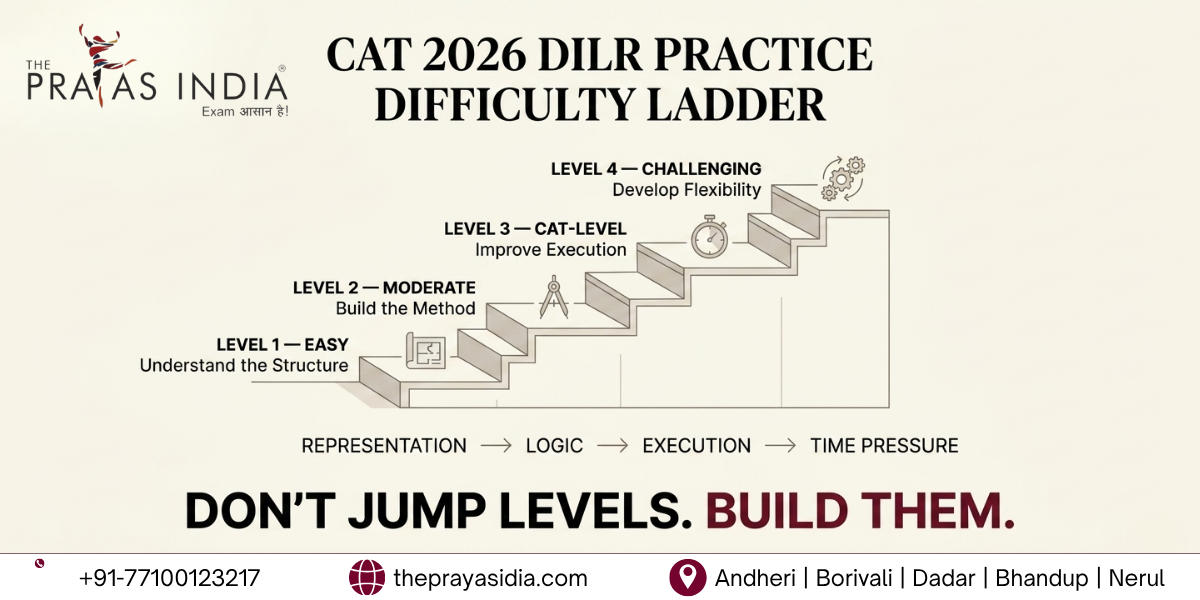
Build a Difficulty Ladder Instead of Random Practice
Your practice should gradually become harder.
A useful progression is:
Easy
↓
Moderate
↓
CAT-Level
↓
Challenging
Easy sets help you understand the fundamentals.
Moderate sets develop your solving process.
CAT-level sets build exam-relevant ability.
Challenging sets develop flexibility and help you become comfortable with uncertainty.
But don’t spend most of your preparation trying to conquer extremely difficult sets.
The CAT rewards smart selection and effective execution, not the ability to solve every difficult set you encounter.
Your DILR Set Diary Can Become a Powerful Revision Tool
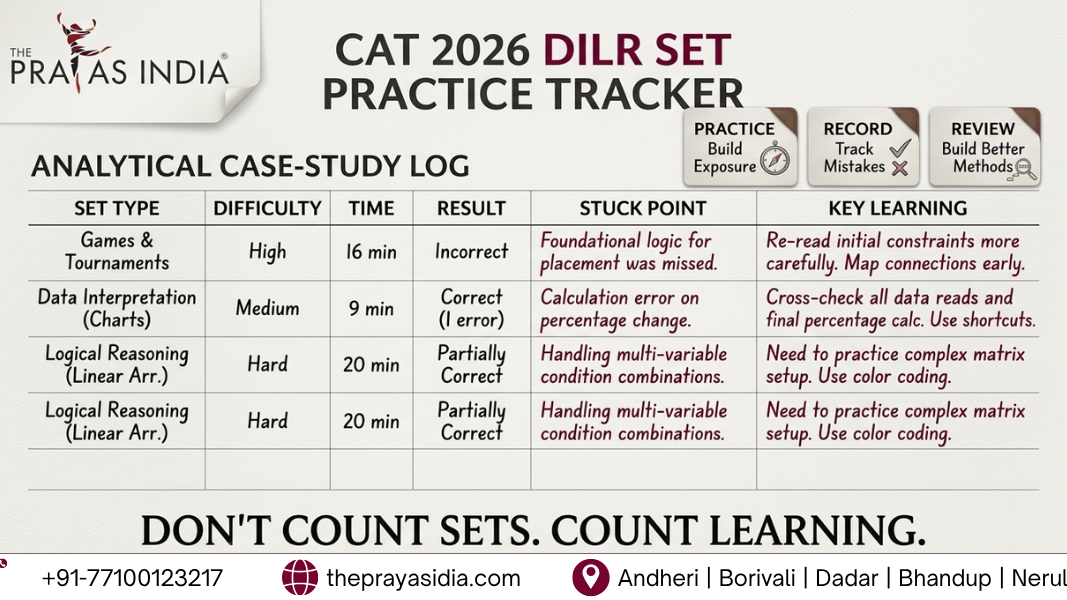
One of the simplest ways to improve the quality of your practice is to maintain a DILR Set Diary.
After solving a useful set, record:
- Set type
- Difficulty
- Time taken
- Solved / Unsolved
- Where you got stuck
- Best representation
- Key deduction
- Alternative approach
- Main learning
For example:
Set Type: Games & Tournament
Difficulty: Moderate
Time: 16 minutes
Result: Solved
Problem: Spent too much time building unnecessary cases
Learning: Establish fixed information first before branching into possibilities
This takes only a few minutes.
But after several months of preparation, your diary can reveal patterns in your thinking.
You may discover that you repeatedly:
- Miss important conditions
- Start with the wrong variable
- Create unnecessary cases
- Spend too long calculating
- Fail to identify a shortcut
That information is far more useful than simply knowing how many sets you completed.
The Right Question to Ask After Every Set
Instead of asking only:
“Did I solve it?”
ask five questions:
1. How did I start?
Was the starting point logical?
2. What was the key breakthrough?
Which observation made the set easier?
3. Where did I lose time?
Was it representation, calculation or reasoning?
4. Was there a better approach?
Could the same information have been organised more efficiently?
5. Can I recognise this structure next time?
This final question is particularly important.
The purpose of repeated practice is to make patterns easier to recognise.
You don’t want every new DILR set to feel completely new.
You want your brain to gradually recognise structures, relationships and possible approaches.
Don’t Be Afraid to Reattempt Difficult Sets
A set you couldn’t solve today can become one of your most valuable practice resources.
If you immediately look at the solution and move on, you may understand the answer but not necessarily develop the ability to find it yourself.
Instead:
Attempt → Identify the block → Study the solution → Close it → Reattempt
When you return to the set later, try solving it again without assistance.
If your second attempt is significantly better, you have converted a difficult question into a learning experience.
This is one reason why a smaller number of well-analysed sets can be more valuable than constantly chasing new questions.
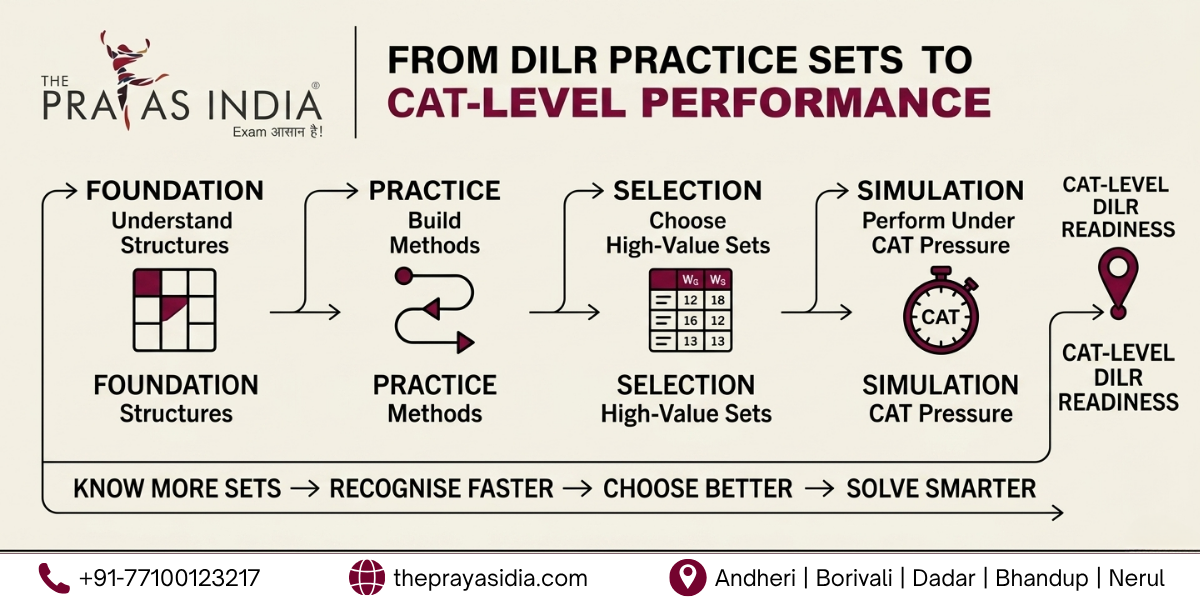
From Practice to CAT-Level Performance
The first stage of DILR preparation is about building exposure and understanding different set structures.
But eventually, practice has to move beyond simply solving sets at your own pace.
CAT DILR is a time-bound decision-making section. You need to decide which set deserves your time, determine how to approach it and execute the solution without getting trapped.
That is why the second half of your preparation should focus on timed practice, reattempts, previous-year questions and mock-based learning.
Introduce Timed Practice Gradually
One common mistake is putting a strict timer on every DILR set from the beginning.
If you are still learning how to represent information, excessive time pressure can encourage rushed decisions rather than better problem-solving.
A better progression is:
Untimed Practice
↓
Lightly Timed Practice
↓
Strictly Timed Sets
↓
Sectional Tests
↓
Full CAT Mocks
Initially, focus on solving the set correctly.
Then start tracking how long you take.
Eventually, you should be able to solve a CAT-level set while maintaining both accuracy and efficiency.
The objective is not simply to become faster.
It is to become faster without losing your logical process.
How Many DILR Sets Should You Practise Per Week?
Your weekly target should depend on your preparation stage.
A beginner doesn’t need to solve the same number of sets as an advanced aspirant.
A practical framework can look like this:
Early Preparation
5–7 quality sets per week
Focus on understanding structures and building fundamentals.
Skill-Building Stage
8–12 quality sets per week
Increase variety and introduce more CAT-level sets.
Advanced Stage
10–15 quality sets per week
Combine difficult sets, timed practice and previous-year questions.
Mock-Focused Stage
Use sets from:
- Sectional tests
- Full-length mocks
- Previous CAT papers
- Reattempt sessions
Don’t treat these numbers as compulsory.
If one difficult set takes considerable time to analyse, solving fewer sets that week is perfectly acceptable.
Depth of learning matters more than hitting an arbitrary weekly number.
Previous-Year CAT Sets Should Be Part of Your Practice
Previous-year CAT questions are among the most valuable resources available to an aspirant.
They expose you to the kind of reasoning and set construction that has actually appeared in the examination.
Use them to understand:
- Difficulty variation
- Set structures
- Information density
- Logical deductions
- Question framing
- Calculation requirements
- Time pressure
But don’t treat previous-year sets as ordinary practice questions.
After solving one, ask:
What made this set manageable?
Where was the key breakthrough?
Could I have identified the structure faster?
Would I have selected this set in an actual CAT paper?
This last question is particularly important.
The goal is not just to solve previous CAT sets.
It is to learn how to think like a CAT test-taker.
Reattempting Sets Can Improve Your DILR Thinking
New questions are important, but reattempting old questions has a different benefit.
Suppose you attempted a set and couldn’t solve it.
After reviewing the solution, you understood the approach.
Don’t permanently close that question.
Return to it after a few days.
Try solving it again without looking at the solution.
If you can now identify the starting point quickly, you have learned something valuable.
This process can be:
Attempt → Analyse → Learn → Forget the Solution → Reattempt
The purpose isn’t to memorise the answer.
It’s to internalise the thinking process.
Practise Set Selection Before You Practise Set Speed
DILR preparation often focuses heavily on solving speed.
But before solving speed comes another important skill:
Choosing what to solve.
Imagine a CAT DILR section contains several sets.
You may be capable of solving three of them.
But you have enough time for only two.
Your score depends partly on selecting the right two.
This is why you should occasionally practise set selection without solving.
Take a collection of DILR sets.
Give yourself a few minutes to review them.
For each set, estimate:
- Difficulty
- Clarity of information
- Number of variables
- Potential starting point
- Calculation requirement
- Likely time investment
Then rank them.
Afterwards, solve them and compare your prediction with reality.
Over time, this develops your ability to judge a set quickly.
Use Sectional Tests to Measure Real Progress
At some point, solving individual sets is no longer enough.
You need to know whether you can perform when:
- The clock is running
- Multiple sets are available
- You don’t know the difficulty in advance
- You have to make selection decisions
- One difficult set can affect your confidence
This is where DILR sectional tests become important.
After every sectional test, record:
Sets Viewed
Sets Selected
Sets Attempted
Questions Correct
Questions Incorrect
Time Spent
Missed Opportunities
This gives you a much clearer picture of your performance than the final score alone.
Don’t Ignore the Sets You Should Have Attempted
During mock analysis, students usually focus on wrong answers.
But DILR has another important category:
The set you could have solved but didn’t select.
Suppose you spent 20 minutes on one difficult set and solved only two questions.
Another set in the same section was relatively manageable, but you ignored it.
That is not necessarily a solving problem.
It is a selection problem.
Your analysis should therefore ask:
“Was there a better use of my time?”
This is one of the most important questions you can ask while preparing for CAT.
Track Three DILR Numbers
Rather than obsessing over one score, track three numbers across your tests.
1. Selection Accuracy
How often are you choosing sets that turn out to be productive?
2. Execution Accuracy
Once you choose a set, how accurately are you solving it?
3. Time Efficiency
How much time are you spending to generate correct answers?
Together, these give you a much clearer picture of your DILR performance.
You may have strong execution but poor selection.
Or excellent selection but slow execution.
Your preparation strategy should depend on which problem is actually holding you back.
When Should You Increase the Difficulty?
Don’t increase difficulty just because you have completed a certain number of sets.
Increase it when your performance indicates that you are ready.
You can move up when:
- Basic sets feel comfortable
- Moderate sets are becoming manageable
- You understand common representations
- Your accuracy is stable
- You are spending less time figuring out where to begin
- You can recover from an unfamiliar structure
Difficulty should increase because your ability has improved, not because your calendar says it is time.
What If You Are Starting CAT DILR Preparation Late?
Not every CAT 2026 aspirant will have the same preparation timeline.
If you are starting late, don’t panic and try to solve hundreds of sets randomly.
Instead, prioritise:
High-Quality Sets
Choose representative sets from different structures.
Previous-Year CAT Sets
Understand the actual examination style.
Sectional Tests
Develop time-bound decision-making.
Mock Analysis
Identify the biggest score-limiting problems.
Reattempts
Convert difficult sets into learning opportunities.
A focused preparation plan can be more productive than an enormous but unstructured question bank.
How Coaching Can Improve DILR Preparation
DILR is one of the areas where students can sometimes struggle to identify why they are not improving.
You may solve dozens of sets and still wonder:
- Am I choosing the wrong sets?
- Is my representation inefficient?
- Do I miss key conditions?
- Am I creating too many cases?
- Am I too slow?
- Do I give up too early?
Structured CAT coaching can help answer these questions.
A good preparation system should provide more than study material.
It should offer:
- Structured DILR practice
- Varied CAT-level sets
- Faculty explanations
- Alternative approaches
- Sectional tests
- Full-length mocks
- Performance analysis
- Doubt support
- Strategy guidance
The biggest advantage is not simply having access to more questions.
It is having a system that helps you learn from those questions.
Choosing the Right CAT Coaching in Mumbai
If you are searching for the best CAT Coaching in Mumbai, DILR should be one of the areas you evaluate carefully.
Don’t choose an institute only because it offers a large number of questions.
Ask whether the institute helps students develop the skills that actually matter in DILR:
Exposure
Are students introduced to a wide variety of set structures?
Method
Are multiple approaches explained where relevant?
Selection
Are students taught how to identify high-value sets?
Testing
Are regular sectional and full-length tests available?
Analysis
Does the system explain why performance is improving or stagnating?
Mentorship
Can students receive guidance when the same problem continues?
A strong CAT preparation environment should help you move from:
“I don’t know how to start this set.”
to:
“I understand the structure, I can evaluate the set and I know how to approach it.”
That transition is far more valuable than simply completing another practice sheet.
So, How Many DILR Sets Are Enough Before CAT 2026?
Let’s return to the original question.
For a serious CAT 2026 aspirant, 150–250 quality DILR sets can be a useful overall preparation range.
But this number should never become the definition of success.
Your preparation may require:
Fewer sets if your fundamentals and exposure are already strong.
More sets if you need greater variety and repeated practice.
What matters is whether those sets help you develop:
- Better pattern recognition
- Stronger representation skills
- Faster set evaluation
- Better logical reasoning
- Higher accuracy
- Improved time management
- Stronger exam decision-making
Think of the number as a framework, not a finish line.
A Smarter DILR Preparation Formula
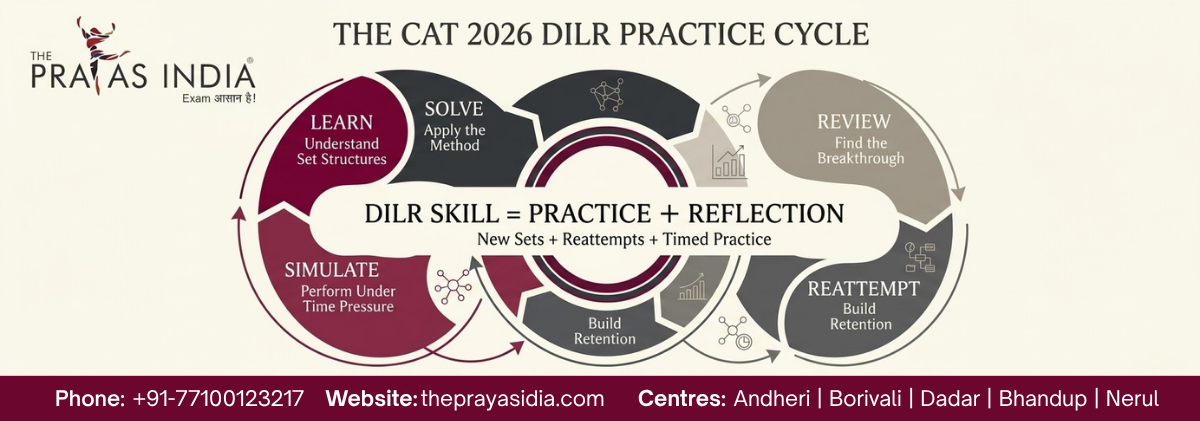
Your CAT 2026 DILR preparation can follow a simple cycle:
Learn
Understand different structures.
Practise
Solve sets across multiple difficulty levels.
Analyse
Identify where and why you struggled.
Reattempt
Solve important difficult sets again.
Time
Gradually introduce pressure.
Simulate
Use sectional tests and mocks.
Improve
Track your selection, accuracy and efficiency.
This approach ensures that your preparation keeps moving forward instead of becoming a repetitive exercise in solving questions.
Final Takeaway
There is no magic number of DILR sets that can guarantee a high CAT percentile.
A serious CAT 2026 aspirant can use 150–250 quality sets as a broad long-term target, but the real objective should be much bigger than the number itself.
You want to reach a stage where:
New set → You understand the structure faster.
Difficult set → You know how to break it down.
Multiple sets → You can identify which one deserves your time.
Timed section → You can make decisions without panicking.
Mock mistake → You know exactly what to improve.
That is what effective DILR preparation looks like.
If you are preparing for CAT 2026 through CAT coaching in Mumbai, choose a programme that gives you structured practice, quality sets, regular testing, detailed analysis and mentorship—not simply a large question bank.
At The Prayas India, the focus should be on building a preparation system where every set has a purpose and every mistake contributes to improvement.
Don’t aim to solve the maximum number of DILR sets. Aim to become better with every set you solve.
Contact Us
📞 Call Now: +91-77100 13217
🌐 Website: theprayasindia.com