How to Crack MBA CET 2027 in the First Attempt | Best MBA CET Coaching in Mumbai | The Prayas India
Cracking MBA CET 2027 in the first attempt is less about studying for long hours and more about understanding how the examination rewards speed, accuracy, question selection and consistent practice. Many aspirants begin their preparation with a simple objective—score well enough to secure admission to a leading Maharashtra management institute—but struggle to convert that objective into a practical preparation plan.
The challenge becomes more significant because MBA CET is a highly time-sensitive examination. A candidate may know how to solve a particular question but still lose valuable marks if the method takes too long. Similarly, attempting too many questions without maintaining accuracy can affect the overall score.
For an aspirant targeting a high percentile, preparation therefore needs to go beyond completing the syllabus. You need a system that connects concept building, timed practice, mock-test analysis, revision and exam strategy.
This article explains how to approach MBA CET 2027 from the beginning, how to structure your preparation and which habits can make first-attempt preparation more effective.
Start With the Exam Before Starting With the Books
One of the most common mistakes in management entrance preparation is beginning with study material without first understanding the examination.
Before creating a timetable, understand the nature of MBA CET.
The exam is designed to test several skills at the same time. You need to work with numbers, interpret information, solve logical problems, understand language and make quick decisions.
This means your preparation cannot be built around one skill alone.
A student may be excellent at Quantitative Aptitude but lose time in Logical Reasoning. Another may have strong Verbal Ability but struggle with lengthy calculation-based questions.
Your first objective should therefore be to understand where you currently stand across the major areas of MBA CET preparation.
A simple diagnostic test can help you identify your starting point.
Don’t worry if your initial score is low. The purpose of the first test is not to predict your final percentile.
It is to answer three questions:
- What can I already solve?
- Where am I losing time?
- Which areas require the most improvement?
Know the Major Areas You Need to Prepare
MBA CET preparation requires a balanced approach across the sections.
The major preparation areas include:
| Area | Key Skills Required |
|---|---|
| Logical Reasoning | Pattern recognition, arrangements, deductions and decision-making |
| Abstract Reasoning | Visual patterns, series and figure-based logic |
| Quantitative Aptitude | Arithmetic, calculation, number-based reasoning and data interpretation |
| Verbal Ability & Reading Comprehension | Vocabulary, grammar, comprehension and language-based reasoning |
The weight of individual topics can vary, and the actual paper can contain different combinations of question types.
That is why preparing only a fixed list of “important chapters” is not enough.
You should develop broad familiarity with the major concepts while using practice and mock tests to identify the areas that deserve additional attention.
Your First Attempt Should Begin With a Diagnostic Test
Before spending weeks studying, take a full-length or representative MBA CET-level test.
Attempt it under realistic conditions.
Do not pause the test to look up formulas.
Do not restart questions because you think you made a mistake.
Do not give yourself unlimited time.
The purpose is to create a baseline.
After completing the test, analyse it carefully.
Your analysis should include:
| What to Track | Why It Matters |
|---|---|
| Correct Answers | Measures current accuracy |
| Incorrect Answers | Identifies conceptual or execution errors |
| Unattempted Questions | Shows missed opportunities |
| Time Taken | Identifies slow areas |
| Guesswork | Shows where decision-making needs improvement |
| Topic-Wise Performance | Helps prioritise preparation |
This first analysis can completely change how you approach the next few months.
Instead of saying, “I need to study everything,” you can start saying, “These are the areas where my preparation needs the most work.”
Don’t Confuse Syllabus Completion With Exam Preparation
Completing a chapter does not mean you have mastered it.
Suppose you study a Quant topic and understand all the formulas.
That is only the beginning.
You still need to:
- Solve basic questions
- Solve exam-level questions
- Identify faster approaches
- Improve calculation efficiency
- Practise under time pressure
- Review mistakes
- Revisit difficult question types
The same principle applies to Logical Reasoning and Verbal Ability.
A topic becomes useful only when you can apply it accurately and efficiently under examination conditions.
This is why a good MBA CET preparation plan should have separate time for learning, practice and testing.
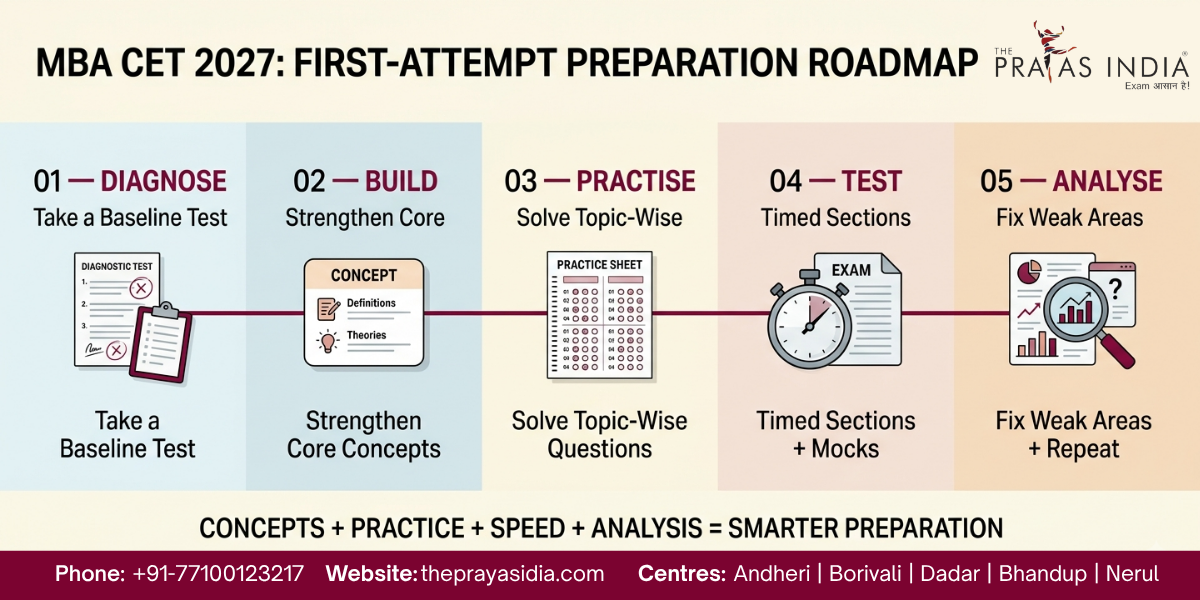
Build a Preparation Plan Around Your Actual Starting Level
Not every MBA CET aspirant should follow exactly the same timetable.
A student starting preparation with strong Quant fundamentals may need more time for speed and mixed practice.
Someone struggling with Logical Reasoning may need additional concept-building and puzzle practice.
Your timetable should therefore be based on diagnosis rather than imitation.
A useful approach is to divide your preparation into three categories:
Strong Areas
You can solve most questions accurately and reasonably quickly.
Maintain these areas through regular practice.
Developing Areas
You understand the basics but struggle with speed, accuracy or certain question types.
These should receive consistent practice.
Weak Areas
You struggle with concepts or cannot identify the correct approach.
These require dedicated learning and gradual practice.
This prevents a common problem where aspirants repeatedly practise topics they already enjoy while avoiding the areas that actually affect their score.
Build Your Quantitative Aptitude Foundation
Quantitative Aptitude can become one of the most time-sensitive parts of MBA CET preparation.
Instead of trying to memorise every possible formula, focus on understanding the underlying concepts.
Your preparation can cover areas such as:
- Percentages
- Ratio and Proportion
- Averages
- Profit and Loss
- Simple and Compound Interest
- Time, Speed and Distance
- Time and Work
- Number System
- Algebra
- Arithmetic
- Data Interpretation
- Basic calculation techniques
The exact importance of topics can change from paper to paper, so don’t build your preparation around predictions alone.
Focus on developing enough conceptual flexibility to handle unfamiliar variations.
Speed Is a Separate Skill
A candidate can understand Quant but still perform poorly in a time-bound management entrance exam.
Why?
Because solving correctly and solving efficiently are not the same skill.
During the early stage of preparation, focus on correctness.
Once the concept becomes comfortable, introduce time limits.
For example:
Stage 1: Solve without worrying about speed.
Stage 2: Solve similar questions with a soft time limit.
Stage 3: Solve mixed questions under strict timing.
Stage 4: Apply the same approach in sectional and full-length mocks.
This gradual progression prevents the timer from becoming a source of anxiety.
Logical Reasoning Needs Pattern Recognition
Logical Reasoning can consume substantial preparation time because it is not always about memorising a formula.
You need to develop the ability to recognise structures.
This can involve:
- Arrangements
- Series
- Coding and decoding
- Blood relations
- Directions
- Syllogisms
- Puzzles
- Logical deductions
- Statements and conclusions
- Selection-based problems
Instead of solving questions mechanically, ask:
“What is the structure of this problem?”
Once you start recognising recurring structures, your solving process becomes more efficient.
Don’t Treat Every Reasoning Question Equally
In a time-bound examination, question selection matters.
Some questions may be immediately approachable.
Others may require several steps.
A smart aspirant learns to differentiate between them.
During practice, classify questions into:
| Category | Approach |
|---|---|
| Direct | Attempt quickly |
| Familiar | Attempt with confidence |
| Moderate | Attempt if time permits |
| Lengthy | Reconsider before investing time |
| Unfamiliar | Avoid unless necessary |
The purpose is not to avoid difficult questions forever.
It is to ensure that a difficult question does not consume the time that could have been used to solve several easier ones.
Improve Your Verbal Ability Through Consistency
Verbal Ability often responds better to regular exposure than occasional intensive study.
Instead of trying to improve English only during dedicated weekly sessions, integrate it into your routine.
You can regularly work on:
- Reading comprehension
- Vocabulary
- Grammar
- Sentence structure
- Para-based questions
- Vocabulary-in-context
- Reading speed
Reading quality material can also improve comprehension and familiarity with different writing styles.
The objective is not to memorise hundreds of isolated words.
It is to become more comfortable understanding language quickly and accurately.
Reading Speed Should Not Come at the Cost of Understanding
Aspirants sometimes try to increase reading speed by rushing through passages.
That can backfire.
If you read faster but have to reread every paragraph, the time saved disappears.
A better goal is efficient comprehension.
While practising reading comprehension, focus on identifying:
- Main idea
- Author’s argument
- Tone
- Important details
- Logical connections
- What the question is actually asking
Over time, comprehension and speed can improve together.
Abstract Reasoning Requires Regular Exposure
Abstract Reasoning may feel unfamiliar at first because it works differently from conventional academic subjects.
The best way to reduce this discomfort is repeated exposure.
Practise different types of visual patterns and learn to look for relationships involving:
- Movement
- Rotation
- Position
- Number of elements
- Direction
- Shape
- Size
- Sequence
You do not need to memorise a single “method” for every abstract question.
Instead, train yourself to observe systematically.
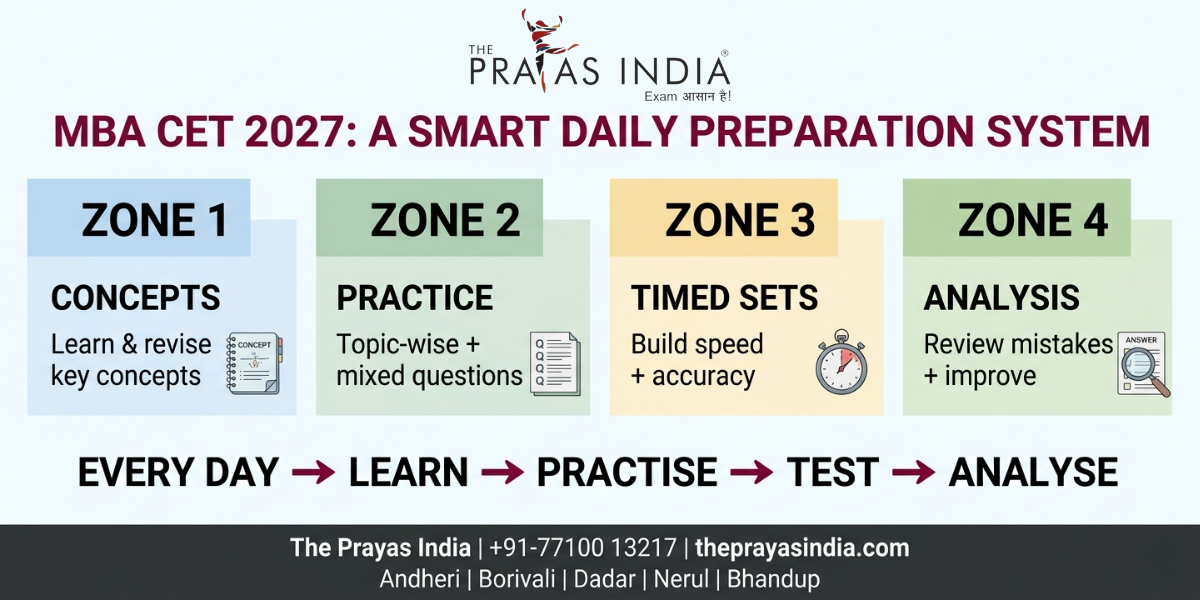
Don’t Study for the Whole Day Without Measuring Output
Long study hours can create the impression of productivity.
But MBA CET preparation should be measured by output, not just time spent at the desk.
Instead of writing:
“Studied for eight hours.”
Track:
“Completed two Quant topics, solved 80 questions, analysed 20 mistakes and completed one timed reasoning set.”
This gives you a more accurate picture of your preparation.
Your daily target should therefore contain measurable activities.
For example:
- Concept revision
- Number of questions
- Timed practice
- Reading practice
- Mock analysis
- Error-log revision
This also makes it easier to identify when your preparation is slowing down.
Use an Error Log From the Beginning
One of the simplest ways to improve is to stop making the same mistake repeatedly.
Maintain a record of important errors.
For every significant mistake, note:
Question type
Reason for the mistake
Correct approach
Whether the issue was concept, calculation or interpretation
How you will avoid repeating it
After a few weeks, review the error log.
You may discover that the same two or three issues appear repeatedly.
Those recurring errors deserve more attention than randomly solving another hundred questions.
Don’t Depend Entirely on Shortcuts
Shortcuts can save time, but they should come after conceptual understanding.
If you memorise a shortcut without understanding where it comes from, an unfamiliar question can leave you confused.
Use shortcuts when:
- You understand the underlying concept
- The shortcut is reliable
- It genuinely reduces calculation
- You can apply it without sacrificing accuracy
The goal is not to collect the maximum number of tricks.
It is to develop efficient problem-solving ability.
Your First Attempt Needs a Long-Term Approach
If you want to crack MBA CET 2027 in your first attempt, don’t wait until the final few months to begin serious preparation.
Early preparation gives you an important advantage: time to make mistakes and correct them.
You can use the initial phase to build fundamentals.
The middle phase can focus on extensive practice.
The later phase can increasingly emphasise mocks, speed, accuracy, revision and exam strategy.
This is much more sustainable than trying to learn concepts, complete practice and develop speed simultaneously in the final weeks.
The Role of Mock Tests in First-Attempt Preparation
Mocks should not be treated as something you do only after completing the syllabus.
They can be introduced gradually.
Early in preparation, mocks help you understand the examination.
Later, they help measure improvement.
Toward the exam, they become a major tool for refining:
- Speed
- Accuracy
- Question selection
- Time allocation
- Exam temperament
But remember:
A mock score is useful only when you analyse it.
Taking another test without understanding why you lost marks can simply repeat the same mistakes.
Key Takeaway
Cracking MBA CET 2027 in the first attempt starts with a realistic understanding of the examination and your own preparation level.
Don’t begin by collecting every possible book, course or question bank.
Begin with diagnosis.
Take a baseline test.
Identify strong and weak areas.
Build your fundamentals.
Practise topic-wise.
Develop speed gradually.
Work consistently on Logical Reasoning, Quantitative Aptitude, Verbal Ability and Abstract Reasoning.
Most importantly, make analysis part of your preparation from the beginning.
A strong MBA CET aspirant is not someone who never makes mistakes.
It is someone who identifies mistakes quickly and converts them into improvement opportunities.
Move From Topic-Wise Practice to Mixed Practice
Topic-wise practice is essential when you are learning a concept, but it cannot remain the only form of preparation.
In the actual examination, you are not going to receive a separate mental label telling you which concept should be used. You have to identify the question type yourself.
This is why mixed practice becomes increasingly important as your preparation progresses.
A mixed set may contain Quantitative Aptitude questions from different areas, several Logical Reasoning patterns, Verbal questions and Abstract Reasoning questions. The challenge is no longer just solving the question. It is recognising the approach quickly.
Start introducing mixed sets once you are reasonably comfortable with individual topics. Initially, don’t make speed your only objective. Focus on identifying the question type correctly. Then gradually introduce strict time limits.
This transition is important because it prepares you for the unpredictability of the actual paper.
Build Speed Without Destroying Accuracy
Speed is one of the most discussed aspects of MBA CET preparation, but it is also one of the most misunderstood.
Trying to solve everything faster from day one can actually make you slower in the long run because repeated calculation errors force you to spend additional time checking answers.
A better approach is to first establish a reliable solving method.
Once you can solve a particular question type consistently, look for ways to reduce unnecessary steps. You may discover that a shorter calculation, a better approximation or a different arrangement of information can save valuable seconds.
The objective should therefore be:
Correct method → Consistent accuracy → Efficient method → Faster execution
That progression is far more sustainable than simply trying to increase your solving speed with a stopwatch.
Understand Your Time-Wasting Habits
Every aspirant has different time-wasting patterns.
Some candidates spend too long trying to solve one difficult Logical Reasoning problem. Others repeatedly recalculate a Quant answer because they lack confidence in their calculation. Some candidates read a passage multiple times because they rush through it initially.
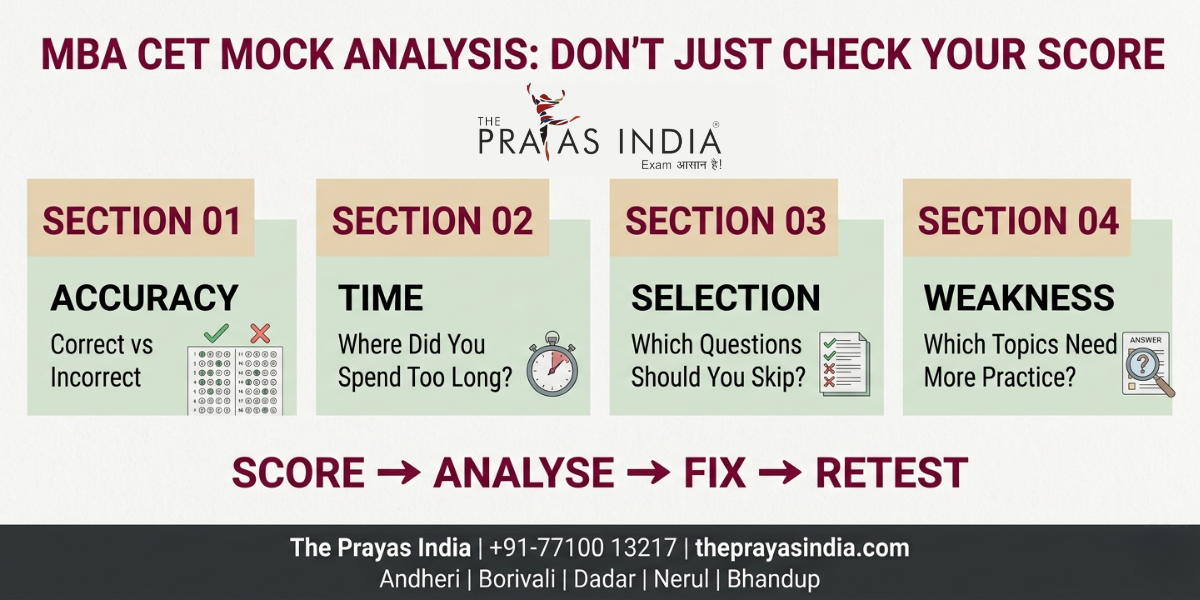
Your mock analysis should identify these habits.
After each test, ask yourself:
Where did I lose time?
Why did I lose that time?
Was the question worth the time I invested?
Could I have skipped it and returned later?
These questions are more valuable than simply checking your percentile.
Over time, you should be able to recognise your personal time traps and deliberately avoid them.
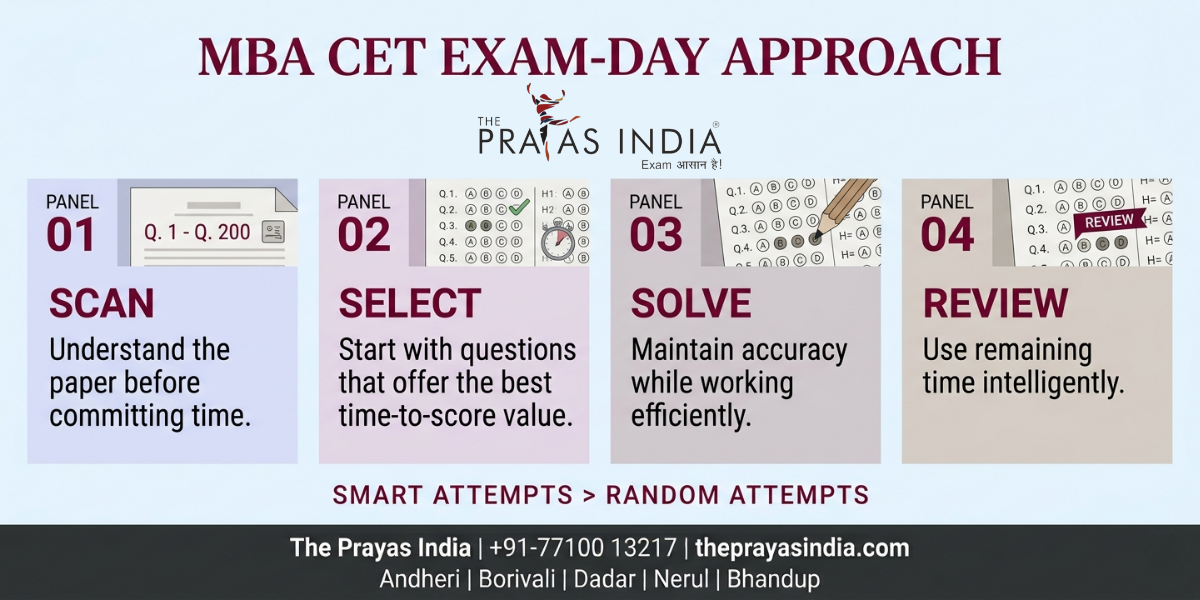
Learn to Select Questions, Not Just Solve Them
A high percentile strategy requires a change in mindset.
Instead of asking, “Can I solve this question?”, train yourself to ask, “Is this the right question to solve at this moment?”
This distinction becomes particularly important when you encounter a lengthy puzzle, a calculation-heavy Quant question or a passage that appears time-consuming.
You don’t necessarily have to reject the question permanently. You can mark it mentally as something to revisit if time remains.
This creates a more flexible examination strategy.
The best candidates are not necessarily those who can solve every question. They are often the candidates who understand which questions deserve their attention first.
Develop a Three-Level Question Selection System
During practice, classify questions based on your expected effort.
Quick-Start Questions
These are questions where the method is immediately visible and the calculation is manageable. They are generally the best candidates for early attempts.
Thinking Questions
These require some reasoning but are still within your comfort zone. Attempt them once you have secured easier opportunities.
Time-Heavy Questions
These involve lengthy calculations, complex arrangements or unfamiliar approaches. They should be approached carefully because they can consume disproportionate amounts of time.
This system should become a habit before the actual examination rather than something you try for the first time on exam day.
Use Sectional Practice Before Full-Length Mocks
Full-length mocks are essential, but they should not be the only testing method.
Sectional tests allow you to isolate individual problems.
If your Quant performance is weak, a Quant sectional test can tell you whether the issue is calculation speed, arithmetic concepts, data interpretation or question selection.
Similarly, a Logical Reasoning sectional test can reveal whether you are struggling with particular puzzle types or simply spending too much time on individual sets.
Sectional practice therefore acts as a bridge between topic-wise learning and full-exam performance.
How Often Should You Take Mock Tests?
There is no single number that works for every MBA CET aspirant.
The frequency should increase as your preparation becomes more mature.
During the earlier stage, occasional tests can help you understand the exam and measure your progress.
As you become more comfortable with the syllabus, sectional tests and mixed tests can become more frequent.
Closer to the examination, full-length mocks should become an important part of your routine.
However, there is one rule that should remain constant:
Never allow mock frequency to replace mock analysis.
One thoroughly analysed test can teach you more than several tests that you simply take and forget.
Create a Mock Analysis Notebook
Maintain a dedicated record of important observations from your tests.
For every mock, note the major mistakes rather than copying every question.
You can record things such as:
- Topics where accuracy dropped
- Questions that consumed excessive time
- Questions incorrectly skipped
- Calculation mistakes
- Misread questions
- Guesswork that resulted in errors
- Areas where you performed faster than before
After several mocks, compare the patterns.
If the same weakness appears repeatedly, it should become a priority in your study plan.
This creates a preparation loop where every test directly influences what you study next.
Don’t Let One Poor Mock Affect the Next One
A low mock score can be frustrating, especially when you have invested several hours in preparation.
But a mock test is not a final verdict.
Sometimes your score may fall because the paper contains question types you are less familiar with. At other times, poor performance may result from ineffective time allocation rather than lack of knowledge.
Instead of saying:
“My preparation is not working.”
ask:
“What specifically caused the score to fall?”
If you can identify the reason, the mock has already served its purpose.
Build Your Preparation Around the Final Months
The final months before MBA CET should not look exactly like the first months.
Your priorities need to evolve.
In the beginning, the focus is primarily on understanding concepts and building familiarity.
As the exam approaches, the emphasis should gradually move towards mixed practice, timed sets, mock tests, revision and exam strategy.
A practical progression can look like this:
| Preparation Stage | Primary Focus |
|---|---|
| Foundation | Concepts and fundamentals |
| Development | Topic-wise and mixed practice |
| Performance | Speed, accuracy and sectional tests |
| Final Stage | Mocks, revision and exam strategy |
The exact duration of each stage depends on when you begin and how strong your existing fundamentals are.
The important principle is to avoid spending the final weeks learning everything from scratch.
Strengthen Your Weak Areas Without Ignoring Your Strengths
A common mistake is to spend almost all preparation time on weak topics.
That can be counterproductive.
Weak areas obviously require attention, but strong areas also need maintenance.
If you completely stop practising a strong section for several weeks, speed and familiarity can decline.
A better approach is to allocate more time to weak areas while continuing short revision and practice sessions for your strengths.
This creates a balanced preparation system.
Revision Should Be Active
Simply rereading notes is not always enough.
Active revision forces you to retrieve information.
Instead of reading a formula sheet repeatedly, close the material and try to recall the concepts.
Instead of rereading a solved reasoning problem, try solving a similar question independently.
Instead of looking at vocabulary lists passively, use words in context.
Active revision helps you determine whether you actually remember something or merely recognise it when you see it.
Don’t Ignore Exam Temperament
Preparation is not only about knowledge.
On exam day, your emotional response to a difficult question can influence your performance.
If you become uncomfortable after encountering a few difficult questions, you may start rushing.
That can increase errors.
Mock tests help you practise this aspect of the examination.
When a difficult question appears, train yourself to remain neutral:
“This question is difficult. I can move on.”
That simple decision can prevent one question from affecting the next five.
How Coaching Can Add Structure to MBA CET Preparation
Self-study can be effective when the aspirant is disciplined, understands the examination and knows how to evaluate progress.
However, many students struggle with the planning side of preparation.
They may have multiple books, videos, mock-test platforms and PDFs but no clear system connecting them.
This is where structured MBA CET coaching in Mumbai can be useful.
The value of coaching should not simply be judged by the number of classes offered. A useful preparation ecosystem should help aspirants understand concepts, practise at the right level, identify weaknesses and evaluate their performance regularly.
For a first-attempt candidate, having a defined preparation structure can reduce the time spent deciding what to study next.
How The Prayas India Can Support MBA CET Aspirants
For students targeting MBA CET and aiming for admission to leading management institutes, The Prayas India can support preparation through a structured learning and practice approach.
The objective is to connect classroom learning with actual examination requirements.
Aspirants need opportunities to strengthen concepts, solve questions, practise under time pressure and understand where they are losing marks.
That process becomes more meaningful when preparation is regularly evaluated.
For a candidate who wants to crack MBA CET 2027 in the first attempt, structured guidance can provide an additional layer of accountability and help keep preparation aligned with the examination rather than allowing it to become an endless cycle of content consumption.
Common Mistakes That Can Affect Your MBA CET Preparation
Some mistakes are not related to academic ability at all.
One common issue is resource overload. Aspirants collect multiple books, coaching notes, online videos and question banks and keep switching between them. This creates repetition without necessarily improving performance.
Another mistake is postponing mock tests until the syllabus is complete. Waiting too long can make it difficult to develop exam temperament.
Some students also focus excessively on speed before building accuracy. This can increase careless errors.
Another problem is ignoring analysis. If you take tests but don’t understand why you made mistakes, your preparation remains disconnected from your actual performance.
Finally, many aspirants follow someone else’s timetable without considering their own starting level, academic background and available study hours.
A good plan should be structured but also realistic.
A Practical Daily Routine for MBA CET 2027
Your daily schedule should contain different types of work rather than several hours of the same activity.
A balanced routine can include a concept-learning block, a practice block, a timed set and a short revision or error-analysis session.
For example, an aspirant might begin the day with a Quant concept and follow it with topic-wise questions. Later, they could work on Logical or Abstract Reasoning and finish with a timed mixed set.
The exact hours are less important than consistency.
A candidate studying four focused hours every day with clear objectives can make stronger progress than someone spending eight distracted hours collecting study material.
What to Do If You Are Starting Late
Starting later does not automatically mean that cracking MBA CET is impossible.
But it does mean that you need to prioritise more carefully.
Begin with a diagnostic test and identify the concepts that are essential for your current level.
Avoid trying to study every resource.
Focus on high-quality practice, regular timed sets and frequent analysis.
As the exam approaches, increase mock-test exposure and spend more time revising recurring mistakes.
The key is to eliminate unnecessary preparation activities and concentrate on work that directly improves performance.
The Final 30 Days Should Be About Execution
The final month should not become a period of panic-driven learning.
Your focus should increasingly shift toward mock tests, revision, speed, accuracy and question selection.
You should know which topics are strong, which remain inconsistent and which question types you tend to spend too much time on.
Your mock-analysis notebook should become a useful reference.
At this stage, avoid constantly changing your preparation resources.
Familiarity and consistency are more valuable than collecting new material.
Frequently Asked Questions
1. Can I crack MBA CET 2027 in my first attempt?
Yes, a first-attempt success is possible with systematic preparation. The important factors include conceptual clarity, regular practice, speed, accuracy, mock-test analysis and effective question selection.
2. When should I start preparing for MBA CET 2027?
Starting early gives you more time to build fundamentals and gradually develop speed. However, even candidates beginning later can make progress by prioritising their weak areas and following a focused preparation plan.
3. Is MBA CET preparation difficult for beginners?
The difficulty depends largely on the candidate's existing fundamentals and familiarity with aptitude-based examinations. Beginners may initially need more time to develop calculation speed, reasoning patterns and exam-taking habits.
4. How important are mock tests for MBA CET?
Mock tests are important because they allow you to practise under realistic time pressure and identify weaknesses in speed, accuracy, selection and time management. Their value increases significantly when you analyse them properly.
5. How can I improve my speed for MBA CET?
First build accuracy and conceptual clarity. Then introduce timed practice and analyse which questions consume excessive time. Learning efficient approaches and improving question selection can also increase effective speed.
6. Should I focus more on Quant or Logical Reasoning?
Your preparation time should depend on your individual strengths and weaknesses. Avoid neglecting any major area, but allocate additional practice time to sections where your performance is consistently weaker.
7. Is coaching necessary to crack MBA CET?
Coaching is not the only route to success. However, structured coaching can be useful for aspirants who want organised learning, guided practice, regular testing, performance analysis and mentorship.
8. How can I avoid wasting time on difficult questions?
Practise classifying questions according to their expected effort. During mocks, learn to identify questions that are straightforward, moderate or likely to consume excessive time. This skill improves with repeated timed practice.
9. What should I do if my mock scores remain low?
Analyse the reason instead of focusing only on the score. Identify whether the problem is conceptual knowledge, accuracy, speed, selection or time management. Then modify your preparation accordingly and retest.
10. How can The Prayas India help with MBA CET preparation?
The Prayas India can provide a structured preparation environment where aspirants can combine concept learning, practice, testing and performance analysis. This can help candidates prepare more systematically for MBA CET and stay focused on their admission goals.
Final Takeaway: Prepare to Perform, Not Just to Complete the Syllabus
Cracking MBA CET 2027 in the first attempt requires more than completing a list of topics.
You need to develop the ability to understand quickly, recognise patterns, select questions intelligently, solve accurately and manage your time under pressure.
Start by diagnosing your current level.
Build the fundamentals.
Move from topic-wise practice to mixed sets.
Develop speed only after establishing accuracy.
Take sectional tests and full-length mocks.
Analyse every important mistake.
Track recurring weaknesses.
Maintain your strong areas.
And gradually make your preparation resemble the actual examination environment.
Most importantly, don’t let the idea of a high percentile turn your preparation into constant pressure. A high target should give your preparation direction, not make every low score feel like failure.
If you are preparing for MBA CET 2027 with the goal of securing admission to a strong management programme, structured preparation can make the journey more focused.
For aspirants looking for MBA CET Coaching in Mumbai, the right learning environment can provide guidance, practice and regular performance evaluation while helping you stay aligned with your admission objective.
Your first attempt should not be treated as a trial run.
Treat it as the attempt you are preparing to convert.
Understand the exam. Build the skills. Practise with purpose. Analyse honestly. Improve continuously.
That is the foundation of a strong MBA CET 2027 preparation strategy.
Contact Us
📞 Call Now: +91-77100 13217
🌐 Website: theprayasindia.com