
How to Select the Right Questions in MBA CET | Best MBA CET Coaching in Mumbai | The Prayas India
MBA CET preparation is often discussed in terms of syllabus completion, mock-test scores and speed. However, there is another skill that can have a major impact on your performance: knowing which questions to attempt and which ones to leave for later.
In a highly time-sensitive management entrance examination, every minute has value. A candidate may know how to solve a difficult question, but if that question takes several minutes while an easier question remains untouched, the decision to attempt it may not be efficient. This is why question selection should not be treated as something you figure out on the examination day. It needs to become a part of your preparation well in advance.
For MBA CET aspirants targeting a strong percentile, the objective should not be to solve every question they see. The objective is to maximise the value of every minute spent in the examination. That requires a combination of conceptual clarity, familiarity with question types, awareness of personal strengths, time management and the ability to make quick decisions under pressure.
This article explains how to develop that skill, how to recognise questions that deserve immediate attention, how to avoid time traps and how regular practice can help you make better question-selection decisions during MBA CET.
Why Question Selection Matters in MBA CET
Question selection becomes particularly important in a speed-oriented examination because the difficulty of a question is not the only factor that determines whether you should attempt it.
A question may look difficult but have a straightforward solution once you recognise the underlying concept. Another question may appear easy but involve lengthy calculations or multiple steps. Similarly, a question from a familiar topic may not always be the best question to attempt if you are currently taking too long to solve that particular type.
This means that question selection involves evaluating three things simultaneously: how well you understand the question, how much time it is likely to require and how confident you are about arriving at the correct answer.
Over time, you need to develop the ability to make this assessment within seconds rather than spending a significant amount of time analysing every question.
A strong question-selection strategy therefore helps you:
- Protect your time from unnecessarily lengthy questions.
- Identify relatively manageable questions quickly.
- Avoid getting emotionally attached to a difficult problem.
- Improve the number of productive attempts.
- Maintain better accuracy under pressure.
- Create opportunities to return to time-consuming questions later.
The objective is not to avoid challenging questions altogether. It is to attempt them at the right time and under the right circumstances.
The First Rule: Don’t Try to Solve Every Question in the Order You See It
One of the most common habits among inexperienced aspirants is moving sequentially through the paper and attempting every question as it appears.
This approach feels comfortable because it provides a clear sequence. However, it can become inefficient when you encounter a question that requires substantially more time than expected.
Imagine spending several minutes working through a complicated reasoning problem while multiple questions that you could have solved quickly remain unanswered. Even if you eventually get the difficult question right, the opportunity cost of those minutes can be significant.
A better approach is to remain flexible.
When you encounter a question, make a quick assessment. If the approach is immediately visible and the expected effort is reasonable, attempt it. If the question appears lengthy or unfamiliar, consider moving ahead and returning to it later if the examination interface and your strategy allow it.
This approach requires practice because initially, many students feel uncomfortable leaving questions unanswered.
That discomfort needs to disappear before the examination.
Learn to Recognise the Three Broad Types of Questions
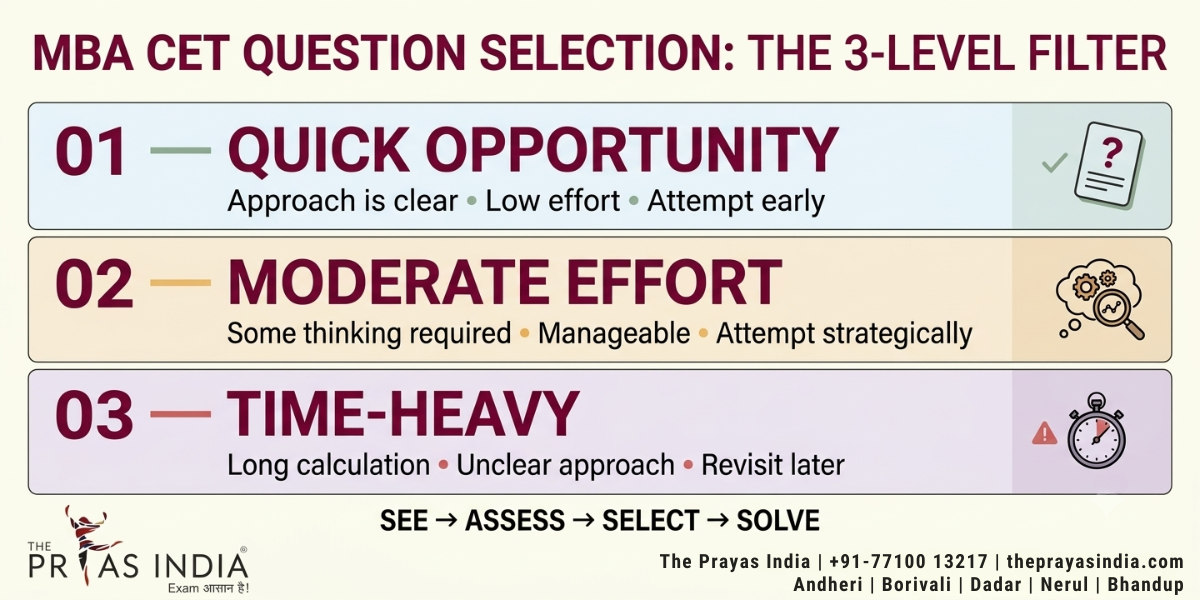
You do not need to create an elaborate classification system during the examination. A simple three-level framework can help you make faster decisions.
1. Quick-Opportunity Questions
These are questions where the concept or approach becomes visible almost immediately. You understand what needs to be done and expect the calculation or reasoning to remain manageable.
These questions generally deserve early attention because they offer an opportunity to convert your knowledge into marks without consuming disproportionate time.
2. Moderate-Effort Questions
These questions require some thought. You may need to perform multiple steps, interpret information carefully or work through a slightly unfamiliar structure.
They are not necessarily bad questions to attempt. However, you should consider them after identifying the more straightforward opportunities.
3. Time-Heavy or Uncertain Questions
These are questions where the method is unclear, the calculations appear lengthy or the problem involves a structure you are not immediately comfortable with.
Such questions can become time traps.
The correct response is not necessarily to abandon them permanently. Instead, recognise that they may be better suited for a later stage of your attempt.
The Difference Between “Difficult” and “Time-Consuming”
A major improvement in question selection comes from understanding that difficulty and time consumption are not always the same thing.
A question can be conceptually difficult but quick to solve if you immediately recognise the correct approach. Conversely, a relatively simple question can become time-consuming because it involves lengthy calculations or careful interpretation.
This distinction is especially important during mock-test analysis.
Suppose you consistently spend too much time on certain Arithmetic questions. The issue may not be that the topic is difficult for you. You may simply be using an inefficient solving method.
On the other hand, if you repeatedly spend several minutes on a particular reasoning structure without being able to establish a workable approach, the issue may genuinely be familiarity or conceptual understanding.
Once you identify this difference, your preparation becomes more precise.
You can improve the first problem through method and calculation practice, while the second may require concept building and exposure to more question types.
Use the First Few Seconds to Decide, Not to Panic
When you read a new question, your first reaction matters.
Some students see an unfamiliar-looking question and immediately assume it is difficult. Others see a familiar topic and automatically decide to attempt it.
Both reactions can be misleading.
Instead, develop a short internal checklist:
Do I understand what the question is asking?
Do I recognise the concept or structure?
Can I see a practical route to the answer?
Is the expected time reasonable?
If the answers are mostly positive, the question may be worth attempting.
If several answers are negative, moving ahead may be the more efficient decision.
With enough practice, this evaluation can become almost automatic.
Question Selection Starts During Preparation
You cannot suddenly develop good question-selection skills on exam day.
The habit needs to be built while solving practice sets.
When you practise a question, don’t record only whether you got it right or wrong.
Also record how long you took and how confident you were when you chose to attempt it.
This gives you a more complete picture of your performance.
For example, you may discover that:
- You solve certain Quant questions accurately but too slowly.
- You skip some reasoning questions unnecessarily because they initially look difficult.
- You attempt familiar-looking questions even when the calculation becomes excessive.
- You spend too much time trying to rescue questions where your approach is not working.
These observations are valuable because they tell you how you make decisions, not just how much you know.
Build a Question-Selection Log
A simple question-selection log can become a useful part of your MBA CET preparation.
You don’t need to record every question. Focus on questions that teach you something about your decision-making.
A useful format could include:
| Question Type | Attempt Decision | Time Taken | Result | Better Decision |
|---|---|---|---|---|
| Familiar & Direct | Attempted | Low | Correct | Attempt early |
| Familiar but Lengthy | Attempted | High | Correct | Consider later |
| Unfamiliar | Attempted | Very High | Incorrect | Skip initially |
| Moderate | Skipped | Low | Solvable | Should have attempted |
This type of record can reveal patterns that are difficult to notice while simply checking your score.
The goal is to gradually improve the quality of your decisions.
Don’t Let One Question Become an Ego Battle
This is an underrated problem in competitive exam preparation.
A difficult question can sometimes become personal.
You may think, “I know this topic. I should be able to solve it.”
Then you continue trying different approaches even though the clock is moving.
This behaviour is particularly dangerous during an actual examination because emotional attachment to one question can influence your performance on the questions that follow.
Remember that leaving a question temporarily is not the same as accepting defeat.
You are making a strategic decision about where your time will produce the best return.
A mature test-taker knows when to persist and when to move.
How Your Strengths Should Influence Question Selection
Question selection is personal.
A question that takes one student 40 seconds may take another student two minutes. Therefore, you cannot blindly copy someone else’s attempt order.
Your own strengths should influence your decisions.
For example, if you are comfortable with arithmetic but relatively slow with complex arrangements, you may prefer to secure manageable Quant questions before spending significant time on lengthy reasoning sets.
Another candidate may have exactly the opposite profile.
This is why mock tests should help you build an individualised attempt strategy.
Your preparation should answer:
- Which question types do I solve quickly?
- Which topics give me reliable accuracy?
- Which questions consume too much time?
- Where do I make avoidable mistakes?
- Which questions do I unnecessarily skip?
- What type of question causes me to lose confidence?
These answers will become the foundation of your exam-day strategy.
Don’t Over-Skip Questions Because of Fear
While wasting time is a problem, excessive skipping can also hurt your performance.
Some aspirants become so focused on speed that they start avoiding questions that require even moderate thinking.
This creates another problem: opportunity loss.
A question may not be immediately obvious but could still be solvable with a reasonable amount of effort. If you automatically reject every question that isn’t instantly easy, you may leave valuable marks behind.
The solution is not to attempt everything.
Instead, develop a distinction between “I don’t know how to solve this” and “I know how to solve this, but it will take some time.”
The first category may deserve a lower priority.
The second may be worth returning to after you have secured easier questions.
Learn to Identify Time Traps
A time trap is a question or set that appears manageable but gradually consumes more time than expected.
These traps are dangerous because the first minute has already been invested, creating a psychological tendency to continue.
You might think:
“I’ve already spent so much time on this; I should finish it.”
That reasoning can lead to even more lost time.
Instead, set internal checkpoints.
If you have made little progress after a reasonable amount of time, stop and reassess.
Ask whether the remaining work is likely to be completed efficiently.
If not, move forward.
This habit should be practised repeatedly during mocks so that it becomes natural during the actual examination.
Key Takeaway
Selecting the right questions in MBA CET is not about finding shortcuts or trying to predict which questions will be easy.
It is a decision-making skill built through preparation and experience.
You need to learn the difference between difficult and time-consuming questions, understand your own strengths and weaknesses, recognise time traps and become comfortable leaving a question temporarily when it is not offering sufficient value for the time being spent.
Most importantly, question selection should become part of your mock-test analysis.
Don’t just ask:
“How many questions did I get right?”
Also ask:
“Which questions should I have attempted earlier?”
“Which questions consumed too much time?”
“Which questions did I skip unnecessarily?”
“Where did my attempt strategy break down?”
These questions can help transform your mock tests from simple score-generating exercises into tools for improving your examination strategy.
Section-Wise Question Selection Requires a Different Approach
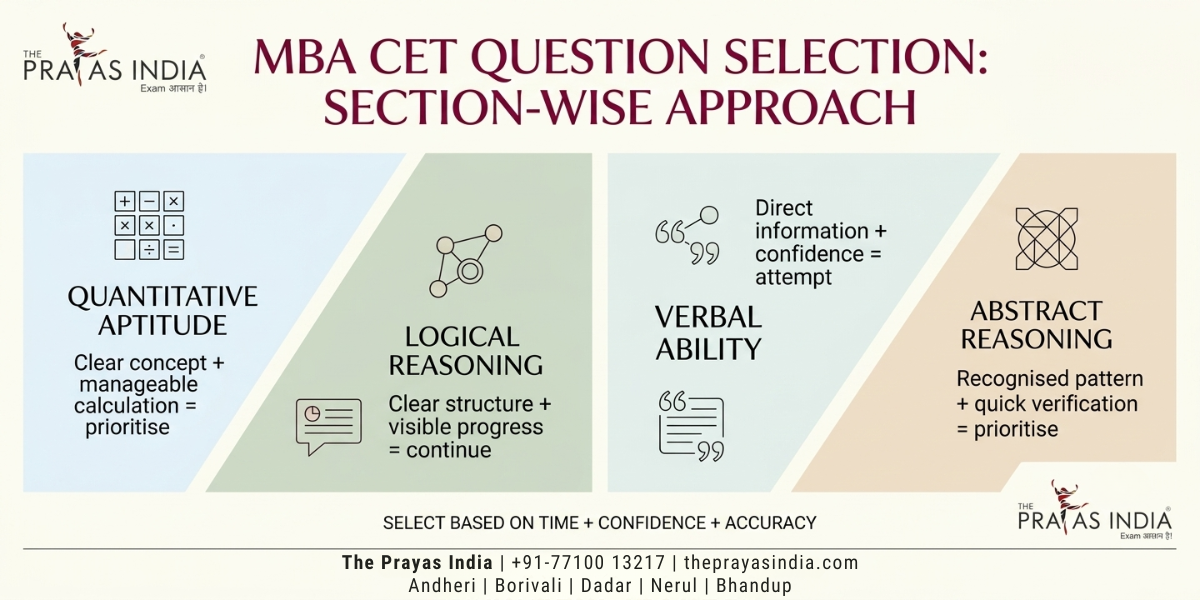
Different sections demand different types of decisions. You cannot necessarily use the same question-selection approach for Quantitative Aptitude, Logical Reasoning, Abstract Reasoning and Verbal Ability.
In Quant, calculation time and familiarity with concepts can heavily influence your decision. In Logical Reasoning, the structure of a problem may determine whether it is worth investing time immediately. Verbal questions may sometimes be answered quickly if the information is clear, while a lengthy reading-based question may require a different approach.
This is why your final strategy should be based on section-wise experience rather than a generic rule.
The more mock tests you take, the easier it becomes to understand your personal pattern.
Quantitative Aptitude: Protect Your Time From Lengthy Calculations
Quantitative Aptitude can become a major source of time loss if you attempt questions without considering the amount of calculation involved.
A question may belong to a familiar topic such as percentages, averages, ratios or arithmetic, yet still require multiple steps. If you are not careful, one calculation-heavy problem can consume the time required to solve several shorter questions.
During practice, classify your Quant questions not only according to topic but also according to effort level.
For example, you may find direct arithmetic questions highly manageable while data-heavy questions require more time. That distinction should influence your attempt order.
Look for questions where:
- The concept is immediately recognisable.
- The calculation is manageable.
- The numbers do not require excessive manipulation.
- You have historically maintained good accuracy.
- The solution path is clear without experimentation.
Questions involving unfamiliar approaches or lengthy calculations can be considered later, particularly if you are already spending more time than expected.
The goal is not to avoid difficult Quant questions. It is to avoid allowing them to control your entire attempt.
Logical Reasoning: Read Before You Commit
Logical Reasoning often presents a different challenge because the time requirement may not become obvious immediately.
A question can look simple but require several deductions. A set can also appear intimidating but become straightforward once the conditions are organised correctly.
Therefore, your first objective should be to determine whether the structure of the problem is clear.
If you can establish the framework quickly, continuing may make sense.
If you are repeatedly rereading the conditions without making meaningful progress, it may be better to move ahead and revisit the question later.
This is particularly important with lengthy arrangements and multi-condition problems.
Do not measure the value of a reasoning question only by how familiar the topic looks. Measure it by how quickly you are progressing after starting it.
Verbal Ability: Avoid Overthinking Direct Questions
In Verbal Ability, overthinking can become its own form of time wastage.
Some questions can be answered confidently based on grammar, vocabulary or clear contextual information. However, students sometimes spend too long searching for hidden meanings or second-guessing an answer that was initially obvious.
The solution is to distinguish between questions that genuinely require careful reading and questions where the answer is sufficiently clear.
For language-based questions, pay attention to:
- Whether the question is asking for a direct interpretation.
- Whether two options are genuinely close.
- Whether the passage contains enough information to support the answer.
- Whether you are relying on the passage or introducing your own assumptions.
- Whether rereading is actually helping.
Your objective should be careful reading without unnecessary repetition.
Abstract Reasoning: Recognise Familiar Patterns Quickly
Abstract Reasoning rewards familiarity.
The more patterns you encounter during preparation, the easier it becomes to recognise recurring structures under time pressure.
However, recognition should not turn into impulsive guessing.
If you immediately recognise a pattern and can verify it quickly, the question may be a good early opportunity. If you are cycling through several possible patterns without a clear direction, spending additional time may not be efficient.
Regular exposure to different Abstract Reasoning question types can therefore improve both speed and question selection.
The important point is that practice should teach you what a good opportunity looks like, not merely how to solve individual questions.
How to Decide When to Skip a Question
Skipping is not a sign that you do not know the subject.
It is a strategic decision about when your time can be used more productively elsewhere.
A useful rule is to identify three situations in which you should consider moving ahead.
The first is when you cannot identify a solution approach even after reading the question carefully. Continuing without a direction can quickly turn into random experimentation.
The second is when the calculation becomes significantly longer than expected. If you have already invested substantial time and the remaining work still appears extensive, continuing may not be the best use of your time.
The third is when your confidence in the answer is low and you are relying heavily on guessing. If other questions offer a clearer opportunity, they may deserve priority.
However, skipping should never become automatic.
Before moving away, ask yourself whether the question is genuinely unmanageable or whether you are simply uncomfortable because it requires moderate thinking.
That distinction improves with practice.
Use the “Progress Check” Instead of a Fixed Time Rule
Many students search for a universal rule such as “skip a question if it takes more than one minute.”
Such rules can be useful as broad guidelines, but they should not become rigid.
Different questions require different amounts of time.
A better method is to monitor progress.
Suppose you have spent some time on a problem and have already established the correct equation or reasoning structure. Continuing may make sense because you are moving towards the answer.
Now consider another problem where you have spent the same amount of time but are still unsure about the approach. That is a different situation.
The clock may show the same elapsed time, but the value of continuing is not the same.
This is why your decision should consider time spent + progress made + confidence in completion.
Build Your Ideal Attempt Order Through Mocks
There is no universally correct attempt order for every MBA CET aspirant.
Some candidates perform better by securing their strongest questions first. Others prefer moving through a section systematically while skipping only obvious time traps.
The important thing is to test different approaches during mocks.
For example, you can compare:
Strategy A: Start with the most familiar questions.
Strategy B: Move sequentially but skip anything that looks excessively time-consuming.
Strategy C: Spend a short initial period identifying high-confidence opportunities before committing deeply.
Record the result.
Look at:
- Number of attempts
- Accuracy
- Time consumed
- Questions left
- Number of avoidable skips
- Number of questions where you spent excessive time
After several tests, you will start seeing which approach works best for you.
That is far more reliable than copying an attempt strategy from another student.
Mock Analysis Should Include Question Selection
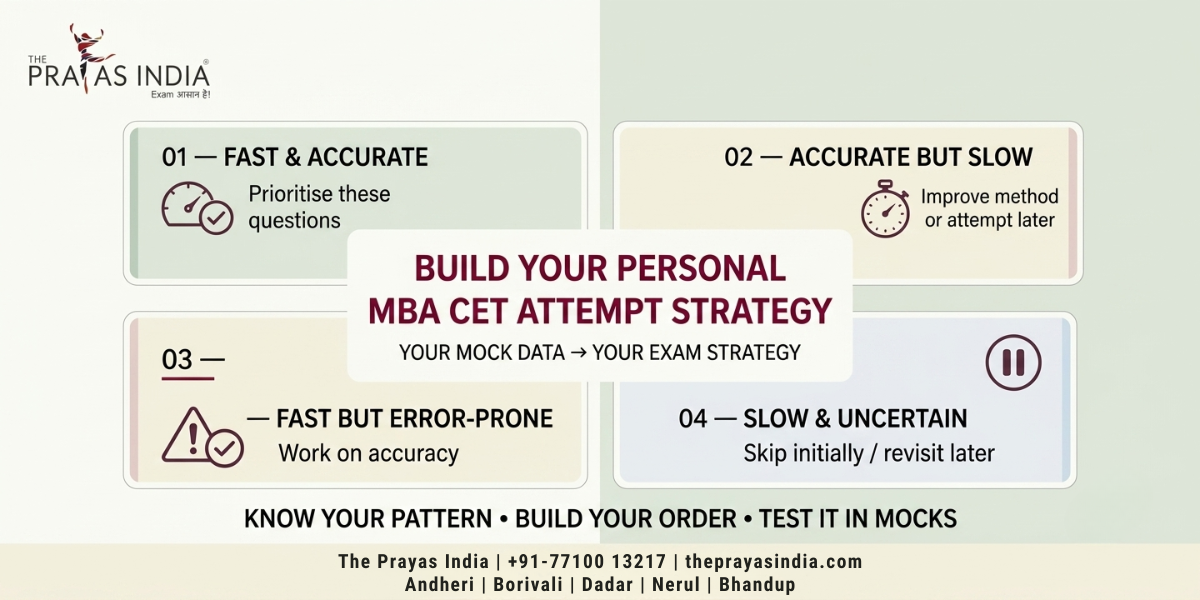
After every mock, divide your questions into four categories.
| Category | What It Tells You |
|---|---|
| Correct & Fast | Strong opportunity area |
| Correct but Slow | Method needs improvement |
| Incorrect & Fast | Accuracy problem |
| Incorrect & Slow | Major time-risk area |
Then add one more category:
Skipped but Solvable
This category is extremely important.
Sometimes your score is lower not because you made too many mistakes but because you failed to recognise questions that you could have solved.
Your mock analysis should therefore identify both bad attempts and missed opportunities.
The “Skipped but Solvable” Category Can Improve Your Score
Imagine you skipped ten questions because they looked difficult. During analysis, you discover that four of them were actually within your capability and could have been solved with reasonable effort.
That is not simply a knowledge problem.
It is a question-selection problem.
Now you have a specific area to work on.
During subsequent practice, expose yourself to similar question types and learn what signals indicate that they are actually manageable.
This is one of the reasons why mock analysis can produce improvement even when you are not learning entirely new concepts.
You are becoming better at recognising opportunities.
Create a Personal “Do First / Do Later / Avoid Initially” List
Once you have completed several mocks, create your own list.
Do First
Include question types that consistently give you good accuracy within reasonable time.
Do Later
Include questions where you are capable of solving them but require more time or concentration.
Avoid Initially
Include question types where you frequently get stuck, make errors or consume excessive time.
This list should not remain permanent.
As your preparation improves, some questions can move from Avoid Initially to Do Later, and eventually to Do First.
That movement is a measurable sign of progress.
Don’t Let the First Few Questions Decide Your Confidence
A difficult opening sequence can affect your mindset.
You may see several unfamiliar questions and immediately feel that the paper is much harder than expected.
This can create panic and lead to poor decisions.
Instead, remember that the difficulty of a few questions does not define the entire paper.
Continue evaluating questions individually.
If the first few questions are not suitable opportunities, move forward.
The ability to remain emotionally neutral is an important part of question selection.
A difficult question should trigger a decision, not a confidence crisis.
Common Question-Selection Mistakes to Avoid
Good question selection is as much about avoiding bad habits as it is about developing good ones.
One common mistake is trying to prove your ability by solving difficult questions immediately. MBA CET is not a test of how many difficult questions you can conquer. It is a competitive examination where your overall performance matters.
Another mistake is following someone else’s attempt sequence blindly. Your strengths, weaknesses and solving speed may be completely different from theirs.
Some students also skip too aggressively. If you leave every question that requires moderate thinking, you may reduce your number of productive attempts.
Another issue is not reviewing skipped questions after mocks. This prevents you from learning whether your decisions were genuinely strategic.
Finally, many aspirants change their strategy after every mock. One poor test can make them abandon an approach that may have worked well previously.
Your strategy should evolve based on patterns across multiple tests, not emotional reactions to one score.
How Coaching Can Improve Your Question-Selection Skills
Question selection can certainly be developed through self-study, but structured guidance can make the learning process more systematic.
A good coaching environment should not focus only on teaching concepts. It should also help students understand how those concepts behave in an actual timed examination.
For example, an experienced faculty member can help an aspirant understand why a particular method is unnecessarily lengthy, why a certain question should have been skipped initially or how an apparently difficult question can be recognised as manageable.
Regular mock discussions can also expose students to different approaches to the same paper.
This becomes particularly valuable for first-time MBA CET aspirants who may know the concepts but have limited experience making decisions under competitive time pressure.
How The Prayas India Can Help MBA CET Aspirants
For aspirants preparing for MBA CET with an admission-focused objective, The Prayas India can provide a structured environment in which learning, practice and performance analysis work together.
The objective should not simply be to attend classes and complete topics.
Students need opportunities to apply concepts, practise under time limits, identify mistakes and understand how their attempt strategy affects performance.
With structured preparation, mock-test practice and guidance, aspirants can gradually develop a more personalised approach to question selection.
For students searching for MBA CET Coaching in Mumbai, this kind of structured preparation can help reduce uncertainty and keep their preparation connected to the actual demands of the examination and their MBA admission goals.
A Practical Question-Selection Routine Before the Exam
In the final phase of preparation, don’t limit yourself to solving questions.
Spend some time deliberately practising decision-making.
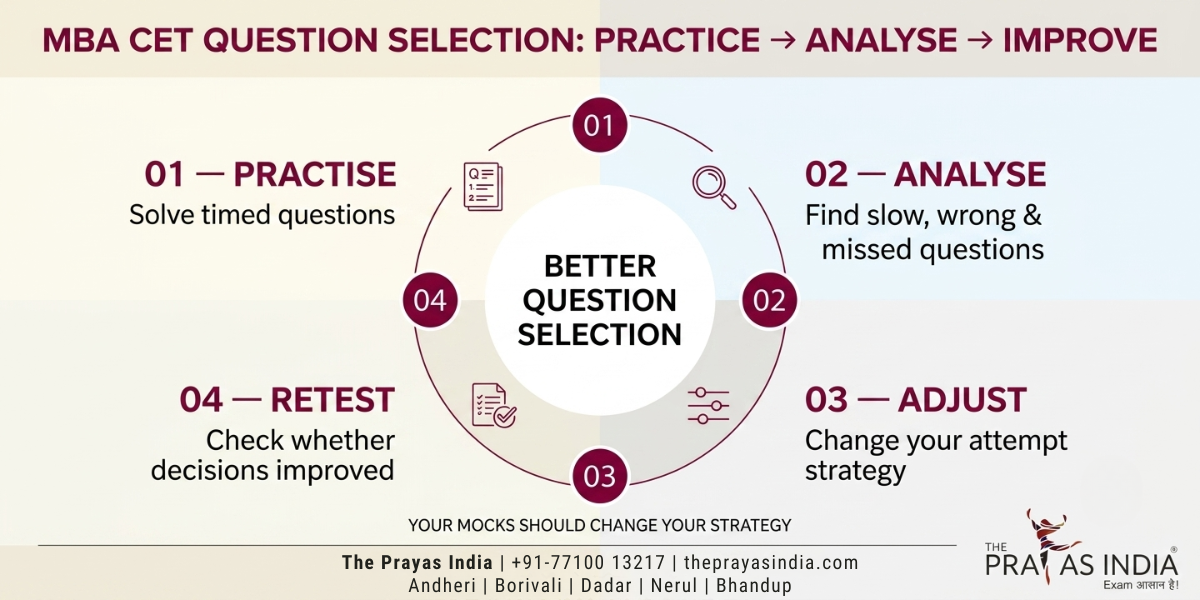
Take a timed mixed set and, before solving each question, classify it mentally as:
Attempt Now
Attempt Later
Low Priority
Then check whether your classification was correct.
This simple exercise teaches your brain to evaluate questions before committing time.
You can also practise with previously attempted mock questions and ask yourself:
If I were taking this test again, which questions would I attempt differently?
That retrospective exercise can be extremely useful.
What Your Final MBA CET Strategy Should Look Like
By the time your preparation reaches the final stage, your strategy should no longer be based entirely on generic advice.
It should be based on your own performance data.
You should know which question types usually work in your favour, where you tend to lose time and which mistakes repeatedly affect your accuracy.
A practical final strategy should include:
- A preferred approach for identifying high-confidence questions.
- A method for handling time-heavy problems.
- A clear rule for moving away from questions where progress has stalled.
- A section-wise understanding of your strengths.
- A mock-tested attempt order.
- A system for reviewing skipped questions.
- A strategy for maintaining accuracy when working quickly.
- A plan for using remaining time effectively.
The strategy should feel familiar because you have already tested it multiple times before the examination.
The Role of MBA CET Coaching in Building Exam Readiness
Choosing the right coaching institute should not be based only on advertisements, batch size or the number of study materials provided.
An aspirant should look at whether the learning environment actually supports the skills required for the examination.
For MBA CET, that includes conceptual learning as well as timed practice, mock analysis, doubt resolution, performance tracking and strategic guidance.
A structured coaching programme can be especially useful for students who find it difficult to maintain consistency independently.
However, coaching works best when students actively participate in the process. Attending classes without practising or analysing performance will not automatically improve question selection.
The most effective approach combines guided learning with deliberate self-analysis.
Final Preparation Checklist for Question Selection
Before entering the examination, make sure you have tested your strategy sufficiently.
You should be comfortable with:
- Identifying questions that are immediately manageable.
- Recognising questions that require disproportionate time.
- Leaving a question temporarily without losing confidence.
- Returning to previously skipped questions when appropriate.
- Managing lengthy calculations.
- Distinguishing unfamiliarity from genuine difficulty.
- Evaluating progress while solving.
- Maintaining accuracy under time pressure.
- Using your mock-test data to decide your attempt order.
- Staying flexible if the actual paper differs from your expectations.
These skills are not developed overnight.
They emerge from repeated practice, honest analysis and gradual refinement.
Frequently Asked Questions
1. How do I know which questions to attempt first in MBA CET?
Start with questions where the approach is clear, the expected effort is reasonable and your historical accuracy is strong. Your exact order should be based on your mock-test performance rather than a universal sequence.
2. Should I attempt difficult questions in MBA CET?
Difficult questions should not automatically be avoided. If you recognise the method and expect to solve the question efficiently, it may be worth attempting. If the approach is unclear or the calculation is becoming excessively long, consider revisiting it later.
3. How much time should I spend on one MBA CET question?
There is no single rigid time limit that works for every question. Consider the progress you are making. If you have a clear solution path, continuing may be worthwhile; if you are stuck without progress, moving ahead may be more efficient.
4. Is skipping questions a good strategy in MBA CET?
Strategic skipping can help protect your time. However, excessive skipping can also reduce your number of productive attempts. The objective is to skip questions that are currently poor time investments, not every question that requires thinking.
5. How can mock tests improve my question-selection skills?
Mocks provide realistic opportunities to practise decision-making under time pressure. Analysing correct, incorrect, slow and skipped-but-solvable questions can reveal patterns in your attempt strategy.
6. What if I keep skipping questions that I could actually solve?
Add a “skipped but solvable” category to your mock analysis. Identify why those questions looked difficult initially and practise similar question types until your recognition improves.
7. Should my question-selection strategy be the same for every MBA CET section?
No. Quantitative Aptitude, Logical Reasoning, Verbal Ability and Abstract Reasoning have different characteristics. Your section-wise strategy should reflect the time, accuracy and confidence patterns you observe in your mocks.
8. Can MBA CET coaching help with question selection?
Yes. Structured coaching can provide guided practice, mock analysis and expert feedback that may help students understand how to make better decisions under examination conditions. However, students should also actively analyse their own performance.
9. How many mock tests should I take before MBA CET?
The exact number depends on your preparation stage and individual needs. The quality of analysis is more important than simply accumulating tests. Every mock should ideally produce actionable insights for your next round of preparation.
10. How can The Prayas India help with MBA CET preparation?
The Prayas India can help aspirants through structured learning, guided practice and performance-focused preparation. For students looking for MBA CET Coaching in Mumbai, this can provide an organised environment for developing both academic knowledge and examination skills.
Final Takeaway: The Right Question at the Right Time
MBA CET success is not simply about how many questions you can solve.
It is about how effectively you use the limited time available to you.
A strong candidate learns to recognise opportunities, protect time from unnecessary traps and remain flexible when a question does not go according to plan. That ability develops through repeated exposure to different question types and, more importantly, through honest analysis of mock-test decisions.
Your preparation should therefore move beyond:
“I got this question right.”
and towards:
“Was this the right question to spend my time on?”
That small change in thinking can transform your approach to MBA CET.
Build your fundamentals first. Practise different question types. Record your time and accuracy. Analyse questions you attempted, questions you got wrong and questions you skipped unnecessarily. Test different attempt orders and retain the strategy that consistently produces better results.
Most importantly, remember that question selection is a skill, not an instinct.
The more deliberately you practise it, the more natural it becomes.
For aspirants preparing for MBA CET and looking for MBA CET Coaching in Mumbai, structured guidance can add value by combining concept learning with practice, mock analysis and strategic preparation.
Your goal should not be to fight every question on the paper.
Your goal should be to identify the questions that give you the best opportunity to convert your preparation into marks.
That is the essence of smart MBA CET preparation.
Contact Us
📞 Call Now: +91-77100 13217
🌐 Website: theprayasindia.com