How to Handle CAT Exam Pressure and Avoid Panic During the Test? | Best CAT Coaching in Mumbai | The Prayas India
CAT preparation is often discussed in terms of syllabus coverage, mock-test scores, shortcuts and question-solving techniques. Yet there is another factor that can influence performance significantly on the actual examination day: how well you handle pressure when the clock is running and the questions do not immediately go according to plan.
An aspirant may prepare consistently for months, perform well in mock tests and understand the concepts thoroughly, but still experience anxiety when sitting in the actual CAT examination. A difficult opening question, an unexpectedly lengthy Reading Comprehension passage or a few questions that seem unfamiliar can create a sudden feeling of panic. Once that happens, the problem is no longer just the question in front of the student. The pressure can begin affecting decision-making, speed, accuracy and confidence across the section.
This is why handling CAT exam pressure should be treated as a preparation skill rather than an examination-day trick. The goal is not to eliminate nervousness completely. A certain amount of pressure is natural when an examination has high stakes. The objective is to prevent that pressure from controlling your decisions.
For CAT aspirants, especially those preparing seriously for MBA admissions, the ability to remain composed can become an important part of the overall test-taking strategy. A calm candidate is more likely to read questions carefully, recognise when a question should be skipped and use the available time intelligently.
CAT Pressure Usually Begins Before the Exam
Exam pressure does not necessarily start when the CAT timer begins. For many aspirants, it develops gradually during the final weeks of preparation.
As the examination approaches, students may start comparing mock scores with friends, checking expected percentiles repeatedly, worrying about the difficulty level or thinking about the consequences of not performing well. These thoughts can make preparation feel more stressful even when academic progress is satisfactory.
Another common source of pressure is the belief that every mock test must produce a higher score than the previous one. This is unrealistic. Mock-test scores can fluctuate because of differences in difficulty, question selection and individual performance on a particular day.
A better approach is to look at patterns rather than isolated scores. If your accuracy is improving, your question selection is becoming smarter and your time management is becoming more stable, the preparation may be progressing even if one particular mock score falls.
Understanding this distinction can reduce unnecessary anxiety during the final phase of CAT preparation.
Do Not Try to Eliminate Nervousness
One of the biggest mistakes aspirants make is believing that they must feel completely confident before entering the examination hall.
That expectation itself can create pressure.
Feeling nervous before an important examination is normal. Your mind recognises that the test matters, and some level of alertness is a natural response. Instead of fighting that feeling, the more practical approach is to learn how to function effectively despite it.
A student who thinks, “I must not feel nervous,” may become more conscious of every physical or mental sign of anxiety. This can create another layer of stress.
A more useful mindset is:
“I may feel nervous, but I know what I need to do next.”
That shift is important because CAT is not won by feeling perfectly calm. It is approached through good decisions under pressure.
Build Familiarity With Pressure During Preparation
The best way to prepare for examination pressure is not to wait until the actual examination day. Your preparation should gradually expose you to conditions that resemble the test environment.
This is where properly conducted CAT mock tests become useful.
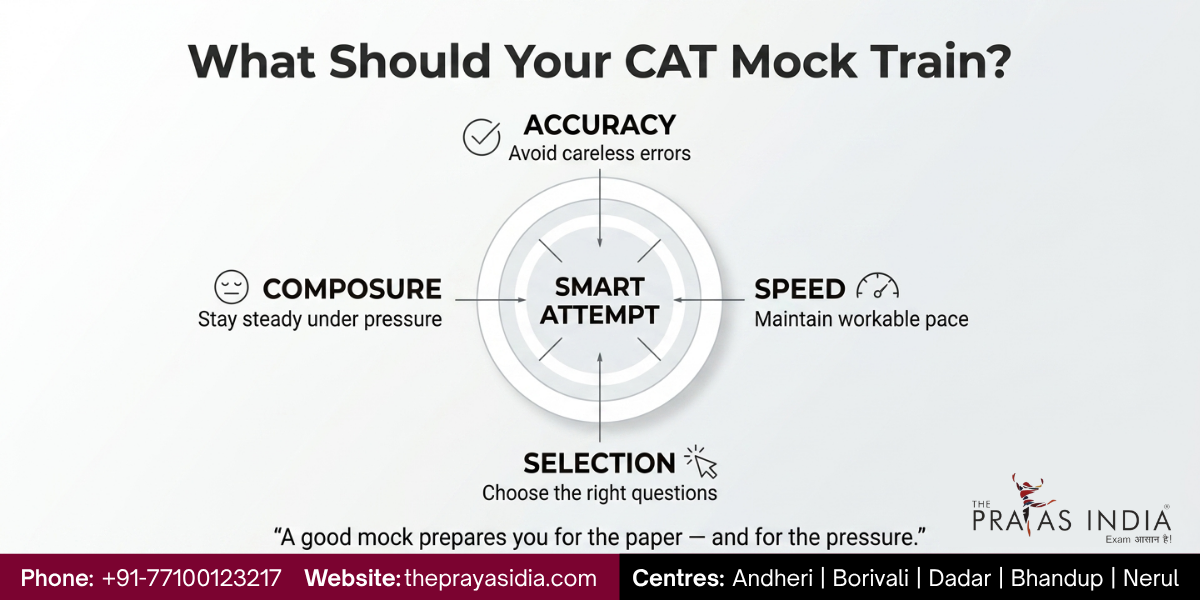
A mock should not simply be treated as a source of questions. It should also be used to practise sitting continuously, managing section-wise time, handling difficult questions and recovering from an unexpected situation.
For example, suppose you encounter a very difficult question early in a mock. Instead of becoming frustrated, use the situation to practise moving on. If a section feels harder than expected, practise maintaining your strategy rather than allowing the difficulty of the first few questions to influence your entire attempt.
Over time, these experiences create familiarity. The difficult situation is no longer completely new when it appears in the actual CAT.
This is one reason quality mock analysis is as important as mock-test frequency.
Your First Few Questions Should Not Decide Your Mood
The opening minutes of CAT can have a disproportionate psychological impact.
If the first few questions appear easy, a candidate may become overconfident and attempt too aggressively. If the first few questions appear difficult, the candidate may immediately assume that the entire section is going badly.
Both reactions can be problematic.
CAT does not require you to solve the paper in the exact order in which it appears. The examination rewards effective selection, not emotional attachment to individual questions.
If a question appears time-consuming or unclear, moving ahead is not a sign of weakness. It is a strategic decision.
A candidate should be able to tell themselves:
“This question is not working for me right now. I will move on and return if time permits.”
That simple decision can prevent one difficult question from consuming valuable time and damaging confidence.
A Better Mental Model: CAT Is a Decision-Making Test
CAT tests concepts and problem-solving ability, but it also demands continuous decision-making.
At every stage, you are deciding:
Should I attempt this?
Can I solve it within a reasonable time?
Should I leave it for later?
Is my answer sufficiently certain?
Am I spending too much time on one problem?
These decisions become particularly important under pressure.
Instead of thinking of the CAT paper as a challenge where you must solve as many questions as possible, think of it as a limited-time decision-making exercise.
You have limited time and multiple opportunities to score. Your responsibility is to use those opportunities intelligently.
This mindset can reduce the emotional pressure attached to individual questions.
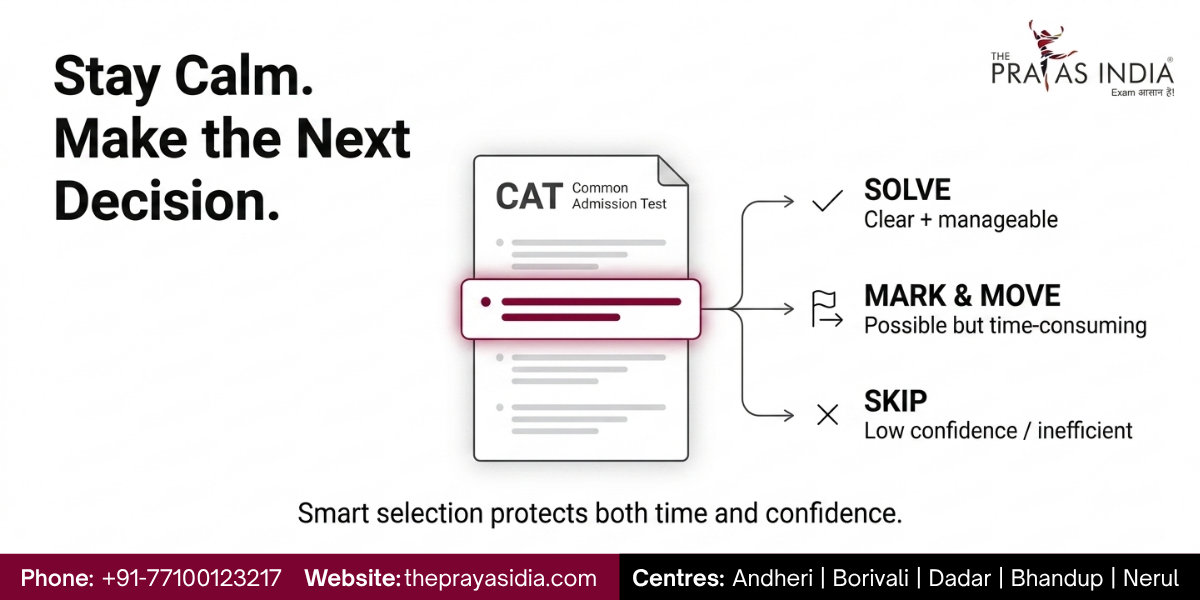
What to Do When a Section Feels Difficult
One of the most uncomfortable CAT situations is entering a section and realising that it appears much harder than expected.
The immediate reaction can be panic: “I prepared so much, but I cannot solve these questions.”
Before allowing that thought to influence your attempt, remember that perceived difficulty is not necessarily a disadvantage that affects only you. If a section is genuinely difficult, it may be difficult for many candidates.
Your focus should remain on identifying the questions that are most accessible to you.
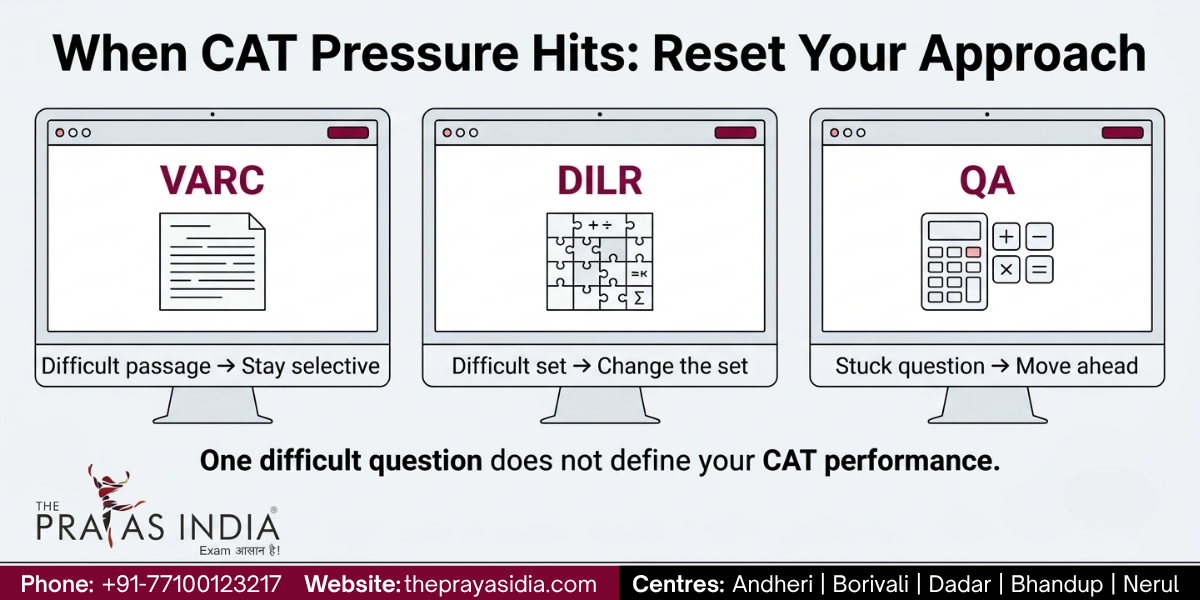
For example, in VARC, a difficult passage does not mean every passage must be attempted immediately. In DILR, one challenging set does not mean the entire section is unmanageable. In QA, a few unfamiliar questions should not force you to abandon your strategy.
The candidate who remains selective can still find scoring opportunities even when the paper feels difficult.
The 30-Second Reset Technique
During CAT, you may occasionally notice that you are rushing, rereading questions without understanding them or repeatedly checking the timer.
That is a signal to reset.
You do not need a complicated relaxation technique. A short mental reset can be enough.
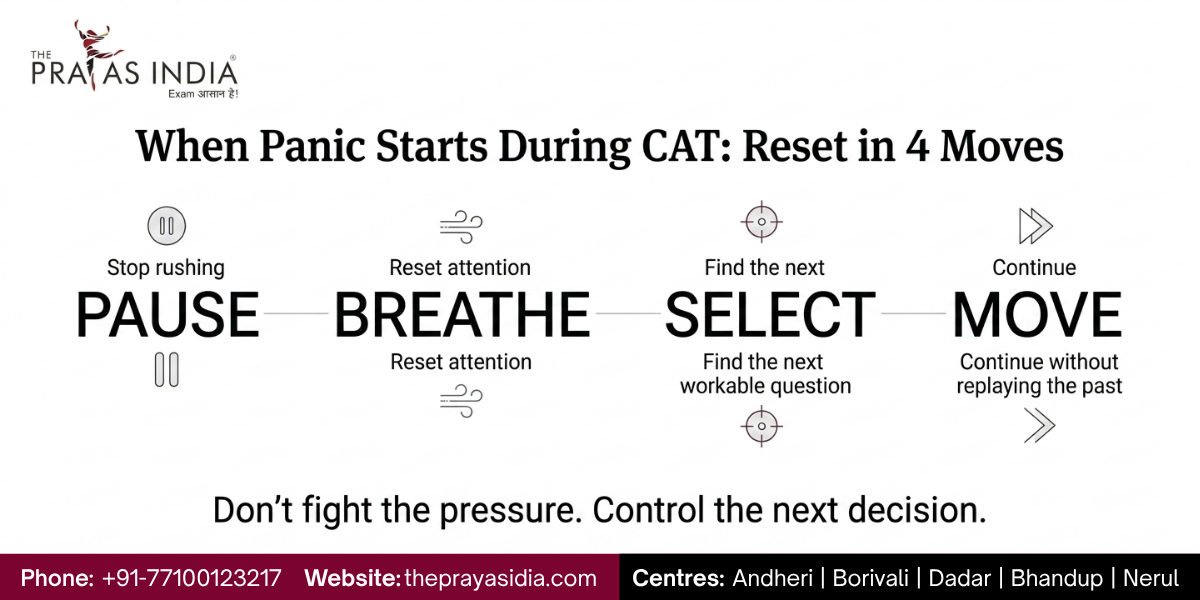
Pause for a few seconds. Take one slow breath. Move your attention away from the previous question and focus only on the question currently in front of you.
The purpose is not to spend valuable examination time trying to become completely relaxed. It is simply to interrupt the chain of unproductive thoughts.
A useful internal instruction is:
“Forget the previous question. Read this one fresh.”
This helps prevent one mistake from becoming a sequence of mistakes.
Do Not Keep Checking Your Overall Performance During the Test
Another source of panic is mentally calculating your score while the examination is still underway.
Candidates may start thinking:
“I have attempted only this many questions.”
“My accuracy must be low.”
“What if this is not enough for a good percentile?”
These calculations rarely improve the next question.
During the test, your job is not to predict your percentile. Your job is to make the best decision available right now.
Score evaluation belongs after the examination. During the test, attention should remain on selection, solving, accuracy and time management.
This distinction can help protect mental energy.
Why Mock Tests Should Include Mental Preparation
Many students analyse mocks only from an academic perspective. They record their score, check wrong answers and identify weak topics.
That is useful, but incomplete.
After each mock, ask yourself how you behaved under pressure.
Did you panic when the first set was difficult?
Did you spend too much time trying to rescue one question?
Did your speed drop after making an error?
Did you start rushing near the end?
Did you keep checking the timer?
Did you abandon your selection strategy because the paper looked different from what you expected?
These observations can reveal behavioural weaknesses that normal score analysis may miss.
Once identified, they can be deliberately practised in subsequent mocks.
Pressure Can Affect Every CAT Section Differently
Different sections can trigger different forms of anxiety.
VARC
Pressure in VARC may arise when a passage feels difficult or when reading speed appears slower than usual. The solution is not necessarily to read faster. It is to maintain comprehension and select questions carefully.
DILR
DILR can create pressure when the first set appears complicated. The key is to avoid becoming emotionally committed to a single set. If another set offers a better opportunity, move there.
Quantitative Aptitude
QA pressure often comes from seeing familiar-looking questions that do not immediately produce a solution. Instead of forcing the question, assess whether another question offers a better return on time.
The underlying principle remains the same across sections:
Do not let one difficult question dictate your entire section strategy.
Turning CAT Anxiety Into Preparation
The most effective way to reduce examination anxiety is to replace uncertainty with familiarity.
You cannot predict exactly what questions will appear in CAT. You cannot guarantee that every section will feel comfortable. You cannot control the difficulty level of the paper.
But you can control your preparation for those situations.
You can practise what to do when the first question is difficult. You can practise moving between DILR sets. You can practise skipping lengthy QA questions. You can practise maintaining composure after making an error. You can practise working through a difficult passage without assuming that the entire section is going badly.
Every such experience adds another layer of familiarity.
Eventually, the difficult situation becomes something you have already practised handling.
Build a Pre-Exam Routine That Reduces Uncertainty
The final few days before CAT should not become a period of frantic learning.
Aspirants often create unnecessary pressure by trying to learn new concepts at the last minute, taking too many mocks or comparing their preparation with others.
The final phase should instead focus on maintaining confidence in the strategy that has already been developed.
A stable routine can include revision of important concepts, light practice, review of common mistakes and adequate rest. The objective is to reach the examination with a clear mind rather than an exhausted one.
The more predictable your routine becomes, the fewer unnecessary decisions you need to make during the final days.
Do Not Compare Your CAT Preparation With Someone Else’s
Comparison can be particularly damaging during the final phase.
One student may be scoring exceptionally well in mocks while another may have a different preparation background, attempt strategy or target.
The relevant question is not:
“Is someone else scoring more than me?”
The more useful question is:
“Is my own performance becoming more consistent?”
Look at your accuracy, question selection, time management and ability to recover from difficult situations.
Improvement in these areas indicates meaningful progress even when the overall score does not increase dramatically every time.
Key Takeaway
Handling CAT exam pressure is not about becoming completely fearless. It is about developing a preparation system that allows you to think clearly when the paper becomes uncomfortable.
The strongest candidates are not necessarily those who never feel pressure. They are often the ones who know how to respond when pressure appears.
If a question is difficult, move on.
If a section feels unusual, stay selective.
If you make a mistake, reset.
If the timer creates anxiety, return your attention to the current decision.
And if your mock score fluctuates, analyse the reason instead of allowing one result to define your confidence.
For students preparing for CAT with the goal of securing admission to leading management institutes, these skills can be developed through consistent practice, realistic mock tests, performance analysis and structured guidance.
The First Few Minutes: Avoid the Emotional Trap
The beginning of the CAT examination can influence your mindset for the rest of the section. This is why the first few minutes should be approached with discipline rather than excitement or fear.
If the initial questions look easy, avoid becoming overconfident and attempting everything without evaluating the time required. If the opening questions look difficult, avoid assuming that you are underprepared.
Give yourself a few moments to understand the nature of the section. Look for questions that appear approachable and begin building momentum through sensible selections.
Your objective is not to prove yourself on the first question. Your objective is to build a productive rhythm.
A steady beginning can be more valuable than an aggressive one.
What If You Make a Mistake?
Every CAT aspirant should expect to make some mistakes during the examination. Even strong candidates can misread a question, make a calculation error or spend longer than expected on a problem.
The important question is what happens next.
A common mistake is to keep thinking about the error. A candidate may mentally replay the previous question while already attempting the next one. This divides attention and increases the likelihood of another mistake.
Instead, treat the error as closed.
You cannot recover the time already spent, but you can protect the remaining time. Tell yourself:
“That question is over. The next decision matters more.”
This simple mental habit can prevent one mistake from becoming several.
How to Recover From a Bad Start
Sometimes an aspirant may realise that the first 10–15 minutes have not gone according to plan. Perhaps too much time was spent on one question, several questions were left unanswered or the section seems harder than expected.
This is exactly when panic can become dangerous.
Do not try to compensate emotionally by suddenly increasing your speed. Rushing can lead to misreading, careless calculations and poor question selection.
Instead, reset your strategy.
Look at the remaining questions with fresh attention. Identify the most approachable opportunities and focus on them. If your original plan needs modification, make the change deliberately rather than impulsively.
A bad beginning does not automatically mean a bad section.
The ability to recover is itself an important test-taking skill.
Use Breathing as an Attention Reset
When anxiety increases, physical tension can affect concentration. A candidate may start reading too quickly, breathing irregularly or feeling restless.
A short breathing reset can help bring attention back to the task.
You do not need a lengthy exercise during the examination. Simply pause briefly, take a slow breath and deliberately shift your attention to the screen.
The purpose is not to spend valuable examination time relaxing. The purpose is to break the cycle of:
Panic → Rushing → Mistake → More Panic
and replace it with:
Pause → Refocus → Decide → Continue
This technique should be practised during mocks rather than introduced for the first time on CAT day.
Don’t Let the Timer Become Your Opponent
The CAT timer is necessary, but constantly monitoring it can create unnecessary stress.
Some candidates check the timer after almost every question. Instead of helping them manage time, it makes them increasingly conscious of how much time has passed.
A better approach is to establish broad time checkpoints during preparation and use mocks to understand your natural pace.
You should know whether you are roughly on track without repeatedly interrupting your concentration.
The exact strategy may differ depending on your section and personal strengths, but the principle remains the same:
Use the clock as a planning tool, not as a source of panic.
Practise Pressure Drills During Mocks
If you want to stay calm during CAT, practise being uncomfortable before CAT.
Instead of making every mock a comfortable practice session, occasionally introduce pressure drills.
For example, after completing several normal mocks, practise a mock where you deliberately focus on recovering from a difficult beginning. Another time, pay special attention to how you respond when your preferred DILR set appears difficult.
You can also practise maintaining your strategy after making an early mistake.
The objective is not to create unnecessary stress. It is to develop behavioural familiarity with difficult situations.
When the actual examination produces a similar situation, your mind has already experienced it.
Analyse Your Mental Performance After Every Mock
CAT mock analysis should go beyond marks and percentile.
After each test, ask yourself a few behavioural questions.
Did I panic after seeing a difficult question?
Did I spend too long trying to solve something because I had already invested time in it?
Did I abandon my planned strategy?
Did I become overconfident after a few easy questions?
Did I rush near the end?
Did I repeatedly check the timer?
Did one mistake affect my next few decisions?
These questions can reveal patterns that may not appear in the conventional mock-analysis report.
If you repeatedly lose composure in a particular situation, that situation should become part of your next practice cycle.
Build Confidence Through Evidence, Not Positive Thinking Alone
Confidence is often discussed as if it can simply be created by telling yourself that you will perform well. In reality, sustainable confidence usually comes from evidence.
When you have completed enough mocks, reviewed your mistakes, improved your accuracy and repeatedly practised difficult situations, your confidence has a foundation.
You know that you have faced difficult papers before.
You know that you can recover after a mistake.
You know when to leave a question.
You know how to manage your time.
You know what your strengths are.
That kind of confidence is much more useful than simply hoping that you will remain calm on examination day.
Don’t Change Your Entire Strategy on CAT Day
The examination hall is not the right place to experiment with a completely new strategy.
You may see a different question distribution, an unfamiliar passage or a section that feels unusual. Your strategy may need small adjustments, but your fundamental approach should already have been tested through mocks.
For example, if you normally use question selection based on estimated difficulty, continue using that principle. If you have developed a particular approach for DILR set selection, rely on it unless the paper genuinely requires modification.
Last-minute experimentation can increase cognitive load and make you doubt decisions that would otherwise come naturally.
CAT day should be about execution, not strategy invention.
Create an Exam-Day Mental Checklist
A short mental checklist can help reduce unnecessary thinking during the test.
Before starting a section, remind yourself:
Read carefully.
Select intelligently.
Do not chase difficult questions.
Keep moving.
Protect accuracy.
Reset after mistakes.
This checklist is intentionally simple. Under pressure, complicated instructions are difficult to remember.
The objective is to have a few reliable principles that guide your decisions automatically.
The Role of CAT Coaching in Managing Exam Pressure
Good CAT coaching should not focus only on teaching concepts. Preparation should also expose students to realistic testing situations where they can develop speed, accuracy and decision-making ability.
Regular mocks provide opportunities to experience pressure before the actual examination. Detailed analysis can then help identify whether the issue is conceptual, strategic or psychological.
For example, a student may know how to solve a particular Quant topic but consistently leave those questions because of hesitation. Another student may have strong DILR skills but waste time on the first set they see.
These are not purely academic problems. They are test-taking behaviour problems, and they can improve through deliberate practice and feedback.
For aspirants considering the best CAT coaching in Mumbai, it is therefore useful to evaluate not just faculty and study material, but also the quality of mock testing, analysis and personalised guidance.
How The Prayas India Can Help Aspirants Build Test-Day Readiness
A structured CAT preparation programme can help students develop the combination of knowledge, practice and examination strategy required for the test.
At The Prayas India, aspirants can work towards building their preparation through concepts, practice, mock tests and performance analysis. The objective is to help students understand not just how to solve questions, but also how to approach the paper strategically.
Regular practice can make difficult situations feel more familiar. Mock analysis can identify recurring mistakes. Guidance can help students refine their attempt strategy.
For an aspirant preparing for CAT with MBA admissions as the ultimate goal, this integrated approach can help transform preparation from simply completing the syllabus into building examination readiness.
What to Do in the Final Week Before CAT
The final week should focus on stability rather than dramatic improvement.
This is not the ideal time to start collecting new resources, completely change your preparation method or attempt an exhausting number of mocks.
Instead, review your established strategy. Look at the mistakes you have made repeatedly. Revise important concepts and formulas according to your personal requirements. Continue light and purposeful practice so that your mind remains connected with the examination format.
Equally important, protect your sleep and routine.
An exhausted candidate may know the concepts but struggle to apply them efficiently. The objective is to arrive at the examination with sufficient mental energy to make decisions for the entire test.
Avoid These Psychological Mistakes on CAT Day
Several behaviours can unnecessarily increase pressure during the examination.
One is becoming emotionally attached to a question. If you have already spent several minutes on it, you may feel that leaving it means wasting the time already invested. But the time has already been spent. The relevant question is whether continuing is still worthwhile.
Another mistake is comparing your perceived performance across sections. If one section felt difficult, you may start worrying about your overall result before the test is finished.
Some candidates also allow one incorrect answer to affect their confidence. A single mistake does not determine the outcome.
Perhaps the most damaging mistake is abandoning selection strategy because of panic. When anxiety increases, candidates often start attempting questions simply because they appear familiar, without evaluating whether they are actually efficient opportunities.
Recognising these behaviours during mocks gives you the chance to correct them before CAT.
A Simple CAT Pressure-Management Framework
You do not need a complicated psychological system to manage CAT pressure.
A practical framework is:
Before the Test
Prepare your strategy and know your strengths.
During the First Few Minutes
Observe the section before committing heavily.
During the Section
Select questions based on opportunity, not ego.
After a Mistake
Close the question mentally and move forward.
When Pressure Rises
Pause briefly, breathe and return your attention to the current question.
When Time Becomes Limited
Protect accuracy and prioritise realistic scoring opportunities.
After the Test
Analyse performance without emotional judgement.
This framework is simple enough to remember and flexible enough to adapt to different CAT papers.
FAQs
1. Why do CAT aspirants panic during the exam?
CAT pressure can come from time constraints, expectations, difficult questions, mock-score comparisons and fear of losing marks. Panic often increases when an aspirant interprets one difficult question as evidence that the entire examination is going badly.
2. How can I stay calm during the CAT exam?
Focus on the current decision instead of predicting your final score. Use your tested question-selection strategy, avoid spending excessive time on difficult questions and take a brief mental reset when you notice yourself rushing.
3. What should I do if the first few CAT questions are difficult?
Do not assume that the entire section is difficult or that your preparation has failed. Evaluate the available questions and look for approachable opportunities. CAT rewards effective selection rather than solving questions in a fixed order.
4. What if I make a mistake during CAT?
Accept the mistake and move forward. Replaying the previous question can affect the next one. Your remaining questions still provide opportunities to score.
5. Can mock tests help reduce CAT exam anxiety?
Yes. Regular, realistic mocks can make the examination environment more familiar. Analysing how you behave under pressure can also help you develop better recovery and decision-making habits.
6. Should I take many CAT mocks in the final week?
More mocks are not automatically better. The focus should be on purposeful testing and analysis while maintaining sufficient rest and revision.
7. How can I stop checking the CAT timer repeatedly?
Use broader time checkpoints developed during mock practice rather than checking the clock after every question. The timer should guide your strategy without constantly interrupting your concentration.
8. Can breathing exercises help during CAT?
A brief controlled breathing reset can help you refocus when anxiety causes rushing or loss of concentration. It is best to practise this during mocks so that it feels natural during the actual test.
9. How should I recover from a bad start in CAT?
Avoid compensating by rushing. Pause, reassess the remaining questions and return to your normal selection principles. A difficult beginning does not necessarily determine the rest of the section.
10. Should I change my CAT strategy on exam day?
Avoid making major strategic changes based solely on initial impressions. Your core strategy should have been tested during mocks. Make only the adjustments required by the actual paper.
11. How does CAT coaching help with exam pressure?
A structured coaching programme can provide realistic mock tests, performance analysis, strategy guidance and repeated exposure to examination conditions. This can help aspirants develop both academic readiness and test-taking confidence.
12. Is CAT exam pressure normal?
Yes. Feeling some nervousness before a high-stakes examination is normal. The goal is not to eliminate every feeling of anxiety but to prevent it from affecting decision-making and performance.
Final Takeaway
CAT exam pressure cannot always be avoided, but it can be prepared for.
The aspirant who has practised difficult situations, analysed mock-test behaviour and developed a reliable selection strategy is better positioned to remain functional when the paper becomes unpredictable.
Remember that you do not need to solve every question.
You do not need every section to feel easy.
You do not need to feel completely fearless.
You simply need to keep making sensible decisions under the conditions given to you.
When pressure rises, return to the basics:
Read. Select. Solve. Skip when necessary. Reset after mistakes. Keep moving.
For students preparing for CAT to secure admission to leading management institutes, structured preparation, realistic mock testing, personalised analysis and consistent practice can help build confidence that is based on actual preparation rather than guesswork.
For aspirants looking for CAT coaching in Mumbai, the right preparation environment should therefore help you develop not only conceptual strength but also the ability to perform when the clock is running.
Contact Us
- Call Now: +91-77100 13217
- Website: theprayasindia.com
- Centres: Andheri | Borivali | Dadar | Nerul | Bhandup