How to Build a CAT Strategy Based on Your Target B-School? | Best CAT Coaching in Mumbai | The Prayas India
Preparing for CAT with a generic goal of “getting a good percentile” can take you only so far. If you have a specific B-school in mind, your preparation strategy should ideally begin with that target and work backwards. The CAT percentile you need, the importance of sectional performance, the type of academic profile that may be competitive, the selection process after CAT and even the way you allocate preparation time can vary considerably from one institute to another.
This is why an aspirant targeting the IIMs may need a somewhat different approach from someone primarily targeting leading non-IIM B-schools. A candidate aiming for a particular programme should understand the admission ecosystem before deciding how much time to spend on Quantitative Aptitude, VARC and DILR, how aggressively to attempt mocks and where to set their percentile targets.
For students preparing for CAT in Mumbai, this target-oriented approach can also make coaching more meaningful. Instead of following a one-size-fits-all schedule, aspirants can use expert guidance, mock-test analysis and personalised preparation planning to understand where they currently stand and what needs to improve.
The objective is not simply to crack CAT. It is to build a profile and performance level that gives you a realistic opportunity at the B-schools you actually want to join.
Your B-School Target Should Come Before Your Study Plan
Many CAT aspirants begin with a timetable.
They decide to study for four hours every day, complete a certain number of questions and take a mock every Sunday. While these habits can be useful, they do not answer the most important strategic question: What exactly are you preparing for?
Your target B-school should influence the way you define success.
For example, if your target institutions have very high overall percentile expectations, your preparation needs to focus on building a substantial performance buffer rather than aiming for the minimum threshold. If sectional cut-offs are relevant to your target institutes, consistently neglecting one section can become a serious problem even if your overall percentile looks strong.
Before building your CAT schedule, identify:
- Your primary target B-schools
- Your realistic target percentile
- Section-wise performance requirements
- Admission criteria beyond CAT percentile
- Your current academic and profile strengths
- Areas where your profile may need stronger performance
- The likely selection stages after the CAT result
This exercise transforms CAT preparation from a generic examination routine into an admission-oriented strategy.
Not Every CAT Aspirant Needs the Same Target
There is a tendency among aspirants to compare themselves with someone else’s percentile target.
A friend may be targeting an extremely competitive IIM, while another student may be focused on a strong private B-school or a specialised management programme. Their preparation requirements do not necessarily have to be identical.
Similarly, a candidate with strong academics and another with a different academic profile may need to think differently about the overall strength of their application.
This does not mean that your profile automatically determines whether you will receive an interview call. B-school selection processes can involve multiple components and criteria, and policies can change from year to year.
The practical lesson is simpler: don’t build your preparation around somebody else’s target.
Build it around the institutes you want to compete for.
Create Three Levels of B-School Targets
A useful way to make your CAT strategy more practical is to divide your target B-schools into three levels.
Dream Targets
These are the institutes you would be extremely excited to join but where admission is highly competitive.
Your preparation target should be ambitious enough to give you a meaningful performance buffer.
Strong Targets
These are institutes where your expected CAT performance and profile make the target more realistic, while still requiring serious preparation.
These should form the core of your application strategy.
Safe or Backup Targets
These are credible alternatives that you would genuinely consider if your primary options do not work out.
The important word is genuinely. A backup college should not simply be a name added to a spreadsheet. It should offer acceptable programme quality, career opportunities, location, fees and return on investment based on your priorities.
This three-level approach helps prevent two opposite problems: setting an unrealistically narrow target or applying without any strategic direction.

Think in Terms of a Percentile Range, Not One Number
CAT preparation becomes psychologically difficult when an aspirant decides that one exact percentile will determine everything.
Instead of saying, “I need exactly 98 percentile,” think in terms of a range.
For example, you might establish:
Minimum competitive target → Preferred target → Stretch target
The exact numbers should be based on your target institutes and their current admission policies rather than a universal rule.
This gives your preparation more flexibility.
If your mock scores initially fall below the target range, you know there is a gap to close. If you consistently perform above your preferred range, you can focus more heavily on reducing section-wise volatility and improving accuracy.
A target range also prevents one bad mock from becoming an unnecessary crisis.
Understand the Difference Between CAT Cut-Offs and Actual Competition
One of the most important concepts for CAT aspirants is the difference between a published or qualifying cut-off and the level of performance that may actually make an application competitive.
Meeting a minimum eligibility threshold does not automatically mean that admission is likely.
B-schools may consider several factors during their selection process, including academic performance, work experience, diversity-related components, CAT performance and subsequent selection stages, depending on the institute’s policy.
Therefore, your strategy should not be based solely on the question:
“What is the minimum percentile required?”
A more useful question is:
“What performance level should I target to give myself the strongest realistic opportunity?”
That distinction can change the way you prepare.
Work Backwards From the Admission Goal
Once you know your target B-schools, work backwards.
Suppose your preferred institutions require an exceptionally strong CAT performance. Your preparation should then begin with that level of ambition.
From there, determine:
B-school target → Percentile target → Sectional targets → Mock performance → Topic-level weaknesses → Daily preparation
This creates a logical chain.
Instead of randomly completing chapters, you can ask whether each part of your preparation is contributing to your target outcome.
For example, if your VARC performance is already consistently strong but DILR accuracy is unstable, spending additional hours on already-mastered VARC concepts may produce less improvement than targeted DILR practice.
Your preparation time should follow your performance gaps, not simply the order in which chapters appear in a book.
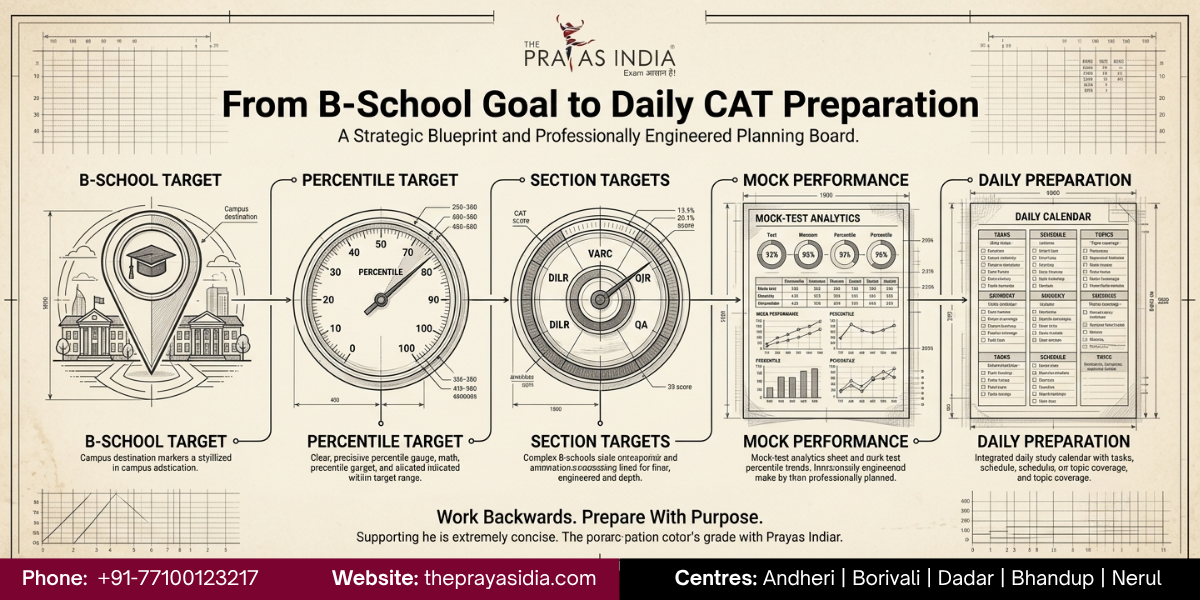
Build Section-Wise Targets
CAT is not a single-subject examination.
Your overall performance is built from VARC, DILR and QA, and your target B-schools may also have sectional requirements.
This means that a strategy based exclusively on overall percentile can be risky.
For each section, identify three levels:
- Current performance: Where are you scoring now?
- Required performance: What level is needed for your target?
- Buffer performance: What score should you aim for so that one difficult section does not derail your overall result?
The third category is often overlooked.
If your strategy is designed only to barely cross a sectional threshold, a difficult paper or an unusually poor section on test day can create problems.
A performance buffer provides some protection against variation.
Your Strongest Section Should Not Become an Excuse
Suppose VARC is your strongest section.
It can be tempting to spend most of your study time there because solving questions feels comfortable and scores come more easily.
But CAT preparation should not simply maximise your favourite section.
If your target B-school has sectional requirements, your weakest section can become the limiting factor.
Your strongest section should therefore be used as a scoring advantage while your weaker section receives enough attention to become reliable.
The goal is not necessarily to make all three sections equally strong.
The goal is to prevent any one section from becoming a serious liability.
Diagnose Your Starting Point Before Making a Timetable
A timetable created without understanding your current level is mostly guesswork.
Before beginning an intensive preparation plan, take a diagnostic test or a CAT-level mock under proper examination conditions.
Do not worry excessively about the initial score.
The purpose of the first test is diagnosis.
Analyse:
- Which questions did you solve correctly?
- Which questions consumed too much time?
- Which topics created uncertainty?
- Where did you make avoidable errors?
- Which questions did you leave despite having the ability to solve them?
- Which section showed the greatest volatility?
This gives you a starting map.
A candidate scoring well in QA but struggling with DILR should not receive the same preparation plan as someone with the opposite profile.
CAT Strategy Should Be Dynamic
Your CAT strategy should not remain unchanged for six or eight months.
As your preparation progresses, your strengths and weaknesses will change.
A topic that initially required significant attention may eventually become one of your strongest areas. Another topic may appear manageable during practice but repeatedly cause errors in mocks.
Your strategy should therefore move through stages.
Stage 1: Foundation
Understand concepts, build basic familiarity and identify weak areas.
Stage 2: Application
Increase question-solving volume and begin working on different difficulty levels.
Stage 3: Selection
Learn which questions to attempt and which to leave.
Stage 4: Simulation
Take full-length mocks under realistic conditions.
Stage 5: Refinement
Use mock analysis to improve timing, accuracy and decision-making.
This progression is more useful than following exactly the same daily routine throughout the year.
VARC Strategy Should Reflect Your Reading Profile
VARC preparation is often reduced to “read more.”
Reading is certainly important, but your CAT strategy should go beyond that.
You need to understand how you personally perform across reading comprehension and verbal ability questions.
Some aspirants read quickly but miss important logical details. Others understand passages accurately but spend too much time on them. Some candidates perform well in familiar topics but struggle with dense or abstract passages.
Your preparation should identify these patterns.
Regular reading can help improve comprehension and familiarity with different writing styles, but it should be supported by CAT-level question practice and analysis.
After every RC set, ask yourself not only whether the answer was correct but why you selected it.
Was the option directly supported by the passage? Did you infer too much? Did you eliminate the correct answer because of a minor wording difference?
This kind of analysis gradually improves decision-making.
DILR Requires Selection Skills as Much as Solving Skills
DILR can be one of the most unpredictable areas of CAT preparation because the difficulty of individual sets can vary.
For this reason, preparation should not focus exclusively on solving difficult sets.
You should also learn to identify the sets that are worth attempting.
During practice, expose yourself to different set structures and gradually develop an understanding of how much information processing a set requires.
During mocks, pay attention to:
- Time required to understand a set
- Number of questions available within the set
- Complexity of calculations
- Clarity of the information provided
- Your confidence after the initial setup
A successful DILR strategy is not necessarily about solving the maximum number of sets.
It is about choosing the right sets and executing them accurately.
QA Preparation Should Be Built Around Your Target
Quantitative Aptitude often creates a different challenge because the syllabus contains multiple topics with varying levels of importance and difficulty.
Instead of trying to master every topic immediately, classify them according to your current ability.
You can broadly divide topics into:
Strong: High accuracy and reasonable speed.
Developing: Conceptually understood but inconsistent in application.
Weak: Low accuracy or limited conceptual familiarity.
Low Priority: Topics where the expected return from additional time is currently limited.
This classification should evolve.
A weak topic should not remain permanently weak simply because you labelled it that way in the first month. Reassess it after structured practice.
The ultimate objective is to build enough command across high-value areas to maximise your score while maintaining the ability to identify and skip time-consuming questions.
Your Mock Strategy Should Be Designed Backwards Too
Many aspirants decide to “start mocks” at a particular point in the calendar.
A more useful approach is to decide what you want mocks to accomplish.
Early mocks can help diagnose weaknesses.
Middle-stage mocks can help build consistency.
Later mocks should increasingly simulate the pressure and decision-making of the actual examination.
After every mock, divide your analysis into four questions:
What should I continue doing?
What should I stop doing?
What should I improve?
What should I learn next?
This turns every mock into a strategic feedback session.
Simply recording your percentile and moving to the next test wastes one of the most valuable sources of information in CAT preparation.
Admission-Focused Preparation Is More Than a CAT Score
CAT is a major component of the B-school admission journey, but it is not necessarily the entire journey.
Depending on the institute, the selection process may involve academic record, work experience, diversity factors, written assessments, interviews and other criteria.
Therefore, a smart aspirant should not wait until CAT results are declared to start thinking about the next stage.
As your target list becomes clearer, start understanding the broader admission process as well.
This can help you identify what else deserves attention.
For example, if you have a strong CAT preparation routine but have never considered how you will explain your academic choices, work experience, career goals or reasons for pursuing an MBA, you may be leaving an important part of your preparation until too late.
How CAT Coaching Can Support a Target-Based Strategy
Preparing for CAT independently is entirely possible, but the challenge is often not access to information. The internet provides an enormous amount of preparation material.
The challenge is selection, structure and feedback.
For aspirants looking for the best CAT coaching in Mumbai, the quality of the preparation ecosystem matters. Good coaching should not simply provide lectures and question banks. It should help students understand where they stand, identify weaknesses, practise at the appropriate difficulty level and use mock-test performance to improve.
The Prayas India can provide a structured environment for CAT aspirants through guided preparation, practice and exam-focused support.
For a candidate pursuing a specific B-school goal, the value of coaching can be particularly relevant when preparation becomes personalised. Instead of blindly following a fixed schedule, students can use performance data and expert feedback to make better decisions about where to invest their preparation time.
Choosing CAT Coaching Based on Your Target
When evaluating CAT coaching in Mumbai, don’t judge an institute only by the number of classes or study hours it offers.
Think about whether its system can support your actual objective.
Consider:
- Quality and experience of faculty
- CAT-level study material
- Section-wise preparation
- Mock-test quality
- Detailed mock analysis
- Doubt-solving support
- Personalised feedback
- Revision strategy
- Guidance for the broader admission process
- Batch structure and learning environment
A candidate targeting a highly competitive B-school may need a preparation system that places considerable emphasis on mock analysis and performance refinement.
Another aspirant may need stronger foundational support.
The best coaching environment is therefore not simply the one with the most content. It is the one that helps your preparation move toward your target.
Don’t Confuse More Preparation With Better Preparation
Aspirants often respond to low mock scores by increasing their study hours.
Sometimes that is necessary.
But sometimes the problem is not insufficient effort. It is inefficient effort.
If you spend three hours studying a topic that contributes very little to your actual weakness while ignoring the reason behind repeated mock-test errors, additional study time may not produce meaningful improvement.
Target-based preparation asks a different question:
Where will my next hour of preparation create the greatest improvement?
That could mean revising a weak QA concept, practising DILR selection, analysing RC mistakes or simply reviewing patterns from previous mocks.
Efficiency becomes increasingly important as the CAT examination approaches.
Build Your Strategy Around the B-School, But Prepare for CAT First
Targeting a B-school does not mean trying to predict every admission criterion or changing your entire CAT preparation around one institute.
CAT remains the central examination you need to prepare for.
The target B-school provides the direction.
It tells you how ambitious your percentile goal should be, how important sectional consistency may be, how much performance buffer you want and what broader admission preparation you should eventually consider.
Your preparation then translates that direction into daily actions.
That is the difference between studying for CAT and preparing strategically for the B-school journey.
The First Step Is to Define Your Target Clearly
Before downloading another study plan or signing up for another mock series, write down your target B-schools.
Then research their current admission criteria and understand the role of CAT performance within the broader selection process.
From there, create your percentile range and section-wise goals.
Finally, compare those targets with your diagnostic performance.
That gap is where your preparation strategy begins.
A strong CAT strategy is not a static timetable pinned to a wall. It is a system that changes as your performance changes while remaining aligned with your ultimate B-school objective.
Turn Your B-School Target Into a Preparation Roadmap
Once you have identified your target B-schools and understood the level of performance you are aiming for, the next step is to convert that information into a practical preparation roadmap.
This is where many CAT aspirants struggle. They know which colleges they want, but their daily preparation does not clearly connect with that goal. They study chapters, take occasional mocks and consume preparation content without measuring whether their performance is moving toward the required level.
A target-based roadmap solves this problem by creating milestones.
Your roadmap should answer four questions: where you are today, where you need to reach, what is preventing you from getting there and how you will measure improvement.
Instead of simply saying that you will “prepare seriously for CAT,” define measurable checkpoints for concepts, question-solving accuracy, sectional performance and mock-test scores.
Divide the Preparation Year Into Strategic Phases
A long CAT preparation journey becomes easier to manage when it is divided into phases rather than treated as one continuous period.
Foundation Phase
The first objective is to understand concepts and identify your strengths and weaknesses. Don’t rush toward full-length mocks if your fundamentals are still developing.
Application Phase
Once the basics are reasonably comfortable, move toward mixed question practice. This is where conceptual knowledge needs to become usable under time pressure.
Performance Phase
Begin taking sectional tests and full-length mocks more regularly. The emphasis shifts from learning concepts to applying them efficiently.
Refinement Phase
Near the examination, your preparation should increasingly revolve around mock analysis, question selection, timing, accuracy and revision.
The duration of each phase can vary according to when you begin preparation and your existing aptitude level. A working professional starting later may need a more compressed roadmap, while a college student with a longer preparation window can spread the same stages over a larger period.
Set Benchmarks Instead of Depending on Motivation
Motivation is unreliable over a long preparation cycle.
A better system uses benchmarks.
For example, rather than deciding that you will “study Quant every day,” establish measurable goals such as improving accuracy in selected topics, reducing average time per question or increasing your performance in sectional tests.
Similarly, for VARC, you can track reading comprehension accuracy and the type of errors you make. For DILR, monitor set selection, completion rate and accuracy.
Benchmarks provide evidence of progress.
They also help you identify when a strategy needs modification. If your study hours are increasing but mock performance remains unchanged for several weeks, the answer may not be to study even longer. You may need to change your practice method or analyse your mistakes more deeply.
Create a Target-to-Score Dashboard
A simple performance dashboard can bring your entire CAT strategy together.
You don’t need complicated software. A spreadsheet or notebook is enough.
Track:
- Target percentile range
- Section-wise target performance
- Latest mock percentile
- Section-wise mock scores
- Accuracy percentage
- Questions left due to time
- Major recurring mistakes
- Topics requiring revision
- Previous mock performance
- Current improvement trend
The value of this dashboard comes from observing trends rather than obsessing over individual scores.
One difficult mock does not define your CAT preparation. However, a repeated pattern of low accuracy in one section deserves attention.
Your dashboard should therefore answer a more useful question than “What percentile did I get?”
It should tell you whether your preparation is moving in the right direction.
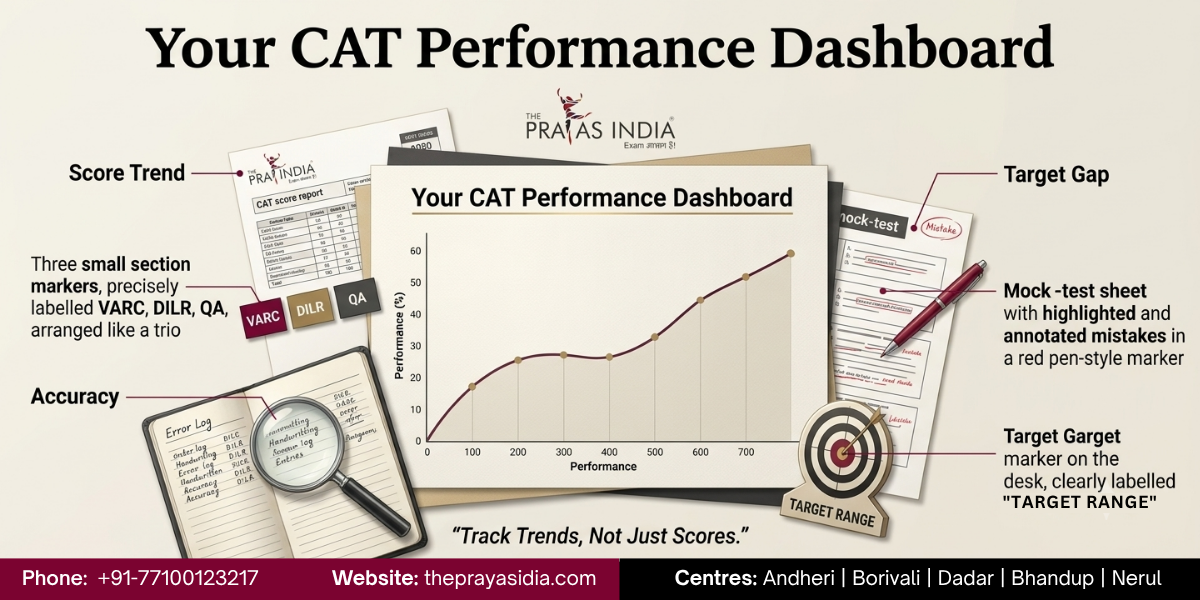
Learn to Interpret Mock Scores Correctly
A mock score is feedback, not a verdict.
CAT mock tests can vary in difficulty, and your performance can fluctuate for several reasons. A lower percentile than expected does not automatically mean that your preparation has failed.
Instead, analyse the paper.
Perhaps you attempted too many uncertain questions. Maybe you spent too long on one DILR set. Perhaps your QA selection was inefficient. Or your VARC errors came from choosing options based on assumptions rather than the passage.
The analysis should therefore go beyond the scorecard.
A useful post-mock review can classify every major error into:
Conceptual Error: You did not know how to solve it.
Application Error: You knew the concept but could not apply it.
Selection Error: You chose the wrong question or set.
Time-Management Error: You spent too long.
Accuracy Error: You made an avoidable mistake.
Decision Error: You attempted when you should have skipped.
This classification makes mock analysis far more actionable.
Your Target B-School Determines How Much Risk You Can Take
Question selection is an important part of CAT strategy.
However, the amount of risk you are willing to take should also depend on your target.
If you are already consistently performing at your desired level, unnecessary experimentation can sometimes hurt more than help.
On the other hand, if your scores are significantly below your target, you may need to identify where additional attempts or stronger section-wise performance can improve your overall result.
The objective should never be “attempt as many questions as possible.”
The objective is to maximise your expected score through a combination of selection, accuracy and time management.
Don’t Build Your Strategy Around One Mock
One of the most common mistakes is changing the entire strategy after every mock.
You take a test, perform badly in one section and immediately decide that your entire preparation plan is wrong.
Then you take another test, perform better and change it again.
This creates instability.
Instead, evaluate performance over multiple tests.
Look for repeated patterns. If the same weakness appears across several mocks, it deserves strategic attention. If something happens once, it may simply be normal performance variation.
A stable strategy should be adjusted based on evidence, not emotion.
Build a Section-Wise Improvement Loop
Each CAT section requires a slightly different improvement mechanism.
For VARC, focus on comprehension quality, option analysis, reading efficiency and accuracy.
For DILR, focus on set selection, structured interpretation, logical organisation and execution.
For QA, focus on conceptual clarity, question selection, calculation efficiency and accuracy.
The common loop is:
Attempt → Analyse → Identify Pattern → Practise → Retest
This is more powerful than simply increasing the number of questions you solve.
Build a Reading Habit That Supports Your CAT Goal
Reading should ideally become part of your CAT lifestyle rather than another task on a checklist.
You do not need to read only CAT material. Exposure to editorials, essays, opinion pieces, business writing, science-related articles and other forms of structured prose can help you become more comfortable with different writing styles.
However, reading should eventually connect with question practice.
Ask yourself:
What is the author’s central argument?
What assumptions are being made?
Which statement is supported by the passage?
How does the argument develop?
Why is one option better supported than another?
This turns passive reading into analytical reading.
For aspirants targeting competitive B-schools, developing this ability can be useful not only for CAT but also for the broader management admission journey.
DILR Preparation Should Include Set Selection
DILR preparation becomes more productive when you stop measuring progress only by the number of sets solved.
A candidate may solve twenty sets but still struggle in the actual examination if they cannot identify which set deserves their time.
Therefore, practice should eventually include a selection component.
After seeing a set, estimate:
- How difficult does the structure appear?
- How quickly can the information be organised?
- Are the relationships clearly defined?
- Does the set offer multiple questions?
- Is there a manageable path toward the solution?
Then compare your initial assessment with the actual difficulty.
Over time, this builds an important CAT skill: recognising opportunity under time pressure.
QA Strategy: Prioritise Return on Preparation Time
Quantitative Aptitude has enough topics to make complete mastery an inefficient short-term objective.
Your strategy should therefore consider return on preparation time.
If a topic is conceptually important, frequently tested and currently weak, improving it can produce meaningful gains.
If another topic consumes significant preparation time but continues to produce very little improvement, you may need to reconsider how much time you allocate to it.
This doesn’t mean permanently ignoring difficult topics.
It means managing preparation intelligently.
Your topic priority should evolve as your accuracy changes.
Keep Profile Preparation Running Alongside CAT
One advantage of starting with a B-school target is that it encourages you to think beyond the CAT examination.
Once your CAT preparation is stable, start gradually working on the broader admission side.
Depending on the institutes you target, this may include being prepared to discuss:
- Academic background
- Career goals
- Work experience
- Internships or projects
- Extracurricular involvement
- Reasons for pursuing an MBA
- Reasons for choosing a particular specialisation
- Awareness of business and current affairs
You don’t need to spend hours preparing interview answers months before the CAT examination.
But maintaining awareness of your own profile means you will not have to start from zero after receiving calls.
Don’t Let Coaching Replace Self-Study
Joining a CAT coaching institute can provide structure, but coaching itself does not create a percentile.
The classroom can explain concepts. Study material can provide questions. A mock series can provide performance data.
The actual improvement happens when you consistently use those resources.
This is why students evaluating the best CAT coaching in Mumbai should look beyond the number of lectures offered.
Ask whether the institute’s system encourages independent practice, analysis and improvement.
At The Prayas India, CAT aspirants can use structured academic guidance as a framework for their preparation while building their own daily practice and revision discipline.
The purpose of coaching should be to make your preparation more organised and measurable—not to make you dependent on classroom hours.
How to Use Coaching According to Your Target
Different students can use the same coaching ecosystem differently.
A beginner may need strong conceptual support.
A student with a solid foundation may benefit more from advanced problem-solving, mock analysis and strategy refinement.
A working professional may value structured scheduling and efficient practice.
Someone targeting highly competitive B-schools may need greater emphasis on performance consistency and sectional risk management.
Therefore, when considering CAT coaching in Mumbai, don’t ask only whether the institute has a syllabus.
Ask whether its teaching, testing and mentoring system can adapt to your preparation stage.
Manage CAT Preparation Alongside College or Work
A target B-school strategy must also fit into your real life.
A preparation plan that requires six or seven uninterrupted hours every weekday may look impressive on paper but become impossible for a working professional.
Similarly, a college student may have more flexibility but less consistency because of classes, examinations, internships or other commitments.
The solution is to build a sustainable minimum.
Decide what your non-negotiable CAT work will be each day and then add additional preparation when your schedule permits.
For example, on a busy weekday, you may focus on one section and a short revision session. On a lighter day, you can add a sectional test or longer practice session.
Consistency over several months matters more than maintaining an unrealistic schedule for two weeks.
Avoid the “Perfect Strategy” Trap
There is no magical CAT strategy that works identically for every aspirant.
The internet is full of claims about the ideal number of mocks, perfect daily study hours, fixed attempts and universal percentile formulas.
These can be useful as references, but they should not replace your own performance data.
Your strategy should answer:
What works for me?
That answer can change during preparation.
A strategy that works at the foundation stage may not be appropriate during the mock-heavy stage. Similarly, the approach that helps you increase your score from a lower level may not be the same approach needed to move from a strong percentile to an exceptional one.
Build a Backup Plan Without Losing Focus
Having alternative B-school options does not mean lowering your ambitions.
It means making your application strategy practical.
Research institutes based on programme quality, career outcomes, fees, location, specialisation and your personal priorities.
Keep your dream targets, but create a broader list of institutes where you would genuinely consider accepting admission.
This prevents the entire outcome of your CAT journey from depending on one institute or one interview call.
At the same time, don’t allow a long college list to distract you from CAT preparation.
The primary objective remains strong CAT performance.
The Final Months Should Focus on Conversion
As CAT approaches, preparation should gradually shift from acquisition to conversion.
You have already learned concepts.
Now you need to convert that knowledge into marks.
That means:
- Better question selection
- Higher accuracy
- Improved time management
- Stronger mock performance
- Faster recognition of familiar patterns
- Reduced careless errors
- Better emotional control during difficult sections
The final phase is less about discovering something new and more about extracting maximum performance from what you already know.
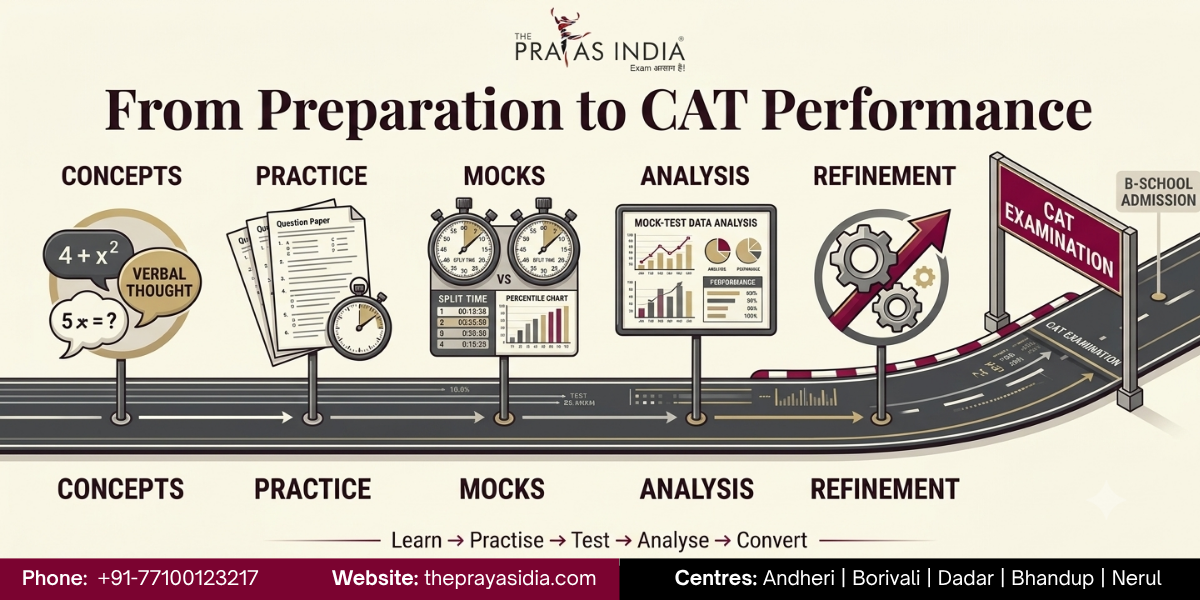
What a Target-Based CAT Strategy Ultimately Looks Like
A well-designed CAT strategy can be visualised as a continuous chain:
Target B-School
↓
Desired Performance Range
↓
Section-Wise Benchmarks
↓
Preparation Priorities
↓
Practice & Mocks
↓
Performance Analysis
↓
Strategy Refinement
↓
CAT Examination
↓
B-School Selection Process
Every stage should connect to the next.
If your daily study schedule has no connection with your target performance, it needs adjustment.
If your mock analysis does not change your preparation, it is not being used effectively.
If your target B-school list has not been researched, your percentile goal may not have enough context.
The strongest preparation systems create this connection from beginning to end.
Final Takeaway
A CAT strategy should not begin with a timetable. It should begin with a destination.
Identify the B-schools you genuinely want to target. Understand their current admission frameworks. Establish an ambitious but realistic percentile range. Convert that range into section-wise performance goals and then build your preparation around the gaps between your current performance and those targets.
As preparation progresses, let your mock-test data influence your decisions. Strengthen weak areas, protect your strong sections, learn to select questions, manage your time and revise strategically.
Most importantly, don’t confuse activity with progress. Completing another PDF, watching another lecture or taking another mock is useful only when it contributes to better performance.
For aspirants looking for CAT coaching in Mumbai, the right academic environment can provide structure, expert guidance, quality practice and performance feedback. The Prayas India aims to help students approach CAT preparation with a systematic and goal-oriented framework while keeping the larger B-school admission objective in focus.
Your target B-school should not merely be something you write at the top of your preparation notebook.
It should influence the decisions you make throughout your CAT journey.
Choose the destination first. Build the strategy around it. Then keep refining the strategy until your performance catches up with the goal.
Contact Us
- Call Now: +91-77100 13217
- Website: theprayasindia.com
- Centres: Andheri | Borivali | Dadar | Nerul | Bhandup
FAQs
1. How should I build a CAT strategy based on my target B-school?
Start by identifying your target institutes and understanding their current admission criteria. Then establish a desired percentile range, section-wise benchmarks and a preparation roadmap based on your current performance. Your strategy should evolve according to mock-test data.
2. Should I target one B-school or multiple B-schools?
It is generally more practical to create a target list rather than depend entirely on one institute. Divide your list into ambitious, strong and backup options based on your preferences and realistic competitiveness.
3. Does my target B-school affect my CAT preparation strategy?
Yes, to an extent. Different institutes can have different selection criteria and sectional expectations. Your target should therefore influence the performance buffer and section-wise consistency you aim to build.
4. How many CAT mocks should I take?
There is no universally correct number. The quality of analysis matters as much as the number of mocks. Take enough tests to build examination stamina and identify patterns, but spend sufficient time analysing and correcting mistakes after each test.
5. What should I analyse after a CAT mock?
Analyse conceptual mistakes, calculation errors, question-selection decisions, time management, accuracy and questions that you could have solved but left due to time. Look for recurring patterns rather than reacting to a single score.
6. Should I focus equally on VARC, DILR and QA?
Not necessarily. You should maintain all three sections while allocating additional time according to your weaknesses and target requirements. A strong section can provide a scoring advantage, but a weak section should not become a liability.
7. Is CAT coaching necessary for admission to a top B-school?
Coaching is not mandatory, and many aspirants prepare independently. However, structured CAT coaching can provide organised study material, expert guidance, mock tests, doubt support and performance analysis, which can be valuable for students who need a systematic preparation environment.
8. How should I choose the best CAT coaching in Mumbai?
Look beyond advertising claims. Compare faculty, study material, mock quality, analysis, doubt-solving support, mentoring, batch structure and the institute's ability to support different preparation levels. The right coaching should help you improve rather than simply provide more study material.
9. When should I start preparing for the B-school interview?
CAT preparation should remain the primary focus until the examination. However, once your preparation becomes stable, you can gradually build awareness of your academic background, career goals, work experience and current business affairs so that you are not starting from scratch after receiving calls.
10. Can working professionals follow a target-based CAT strategy?
Yes. Working professionals can use the same target-based framework but should adapt the timetable to their available hours. A sustainable daily routine with focused practice is generally more practical than an unrealistic schedule that cannot be maintained.