CAT Preparation Without Losing Momentum: How to Stay Consistent Until Exam Day | The Prayas India
Preparing for CAT is not only a test of aptitude; it is also a test of consistency. Most aspirants begin their preparation with strong motivation, ambitious study plans and clear percentile goals. The challenge usually appears several weeks or months later, when the initial excitement fades and preparation starts competing with college, work, social commitments, mock-test pressure and everyday distractions. At that stage, the difference between an inconsistent preparation cycle and a successful CAT preparation strategy often comes down to one factor: momentum.
CAT preparation is a long process involving Quantitative Ability, Data Interpretation and Logical Reasoning, and Verbal Ability and Reading Comprehension. Each section requires a different approach, and improvement rarely happens in a straight line. Some days may bring excellent mock scores, while others may expose weaknesses that can feel discouraging. Staying consistent does not mean studying for the same number of hours every day or following a perfect timetable without interruption. It means continuing to make meaningful progress even when motivation is low, scores fluctuate or the preparation journey becomes demanding.
For CAT aspirants targeting a high percentile, consistency becomes particularly important as the examination approaches. The final months should not be treated as a period of panic-driven preparation. They should be used to strengthen concepts, improve question selection, analyse mocks, revise strategically and develop the decision-making ability required on the actual exam day. A sustainable preparation routine allows students to enter the examination with confidence built through repeated practice rather than last-minute effort.
The Real Challenge in CAT Preparation Is Staying Consistent
Many students assume that the most difficult part of CAT preparation is understanding difficult Quant questions or solving complex DILR sets. While these can certainly be challenging, maintaining a routine over several months is often a bigger test. Students frequently start with a detailed timetable that allocates several hours to every section, multiple practice sessions and regular mock tests. The schedule looks excellent on paper but becomes difficult to maintain in real life.
When the timetable is too ambitious, missing one day can create a sense of failure. The student then tries to compensate by studying for unusually long hours the following day. This creates fatigue, reduces concentration and makes the routine even harder to sustain. Eventually, preparation becomes a cycle of overworking, falling behind and restarting.
A better approach is to create a preparation system that can survive imperfect days. A student who studies consistently for a manageable amount of time is likely to make more progress than someone who follows an intense schedule for a few days and then stops completely. CAT preparation should therefore be built around repeatable habits rather than temporary bursts of motivation.
Consistency also does not mean giving equal attention to every topic every day. Your priorities should change as your preparation progresses. Early preparation may require more time for concept building, while the middle phase can focus on sectional practice and mixed questions. Closer to CAT, mock tests, revision, analysis and exam strategy should become increasingly important.
Set a CAT Preparation Routine That You Can Actually Follow
The first step towards maintaining momentum is creating a realistic daily and weekly routine. Instead of asking, “How many hours can I study when everything goes perfectly?”, ask, “What amount of preparation can I realistically maintain even on a busy day?”
This simple change in thinking can make a major difference. A college student may have lectures, assignments and examinations, while a working professional may have unpredictable work schedules. Their CAT preparation routines cannot be identical. The objective should be to create a structure that fits your existing responsibilities instead of creating a timetable that ignores them.
A practical routine can divide preparation into focused blocks. For example, one session can be dedicated to Quantitative Ability, another to VARC practice, and selected days can include DILR sets or mock-test analysis. The exact number of hours matters less than whether the routine is sustainable.
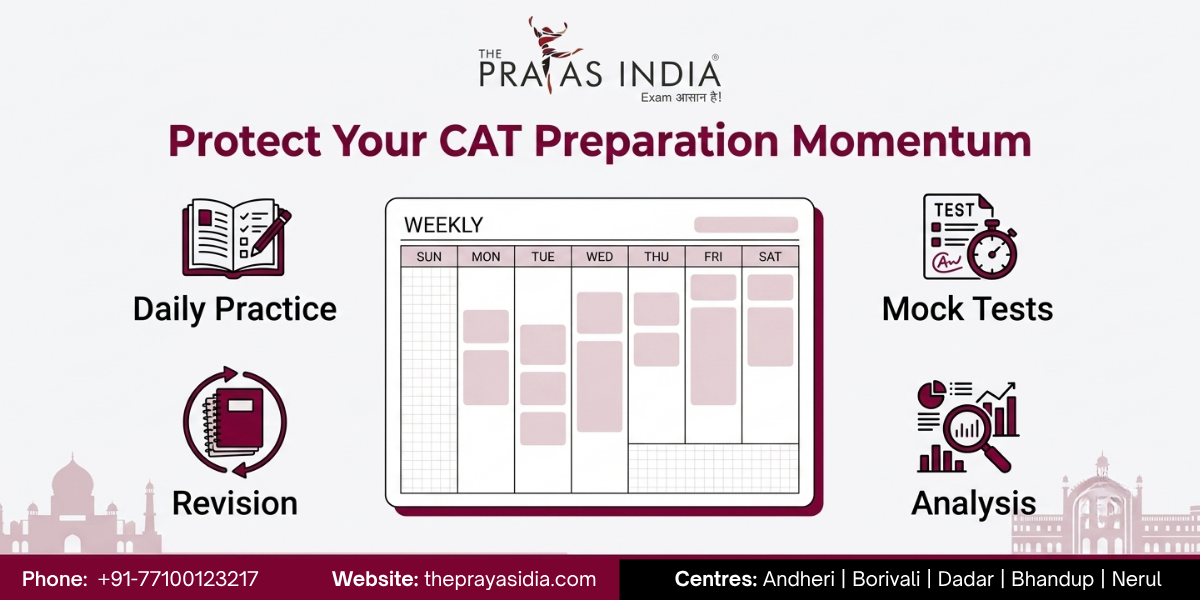
Weekly planning is also more useful than constantly creating new daily schedules. At the beginning of the week, identify the topics you want to complete, the number of questions or sets you want to solve, the sectional tests you want to attempt and the mock or analysis sessions you need to schedule. Once these priorities are clear, individual days can be adjusted around your academic or professional commitments.
The most important principle is simple: build a routine that is difficult to break but easy to restart.
Use Minimum Daily Targets to Protect Your Momentum
One of the most effective ways to avoid long preparation gaps is to create a minimum daily target. This is the amount of CAT preparation you commit to completing even on a difficult day.
Your minimum target could be something as simple as solving a small set of Quant questions, completing one DILR set, reading for a fixed period or analysing a few mistakes from a previous mock. On a productive day, you can obviously do much more. The minimum target exists to ensure that a busy or low-energy day does not turn into a complete break from preparation.
This approach is particularly useful during the later stages of CAT preparation. As the examination gets closer, students sometimes become overwhelmed by the amount of revision still left. Instead of studying, they spend time worrying about what they have not completed. Breaking the workload into small, measurable tasks can reduce that pressure.
A minimum target also creates psychological continuity. When you continue interacting with CAT-level questions every day, the preparation process remains part of your routine. You do not have to rebuild your study habit after every break.
Stop Measuring Preparation Only by Study Hours
Study hours are an easy metric to track, but they do not always represent the quality of CAT preparation. Someone may spend five hours sitting with books but solve very few meaningful questions. Another student may spend three focused hours solving questions, analysing errors and revising concepts, and make considerably more progress.
Instead of tracking only time, track outcomes. Ask yourself how many questions you solved, how accurately you solved them, which concepts you revised, how many DILR sets you attempted, how your VARC accuracy is changing and whether your mock-test analysis is identifying recurring mistakes.
This shift is particularly important for aspirants preparing alongside college or employment. A student who has limited time should not feel that preparation is ineffective simply because another aspirant studies for more hours. What matters is whether the available time is being used intelligently.
A simple weekly progress tracker can include four areas: concepts completed, practice completed, tests attempted and mistakes identified. This gives you a clearer picture of progress and helps you identify where your preparation is actually improving.
Create a System for Difficult Days
Every serious CAT aspirant will have difficult days. There may be days when a mock score falls unexpectedly, a DILR set refuses to open up, Quant accuracy drops or personal responsibilities leave very little time for preparation. The mistake is to interpret one difficult day as evidence that the entire preparation strategy is failing.
Instead, create a fallback routine for such situations. If you cannot complete your normal study schedule, reduce the workload rather than abandoning it completely. Spend some time revising formulas, reading an article, solving a small set of questions or reviewing previous mistakes. The goal is not to achieve maximum productivity every day; it is to prevent temporary setbacks from becoming long gaps.
This is also where emotional discipline becomes important. CAT preparation naturally involves fluctuations in performance. A low score should be treated as information rather than a final judgment on your ability. The right question is not “Why am I performing badly?” but “What does this result tell me about what I need to improve?”
Once this mindset becomes habitual, mock-test scores and difficult practice sessions become part of the learning process rather than reasons to stop.
Avoid the Trap of Constantly Changing Your Strategy
Another major reason students lose momentum is strategy switching. They begin with one preparation plan, then watch a new strategy video, read a different study plan or compare their preparation with another aspirant. Within a few days, they change books, resources, schedules and even their approach to individual sections.
Some flexibility is necessary, but constant switching can create confusion. CAT preparation requires repetition and familiarity. If you keep changing resources before completing them, you may accumulate information without developing enough practice.
Choose reliable preparation resources and give your strategy enough time to produce measurable results. If your mock analysis shows that something is not working, make a specific adjustment rather than rebuilding your entire preparation system.
For example, if your VARC accuracy is consistently weak, identify whether the issue is reading comprehension, question selection, interpretation or time management. If DILR is the problem, determine whether you struggle with set selection, calculations, logical structuring or incomplete practice. If Quant accuracy is falling, identify the relevant topic areas and error patterns.
Targeted correction is far more effective than repeatedly starting over.
Build Consistency Through Weekly Goals
Daily targets help maintain momentum, but weekly goals provide a broader sense of direction. A weekly CAT preparation plan should contain a limited number of meaningful objectives rather than an unrealistic list of everything you want to complete.
For example, one week could focus on completing selected Arithmetic concepts, practising a set number of VARC passages, solving several DILR sets and taking one sectional test. The following week can build on those areas while introducing revision and mixed practice.
Weekly goals also make it easier to accommodate unexpected events. If one day becomes unavailable, you can redistribute the work across the remaining days instead of feeling that the entire schedule has collapsed.
At the end of each week, spend a few minutes reviewing your progress. Identify what was completed, what remains unfinished and what caused the delay. This simple review can help you continuously improve your preparation routine.
The objective is not to achieve a perfect week every week. The objective is to understand your preparation well enough to keep moving forward.
Make Mock Tests Part of Your Routine, Not a Source of Fear
Mock tests become increasingly important as CAT approaches, but students often make one of two mistakes. Some avoid mocks because they are worried about low scores, while others take too many mocks without analysing them properly.
A mock test should be treated as a diagnostic tool. The score tells you where you currently stand, but the analysis tells you how to improve. After every mock, examine incorrect answers, unanswered questions, questions that consumed too much time and questions where you used an inefficient approach.
Also pay attention to decision-making. CAT is not simply about knowing how to solve questions. It is about deciding which questions to attempt, which ones to leave and how much time to allocate to different sections.
A consistent mock-analysis cycle can therefore become one of the strongest habits in your preparation. As your exam date approaches, this habit helps transform practice into a more realistic understanding of your strengths, weaknesses and test-taking behaviour.
Protect Your Motivation by Measuring Progress Against Yourself
CAT preparation becomes mentally exhausting when students constantly compare their performance with others. A friend may score higher in a mock, someone online may claim to study ten hours a day, or another aspirant may appear to have completed the syllabus much earlier.
These comparisons rarely provide useful information because every student starts with a different academic background, preparation timeline and set of strengths and weaknesses.
A better benchmark is your own previous performance. If your accuracy has improved, if you can solve DILR sets more efficiently, if your reading speed has increased or if your mock-test decisions are becoming better, you are making progress.
Maintaining a record of these improvements can also be useful during difficult phases. CAT preparation is long enough that students sometimes forget how much they have improved since they started. Reviewing earlier mock scores, error logs and completed topics can provide a realistic picture of progress.
Consistency Matters More as CAT Gets Closer
The final phase of CAT preparation should not be about trying to learn everything from scratch. It should be about consolidating what you already know and converting preparation into performance.
As the exam approaches, your routine should gradually become more focused on mock tests, sectional practice, revision, error analysis and question-selection strategy. New topics can still be addressed where necessary, but they should not completely replace revision and testing.
The final weeks are also when consistency becomes particularly valuable. A student who has maintained regular practice throughout the preparation period is more likely to enter the exam with familiarity with different question types, realistic expectations about time pressure and a clearer understanding of personal strengths and weaknesses.
The goal is not to arrive at exam day having solved every possible CAT question. The goal is to arrive prepared enough to make good decisions under pressure.
The Right Preparation Environment Can Help Sustain Momentum
Individual discipline remains central to CAT preparation, but the right preparation environment can make consistency easier. Structured classes, regular practice schedules, faculty guidance, doubt-solving support and mock-test analysis can help students avoid the uncertainty that often comes with completely self-directed preparation.
This can be particularly valuable for students who struggle to maintain a routine independently or who are unsure how to respond when their preparation stops progressing. A structured CAT coaching programme can provide an external framework while still allowing students to develop their own study habits.
For aspirants looking for CAT coaching in Mumbai, the important consideration should not simply be the number of classes offered. Students should evaluate the overall preparation system: quality of teaching, practice material, mock-test support, doubt resolution, feedback, faculty accessibility and the extent to which the programme helps them identify and correct weaknesses.
The right coaching environment should complement your effort, not replace it. Consistency still comes from the student, but a structured system can make that consistency easier to maintain.
Build a Preparation Roadmap That Changes With Your CAT Journey
Consistency does not mean following exactly the same study routine from the beginning of CAT preparation until exam day. Your priorities should evolve as your understanding of the syllabus, question types and personal performance becomes clearer. A good preparation roadmap therefore changes gradually instead of forcing you to follow one rigid schedule for several months.
In the early stage, the focus should be on building fundamentals. Quantitative Ability requires conceptual clarity across important topics, while VARC demands regular reading and practice. DILR needs exposure to different types of sets and the ability to identify patterns. During this phase, students should resist the temptation to focus only on mock-test scores. The objective is to build the foundation that will later support speed and accuracy.
The middle phase should gradually shift towards application. Once important concepts have been covered, practice should become more varied. Mixed-question sets, sectional tests and timed practice can help students understand how well they can apply concepts under pressure. This is also the stage where error analysis should become a regular habit.
The final phase should focus heavily on testing, revision and decision-making. Instead of continuously adding new resources, students should consolidate the material they have already studied. Mock tests, sectional tests, revision notes and error logs become increasingly valuable because they reveal whether preparation is translating into actual exam performance.
A Simple CAT Preparation Progression
| Preparation Stage | Primary Focus | Key Activities |
|---|---|---|
| Foundation | Concepts | Learn fundamentals and build basics |
| Development | Application | Topic-wise and mixed practice |
| Testing | Performance | Sectional tests and mocks |
| Refinement | Accuracy | Analyse errors and improve strategy |
| Final Phase | Exam Readiness | Revision, mocks and question selection |

What to Do When You Fall Behind in CAT Preparation
Falling behind is not unusual. Students miss study sessions because of college examinations, work deadlines, family responsibilities, health, travel or simply because their original timetable was unrealistic. The biggest mistake is allowing a temporary delay to become a permanent break.
When you realise that you are behind schedule, do not attempt to complete everything simultaneously. First, identify the topics that are most important and the areas where your performance is currently weakest. Then divide the unfinished work into manageable categories: essential, important and optional. This allows you to protect the core of your preparation while accepting that not every resource or topic needs equal attention.
Avoid trying to recover lost time by suddenly doubling your daily study hours. This may work for a few days, but it can quickly create fatigue. Instead, increase your workload gradually and use your weekends or less demanding days for additional practice.
Most importantly, restart immediately. You do not need to wait for Monday, the beginning of a new month or the “perfect” schedule. A missed week becomes much less damaging when preparation resumes quickly.
Maintain an Error Log Throughout Your Preparation
An error log is one of the simplest tools that can improve CAT preparation over time. Every mistake does not need a lengthy explanation. The purpose is to identify patterns.
For Quant, record the concept involved and the reason for the mistake. Was the formula forgotten? Was the calculation incorrect? Did you misunderstand the question? Did you use a longer method when a simpler approach was available?
For DILR, note whether the difficulty came from interpreting the set, selecting the right starting point, managing calculations or spending too much time before deciding to leave the set.
For VARC, analyse whether an error came from misunderstanding the passage, choosing an extreme option, overlooking a qualifier or making an assumption that was not supported by the text.
Over several weeks, the error log can become a personalised revision resource. Instead of repeatedly revising everything, you can focus on the mistakes that actually occur in your preparation.
Do Not Let Mock Scores Decide Your Confidence
Mock-test scores can have a powerful psychological impact. A strong score can create confidence, while a sudden drop can make an aspirant question the entire preparation strategy. Neither reaction is ideal.
A mock is a snapshot of performance on one particular day. It is useful because it provides data, but it should not become the sole measure of your potential.
Instead of asking only whether your percentile increased, examine the reasons behind the result. Did you attempt too many difficult questions? Did you spend excessive time on one DILR set? Did your VARC accuracy fall because of poor question selection? Did calculation errors affect Quant?
This analysis turns a score into actionable information.
Over time, your objective should be to identify recurring weaknesses and eliminate them one by one. A student whose score improves because of better decision-making is developing a more valuable skill than someone who simply gets a higher score through a particularly easy mock.
Develop a Consistent Mock-Test Analysis Routine
Taking a mock test requires time, but analysing it properly requires additional time and concentration. Students should therefore schedule mock analysis as part of the test itself rather than treating it as optional work.
After completing a mock, first review questions that you got wrong. Then look at questions you left unanswered but could potentially have solved. Finally, review questions where you spent too much time even if you eventually answered them correctly.
This third category is often overlooked. In CAT, a correct answer obtained after spending too much time may still represent a strategic problem. Your preparation should therefore improve not just accuracy but also efficiency.
Create three simple categories in your analysis:
Solved Correctly: Questions and approaches that are working.
Solved Incorrectly: Concepts or decisions that need correction.
Could Have Solved: Questions that were missed because of time, selection or hesitation.
This makes mock analysis easier to repeat and prevents it from becoming an overwhelming exercise.
Protect the Final Months From Resource Overload
As CAT gets closer, aspirants are exposed to an increasing number of preparation resources. New books, online videos, test series, strategy discussions and social-media advice can make students feel that they are missing something important.
This can damage consistency because students repeatedly abandon their existing routine to try something new.
The final months should instead be about consolidation. Identify the resources you trust, complete them properly and use your mock performance to decide where additional practice is required. You do not need ten different explanations for the same concept if one reliable explanation has already helped you understand it.
The same principle applies to study plans. A new timetable may look more productive, but changing schedules repeatedly does not automatically improve preparation. The value lies in following a workable plan long enough to produce measurable results.
Your Final 30 Days Should Be About Refinement
The final month before CAT should be treated differently from the beginning of preparation. By this point, most aspirants should have a reasonably clear understanding of their strengths, weaknesses and preferred exam strategy.
The focus should shift towards full-length mocks, sectional tests, revision and detailed analysis. Important formulas, shortcuts, concepts and recurring mistakes should be revised regularly. VARC preparation should continue through reading and practice, while DILR should involve exposure to varied sets rather than repeatedly solving only familiar formats.
Quant preparation during this stage should prioritise accuracy and question selection. Instead of trying to complete every remaining topic, identify the areas where additional effort is most likely to improve performance.
The final 30 days are also an ideal time to experiment with exam strategy during mocks. Determine how you want to distribute time, how quickly you want to move away from an unproductive question and how you will approach each section. The aim is to reduce uncertainty before the actual exam.
The Last Seven Days: Reduce, Do Not Expand
During the final week, many students make the mistake of increasing their workload dramatically. They attempt to cover new topics, watch hours of strategy videos and take multiple tests because they feel that there is still something left to do.
A better approach is controlled revision.
Review your important formulas, error log, frequently missed concepts and mock-test observations. If you have identified a particular question-selection strategy that works for you, reinforce it rather than experimenting with something completely new.
Your sleep schedule should also remain stable. CAT requires sustained concentration, and sacrificing sleep for additional study hours can negatively affect attention and decision-making.
The final week should create familiarity and confidence, not exhaustion.
Avoid These Consistency Mistakes Before CAT
Several preparation habits repeatedly cause students to lose momentum. The first is creating unrealistic schedules. A timetable that requires perfect discipline every day is not a practical timetable.
The second is studying according to mood. Motivation naturally fluctuates, so preparation cannot depend entirely on feeling motivated. A routine should tell you what to do even when motivation is low.
The third is avoiding difficult sections. Students sometimes spend more time practising subjects they enjoy because the experience feels productive. Improvement, however, often requires deliberately working on weaker areas.
The fourth is taking mocks without analysis. Mock scores alone cannot tell you exactly what needs improvement.
The fifth is comparing your preparation constantly with other aspirants. Your preparation should be driven by your own performance data.
Finally, do not confuse being busy with being productive. Watching preparation videos for several hours may feel like studying, but solving questions, analysing mistakes and revising weak areas usually provide more measurable value.
Create a CAT Preparation System You Can Sustain
The strongest CAT preparation strategy is rarely the one with the most complicated timetable. It is the one that can be followed consistently over a long period.
A sustainable system can be built around five habits: regular practice, weekly planning, mock tests, error analysis and revision. These habits provide structure without making preparation unnecessarily complicated.
Your daily routine can change depending on your schedule, but the underlying system should remain stable. If you have more time on one day, practise additional questions. If you have less time, complete your minimum target. If a mock score falls, analyse it. If a topic remains weak, revise it. If you miss a day, restart the next day.
This approach transforms CAT preparation from a series of motivational bursts into a continuous process.
How Structured CAT Coaching Can Support Consistent Preparation
Self-study can work extremely well for students who are disciplined, understand the CAT syllabus and know how to evaluate their own performance. However, many aspirants struggle not because they lack ability but because they lack structure.
A structured CAT coaching programme can provide a defined preparation path, classroom or online instruction, practice material, regular tests, doubt-solving support and feedback. This can reduce the time students spend deciding what to study next and allow them to focus more directly on preparation.
For students considering CAT coaching in Mumbai, the decision should be based on the complete learning system rather than simply the number of classes or advertised features. Evaluate whether the programme provides sufficient practice, quality mock tests, detailed analysis, faculty support and personalised guidance.
The Prayas India can be considered by aspirants looking for a structured approach to CAT preparation in Mumbai. A coaching environment can be particularly useful for students who want regular academic guidance, a defined preparation schedule and support throughout the preparation journey.
However, coaching should be viewed as a support system rather than a substitute for personal effort. The final result depends on how consistently the student attends classes, practises questions, analyses performance and acts on feedback.

Build Momentum Today Instead of Waiting for Motivation
CAT preparation becomes easier to sustain when students stop expecting motivation to remain constant. Motivation can help you begin, but routine is what keeps preparation moving.
There will be productive days and difficult days. There will be mocks where everything seems to work and others where your performance falls unexpectedly. There may be periods when your schedule becomes difficult to manage. None of these situations automatically mean that your preparation is failing.
The objective is to keep returning to the process.
Set realistic daily targets. Review your progress every week. Practise consistently. Analyse your mistakes. Take mocks seriously. Adjust your strategy when the data tells you to. Most importantly, avoid repeatedly starting from zero.
For aspirants targeting CAT 2026, the preparation journey should be viewed as a long-term performance-building process rather than a race against the calendar. The students who maintain momentum, learn from their mistakes and steadily refine their strategy are better positioned to make their preparation count when exam day arrives.
Final Takeaway
Consistency in CAT preparation does not mean studying for a fixed number of hours every single day. It means maintaining continuity, even when the pace changes. A realistic routine, measurable goals, regular testing and disciplined analysis can help you stay on track without depending on constant motivation.
As CAT approaches, the focus should gradually move from learning more to performing better. Concepts need to become application skills, practice needs to become speed and accuracy, and mock tests need to become opportunities for strategic refinement.
If you are preparing for CAT in Mumbai and want a structured learning environment, selecting the right coaching programme can provide additional direction and accountability. The key, however, remains the same: start with a realistic plan, follow it consistently, measure your progress and keep improving until exam day.
Contact Us
- Call Now: +91-77100 13217
- Website: theprayasindia.com
- Centres: Andheri | Borivali | Dadar | Nerul | Bhandup
Frequently Asked Questions
1. How can I stay consistent during CAT preparation?
Create a realistic routine with achievable daily and weekly targets. Track practice, mock tests and mistakes instead of focusing only on study hours. Most importantly, restart quickly after missed days instead of allowing a short break to become a long gap.
2. How many hours should I study for CAT every day?
There is no universal number of hours that works for every aspirant. The right duration depends on your preparation level, academic or professional commitments and remaining time before CAT. Consistency and productive practice are more important than simply counting hours.
3. What should I do if I fall behind in CAT preparation?
Identify the most important unfinished topics, prioritise them and create a realistic recovery plan. Avoid trying to compensate by dramatically increasing study hours. Restart immediately and gradually bring your preparation back on track.
4. How important are mock tests for CAT preparation?
Mock tests are extremely useful for understanding your current performance, time management and question-selection strategy. Their value increases significantly when you analyse incorrect, unanswered and time-consuming questions after every test.
5. Should I change my CAT preparation strategy frequently?
Frequent strategy changes can disrupt consistency. Choose reliable resources and give your approach enough time to work. Make targeted changes based on your mock-test performance rather than changing everything after every setback.
6. When should I increase mock-test frequency?
As your fundamentals become stronger and CAT gets closer, mock tests can gradually become a larger part of your preparation. The exact frequency should depend on your preparation level and, more importantly, whether you have enough time to analyse each test properly.
7. Is CAT coaching necessary for consistent preparation?
Not necessarily. Some students can maintain an effective self-study routine. However, structured coaching can provide a defined preparation schedule, expert guidance, practice material, mock tests and feedback, which may be valuable for students who need additional structure.
8. How can The Prayas India help with CAT preparation?
The Prayas India provides a structured preparation environment for CAT aspirants, with academic guidance, practice and test-based preparation. Students considering CAT coaching can evaluate the programme based on their individual preparation needs, learning style and goals.