How to Prepare for CAT 2027 While Working: A Practical Study Plan for Working Professionals | The Prayas India
Preparing for CAT 2027 while working full-time can feel challenging, but it is entirely possible with a realistic study schedule, consistent practice and the right preparation strategy. Working professionals have one major advantage over many full-time aspirants: they already have experience managing deadlines, solving problems under pressure and working within structured routines. The challenge is to convert limited daily time into productive CAT preparation.
Unlike students who may be able to dedicate several hours every day to preparation, working professionals often have to balance office responsibilities, commuting, meetings, deadlines and personal commitments. This makes time management for CAT preparation one of the most important parts of the journey.
The good news is that you do not necessarily need to study for six or eight hours every day. A consistent 2–3 hours on weekdays and focused study sessions on weekends, combined with regular mock tests and analysis, can create a sustainable preparation system when started well in advance.
For CAT 2027 aspirants, starting early also provides another advantage: you can build your fundamentals gradually instead of trying to complete the entire syllabus under pressure.
This guide explains how to prepare for CAT 2027 while working, how to create a practical weekday and weekend routine, how to divide time between VARC, DILR and QA, when to start mock tests, how to use online coaching effectively and how The Prayas India can support working professionals through structured CAT preparation.
Why Working Professionals Need a Different CAT Preparation Strategy
A working professional should not simply copy the timetable of a full-time CAT aspirant.
Your preparation plan needs to account for your working hours, commute, energy levels and professional responsibilities. A timetable that looks impressive on paper but cannot be followed after a long workday will eventually become difficult to sustain.
The goal should therefore be consistency rather than maximum daily study hours.
For example, studying for two focused hours after work four or five days a week can be more useful than planning five hours every weekday and regularly failing to complete the schedule.
Working professionals should build their CAT preparation around three principles:
- Small but consistent weekday sessions
- Longer and deeper weekend sessions
- Regular testing and performance analysis
This approach allows you to keep progressing without completely disrupting your professional life.
How Much Time Do You Need for CAT 2027 While Working?
There is no fixed number of hours that guarantees success in CAT. Your required study time depends on your current level, target, strengths, weaknesses and the amount of time available before the examination.
For someone beginning CAT 2027 preparation well in advance, a practical starting structure can look like this:
| Day | Suggested CAT Preparation |
|---|---|
| Monday | 1.5–2 hours |
| Tuesday | 1.5–2 hours |
| Wednesday | 1.5–2 hours |
| Thursday | 1.5–2 hours |
| Friday | 1–1.5 hours |
| Saturday | 3–4 hours |
| Sunday | 3–5 hours |
This does not mean every aspirant must follow these exact timings. The important point is to create a schedule that you can realistically maintain.
If your work schedule is unpredictable, use a weekly target system instead of depending entirely on fixed daily hours.
For example, you could set weekly targets such as:
QA: 3 concepts + 80–100 questions
DILR: 8–10 sets
VARC: 5–6 RC practice sessions + verbal practice
Mocks: 1 test when you reach the appropriate preparation stage
Analysis: Detailed analysis of every mock
This makes your preparation more flexible.
Start CAT 2027 Preparation With a Diagnostic Test
Before creating a long-term CAT study plan, understand your current level.
Take a diagnostic test or an initial mock without worrying too much about the score.
The purpose is not to predict your final CAT performance.
Instead, identify:
- Which QA topics you already understand
- Which topics require foundational work
- How comfortable you are with Reading Comprehension
- Whether you can identify DILR sets efficiently
- How quickly you solve questions
- How accurately you answer
- Where you lose time
- Which question types make you uncomfortable
This creates a baseline.
Once you know your starting point, you can allocate preparation time more intelligently.
For example, a working professional with a strong quantitative background but weak reading speed should not spend exactly the same amount of time on every section.
CAT 2027 Preparation Strategy for Working Professionals
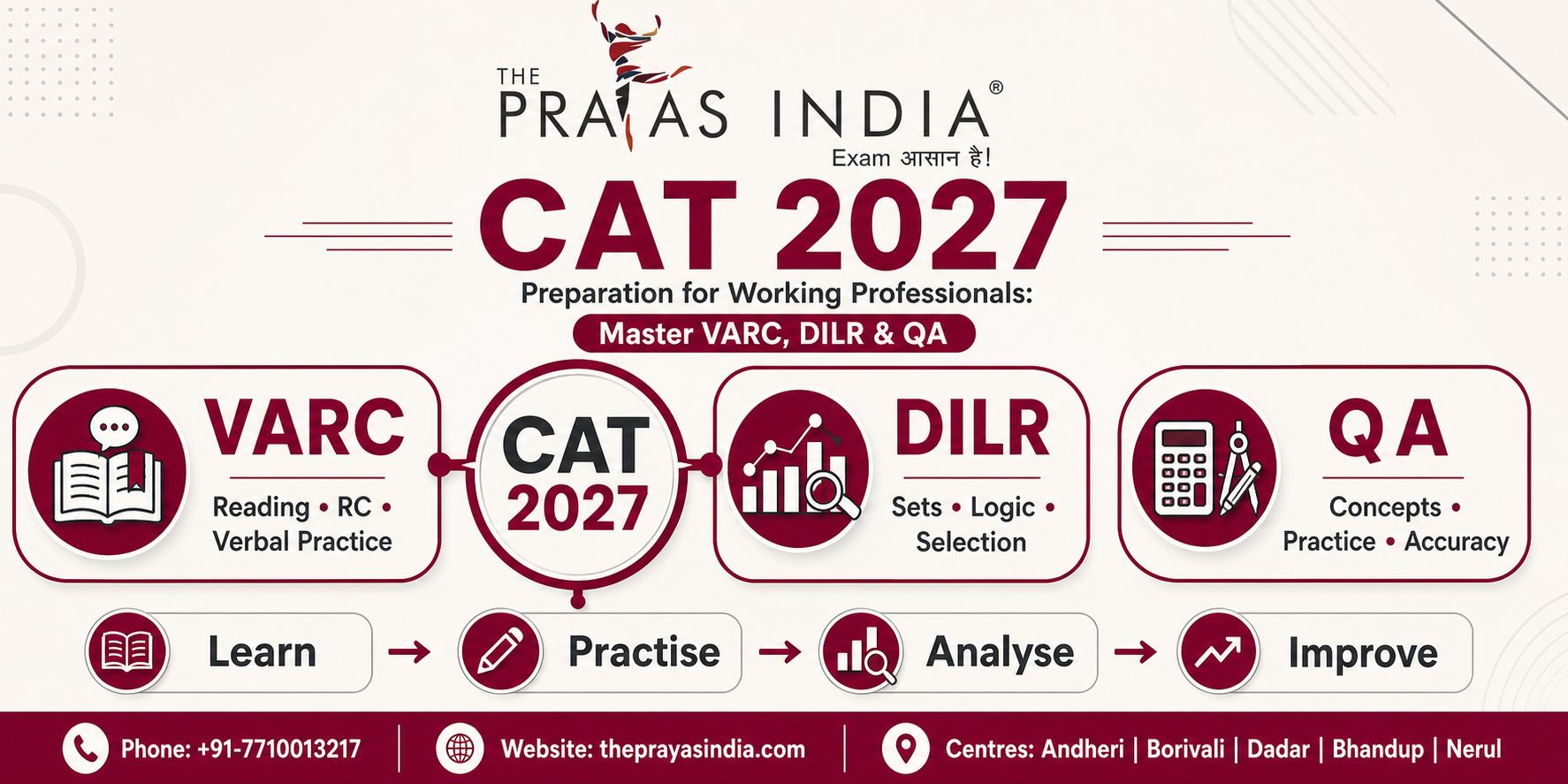
CAT preparation broadly revolves around three sections:
VARC — Verbal Ability and Reading Comprehension
DILR — Data Interpretation and Logical Reasoning
QA — Quantitative Ability
The three sections require different approaches.
VARC: Build a Daily Reading Habit
VARC can be particularly suitable for working professionals because reading practice can be incorporated into smaller time slots.
You can use short periods during the day for reading, provided your work environment and commute allow it.
Read consistently across different subjects and writing styles. The objective is to become comfortable understanding arguments, identifying the central idea, distinguishing between supporting and contradictory information and following complex passages.
For CAT preparation, do not restrict yourself to only exam-specific passages.
Develop a broader reading habit through:
- Editorials
- Essays
- Business and economic articles
- Science and technology articles
- Philosophy and psychology-related writing
- History and culture
- Social and political analysis
During dedicated study sessions, move from reading to timed RC practice.
The important transition is:
Read → Understand → Analyse → Solve → Review
DILR: Focus on Set Selection and Practice
DILR often requires more than knowing a particular formula or concept.
You need to identify how information is structured, determine what the set is asking and decide whether it is worth attempting.
Working professionals should therefore practise DILR consistently instead of postponing it until the final months.
Even one or two quality sets on a weekday can contribute to gradual improvement.
During weekends, solve multiple sets under timed conditions.
After solving a set, do not immediately move to another one. Understand:
- Why you selected the set
- Whether your initial approach was correct
- Where you got stuck
- Whether another arrangement would have been faster
- How much time you spent
- Whether the set was actually worth attempting
This is how DILR preparation moves beyond simply solving more questions.
QA: Build Fundamentals Before Chasing Speed
Quantitative Ability can become difficult for working professionals who have been away from mathematics for several years.
Do not begin by attempting the most difficult questions.
Start by rebuilding your fundamentals.
Important areas commonly associated with CAT QA preparation include:
- Arithmetic
- Algebra
- Geometry
- Number System
- Modern Mathematics
Within these broad areas, develop conceptual understanding first and then gradually increase difficulty.
Your progression should be:
Concept → Basic Questions → Application → Mixed Practice → Timed Practice
If a concept is weak, spending another 20 minutes understanding it properly may be more productive than attempting 30 questions without understanding the underlying method.
Build Your CAT Preparation Around Your Work Schedule
One of the biggest mistakes working professionals make is treating office hours and preparation hours as completely separate worlds.
Instead, build a realistic system around your existing routine.
For example, if you leave for work at 8:30 AM and return at 7:30 PM, attempting to study for four hours every evening may not be sustainable.
A better structure could be:
Morning: 30–45 minutes of reading or revision
During suitable breaks/commute: Vocabulary or reading-based practice where practical
Evening: 60–90 minutes of focused QA or DILR
Weekend: Longer practice sessions, revision and mock analysis
The exact schedule will depend on your job.
A person working fixed hours can maintain a different schedule from someone working shifts or travelling frequently.
The important thing is to protect a few consistent preparation windows every week.
A Practical Weekday CAT Routine for Working Professionals
A weekday schedule can be kept simple.
Monday — QA
Spend the main session learning or revising one QA concept and solving practice questions.
Tuesday — VARC
Complete RC practice and review your incorrect answers.
Wednesday — DILR
Solve selected DILR sets and analyse your approach.
Thursday — QA
Continue QA practice, preferably focusing on a different concept or a previously weak area.
Friday — VARC + Revision
Keep Friday relatively lighter if your workweek is demanding. Complete reading practice and revise what you studied during the week.
The purpose of the weekday schedule is continuity.
You do not have to complete a huge number of questions every day.
How to Use Your Weekends for CAT Preparation
Weekends provide the opportunity to do the deeper work that may not be practical on weekdays.
A possible structure is:
Saturday
Session 1: QA concept building
Session 2: DILR practice
Session 3: VARC practice
Sunday
Session 1: Mixed practice
Session 2: Mock test or sectional test, depending on your preparation stage
Session 3: Test analysis and revision
Avoid turning the entire weekend into a marathon of random questions.
A structured weekend with defined objectives is much more productive.
How to Manage CAT Preparation During Busy Work Weeks
Some weeks will inevitably become difficult.
You may have:
- A project deadline
- Client meetings
- Business travel
- Extended working hours
- Personal commitments
- Unexpected work pressure
Do not abandon CAT preparation completely during such weeks.
Instead, switch to maintenance mode.
For example, instead of your normal two-hour session, complete:
- 20–30 minutes of reading
- 5–10 QA questions
- One DILR set
- Short revision
The objective is to maintain continuity.
Once your workload becomes normal again, return to your regular schedule.
This prevents the common cycle of:
Busy Week → No Study → Guilt → Overloaded Timetable → Burnout → Another Break
A sustainable CAT plan should be flexible enough to survive busy weeks.
CAT 2027 Preparation Timeline for Working Professionals
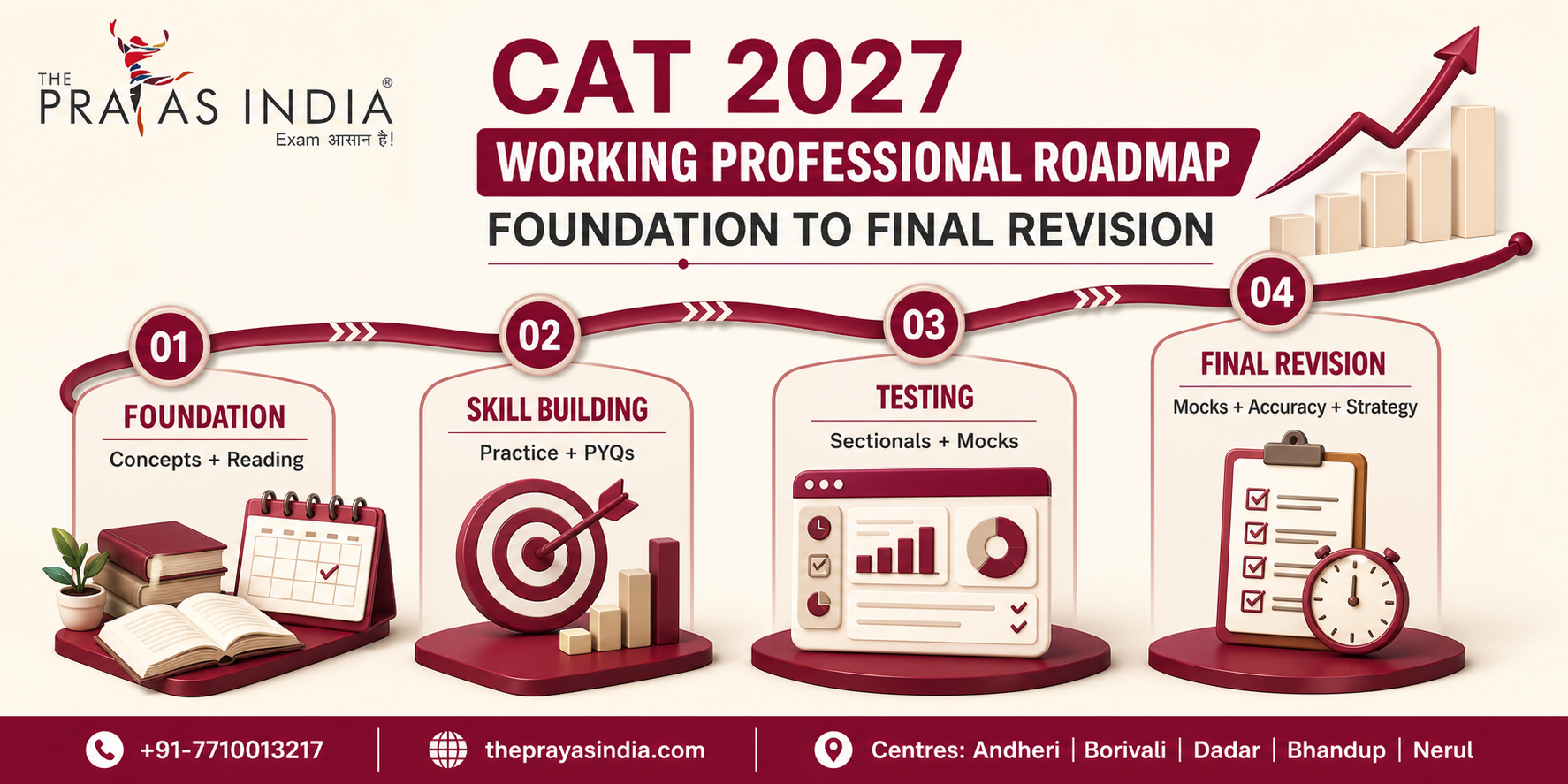
Starting early allows you to divide CAT preparation into phases.
Phase 1: Foundation
Focus on understanding concepts and building a study habit.
Prioritise:
- QA fundamentals
- Reading habit
- Basic VARC practice
- DILR fundamentals
- Previous CAT questions
Phase 2: Skill Building
Once the basics become stronger, increase:
- Question difficulty
- DILR set variety
- Timed practice
- Sectional tests
- Previous-year question practice
Phase 3: Testing and Analysis
Move progressively towards:
- Sectional tests
- Full-length mocks
- Time management
- Question selection
- Accuracy improvement
- Detailed mock analysis
Phase 4: Final Revision
The final stage should focus on:
- Revision
- Mocks
- Weak areas
- Previous mistakes
- Time management
- Maintaining accuracy
Starting early means you can spend more time in each phase instead of rushing through the fundamentals.
CAT Preparation While Working: Online Coaching Can Make the Schedule Easier
For working professionals, one of the biggest challenges is not necessarily finding study material. It is maintaining a structured preparation routine around a demanding work schedule.
This is where online CAT coaching can be useful.
Instead of spending additional time travelling to a coaching centre every day, working professionals can use live online classes and structured learning resources around their existing schedules.
A well-designed online CAT programme can bring together:
- Live classes
- Recorded lectures
- Study material
- Section-wise practice
- Doubt-solving support
- Mock tests
- Performance analysis
- Revision resources
However, online coaching works best when combined with personal discipline.
The flexibility of online learning should not become an excuse to postpone classes or practice.
Create fixed learning slots and treat them like professional appointments.
When Should Working Professionals Join CAT 2027 Coaching?
There is no single month that is right for every aspirant.
Someone with strong fundamentals may require a different preparation duration from someone who has not studied mathematics for several years.
However, starting early can be particularly useful for working professionals because preparation time is naturally limited by job responsibilities.
Early preparation gives you time to:
- Build fundamentals gradually
- Develop reading habits
- Practise DILR regularly
- Relearn mathematics
- Identify weak areas
- Take sectional tests
- Improve gradually through mocks
Instead of waiting until work becomes less busy, build a CAT preparation routine that works alongside your job.
How The Prayas India Can Support Working Professionals Preparing for CAT 2027
The Prayas India can provide a structured preparation environment for aspirants who are managing CAT preparation alongside college or professional responsibilities.
For working professionals, the availability of online and offline CAT coaching allows candidates to choose a learning format according to their routine.
A structured CAT preparation programme can help with:
- VARC, DILR and QA concept building
- Live learning support
- Recorded lectures for revision
- Practice material
- Doubt-solving
- Sectional preparation
- Mock tests
- Performance analysis
- Exam-oriented strategy
- Regular preparation guidance
The major benefit of structured preparation is that you do not have to spend excessive time deciding what to study next.
Your responsibility becomes simple:
Attend → Learn → Practise → Analyse → Improve
The Prayas India can be a suitable option for working professionals looking for a guided CAT preparation environment while continuing their professional careers.
CAT 2027 Preparation: Online vs Offline for Working Professionals
Both learning formats can work. The better option depends on your schedule, location and learning preferences.
| Factor | Online Coaching | Offline Coaching |
|---|---|---|
| Flexibility | High | Fixed schedule |
| Travel Time | Minimal | Requires travel |
| Classroom Interaction | Virtual | Face-to-face |
| Recorded Revision | Can be highly useful | Depends on programme |
| Discipline Required | High | Structured environment |
| Suitable For | Variable work schedules | Candidates who prefer classroom learning |
Working professionals with unpredictable schedules may value the flexibility of online preparation, while those who prefer a classroom environment may benefit from offline learning.
The important thing is to choose a format that you can consistently follow for the entire preparation journey.
How to Stay Consistent With CAT Preparation
Motivation will fluctuate.
There will be days when studying after work feels difficult.
Instead of depending on motivation, create systems.
Keep Daily Targets Small
“Study QA” is vague.
“Complete percentages concept + 20 questions” is measurable.
Track Your Weekly Progress
Maintain a simple record of:
- Hours studied
- Questions solved
- DILR sets completed
- RCs attempted
- Tests taken
- Accuracy
- Mistakes repeated
Keep an Error Log
Every repeated mistake represents a learning opportunity.
Record:
- Question type
- Your approach
- Correct approach
- Why you made the mistake
- What you should remember next time
Protect Your Sleep
Working professionals already have demanding schedules. Sacrificing sleep continuously to create extra study hours can make the overall routine difficult to sustain.
Consistency requires energy as well as time.
When Should You Start Taking CAT 2027 Mock Tests?
Mock tests are an essential part of CAT preparation, but working professionals should not rush into taking full-length mocks before developing enough familiarity with the syllabus and question types.
During the foundation stage, focus primarily on concepts and topic-wise practice.
As your preparation progresses, introduce sectional tests and eventually full-length CAT mocks.
A practical progression can be:
Foundation → Topic Tests → Sectional Tests → Full-Length Mocks → Final Mock Strategy
The exact timeline depends on your preparation level.
The important point is that mocks should become increasingly important as the examination approaches.
CAT Mock Tests Are Not Just About Your Score
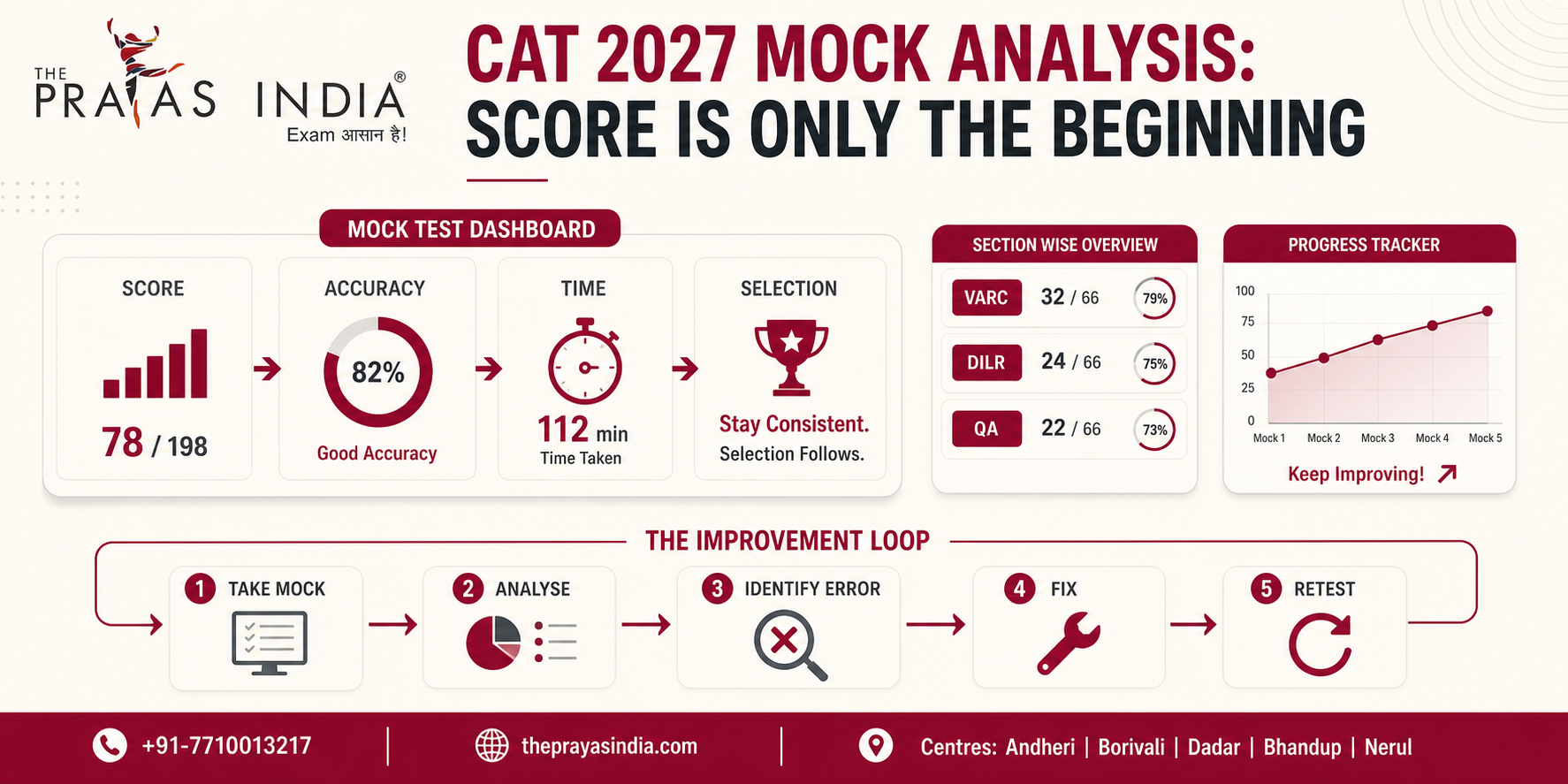
One of the most important lessons for working professionals is that a mock-test score is only one part of the feedback.
After every mock, analyse:
- Number of questions attempted
- Number of correct answers
- Number of incorrect answers
- Accuracy
- Questions left unattempted
- Time spent per section
- Questions that consumed excessive time
- Easy questions missed
- DILR sets selected
- QA questions skipped
- RC accuracy
- Repeated mistakes
A low score can be useful if it reveals a problem that you can fix.
A high score can also be misleading if the improvement is not consistent.
The objective should be to identify why your performance looks the way it does.
How Working Professionals Should Analyse CAT Mocks
Use a four-step process:
Step 1: Check Your Score
Understand your overall performance.
Step 2: Check Accuracy
Determine whether mistakes are coming from conceptual gaps, misreading or rushed attempts.
Step 3: Check Time Management
Identify where you spent too much time.
Step 4: Check Question Selection
Ask whether you selected the right questions and sets.
This final point is particularly important for CAT.
You do not need to solve every question.
You need to make better decisions about which questions to attempt and which questions to leave.
How to Balance Office Deadlines and CAT Preparation
There will be periods when your job demands more attention.
Instead of treating this as a failure in CAT preparation, plan for such periods.
At the beginning of each week, identify your expected workload.
If you know Wednesday and Thursday will involve late meetings, move some CAT preparation to Monday, Tuesday and the weekend.
This is more realistic than assuming every weekday will be identical.
Use three types of preparation days:
Normal Day: 1.5–2 hours
Busy Day: 30–60 minutes
Free Day: 2–4 hours
This gives your preparation flexibility without completely losing momentum.
A Weekly CAT 2027 Checklist for Working Professionals
At the end of each week, review whether you completed:
VARC
- Reading practice
- RC practice
- Verbal Ability practice
- Incorrect-question analysis
DILR
- Multiple sets
- Different set types
- Timed practice
- Set-selection analysis
QA
- Concept revision
- Practice questions
- Previous-year questions
- Error-log revision
Testing
- Sectional test or mock, depending on your stage
- Detailed analysis
- Mistake classification
Planning
- Review weekly progress
- Identify weak areas
- Plan the next week
This five-minute weekly review can prevent your preparation from becoming unstructured.
How to Improve CAT Speed Without Sacrificing Accuracy
Working professionals often feel pressure to compensate for limited preparation time by solving questions faster.
This can lead to unnecessary mistakes.
Speed should develop naturally through familiarity and practice.
For QA, learn multiple approaches where useful.
For DILR, improve set selection.
For VARC, improve reading comprehension and eliminate options systematically.
Most importantly, track whether increased attempts are actually producing better scores.
The goal is not:
Maximum Attempts
The goal is:
Optimal Attempts + High Accuracy
How to Improve Accuracy in CAT 2027
Accuracy improves when you understand the reason behind your mistakes.
Classify every incorrect question.
Conceptual Error
You did not understand the concept.
Action: Revise the concept.
Calculation Error
Your approach was correct but the calculation went wrong.
Action: Practise carefully and improve calculation discipline.
Interpretation Error
You misunderstood the question or data.
Action: Slow down slightly while reading.
Guessing Error
You attempted without sufficient confidence.
Action: Improve question-selection discipline.
Time-Pressure Error
You rushed because you had spent too much time earlier.
Action: Work on time management and selection.
This error classification is more useful than simply writing “wrong answer” in a notebook.
How to Use Previous CAT Questions While Working
Previous-year CAT questions should be an important part of your preparation.
They help you understand the types of reasoning required and expose you to realistic question styles.
Do not use them only as a question bank.
Analyse them.
Ask:
- What concept was tested?
- How difficult was the question?
- Was my approach efficient?
- Could I solve it another way?
- Would I attempt it in a timed test?
- What clue helped identify the correct approach?
For DILR, also study the structure of the sets.
For VARC, examine why one option is correct and why the others are not.
For QA, compare different solution approaches where appropriate.
CAT 2027 Preparation in the Final Months
As CAT 2027 approaches, your strategy should gradually shift from learning to performance optimisation.
The final months should contain more:
- Full-length mocks
- Sectional tests
- Previous CAT questions
- Revision
- Error-log analysis
- Time management practice
- Question-selection practice
At this stage, avoid continuously adding new preparation resources.
Too many books, courses, Telegram groups, videos and test series can make preparation fragmented.
Choose a manageable set of resources and complete them properly.
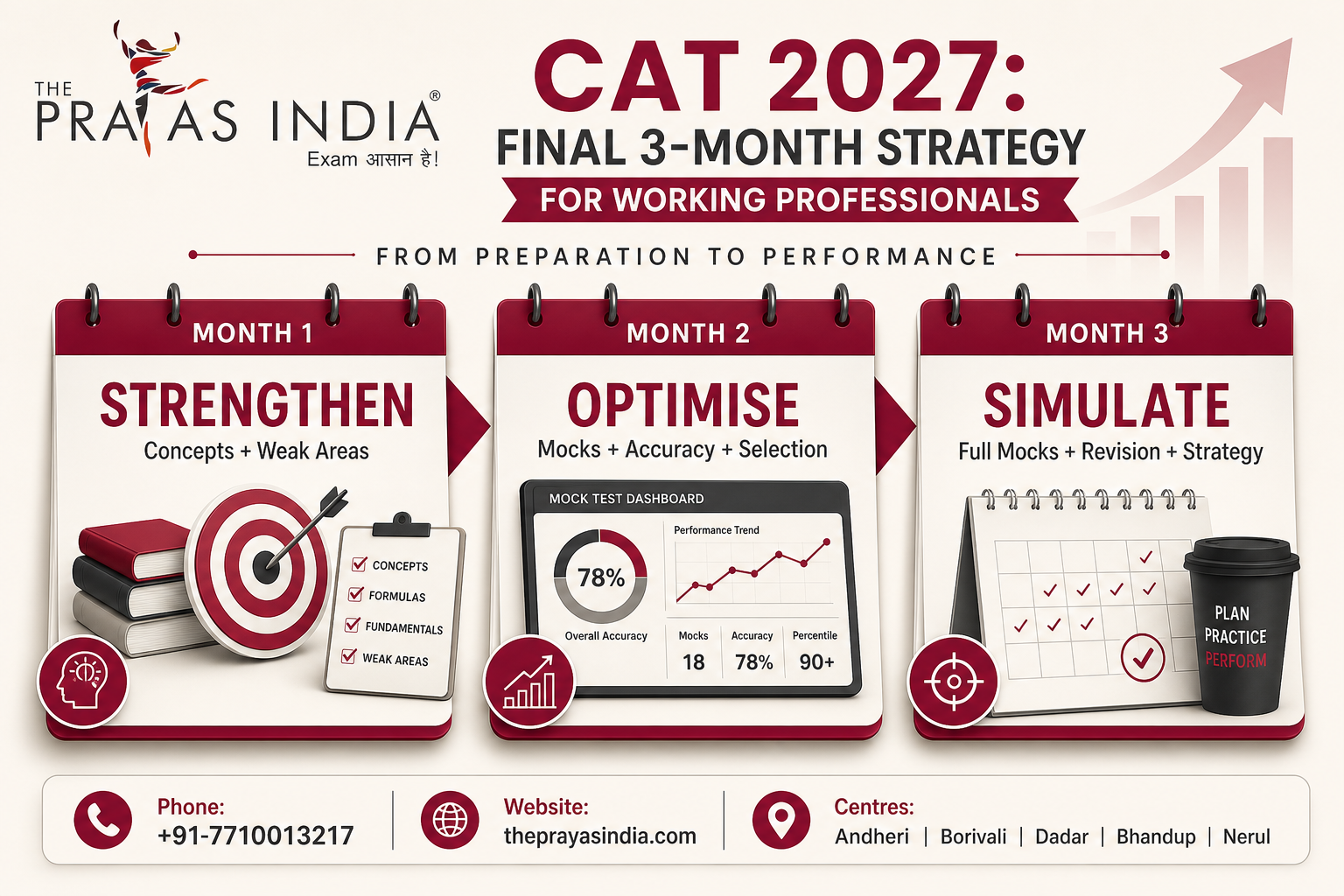
What Should Working Professionals Do in the Last 3 Months?
A practical final-phase approach can be:
Month 1: Strengthen
Identify weak concepts and revise them.
Increase sectional practice and start taking regular full-length mocks.
Month 2: Optimise
Focus more heavily on mock tests, analysis, time management and question selection.
Month 3: Simulate
Replicate the exam environment more frequently.
Focus on:
- Full-length mocks
- Accuracy
- Sectional strategy
- Time management
- Revision
- Error correction
Do not allow office workload to completely disrupt your testing schedule.
If necessary, take mocks on weekends and use weekdays for analysis and targeted improvement.
Common Mistakes Working Professionals Should Avoid During CAT 2027 Preparation
Waiting for the “Perfect aTime”
Your job may never become completely stress-free.
Start with the time you currently have.
Creating an Unrealistic Timetable
A schedule should fit your professional life rather than fight against it.
Ignoring DILR Until the End
DILR improves through consistent exposure to different sets.
Treating VARC as Only Vocabulary
CAT VARC requires reading comprehension and reasoning abilities, not simply vocabulary memorisation.
Focusing Only on QA
A strong performance requires balanced preparation across sections.
Taking Mocks Without Analysis
The learning happens after the mock when you identify what went wrong.
Changing Resources Constantly
Too many resources can create confusion.
Comparing Your Preparation With Full-Time Aspirants
Your preparation conditions are different.
Measure your progress against your own baseline.
Sacrificing Sleep Every Day
A sustainable routine requires physical and mental energy.
Ignoring Your Professional Experience
Your work experience can actually become a useful source of discipline, time management and problem-solving habits.
How to Stay Motivated for CAT 2027 Alongside a Job
Motivation is not constant.
Some days will be productive and some will not.
Instead of focusing on daily perfection, measure your progress over several weeks.
For example:
Week 1: 8 hours
Week 2: 10 hours
Week 3: 11 hours
Week 4: 9 hours
This can still represent meaningful progress even if every week looks different.
Track improvement in measurable areas:
- QA accuracy
- RC accuracy
- DILR set selection
- Mock scores
- Time management
- Number of repeated mistakes
Visible improvement can make long-term preparation easier to sustain.
Why Structured CAT Coaching Can Help Working Professionals
Self-study can work, but working professionals often have one additional challenge: decision fatigue.
After spending the day making professional decisions, it can be difficult to decide at night:
“What should I study today?”
A structured CAT course can reduce this uncertainty by providing a defined learning sequence.
With a structured programme, your preparation can be organised around:
Classes → Practice → Tests → Analysis → Revision
The Prayas India offers CAT preparation through online and offline learning formats, allowing working professionals to select an approach that fits their schedule.
The combination of structured teaching, practice resources, mock tests and guidance can help aspirants use their limited preparation time more effectively.
CAT 2027 Admissions at The Prayas India
If you are a working professional planning to appear for CAT 2027, starting your preparation early can help you distribute the workload instead of trying to complete everything near the examination.
At The Prayas India, aspirants can explore online and offline CAT coaching options designed around structured preparation for VARC, DILR and QA.
The preparation journey can include:
- Concept-focused classes
- Live learning support
- Recorded lectures
- Practice material
- Doubt-solving support
- Sectional tests
- Full-length mock tests
- Performance analysis
- Revision support
- Exam-oriented guidance
For working professionals, the objective should be to create a preparation system that can coexist with their career.
You do not need to stop working to prepare for CAT. You need a strategy that works with your schedule.
Final CAT 2027 Working Professional Checklist
Before starting your preparation, make sure you have:
- Taken a diagnostic test
- Identified your strengths and weaknesses
- Created a realistic weekly schedule
- Allocated time to VARC, DILR and QA
- Started regular reading
- Built QA fundamentals
- Practised DILR consistently
- Included previous CAT questions
- Created an error log
- Planned sectional tests
- Planned full-length mocks
- Reserved time for mock analysis
- Adjusted your schedule around work deadlines
- Selected manageable preparation resources
- Included revision in your weekly routine
- Protected sufficient rest
- Chosen an appropriate coaching format if you need structured guidance
Final Takeaway
Preparing for CAT 2027 while working is primarily a challenge of consistency and planning. You may have fewer hours than a full-time aspirant, but you can still make those hours highly productive by following a structured approach.
Start by understanding your current level. Build your QA fundamentals, develop a consistent VARC reading habit and practise DILR regularly. Use weekdays for shorter focused sessions and weekends for deeper practice, tests and analysis.
As the examination gets closer, gradually shift from concept building to sectional tests, full-length mocks, revision, time management and question selection.
Most importantly, do not create a CAT timetable that looks perfect but cannot survive your working life. Build a schedule that you can actually follow during normal weeks, busy weeks and professional deadlines.
For aspirants who want additional structure, The Prayas India offers online and offline CAT coaching, with learning support, practice, mock tests and guidance that can help working professionals organise their preparation more effectively.
The ideal CAT preparation plan is not the one with the most study hours.
It is the one you can follow consistently, measure honestly and improve every week.
FAQs: How to Prepare for CAT 2027 While Working
1. Can I prepare for CAT 2027 while working full-time?
Yes. Working professionals can prepare for CAT by creating a realistic schedule around their working hours. Consistent weekday preparation combined with focused weekend sessions can help build preparation over time.
2. How many hours should I study for CAT 2027 while working?
There is no universal number. Many working professionals can begin with around 1.5–2 hours on working days and longer sessions on weekends, then adjust according to their preparation level and professional schedule.
3. Should I join CAT coaching while working?
Structured coaching can be useful if you need a defined study plan, guided concept building, practice resources, mock tests and feedback. The choice ultimately depends on your preparation needs and learning style.
4. Is online CAT coaching suitable for working professionals?
Online coaching can provide flexibility for professionals who have changing work schedules, commuting responsibilities or limited weekday availability. It can also make recorded revision more convenient.
5. Should working professionals choose online or offline CAT coaching?
Both formats can work. Online coaching generally offers greater flexibility, while offline coaching provides a physical classroom environment. Choose the format that you can follow consistently alongside your job.
6. When should I start CAT 2027 preparation?
Starting early gives working professionals more time to build fundamentals gradually and balance preparation with professional responsibilities. Your ideal starting point depends on your current level and available time.
7. How should I divide CAT preparation time between VARC, DILR and QA?
There is no fixed ratio for every candidate. Begin with balanced preparation and then allocate additional time to your weaker areas based on diagnostic tests and practice performance.
8. When should I start taking CAT mock tests?
Begin with topic-wise and sectional practice while building fundamentals. Introduce full-length mocks progressively once you have sufficient familiarity with the syllabus and question types.
9. How can I prepare for CAT if my office hours are unpredictable?
Use a flexible weekly target system instead of relying only on fixed daily hours. Plan normal, busy and free days so that your preparation can adapt to changing work demands.
10. How can I improve CAT preparation consistency?
Set measurable weekly targets, maintain an error log, track your practice and keep your daily goals realistic. A sustainable routine is more useful than an extremely demanding schedule.
11. Can I prepare for CAT 2027 without quitting my job?
Yes. Many working professionals choose to continue working while preparing for management entrance examinations. The key is to manage time, maintain consistency and use preparation resources efficiently.
12. Does The Prayas India offer CAT coaching for working professionals?
The Prayas India offers CAT preparation through online and offline coaching formats, with structured learning, practice, mock tests and guidance. Working professionals can choose a format that best fits their preparation schedule.
Balance Your Job and CAT 2027 Prep Effortlessly!
Quitting your job isn’t the solution; smart time management is. Connect with the corporate-batch MBA mentors at The Prayas India to build a flexible, high-yielding study roadmap that fits perfectly around your working hours.
Official Website: theprayasindia.com
Visit Our Mumbai Centres: