CAT 2027 Preparation for Average Students: How to Build Confidence and Improve Performance
Many students begin their CAT 2027 preparation with a thought that can affect their entire preparation journey: “I am an average student. Can I really crack CAT?”
This concern is especially common among students who have not always been among the top performers in school or college, students who feel weak in Mathematics, aspirants who struggle with English comprehension, and working professionals who have been away from academic studies for several years.
The problem is not necessarily a lack of ability. In many cases, the bigger problem is a lack of direction, consistency, structured practice and confidence.
CAT preparation is not simply about being naturally brilliant at Mathematics, English or Logical Reasoning. It requires a combination of conceptual understanding, logical thinking, reading ability, question selection, time management, accuracy, mock-test analysis and consistent improvement.
That means your current academic level does not have to define your final preparation level.
If you currently consider yourself an “average student”, your objective should not be to suddenly become an extraordinary student overnight. Your objective should be to identify your weaknesses, strengthen your fundamentals, follow a structured preparation plan, practise consistently and measure your progress regularly.
For CAT 2027 aspirants, starting early can provide an important advantage because there is enough time to move gradually from fundamentals to advanced practice instead of trying to complete everything under pressure.
Important Note for CAT 2027 Aspirants
Important: CAT 2027-specific dates, registration details, examination pattern and other official information should be checked against the official CAT website when the relevant notification and information are released. This article focuses on the preparation strategy rather than assuming unannounced CAT 2027-specific details.
What Does Being an “Average Student” Actually Mean for CAT 2027?
The term “average student” is often used too broadly.
A student may have scored average marks in school but have strong logical reasoning ability. Another student may have been good academically but struggle with speed and time management. Someone else may have strong Mathematics fundamentals but find Reading Comprehension difficult.
Therefore, there is no single definition of an average CAT aspirant.
For preparation purposes, an average student can simply mean someone who is not yet confident about their CAT-level skills.
You may currently experience problems such as:
- Weak or forgotten mathematical fundamentals
- Slow calculations
- Difficulty understanding difficult RC passages
- Problems identifying the main idea of a passage
- Difficulty solving DILR sets within a time limit
- Low mock-test scores
- Poor question selection
- Too much time spent on individual questions
- Inconsistent preparation
- Confusion about study material
- Lack of a realistic study schedule
- Difficulty analysing mistakes after tests
None of these automatically determines your final CAT performance.
The important question is whether you are willing to identify these gaps and work on them systematically.
This is where a structured preparation strategy becomes particularly important.

Why Average Students Can Improve Significantly With the Right Preparation
One of the biggest misconceptions about CAT is that only students who have always been academically strong can perform well.
In reality, preparation changes your skill level.
Consider a student who initially takes several minutes to solve a basic Quant question. With proper conceptual learning, calculation practice and repeated exposure, the same student can become significantly more comfortable with that question type.
Similarly, a student who initially struggles with Reading Comprehension can improve by developing a regular reading habit and learning how to identify arguments, tone, assumptions, conclusions and relevant information.
A DILR beginner may initially find an entire set confusing. With guided practice, however, the student can learn how to organise information, identify relationships, create tables or diagrams and determine whether a particular set is worth attempting.
This is why CAT preparation should be viewed as a skill-building journey, not simply as a test of your current academic ability.
Your first assessment tells you where you are.
Your preparation determines how much you improve from that point.
The Biggest Mistake Average Students Make: Starting Without a Strategy
One of the most common mistakes is beginning CAT preparation with enthusiasm but without a clear roadmap.
A student may purchase multiple books, watch dozens of YouTube videos, download PDFs, join online discussion groups and start taking random mock tests.
It may feel like preparation is happening because the student is constantly studying.
But activity is not the same as progress.
A student can spend four hours studying every day and still remain confused if those four hours are not directed towards the right objectives.
A structured preparation plan should answer questions such as:
- What should I study first?
- Which topics are my weakest?
- How much time should I devote to each section?
- When should I start sectional tests?
- When should I start full-length mocks?
- How should I analyse my mistakes?
- Which topics need revision?
- How can I improve my speed?
- How can I improve accuracy?
- How do I know whether my preparation is actually improving?
Without answers to these questions, CAT preparation can become a cycle of studying more without necessarily improving enough.
This is one of the major reasons why structured CAT coaching can become valuable for students who find self-study difficult to organise.
Start CAT 2027 Preparation With a Proper Assessment
Before creating an aggressive study schedule, understand your current level.
An initial assessment should help you identify your strengths and weaknesses across the major CAT preparation areas.
Quantitative Ability
Ask yourself:
- Are my basic arithmetic concepts clear?
- Can I solve percentages, ratios and averages comfortably?
- How strong are my algebra fundamentals?
- How quickly can I perform basic calculations?
- Do I understand the logic behind formulas or simply memorise them?
DILR
Evaluate:
- Can I understand a complicated set of information?
- Can I organise data efficiently?
- Can I identify relationships between variables?
- Can I solve sets without getting stuck on one interpretation?
- Can I identify which sets are worth attempting?
VARC
Evaluate:
- How comfortable am I with long passages?
- Can I identify the central argument?
- Can I distinguish between an inference and an assumption?
- How accurately can I eliminate incorrect options?
- Can I understand the author’s tone and purpose?
The objective of this assessment is not to judge you.
It is to create your starting point.
Once your starting point is clear, your preparation becomes much easier to structure.
CAT 2027 Quant Preparation for Students Who Are Weak in Mathematics
For many average students, Quant is the section that creates the most anxiety.
Some students have not studied Mathematics seriously since school. Others understand concepts but struggle with calculations. Some remember formulas but cannot determine which formula or method should be applied.
The solution is not to immediately start solving the hardest questions.
The better approach is to rebuild the foundation.
Step 1: Strengthen the Fundamentals
Start with core concepts and understand how different types of questions are structured.
Instead of memorising dozens of formulas without understanding them, focus on:
Concept → Example → Basic Questions → Application → Timed Practice
Once the basics become comfortable, gradually increase difficulty.
Step 2: Develop Calculation Confidence
Speed matters in a competitive aptitude examination.
However, trying to become extremely fast before becoming accurate can create careless mistakes.
First develop accuracy.
Then improve calculation speed through regular practice.
Step 3: Learn Multiple Approaches
Some CAT questions can be solved using different methods.
A good preparation environment should expose students to efficient approaches and help them understand when a particular method is useful.
This is one area where faculty guidance can save considerable time because students do not have to discover every efficient approach entirely on their own.
Step 4: Practise Under Time Pressure
Once the concepts are reasonably strong, introduce timed practice.
This helps you understand whether a problem is actually conceptual or whether the difficulty is coming from slow execution.
CAT 2027 VARC Preparation: From Reading Difficulty to Better Comprehension
A student who is weak in VARC often says, “My English is not good.”
But CAT VARC preparation is not simply about speaking fluent English or memorising thousands of vocabulary words.
A major part of preparation involves understanding what a passage is saying and determining what the questions are actually asking.
A student should gradually develop the ability to identify:
- The central idea
- Supporting arguments
- Author’s perspective
- Tone
- Inference
- Contradictions
- Assumptions
- Relevant and irrelevant information
Regular reading is useful, but reading alone is not enough.
You also need to analyse your answers.
If you select the wrong option, ask:
Why did I choose it?
Then ask:
Why is the correct option better supported by the passage?
This type of analysis gradually improves decision-making.
Over time, VARC preparation becomes less about guessing the “most attractive” answer and more about identifying the answer supported by the passage.
CAT 2027 DILR: Why Practice and Guidance Matter
DILR can initially feel unfamiliar because students are required to process information and discover relationships rather than simply apply a formula.
This makes DILR particularly intimidating for beginners.
A student may look at a set and think:
“I don’t even know where to start.”
That reaction is normal during the early stages.
The objective of preparation is to develop a systematic way of approaching unfamiliar sets.
You need to learn how to:
- Read the information carefully.
- Identify the variables.
- Organise the information.
- Look for relationships.
- Create a suitable representation.
- Test possible cases.
- Avoid unnecessary calculations.
- Decide whether continuing with the set is worthwhile.
With practice, students start recognising recurring structures.
The important point is that DILR should not be approached only through random difficult sets. Beginners benefit from progressive difficulty, guided solving and repeated exposure.
Why CAT Mock Tests Are So Important for Average Students
Mock tests can become a turning point in CAT preparation—but only when they are used correctly.
Many students make one common mistake:
They take a mock, see the score and move on.
That is not enough.
A mock test should provide information about your preparation.
After every mock, ask:
Conceptual Errors
Did I get questions wrong because I did not understand the concept?
Calculation Errors
Did I know the method but make a calculation mistake?
Selection Errors
Did I spend too much time on questions that should have been skipped?
Time-Management Errors
Did one difficult question affect the rest of the section?
Accuracy Errors
Did I rush through questions I could otherwise have solved correctly?
Strategy Errors
Did I choose the wrong questions or sets to attempt?
This analysis can be more valuable than simply knowing the score.
A student who gets a lower score but thoroughly understands the reasons behind the mistakes may have a much clearer improvement path than a student who gets a higher score but does not analyse the test.

Your Mock Score Is Feedback, Not Your Identity
Average students often lose confidence after a poor mock.
A low score can create thoughts such as:
“Maybe CAT is not for me.”
But an early mock is primarily a diagnostic tool.
It tells you where you currently stand.
If your Quant accuracy is weak, work on Quant.
If your DILR attempts are too low, analyse set selection and practice.
If your VARC accuracy is inconsistent, analyse reading and option elimination.
If your score is suffering because of excessive time spent on individual questions, work on selection and time management.
Instead of asking:
“Why is my score so low?”
ask:
“What exactly is causing my score to remain low?”
That change in approach can make preparation much more productive.
The Importance of a Structured Weekly CAT 2027 Study Plan
A good CAT preparation plan does not necessarily mean studying for an unrealistic number of hours every day.
Consistency matters.
A student who can consistently follow a realistic plan is often in a better position than someone who studies intensely for a few days and then stops.
A weekly plan can include:
Concept Learning
Dedicated time for learning new concepts.
Topic-Wise Practice
Questions based on the concepts studied during the week.
Reading Practice
Regular reading and VARC practice.
DILR Sets
Progressive practice across different types of sets.
Revision
Revisit previously studied concepts.
Sectional Testing
Measure performance in individual areas.
Mock Analysis
Identify errors and improvement areas.
Doubt Resolution
Resolve questions and concepts that remain unclear.
This creates a cycle of learning, application and feedback.
Why Studying More Does Not Always Mean Preparing Better
Another common problem among average students is the belief that they need to study everything.
They collect multiple books, PDFs, online courses, question banks and video playlists.
Eventually, they have more material than they can realistically complete.
This creates preparation overload.
Instead of asking:
“How many resources do I have?”
ask:
“How effectively am I using the resources I already have?”
A structured coaching program can help simplify this process by providing a defined learning path and curated practice instead of leaving students to constantly decide what to study next.
For students who are already struggling with consistency, reducing unnecessary choices can make preparation easier to sustain.
Self-Study vs Structured CAT Coaching for an Average Student
Self-study can work for students who have strong discipline, understand the syllabus, know how to select resources and can objectively analyse their own performance.
However, not every student has these skills at the beginning.
Some students repeatedly face questions such as:
- Which book should I use?
- Which topic should I study next?
- Why are my mock scores not improving?
- How should I analyse my mistakes?
- How much should I practise?
- When should I start mocks?
- Which questions should I attempt?
- Why am I spending so much time on DILR?
- Why am I making the same mistakes repeatedly?
If these questions remain unanswered for weeks, the issue may not be effort.
The issue may be lack of structured guidance.
This is where coaching can provide value beyond classroom teaching.
A structured CAT preparation program can bring together:
Faculty Guidance + Study Material + Practice + Tests + Analysis + Mentorship + Accountability
For an average student, this structure can help reduce uncertainty and create a clearer path from fundamentals to exam-level preparation.
How The Prayas India Can Support CAT 2027 Aspirants
For students who are serious about CAT 2027 but are unsure about their current level, joining a structured preparation environment can provide the direction they may be missing.
At The Prayas India, CAT preparation can be approached as a complete learning journey rather than simply a series of classroom lectures.
The objective is to help students understand concepts, practise them systematically, identify their weaknesses and continuously evaluate their performance.
For an average student, this approach can be particularly useful because improvement usually requires consistency rather than occasional bursts of preparation.
Faculty guidance can help students understand difficult concepts, while regular practice can convert those concepts into problem-solving ability.
Mock tests and performance analysis can then show students where they are improving and where additional work is required.
Mentorship can also help students avoid one of the biggest problems in competitive exam preparation: constantly changing their strategy.
Instead of moving from one resource to another whenever preparation becomes difficult, students can follow a defined plan and make changes based on actual performance data.

When Should an Average Student Join CAT 2027 Coaching?
There is no single perfect day for every student to join CAT preparation.
However, if you identify with several of the following situations, structured guidance may be worth considering:
- You do not know how to start your preparation.
- Your Quant fundamentals are weak.
- You struggle to understand DILR sets.
- You find RC passages difficult.
- You repeatedly change your study material.
- You cannot maintain a consistent schedule.
- You have taken mocks but do not know how to analyse them.
- Your scores remain stagnant despite studying.
- You are unsure which topics need priority.
- You need regular accountability.
- You want faculty support for difficult concepts.
- You are preparing alongside college or a job and need better time management.
The purpose of coaching is not to suggest that every student must join an institute.
Rather, students should understand what their preparation currently lacks.
If your self-study system is working and your performance is consistently improving, continue refining it.
If your preparation repeatedly gets stuck because of lack of direction, feedback or accountability, structured coaching can address those gaps.
CAT 2027 Preparation Roadmap for Average Students
A practical preparation journey can be divided into four broad stages.
Stage 1: Foundation Building
Start by strengthening your fundamentals.
Focus on understanding concepts instead of rushing towards difficult questions.
The objective is to build confidence.
Stage 2: Concept Application
Once the basics are clear, increase question practice.
Begin applying concepts to different question formats.
The objective is to become comfortable with unfamiliar problems.
Stage 3: Timed Practice and Sectional Tests
Introduce time pressure gradually.
Work on accuracy, speed and question selection.
The objective is to convert knowledge into exam-oriented performance.
Stage 4: Mocks, Analysis and Refinement
Regularly take full-length tests and analyse them deeply.
Identify recurring mistakes and refine your strategy.
The objective is to make your performance more consistent.
This progression is much more manageable than trying to master everything simultaneously.
What Average CAT Aspirants Should Stop Doing
If you want your CAT 2027 preparation to become more effective, there are certain habits worth eliminating.
Stop Changing Your Strategy Every Few Days
A strategy needs enough time to produce measurable results.
Stop Collecting Unlimited Study Material
More PDFs do not automatically mean better preparation.
Stop Avoiding Weak Topics
Your weakest topics need structured attention.
Stop Taking Mocks Without Analysis
A mock without analysis gives you a score but limited learning.
Stop Comparing Your Beginning With Someone Else’s Progress
Your preparation should be measured against your own baseline.
Stop Studying Only What You Like
Competitive exams require balanced preparation.
Stop Treating Every Difficult Question as a Must-Solve Question
Question selection is itself an important skill.
What You Should Start Doing Instead
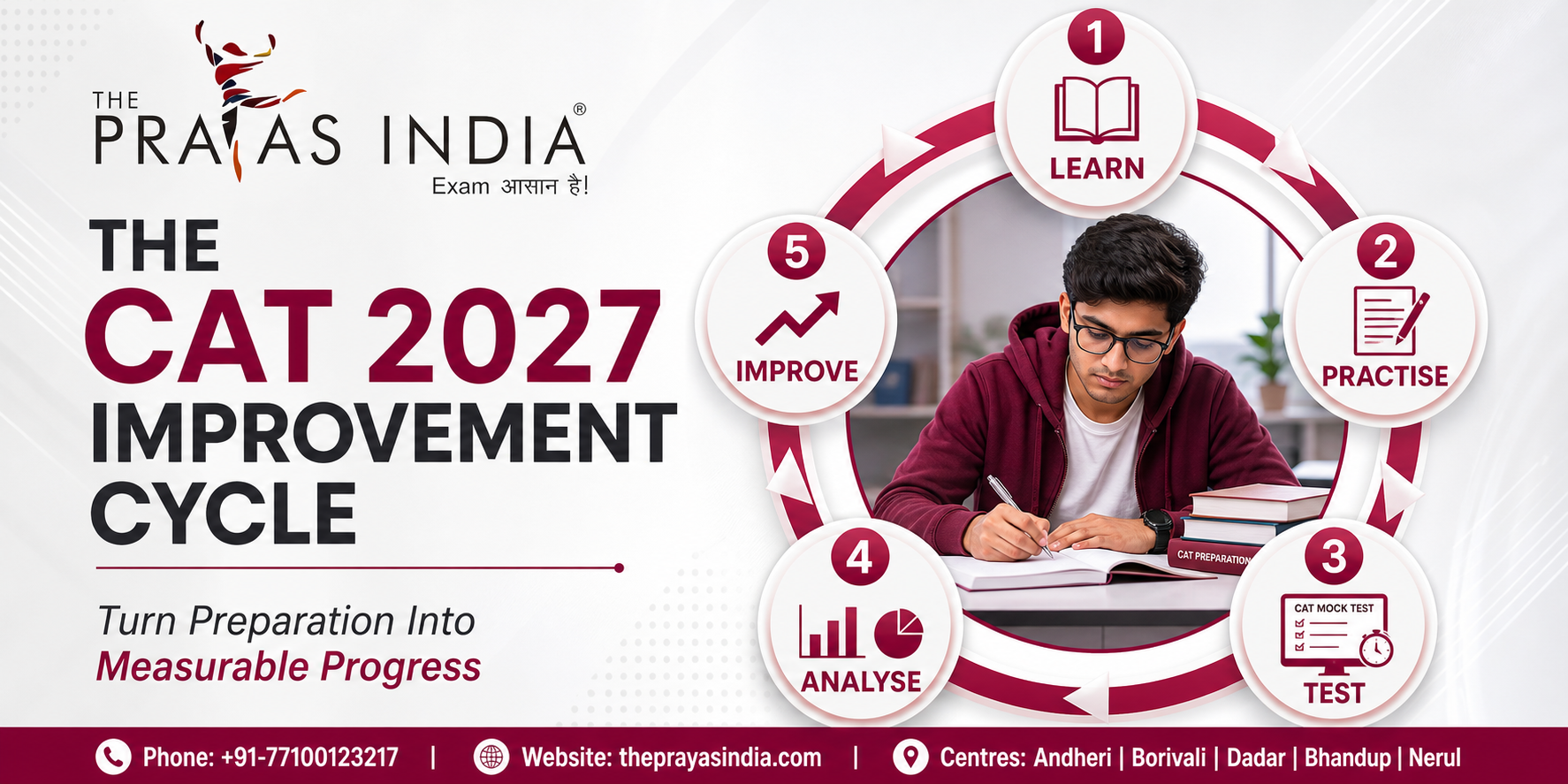
Build a preparation system around five principles:
1. Learn
Understand the concept properly.
2. Practise
Solve enough questions to develop application skills.
3. Test
Measure your performance through sectional and full-length tests.
4. Analyse
Understand exactly why you made mistakes.
5. Improve
Use that analysis to modify your next preparation cycle.
This creates a continuous improvement loop:
Learn → Practise → Test → Analyse → Improve → Repeat
That is the kind of preparation process that can gradually transform an uncertain beginner into a confident CAT aspirant.
How to Build Confidence During CAT 2027 Preparation
Confidence should not be confused with simply feeling positive.
Real preparation confidence comes from evidence.
You become confident when:
- You understand a concept that previously confused you.
- You solve questions without depending on solutions.
- Your accuracy improves.
- You make fewer repeated mistakes.
- You become faster at familiar question types.
- You can handle unfamiliar DILR sets more calmly.
- You understand why an RC option is correct.
- Your mock analysis becomes more systematic.
- Your performance becomes more consistent.
Therefore, don’t wait to “feel confident” before starting serious preparation.
Build confidence through preparation.
Every successfully completed topic, every corrected mistake and every analysed mock can contribute to that confidence.
CAT 2027 Preparation Alongside College or a Job
Many CAT aspirants are not full-time students.
They may be attending college, completing internships, working full-time or managing other responsibilities.
For such students, planning becomes even more important.
Instead of setting an unrealistic target such as studying for many hours every day, create fixed preparation blocks.
For example, one period can be dedicated to Quant, another to VARC reading and another to DILR practice.
Weekends can be used for longer practice sessions, sectional tests and detailed analysis.
A structured coaching schedule can also help students create external accountability when their personal schedules are unpredictable.
The goal is not to study every available minute.
The goal is to make your preparation consistent and measurable.
Why Mentorship Can Matter for an Average CAT Student
One of the differences between studying alone and studying under structured guidance is feedback.
When you prepare completely alone, you may not realise that your method is inefficient.
For example, you may think:
“I am spending two hours on DILR, so I must be working hard.”
But a mentor may help you identify that you are spending too much time on sets that should have been skipped.
Similarly, you may believe that your Quant problem is lack of knowledge when the real issue is calculation speed.
Or you may believe your VARC problem is vocabulary when the real issue is option interpretation.
This external perspective can help students correct their preparation more quickly.
For average students, the benefit is not simply getting answers to questions.
It is learning how to think about the questions and how to improve the preparation process itself.
Your Current Performance Does Not Have to Be Your CAT 2027 Performance
If your current mock score is disappointing, your fundamentals are weak or you feel less prepared than other aspirants, do not treat your present level as your final level.
CAT preparation is a process.
You have time to build skills, provided you use that time properly.
The difference between a confused student and a confident aspirant is often not a sudden change in intelligence.
It is the result of:
better planning + consistent practice + proper feedback + repeated revision + effective testing.
This is why starting with the right preparation framework matters.
Final Takeaway: Don’t Let the Word “Average” Decide Your CAT 2027 Journey
Being an average student today does not mean that you have to remain an average CAT aspirant throughout your preparation.
Your current level is simply your starting point.
What matters is what you do with that starting point.
If your Quant fundamentals are weak, strengthen them.
If VARC is difficult, develop your reading and comprehension skills.
If DILR feels unfamiliar, practise progressively and learn how to approach different sets.
If your mock scores are stagnant, stop looking only at the score and start analysing the reasons behind it.
And if your preparation repeatedly lacks direction, consider whether structured CAT coaching and mentorship can help you create a more organised path.
The right preparation environment can provide more than study material. It can provide clarity, faculty support, regular practice, testing, performance analysis and accountability—the elements that many students struggle to create on their own.
For CAT 2027 aspirants who currently consider themselves average, the goal should not be to compare themselves with students who started earlier or already have strong fundamentals.
The goal should be simple:
Start where you are. Identify what is holding you back. Build the right skills. Measure your progress. Keep improving.
And if you want expert guidance to make that journey more structured, exploring a suitable CAT 2027 coaching program early can help you understand what kind of preparation support you actually need.
Frequently Asked Questions (FAQs) – CAT 2027 Preparation for Average Students
Can an average student crack CAT 2027?
Yes. CAT preparation depends heavily on conceptual clarity, regular practice, question selection, time management and mock-test analysis. A student who currently considers themselves average can improve significantly through a structured and consistent preparation approach.
How should I start CAT 2027 preparation if my basics are weak?
Start by identifying your weak areas and strengthening fundamental concepts in Quantitative Aptitude, VARC and DILR. Avoid jumping directly into advanced-level questions. Build accuracy first, then gradually increase difficulty and speed.
How much time should an average student study for CAT 2027?
The ideal study time varies according to the student’s starting level, academic background and preparation timeline. Instead of focusing only on the number of hours, maintain a consistent schedule covering concepts, practice, revision, sectional tests and mock analysis.
Can a student who is weak in Maths prepare for CAT?
Yes. CAT Quantitative Aptitude preparation can be approached progressively by rebuilding arithmetic and other fundamental concepts before moving towards higher-level problem solving. Regular practice can help improve both accuracy and confidence.
Are CAT mock tests useful for average students?
Yes. Mock tests provide an opportunity to evaluate time management, question selection, accuracy and section-wise performance. The analysis after each mock is particularly important because it helps identify recurring mistakes and areas requiring additional practice.
What should I do if my CAT mock scores are not improving?
Do not rely only on taking more mocks. Analyse incorrect questions, unattempted questions, time-consuming problems and avoidable errors. Identify the specific reason behind the stagnant score and modify your preparation accordingly.
Should I prepare for CAT 2027 through self-study or coaching?
Both approaches can work depending on the student’s learning style, discipline, available resources and need for guidance. Students who struggle with consistency, conceptual clarity, doubt resolution or preparation planning may find structured coaching and mentorship useful.
How can I improve my VARC performance for CAT 2027?
Develop a regular reading habit and practise different types of Reading Comprehension passages and verbal questions. Focus on understanding the author’s argument, identifying the central idea, eliminating unsuitable options and reviewing mistakes after practice sessions.
How should average students prepare for DILR?
DILR preparation should focus on developing familiarity with different set structures and improving logical interpretation. Practise sets regularly, learn to identify manageable sets quickly and analyse the approach used after solving each set.
When should I start preparing for CAT 2027?
Starting early provides more time to strengthen fundamentals, practise questions, take sectional tests and analyse mock performance. The right starting point ultimately depends on your current aptitude level and the amount of time available each week.
Where can I get structured CAT 2027 preparation and guidance?
The Prayas India provides structured CAT preparation support with classroom guidance, conceptual learning, practice, test-based preparation and mentorship. Aspirants can explore the available CAT preparation options and choose a programme based on their preparation requirements.
Start Your CAT 2027 Preparation With the Right Guidance
Don’t let an average starting point decide your CAT journey. Build your concepts, improve your problem-solving skills and prepare with a structured strategy.
Enquire Now | Get CAT 2027 Preparation Guidance | Start With Confidence