
CAT Exam Time Management Tips: A Practical Guide for Aspirants in Nerul
Preparing for the Common Admission Test (CAT) requires more than understanding concepts and solving practice questions. You also need to manage your time effectively, identify the right questions to attempt, and maintain accuracy under exam conditions.
Many aspirants understand the concepts but struggle to complete questions within the allotted time. Others spend too long on difficult problems and miss questions they could have solved more confidently. This is why CAT exam time management tips are an important part of an effective preparation strategy.
For students preparing in Nerul and nearby areas of Navi Mumbai, a structured routine involving concept practice, mock tests, and performance analysis can help make preparation more organised. If you are exploring CAT coaching in Nerul, it is also worth considering how a preparation programme supports time management and section-wise practice.
Why Is Time Management Important in the CAT Exam?
CAT assesses candidates across three main areas: Verbal Ability and Reading Comprehension (VARC), Data Interpretation and Logical Reasoning (DILR), and Quantitative Aptitude (QA).
Each section requires a different approach. VARC involves reading and interpreting information, DILR requires analysing sets and identifying patterns, and QA involves applying mathematical concepts efficiently.
Effective CAT time management can help you:
- Allocate attention across the examination sections.
- Avoid spending too much time on a single difficult question.
- Identify questions that match your strengths.
- Improve your ability to work under timed conditions.
- Review mistakes and make better decisions in future mock tests.
The goal is not to solve every question as quickly as possible. It is to use the available time strategically while maintaining accuracy.
Understand the CAT Exam Pattern Before Planning Your Time
Before creating a time management strategy, understand the latest CAT examination pattern, section structure, marking scheme, and applicable time limits.
The exact format and instructions should always be checked in the official CAT notification for your examination year.
Once you understand the format, create a section-wise preparation plan. Do not assume that a strategy used by another aspirant will work equally well for you. Your approach should reflect your strengths, weaknesses, reading speed, calculation skills, and mock-test performance.
CAT VARC Time Management Tips
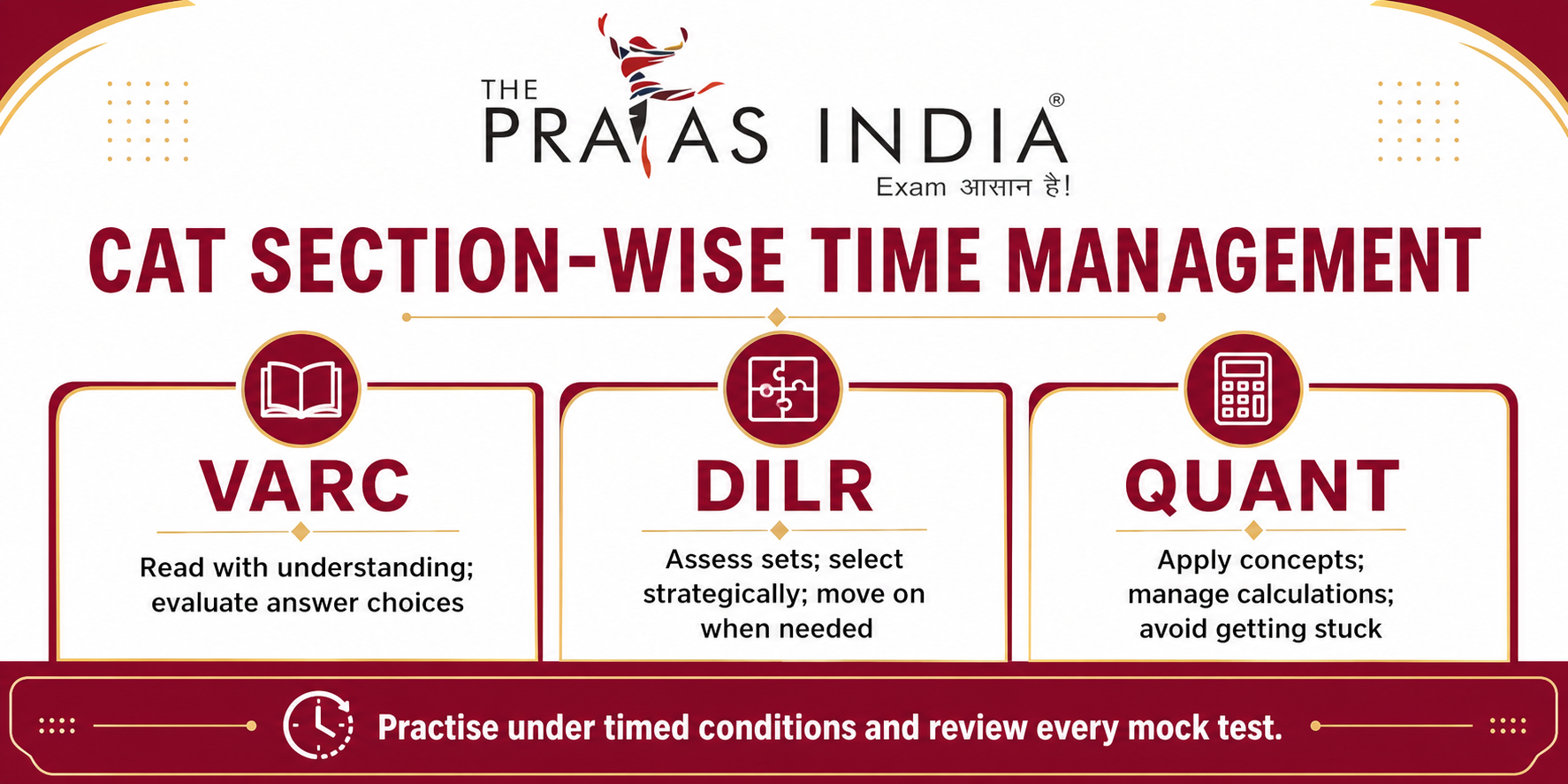
Verbal Ability and Reading Comprehension requires focused reading, comprehension, and careful interpretation. Spending too long on one passage or getting stuck between answer choices can affect your overall performance.
Read with understanding, not just speed
Practise reading articles and passages while identifying the central idea, author’s viewpoint, tone, and supporting arguments. The aim is to understand the passage efficiently rather than rushing through it.
Evaluate passages strategically
During mock tests, observe which passage types you understand comfortably and which ones take longer. Use this information to develop a passage-selection strategy that suits your reading ability.
Avoid overthinking answer choices
Some questions include options that appear similar. Return to the passage and assess each option against the information provided. Avoid choosing an answer simply because it sounds familiar or plausible.
Practise verbal ability separately
Set aside practice time for the verbal ability question types included in your preparation material and the applicable CAT pattern. Review why your answers were correct or incorrect.
Practical tip: After each VARC mock test, record which questions consumed the most time and whether the extra time improved your accuracy.
CAT DILR Time Management Strategy
Data Interpretation and Logical Reasoning can be challenging because some sets require several connected steps before you can answer the questions.
Learn to select sets carefully
At the beginning of a DILR practice session, spend time understanding the information in each set. Assess its structure and complexity before deciding where to invest your effort.
Avoid getting stuck on one set
If a set is not progressing despite repeated attempts, recognise when it may be more productive to move on. Practise this decision during mock tests so that it becomes part of your examination strategy.
Build a strong foundation
Practise arrangements, tables, charts, logical conditions, grouping problems, and other relevant question types. Focus on understanding how information connects rather than memorising solutions.
Review your set-selection decisions
After every mock test, examine whether you selected manageable sets and whether the time spent on each set was justified by your results.
Practical tip: Your DILR analysis should cover not only how many questions you solved, but also whether you chose the right sets for your current ability.
CAT Quantitative Aptitude Time Management Tips
Quantitative Aptitude tests your understanding of mathematical concepts and your ability to apply them to questions. Strong fundamentals can reduce the time you spend figuring out how to approach a problem.
Strengthen important concepts
Build your foundation in arithmetic, algebra, geometry, number systems, and other topics relevant to the syllabus and your preparation plan.
Practise different solving methods
Some questions can be solved using more than one approach. During practice, compare methods and identify which one is accurate and efficient for you.
Recognise time-consuming questions
If a question requires lengthy calculations or involves a concept you do not understand, assess whether continuing is worthwhile. Avoid allowing one problem to consume a disproportionate amount of your available time.
Improve calculation accuracy
Regular practice with percentages, ratios, fractions, equations, and other foundational skills can help reduce avoidable errors.
Practical tip: Maintain an error notebook for calculation mistakes, concept gaps, and questions where you used an unnecessarily complicated method.
Use CAT Mock Tests to Improve Time Management
Mock tests are among the most useful tools for developing a realistic CAT time management strategy. They let you practise under timed conditions and evaluate your decisions.
However, simply taking more tests is not enough. You must analyse what happened during each test.
After every mock test, review the following:
- Which questions did you solve correctly and confidently?
- Which questions consumed too much time?
- Did you spend too long on difficult questions?
- Were any errors caused by rushing?
- Which topics need additional concept practice?
- Could you have selected a more suitable question or DILR set?
Create a simple performance tracker with columns for the section, question or set, time spent, result, error type, and lesson learned.
Over several tests, this record can help you recognise patterns and make informed adjustments to your approach.
Create a Daily CAT Study Timetable
A daily timetable helps you practise all three sections without neglecting revision or mock-test analysis.
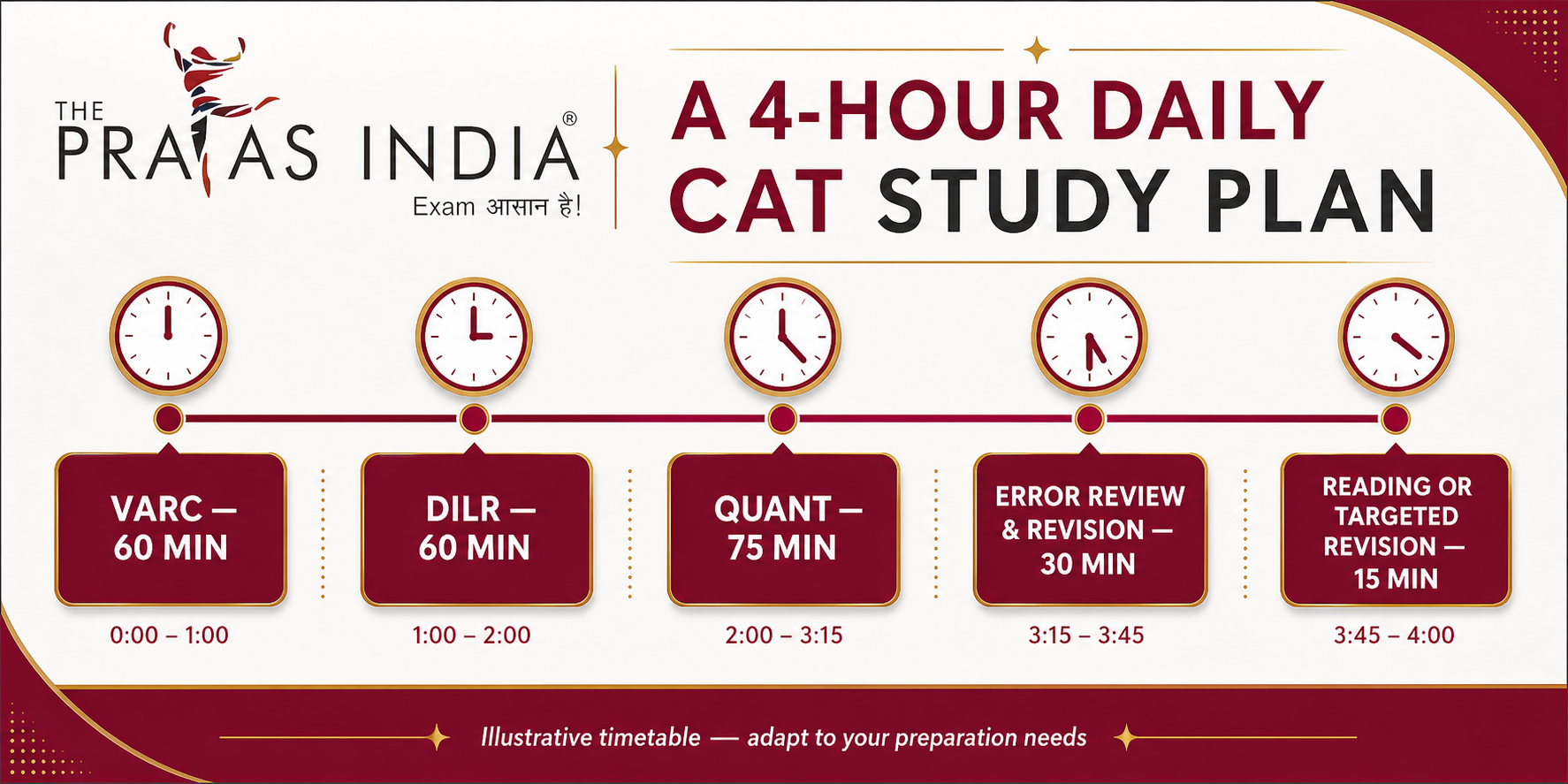
Here is an illustrative study plan for an aspirant with approximately four focused study hours available:
| Activity | Suggested time |
|---|---|
| VARC practice | 60 minutes |
| DILR practice | 60 minutes |
| Quantitative Aptitude | 75 minutes |
| Reviewing errors and revising concepts | 30 minutes |
| Vocabulary, reading or targeted revision | 15 minutes |
| Total | 4 hours |
Adjust this timetable according to your preparation stage and performance. If you are weak in a particular section, you may need to allocate additional time to it while continuing to practise the other sections.
On mock-test days, allow enough time for the test and a detailed review. Avoid trying to complete every preparation activity on the same day if it makes your schedule unrealistic.
CAT Exam Time Management Mistakes to Avoid
Even well-prepared candidates can lose valuable time through avoidable habits. Watch out for these common mistakes.
Spending too long on difficult questions
A difficult question is not always the best use of your time. Learn to recognise when to continue and when to move forward.
Attempting questions without a clear strategy
Random question selection can lead to inefficient use of time. Practise assessing questions and sets before committing to them.
Focusing only on speed
Speed without accuracy can produce avoidable mistakes. Evaluate your performance using accuracy, time spent, question selection, and the difficulty of the questions attempted.
Ignoring mock-test analysis
If you take tests without reviewing your decisions, you may repeat the same mistakes. Reserve dedicated time for analysis.
Comparing your performance with everyone else
Other aspirants may have different strengths, preparation levels, and study schedules. Use your own performance data to track progress and decide what to improve next.
How CAT Aspirants in Nerul, Navi Mumbai Can Prepare More Effectively
Students searching for CAT coaching in Nerul or CAT coaching in Navi Mumbai should consider more than location when comparing preparation options.
Look for a learning approach that supports concept clarity, section-wise practice, mock tests, performance analysis, and doubt-solving. Ask about class schedules and the preparation support included in currently available programmes.
The Prayas India has a branch in Nerul West, Navi Mumbai. Aspirants interested in CAT preparation can contact the branch to enquire about currently available programmes, batch timings, and learning support.
Before choosing a programme, consider your current preparation level, preferred learning format, daily schedule, and areas where you need guidance.
The Prayas India – Nerul Branch
Address: F-105, 1st Floor, Nerul West, Nerul, Maharashtra 400706
Phone: +91 7710013217
Students looking for CAT classes in Nerul can contact the branch to confirm current programme availability and discuss their preparation needs.
A Practical CAT Time Management Plan for the Final Preparation Phase
As the examination approaches, focus on refining your strategy rather than making constant changes to your entire study routine.
Review your mock-test history: Identify the sections and question types where you lose the most time.
Practise targeted question sets: Work on the specific concepts or formats responsible for repeated errors.
Simulate examination conditions: Take full-length mocks according to the applicable exam pattern and instructions.
Refine question selection: Learn which questions to attempt first, which to revisit, and when to move on.
Protect revision time: Continue revising concepts and reviewing mistakes instead of spending all your available time on new material.
In the final days, prioritise a sustainable routine and adequate rest. Avoid assuming that studying for longer hours automatically improves examination performance.
Conclusion
Effective CAT exam time management is built through practice, thoughtful question selection, and honest analysis of your performance. VARC, DILR, and Quantitative Aptitude each require a different approach, so your preparation strategy should reflect the demands of each section.
Take mock tests regularly, review how you use your time, strengthen weak concepts, and refine your approach gradually. The aim is to make better decisions under timed conditions rather than simply trying to solve every question.
If you are searching for CAT coaching in Nerul or the best CAT coaching in Navi Mumbai, you can contact The Prayas India’s Nerul branch to enquire about currently available preparation programmes and batch schedules.
A consistent preparation plan, combined with suitable guidance and regular practice, can help you approach the CAT examination with a more organised strategy.
Frequently Asked Questions
1. How can I manage time effectively in the CAT exam?
Practise under timed conditions, learn to select questions strategically, avoid spending too long on difficult problems, and analyse your mock tests to identify time-management mistakes.
2. How should I manage time in CAT VARC?
Practise reading comprehension, identify the central idea of passages, evaluate answer choices carefully, and review which questions consume the most time during mock tests.
3. How can I improve time management in CAT DILR?
Practise different DILR set types, assess set difficulty before committing to a solution, and learn when to move on from a set that is consuming too much time.
4. Are CAT mock tests useful for time management?
Yes. Mock tests let you practise under timed conditions, evaluate question selection, assess accuracy, and identify areas that need improvement. Reviewing each test is an important part of the process.
5. How many hours should I study daily for CAT?
Study hours depend on your preparation level, available time, and target. Create a realistic schedule covering VARC, DILR, Quantitative Aptitude, revision, and mock-test analysis.
6. Where can I enquire about CAT coaching in Nerul?
Contact The Prayas India at F-105, 1st Floor, Nerul West, Nerul, Maharashtra 400706, or call +91 7710013217 to enquire about currently available programmes and batch timings.
Prepare for CAT with a Clear Strategy
Working on VARC, DILR and Quantitative Aptitude? Contact The Prayas India, Nerul, to enquire about currently available CAT preparation programmes, batch timings and learning support.