
CAT Quantitative Aptitude: Important Topics to Revise for CAT 2026
The Common Admission Test (CAT) is one of the most popular management entrance examinations in India. It is an important pathway for students aspiring to pursue an MBA from leading business schools, including the Indian Institutes of Management (IIMs). Among the different sections of the CAT examination, Quantitative Aptitude plays a significant role in evaluating a candidate’s mathematical understanding, problem-solving ability and calculation skills.
Many students find CAT Quantitative Aptitude challenging because questions are designed to test conceptual clarity, logical thinking and the ability to solve problems within a limited time. However, with a structured preparation strategy and regular practice, candidates can gradually improve their performance.
For students preparing in Navi Mumbai, choosing the right study approach and getting proper academic guidance can make preparation more organised. Aspirants looking for CAT coaching in Nerul can also explore the preparation guidance available at The Prayas India.
In this article, we will discuss the important CAT Quantitative Aptitude topics that candidates should revise, along with practical preparation strategies and common mistakes to avoid.
Understanding the CAT Quantitative Aptitude Section
The Quantitative Aptitude section of CAT evaluates a candidate’s ability to understand mathematical concepts and apply them to different types of problems.
Questions generally cover topics from school-level mathematics, but the difficulty comes from the way concepts are combined and presented.
Candidates should focus on:
- Understanding mathematical concepts rather than memorising formulas.
- Improving calculation speed and accuracy.
- Identifying the right approach to solve a question.
- Practising different question formats.
- Managing time effectively during the examination.
- Analysing mistakes after every mock test.
The exact number of questions and examination pattern may change. Candidates should refer to the latest official CAT notification for updated details.
1. Arithmetic – One of the Most Important Areas
Arithmetic is an important part of CAT Quantitative Aptitude preparation. Many questions test the candidate’s ability to apply basic mathematical concepts to practical situations.
Students should revise the following topics:
Important Arithmetic Topics
- Percentages
- Profit and Loss
- Simple and Compound Interest
- Ratio and Proportion
- Averages
- Mixtures and Alligation
- Time, Speed and Distance
- Time and Work
- Pipes and Cisterns
How to Prepare Arithmetic
Start by understanding the basic concepts and formulas. Once the fundamentals are clear, move towards application-based questions.
For example, percentage concepts are useful in solving questions related to profit and loss, discounts and interest. Similarly, ratio and proportion can help solve problems involving mixtures, partnerships and comparisons.
Preparation Tip: Practise questions of different difficulty levels and focus on understanding the logic behind each solution.
2. Algebra – Strengthen Your Conceptual Understanding
Algebra is another important area of CAT Quantitative Aptitude. Questions often require candidates to simplify expressions, solve equations and identify relationships between variables.
Important Algebra Topics
- Linear Equations
- Quadratic Equations
- Inequalities
- Functions
- Logarithms
- Surds and Indices
- Algebraic Expressions
- Progressions
- Modulus
How to Prepare Algebra
Begin with basic algebraic identities, equations and inequalities. Practise solving equations using different methods instead of depending on only one approach.
Pay special attention to functions, logarithms and quadratic equations. These topics require conceptual clarity and regular problem-solving practice.
Preparation Tip: Maintain a separate notebook for important formulas, identities and questions that you find difficult.
3. Geometry and Mensuration – Focus on Visual Understanding
Geometry questions test a candidate’s understanding of shapes, angles, measurements and spatial relationships.
Students should become comfortable with diagrams and learn how different geometric properties can be applied to solve questions.
Important Geometry Topics
- Lines and Angles
- Triangles
- Circles
- Quadrilaterals
- Polygons
- Coordinate Geometry
- Areas and Perimeters
- Surface Areas
- Volumes
How to Prepare Geometry
Revise important properties and theorems regularly. Draw diagrams while solving questions to understand the relationships between different elements.
For mensuration, practise questions involving two-dimensional and three-dimensional figures.
Preparation Tip: Do not simply memorise geometry formulas. Understand their applications and practise questions that combine multiple concepts.
4. Number System – Build Strong Mathematical Fundamentals
Number System questions test the candidate’s understanding of numbers and their properties.
Although the difficulty of questions may vary, a strong foundation in this area can help students approach unfamiliar problems more confidently.
Important Number System Topics
- Types of Numbers
- Divisibility Rules
- Factors and Multiples
- Prime Numbers
- HCF and LCM
- Remainders
- Unit Digits
- Factorials
- Cyclicity
- Number Properties
How to Prepare Number System
Start with basic number properties and divisibility rules. Gradually move towards questions involving remainders, factorials and cyclicity.
Try to understand why a particular method works instead of memorising shortcuts without understanding their application.
Preparation Tip: Practise different question patterns and revise important properties regularly.
5. Modern Mathematics – Revise the Fundamentals
Modern Mathematics includes topics that require logical thinking and a clear understanding of mathematical rules.
- Important Modern Mathematics Topics
- Permutations and Combinations
- Probability
- Set Theory
How to Prepare Modern Mathematics
Understand the fundamental concepts before attempting advanced questions. In permutations and combinations, focus on identifying whether a problem involves arrangements or selections.
For probability, revise basic outcomes, events and probability rules. Practise set theory questions involving Venn diagrams and relationships between groups.
Preparation Tip: Solve questions step by step and avoid using formulas without understanding the conditions in which they apply.
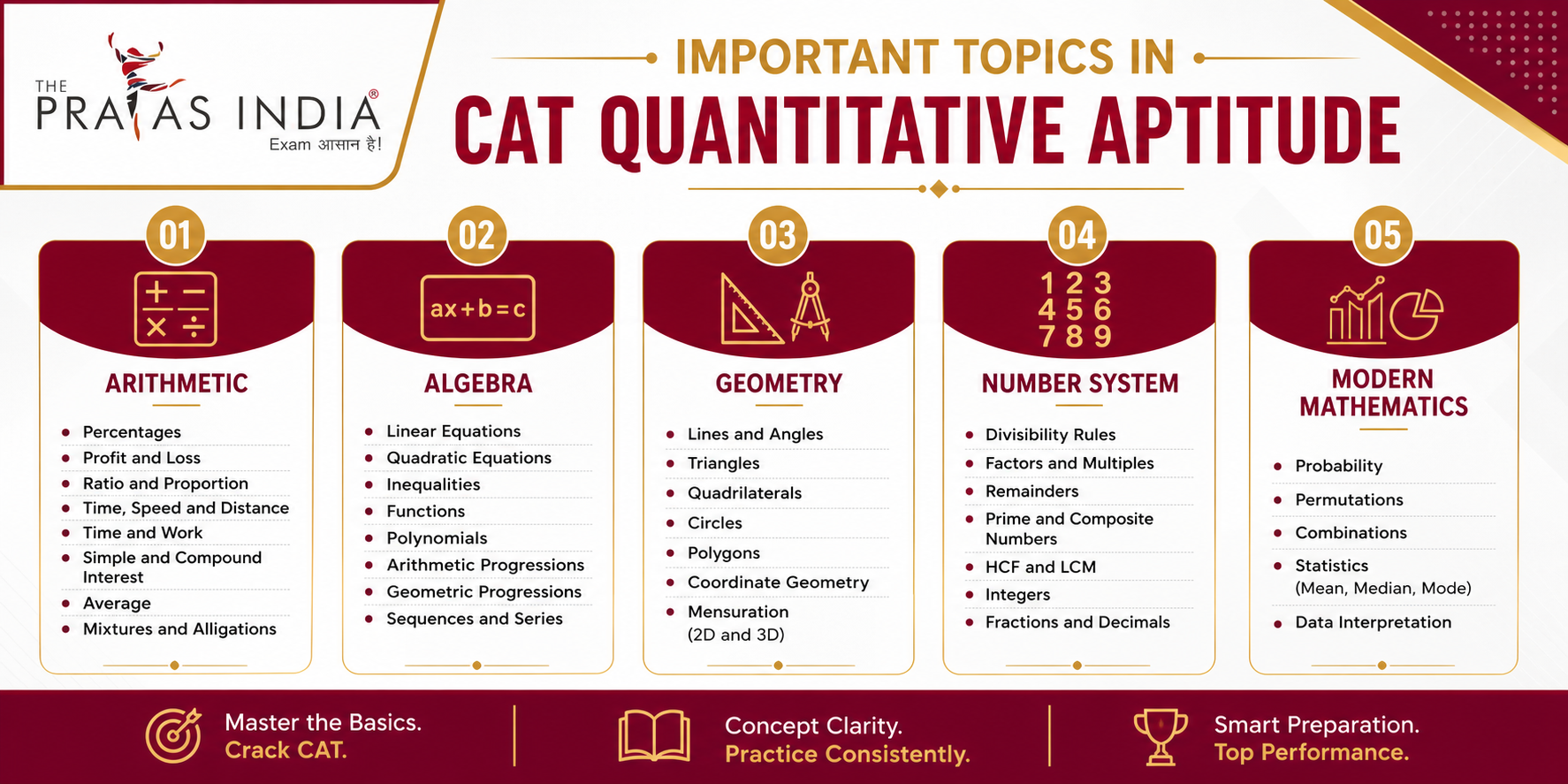
6. Important CAT Quant Topics at a Glance
The following table provides a convenient revision checklist for CAT aspirants.
| Topic Area | Important Topics |
|---|---|
| Arithmetic | Percentages, Ratio, Profit and Loss, Time and Work |
| Algebra | Equations, Inequalities, Functions, Logarithms |
| Geometry | Triangles, Circles, Angles, Mensuration |
| Number System | Divisibility, Remainders, Factors, HCF and LCM |
| Modern Mathematics | Probability, P&C, Set Theory |
Candidates should use this as a revision guide rather than assuming a fixed topic-wise question distribution. CAT does not guarantee a particular number of questions from any one topic.
7. How to Create an Effective CAT Quant Revision Strategy
Knowing the important topics is only the first step. Candidates also need a practical revision plan that helps them cover concepts, practise questions and evaluate their progress.
Here are some useful preparation strategies.
Step 1: Identify Your Strong and Weak Topics
Attempt a topic-wise diagnostic test to understand your current preparation level.
Divide topics into three categories:
- Strong topics that require regular revision.
- Average topics that need more practice.
- Weak topics that require conceptual improvement.
This approach helps you use your preparation time more effectively.
Step 2: Revise Concepts Before Solving Advanced Questions
Do not directly jump into difficult questions without understanding the fundamentals.
Revise basic concepts, important formulas and standard question types before attempting advanced problems.
Step 3: Practise Questions Regularly
Consistency is important in Quantitative Aptitude preparation.
Try to practise a combination of easy, moderate and difficult questions. Focus on accuracy first and gradually work towards improving your solving speed.
Step 4: Analyse Mock Test Performance
Mock tests help candidates understand how well they can apply concepts under examination conditions.
After every mock test, analyse:
- Questions answered correctly.
- Incorrect answers.
- Questions left unattempted.
- Time spent on each question.
- Concepts that need revision.
For example, if you frequently make mistakes in Time and Work questions, revise the underlying concepts and solve additional practice questions from that topic.
Step 5: Maintain a Formula and Mistake Notebook
Create a notebook containing important formulas, shortcuts, conceptual mistakes and difficult questions.
Revise this notebook regularly, especially before attempting mock tests.

8. Common Mistakes to Avoid in CAT Quantitative Aptitude
Many candidates understand the concepts but struggle to convert their preparation into consistent performance.
Avoid these common mistakes:
1. Memorising Formulas Without Understanding Them
Formula memorisation alone is not sufficient. Learn how and when to apply each formula.
2. Ignoring Basic Concepts
Students sometimes move directly to difficult questions without strengthening their fundamentals. This can create problems when questions are presented in unfamiliar formats.
3. Spending Too Much Time on One Question
If a question is taking too long, consider moving ahead and returning to it later if time permits.
4. Avoiding Mock Test Analysis
Attempting mock tests without analysing mistakes reduces their learning value.
5. Practising Only Favourite Topics
Give attention to weaker areas instead of repeatedly solving questions from topics you already understand.
9. How CAT Coaching Can Support Your Quantitative Aptitude Preparation
Preparing for CAT requires more than solving a large number of questions. Candidates also need structured learning, regular practice and an understanding of their performance.
A suitable coaching programme can help students organise their preparation through:
- Concept-based learning.
- Topic-wise practice.
- Doubt-solving support.
- Mock test practice.
- Performance analysis.
- Guidance on time management and question selection.
Students searching for CAT coaching in Nerul or CAT coaching in Navi Mumbai can explore The Prayas India to understand the available preparation options.
At the Nerul centre, students can enquire about the relevant programmes, learning support and preparation guidance based on their requirements.
10. Why CAT Aspirants in Nerul Should Follow a Structured Study Plan
Students from Nerul, Seawoods, CBD Belapur, Juinagar, Sanpada and Vashi may be preparing for CAT alongside graduation, internships or employment.
Managing different responsibilities can make preparation challenging. A realistic timetable helps students maintain consistency without unnecessarily increasing their study pressure.
A practical daily routine may include:
- Revising one Quantitative Aptitude concept.
- Solving topic-wise practice questions.
- Reviewing formulas and previous mistakes.
- Practising questions from weaker areas.
- Analysing mock test performance when applicable.
The most important factor is consistency. Regular practice and proper revision can help students develop confidence in solving quantitative problems.
Conclusion
CAT Quantitative Aptitude requires a combination of conceptual understanding, calculation skills, logical thinking and effective time management.
Arithmetic, Algebra, Geometry, Number System and Modern Mathematics are important areas that candidates should include in their preparation and revision plans.
Instead of studying every topic randomly, identify your weak areas, practise questions regularly and analyse your performance through mock tests. A structured approach can help you improve your problem-solving ability and prepare more confidently for CAT.
If you are looking for CAT coaching in Nerul, Navi Mumbai, you can connect with The Prayas India to enquire about available programmes and preparation guidance.
Frequently Asked Questions – CAT Quantitative Aptitude
1. Which topics are important in CAT Quantitative Aptitude?
Important CAT Quantitative Aptitude topics include Arithmetic, Algebra, Geometry, Number System and Modern Mathematics. Candidates should revise the fundamentals and practise different question types from each area.
2. Is Arithmetic important for CAT Quantitative Aptitude?
Yes. Arithmetic is an important area of CAT Quant preparation. Topics such as Percentages, Profit and Loss, Ratio and Proportion, Averages, Time and Work, and Time, Speed and Distance should be included in the revision plan.
3. How can I improve my CAT Quantitative Aptitude score?
Improve your score by strengthening basic concepts, practising topic-wise questions, revising formulas, attempting mock tests and analysing mistakes. Focus on accuracy and effective question selection.
4. Can beginners prepare for CAT Quantitative Aptitude?
Yes. Beginners can start with basic mathematical concepts and gradually move towards CAT-level questions. A consistent study schedule and regular practice can help build confidence.
5. How important are mock tests for CAT Quant preparation?
Mock tests help candidates evaluate their preparation, understand time management and identify weak topics. Analysing each test is as important as attempting it.
6. Where can I find CAT coaching in Nerul, Navi Mumbai?
Students looking for CAT coaching in Nerul can contact The Prayas India at its Nerul centre to enquire about available programmes, preparation guidance and learning support.
Start Your CAT Preparation with The Prayas India – Nerul
Looking for CAT coaching in Nerul or Navi Mumbai? Connect with The Prayas India to enquire about available CAT preparation programmes and get guidance for your MBA entrance exam journey.
Address: F-105, 1st Floor, Nerul West, Nerul, Maharashtra 400706
Serving: Nerul, Seawoods, CBD Belapur, Juinagar, Sanpada, Vashi and Navi Mumbai