How to Balance College and Competitive Exam Preparation in Borivali
Introduction
College life and competitive examination preparation often demand two different kinds of commitment. While college students have lectures, assignments, internal examinations, projects and attendance requirements, competitive examinations such as UPSC, SSC, banking and MBA entrance tests require consistent practice, conceptual understanding and months of preparation.
For many students, the challenge is not a lack of motivation. It is the difficulty of managing limited time without neglecting either college or their competitive examination goals.
Students in Borivali West and surrounding areas often begin preparing for competitive examinations during their undergraduate years because they want to use their college period productively. However, studying for two different academic objectives simultaneously can become overwhelming if there is no realistic schedule.
The good news is that college and competitive exam preparation can be managed together. It requires prioritisation, an understanding of your examination syllabus, a realistic timetable and a study strategy that makes the most of available time.
Whether you are preparing for UPSC, SSC CGL, banking examinations, CAT, MBA CET or another competitive examination, this guide explains how to balance college and competitive exam preparation, how to build a sustainable routine and how students can approach their preparation more effectively.
1. Why College Is a Good Time to Start Competitive Exam Preparation
College provides an opportunity to develop skills and prepare for future career options while completing your graduation. For students interested in government jobs, management entrance examinations or banking careers, starting preparation during college can help them become familiar with the examination pattern before graduation.
However, starting early does not mean studying for six to eight hours every day alongside college. It means developing the right habits and gradually building your preparation.
Benefits of preparing during college
| Benefit | How it helps |
|---|---|
| More preparation time | You can gradually cover the syllabus over several semesters. |
| Stronger fundamentals | You have more time to understand concepts instead of rushing. |
| Familiarity with exams | You can understand examination patterns, question types and competition. |
| Better time management | You develop the habit of balancing multiple responsibilities. |
| Reduced pressure after graduation | You may have already covered a significant portion of your syllabus. |
| Regular practice | You can improve speed, accuracy and problem-solving gradually. |
For example, a student preparing for SSC CGL or banking examinations may begin with Quantitative Aptitude, Reasoning and English during the first year of college. A UPSC aspirant may begin reading newspapers, understanding NCERT concepts and gradually exploring the syllabus.
The objective is to create a foundation, not to exhaust yourself before graduation.
2. Choose One Primary Competitive Examination
One of the most common mistakes college students make is trying to prepare for multiple competitive examinations without understanding how much preparation each requires.
A student may simultaneously decide to prepare for UPSC, SSC CGL, banking, CAT, railway examinations and several other tests. Although some subjects overlap, every examination has its own syllabus, pattern, difficulty level, preparation requirements and selection process.
Trying to prepare for everything at once can result in scattered preparation and inconsistent progress.
Identify your primary examination
Start by selecting the examination that aligns with your long-term career goal.
| Your career goal | Primary examination to consider |
|---|---|
| Civil services and administration | UPSC Civil Services |
| Central government employment | SSC CGL |
| Banking career | IBPS PO, SBI PO and other relevant banking examinations |
| Management education | CAT, MBA CET and other management entrance exams |
| Railway careers | Relevant RRB recruitment examinations |
| State government careers | Relevant state-level recruitment examinations |
What if you want to prepare for more than one exam?
You can explore examinations with overlapping syllabi, but choose a primary examination first.
For example:
- SSC CGL and certain banking examinations share some preparation areas, such as Quantitative Aptitude, Reasoning and English, although their patterns and requirements differ.
- CAT and MBA CET share some broad aptitude areas, but their examination formats, question styles and strategies may differ.
- UPSC and some other government examinations may involve overlapping general awareness topics, but UPSC requires a substantially different depth and approach.
3. Understand Your College Timetable Before Making a Study Plan
Before creating a competitive examination timetable, understand how much time your college actually requires.
Many students create ambitious study schedules without considering lectures, practical sessions, travel, assignments, projects, internal examinations and extracurricular activities.
A timetable that looks impressive on paper but cannot be followed consistently is not useful.
Calculate your available study time
Consider a typical college day.
| Activity | Approximate time |
|---|---|
| College lectures and campus time | 5–6 hours |
| Travel | 1–2 hours |
| Meals and personal activities | 2 hours |
| Sleep | 7–8 hours |
| Remaining flexible time | Depends on your routine |
These are illustrative estimates, not a fixed schedule. Your actual college hours, commute and responsibilities may vary.
Instead of trying to study whenever you find time, identify specific study windows.
These may include:
- Early morning before college.
- A short session after returning home.
- Time between lectures, if available.
- Evening study hours.
- Weekend mornings or afternoons.
Use your college schedule as the foundation
Your competitive exam preparation should fit around your college responsibilities rather than constantly interfering with them.
If you have a full day of lectures, schedule lighter preparation. If you have a relatively free day, you can allocate a longer study session.
This flexibility makes your timetable more sustainable.
4. Create a Practical Daily Study Timetable
College students do not necessarily need a full-time aspirant’s schedule. The goal is to establish regular preparation hours that gradually improve your knowledge and skills.
A practical daily routine may include one focused morning session and one evening session.
Sample timetable for a college student
| Time | Activity |
|---|---|
| 6:30 AM – 7:30 AM | Competitive exam preparation |
| 7:30 AM – 8:30 AM | Get ready and breakfast |
| 9:00 AM – 3:00 PM | College, lectures and academic activities |
| 3:00 PM – 4:00 PM | Travel, lunch and rest |
| 4:00 PM – 5:30 PM | Assignments, college study or practical work |
| 5:30 PM – 6:30 PM | Break, exercise or personal activities |
| 7:00 PM – 8:00 PM | Competitive exam practice |
| 8:00 PM onwards | Dinner, relaxation and preparation for the next day |
This is only an illustrative timetable. Adjust it according to your college timings, commute, energy levels and examination requirements.
How much time should college students study for competitive exams?
The ideal duration depends on your semester, preparation stage and target examination.
| College situation | Suggested competitive exam preparation |
|---|---|
| Regular college day | 1–2 focused hours |
| Lighter academic day | 2–3 hours |
| Weekend or holiday | 3–5 hours, with breaks |
| College examination period | Reduce competitive preparation and prioritise college exams |
| Semester break | Increase preparation time gradually if useful |
Consistency matters more than forcing long study hours.
Studying for two focused hours regularly can be more productive than attempting six hours on one day and abandoning the schedule for the next several days.
5. Divide Your Preparation into Small, Manageable Goals
A large competitive examination syllabus can feel overwhelming, especially when you are also attending college.
Instead of planning to complete the entire syllabus within a few weeks, divide your preparation into smaller targets.
Weekly study targets
For example, an SSC or banking aspirant may plan the following:
| Subject | Weekly target |
|---|---|
| Quantitative Aptitude | 3 concept sessions and practice |
| Reasoning | 3 practice sessions |
| English | Daily reading and 2 focused sessions |
| General Awareness | Regular current affairs and revision |
| Mock practice | 1 sectional test or suitable practice session |
| Revision | Review previously studied topics |
A UPSC aspirant may instead focus on foundational subjects, NCERT books, current affairs, syllabus understanding and gradual answer-writing practice.
An MBA CET or CAT aspirant may prioritise Quantitative Aptitude, Logical Reasoning, Data Interpretation and Verbal Ability according to their target examination.
Use the weekly target approach
Rather than writing vague goals such as “study reasoning”, write specific targets.
For example:
- Complete 2 topics in arithmetic.
- Practise 100 reasoning questions over the week.
- Read and analyse 5 editorial articles.
- Revise 3 previously studied chapters.
- Complete 1 sectional mock test.
- Analyse mistakes from the mock test.
This approach helps you evaluate your progress even when your college schedule changes.
6. Make Use of College Breaks and Free Periods
College students often have small pockets of free time between lectures, during breaks or while waiting for transportation.
These periods can be useful for revision, provided you are not sacrificing rest or important academic activities.
Activities you can complete in short study sessions
| Available time | Useful activity |
|---|---|
| 10–15 minutes | Revise formulas or vocabulary |
| 20–30 minutes | Solve a short reasoning set |
| 30–40 minutes | Read current affairs or revise notes |
| 45–60 minutes | Practise a topic or sectional questions |
| Longer break | Complete a focused study session |
For instance, a banking aspirant can revise percentage formulas during a short break, while a UPSC aspirant can review current affairs notes or revise important concepts.
Avoid multitasking
Do not attempt to study competitive examination material during every college activity.
If you are attending a lecture, focus on the lecture. If you are completing a college assignment, complete it properly.
Switching between tasks constantly can make both activities less effective.
Use available breaks intentionally, but do not feel obligated to fill every free minute with studying.
7. Use a Semester-Wise Competitive Exam Preparation Strategy
College students should change their preparation strategy depending on their academic year.
A first-year student does not necessarily need the same study schedule as a final-year student preparing for an examination shortly after graduation.
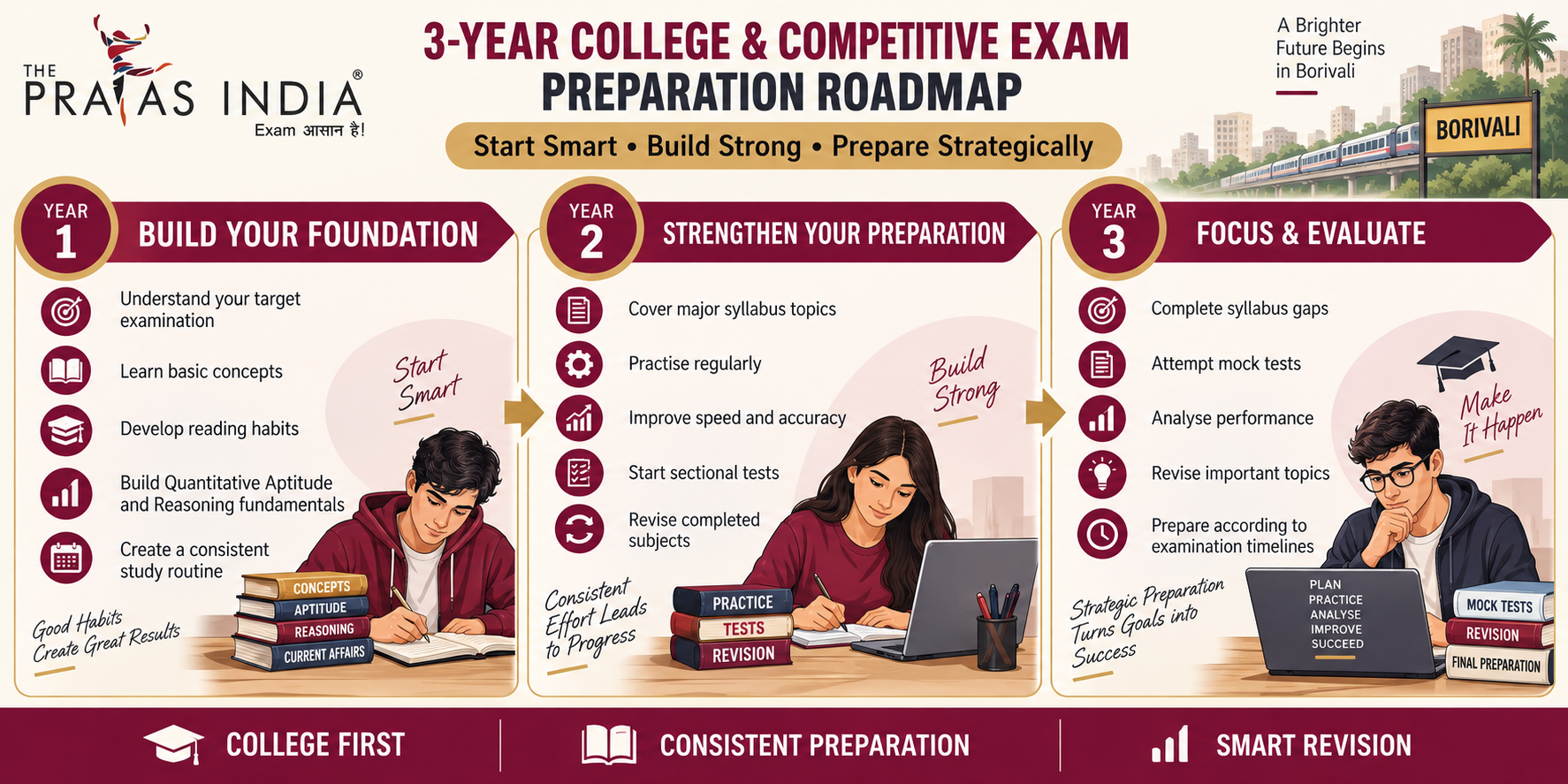
First year: Build the foundation
The first year is an excellent time to explore different career opportunities and understand the examinations you may want to pursue.
You can focus on:
- Understanding the examination syllabus.
- Developing basic aptitude and reasoning skills.
- Improving English comprehension.
- Building general awareness.
- Establishing regular study habits.
Avoid rushing into advanced mock tests before understanding the fundamentals.
Second year: Strengthen your preparation
By the second year, you should have a clearer understanding of your target examination.
Focus on:
- Covering major syllabus topics.
- Practising questions regularly.
- Improving problem-solving skills.
- Revising completed topics.
- Attempting sectional tests.
- Evaluating weak areas.
If your target examination requires descriptive writing, gradually develop your writing skills.
Final year: Prepare strategically
The final year of graduation may involve university examinations, projects, internships and other academic responsibilities.
At this stage, your competitive preparation should become more targeted.
You can:
- Complete important syllabus areas.
- Practise examination-specific questions.
- Attempt mock tests.
- Analyse mistakes.
- Revise regularly.
- Track recruitment and examination notifications.
Your final-year schedule should be adjusted according to your university examination dates and your target competitive examination.
8. Prioritise College Examinations Without Abandoning Competitive Preparation
Many students become anxious when university examinations approach. They worry that focusing on college will interrupt their competitive exam preparation.
However, college examinations should not be treated as an obstacle to your career preparation.
Graduation is an important qualification, and completing your degree successfully can be essential for eligibility in many competitive examinations.
What should you do during semester examinations?
During the university examination period:
- Prioritise college subjects and examination preparation.
- Reduce your competitive examination study hours.
- Avoid starting large new competitive examination topics.
- Use short revision sessions where appropriate.
- Resume your regular preparation schedule after your college examinations.
For example, if you normally study competitive examinations for two hours daily, you may temporarily reduce this to 20–30 minutes of revision or take a complete break when your college workload requires it.
There is no need to feel guilty about adjusting your preparation schedule.
Maintain a minimum preparation routine
If you have time, you can maintain a light routine through:
- Formula revision.
- Vocabulary revision.
- Reading current affairs.
- Short reasoning exercises.
- Reviewing previously studied topics.
However, this routine should not interfere with your college examinations, sleep or wellbeing.
9. Avoid These Common Mistakes While Preparing for Competitive Exams in College
Balancing college and competitive exam preparation becomes difficult when students follow unrealistic expectations or inefficient study habits.
Mistake 1: Preparing for too many examinations
Preparing for multiple examinations without a clear strategy can create confusion.
Choose a primary examination and explore related examinations only when the syllabus overlap and preparation requirements make sense.
Mistake 2: Following someone else’s timetable
A timetable designed for a full-time aspirant may not work for a college student.
Your schedule should reflect your actual college hours, commute, assignments and personal responsibilities.
Mistake 3: Ignoring college academics
Competitive examination preparation should not come at the cost of neglecting your degree.
Attendance, assignments, practical work and semester examinations may be important for completing your graduation successfully.
Mistake 4: Studying without revision
Completing new topics without revisiting them can lead to forgetting concepts.
Include weekly revision sessions in your preparation schedule.
Mistake 5: Taking too many mock tests without analysis
Mock tests are useful when you evaluate your mistakes.
After each test, identify:
- Questions you answered incorrectly.
- Questions you skipped.
- Topics where you lost time.
- Concepts you need to revise.
- Accuracy and time-management problems.
Mistake 6: Sacrificing sleep
A timetable that requires waking up extremely early after sleeping late is difficult to maintain.
Regular sleep and rest are important for concentration, memory and learning.
Mistake 7: Constantly changing preparation resources
Using too many books, videos, courses and study materials can create unnecessary confusion.
Choose reliable resources for your target examination and use them consistently.
10. How to Use Weekends Effectively for Competitive Exam Preparation
Weekends can provide college students with additional preparation time, particularly when weekdays are occupied by lectures and assignments.
However, weekends should not become exhausting study marathons. Use them to complete weekly targets, revise topics and evaluate your progress.
Sample weekend preparation schedule
| Time | Activity |
|---|---|
| 8:00 AM – 9:30 AM | Study a difficult topic |
| 9:30 AM – 10:00 AM | Break |
| 10:00 AM – 11:00 AM | Practice questions |
| 11:00 AM – 12:00 PM | Revision |
| Afternoon | College assignments, projects or personal activities |
| 4:00 PM – 5:00 PM | Mock test or sectional test |
| 5:00 PM – 5:45 PM | Analyse mistakes |
This is an illustrative weekend schedule. You can modify it according to your college workload and preparation requirements.
Weekend activities that can improve your preparation
- Complete pending syllabus topics.
- Revise the week’s concepts.
- Practise examination-specific questions.
- Attempt a sectional test.
- Analyse your mock-test performance.
- Plan the upcoming week’s preparation.
- Complete college assignments and projects.
Use weekends to plan the following week
At the end of Sunday, spend 15–20 minutes planning the upcoming week.
Identify your college commitments, academic deadlines and competitive examination targets.
This simple planning exercise can help you avoid last-minute confusion and make your weekday preparation more organised.
11. How Coaching Can Help College Students Prepare for Competitive Exams
College students often struggle with deciding what to study, which resources to follow, how to practise and how to evaluate their preparation.
Structured coaching may help students organise their preparation through guided learning, subject coverage, practice and a planned approach, depending on the course and institute.
For students exploring competitive exam coaching in Borivali West, selecting a suitable coaching institute can be one of the considerations in their preparation strategy.
What should college students look for in a coaching institute?Before enrolling, evaluate the following aspects.
| Factor | What to evaluate |
|---|---|
| Course structure | Does the course cover the relevant examination syllabus? |
| Batch timings | Are the timings compatible with college lectures? |
| Teaching approach | Is the teaching suitable for your current preparation level? |
| Practice opportunities | Are practice sessions and assessments included? |
| Revision | Is there a suitable revision plan? |
| Doubt-solving | How can students address their doubts? |
| Course duration | Does the course fit your preparation timeline? |
| Fees | Are the fees and payment conditions clearly explained? |
The Prayas India – Borivali
Students from Borivali West and nearby areas who are planning to prepare for UPSC, SSC, banking, MBA entrance examinations or other competitive exams can explore The Prayas India – Borivali and enquire about relevant courses and batch timings.
The institute is located at Orchid Plaza, 205, Swami Vivekanand Rd, behind Gokul Shopping Complex, Meghdoot, Mhatre Wadi, Borivali West, Mumbai, Maharashtra 400092.
College students should specifically enquire about batch timings, course availability, preparation requirements and whether the schedule can accommodate their college commitments.
THE PRAYAS INDIA – BORIVALI
Competitive Examination Preparation
Orchid Plaza, 205, Swami Vivekanand Rd, behind Gokul Shopping Complex, Meghdoot, Mhatre Wadi, Borivali West, Mumbai, Maharashtra 400092.
077100 13217
Borivali West, Mumbai
12. A Simple Weekly Planning Framework for College Aspirants
If you are still struggling to balance college and competitive examination preparation, use a simple weekly framework.
Instead of planning every minute of your day, organise your preparation into a few important categories.
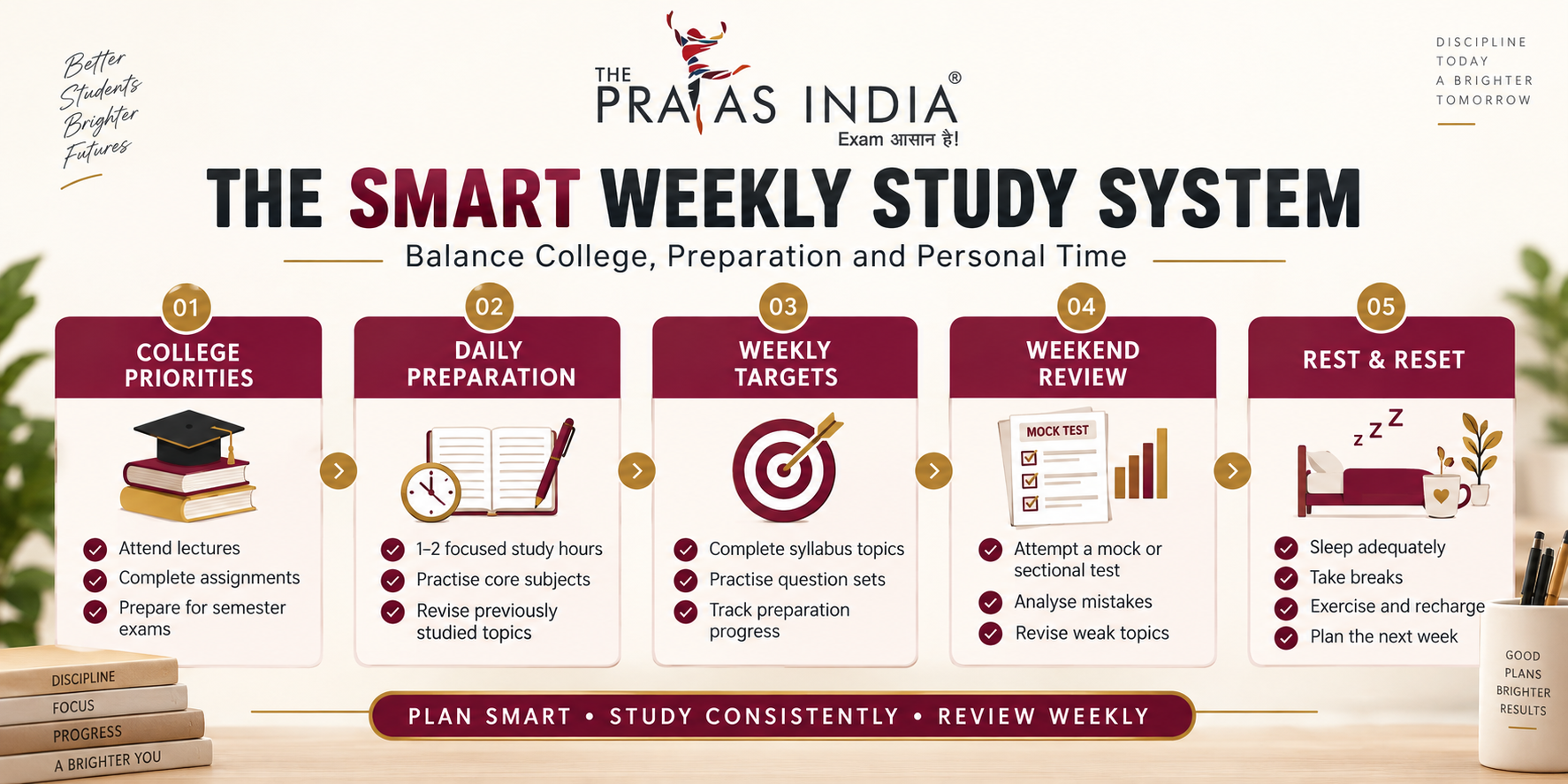
Your weekly framework
| Day or period | Preparation focus |
|---|---|
| Monday | Study one major topic |
| Tuesday | Practise questions from the topic |
| Wednesday | Study another topic |
| Thursday | Revise and practise |
| Friday | Complete pending targets |
| Saturday | Focused syllabus coverage |
| Sunday | Mock test, analysis and planning |
This framework is flexible. You can modify it according to your college schedule, semester examinations and competitive examination requirements.
The objective is to create a preparation routine that you can follow consistently throughout the academic year.
Conclusion
Balancing college and competitive exam preparation is possible when students approach it with realistic expectations, proper planning and consistent effort.
You do not need to sacrifice your college education, sleep or personal life to prepare for competitive examinations. Instead, develop a routine that allows you to manage your academic responsibilities while gradually building the knowledge and skills required for your target examination.
Start by selecting one primary examination, understanding its syllabus, identifying your available study hours and creating weekly preparation goals. Use college breaks thoughtfully, revise regularly and increase your preparation gradually as your academic schedule allows.
Whether you are preparing for UPSC, SSC CGL, banking examinations, CAT, MBA CET or other competitive examinations, consistency and planning can make your preparation more manageable.
If you are looking for competitive examination coaching in Borivali West, The Prayas India can be explored as a local option. Enquire about relevant courses and batch timings to understand whether they fit your college schedule and preparation requirements.
Your college years can be an opportunity to build your future. Plan wisely, stay consistent and make every study session count.
Frequently Asked Questions
Can I prepare for competitive exams while attending college?
How many hours should a college student study for competitive exams?
Which competitive exams can I prepare for during college?
Is the first year of college a good time to start competitive exam preparation?
How can I manage college assignments and competitive exam preparation?
Should I join coaching classes while attending college?
How can I prepare for UPSC during college?
Can I prepare for SSC and banking examinations together during college?
What should I do during college semester examinations?
Which coaching classes are available in Borivali West for competitive examination preparation?
Balancing College & Competitive Exam Preparation?
Explore competitive examination coaching at The Prayas India – Borivali. Enquire about relevant courses, batch timings and preparation options.
077100 13217
Orchid Plaza, 205, Swami Vivekanand Rd, behind Gokul Shopping Complex, Meghdoot, Mhatre Wadi, Borivali West, Mumbai, Maharashtra 400092.