Bank PO Mains Descriptive English: Preparation Strategy and Writing Tips | Best Banking Coaching in Mumbai | The Prayas India
Introduction
Bank PO Mains is not simply a test of speed and accuracy. Once an aspirant clears the objective stages, the preparation begins to demand a different set of skills—particularly the ability to read a topic carefully, organise ideas, write with clarity and present an argument within a limited time. Descriptive English can therefore become an important area of preparation for candidates who want to perform strongly in the Mains stage.
Many aspirants make the mistake of treating descriptive English as something that can be prepared during the final few days before the examination. That approach can create problems because good writing is a skill that develops through repeated practice. Knowing grammar rules or reading model essays is not enough. Candidates need to learn how to convert their knowledge into a structured response under examination pressure.
For students preparing for Bank PO exams and looking for Banking Coaching in Mumbai, a structured preparation environment can make this process more manageable. The right guidance can help aspirants understand the expectations of descriptive writing, practise regularly, identify recurring mistakes and improve their writing over time.
The objective should not be to write complicated English. It should be to write clear, relevant, well-structured and logically connected English.
What Is Descriptive English in Bank PO Mains?
The descriptive component of Bank PO Mains is designed to evaluate a candidate’s written communication skills rather than simply their ability to identify correct grammatical options.
Depending on the examination and its latest official pattern, descriptive tasks may include formats such as essay writing, letter writing or other forms of written communication. Candidates must always verify the specific pattern, word limit, time allocation and marking scheme from the latest official notification of the examination they are appearing for.
The broader skills being tested, however, remain highly relevant:
- Understanding the topic correctly
- Organising ideas logically
- Maintaining relevance
- Using appropriate vocabulary
- Constructing grammatically sound sentences
- Maintaining coherence between paragraphs
- Managing the prescribed word limit
- Completing the response within the available time
This makes descriptive English different from the objective English section. In an MCQ, selecting the correct option may be enough. In descriptive writing, the candidate has to construct the response independently.
Why Aspirants Should Start Descriptive Preparation Early
The biggest advantage of starting descriptive English preparation early is that writing quality improves gradually.
A candidate who writes one essay every few weeks may understand the basic structure but may struggle with speed, organisation and consistency. Someone who regularly writes, receives feedback and rewrites weak responses is more likely to develop a reliable writing process.
Early preparation also gives aspirants enough time to correct recurring problems.
For instance, a student may initially discover that:
- Introductions are too long.
- Arguments are repetitive.
- Paragraphs lack logical transitions.
- Conclusions introduce new ideas instead of summarising the argument.
- Grammar mistakes occur repeatedly.
- Examples are used without explaining their relevance.
- The response exceeds the word limit.
- Too much time is spent thinking about the introduction.
These issues are difficult to correct through last-minute preparation. Regular practice gives students the opportunity to identify and fix them before the examination.
Don’t Try to Impress the Examiner With Complicated English
One of the most common misconceptions about descriptive English is that sophisticated vocabulary automatically produces a better answer.
It does not.
Using unnecessarily complicated words can actually make writing less clear. A strong Bank PO descriptive response should communicate ideas efficiently. The examiner should be able to understand the argument without having to decode the language.
Compare these two approaches:
Simple and effective:
“Digital banking has improved access to financial services, particularly for customers in areas where traditional banking facilities are limited.”
Overcomplicated:
“The unprecedented proliferation of digitalised financial mechanisms has revolutionised the accessibility paradigm of conventional banking services.”
The second sentence may sound impressive, but it does not necessarily communicate the idea better.
For competitive examinations, clarity should come before vocabulary decoration.
Aspirants should focus on:
- Precise vocabulary
- Grammatically correct sentences
- Natural expression
- Logical sequencing
- Appropriate tone
- Relevant examples
Build a Reliable Structure Before You Start Writing
A good descriptive answer should not feel like a collection of disconnected points.
Before writing, candidates should spend a short amount of time understanding the topic and mentally organising their response. This can prevent the common problem of discovering halfway through the essay that the argument has no clear direction.
A practical structure for an essay can be:
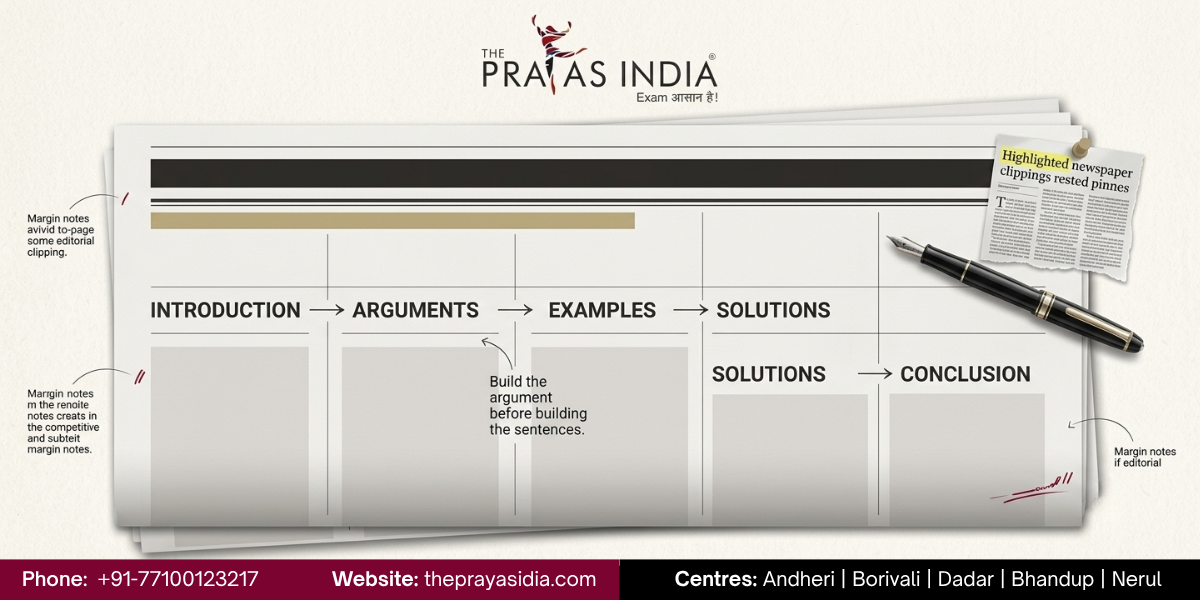
Introduction → Context → Main Arguments → Different Dimensions → Examples → Challenges/Solutions → Conclusion
This does not mean every topic must follow exactly the same template. The structure should change according to the subject.
For example, an essay on financial inclusion may require discussion of access, technology, affordability, awareness and policy. A topic related to artificial intelligence may require discussion of opportunities, risks, employment, ethics and regulation.
The structure provides a framework; the content should be adapted to the topic.
The Introduction Sets the Direction of Your Answer
The introduction does not need to be dramatic or extremely long. Its primary purpose is to establish the context of the topic and indicate what direction the response will take.
A strong introduction can begin with a definition, a relevant observation, a current development, a brief context or a direct statement about the issue.
For example, if the topic is about financial inclusion, the introduction can establish why access to formal financial services matters before moving into the broader discussion.
The introduction should ideally be:
- Relevant to the topic
- Concise
- Easy to understand
- Grammatically sound
- Connected to the argument that follows
Avoid beginning every essay with generic statements such as “Since the beginning of time…” or “In today’s modern world…”. Such openings consume valuable words without adding meaningful substance.
Develop Arguments Instead of Listing Random Points
Once the introduction is complete, the body of the response should develop the central argument.
A common weakness in descriptive answers is point accumulation. Aspirants may know several facts about a topic and try to include all of them, but the final answer becomes a list rather than a coherent discussion.
A better approach is to develop each important point.
For instance, instead of simply writing:
“Digital banking creates financial inclusion.”
develop the idea:
“Digital banking can improve financial inclusion by reducing geographical barriers and allowing customers to access basic banking services remotely. However, its effectiveness depends on digital literacy, internet connectivity and customer awareness.”
The second version demonstrates reasoning. It gives the examiner more than a fact; it shows that the candidate understands the issue from multiple dimensions.
This is especially important for banking examinations because many descriptive topics can relate to economy, technology, banking, financial awareness, social development and governance.
Use Examples, But Don’t Turn the Essay Into a Fact Sheet
Examples can make a descriptive response more convincing, but they should support the argument rather than dominate it.
Aspirants can use relevant examples from:
- Banking and financial services
- Government initiatives
- Technology
- Business and economy
- Social developments
- International developments
- Everyday experiences
The key is relevance.
If an example does not strengthen the argument, it may simply consume words and time.
Similarly, candidates should avoid filling essays with statistics they are not completely confident about. An incorrect statistic can weaken an otherwise good response.
A reliable example explained properly is often more valuable than several unrelated facts.
Improve Your Vocabulary Through Context, Not Memorisation Alone
Vocabulary is useful in descriptive English, but memorising hundreds of difficult words is not the most efficient strategy.
Aspirants should focus on learning words in context. Reading quality newspapers, editorials and analytical articles can help candidates understand how formal English is naturally constructed.
When learning a new word, understand:
- Its meaning
- Its appropriate context
- Its common alternatives
- Its grammatical usage
- Whether it is formal or conversational
This approach makes vocabulary easier to use naturally during the examination.
The objective is not to insert impressive words into every sentence. It is to have enough vocabulary to express ideas accurately without repetition.
Grammar Accuracy Can Be Improved Through Error Tracking
Grammar mistakes are often repetitive.
A candidate who repeatedly makes errors with subject-verb agreement, articles, prepositions or sentence construction may continue making the same mistakes unless those errors are consciously tracked.
Instead of simply checking whether an essay is “good” or “bad”, maintain an error log.
For every writing practice session, identify:
- Grammar errors
- Spelling errors
- Repeated words
- Weak sentence structures
- Incorrect punctuation
- Unclear expressions
- Unnecessary phrases
Over time, patterns become visible.
This is where guided preparation can be particularly useful. Faculty evaluation can help aspirants identify errors that they may not notice while checking their own writing.
Time Management Is Part of Descriptive English Preparation
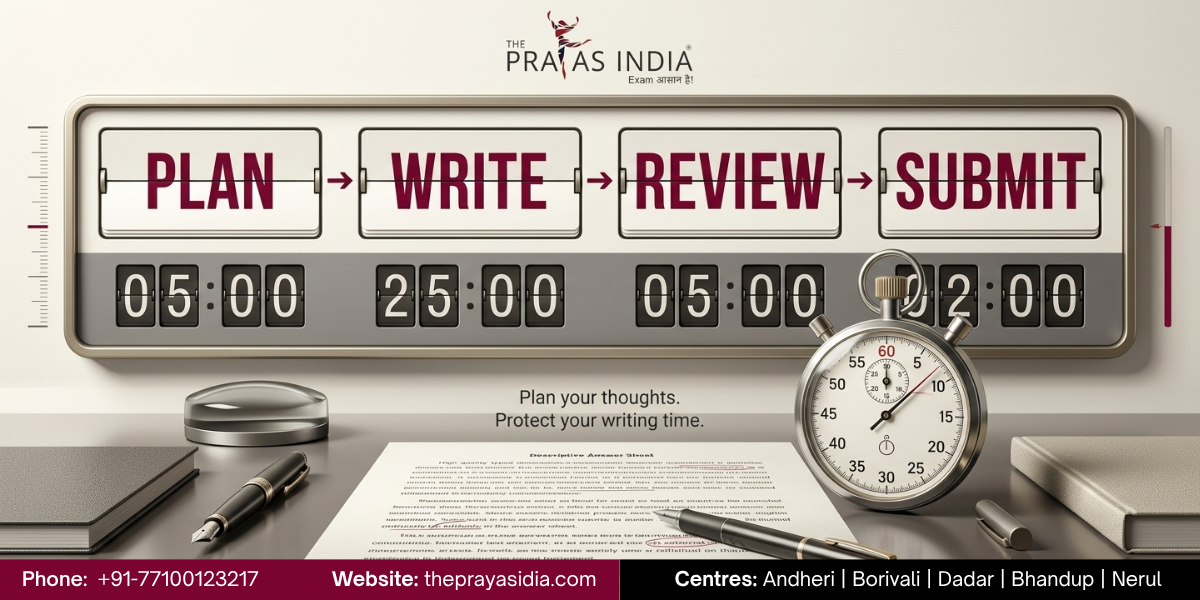
Even a well-written response has limited value if the candidate cannot complete it within the examination’s prescribed time.
Time management should therefore be practised alongside writing.
Initially, aspirants can focus primarily on content quality. As they become more comfortable with structure, they should introduce timed writing sessions.
A useful progression is:
- First, write without strict time pressure.
- Then introduce a comfortable time limit.
- Gradually move towards examination-level timing.
- Analyse where time is being lost.
- Practise planning the response faster.
- Repeat until the writing process becomes natural.
The goal is to reduce the amount of time spent staring at a blank screen or repeatedly rewriting the opening sentence.
How The Prayas India Can Support Banking Exam Preparation
For aspirants searching for Banking Coaching in Mumbai, structured guidance can help bring different components of preparation into one organised system.
The Prayas India focuses on competitive-exam preparation through structured learning, practice and examination-oriented preparation. For Bank PO aspirants, this kind of environment can help students work systematically across the objective and descriptive requirements of the examination.
However, coaching should complement self-study rather than replace it. Students still need to read, practise, revise, attempt tests and analyse their performance independently.
The strongest preparation usually comes when classroom guidance + individual practice + testing + feedback work together.
For students considering admission, the important question is not simply whether an institute provides classes. Aspirants should evaluate whether the overall preparation system fits their learning needs, schedule and examination goals.
Start Practising With Topics Relevant to Banking and the Economy
Aspirants preparing for Bank PO descriptive English should not practise only generic school-level essay topics.
The preparation should gradually include subjects that are relevant to banking, finance, technology, economy and society. This makes it easier to generate ideas during the examination because candidates become familiar with the terminology and dimensions associated with such topics.
Useful practice areas can include:
- Digital banking and financial technology
- Financial inclusion
- Cybersecurity and digital fraud
- Artificial intelligence in banking
- Economic growth and employment
- Women in the workforce
- Entrepreneurship
- Sustainable development
- Financial literacy
- Digital payments
- Customer service in banking
- Data privacy and technology
The purpose is not to memorise essays on these topics. Instead, aspirants should develop the ability to think about them from multiple perspectives.
Don’t Memorise Model Essays
Model answers can be useful for understanding structure and language, but memorising complete essays is a risky strategy.
The actual examination topic may be framed differently, and a memorised response may not directly address the question.
Instead, study model answers to understand:
- How introductions are developed
- How paragraphs are connected
- How arguments are balanced
- How examples are incorporated
- How conclusions are constructed
- How language remains concise
Then practise writing the same topic in your own words.
This approach develops adaptability, which is far more useful than memorisation.
Make Revision Part of Descriptive English Preparation
Revision is not limited to formulas and factual information.
Aspirants should also revise their writing mistakes.
Maintain a personal record of frequently repeated errors and review it regularly. Over time, this can become one of the most useful resources for descriptive preparation.
You can also maintain a small collection of:
- Useful transition phrases
- Commonly confused words
- Banking and economic terminology
- Strong examples
- Important current-affairs themes
- Frequently repeated grammar mistakes
This keeps revision focused and prevents students from wasting time revisiting entire chapters of English grammar unnecessarily.
What Separates an Average Descriptive Answer From a Strong One?
The difference is usually not the number of difficult words used.
A strong response tends to demonstrate clarity, relevance, structure, balance and control.
An average response may contain several correct facts but fail to connect them. It may have a lengthy introduction, repetitive arguments or a weak conclusion.
A stronger response generally gives the examiner a clear progression:
Here is the issue → this is why it matters → these are its major dimensions → these are the challenges → these are practical solutions → this is the conclusion.
Developing this thought process takes practice.
That is why descriptive English should be treated as a skill-building component of Bank PO Mains preparation rather than a last-minute scoring opportunity.
Key Takeaway
Bank PO Mains descriptive English requires a different preparation mindset from objective sections. Candidates must learn to communicate ideas rather than simply recognise correct answers.
The most effective preparation combines reading, topic understanding, structured writing, grammar correction, vocabulary development, timed practice and feedback.
Aspirants should start early enough to identify their weaknesses and gradually build a repeatable writing process. Instead of chasing complicated vocabulary or memorising model essays, focus on expressing relevant ideas in clear and well-organised language.
For candidates preparing for Bank PO examinations in Mumbai, a structured coaching environment can provide useful academic direction while regular self-practice builds individual writing ability.
How to Approach Essay Writing in Bank PO Mains
Essay writing becomes considerably easier when you stop treating it as a test of vocabulary and start treating it as a test of structured thinking. Before writing, understand exactly what the topic is asking and identify the major dimensions that can be discussed within the available word and time limits.
A good essay should have a clear direction from the beginning. The introduction should establish the context, the body should develop relevant arguments, and the conclusion should bring the discussion to a logical close. The objective is to demonstrate that you can understand an issue and communicate your thoughts in an organised manner.
A practical essay structure can be:
- Introduction: Introduce the issue and establish context.
- Background: Explain why the topic is relevant.
- Main discussion: Present two or more meaningful dimensions.
- Examples: Support important arguments with relevant examples.
- Challenges: Discuss limitations or concerns where applicable.
- Way forward: Suggest practical solutions.
- Conclusion: End with a balanced and relevant closing thought.
This structure should not become a rigid formula. Different topics require different approaches, but having a mental framework prevents the response from becoming disorganised.
How to Write a Strong Introduction
The first paragraph should make it clear that you have understood the topic. It does not need to contain every argument you plan to discuss.
For a banking-related topic, you can introduce the broader context and then narrow it down to the specific issue. For a social or technological topic, a short observation or current development can establish relevance.
Avoid generic introductions that could be pasted onto almost any essay. Statements such as “Technology is an important part of our life” provide very little value unless they are connected to the specific subject.
A better introduction should answer one basic question:
What is the central issue that this essay is going to examine?
Once that is clear, the reader can follow the rest of the argument more easily.
Develop the Body Through Multiple Dimensions
A high-quality descriptive answer should demonstrate that you can look at an issue from more than one angle.
For example, if the topic concerns digital banking, the discussion could cover convenience and accessibility, financial inclusion, cybersecurity, customer awareness and regulatory challenges. This gives the response depth without requiring unnecessarily complicated language.
Depending on the topic, useful dimensions may include:
- Economic impact
- Social impact
- Technological implications
- Benefits and opportunities
- Challenges and risks
- Government or institutional role
- Individual responsibility
- Future possibilities
The key is to select dimensions that are genuinely relevant. Adding unrelated points simply to make the essay longer can reduce its overall quality.
Use Current Affairs Without Turning the Answer Into a News Report
Current affairs can significantly strengthen Bank PO descriptive writing, particularly when the topic involves banking, economy, technology, government policy or social developments.
However, current affairs should be used as evidence, not as the entire answer.
Suppose the topic is about digital payments. Instead of listing multiple developments, explain how the growth of digital payment systems has influenced consumer convenience, transaction accessibility and financial participation. A relevant example can then support the argument.
This approach demonstrates both awareness and analytical ability.
Aspirants should therefore regularly read about:
- Banking and financial-sector developments
- RBI-related developments
- Digital payments
- Economic policies
- Financial inclusion
- Cybersecurity
- Technology and AI
- Employment and entrepreneurship
- Major national and international developments
The purpose is to build a bank of ideas that can be adapted to unfamiliar topics.

Letter Writing Requires a Different Tone
If the examination includes letter writing, candidates need to understand that the format and tone are different from an essay.
The first step is to identify who is writing to whom and for what purpose. A formal letter should maintain a professional and respectful tone throughout.
The language should be direct but courteous. Avoid conversational expressions, slang or unnecessarily emotional statements.
A formal letter generally requires attention to:
- Appropriate format
- Purpose of the letter
- Clear description of the issue
- Relevant supporting details
- Polite request or proposed action
- Appropriate closing
Candidates should also pay attention to the word limit and avoid repeating the same information in different sentences.
Practice Formal Letters Around Banking and Public Issues
Bank PO aspirants can make their practice more relevant by choosing topics connected to the kind of issues a banking professional may encounter.
Examples include writing about:
- Banking service-related problems
- Digital transaction failures
- Cyber fraud awareness
- ATM or online banking issues
- Financial literacy
- Customer service
- Banking accessibility
- Loan-related concerns
- Digital payment awareness
- Workplace or institutional communication
This type of practice develops familiarity with formal language while simultaneously improving awareness of banking-related issues.
Don’t Ignore Proofreading
Proofreading is one of the simplest ways to improve descriptive writing, yet it is often ignored because candidates are eager to move to the next question.
Even a short review can identify spelling mistakes, missing words, punctuation errors and incomplete sentences.
During practice, reserve a few minutes specifically for checking the response.
Look for:
Grammar: Are the sentences structurally correct?
Spelling: Have common words been written correctly?
Punctuation: Are full stops, commas and apostrophes used appropriately?
Relevance: Did you actually answer the topic?
Repetition: Have you repeated the same argument?
Word limit: Is the response within the prescribed range?
This habit should become part of preparation rather than something attempted only before the examination.
Build a Personal Descriptive Answer Checklist
One of the easiest ways to make writing practice more productive is to evaluate every response using the same checklist.
Instead of simply asking whether an essay “looks good”, give yourself specific criteria.
After every practice session, evaluate:
- Did I understand the topic correctly?
- Is the introduction relevant?
- Does every paragraph have a clear purpose?
- Are the arguments logically connected?
- Did I provide relevant examples?
- Did I maintain a formal tone?
- Are there recurring grammar errors?
- Did I use unnecessary words?
- Did I stay within the required word limit?
- Did I finish within the target time?
Over several weeks, this checklist can reveal patterns in your writing.
For example, if your arguments are consistently strong but grammar errors remain frequent, your preparation should focus more heavily on language correction. If your writing is accurate but slow, timed practice should become a bigger part of your routine.

A Practical 30-Day Descriptive English Preparation Plan
Aspirants who have limited time can still improve their descriptive performance by following a focused practice cycle.
Days 1–7: Build the Foundation
Spend the first week understanding the required formats, paragraph structure, formal tone and common grammar errors. Write a few short responses without placing excessive pressure on speed.
The priority during this stage should be quality and correctness.
Days 8–15: Increase Writing Practice
Start writing regularly on banking, economy, technology and social topics. Introduce a time limit and analyse every response after completing it.
At this stage, focus on improving:
- Introduction quality
- Paragraph transitions
- Argument development
- Examples
- Grammar
Days 16–23: Introduce Examination Conditions
Begin writing complete responses under stricter time constraints. Practise switching between different topics rather than preparing only familiar subjects.
The objective is to develop adaptability.
Days 24–30: Full Revision and Mock Practice
Use the final stage to identify recurring weaknesses. Attempt descriptive mock exercises and review them carefully.
Do not spend the final days memorising dozens of model essays. Instead, revise your writing framework, common errors, important current-affairs themes and frequently used formal expressions.
How to Balance Descriptive English With Other Bank PO Subjects
Bank PO Mains preparation involves multiple components, so descriptive English should not consume the entire preparation schedule.
The most effective approach is to integrate it into the broader timetable.
For example, aspirants can combine:
- Quantitative Aptitude: Concept revision + advanced practice
- Reasoning: Mixed sets + timed practice
- English: Reading + objective practice + descriptive writing
- General/Financial Awareness: Current-affairs revision
- Descriptive: Essay/letter practice + evaluation
Even 30–45 minutes of focused descriptive practice several times a week can be useful when maintained consistently.
As the Mains examination approaches, the frequency of timed descriptive practice can be increased.
Common Mistakes That Can Reduce Descriptive Scores
Candidates often lose marks not because they lack knowledge but because their answers are poorly presented.
1. Writing Without Planning
Starting immediately without understanding the topic can lead to repetition and poor organisation.
2. Using Overly Complex Vocabulary
Difficult words do not automatically make an answer impressive. Incorrect usage can actually weaken it.
3. Ignoring the Word Limit
Writing significantly more than required can indicate poor control and may leave insufficient time for other tasks.
4. Repeating the Same Argument
A response should develop different aspects of the topic instead of presenting the same idea in multiple sentences.
5. Using Unverified Statistics
Incorrect data can undermine the credibility of an otherwise well-structured response.
6. Writing a Generic Conclusion
The conclusion should reflect the discussion rather than introduce an entirely new argument.
7. Skipping Practice
Understanding descriptive writing theoretically is not enough. Candidates need actual writing practice.
How Structured Banking Coaching Can Strengthen Preparation
Preparing for Bank PO independently is certainly possible, but many aspirants struggle to determine whether their preparation is progressing in the right direction.
This is where a structured Banking Coaching in Mumbai programme can add value. A good preparation system can provide a defined roadmap, regular practice, mock tests, performance analysis and academic guidance.
For descriptive English specifically, feedback is particularly important because candidates cannot always identify their own writing weaknesses.
The Prayas India can be considered by aspirants looking for a structured competitive-exam preparation environment in Mumbai. Students should evaluate the course structure, faculty support, practice methodology, test series and overall academic ecosystem before making an admission decision.
The right coaching programme should help students understand what to study, how to practise and how to evaluate their progress, rather than simply providing study material.
Admission-Focused Preparation at The Prayas India
For students preparing for Bank PO examinations and exploring the best banking coaching in Mumbai, choosing the right preparation environment is an important decision.
The Prayas India offers a structured approach for competitive-exam aspirants, helping students work towards their examination goals through organised preparation and practice. For Bank PO aspirants, the focus should remain on developing the complete set of skills required for Prelims and Mains rather than preparing individual sections in isolation.
Students considering admission should look for a programme that allows them to combine classroom learning with self-study, mock tests, revision and performance analysis.
Ultimately, the value of coaching comes from how effectively it helps an aspirant convert a large syllabus into a manageable and measurable preparation plan.
Final Takeaway
Bank PO Mains Descriptive English should not be treated as a last-minute section.
Strong writing develops through repetition. Candidates need to learn how to understand a topic, organise their thoughts, develop arguments, use relevant examples and communicate ideas within a defined word limit.
The most effective strategy is therefore built around a simple cycle:
Read → Think → Write → Review → Correct → Rewrite
Aspirants who follow this cycle consistently can gradually improve both writing quality and examination confidence.
For candidates preparing in Mumbai, structured Banking Coaching in Mumbai can provide additional guidance, practice and feedback while self-study remains the foundation of individual improvement.
The goal is not to produce literary English. The goal is to produce clear, relevant, structured and error-controlled writing under examination conditions.
FAQs
1. Is descriptive English important for Bank PO Mains?
Yes. Wherever descriptive English is part of the applicable Bank PO Mains examination pattern, candidates need to prepare for it seriously because it evaluates written communication skills that are different from objective English.
2. When should I start preparing for Bank PO descriptive English?
Ideally, preparation should begin well before the Mains examination. Starting early gives you enough time to practise writing, identify grammar mistakes and improve your speed and structure.
3. How can I improve my Bank PO essay writing?
Read quality editorials and current-affairs material, practise essays regularly, follow a logical structure and analyse every response for grammar, relevance, organisation and word-limit control.
4. Should I memorise model essays?
No. Model essays are useful for understanding structure and language, but memorising complete essays can limit your ability to handle unfamiliar topics. Focus on developing adaptable ideas and writing skills.
5. How important is current affairs for descriptive English?
Current affairs can be highly useful for supporting arguments with relevant examples, particularly for topics related to banking, economy, technology and social issues. However, current affairs should support your analysis rather than replace it.
6. How can coaching help with Bank PO descriptive English?
Structured coaching can provide a preparation roadmap, writing practice, mock exercises and feedback. This can help candidates identify weaknesses that may be difficult to recognise through self-evaluation alone.
7. Is descriptive English difficult for candidates from a non-English-medium background?
It can initially require additional practice, but consistent reading, writing and feedback can significantly improve confidence and language control. Candidates should focus on clarity rather than trying to imitate highly complicated English.
8. How much time should I dedicate to descriptive English?
The ideal time depends on your overall Bank PO preparation schedule. Regular short practice sessions are generally more sustainable than attempting large amounts of writing immediately before the examination.