Banking Awareness and Current Affairs for Bank Exams: Complete Preparation Guide for Bhandup Aspirants
Preparing for competitive banking examinations requires more than speed in Quantitative Aptitude, accuracy in Reasoning Ability, and command over English. Candidates must also develop a clear understanding of banking concepts, financial developments, government initiatives, and important national and international events. Banking Awareness and Current Affairs for Bank Exams help aspirants connect theoretical knowledge with developments in India’s financial system.
For candidates preparing for SBI PO, SBI Clerk, IBPS PO, IBPS Clerk, and other banking recruitment examinations, General Awareness preparation should be systematic, consistent, and aligned with the latest official examination notification. Memorising random headlines without understanding their significance can make revision difficult, particularly when several months of information need to be covered.
Aspirants from Bhandup West, Bhandup East, Mulund, Nahur, Kanjurmarg, Vikhroli, and Ghatkopar can benefit from establishing a manageable study routine that balances conceptual learning with daily news revision and objective-question practice. Those exploring banking exam preparation in the area can also investigate the available guidance and course structure at The Prayas India Bhandup.
Why Banking Awareness and Current Affairs Matter in Bank Exams
Banking recruitment examinations assess different abilities. Quantitative Aptitude tests numerical problem-solving, Reasoning Ability examines logical thinking, and English Language evaluates comprehension and communication-related skills. General Awareness preparation, where included in the examination, requires a different approach because candidates must understand concepts and retain relevant information over time.
Banking Awareness introduces candidates to the institutions, rules, products, and processes that support the financial system. Current Affairs complements this knowledge by covering recent developments involving banks, financial regulators, government policies, the economy, and other examination-relevant subjects.
For example, understanding the purpose of the Reserve Bank of India (RBI) is a conceptual task. Learning about a recent RBI monetary policy announcement is a current-affairs task. Understanding what a policy-rate change means for lending conditions connects both areas.
The exact importance, syllabus, number of questions, examination stages, and timing of General Awareness assessments can vary between recruitment processes. Candidates should consult the latest official notification for their target examination rather than assume that SBI PO, SBI Clerk, IBPS PO, and IBPS Clerk follow identical patterns.
1. Understanding Banking Awareness for Bank Exams
Banking Awareness covers the basic concepts, institutions, financial terminology, and banking operations that candidates are expected to understand. Beginners should first focus on the meaning and purpose of each concept before trying to memorise definitions for objective questions.
The Reserve Bank of India and Its Functions
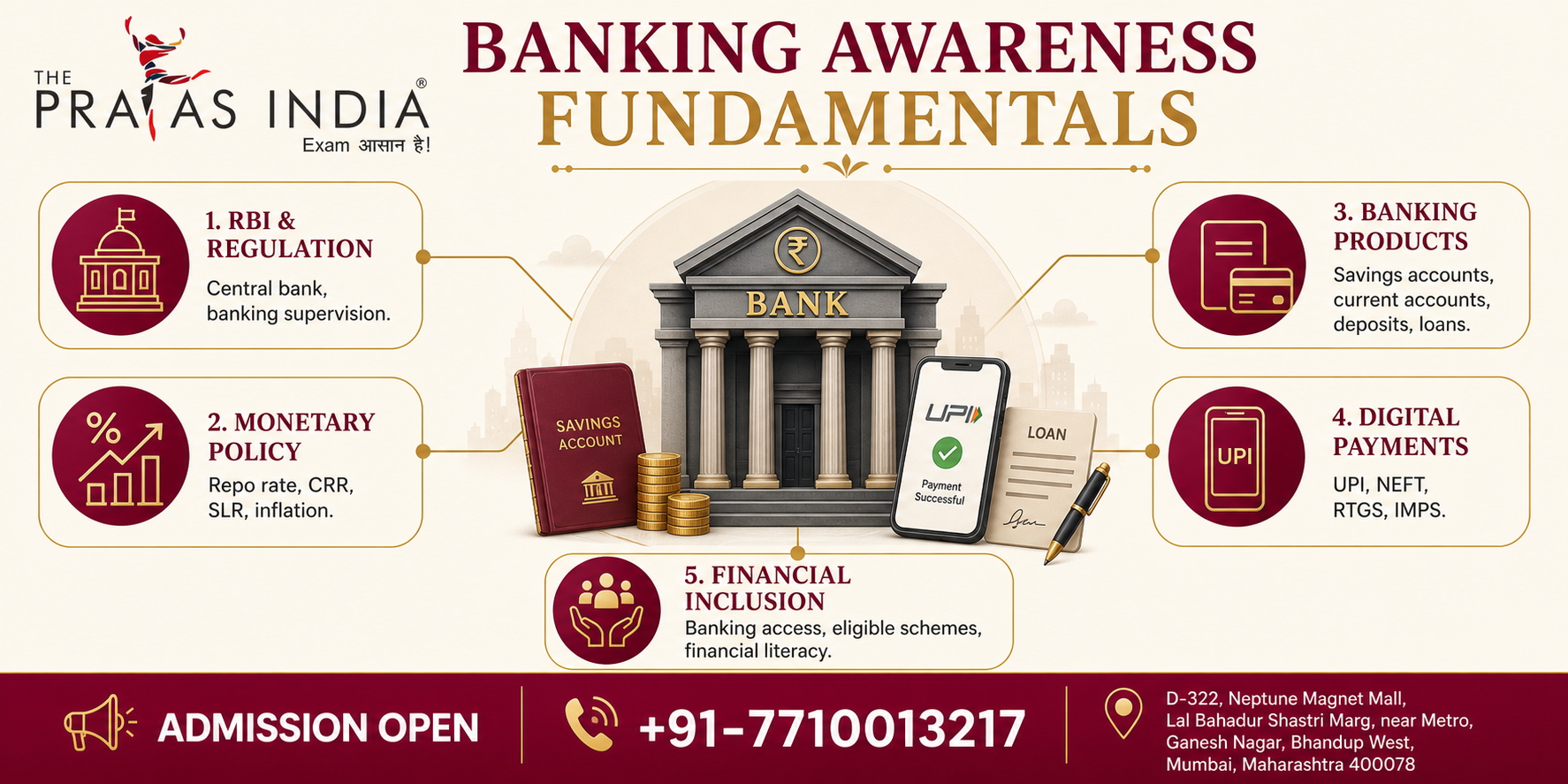
The Reserve Bank of India is India’s central bank. Its responsibilities include monetary policy, regulation and supervision of banks, currency management, payment-system oversight, and other functions related to financial stability. Its monetary policy framework gives particular importance to price stability while keeping economic growth in consideration.
Candidates should understand the RBI’s role in the financial system, its relationship with commercial banks, and the purpose of its major regulatory and monetary functions.
Monetary Policy and Important Policy Rates
Monetary policy refers to measures used by the central bank to influence monetary and liquidity conditions in the economy. Important terms include:
- Repo rate: The rate at which the RBI provides eligible short-term liquidity to banks under the applicable liquidity framework against eligible collateral.
- Reverse repo rate: The rate associated with the RBI absorbing liquidity from banks through eligible reverse-repo operations. Candidates should distinguish this instrument from the Standing Deposit Facility.
- Cash Reserve Ratio (CRR): The prescribed proportion of a bank’s relevant net demand and time liabilities that it must maintain as cash balances with the RBI.
- Statutory Liquidity Ratio (SLR): The prescribed proportion of relevant liabilities that banks must maintain in specified liquid assets.
- Bank Rate: A rate defined under the RBI Act and associated with specified central-bank functions and regulatory provisions.
A useful way to study these terms is to compare their purpose, the institution involved, and their potential effect on banking-system liquidity. Do not memorise policy rates as permanent facts: rates and operating arrangements can change. Verify the applicable values from the RBI’s official current-rate information.
Inflation and Its Economic Impact
Inflation refers to a sustained increase in the general price level of goods and services. When inflation rises, the purchasing power of money can decline. Inflation is relevant to banking examinations because it connects monetary policy, interest rates, household spending, savings, and economic conditions.
Candidates should understand the difference between inflation and deflation, how inflation is measured, and why central banks monitor price stability. They should also distinguish an inflation rate from the price level itself.
Commercial Banks and Types of Accounts
Commercial banks accept deposits, facilitate payments, provide loans, and deliver other financial services. Candidates should understand the functions of public-sector banks, private-sector banks, regional rural banks, cooperative banks, and small finance banks at an appropriate examination level.
Important account types include:
- Savings account: Primarily designed to hold personal savings and facilitate routine transactions.
- Current account: Commonly used by businesses and customers with frequent transactions.
- Fixed deposit: A deposit placed for an agreed tenure under the bank’s applicable terms.
- Recurring deposit: A deposit arrangement involving regular contributions over a specified period.
Questions may test account features, intended uses, interest treatment, and differences between deposit products. Study the general principles first, then verify product-specific rules where necessary.
NPAs and Priority Sector Lending
A Non-Performing Asset (NPA) is a loan or advance classified as non-performing under applicable regulatory norms. Candidates should understand why overdue loans create problems for banks, how asset quality affects profitability, and why banks monitor credit risk.
Priority Sector Lending refers to lending categories identified under RBI guidelines for supporting designated sectors and activities. Preparation should cover its purpose, broad eligible categories, and the role of regulatory guidelines. Specific classification criteria and targets should be checked against current official instructions.
Digital Banking and Payment Systems
Digital banking is an important area because it connects everyday financial transactions with banking infrastructure.
| Payment system | Basic concept |
|---|---|
| UPI | Facilitates instant payment transactions through participating banking accounts and supported applications. |
| NEFT | An electronic funds-transfer system that processes transactions in batches under its operating framework. |
| RTGS | A funds-transfer system that settles transactions individually in real time. |
| IMPS | An electronic funds-transfer service designed to support immediate interbank payments. |
Candidates should learn the full forms, core features, settlement principles, and practical distinctions between these systems. They should also understand the role of the National Payments Corporation of India (NPCI) in retail payment infrastructure and distinguish NPCI’s functions from those of the RBI. Official NPCI resources provide information about UPI products and payment-system developments.
Financial inclusion, banking access, digital security, important financial institutions, and government initiatives related to financial services should also form part of a candidate’s conceptual preparation.
2. Understanding Current Affairs for Banking Examinations
Current Affairs for Bank Exams involves identifying, understanding, organising, and revising recent developments relevant to the examination. The objective is not to remember every headline. It is to recognise which developments have financial, economic, administrative, or national significance.
Important Current-Affairs Categories
RBI announcements and monetary policy: Follow official policy decisions, regulatory circulars, changes to applicable rates, banking instructions, and significant reports. Record the date and the actual decision instead of relying on an incomplete headline.
Banking and financial-sector news: Track relevant developments involving banks, financial institutions, digital payment systems, financial inclusion, banking services, and regulatory compliance.
Government schemes and financial inclusion: Study the purpose, implementing ministry or agency, target beneficiaries, and principal features of relevant schemes. Avoid confusing a scheme’s launch date with a subsequent modification or extension.
Union Budget and Economic Survey: Understand important fiscal and economic priorities, major announcements, and relevant economic terminology. Where figures are examination-relevant, record the financial year and source.
Economic indicators: Revise concepts such as GDP, inflation, fiscal deficit, foreign-exchange reserves, and unemployment. Learn what each indicator measures before memorising specific reported values.
Reports, indices, appointments, and awards: Prioritise credible, examination-relevant developments. Record the organisation, report or index name, purpose, and important associated facts.
National and international developments: Focus on developments with clear relevance to the economy, public policy, international institutions, financial cooperation, or other likely examination themes.
Fintech and digital payments: Follow developments in payment infrastructure, digital banking, cybersecurity, and financial technology. Distinguish officially announced features from proposals, pilots, and future plans.
How to Prioritise News
For every important item, ask three questions:
- Does the development relate to banking, finance, the economy, government policy, or another examination-relevant category?
- Is there an underlying concept that could be tested through an objective question?
- Can the information be verified through a primary or otherwise reliable source?
This approach helps aspirants avoid spending excessive time on news that contributes little to their preparation.
3. Banking Awareness vs Current Affairs
Banking Awareness and Current Affairs overlap, but they are not interchangeable. Banking Awareness builds conceptual understanding, while Current Affairs records relevant developments over time.
| Comparison | Banking Awareness | Current Affairs |
|---|---|---|
| Main purpose | Understand banking concepts and institutions | Follow relevant recent developments |
| Typical topics | RBI, CRR, SLR, NPAs, payment systems | New RBI decisions, banking announcements, schemes |
| Study method | Learn definitions, functions, and differences | Read, verify, summarise, and categorise news |
| Revision | Concept maps and topic-wise questions | Daily, weekly, and monthly revision |
| Practice | Definition, application, and concept-based MCQs | Fact-based and news-linked MCQs |
| Common difficulty | Confusing similar technical terms | Forgetting dates, names, and important details |
Consider a hypothetical example: a candidate learns how the repo rate works in Banking Awareness. If the RBI subsequently announces a policy decision, the candidate adds the verified decision to Current Affairs notes and connects it to the repo-rate concept. This integrated approach supports both understanding and retention.
4. How to Prepare Banking Awareness from Basics
A beginner should follow a clear sequence rather than study topics randomly.
Step 1: Build a Banking Terminology Foundation
Start with banks, deposits, loans, interest, credit, debit, inflation, liquidity, and financial institutions. Write definitions in your own words and use a simple example for each term.
Step 2: Understand the RBI and Other Institutions
Study the RBI first, followed by relevant financial regulators, development institutions, and payment-system organisations. Focus on their responsibilities and the distinctions between them.
Step 3: Learn Monetary Policy and Financial Concepts
Create a comparison notebook for repo rate, reverse repo rate, CRR, SLR, NPA, inflation, and related concepts. Include the meaning, purpose, and important differences between each pair of similar terms.
Step 4: Connect News to Concepts
Whenever a relevant banking announcement appears, identify the concept behind it. This makes a news item easier to understand and provides context for future revision.
For example, a hypothetical note about a change in a bank’s digital payment facility could be organised under three headings: the institution involved, the payment-system concept, and the verified details of the announcement. This example illustrates a note-making method, not an actual news event.
Step 5: Maintain Concise Notes
Organise notes into categories such as RBI, banking terminology, digital payments, government schemes, economic indicators, and financial institutions. Record dates and sources for time-sensitive facts.
Avoid copying lengthy articles. Your notes should be short enough for repeated revision but detailed enough to explain the original fact.
Step 6: Practise Topic-Wise MCQs
Attempt questions immediately after completing a topic. Explain why the correct option is right and why your chosen wrong option is incorrect. This helps identify whether the problem is conceptual confusion, incomplete knowledge, or careless reading.
Step 7: Use Spaced Revision
Revisit material after progressively longer intervals instead of reading it once. For example, review a topic the next day, again later in the week, and during the monthly revision session. Adjust the intervals according to your recall.
Step 8: Review Weak Areas
Maintain an error notebook with the question, correct answer, reason for the mistake, and the date of revision. Review recurring errors before attempting another quiz on the same topic.
5. How to Prepare Current Affairs for Bank Exams
A practical daily routine is more sustainable than trying to memorise a large collection of monthly PDFs shortly before an examination.
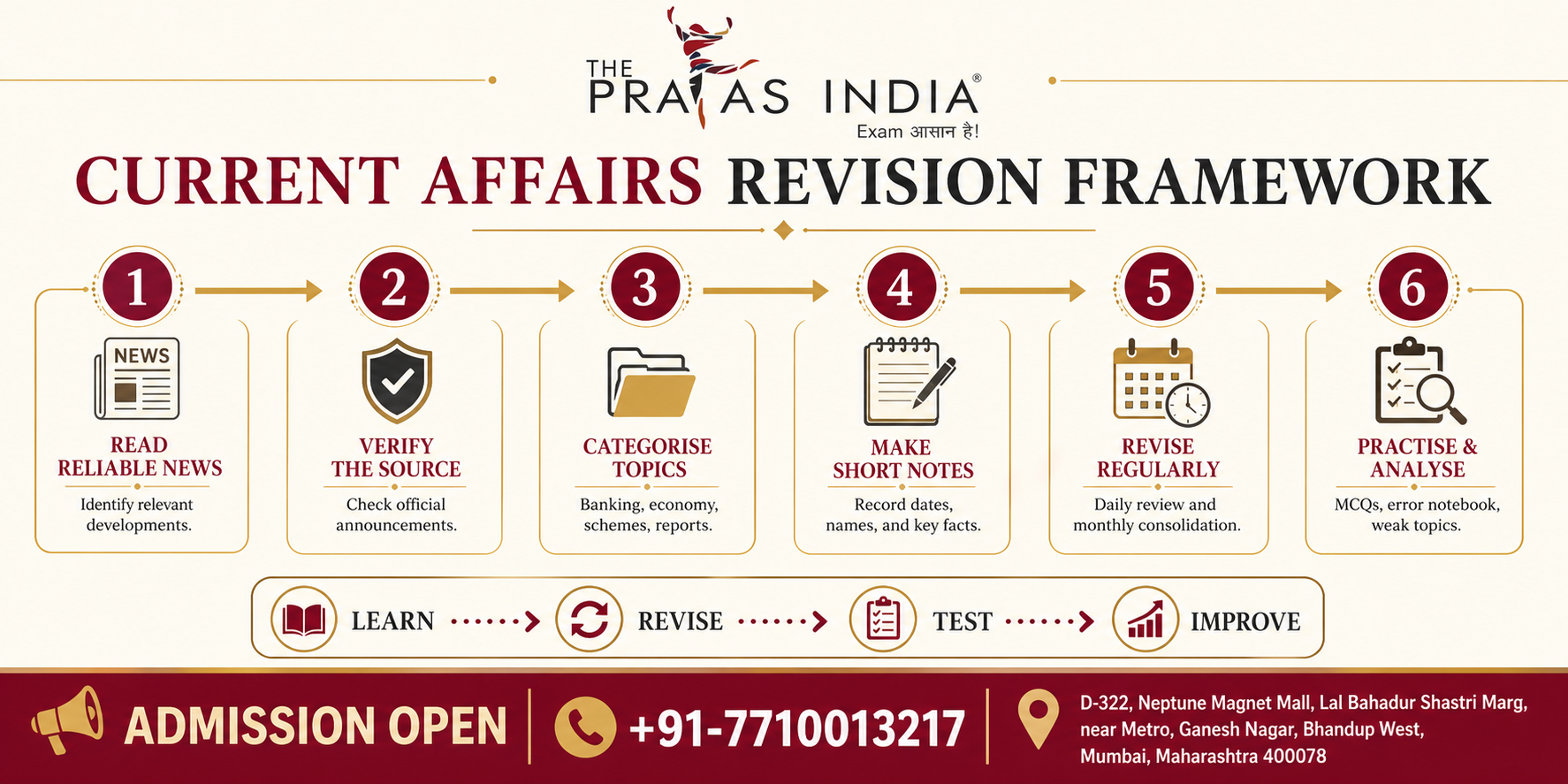
Begin by selecting a small number of reliable news and revision sources. Read relevant developments, cross-check important announcements, and write short notes. Separate banking and financial news from other current-affairs categories so that revision remains organised.
Your notes should capture the event, date, institution, key fact, and significance. For numerical information, include the unit, reporting period, and financial year where applicable. For government schemes, record the implementing body and purpose rather than memorising only the scheme name.
At the end of each week, revisit the material and attempt a short quiz. At the end of each month, prepare a consolidated revision sheet covering the most important items. Monthly summaries are useful, but they should not replace the original source when an announcement or figure needs verification.
The number of months of current affairs to revise should be determined by the target examination’s latest notification, the timing of its stages, and a reasoned preparation plan. There is no single revision window that should automatically be treated as compulsory for every banking examination.
Candidates preparing for Current Affairs for SBI PO, SBI Clerk General Awareness, IBPS PO Current Affairs, and IBPS Clerk Banking Awareness should therefore begin with a consistent daily habit and adapt their final revision to the specific recruitment process.
6. Reliable Sources for Banking Awareness and Current Affairs
Reliable sources are essential because incorrect dates, outdated rates, and misleading summaries can create avoidable mistakes. Candidates should use educational resources for convenience but verify important facts through primary sources.
| Source | What to study |
|---|---|
| Reserve Bank of India — rbi.org.in | Monetary policy, banking regulations, notifications, reports, and current rates |
| Press Information Bureau — pib.gov.in | Government announcements, schemes, and official releases |
| Ministry of Finance — finmin.gov.in | Budget-related information, financial policy, and official ministry updates |
| National Payments Corporation of India — npci.org.in | UPI, digital payments, payment-system products, and relevant statistics |
| State Bank of India — Official SBI Careers | SBI recruitment notifications, examination information, and official updates |
| Institute of Banking Personnel Selection — ibps.in | Official recruitment notifications and examination-related information |
Official RBI resources explain its functions and monetary policy framework, while NPCI publishes information about its payment products and UPI statistics. These sources are especially useful when a current-affairs question refers to a financial institution or payment system.
Newspapers and educational summaries can help candidates discover important topics. However, check significant policy decisions, rates, scheme details, examination dates, and recruitment requirements against the relevant primary source. Always check the publication date and ensure that an older announcement has not been superseded.
7. Common Mistakes to Avoid
Even candidates who spend considerable time on General Awareness can struggle if their preparation lacks structure. The following corrections can make their efforts more effective.
Memorising without understanding: Learning definitions by rote makes similar terms difficult to distinguish. Write a short explanation and an example for every major concept.
Using too many sources: Collecting multiple PDFs and daily news digests often creates duplicate material. Choose a manageable set of resources and use additional sources only when verification is necessary.
Ignoring revision: Reading something once does not guarantee recall. Schedule weekly quizzes and monthly reviews instead of repeatedly collecting new information.
Relying on outdated current affairs: Older notes may contain superseded rates, incomplete policy details, or obsolete recruitment information. Verify time-sensitive facts before including them in final revision notes.
Confusing banking terms: Repo rate, CRR, SLR, NEFT, RTGS, and IMPS describe different concepts or systems. Build comparison tables and practise questions that test the distinctions.
Neglecting mock-test analysis: Completing questions without reviewing mistakes limits the value of practice. Categorise each error and revise the relevant topic.
Studying irrelevant news in excessive detail: Every headline does not deserve equal attention. Prioritise developments with a clear connection to the examination’s subjects and requirements.
Leaving current affairs until the last minute: Last-minute memorisation can create a large, difficult-to-revise backlog. Establish a daily reading and note-making routine early.
Assuming every banking examination is identical: Recruitment processes may differ in their stages, syllabus, question distribution, and timing. Check the latest notification for each examination you intend to attempt.
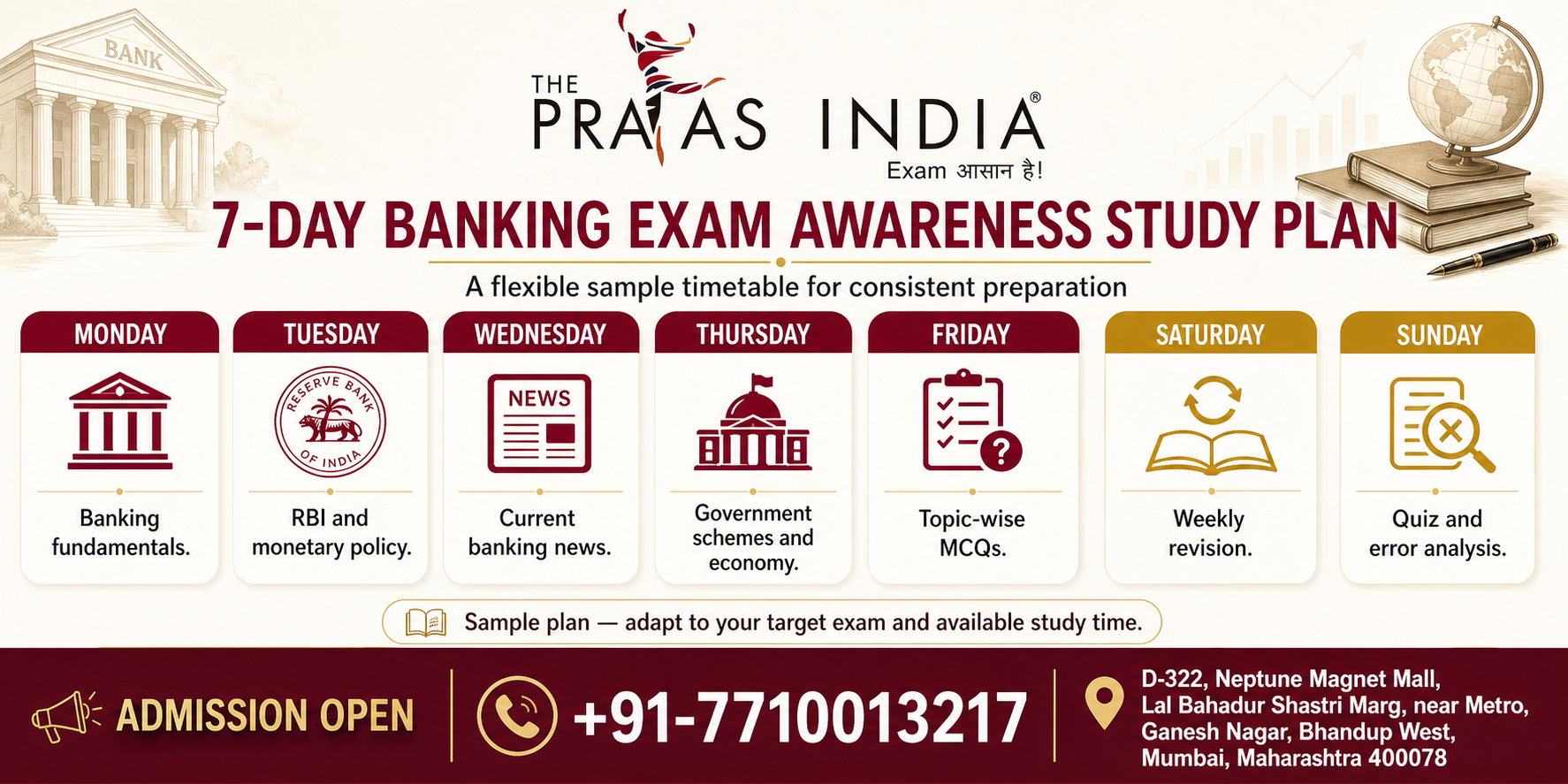
8. A Practical Seven-Day Study Plan
The following timetable is an adaptable example, not an official examination schedule. It assumes that candidates can dedicate a regular study period to General Awareness each day. Adjust the time and workload according to your other subjects, college timetable, job, and preparation stage.
| Day | Main focus | Suggested activity |
|---|---|---|
| Monday | Banking fundamentals | Study account types, commercial banks, deposits, and basic terminology |
| Tuesday | RBI and monetary policy | Revise RBI functions, policy rates, CRR, SLR, and inflation |
| Wednesday | Current banking news | Review verified banking announcements and digital-payment developments |
| Thursday | Schemes and economy | Study relevant government schemes, Budget-related developments, and economic indicators |
| Friday | Objective practice | Attempt topic-wise MCQs and review incorrect answers |
| Saturday | Consolidated revision | Revise weekly notes, compare similar concepts, and revisit weak areas |
| Sunday | Weekly assessment | Take a short quiz, analyse mistakes, and prepare the next week’s revision priorities |
College students can divide their preparation into shorter sessions around classes. Working professionals may prefer a brief daily news-reading session followed by a longer revision period on days off. Full-time aspirants can dedicate additional time to MCQs and error analysis without allowing General Awareness to displace preparation for other required subjects.
The essential principle is consistency. A manageable routine that is followed regularly is generally more useful than an ambitious timetable that becomes difficult to sustain.
9. How Mock Tests and MCQs Improve General Awareness Preparation
Mock tests help candidates assess their understanding, recall, and ability to identify the correct answer under examination conditions. They also reveal whether mistakes result from forgotten facts, conceptual confusion, incomplete reading, or weak revision.
After each test, classify mistakes into three groups:
- Factual gaps: You did not know or could not recall the relevant information.
- Conceptual errors: You confused two banking terms or misunderstood a process.
- Application or reading errors: You knew the material but misread the question or selected an option without checking the details.
Maintain an error notebook and revisit the corresponding source. If you repeatedly confuse two concepts, prepare a comparison table rather than merely rereading the same paragraph. If you forget current-affairs facts, revise the associated monthly notes and test your recall again.
Sample Banking Awareness Questions
These original practice questions focus on stable concepts rather than unverified current-affairs claims.
Question 1: Which institution is India’s central bank?
A. State Bank of India
B. Reserve Bank of India
C. National Payments Corporation of India
D. Institute of Banking Personnel Selection
Correct answer: B. Reserve Bank of India.
Explanation: The RBI is India’s central bank and has responsibilities that include monetary policy and banking regulation.
Question 2: What does CRR stand for?
A. Cash Reserve Ratio
B. Credit Recovery Rate
C. Capital Return Reserve
D. Current Repayment Ratio
Correct answer: A. Cash Reserve Ratio.
Explanation: CRR refers to the prescribed cash balances banks must maintain with the RBI, calculated according to the applicable rules.
Question 3: Which payment system is associated with real-time gross settlement?
A. NEFT
B. RTGS
C. Recurring Deposit
D. Fixed Deposit
Correct answer: B. RTGS.
Explanation: RTGS settles eligible transactions individually in real time, unlike NEFT’s batch-based processing framework.
Question 4: What is the principal purpose of a savings account?
A. To facilitate personal savings and routine transactions
B. To determine the RBI’s policy rate
C. To regulate all commercial banks
D. To publish government recruitment notifications
Correct answer: A. To facilitate personal savings and routine transactions.
Explanation: A savings account is a deposit product intended primarily for holding personal funds and supporting everyday banking needs.
Question 5: Why should candidates verify current RBI policy rates before an examination?
A. Policy rates never change.
B. Rates apply only to international banks.
C. Rates and monetary policy decisions can change over time.
D. Current rates are unrelated to banking awareness.
Correct answer: C. Rates and monetary policy decisions can change over time.
Explanation: Candidates should distinguish permanent conceptual knowledge from facts that may change following official announcements.
Use questions like these to test the underlying concept. For actual current-affairs practice, prepare additional questions from verified announcements and retain the source and date with each answer.
10. Banking Exam Preparation Support in Bhandup
Aspirants looking for banking exam coaching in Bhandup West may wish to compare local preparation options with self-study and online learning. The right approach depends on the candidate’s existing knowledge, study discipline, preferred learning environment, and need for structured guidance.
For students in Bhandup West and Bhandup East, a local centre may be worth exploring if it provides a suitable combination of classroom learning, practice, revision, and doubt-solving support. Candidates travelling from Mulund, Nahur, Kanjurmarg, Vikhroli, and Ghatkopar should also consider travel time and batch schedules when planning their preparation.
The Prayas India Bhandup is a local option for candidates researching banking exam preparation in the area. Aspirants considering the centre should confirm the current course structure and whether the available programme covers their target examination, including SBI PO, SBI Clerk, IBPS PO, or IBPS Clerk.
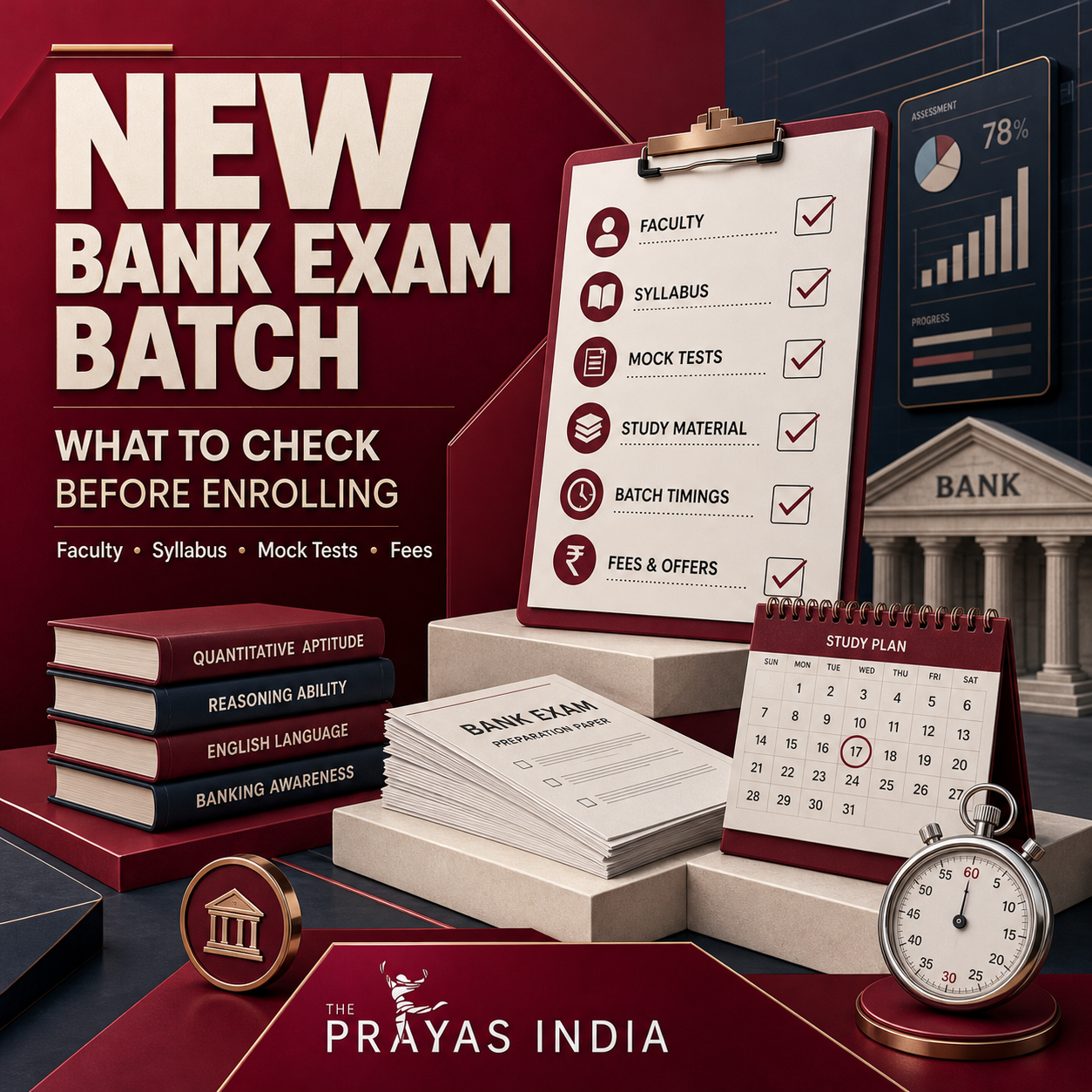
Before enrolling, ask about:
- Faculty experience and subject-wise teaching arrangements.
- Coverage of Quantitative Aptitude, Reasoning Ability, English, and General Awareness, as applicable to the target examination.
- Banking Awareness classes and current-affairs revision support.
- Availability of topic-wise practice, mock tests, and performance analysis.
- Doubt-solving arrangements, batch timings, fees, and course duration.
- Access to study material and revision resources.
These checks help candidates make an informed decision rather than relying solely on promotional claims. Course details and availability should always be confirmed directly.
The Prayas India, Bhandup
- Address: D-322, Neptune Magnet Mall, Lal Bahadur Shastri Marg, near Metro, Ganesh Nagar, Bhandup West, Mumbai, Maharashtra 400078.
- Contact number: +91-7710013217
- Google Maps / Business Profile: View The Prayas India Bhandup
Contact the centre to confirm current banking exam batches, fees, class timings, and preparation support before making an enrolment decision.
For candidates searching online for Bank Exam Coaching in Bhandup West, Bank Exam Classes Near Bhandup Railway Station, or Banking Coaching in Central Mumbai, comparing the actual course offerings and daily travel requirements can help narrow the available choices. The most suitable programme is one that fits the candidate’s examination target, learning needs, and available preparation time.
11. Conclusion
Banking Awareness and Current Affairs for Bank Exams should be approached as a continuous learning process rather than a last-minute memorisation exercise. Strong preparation combines a foundation in banking concepts, consistent current-affairs reading, reliable official sources, concise notes, topic-wise MCQs, and regular error analysis.
Candidates preparing for SBI PO, SBI Clerk, IBPS PO, and IBPS Clerk should adapt their study plan to the latest official notification and maintain a balance between General Awareness and the other required subjects.
If you are preparing in Bhandup or the surrounding Central Mumbai localities, you can contact The Prayas India Bhandup to enquire about current banking exam courses and available preparation support. Confirm the syllabus coverage, batch timings, practice resources, and fees before deciding on your next step.
Frequently Asked Questions (FAQs)
Banking Awareness and Current Affairs for Bank Exams: Bhandup Guide
1. What is Banking Awareness for bank exams?
Banking Awareness covers banking institutions, RBI functions, monetary policy, deposit accounts, loans, NPAs, financial inclusion, and digital payment systems. The exact topics required depend on the target examination’s syllabus and notification.
2. How is Banking Awareness different from Current Affairs?
Banking Awareness focuses on concepts and how the banking system works. Current Affairs focuses on recent developments, announcements, schemes, and economic events. Both subjects complement each other when candidates connect news to the underlying concepts.
3. Which topics should candidates study for Banking Awareness?
Begin with RBI functions, monetary policy, CRR, SLR, inflation, commercial banks, account types, NPAs, Priority Sector Lending, financial institutions, UPI, NEFT, RTGS, and IMPS. Check current regulatory information and the examination-specific syllabus before finalising your topic list.
4. How should aspirants revise current affairs?
Read reliable sources daily, prepare concise topic-wise notes, review the notes weekly, and consolidate important developments monthly. Practise MCQs and verify time-sensitive information against official announcements. Adapt the revision period to your examination schedule and preparation requirements.
5. Which official sources are useful for banking-related updates?
The RBI, Press Information Bureau, Ministry of Finance, NPCI, official bank websites, and official SBI and IBPS recruitment portals are useful sources. Candidates should prioritise primary documents when checking policy decisions, financial figures, regulatory changes, and recruitment details.
6. Are mock tests useful for General Awareness preparation?
Yes. Mock tests help assess recall, identify weak topics, and reveal confusion between similar banking concepts. Their value increases when candidates review incorrect answers, verify the correct information, and revisit mistakes through a structured error notebook.
7. Can beginners prepare Banking Awareness from scratch?
Yes. Beginners can start with banking terminology, account types, RBI functions, and basic monetary concepts. They can gradually add current affairs, topic-wise MCQs, and regular revision. A structured routine helps build knowledge without requiring candidates to learn every topic simultaneously.
8. How can aspirants enquire about banking exam preparation in Bhandup?
Aspirants can contact The Prayas India Bhandup at
+91-7710013217
or use the
Google Maps / Business Profile link.
Ask about current banking exam batches, syllabus coverage, mock tests, revision support, timings, and fees before enrolling.
THE PRAYAS INDIA · BHANDUP
Prepare Smarter for Your Banking Exam
Strengthen your Banking Awareness and Current Affairs preparation for SBI PO, SBI Clerk, IBPS PO and IBPS Clerk. Contact The Prayas India Bhandup to enquire about current courses, batch timings and preparation support.
Call for Course and Admission Enquiries
Visit Our Bhandup Centre
The Prayas India, D-322, Neptune Magnet Mall,
Lal Bahadur Shastri Marg, near Metro, Ganesh Nagar,
Bhandup West, Mumbai, Maharashtra 400078.
Contact the centre to confirm current course availability, syllabus coverage, batch timings and fees before enrolling.