Can an Average Student Crack SSC CGL? | Best SSC Coaching in Mumbai | The Prayas India
Can an Average Student Really Crack SSC CGL?
“I’m an average student. Can I crack the SSC CGL exam?”
This is one of the most common doubts among SSC aspirants. Many students look at successful candidates and assume that they must have been academically brilliant, exceptionally fast in Mathematics or naturally strong in English. When they compare themselves with such candidates, they often underestimate their own potential before their preparation has even started.
The truth is that SSC CGL is not an examination reserved for academic toppers. Your school or college marks do not decide how well you will perform in a competitive examination. What matters far more is whether you can understand the exam pattern, build the required concepts, practise consistently, improve your speed and accuracy, and learn from your mistakes.
An average student can absolutely build a strong SSC CGL preparation strategy. However, there is an important difference between simply believing that you can crack the examination and actually preparing in a way that makes selection possible. Confidence can help you begin, but structured preparation, consistency and continuous performance improvement are what move you towards your goal.
Stop Defining Yourself as an “Average Student”
Before discussing preparation, it is important to understand what students usually mean when they call themselves average.
Some students use the term because their academic marks were ordinary. Others may have struggled with Mathematics throughout school or college. Some students understand concepts but take too much time to solve questions. Others may have decent subject knowledge but cannot maintain consistency for more than a few days.
Some aspirants have never prepared for a competitive examination before and feel overwhelmed by the size of the SSC CGL syllabus. They see experienced candidates discussing mock scores, shortcuts and advanced strategies and immediately assume that they are far behind.
These situations are common, but none of them means that you cannot improve.
Instead of asking, “Am I intelligent enough to crack SSC CGL?”, ask more useful questions:
- Which subjects are currently strong and weak?
- Which concepts do I need to rebuild?
- How much time do I currently take to solve questions?
- How accurate am I under time pressure?
- Which mistakes do I repeat?
- How consistently can I study every day?
- Am I practising questions relevant to the actual examination?
- Do I analyse my mock tests properly?
Once you start asking these questions, “average student” stops being an identity and becomes simply a starting point from which improvement can be measured.
SSC CGL Is Not Just About Academic Intelligence
One of the biggest misconceptions about SSC CGL is that candidates with strong academic backgrounds automatically have an advantage throughout the preparation.
Academic knowledge certainly helps, particularly when you already have strong fundamentals. But competitive examinations require a different combination of skills.
You need to understand concepts, but you must also recognise question patterns quickly. You need to know the correct method, but you must also execute it within a limited amount of time. You need to attempt questions confidently, but you must also know when a question is not worth spending additional time on.
This is why exam-specific practice matters so much.
A student who was not particularly strong in Mathematics may gradually become comfortable with SSC-level arithmetic after solving hundreds of well-selected questions and analysing the methods used. Similarly, a candidate who initially struggles with English can improve through systematic work on grammar, vocabulary, comprehension and previous-year questions.
The improvement may not happen in a week. It happens because repeated exposure makes familiar question types easier to recognise and solve.
That is an important distinction: you do not need to start as an expert. You need to be willing to become better through structured practice.
What Does SSC CGL Actually Demand From You?
The right preparation begins with understanding what the examination expects from a candidate.
SSC CGL preparation broadly revolves around Quantitative Aptitude, General Intelligence and Reasoning, English Language and Comprehension, and General Awareness, along with the requirements of subsequent stages. The challenge is not simply covering these subjects but developing the ability to perform consistently under examination conditions.
For an average student, this means preparation should happen in stages rather than through random question solving.
First, you need to understand the concepts. Once the fundamentals are clear, you need to practise different question types. After that, you need to introduce time limits and sectional tests. Eventually, full-length mocks should become an important part of your preparation.
The process can be understood as:
Concept Building → Practice → Previous-Year Questions → Sectional Testing → Mock Tests → Analysis → Revision → Improvement
Skipping one of these stages can create problems later. For example, taking mocks without having sufficient conceptual understanding may produce repeatedly low scores without actually telling you how to improve. Similarly, studying concepts for months without timed practice can leave you unprepared for the pressure of the actual examination.
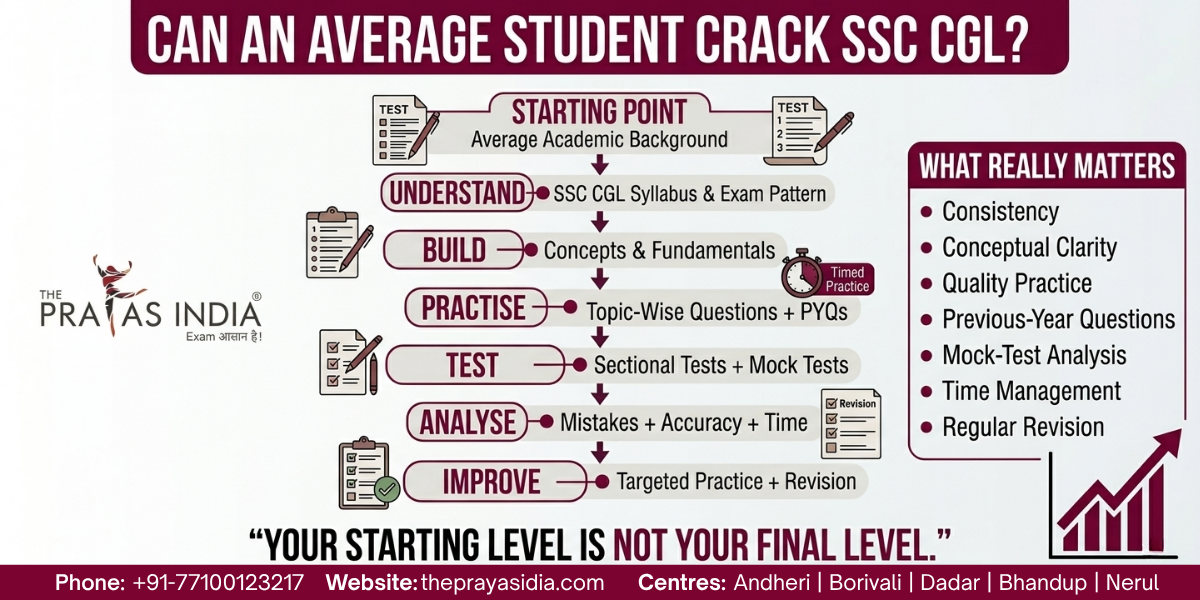
Your Starting Score Does Not Decide Your Final Score
This is particularly important for students who take an initial mock test and become discouraged by the result.
Suppose you attempt your first mock and your score is much lower than expected. It is tempting to conclude that SSC CGL is too difficult for you.
But an initial mock is not supposed to prove that you are already prepared. Its purpose is to show you where you currently stand.
A low score can reveal that your Quant fundamentals need work. It can show that you are spending too much time on Reasoning. It can reveal that your English accuracy is lower than you expected. It can also show that your General Awareness preparation is incomplete.
That information is valuable.
The more important question is what happens after that first score.
If you identify your weaknesses, work on them and take another test after sufficient practice, your performance becomes a much better indicator of your potential. A student who moves from one level to another through consistent improvement may eventually outperform someone who started stronger but failed to maintain discipline.
Your preparation trajectory matters more than your starting point.
Mathematics: The Biggest Fear for Many Average Students
For many SSC aspirants, Mathematics is the subject that creates the most anxiety.
Students who have struggled with Maths earlier often enter SSC preparation believing that they are simply “not a Maths person”. This mindset can become more damaging than the actual weakness because it discourages them from practising enough.
SSC CGL Mathematics should instead be approached as a collection of concepts and recurring question patterns.
You do not need to master everything in a single month. Begin by identifying the areas where your fundamentals are weak and build them one by one.
Topics such as percentage, ratio and proportion, average, profit and loss, simple and compound interest, time and work, time and distance, algebra, geometry, mensuration and other relevant areas should be approached systematically.
For each topic, the process should be:
- Understand the basic concept.
- Learn the standard methods.
- Solve basic questions without time pressure.
- Move towards SSC-level questions.
- Practise previous-year questions.
- Identify calculation mistakes.
- Gradually reduce solving time.
- Revise the methods that repeatedly cause difficulty.
This approach is much more effective than trying to memorise dozens of shortcuts without understanding when to use them.
An average student may initially require more time than an experienced aspirant. That is normal. The objective is to reduce that gap through practice rather than assuming that the gap can never be reduced.
English Can Be Improved Even If Your Foundation Is Weak
English is another area where students often make assumptions about their ability.
Someone who has studied in an English-medium environment may still struggle with grammar-based questions, while another student with an average academic background may develop excellent examination accuracy through consistent practice.
For SSC CGL, the focus should be on the areas that are actually relevant to the examination rather than trying to become fluent in every aspect of the English language.
Your preparation can include:
- Grammar rules and their application
- Error detection
- Sentence improvement
- Fill in the blanks
- Vocabulary
- Synonyms and antonyms
- Idioms and phrases
- Cloze tests
- Reading comprehension
- Sentence arrangement and related question types
The important part is revision.
If you learn a grammar rule today but never revisit the mistakes associated with it, the information may not remain useful during the examination. Similarly, memorising vocabulary once is not enough. Regular revision and repeated exposure are necessary.
For an average student, the objective should be to turn English from an uncertain subject into a predictable scoring opportunity through consistent preparation.
Reasoning: Practice Creates Familiarity
Reasoning can look difficult when you first encounter unfamiliar patterns.
Questions involving series, analogy, classification, coding-decoding, directions, blood relations, syllogism and other reasoning areas may initially require considerable thought. With regular practice, however, many question structures become easier to identify.
This is why students should not judge their Reasoning potential based on their first few practice sessions.
The first objective should be understanding the logic behind each question type. Once the basic approach is clear, practice should focus on recognising patterns quickly and avoiding unnecessary steps.
Over time, you should be able to look at a question and determine whether it is straightforward, moderate or likely to consume too much time.
That ability becomes particularly important in a competitive examination.
A strong Reasoning score does not come only from knowing how to solve questions. It also comes from knowing which questions deserve your time.
General Awareness: Avoid the Resource Overload Trap
General Awareness can be overwhelming because the subject appears extremely broad.
An average student may react by collecting multiple books, PDFs, video playlists, current-affairs sources and online notes. Instead of improving preparation, this can create confusion because the candidate is constantly switching between resources.
The better approach is to create a limited and structured source strategy.
Your priority should be to understand the relevant areas, make concise notes where required and revise repeatedly. Revision is especially important because General Awareness involves retaining a large amount of factual information.
Do not measure your preparation by the number of pages you have read.
Measure it by how much of the relevant material you can actually recall when you encounter a question.
The Difference Between a Weak Student and an Unprepared Student
There is another distinction that every SSC aspirant should understand.
A student may genuinely have weak fundamentals in one or more subjects. That is a preparation problem, and it can be addressed through teaching, practice and revision.
But many students who call themselves weak are actually underprepared.
They have not studied the complete syllabus. They have not solved enough previous-year questions. They have not taken enough sectional tests. They have not analysed their mistakes. They have not yet developed the speed required for a competitive examination.
Calling yourself “weak” before giving yourself enough time to prepare is unfair.
Instead, measure your preparation objectively.
If you cannot solve a particular topic, identify why. If you make repeated mistakes, record them. If you are slow, determine which question types consume your time. If your mock scores remain stagnant, analyse the reason rather than simply taking another mock.
This approach replaces self-doubt with measurable preparation.
Consistency Matters More Than Occasional Long Study Sessions
One of the biggest challenges for an average student is maintaining consistency.
Many aspirants begin with intense enthusiasm. They create a timetable that includes eight or ten hours of daily study, multiple subjects, several mock tests and extensive revision. After a few days, the schedule becomes difficult to maintain, and the student begins to feel that they are not disciplined enough.
The solution is not necessarily to study harder. It is to create a routine that you can realistically maintain.
A sustainable routine should provide enough time for concept learning, question practice, revision and testing without making every day feel impossible.
Your study schedule should also reflect your current level. If you are starting from the basics, more time may initially be required for concept building. As your preparation improves, the balance can gradually shift towards timed practice, mocks and revision.
The goal is not to have the most impressive timetable.
The goal is to follow your timetable consistently enough for your preparation to compound over time.
Don’t Compare Your Day One With Someone Else’s Final Phase
Social media makes competitive-exam preparation look much more intimidating than it needs to be.
You may see aspirants posting extremely high mock scores, discussing difficult questions or claiming to have completed the syllabus multiple times. If you are at the beginning of your preparation, such comparisons can make you believe that you are already too far behind.
But you are not seeing their complete preparation history.
Instead of comparing your first month with someone else’s final revision phase, track your own progress.
For example, if you initially solved 15 Quant questions with 60% accuracy and later solve 25 with 80% accuracy, that is meaningful progress. If your Reasoning section used to consume most of your available time but you can now complete it more efficiently, that is progress as well.
Your preparation should be evaluated through measurable improvement, not constant comparison.
What an Average Student Should Focus on First
An average student does not need to master every topic simultaneously. The first objective should be to establish a strong preparation foundation.
Start by understanding the SSC CGL syllabus and dividing the preparation into manageable subject areas. Then identify your current strengths and weaknesses through topic-level practice or an initial test.
Once you know where you stand, create a priority order.
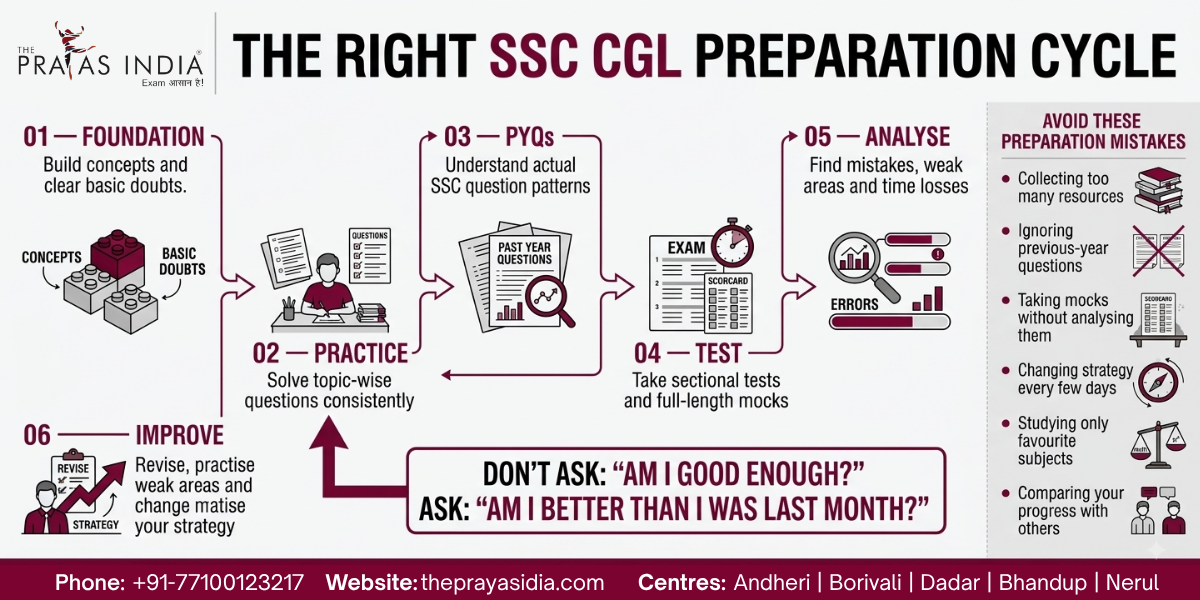
Your preparation should generally move through these stages:
- Foundation: Build concepts and clear basic doubts.
- Practice: Solve questions topic by topic and gradually increase difficulty.
- PYQs: Study previous-year questions to understand recurring patterns.
- Sectional Tests: Introduce time pressure and improve section-wise performance.
- Mock Tests: Practise the complete examination environment.
- Analysis: Identify why questions were wrong, skipped or unnecessarily time-consuming.
- Revision: Revisit weak concepts and recurring mistakes.
- Improvement: Repeat the cycle with a more refined strategy.
This system prevents preparation from becoming a random collection of study sessions.
When Should an Average Student Consider Professional SSC Coaching?
Self-study can work for many aspirants, but it is not always the easiest route for everyone.
If you already have strong fundamentals, understand the examination pattern and can independently create and follow a preparation plan, self-study may be sufficient for your requirements.
However, some students spend months preparing without knowing whether their strategy is actually working. They keep changing resources, struggle with difficult topics and take mock tests without understanding their mistakes. In such situations, structured coaching can provide a clearer path.
Professional SSC coaching can be particularly useful when you need:
- A structured syllabus completion plan
- Faculty support for difficult concepts
- Regular practice and testing
- Previous-year question-based preparation
- Doubt-solving assistance
- Performance analysis
- Guidance on time management and attempt strategy
- A disciplined preparation environment
- Consistent revision and evaluation
For students looking for SSC coaching in Mumbai, The Prayas India offers preparation support across Andheri, Borivali, Dadar, Bhandup and Nerul.
The right coaching institute should not simply give you more study material. It should help you understand what to study, how to practise, how to evaluate your performance and what to improve next.
The Goal Is Not to Become Perfect Before You Start
An average student often waits for the “right time” to begin.
They think they should first improve their Mathematics, strengthen their English, understand all the SSC topics and then start serious preparation.
That approach can delay preparation indefinitely.
You become better by preparing.
Your first few weeks may feel difficult. Your first mock may be disappointing. Some topics may take multiple attempts to understand. That is a normal part of competitive-exam preparation.
What matters is whether you respond to those difficulties constructively.
Instead of saying, “I cannot solve this,” ask, “What concept am I missing?”
Instead of saying, “My mock score is bad,” ask, “Where did I lose these marks?”
Instead of saying, “Others are ahead of me,” ask, “What can I improve before my next test?”
This shift in thinking is important because it turns preparation into a process of continuous problem-solving.
Can an Average Student Crack SSC CGL? The Practical Answer
Yes, an average student can prepare seriously for SSC CGL and compete effectively, but there is no shortcut around disciplined preparation.
You do not need to begin as a topper. You need to build the skills the examination demands.
If your Mathematics is weak, work on the fundamentals. If your English needs improvement, practise the relevant question types consistently. If Reasoning feels unfamiliar, build familiarity through repeated exposure. If General Awareness feels too broad, create a focused source and revision strategy.
Most importantly, do not confuse your current performance with your final potential.
The student you are on the first day of preparation does not have to be the student you are on the day of the examination.
With the right strategy, consistent practice, previous-year question analysis, mock-test evaluation and appropriate guidance, an average starting point can become a strong preparation journey.
For aspirants who want structured guidance, The Prayas India provides SSC exam preparation support in Mumbai through its centres at Andheri, Borivali, Dadar, Bhandup and Nerul.
📞 Call Now: +91-77100 13217
🌐 Website: theprayasindia.com
📍 Centres: Andheri | Borivali | Dadar | Nerul | Bhandup
Build Your SSC CGL Preparation Around Your Current Level
Once you stop worrying about whether you are an “average student”, the next question becomes more practical: What should you actually do every day to become competitive for SSC CGL?
The answer is not to copy the timetable of someone who has already been preparing for a year. Your study plan should be built around your current level, available time and subject-wise weaknesses. A student starting from the basics needs more concept-building initially, while someone who has already completed the syllabus should spend more time on revision, previous-year questions and mock-test analysis.
The most effective preparation plans have one common feature: they divide the large SSC CGL syllabus into smaller, measurable tasks. Instead of sitting down with the vague goal of “studying SSC today”, decide exactly what you will complete, practise and revise.
For example, a productive study session could involve learning one Quant concept, solving a defined set of questions, reviewing mistakes and revising an earlier topic. This gives you a clear measure of progress and prevents long study hours from becoming unproductive.
How Many Hours Should an Average Student Study for SSC CGL?
There is no universal number of hours that guarantees SSC CGL selection.
A candidate studying six highly focused hours can make better progress than someone sitting with books for ten hours but spending much of the time watching unrelated videos, switching between resources or repeatedly revising topics they already know.
Instead of chasing a specific number, focus on creating enough effective study hours to cover the syllabus, practise questions, revise and take tests.
For a full-time aspirant, a structured day could gradually include:
- Concept learning for weak subjects
- Topic-wise question practice
- Previous-year question practice
- Vocabulary and English revision
- General Awareness revision
- Calculation or speed practice
- Sectional tests
- Mock-test analysis
- Revision of mistakes
If you are a college student or working professional, your available hours may be lower. That does not make preparation impossible. It simply means your schedule needs to be more selective and consistent.
The important principle is simple: do not measure preparation only by the number of hours. Measure it by what those hours produce.
A Practical Daily Study Structure
An average student should avoid creating an unrealistic timetable with too many subjects and targets in a single day.
A better approach is to divide the day into focused blocks.
For example, one study block can be dedicated to Quantitative Aptitude, another to English, and another to Reasoning or General Awareness. Short revision sessions can then be placed between or towards the end of the day.
The exact schedule can change according to your strengths and weaknesses. If Quant is your weakest subject, it deserves more consistent attention than a subject where you are already performing strongly.
A practical daily structure could include:
| Study Area | Main Objective |
|---|---|
| Quantitative Aptitude | Concepts + practice + calculations |
| Reasoning | Topic practice + speed |
| English | Grammar + vocabulary + comprehension |
| General Awareness | Learning + revision |
| PYQs | Understanding SSC question patterns |
| Tests | Measuring performance |
| Analysis | Finding mistakes and weak areas |
This structure is more useful than blindly following a timetable created for someone else.
Give More Time to Your Weakest Subject, Not Your Favourite Subject
Students naturally prefer studying subjects they are already comfortable with.
If you are good at English, you may spend an extra hour reading vocabulary because it feels productive. If you enjoy Reasoning, you may keep solving Reasoning questions while avoiding Quant.
This creates an uncomfortable problem: your strengths keep improving while your weaknesses remain weak.
Your preparation should therefore include a weakness-first approach.
Suppose your current performance looks like this:
- English: Strong
- Reasoning: Strong
- Quant: Weak
- General Awareness: Moderate
Your timetable should not give equal attention to every subject simply because equal time looks balanced.
Quant needs additional attention because improving it can produce a larger overall improvement in your performance.
This does not mean ignoring your strengths. It means maintaining them while deliberately working on the areas that can limit your final score.
How to Prepare for SSC CGL Quant if You Are Weak in Maths
If Quant is your biggest weakness, do not begin by trying to solve the hardest questions.
Start with fundamentals.
A topic such as percentage may appear simple, but if your basic understanding of fractions, ratios and calculations is weak, advanced questions will continue to feel difficult.
Build the subject in layers.
First Layer: Fundamentals
Understand the basic concepts and formulas without rushing.
Second Layer: Standard Questions
Solve straightforward questions until the method becomes familiar.
Third Layer: SSC-Level Questions
Move towards previous-year questions and questions that resemble the actual examination.
Fourth Layer: Timed Practice
Once your accuracy becomes stable, introduce time limits.
Fifth Layer: Mixed Practice
Combine different topics so that you learn to identify the appropriate method without being told which chapter the question belongs to.
This progression is particularly useful for average students because it prevents the common mistake of jumping directly from weak fundamentals to difficult questions.
Previous-Year Questions Should Be at the Centre of Your Preparation
Many students spend too much time solving random questions and too little time understanding what SSC has actually asked.
Previous-year questions help bridge that gap.
They show you the types of concepts SSC repeatedly tests, the level of difficulty you can expect, the wording patterns and the areas where certain concepts appear frequently.
PYQs should not be treated as something you solve only after completing the entire syllabus.
Use them during preparation itself.
After completing a topic, solve relevant previous-year questions and ask:
- Which concepts are repeatedly tested?
- Which methods are commonly required?
- Which questions took too much time?
- Which mistakes did I make?
- Are there patterns in the questions I find difficult?
This makes your preparation examination-oriented rather than purely theoretical.
Don’t Memorise Shortcuts Before Understanding the Method
Short tricks can be useful in SSC CGL, particularly when they reduce calculation time.
However, shortcuts should come after conceptual understanding.
If you memorise a shortcut without knowing why it works, you may struggle when the question is presented differently.
For an average student, the better sequence is:
Understand → Practise → Recognise the Pattern → Learn the Faster Method → Apply Under Time Pressure
Once the basic method becomes clear, shortcuts can help improve speed.
The objective is not to collect the maximum number of tricks.
The objective is to develop enough command over the subject that you can select the most efficient method during the examination.
How to Build SSC CGL English Step by Step
English preparation should be divided into specific areas rather than treated as one large subject.
If grammar is weak, identify the rules responsible for your errors. If vocabulary is weak, create a daily revision system instead of attempting to memorise thousands of words at once. If comprehension is slow, practise reading and learn how to identify the information required by the question.
A balanced English routine can include:
- Daily vocabulary revision
- Grammar practice
- Error detection
- Sentence improvement
- Cloze tests
- Reading comprehension
- Previous-year questions
- Revision of frequently repeated mistakes
The important point is consistency.
Studying English for five hours once a week is generally less useful than giving it regular attention throughout your preparation.
Language-based improvement is cumulative. The more regularly you encounter words, grammar structures and question patterns, the more familiar they become.
Make Reasoning a Practice-Driven Subject
Reasoning does not always require long theoretical study sessions.
For many topics, improvement comes from solving enough questions to recognise the underlying pattern quickly.
Begin with individual topics and understand the basic approach. Once you are comfortable, introduce mixed practice.
This is where you begin developing an important examination skill: question selection.
During a timed test, you may encounter several Reasoning questions that are technically solvable. That does not mean all of them should be attempted immediately.
A question that can be solved confidently in a short time may deserve priority over a question that requires several steps and carries a higher risk of error.
The objective is not to prove that you can solve every question.
It is to maximise the marks you can obtain within the available time.
General Awareness Needs Revision, Not Endless Reading
General Awareness can consume an enormous amount of preparation time if you do not have a defined system.
Aspirants often keep reading new material because they feel that they have not studied enough. The result is a large amount of information but poor retention.
Build a revision cycle instead.
Study a defined portion, revise it after a suitable interval and test yourself. Keep track of areas that repeatedly cause errors.
Your General Awareness preparation should therefore involve:
- Focused study
- Short notes where necessary
- Previous-year questions
- Regular revision
- Self-testing
- Tracking repeated mistakes
Remember that reading something once is not the same as being able to recall it during an examination.
The Role of Mock Tests in an Average Student’s Preparation
Mock tests become particularly important once you have built a reasonable foundation.
However, taking mocks too early and becoming obsessed with the score can sometimes damage confidence. Your initial mocks should be treated as diagnostic tools.
As your preparation develops, mocks should gradually become more important.
A mock can tell you:
- Which sections are consuming too much time
- Which topics are producing repeated mistakes
- Whether your accuracy is improving
- Whether your attempt strategy is working
- Which easy questions you are missing
- How you perform under time pressure
The score is important, but the information behind the score is even more valuable.
How to Analyse an SSC CGL Mock Test
After every serious mock, do not immediately move on to the next one.
Spend time reviewing the paper.
Separate the questions into different categories.
Correct and Fast
These are your strengths. Continue maintaining them.
Correct but Slow
These questions indicate that you understand the concept but need better execution or method selection.
Incorrect Because of Concept
These require revision and additional practice.
Incorrect Because of Carelessness
These indicate a problem with reading, calculation or attention.
Skipped but Should Have Been Attempted
These reveal potential marks lost because of poor question selection or lack of confidence.
Skipped and Correctly Avoided
These indicate good decision-making. Not every unattempted question is a weakness.
This type of analysis makes your next study plan much more precise.
Track Your Mistakes Instead of Repeating Them
One of the simplest ways for an average student to improve is to maintain a mistake notebook or digital error log.
Whenever you make a significant mistake, record:
- The topic
- The question type
- Why you made the mistake
- The correct approach
- Whether the problem was conceptual, calculation-based or careless
- What you will do to prevent it next time
Over several weeks, patterns will appear.
You may discover that you repeatedly make calculation errors in certain Quant topics, misread specific types of English questions or spend too much time on particular Reasoning patterns.
That information can directly influence your next revision cycle.
A mistake that has been identified but not corrected is only half analysed. The real improvement comes when the same error stops appearing in your tests.
When Should You Start Taking Full-Length Mocks?
There is no benefit in waiting until you feel completely prepared.
At the same time, taking full-length mocks continuously before building sufficient fundamentals can create unnecessary frustration.
A balanced approach is better.
During the early stage, focus more on topic-wise practice and sectional tests. As your syllabus coverage increases, introduce full-length mocks regularly.
In the later stages, mocks should become an important part of your weekly preparation, with enough time reserved for detailed analysis.
The key principle remains:
Do not measure your preparation by how many mocks you have taken. Measure it by how much each mock has taught you.
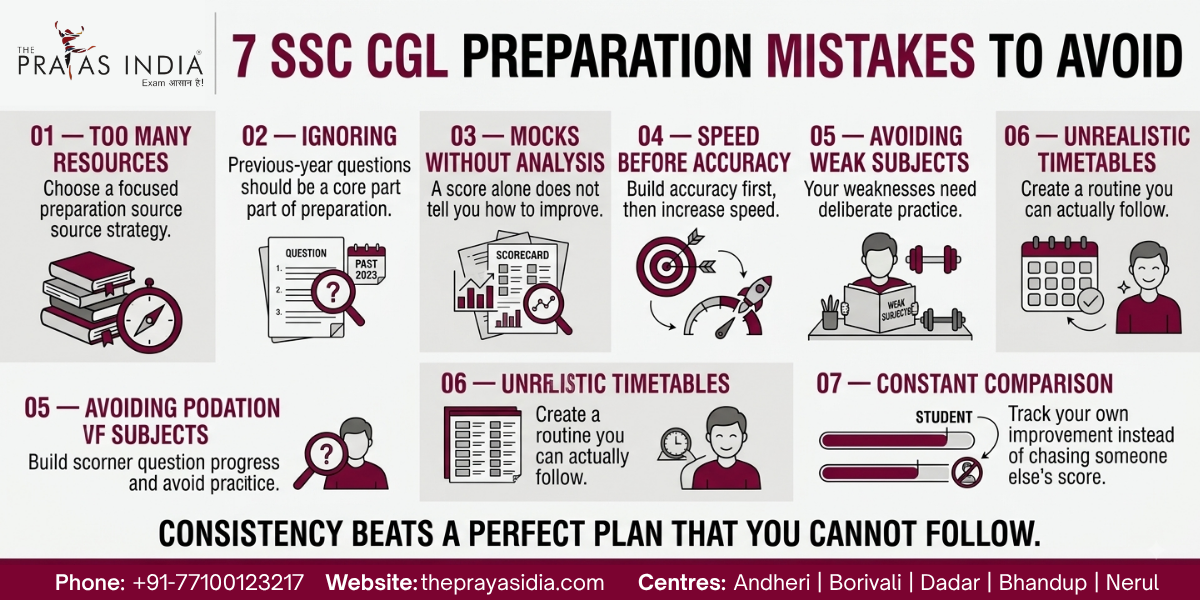
Common Mistakes That Keep Average Students Average
The biggest obstacle is often not lack of ability but inefficient preparation.
Changing Resources Too Frequently
Every time you switch books, teachers or strategies, you lose time adapting to a new system. Choose reliable resources and use them thoroughly.
Studying Only Easy Topics
Comfortable topics can create the illusion of progress. Your difficult areas need deliberate attention because they often determine your overall improvement.
Ignoring Previous-Year Questions
Without PYQs, you may spend too much time preparing material that has little relevance to the actual examination.
Taking Mocks Without Analysis
A mock score without analysis gives you limited information. The real learning begins when you investigate your mistakes.
Chasing Speed Before Accuracy
Fast wrong answers do not improve your score. Build accuracy first and then work on execution speed.
Constantly Comparing Yourself With Others
Another student’s score does not tell you what your next step should be. Your own performance data is more useful.
Creating Unrealistic Timetables
A timetable that cannot be followed consistently is not a strategy. Build a routine you can maintain.
Self-Study vs Coaching: Which One Is Better for an Average Student?
There is no universal answer because students begin their preparation with different strengths, schedules and learning requirements.
Self-study can work well when you are disciplined, understand the syllabus, have access to reliable resources and can independently identify and correct your weaknesses.
However, self-study can become difficult when you are repeatedly stuck on concepts, cannot decide what to study next or struggle to evaluate your performance objectively.
A structured coaching environment can help reduce these problems by providing a planned learning sequence, faculty guidance, regular practice and testing.
For an average student, the biggest advantage of structured coaching is not simply access to classes. It can provide direction and accountability.
Instead of spending days deciding which topic to study, which questions to practise or which resource to follow, you can work within a defined preparation system and use your time more efficiently.
That can be particularly useful for aspirants who are starting from the basics or have previously struggled to maintain consistency.
What Should You Look for Before Joining SSC Coaching in Mumbai?
If you decide that professional guidance would benefit your preparation, do not choose an institute only because it is popular or because someone else joined it.
Look at the actual preparation system.
A serious SSC aspirant should consider:
- Whether the syllabus is covered systematically.
- Whether faculty explain concepts rather than simply provide shortcuts.
- Whether previous-year questions are integrated into preparation.
- Whether regular sectional and full-length tests are available.
- Whether mock performance is analysed properly.
- Whether students can get their doubts resolved.
- Whether revision is built into the course.
- Whether the study material is focused and relevant.
- Whether the batch structure suits your preparation level.
- Whether the centre is convenient for regular attendance.
For aspirants in Mumbai, The Prayas India offers SSC exam preparation support through its centres at Andheri, Borivali, Dadar, Bhandup and Nerul.
The right coaching decision should ultimately be about finding an environment that helps you study consistently, understand difficult concepts, practise relevant questions and evaluate your progress.
How The Prayas India Can Support an Average SSC CGL Aspirant
Students often join coaching because they need more than just study material. They need a structured preparation environment that helps them stay on track.
For an aspirant who is still building fundamentals, a systematic learning approach can make the syllabus feel more manageable. Concepts can be studied progressively, followed by practice and testing rather than trying to complete everything at once.
As preparation advances, the focus can shift towards previous-year questions, timed practice, mock tests and performance analysis.
This progression is important because an average student does not necessarily need more information. They often need a clearer system for converting information into exam performance.
The Prayas India’s presence across Andheri, Borivali, Dadar, Bhandup and Nerul gives Mumbai-based aspirants multiple centre options for structured SSC preparation.
Students looking for guidance can connect with The Prayas India at:
📞 Call Now: +91-77100 13217
🌐 Website: theprayasindia.com
📍 Centres: Andheri | Borivali | Dadar | Nerul | Bhandup
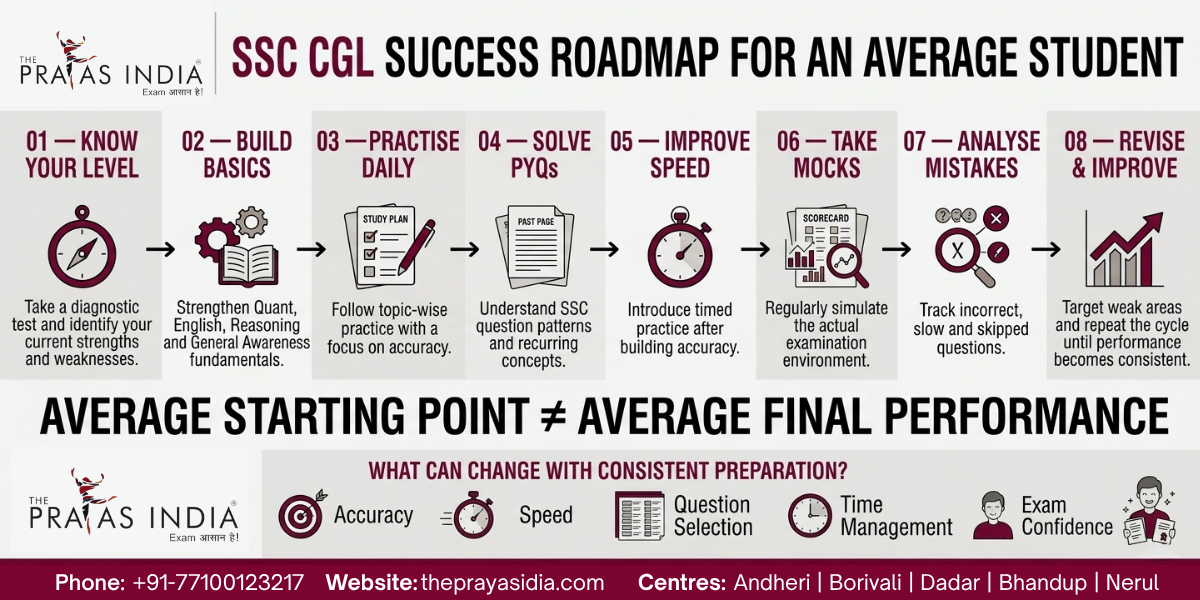
Your Preparation Should Have Milestones
A long SSC CGL preparation journey becomes easier when you divide it into milestones.
Instead of thinking, “I have to complete the entire SSC syllabus,” create smaller targets.
For example:
Milestone 1: Complete basic concepts in major topics.
Milestone 2: Solve topic-wise questions with improving accuracy.
Milestone 3: Complete relevant previous-year questions.
Milestone 4: Start regular sectional tests.
Milestone 5: Introduce full-length mocks.
Milestone 6: Identify recurring weaknesses through mock analysis.
Milestone 7: Strengthen weak areas and improve attempt strategy.
Milestone 8: Enter the final revision phase with a clear performance strategy.
These milestones create a sense of progress without making the entire syllabus feel overwhelming.
They also make it easier to identify when your preparation is falling behind and where corrective action is needed.
The Final 60 Days Should Be About Conversion, Not Starting From Scratch
As the examination approaches, your preparation should gradually move from learning everything for the first time towards converting knowledge into performance.
The final phase should involve more revision, previous-year questions, mock tests and targeted improvement.
If your Quant accuracy is already strong, there may be limited value in repeatedly studying the same basic concepts. Your time may be better spent on mixed practice and timed tests.
If General Awareness is weak, focused revision may be more important.
If you are losing marks because of careless mistakes, your priority should be accuracy and test discipline.
The final phase should therefore be based on your performance data rather than a generic timetable.
Ask yourself:
- Which topics are still weak?
- Which mistakes are repeating?
- Which sections are consuming too much time?
- How stable is my mock performance?
- Which questions am I unnecessarily leaving?
- Where can I gain additional marks without taking excessive risk?
These questions help you turn the remaining preparation time into targeted improvement.
Don’t Let One Bad Mock Change Your Entire Strategy
An average student may be particularly sensitive to fluctuations in mock scores.
One day the score increases, and confidence rises. The next day the score falls, and the entire preparation strategy is suddenly questioned.
This is not a productive way to use mocks.
Mock difficulty can vary. Your mental state can vary. Certain topics may appear more frequently in one paper than another. A single score should therefore not determine your entire strategy.
Look at your performance across multiple tests.
Focus on trends such as:
- Accuracy over time
- Average attempts
- Section-wise scores
- Repeated mistakes
- Time spent per section
- Performance in different question types
If the overall trend is improving, continue refining the strategy.
If the trend is stagnant, investigate the underlying problem.
The Most Important Skill: Learning From Your Own Preparation
The strongest candidates are not necessarily those who never make mistakes.
They are often the candidates who notice their mistakes and make sure they become less frequent.
This is why keeping records can be so valuable.
Maintain a simple performance tracker containing:
| Area | What to Track |
|---|---|
| Quant | Accuracy, calculation errors, slow topics |
| Reasoning | Question selection, time taken, repeated patterns |
| English | Grammar mistakes, vocabulary errors, comprehension |
| General Awareness | Weak areas and revision performance |
| Mocks | Score, attempts, accuracy and time management |
| Overall | Recurring mistakes and improvement trend |
Review this information regularly.
Over time, your preparation becomes increasingly personalised. Instead of following a generic plan, you begin making decisions based on your own performance.
That is when preparation becomes much more efficient.
Can an Average Student Crack SSC CGL Without Being Perfect?
Yes, but the word **“average” should not become an excuse for inconsistent preparation.
You do not need to know everything before you begin. You do not need to solve every question faster than everyone else. You do not need a perfect academic record.
You need a preparation system that allows you to improve.
That means learning the basics, practising relevant questions, solving previous-year papers, taking mocks, analysing mistakes and revising consistently.
If you are weak in one subject, give it more attention. If your speed is low, work on timed practice. If your accuracy is poor, slow down and understand the reason behind your mistakes. If you cannot maintain a routine, create a smaller routine that you can actually follow.
The objective is not to transform overnight.
The objective is to become a little better, a little faster and a little more accurate through every stage of preparation.
The Final Reality Check for SSC CGL Aspirants
Can an average student crack SSC CGL?
Yes, but selection cannot be built on the label of being “average” or on motivation alone.
Your current academic background may influence your starting point, but it does not have to determine your final performance. Competitive-exam skills can be developed through deliberate practice, structured revision, previous-year questions, mock testing and continuous analysis.
The students who eventually become competitive are not always the ones who started with the strongest fundamentals. Many are the ones who stayed with the process long enough to convert weaknesses into strengths.
If you are beginning your SSC CGL journey and feel that you are behind others, do not spend months worrying about whether you are good enough.
Find your current level. Identify your weaknesses. Build a realistic plan. Practise consistently. Analyse your performance. Improve one weakness at a time.
That is a much more useful strategy than trying to become a topper before you even begin.
For aspirants seeking structured SSC coaching in Mumbai, The Prayas India offers preparation support at Andheri, Borivali, Dadar, Bhandup and Nerul.
A Stronger Way to Look at Your SSC CGL Journey
Your first mock score is not your identity.
Your weakest subject is not your identity.
Your previous academic performance is not your identity.
They are simply indicators of where you are starting.
What matters is what you do after discovering that starting point.
An average student who follows a structured preparation plan, practises consistently, analyses performance honestly and keeps improving can become a serious SSC CGL aspirant.
The goal should never be to prove that you were always exceptional.
The goal is to build the level of preparation required to perform exceptionally on the day that matters.
FAQs: Can an Average Student Crack SSC CGL?
1. Can an average student crack SSC CGL?
Yes, an average student can crack SSC CGL with structured preparation, consistent practice and regular performance analysis. Academic marks alone do not determine SSC CGL performance. A candidate who builds strong fundamentals, practises previous-year questions, improves speed and accuracy, and takes mock tests regularly can significantly improve their chances.
2. Is SSC CGL difficult for an average student?
SSC CGL can be challenging, particularly because of the large syllabus, competition and time pressure. However, difficulty should not be confused with impossibility. An average student can make the examination manageable by breaking the syllabus into smaller topics, focusing on fundamentals and gradually moving towards timed practice and full-length mocks.
3. How many hours should an average student study for SSC CGL?
There is no fixed number of hours that guarantees success. The focus should be on productive and consistent study rather than simply sitting with books for a specific number of hours. Your daily schedule should include concept building, question practice, previous-year questions, revision and testing according to your current preparation level.
4. Can I crack SSC CGL if my Maths is weak?
Yes. Weak Mathematics does not mean that you cannot prepare for SSC CGL. Start with basic concepts, practise standard questions and gradually move towards SSC-level and previous-year questions. Once your accuracy improves, introduce timed practice to develop calculation speed and question-solving efficiency.
5. How important are previous-year questions for SSC CGL preparation?
Previous-year questions are extremely useful because they help aspirants understand the types of questions SSC has asked, recurring concepts, difficulty levels and common patterns. PYQs should be integrated into preparation instead of being left only for the final stage.
6. Are mock tests necessary for SSC CGL?
Yes, mock tests are an important part of preparation. They help you evaluate your accuracy, speed, time management, question selection and overall examination strategy. However, simply taking mocks is not enough. Detailed mock-test analysis is necessary to identify and correct recurring mistakes.
7. How can an average student improve SSC CGL mock-test scores?
Start by analysing every incorrect, skipped and unnecessarily time-consuming question. Categorise mistakes as conceptual, calculation-based, careless or strategy-related. Then revise the relevant topic and practise similar questions before taking the next mock. Tracking performance across multiple tests is more useful than focusing on one score.
8. Should an average student join SSC coaching or prepare through self-study?
Both approaches can work, depending on the student's discipline, fundamentals, available time and ability to plan independently. Self-study can be effective when you have a clear strategy and reliable resources. Coaching can be useful if you need structured classes, faculty guidance, regular testing, doubt support and a defined preparation system.
9. How can I prepare for SSC CGL if I am starting from the basics?
Start by understanding the syllabus and examination structure. Assess your current level, identify weak subjects and build fundamentals topic by topic. After learning each concept, practise relevant questions and previous-year questions. Gradually introduce sectional tests, mock tests, revision and performance analysis.
10. Is English important for SSC CGL?
Yes. English is an important component of SSC CGL preparation. Candidates should work systematically on grammar, vocabulary, comprehension, sentence improvement, error detection, cloze tests and other relevant question types. Regular practice and revision can significantly improve accuracy.
11. How should I prepare General Awareness for SSC CGL?
General Awareness should be prepared with a focused source strategy and regular revision. Avoid collecting too many resources. Study relevant topics, practise previous-year questions, maintain concise notes where necessary and repeatedly revise important information to improve retention.
12. Which is the best SSC coaching in Mumbai for SSC CGL preparation?
The right coaching institute should offer structured syllabus coverage, experienced faculty, relevant study material, regular practice, previous-year question-based preparation, mock tests, doubt resolution and performance guidance. The Prayas India offers SSC exam preparation support in Mumbai through its centres at Andheri, Borivali, Dadar, Bhandup and Nerul.
13. Can I crack SSC CGL while working or studying in college?
Yes, but your preparation needs to be planned around your available time. Instead of trying to follow an unrealistic full-time aspirant's timetable, create consistent study blocks and prioritise high-value activities such as concept building, PYQs, revision and mock-test analysis.
14. What is the biggest mistake an average SSC CGL aspirant should avoid?
One of the biggest mistakes is changing preparation strategies repeatedly without giving any strategy enough time to work. Other common problems include ignoring weak subjects, collecting excessive study material, skipping PYQs, taking mocks without analysis and focusing on speed before developing accuracy.
15. Can an average student improve enough to become competitive in SSC CGL?
Yes. Preparation can significantly change a candidate's performance level. Concepts, accuracy, speed, question selection, time management and exam familiarity can all improve through deliberate practice. Your initial performance should be treated as a starting benchmark rather than a permanent measure of your ability.