CAT 2025 Topic-Wise Weightage & Strategy: QA, LRDI, VARC Detailed Practice Plan
The syllabus for the CAT 2025 exam is divided into three main sections: Verbal Ability & Reading Comprehension (VARC), Data Interpretation & Logical Reasoning (DILR), and Quantitative Aptitude (QA). These sections assess candidates on multiple skills such as verbal reasoning, numerical ability, logical thinking, and data interpretation.
The CAT syllabus has changed twice in recent years, making it important for aspirants to stay updated. Candidates preparing for the CAT 2025 exam should first review the latest syllabus updates and exam pattern before beginning their preparation. Analyzing previous year’s papers is also essential to understand the distribution of questions and difficulty levels.
We have compiled everything you need in this article, including section-wise topics, question types, weightage for each part, and an analysis of CAT 2024.
MBA Entrances Exam Update
CAT Syllabus 2025 – Exam Pattern and Other Highlights
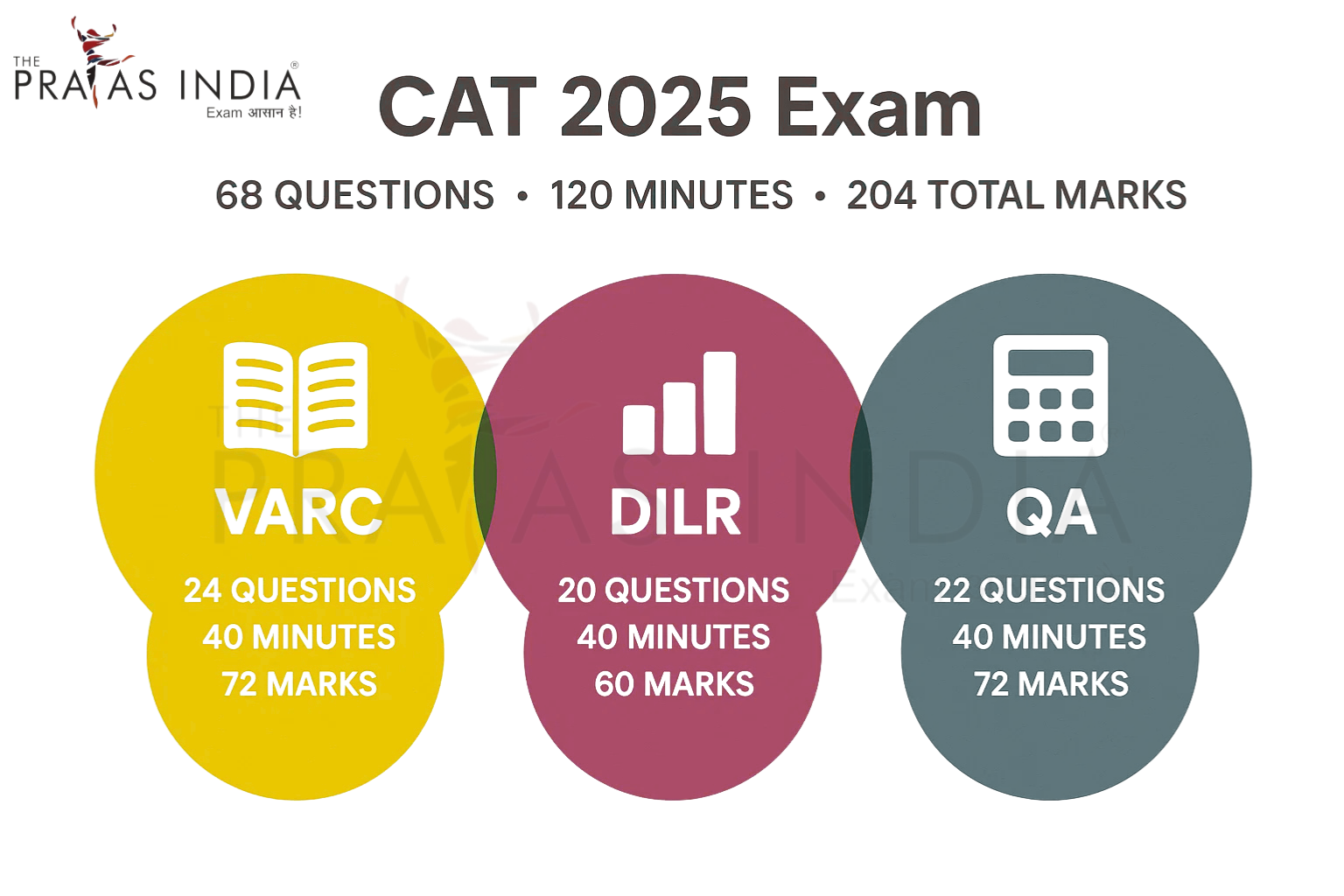
The CAT 2025 syllabus and exam pattern will include 68 questions, each carrying 3 marks, to be completed in 120 minutes. The syllabus is divided into three sections as mentioned below:
Verbal Ability and Reading Comprehension (VARC):
This section consists of 24 questions, out of which around 12–14 questions will be from Reading Comprehension (RC). The CAT VARC syllabus covers Verbal Reasoning and Reading Comprehension. To perform well in this section, candidates should focus on improving English grammar and vocabulary, as these are essential for understanding and answering RC passages accurately.
Data Interpretation and Logical Reasoning (DILR):
This section has 22 questions and tests a candidate’s ability to interpret data and apply logical reasoning. The CAT DILR syllabus includes topics that require analytical problem-solving using data sets. The data is presented in various forms, such as Puzzles, Family Trees, Blood Relations, Series, Pie Charts, Bar Graphs, Tables, and Syllogisms.
Quantitative Aptitude (QA):
The QA section also includes 22 questions, focusing on Arithmetic and Algebra to evaluate the mathematical aptitude of candidates. The CAT Quant syllabus is based on concepts from Class 9 and 10 Mathematics, covering topics like Number System, Geometry, and Trigonometry.
CAT Syllabus Overview
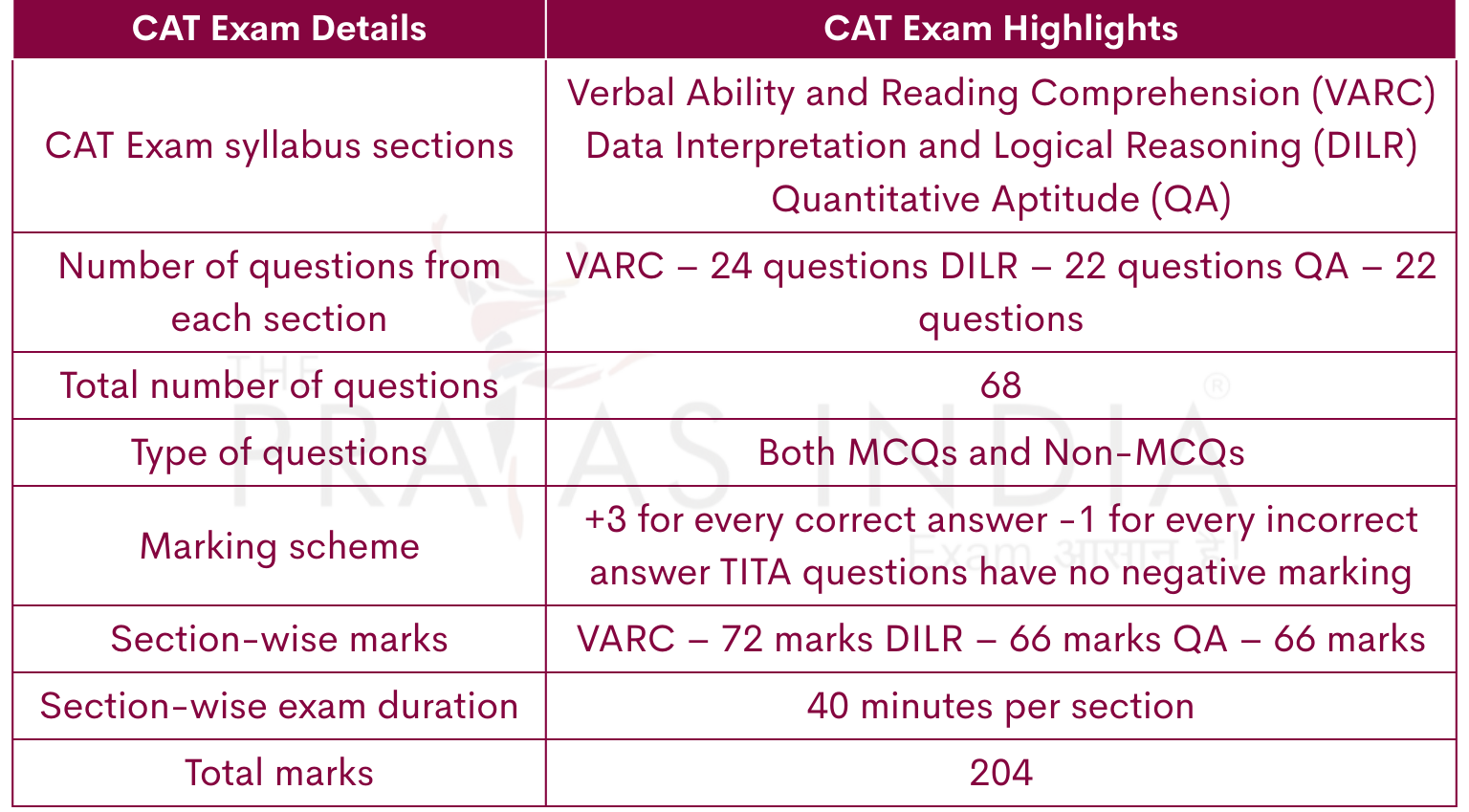
Please refer to the table below for a detailed overview of the CAT 2025 syllabus and exam pattern:
Note:
Candidates are given 40 minutes per section, while PwD candidates get slightly more than 50 minutes per section. The order of sections is fixed, although candidates can move within a section during its allotted time. Questions can be marked for review and revisited within the same section.
What Type of Questions are Asked in CAT Syllabus?
Two types of questions are included in the CAT exam, and your preparation should cover both:
- MCQs (Multiple Choice Questions): Incorrect answers result in -1 negative marking.
- TITA (Type in the Answer) Questions: There is no negative marking for these questions.
Section-Wise CAT Syllabus 2025: Important Topics, Question Types & Weightage
This section will make more sense once you have gone through the detailed video explanation above. We have outlined the most important topics along with their expected weightage in CAT 2025, section by section. This breakdown will give you better clarity about the CAT syllabus and guide you on how to allocate your preparation time effectively.
♦ Focus more on high-weightage topics as they carry more marks, while spending proportionally less time on topics that have lesser weightage in the exam.
CAT VARC Syllabus: Weightage and Pattern
The VARC (Verbal Ability and Reading Comprehension) section in CAT generally follows this pattern:
- 66% weightage for Reading Comprehension (RC) passages.
- 33.33% weightage for Verbal Ability (VA) questions.
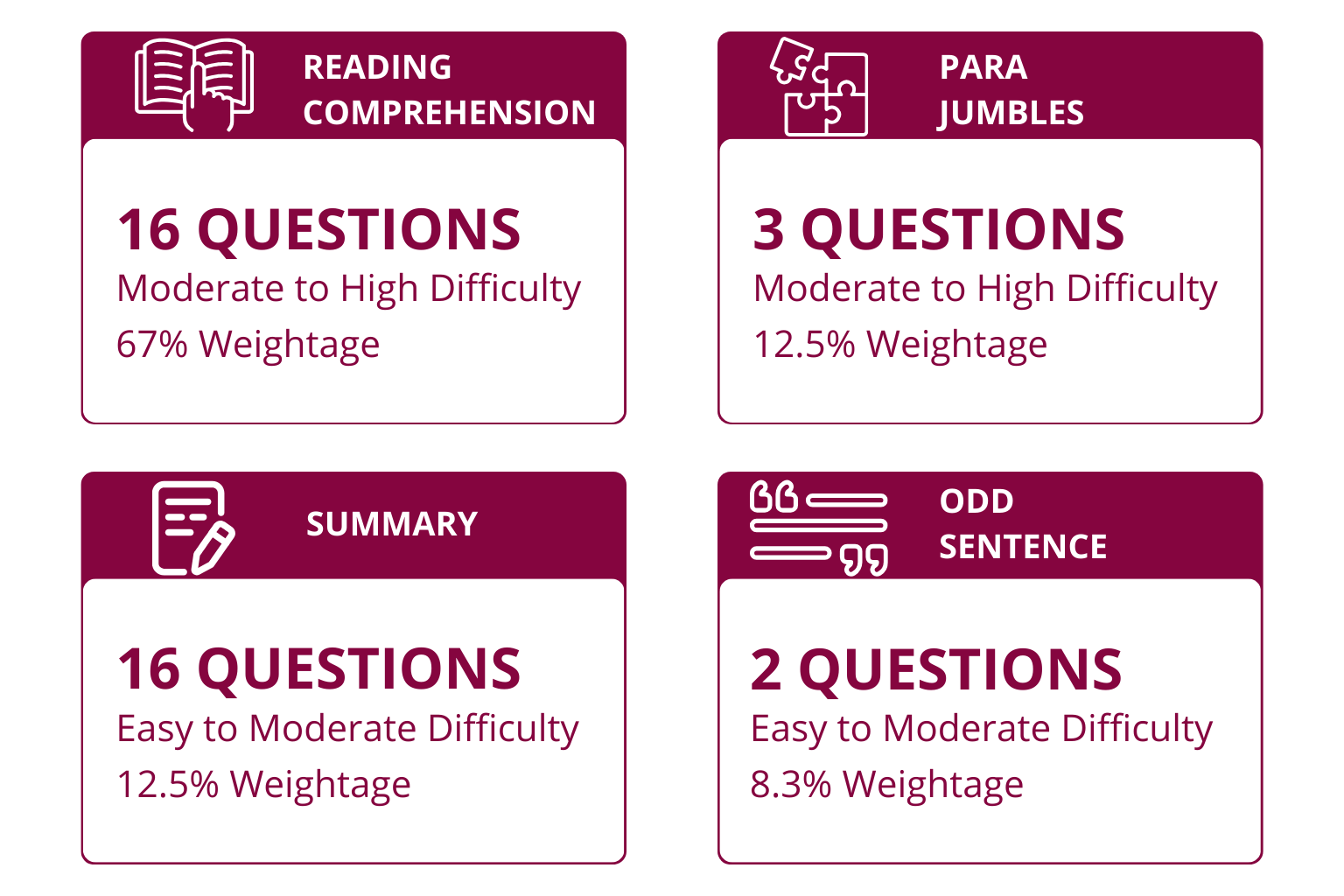
Each RC passage is typically around 600 words and is followed by 4–5 questions. The remaining 34% weightage comes from Verbal Ability topics such as Para-Jumbles, Para-Summary, and Odd-One-Out questions.
CAT VARC Question Pattern
This section tests the English language of the candidates along with their ability to comprehend passages. In CAT 2024, there were no questions on parajumble.
- Sentence correction & completion
- Para Jumbles
- Summary-based questions
Types of Questions in the CAT Reading Comprehension Section
Below are the different question types asked in the RC section, which will help you prepare with better accuracy:
| Question Type | Description |
|---|---|
| Inference-Based | Draw conclusions based on the given passage. |
| Specific Details Question | Identify the author’s tone or perspective towards the subject. |
| Detail-Oriented Question | Find answers related to specific facts or details within the passage. |
| Application/Purpose Question | Determine the purpose or application of a particular part of the text. |
| Logical Structure | Analyze and understand the logical structure of the paragraph. |
| Vocabulary Question | Identify contextual meanings of words within the passage. |
CAT 2025 Study Plan
Types of Questions in the CAT Verbal Ability Section
Here are the main question types in the VA section, along with their evaluation focus:
| Topic | Description |
|---|---|
| Para-Jumbles | Arrange a set of jumbled sentences into a coherent paragraph. |
| Sentence Correction | Test your grammar and language skills by identifying errors in sentences. |
| Analogies | Recognize similar relationships between different word pairs. |
| Odd-One-Out | Identify the sentence that does not logically fit with the rest. |
| Para-Completion | Choose the correct sentence to complete a paragraph meaningfully. |
Types of Passages in the CAT VARC Section
The CAT VARC section includes different types of reading passages, each with varying levels of importance. Here is the weightage distribution:
| Reading Passage Type | Weightage |
|---|---|
| Descriptive Passages | Less |
| Narrative Passages | Less |
| Argumentative Passages | Most |
| Analytical Passages | Most |
| Abstract Passages | Less |
CAT VARC Syllabus – Topic-Wise Weightage
The VARC (Verbal Ability and Reading Comprehension) section in CAT focuses on evaluating your ability to comprehend reading passages and organize sentences logically. It consists of four main question types, each with a different number of questions and difficulty level based on the previous year’s analysis.
| VARC Topics for CAT | No. of Questions in CAT Exam | Level of Difficulty |
|---|---|---|
| Reading Comprehension | 16 | Moderate to Difficult |
| VA – Para Jumbles | 3 | Moderate to Difficult |
| VA – Odd Sentence | 2 | Easy to Moderate |
| VA – Summary | 3 | Easy to Moderate |
| Overall | 24 | Moderate to Difficult |
Topic-wise Weightage of the VARC Section for Each Slot of Last Year’s CAT Exam
| Topic | Slot 1 | Slot 2 | Slot 3 |
|---|---|---|---|
| Reading Comprehension | 16 | 16 | 16 |
| Para Jumbles | 3 | 3 | 3 |
| Para Summary | 3 | 3 | 3 |
| Odd Sentence Out | 2 | 2 | 2 |
CAT Syllabus 2025 – CAT DILR Syllabus
The DILR (Data Interpretation and Logical Reasoning) section is often considered the most challenging yet highly rewarding for those who adopt the right preparation strategy. It consists of 22 questions and appears right after VARC in the exam.
To excel in this section, candidates need to practice a wide variety of data sets and logical puzzles. The CAT 2025 DILR syllabus covers topics such as circular arrangements, cubes, games & tournaments, pie charts, line & bar graphs, and more.
Key Topics Covered in Data Interpretation & Logical Reasoning
Here is a breakdown of the important topics for DILR, categorized into Data Interpretation (DI) and Logical Reasoning (LR):
| DI | LR |
|---|---|
| Percentages and Ratios | Seating Arrangements |
| Averages and Weighted Averages | Blood Relations |
| Profit and Loss | Direction Sense |
| Growth Rates | Syllogisms |
| Data Comparison | Clocks and Calendars |
| Venn Diagrams | Coding-Decoding |
| Tables-Based DI | Number Series |
| Routes and Networks | Logical Sequences |
| Mathematical Puzzles | Puzzles |
| Graphs | Games and Tournaments |
Types of Questions in the DILR Section
The DILR section of CAT tests candidates through various question types. Here are the most common types of questions you should practice:
| Question Type | Description |
|---|---|
| Graph-Based Questions | Interpret data from graphs such as bar graphs, line graphs, Venn diagrams, and pie charts. |
| Calculation-Intensive Questions | Perform complex calculations based on given data sets. Accuracy and speed are crucial. |
| Caselets | Analyze a passage or a small case study containing data to answer multiple questions. |
| Mixed Data Interpretation | Solve questions that combine tables, graphs, and caselets in a single problem. |
CAT DILR Questions Pattern
This section assesses logical reasoning and ability to interpret data.
- It has 2 sets of data interpretation and logical reasoning each, or it can have a combination of both.
- Bar graphs, arrangements, missing data, and puzzles (games) are the focus.
No. of Questions in CAT DILR Syllabus
Here is the question distribution and difficulty level for DILR based on previous year trends:
| Section | No. of Questions | Level of Difficulty |
|---|---|---|
| Data Interpretation (DI) | 11 | Easy to Moderate |
| Logical Reasoning (LR) | 11 | Moderate to Difficult |
| Overall | 22 | Moderate |
Important Note: The pattern for the DILR section may change in CAT 2025. Therefore, it is essential to practice different types of question sets and enhance your problem-solving speed and accuracy.
Topic-wise Weightage of the DILR Section for Each Slot of Last Year’s CAT Exam
| Set/Topic | Slot 1 | Slot 2 | Slot 3 |
|---|---|---|---|
| Set 1 | DI – Candle Stick | DI (Rating) | Bar Graph |
| Set 2 | DI – Bar Graph | Schematic Diagram | DI (GDP of Countries) |
| Set 3 | Arrangement | DI (2 Graphs) | Table with Missing Values |
| Set 4 | Games and Tournament | Puzzle (Rating) | Line Graph |
| Set 5 | DI (Lengthy Set) | Arrangements | Network of Roads |
CAT Quant Syllabus 2025
The Quantitative Aptitude (QA) section of CAT primarily tests your mathematical ability, accuracy, and speed. The syllabus is broadly divided into five major areas:
- Arithmetic
- Algebra
- Geometry
- Modern Mathematics
- Number System
Among these, Arithmetic and Algebra carry the highest weightage, while Geometry, Number System, and Modern Math contribute moderately to the overall section.
CAT Quantitative Aptitude Questions Pattern
This section has numerical based mathematics questions and in 2024 there were a total of 22 QA questions in CAT.
- Around 8 questions are from basic Arithmetic.
- From number system, there were 1-3 questions.
- 5-7 Algebra questions in CAT.
- Geometry and Mensuration has 3 questions.
- 0-3 questions are from modern maths
CAT Quant Syllabus: Key Topics and Weightage in Quantitative Aptitude
The CAT Quant section includes calculation-intensive questions, requiring strong concept clarity and speed. To perform well, candidates must practice mental math techniques and shortcut methods for quick problem-solving.
Here’s the topic-wise breakdown with question count and weightage:
| Quant Sections | Topics | No. of Questions | Weightage |
|---|---|---|---|
| Arithmetic | Percentages, Ratio and Proportion, Averages and Mixtures, Profit & Loss, Simple and Compound Interest, Time-Speed-Distance, Time & Work, Pipes & Cisterns, Boats & Streams, Partnerships | 8-10 | 40% |
| Algebra | Linear Equations, Quadratic Equations, Inequalities, Functions, Logarithms, Progressions (AP, GP, HP), Sequences and Series, Maxima & Minima, Polynomials | 5-7 | 30% |
| Geometry | Lines & Angles, Triangles, Circles, Quadrilaterals, Polygons, Mensuration (2D & 3D), Coordinate Geometry, Trigonometry, Similarity of Triangles, Properties of Circles | 1-3 | 15% |
| Numbers | Number System (Natural, Whole, Integers, Rational & Irrational, Real Numbers), Divisibility & Remainders, Factors & Multiples, HCF & LCM, Prime & Composite Numbers, Cyclicity & Factorials, Base System, Indices & Surds | 1-2 | 5%-7% |
| Modern Math | Permutations & Combinations, Probability, Set Theory, Venn Diagrams, Binomial Theorem, Functions & Graphs | 2-4 | 5%-7% |
| Overall | — | 22 | — |
Topic-wise Weightage of the Quants Section for Each Slot of Last Year’s CAT Exam
| Topic Name | Slot 1 | Slot 2 | Slot 3 |
|---|---|---|---|
| Number System | 3 | 2 | 3 |
| Logarithms, Surds and Indices | 2 | 2 | 3 |
| Inequalities and linear equations | 1 | 2 | 2 |
| Progressions and Series | 2 | 1 | 1 |
| PnC and Probability | 0 | 1 | 0 |
| Quadratic Equations | 2 | 2 | 0 |
| Averages, Ratios and Proportion | 5 | 4 | 3 |
| Time, Work and Distance | 2 | 2 | 2 |
| Geometry | 2 | 3 | 3 |
| Profit, Loss and Interest | 2 | 2 | 3 |
| Functions and Graphs | 1 | 1 | 2 |
CAT Exam Pattern Trend
| CAT Year | Total Questions | CAT Exam Time Duration | CAT Sections |
|---|---|---|---|
| 2024 | 68 | 120 minutes | QA, DILR, VARC |
| 2023 | 66 | 120 minutes | QA, DILR, VARC |
| 2022 | 66 | 120 minutes | QA, DILR, VARC |
| 2021 | 66 | 120 minutes | QA, DILR, VARC |
| 2020 | 76 | 120 minutes | QA, DILR, VARC |
| 2019 | 100 | 180 minutes | QA, DILR, VARC |
| 2018 | 100 | 180 minutes | QA, DILR, VARC |
| 2017 | 100 | 180 minutes | QA, DILR, VARC |
| 2016 | 100 | 180 minutes | QA, DILR, VARC |
| 2015 | 100 | 180 minutes | QA, DILR, VARC |
| 2014 | 100 | 170 minutes | QA & DI, LR & VARC |
| 2013 | 60 | 140 minutes | QA & DI, LR & VARC |
| 2012 | 60 | 140 minutes | QA & DI, LR & VARC |
| 2011 | 60 | 140 minutes | QA & DI, LR & VARC |
| 2010 | 60 | 150 minutes | QA, DILR, VARC |
Strategy and Practice Plan for CAT 2025
To crack CAT 2025, candidates must adopt a smart and consistent preparation strategy. Here are some key steps:
1. Understand the Exam Pattern and Syllabus:
Before starting, go through the latest CAT syllabus and previous year papers. This will help you identify important topics and question trends.
2. Create a Daily Study Schedule:
Divide your time equally among VARC, DILR, and QA. Dedicate extra hours to your weaker areas without neglecting your strong sections.
3. Focus on Concept Clarity:
Practice the basics first. For Quantitative Aptitude, strengthen arithmetic, algebra, and geometry. For DILR, solve different sets daily to build speed and accuracy. For VARC, read editorials and practice RC passages regularly.
4. Take Sectional and Full-Length Mocks:
Start with topic-wise tests, then move to sectional mocks, and finally take full-length mocks. Analyze your performance after each test and work on weak areas.
5. Time Management and Accuracy:
CAT is all about smart attempts. Focus on accuracy rather than attempting all questions. Develop the ability to leave tough questions and maximize your score in easy-to-moderate ones.
How The Prayas India Helps in Your CAT Journey
The Prayas India offers structured courses, personalized mentorship, and updated study material tailored for CAT 2025 aspirants. With expert faculty, adaptive learning methods, and regular mock tests, The Prayas ensures that students develop strong concepts and exam-oriented strategies. The hybrid learning mode (online + offline) provides flexibility and convenience to all aspirants.
Conclusion
The CAT 2025 preparation journey requires a balance of concept clarity, consistent practice, and strategic test-taking. By following a structured plan and leveraging expert guidance from institutes like The Prayas India, aspirants can significantly improve their chances of securing admission to top B-schools.