CAT 2026 Preparation Strategy for 6–7 Months: Complete Study Plan, Section-Wise Approach & Mock Strategy
Preparing for the CAT 2026 exam in just 6–7 months may seem challenging, but with the right strategy, disciplined routine, and consistent practice, it is absolutely achievable. Whether you are a beginner or a repeater, a well-structured preparation plan can help you maximize your score and target top MBA colleges.
In this detailed guide by The Prayas India, we break down the CAT preparation strategy for 6–7 months, covering exam pattern, month-wise plan, section-wise approach, mock strategy, and expert tips.
Understanding the CAT Exam Pattern
Before starting your preparation, it is crucial to understand the structure of the Common Admission Test.
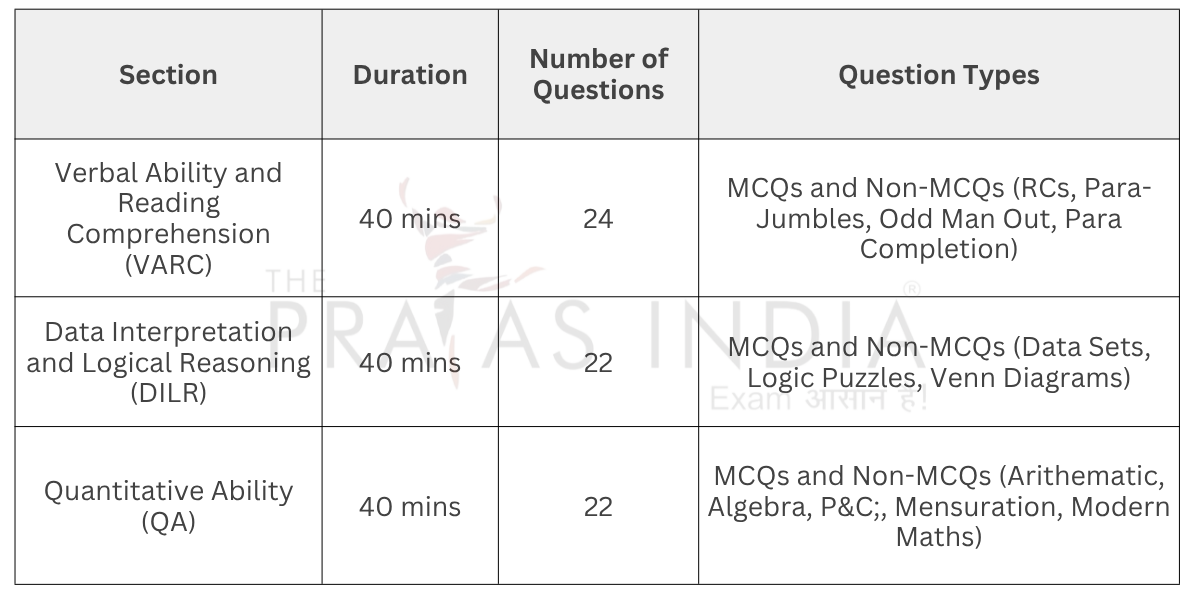
Key Highlights of CAT Exam:
- Total Duration: 2 Hours (40 minutes per section)
- Total Questions: Approx. 66–68
- Sections:
- VARC (Verbal Ability & Reading Comprehension)
- DILR (Data Interpretation & Logical Reasoning)
- QA (Quantitative Ability)
- Marking Scheme:
- +3 for correct answer
- -1 for incorrect MCQs
- No negative marking for non-MCQs
Understanding the pattern helps you plan time allocation and strategy effectively.
Exam Updates/CAT Mock Test
What Is the Best Strategy Based on Previous Year Trends?
The CAT entrance exam has been evolving continuously, with each year bringing subtle changes in difficulty level, question patterns, and time pressure. Over the years, the exam has clearly shifted towards testing not just conceptual clarity but also speed, accuracy, and decision-making ability under pressure.
To achieve a high percentile, it is essential for aspirants to carefully analyse previous year trends and understand how each section behaves. A strong CAT score is not just about hard work—it is the result of consistent effort, smart planning, and the ability to play to your strengths while minimizing weaknesses.
In this section, we present a detailed analysis of sectional trends from the past five years (2021–2025). This is followed by key observations and practical preparation strategies for each section to help you prepare in a structured and effective manner.
Verbal Ability & Reading Comprehension (VARC)
The following table presents a detailed evaluation of the VARC section from 2021 to 2025. This analysis has been prepared by our expert faculty after thorough examination of past papers.
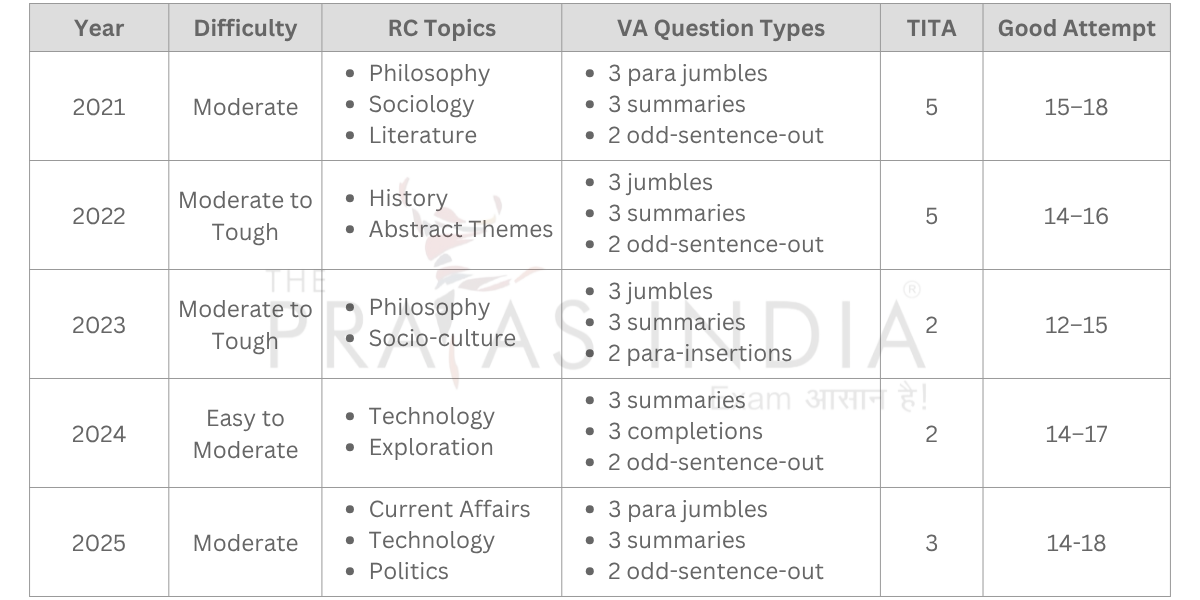
VARC 2021–2025 Trends
Over the past five years, the VARC section has shown a high level of consistency in its structure. The Reading Comprehension (RC) portion has consistently included 16 questions, typically divided across four passages. Each passage generally ranges between 400 to 600 words and covers diverse topics.
In the last two years, there has been a noticeable inclination towards passages based on Technology and contemporary issues, although subjects like Philosophy and Sociology continue to appear frequently.
The Verbal Ability (VA) section usually consists of 8 questions, with a mix of MCQs and TITA (Type In The Answer) questions. Among VA topics, para jumbles, summary-based questions, and odd-sentence-out have remained consistently important across all years.
Overall, VARC is less about rote learning and more about reading efficiency, comprehension depth, and logical interpretation.
VARC Tips and Preparation Strategy
Focus on Reading Comprehension (RC):
Since RC carries the highest weightage in VARC, candidates must prioritize improving their reading speed and comprehension skills. Develop the habit of reading editorials, essays, and articles from diverse domains such as Philosophy, Sociology, Technology, and Current Affairs. This helps in adapting to unfamiliar topics during the exam.
Master Verbal Ability Question Types:
Regular practice of para jumbles, summary questions, and odd-sentence-out is essential. These question types test logical flow and understanding of sentence structure, which improves with consistent practice.
Practice TITA Questions Effectively:
TITA questions are crucial as they carry no negative marking. This allows candidates to attempt them without risk. Practicing these regularly can significantly improve overall VARC scores.
FREE GDPI WAT Prep & Profile Building
Data Interpretation & Logical Reasoning (DILR)
The following table provides a comprehensive analysis of the DILR section from 2021 to 2025, compiled by our experienced faculty.
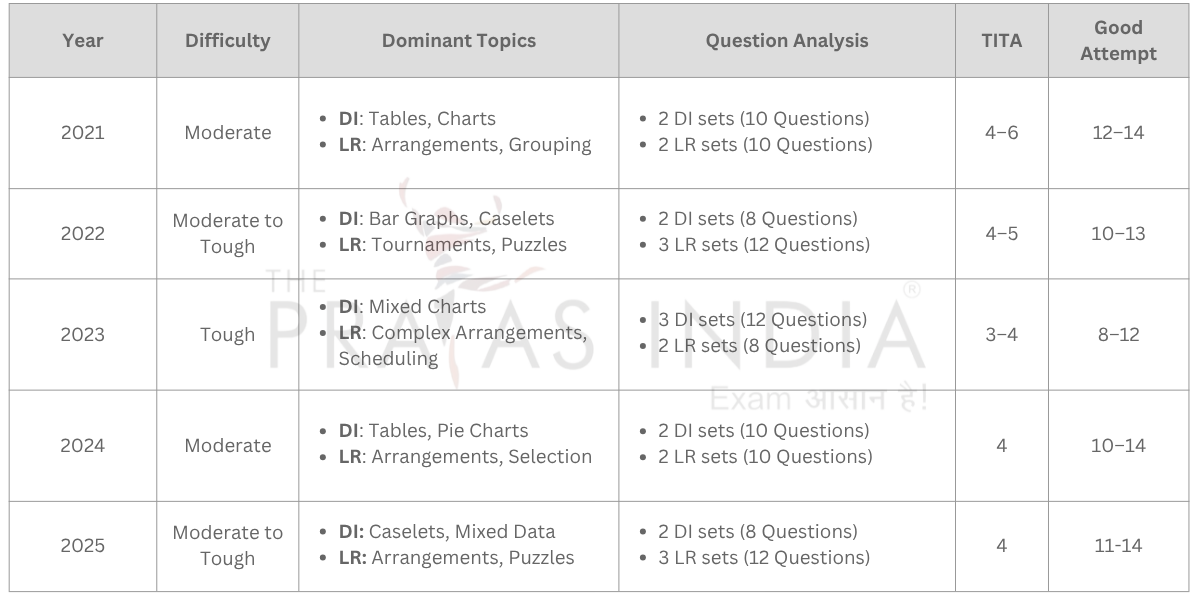
DILR 2021–2025 Trends
The DILR section has remained structurally stable over the years, typically consisting of 20 questions. These questions are divided into 4 to 5 sets, each with varying levels of difficulty.
Each set usually combines elements of both Data Interpretation and Logical Reasoning, requiring candidates to apply analytical thinking along with data-handling skills. Over the past two years, the number of TITA questions has remained consistent at around 4.
The section continues to be considered unpredictable, with some sets being relatively straightforward while others are time-consuming and complex. Selection of the right sets has become a key factor in maximizing scores.
DILR Tips and Preparation Strategy
Strengthen Data Interpretation Skills:
Focus on topics such as tables, bar graphs, pie charts, caselets, and mixed data sets. These formats have been dominant in recent years. Practice interpreting data quickly and accurately to save time during the exam.
Master Logical Reasoning Concepts:
Regularly practice puzzles based on arrangements, grouping, scheduling, and tournaments. These are commonly repeated themes in CAT and require strong logical structuring skills.
Practice Timed Sets:
DILR is a time-intensive section. It is important to practice solving 2–3 full sets within a fixed time limit. This helps in improving both speed and decision-making ability regarding which sets to attempt and which to skip.
Quantitative Aptitude (QA)
The following table outlines a detailed analysis of the QA section from 2021 to 2025, curated by our expert faculty.
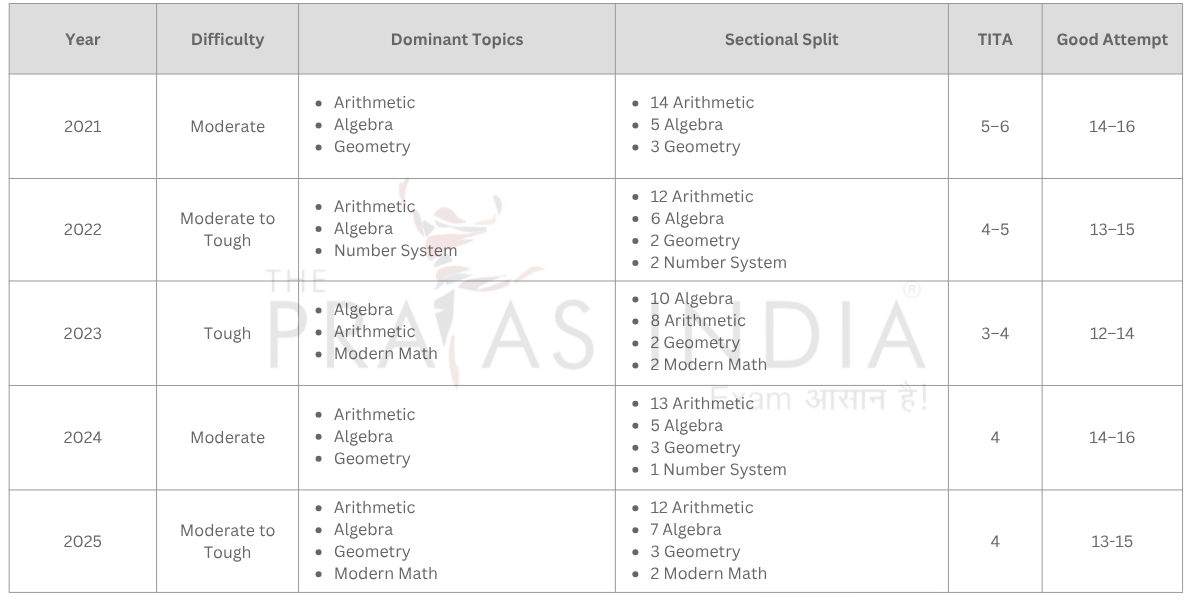
QA 2021–2025 Trends
Between 2021 and 2025, the Quantitative Aptitude section has maintained a balanced distribution of questions across key topics such as Arithmetic, Algebra, Geometry, and Number Systems.
There has been a clear emphasis on application-based questions rather than direct formula-based problems. This indicates that conceptual clarity and problem-solving ability are more important than rote memorization.
Similar to DILR, the number of TITA questions in QA has remained stable at around 4 in the last two years. Additionally, there has been a gradual increase in questions from Modern Mathematics, particularly in years like 2023 and 2025.
QA Tips and Preparation Strategy
Prioritize Arithmetic:
Arithmetic continues to dominate the QA section. Topics such as percentages, ratios, averages, profit & loss, and time-speed-distance should be thoroughly practiced as they frequently appear in the exam.
Strengthen Algebra and Geometry:
Algebra-based questions, including equations and inequalities, are commonly asked. Geometry topics like circles, triangles, and mensuration also play a significant role. Building conceptual clarity in these areas is essential.
Focus on Modern Mathematics:
Topics like Probability, Permutations & Combinations, and Set Theory have gained importance in recent years. Aspirants should ensure they are comfortable with these concepts.
Work on Speed and Accuracy:
QA requires a balance between speed and precision. Regular timed practice is crucial to improve calculation speed and minimize errors during the exam.
CAT Study Plan for 6–7 Months: Month-Wise Breakdown
A structured timeline is the key to success. Below is a practical 7-month preparation plan:
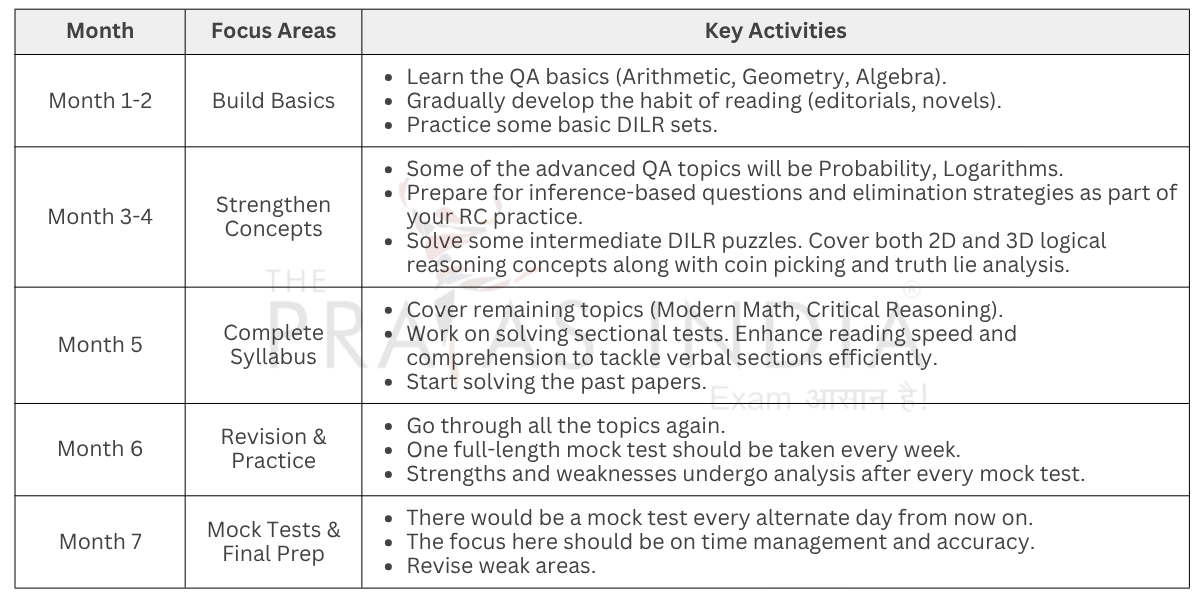
Month-wise Focus:
- Months 1–2: Build fundamentals (basic concepts in QA, reading habits for VARC, basic puzzles for DILR)
- Months 3–4: Advance concepts + sectional practice
- Months 5–6: Intensive practice + mocks + PYQs
- Month 7: Revision + full-length mocks + strategy building
Section-Wise CAT Preparation Strategy
1. Quantitative Ability (QA)
Quant is often the most feared section but also the most scoring if prepared well.
Months 1–2:
- Focus on Arithmetic:
- Percentages
- Profit & Loss
- Ratio & Proportion
- These topics carry maximum weightage
Months 3–4:
- Algebra, Geometry, Number System
- Expect 2–5 questions from these areas
Months 5–6:
- Probability & Functions
- Important for 99+ percentile aspirants
Month 7:
- Only revision + formula practice
- Focus on timed sectional tests (40 minutes)
2. Verbal Ability & Reading Comprehension (VARC)
VARC is all about reading skills, comprehension, and accuracy.
- Read daily articles (2–3 per day) from diverse topics
- Focus on:
- Tone identification
- Inference-based questions
- Practice:
- Para-jumbles
- Para-summary
- Odd one out
Daily Practice:
- Solve 2 RCs daily (3–4 if weak)
Important Tip:
- Increase attempts intelligently
- Don’t sacrifice accuracy completely, but attempt more with calculated risk
3. Data Interpretation & Logical Reasoning (DILR)
DILR is considered the most unpredictable section.
Preparation Strategy:
- Start with:
- Basic arrangement puzzles
- Move to:
- Games & tournaments
- Maxima-minima sets
Daily Practice:
- Solve 2 sets daily
- Practice last 5 years PYQs
Extra Practice:
- Sudoku & Kakuro puzzles improve logical thinking
CAT 2026 Mock Test Strategy
Mock tests are the backbone of CAT preparation.
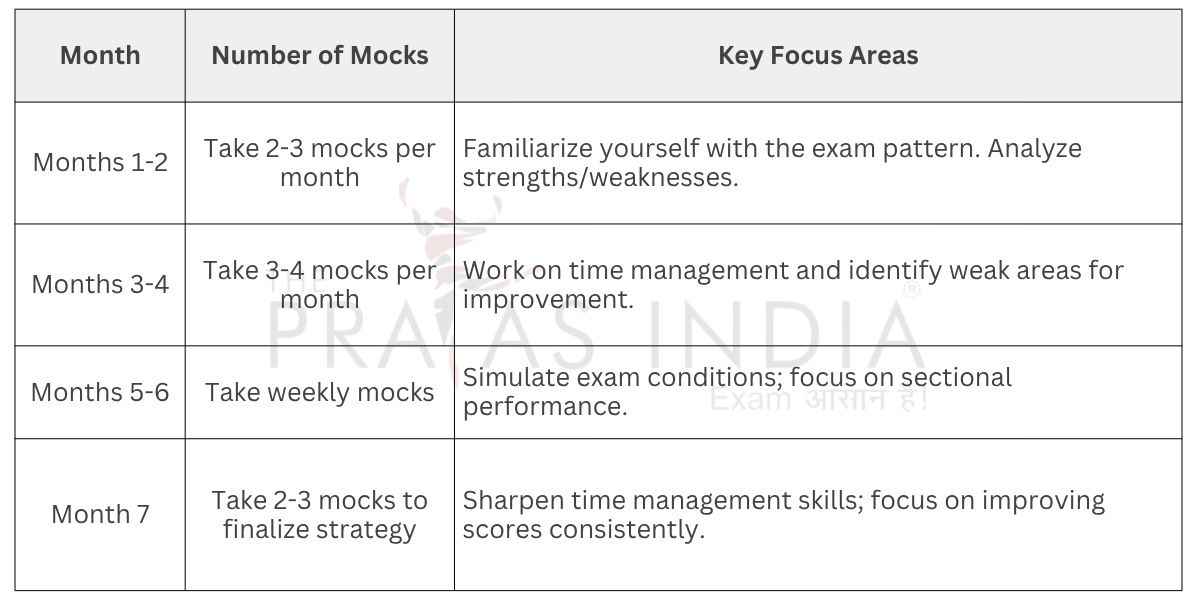
How to Use Mock Tests Effectively:
- Start mocks from Month 3
- Increase frequency gradually
- Focus on:
- Speed
- Accuracy
- Time management
Most Important: Mock Analysis
- Spend more time analyzing than attempting mocks
- Identify:
- Weak areas
- Silly mistakes
- Time-consuming questions
Top B-schools have sectional cut-offs, so balanced performance is essential.
CAT Preparation Strategy: Final Phase (Last 1 Month)
The last phase is emotionally and mentally challenging.
- Don’t panic over low mock scores
- Focus on error analysis
- Revise formulas and concepts
- Avoid giving mocks just before the exam day
Golden Rule:
Trust your preparation and stay calm
Effective Strategies for CAT Preparation in 6–7 Months
1. Consistency is Key
Daily study targets are essential. Even 2–3 hours daily can bring great results if done consistently.
2. Time Management
- Weekdays: 3 hours/day
- Weekends: 6–8 hours/day
- Total: ~25–30 hours/week
3. Focus on Weak Areas
- Identify weak sections early
- Allocate extra time for improvement
4. Practice Under Time Limit
- Solve questions with a timer
- Improves speed and accuracy
5. Smart Study Approach
- Don’t just study more, study smart
- Prioritize high-weightage topics
Weekly Study Schedule for CAT Preparation
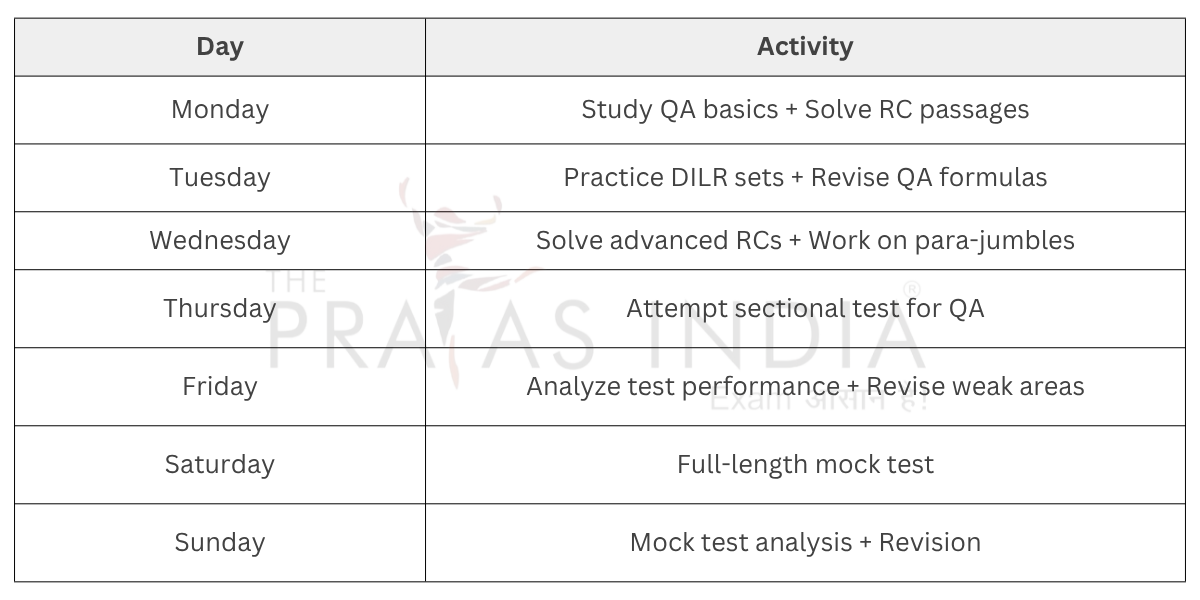
Example Structure:
- Monday–Friday: Concept + Practice
- Saturday: Sectional tests
- Sunday: Full mock + analysis
Why The Prayas India is the Best Choice for CAT Preparation
When it comes to structured and result-oriented preparation, The Prayas India stands out as a trusted platform for CAT aspirants.
1. Structured Study Plan
The Prayas India provides a well-designed roadmap for 6–7 months preparation, ensuring complete syllabus coverage without confusion.
2. Expert Faculty Guidance
Learn from experienced mentors who understand:
- CAT exam trends
- Question patterns
- Shortcut techniques
3. High-Quality Study Material
- Updated notes based on latest CAT pattern
- Concept clarity + advanced level questions
- Section-wise practice modules
4. Mock Tests & Performance Analysis
- Full-length mocks similar to actual CAT
- Detailed performance reports
- Strength & weakness identification
5. Sectional Test Strategy
- Timed sectional tests
- Strategy building for each section
- Real exam simulation
6. Personalized Mentorship
- One-on-one guidance
- Doubt-solving sessions
- Strategy customization based on student performance
7. Focus on Accuracy & Percentile Improvement
The Prayas India emphasizes:
- Smart attempt strategy
- Accuracy improvement
- Time optimization
8. Ideal for Beginners & Working Professionals
Whether you are:
- Starting from scratch
- Preparing alongside a job
The Prayas India provides flexible and effective preparation solutions.
CAT 2026 Preparation Strategy for 6–7 Months: Conclusion
Preparing for the CAT exam in 6–7 months is challenging but completely achievable with the right mindset and strategy. The key lies in:
- Consistent practice
- Strong fundamentals
- Regular mock analysis
- Smart time management
A well-planned preparation strategy combined with expert guidance can significantly boost your chances of securing a high percentile in CAT 2026.
With the right support system like The Prayas India, aspirants can confidently prepare, improve performance, and move closer to their dream MBA college.
FAQs on CAT 2026 Preparation Strategy
Q1. Is 6–7 months enough to prepare for CAT 2026?
Yes, 6–7 months are sufficient for CAT preparation if you follow a structured study plan, stay consistent, and regularly practice mock tests.
Q2. How many hours should I study daily for CAT 2026?
Ideally, you should study 2–3 hours on weekdays and 6–8 hours on weekends, making it around 25–30 hours per week.
Q3. When should I start taking CAT mock tests?
You should start taking mock tests from the 3rd month of preparation and gradually increase the frequency as the exam approaches.
Q4. Which section is the toughest in CAT?
Most aspirants find DILR (Data Interpretation & Logical Reasoning) the toughest due to its unpredictable nature, but difficulty varies from student to student.
Q5. How can I improve my VARC score for CAT?
Improve VARC by:
- Reading daily (articles, editorials)
- Practicing RC passages regularly
- Working on para-jumbles and summaries
Q6. What is a good score in CAT 2026?
A good score depends on your target college, but generally:
- 90+ percentile = Good
- 95+ percentile = Very Good
- 99+ percentile = Top B-school level
Q7. How important is mock analysis in CAT preparation?
Mock analysis is extremely important. It helps identify weak areas, improve accuracy, and refine your exam strategy.
Q8. Can working professionals crack CAT in 6–7 months?
Yes, with proper time management and a disciplined schedule, working professionals can successfully crack CAT in 6–7 months.
Q9. How many mocks should I attempt before CAT?
You should aim to attempt 25–40 full-length mock tests along with sectional tests for effective preparation.
Q10. Why choose The Prayas India for CAT preparation?
The Prayas India offers structured study plans, expert mentorship, high-quality study material, and detailed mock analysis, making it a reliable choice for CAT aspirants.