CAT 2027 Preparation Timeline: Month-Wise Study Plan for Aspirants Starting Early | Best CAT Coaching in Mumbai | The Prayas India
CAT preparation is often treated as a race that begins only a few months before the examination. However, aspirants targeting CAT 2027 have the advantage of something extremely valuable: time.
With CAT 2026 still ahead, September 2026 can be a practical starting point for students who already know that they want to pursue an MBA through CAT 2027. Starting early does not mean completing the entire syllabus immediately. It means building the right foundation, developing consistent study habits, understanding the CAT exam structure and gradually moving towards timed practice and mock tests.
For students starting their CAT journey now, the biggest advantage is flexibility. There is enough time to strengthen weak areas, experiment with different preparation methods, analyse performance and build speed without creating unnecessary pressure.
At The Prayas India, CAT aspirants can prepare through a structured learning approach designed around concepts, practice, testing and analysis. With online and offline learning options and centres across Andheri, Borivali, Dadar, Bhandup and Nerul, students can begin their CAT 2027 preparation with a long-term plan rather than rushing through the syllabus at the last moment.
Why Start CAT 2027 Preparation in September 2026?
Starting CAT preparation more than a year before the target examination does not mean studying for several hours every day. Instead, the objective should be to build a sustainable preparation system.
Students who begin early can divide CAT preparation into multiple stages. The initial months can focus on fundamentals and identifying strengths and weaknesses. The middle phase can be used for systematic syllabus coverage and practice, while the later months can focus increasingly on sectional tests, full-length mocks, revision and examination strategy.
This approach can be particularly useful for college students and working professionals who cannot dedicate their entire day to CAT preparation.
Early preparation also gives you time to recover from mistakes. If a student discovers in January that Quantitative Aptitude is a weak area, there is still sufficient time to rebuild the basics. Similarly, a student struggling with DILR can gradually improve set selection and logical reasoning rather than trying to fix everything immediately before the examination.
The goal of starting early should therefore be consistency, not intensity.
CAT 2027 Preparation Timeline at a Glance
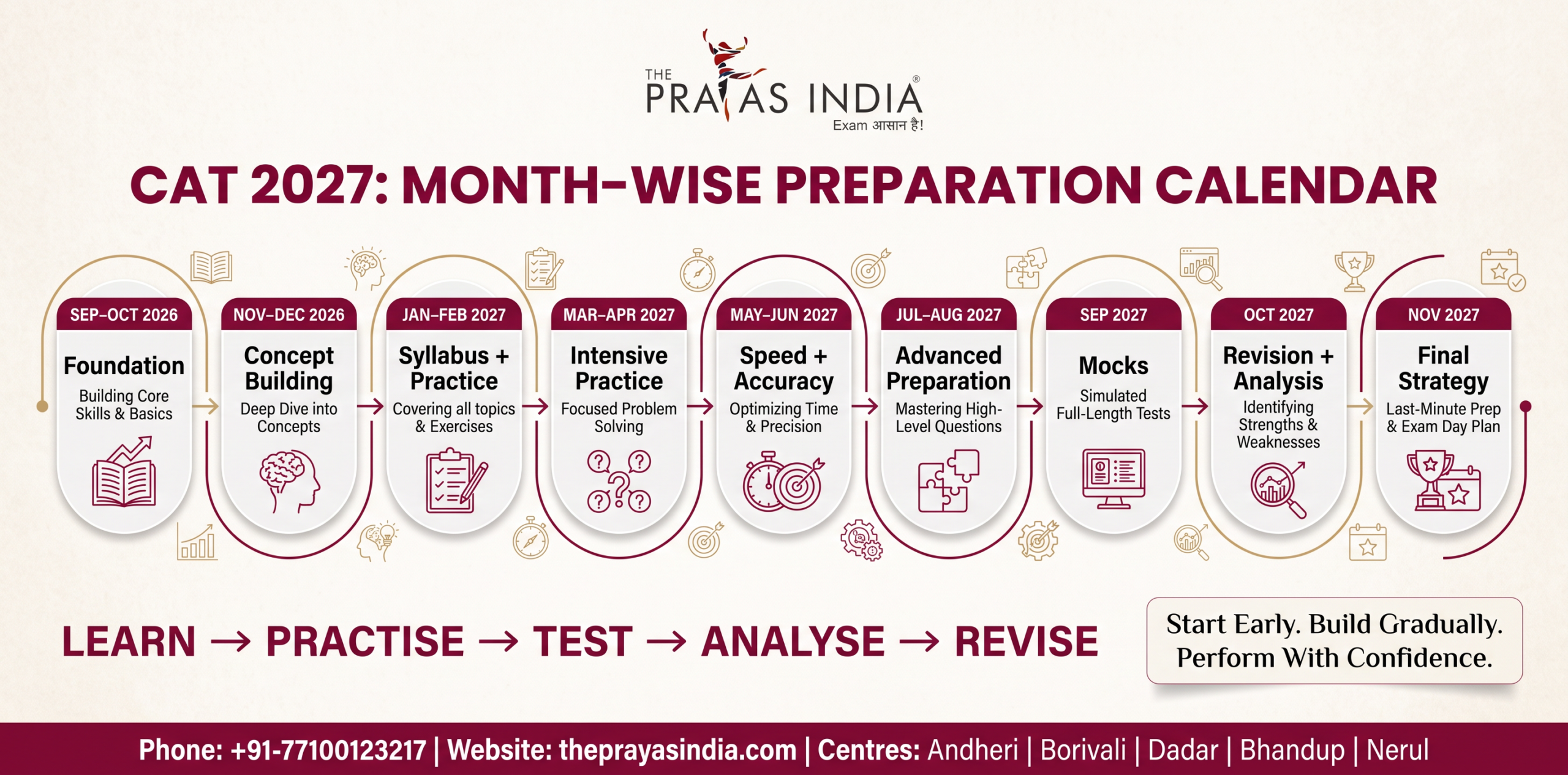
A long-term CAT preparation plan can be divided into the following stages:
| Period | Primary Focus | Main Objective |
|---|---|---|
| September–October 2026 | Foundation | Understand CAT and assess your level |
| November–December 2026 | Concept Building | Strengthen QA, VARC and DILR fundamentals |
| January–February 2027 | Syllabus Development | Cover major topics systematically |
| March–April 2027 | Practice Phase | Increase question and set-solving ability |
| May–June 2027 | Speed & Accuracy | Introduce more timed practice |
| July–August 2027 | Advanced Preparation | Sectionals, mixed practice and difficult areas |
| September 2027 | Mock Phase | Increase full-length CAT mocks |
| October 2027 | Intensive Revision | Analyse mocks and fix recurring weaknesses |
| November 2027 | Final Preparation | Revision, strategy and examination readiness |
The exact schedule can be adjusted according to your starting level, academic commitments and performance.
September–October 2026: Build Your CAT Foundation
If you are beginning CAT 2027 preparation in September 2026, do not immediately try to complete large portions of the syllabus.
The first objective should be to understand what CAT demands.
The examination requires preparation across three broad areas: VARC, DILR and QA. Each section requires a different type of preparation, so your initial months should be used to understand your current level in all three.
Take a diagnostic test or a few representative questions from each section. The objective is not to chase a high score at this stage. Instead, identify areas where you are comfortable and areas where you need significant improvement.
For example, you may discover that your Quant concepts are strong but your calculation speed is slow. Another student may understand Quant concepts but struggle with algebra. A third student may read quickly but find CAT-level RC questions difficult. DILR may be unfamiliar for many students because its questions require a different approach from conventional school mathematics.
Your preparation plan should be based on these observations.
Your September–October priorities should include:
- Understanding the CAT syllabus and examination structure
- Taking an initial diagnostic test
- Revising basic Quant concepts
- Developing a daily reading habit
- Beginning basic DILR practice
- Creating a preparation timetable
- Maintaining a mistake log
- Identifying weak and strong areas
Do not worry if your initial performance is not impressive. At this stage, the purpose of testing is diagnosis rather than selection or score maximisation.

November–December 2026: Strengthen Your Core Concepts
Once your initial assessment is complete, move into systematic concept building.
For Quantitative Aptitude, begin strengthening arithmetic, algebra, geometry and other major areas that form the foundation of CAT preparation. Do not simply collect formulas. Focus on understanding concepts and learning how to identify the appropriate approach for different questions.
For VARC, reading should become a daily habit. Read quality articles, editorials, essays and long-form content across different subjects. The purpose is not just to increase reading speed. You also need to understand arguments, identify the author’s viewpoint, distinguish important information from supporting details and follow complex passages.
DILR requires a different kind of preparation. Rather than memorising formulas, you should expose yourself to different set structures. Practise tables, arrangements, selections, distributions, networks, games, charts and other logical structures.
At this stage, your primary objective is quality of understanding.
Do not measure your preparation only by the number of questions completed.
A student who solves 30 questions after understanding the underlying concepts may make more progress than someone who solves 100 questions mechanically.
January–February 2027: Move Towards Systematic Syllabus Coverage
By January, your preparation should become more structured.
Create a topic tracker for all three sections. Mark topics as:
- Not Started
- Learning
- Practising
- Revised
- Strong
This simple system can prevent important topics from being forgotten.
For Quant, continue covering important concepts while revisiting topics from the previous months. For VARC, increase the frequency of RC practice and begin analysing why particular options are correct or incorrect. For DILR, gradually increase the variety of sets you solve.
This is also a good stage to start introducing sectional practice.
You do not necessarily need to take full-length CAT mocks every week at this point. Instead, use shorter timed exercises to understand how well you perform under constraints.
The key transition during these months is from:
Learning concepts → Applying concepts
March–April 2027: Enter the Intensive Practice Phase
By March, your preparation should gradually shift towards application.
You should have already encountered a substantial portion of the syllabus and should now spend more time solving questions rather than simply watching lectures or reading theory.
This is where your preparation begins to become increasingly individualised.
Suppose two students have covered the same syllabus. One may need more Quant practice while the other may need more VARC work. A third student may need extensive DILR exposure.
Therefore, avoid following someone else’s timetable blindly.
Analyse your performance and allocate preparation time according to your actual weaknesses.
During March and April, focus on:
- Topic-wise practice
- Mixed question sets
- DILR set variety
- RC practice
- Timed QA practice
- Sectional tests
- Previous CAT questions
- Error analysis
- Revising weak concepts
This is also the right time to become comfortable with solving questions without immediately looking at solutions.
Struggle is part of learning. The important thing is to distinguish productive struggle from spending excessive time on an unproductive approach.
May–June 2027: Improve Speed and Accuracy
Once your conceptual base becomes stronger, speed should receive greater attention.
CAT is not simply a test of whether you know the concepts. You must be able to apply them within a limited amount of time.
However, speed should not mean rushing.
The ideal progression is:
Concept Clarity → Accuracy → Consistency → Speed
If you increase speed before developing accuracy, you may simply make mistakes faster.
Use timed practice to identify where your time is being lost.
For example, in Quant, you may spend too much time understanding questions. In VARC, you may spend too long debating between two options. In DILR, you may select sets that consume excessive time.
These are not merely academic problems. They are test-taking strategy problems.
During May and June, start paying closer attention to them.
What Should Your Weekly CAT 2027 Schedule Look Like?
Your weekly schedule should contain a balance of learning, practice and analysis.
A sample structure could look like this:
| Activity | Suggested Focus |
|---|---|
| Quant | Concepts + practice |
| VARC | RC + verbal practice |
| DILR | Mixed sets |
| Sectional Test | Timed performance |
| Previous CAT Questions | Exam-level exposure |
| Mock Analysis | Identifying weaknesses |
| Revision | Mistake log + formulas/concepts |
The exact number of hours will depend on whether you are a college student, working professional or full-time aspirant.
A sustainable schedule that you can follow for several months is generally more useful than an extremely aggressive routine that lasts only a few weeks.
July–August 2027: Shift Towards Advanced CAT Preparation
By July, your preparation should increasingly resemble the actual examination environment.
You should be solving mixed questions and sets rather than remaining restricted to individual topics.
Sectional tests should become a regular part of your schedule. Full-length mocks can also be introduced more systematically.
At this stage, the objective is not simply to increase the number of tests.
Mock analysis becomes as important as taking the mock itself.
After every test, identify:
- Questions you got wrong despite knowing the concept
- Questions where you made calculation or interpretation errors
- Questions you spent too much time on
- Questions you should have attempted but skipped
- Questions you correctly avoided
- Topics that continue to cause difficulty
This analysis will help you build a personalised CAT strategy.
September 2027: Make Mock Tests a Major Part of Preparation
September should mark a major transition towards examination-oriented preparation.
At this stage, mocks should not be treated as simple score-generating exercises. Each mock should provide information about your preparation.
After completing a mock, analyse your performance section by section.
For VARC, examine whether mistakes came from poor comprehension, incorrect option elimination or rushed decisions.
For DILR, analyse your set selection and whether you invested time in the right sets.
For QA, identify whether mistakes were conceptual, calculation-based or caused by poor time management.
Maintain a CAT Mock Analysis Sheet where you record these observations.
Over several tests, patterns will emerge.
You may discover that your score is not limited by your conceptual knowledge but by your selection strategy. Or perhaps you are performing well in untimed practice but struggling under pressure.
The purpose of mock analysis is to identify these patterns while there is still time to correct them.
October 2027: Intensive Revision and Strategy Building
By October, avoid making major changes to your preparation resources unless absolutely necessary.
This is the time to consolidate.
Revise important concepts, revisit your mistake log and solve selected questions from topics where you continue to struggle.
Your mock frequency can increase according to your preparation level, but every mock should be followed by meaningful analysis.
Do not take several mocks simply because you believe more tests automatically mean better preparation.
A mock that you analyse deeply can teach you more than multiple tests that you complete and forget.
October should focus on:
- Full-length mock tests
- Mock analysis
- Weak-area revision
- Previous CAT questions
- Time management
- Sectional strategy
- Set/question selection
- Accuracy improvement
Your preparation should now be focused on execution rather than endless syllabus expansion.
November 2027: Final CAT Preparation
The final month should be about stability.
Avoid starting completely new resources or attempting to learn every difficult topic you have ignored throughout the year.
Focus on areas where additional revision can realistically improve your performance.
Review your notes, formulas, common mistakes and important question types.
Continue taking mocks according to your strategy, but pay particular attention to maintaining confidence and consistency.
Your final preparation should answer three questions:
What should I attempt?
What should I skip?
How should I manage my time?
Having clear answers to these questions can make your preparation feel much more controlled.

How Many Hours Should You Study for CAT 2027?
There is no single number of study hours that works for every CAT aspirant.
A college student may initially have two to three focused hours available each day, while a full-time aspirant may be able to dedicate significantly more time. Working professionals may need to build their preparation around their working schedule.
Instead of focusing only on hours, focus on effective study time.
Two hours of concentrated problem-solving, reading and analysis can be more valuable than five hours of distracted study.
A useful long-term approach is to gradually increase study intensity as the examination approaches.
Early Stage
Focus on consistency and fundamentals.
Middle Stage
Increase practice and introduce timed exercises.
Advanced Stage
Increase sectionals, mocks and detailed analysis.
This gradual progression helps prevent burnout while ensuring that preparation becomes more intensive at the appropriate time.
Should You Join CAT Coaching for CAT 2027 Preparation?
Starting CAT preparation early gives you the option to choose your preparation method carefully.
Self-study can work for students who are comfortable creating their own schedule, selecting resources, learning concepts independently and analysing their own performance.
However, structured CAT coaching can be useful for aspirants who want a defined preparation path and regular guidance.
A structured programme can help bring together:
- Concept-based learning
- Systematic syllabus coverage
- DILR practice
- VARC practice
- Quantitative Aptitude preparation
- Doubt-solving support
- Sectional tests
- Full-length mocks
- Performance analysis
- Revision planning
The advantage of joining a CAT coaching programme early is that you do not have to compress all of these components into the final few months.
You can use the initial months to understand concepts, the middle months to build application skills and the final months for intensive testing.
For students looking for CAT coaching in Mumbai, The Prayas India provides CAT preparation through online and offline learning options, with centres in Andheri, Borivali, Dadar, Bhandup and Nerul.
The right preparation environment should not simply provide study material. It should help you understand what to study, when to practise, how to analyse your performance and where you need improvement.
What Makes Early CAT 2027 Preparation Different?
One of the biggest advantages of early preparation is that you do not have to treat every week like a crisis.
If you struggle with a topic in September, you can revisit it in October. If a DILR format takes too long in January, you can continue practising it over the following months. If mock scores fluctuate later in the year, there is time to identify the reasons and adjust your strategy.
Early preparation therefore creates room for experimentation and correction.
This is especially valuable for first-time CAT aspirants who may initially be unfamiliar with the examination’s style.
Instead of asking:
“How can I finish CAT preparation quickly?”
you can ask:
“How can I build the skills required to perform consistently by CAT 2027?”
That is a much more sustainable approach.
Can You Prepare for CAT 2027 Alongside College?
Yes, and starting early can make this significantly more manageable.
College students do not necessarily need to study for CAT for several hours every day from September 2026.
A better strategy is to create a routine that fits around college.
For example, weekdays can be used for shorter focused sessions while weekends can include longer practice sessions, sectional tests or mock analysis.
The important thing is consistency.
A student who studies regularly throughout the academic year may enter the final CAT preparation phase with a strong foundation, while someone who postpones preparation may have to balance college commitments with an extremely compressed CAT schedule.
Can Working Professionals Start CAT 2027 Preparation Now?
Working professionals can also benefit from an early start because their biggest constraint is often time rather than motivation.
Instead of waiting for the ideal schedule, begin with manageable preparation blocks.
A weekday routine could include reading and Quant practice, while weekends could be reserved for DILR sets, sectional tests and revision.
As the CAT examination approaches, preparation intensity can gradually increase.
The key is to avoid comparing your schedule with that of a full-time aspirant.
Your objective is to build a plan that you can sustain alongside your professional responsibilities.
Common Mistakes CAT 2027 Aspirants Should Avoid
Starting With an Unrealistic Timetable
A timetable that looks impressive on paper but cannot be followed consistently is not useful.
Build a realistic schedule first and increase intensity gradually.
Trying to Finish the Entire Syllabus Immediately
Early preparation does not require rushing.
Conceptual clarity is more important than ticking topics off a checklist.
Ignoring DILR Until the End
DILR requires exposure and practice. It should remain part of your preparation throughout the year.
Treating Reading as Optional
VARC improvement, particularly in Reading Comprehension, benefits from consistent reading and analysis.
Taking Mocks Without Analysing Them
A mock is not complete when you submit it.
The analysis is where you discover your recurring mistakes and decision-making patterns.
Constantly Changing Resources
Using too many books, courses, websites and question banks can create confusion.
Choose reliable resources and follow a structured plan.
Comparing Your Timeline With Other Aspirants
Different students start at different levels and have different academic or professional commitments.
Track your own improvement.
How to Know Whether Your CAT 2027 Preparation Is on Track
Do not judge your preparation only by your mock score.
Instead, look for gradual improvements in several areas.
You should ideally see progress in:
- Conceptual clarity
- Accuracy
- Reading comprehension
- DILR set selection
- Question selection
- Calculation speed
- Time management
- Mock analysis
- Ability to remain calm under timed conditions
- Reduction in repeated mistakes
If your score fluctuates but your underlying skills are improving, do not immediately assume that your preparation has failed.
Use your analysis to understand what is actually changing.
A Simple Month-Wise CAT 2027 Study Plan
Here is the complete timeline in a simplified format:
September 2026
Understand CAT, take a diagnostic test and identify your strengths and weaknesses.
October 2026
Start foundation-level Quant, VARC and DILR preparation.
November 2026
Strengthen core concepts and develop consistent study habits.
December 2026
Continue concept building and begin more systematic practice.
January 2027
Increase syllabus coverage and introduce regular sectional practice.
February 2027
Continue topic-wise preparation and revise previously completed areas.
March 2027
Move towards intensive practice and mixed questions.
April 2027
Increase timed practice and work on weak areas.
May 2027
Focus on speed, accuracy and question selection.
June 2027
Increase sectional tests and previous CAT question practice.
July 2027
Begin advanced mixed practice and regular mock preparation.
August 2027
Strengthen examination strategy through sectionals and mocks.
September 2027
Make full-length mocks and analysis a major part of preparation.
October 2027
Focus on intensive revision, mock analysis and strategy refinement.
November 2027
Consolidate preparation, revise key areas and enter the examination with a stable strategy.
CAT 2027 Preparation at The Prayas India
A long-term CAT preparation journey becomes easier to manage when students have access to a structured learning system.
At The Prayas India, CAT aspirants can prepare through online and offline learning options designed to support different stages of preparation. Students can use structured classes, practice material, tests and performance analysis to gradually build their preparation.
For students in Mumbai, CAT coaching is available through centres at:
Andheri | Borivali | Dadar | Bhandup | Nerul
Starting preparation early also gives students more time to understand whether they need additional support in Quantitative Aptitude, VARC or DILR.
Instead of waiting until the final months to search for coaching, study material or test series, CAT 2027 aspirants can evaluate their options early and choose a preparation structure that fits their academic or professional schedule.
If you are planning to target CAT 2027, this is a good stage to focus on building the right foundation and choosing a preparation approach that you can sustain for the entire journey.
A Practical CAT 2027 Routine for Students Starting in 2026
A student beginning CAT preparation in September 2026 does not need to follow the same routine as someone preparing in the final three months.
The early-stage routine should be sustainable.
A typical week could include:
Quantitative Aptitude: Concept learning and practice
VARC: Daily reading and regular RC practice
DILR: Multiple sets across different formats
Revision: Weekly review of concepts and mistakes
Testing: Periodic diagnostic or sectional tests
Analysis: Review of incorrect and time-consuming questions
As the examination approaches, the balance should gradually shift towards timed practice, sectionals, mocks and analysis.
This gradual change is one of the biggest advantages of starting early.
Final Checklist for CAT 2027 Aspirants
Before beginning your CAT 2027 preparation, make sure you have:
- A realistic long-term timeline
- A diagnostic assessment
- A clear study schedule
- Separate preparation plans for VARC, DILR and QA
- A mistake log
- A revision system
- A source of reliable practice material
- A sectional testing strategy
- A mock-test plan
- A method for analysing performance
- A clear approach for improving weak areas
Most importantly, do not wait for the perfect moment to begin.
You do not need to finish CAT preparation in September 2026. You simply need to start building the foundation that will make your 2027 preparation stronger.
Final Thoughts: Start Early, But Start Strategically
CAT 2027 is still far enough away for aspirants to prepare without unnecessary pressure, but that does not mean preparation should be postponed.
September 2026 can be the beginning of a structured journey where concepts are developed gradually, practice is increased over time and mock tests are introduced when the foundation is ready.
The objective should not be to study as much as possible today.
The objective should be to become a stronger CAT aspirant every month.
If you are planning to target CAT 2027, starting early also gives you enough time to evaluate whether you need self-study or structured coaching support. For students who prefer guided preparation, The Prayas India offers CAT coaching through online and offline modes, with Mumbai centres at Andheri, Borivali, Dadar, Bhandup and Nerul.
The right preparation timeline is not about rushing through the syllabus. It is about building the right skills in the right order:
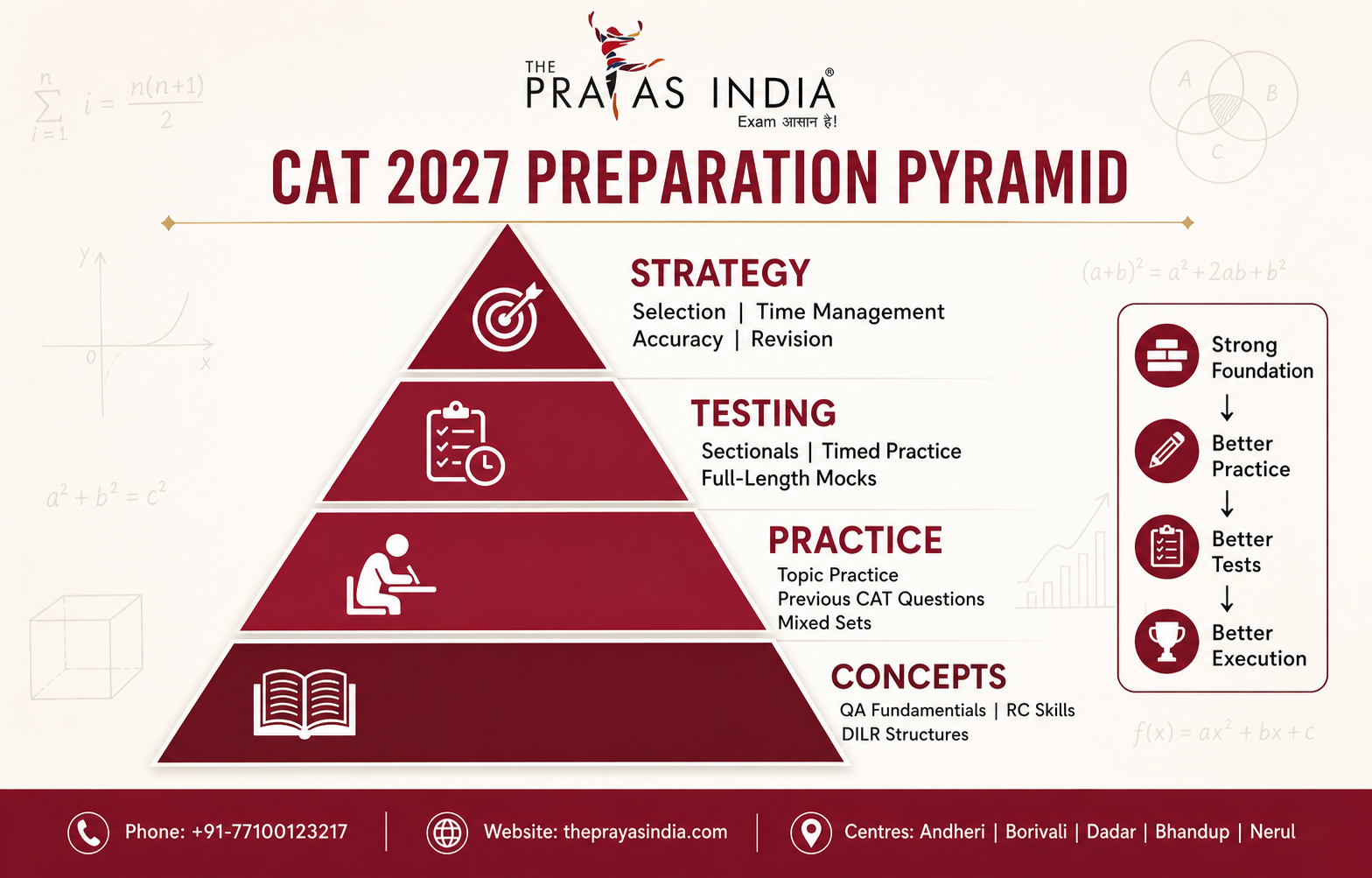
Foundation → Concepts → Practice → Speed → Testing → Analysis → Revision
Start early, stay consistent and use the additional time to build a preparation strategy that works for you.
FAQs
When should I start preparing for CAT 2027?
If you are targeting CAT 2027, starting around September or October 2026 gives you a long preparation window. The initial months can focus on fundamentals, reading habits and understanding the three CAT sections before moving towards intensive practice.
Is it too early to start CAT 2027 preparation before CAT 2026?
No. Students specifically targeting CAT 2027 can begin early without waiting for CAT 2026 results. Starting early allows more time for concept building, practice and gradual improvement.
How many hours should I study for CAT 2027?
There is no fixed number of hours suitable for every aspirant. Your study time should depend on your current level, college or work commitments and preparation stage. Consistent, focused study is more important than following an unrealistic number of hours.
Can I prepare for CAT 2027 while attending college?
Yes. College students can use a flexible long-term schedule. Starting early allows you to distribute preparation across several months rather than trying to manage the entire CAT syllabus alongside college in a short period.
When should I start taking CAT 2027 mock tests?
Diagnostic and sectional tests can be introduced relatively early. Full-length mocks should become increasingly important once you have developed sufficient familiarity with the syllabus and question types. The final months should include regular mock practice and detailed analysis.
Should I join CAT coaching for CAT 2027?
The decision depends on your preparation style. Students who want structured classes, organised study material, regular testing and guidance may benefit from a coaching programme. Starting early allows you to evaluate your options without waiting until the final preparation phase.
Does The Prayas India provide CAT coaching in Mumbai?
Yes. The Prayas India provides CAT preparation through online and offline learning options, with centres in Andheri, Borivali, Dadar, Bhandup and Nerul.
Can working professionals prepare for CAT 2027?
Yes. Working professionals can use the extended preparation timeline to balance CAT preparation with professional responsibilities. A consistent weekday and weekend schedule can help build preparation gradually.
Want a Personalized CAT 2027 Study Roadmap?
Don’t just study hard, study smart. Connect with our MBA experts to build a custom month-wise preparation strategy tailored to your strengths and weaknesses.
Official Website: theprayasindia.com
Visit Our Centres: