
CAT 2027 Quant Preparation Strategy: How to Build Strong QA Fundamentals | The Prayas India
Quantitative Ability, commonly known as QA, is one of the sections where a strong foundation can significantly change the way you approach CAT preparation. For many CAT aspirants, Quant is not difficult because every question requires advanced mathematics. The bigger challenge is that basic concepts may not be clear, calculations may take too long, and students often struggle to identify which concept a question is actually testing.
This becomes especially important for beginners and intermediate-level aspirants preparing for CAT 2027. If your school-level mathematics is rusty, jumping directly into difficult CAT-level questions can create unnecessary frustration. Similarly, if you have already studied the basics but your mock-test performance remains inconsistent, simply solving more questions may not solve the problem. You need to identify the gaps in your fundamentals, strengthen them systematically and then convert conceptual knowledge into speed and accuracy.
A strong CAT Quant preparation strategy should therefore not begin with the question, “How many questions can I solve every day?” It should begin with a more important question: “How well do I understand the concepts behind the questions I am solving?”
The objective should be to build a QA foundation that allows you to recognise patterns, select the right approach, calculate efficiently and avoid unnecessary mistakes under time pressure.
Important Note for CAT 2027 Aspirants
CAT 2027-specific exam details should always be checked against the official CAT website when the relevant notification and information become available. This preparation framework focuses on the skills required for CAT-level Quant preparation and is not based on an assumed future exam pattern.
Why Strong QA Fundamentals Matter for CAT 2027
CAT Quant is not simply a test of whether you remember mathematical formulas. A question may give you a familiar concept in an unfamiliar situation and expect you to translate the information, identify relationships and reach the answer efficiently.
This is why two students who have studied the same formulas can perform very differently in a timed test. One may immediately recognise that a question is based on ratios, while another may spend several minutes trying different calculations without identifying the underlying relationship.
Strong fundamentals reduce this uncertainty.
When your concepts are clear, you can focus more attention on understanding the question rather than remembering what to do next. You also become better at eliminating unnecessary calculations and selecting shorter solution methods.
For CAT 2027 aspirants, this creates a progression:
Concept Clarity → Question Recognition → Application → Speed → Accuracy → Exam Readiness
The important point is that these stages are connected. Speed should not be treated as the first target. It is usually a result of repeated exposure to concepts and question types.
What Does “Strong QA Fundamentals” Actually Mean?
A student with strong Quant fundamentals does not necessarily solve every difficult question. Instead, the student can comfortably handle the building blocks required to approach different types of problems.
Strong fundamentals include:
- Understanding what a formula actually represents
- Knowing when a particular concept should be applied
- Converting word problems into mathematical relationships
- Performing basic calculations with reasonable efficiency
- Recognising common question structures
- Comparing different solution methods
- Checking whether an answer is logically possible
- Identifying calculation and conceptual errors
- Applying concepts to unfamiliar situations
For example, knowing the percentage formula is not enough. You should also understand percentage increase and decrease, successive percentage changes, comparisons, reverse percentages and how percentages interact with ratios and averages.
Similarly, knowing the formula for time, speed and distance is only the starting point. You should be comfortable interpreting relative speed, changing units, average speed and the relationships hidden inside word problems.
That difference between formula knowledge and conceptual understanding is one of the most important distinctions in CAT Quant preparation.
CAT 2027 Quant Syllabus: Build Your Preparation Around Major Concept Areas
Rather than trying to memorise hundreds of individual question types, beginners should organise their preparation into broader mathematical areas.
A practical structure is:
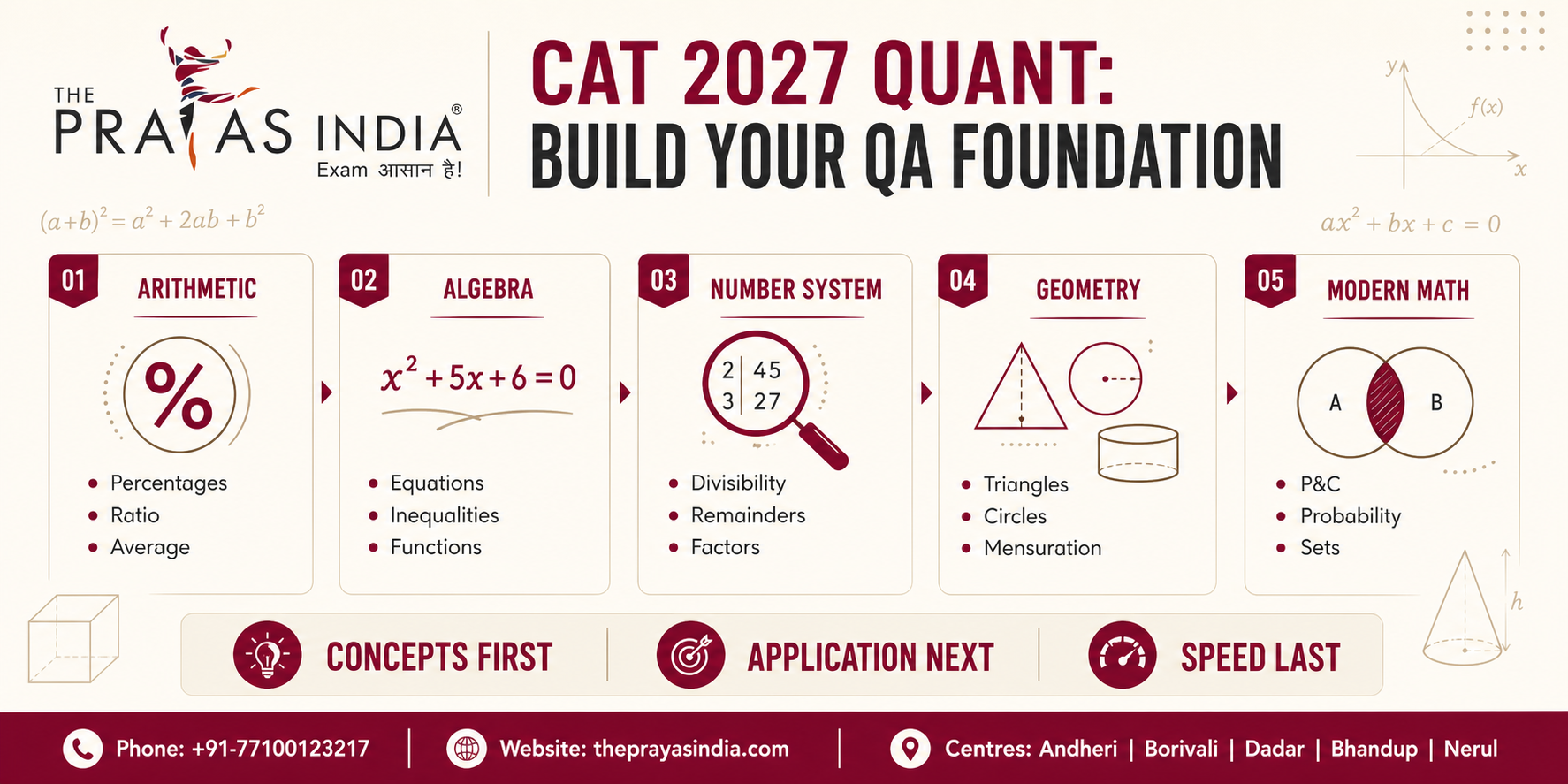
1. Arithmetic
Arithmetic is an important foundation for CAT Quant preparation because many questions require you to understand relationships between quantities rather than perform complicated mathematics.
Important areas include:
- Percentages
- Profit, Loss and Discount
- Ratio and Proportion
- Averages
- Mixtures and Alligation
- Simple and Compound Interest
- Time, Speed and Distance
- Time and Work
- Pipes and Cisterns
- Partnership
- Basic commercial mathematics
The goal should not be to finish every chapter as quickly as possible. Instead, understand the relationship between concepts.
For instance, percentages are connected to profit and loss, discounts, interest, mixtures, averages and data interpretation. Once you become comfortable with percentage-based reasoning, several seemingly different topics become easier to handle.
2. Algebra
Algebra can initially appear intimidating to beginners because it introduces variables and equations. However, a structured approach can make the section much more manageable.
Focus on:
- Linear equations
- Quadratic equations
- Inequalities
- Algebraic identities
- Functions
- Sequences and series
- Progressions
- Logarithms
- Basic graphs
- Equations involving multiple variables
The key is to understand what the equation represents instead of treating algebra as a collection of formulas.
When practising algebra, ask yourself:
What information is given?
What needs to be found?
What relationship connects the two?
This habit gradually improves your ability to translate a word problem into an equation.
3. Number System
Number System questions often test conceptual understanding.
Important areas include:
- Divisibility
- Factors and multiples
- Prime numbers
- Remainders
- HCF and LCM
- Unit digits
- Cyclicity
- Number properties
- Odd and even numbers
- Integers
- Fractions
- Basic modular reasoning
Instead of memorising isolated tricks, try to understand why the rule works.
For example, knowing divisibility rules is useful, but understanding factorisation and number properties gives you a broader toolkit for solving unfamiliar problems.
4. Geometry and Mensuration
Geometry requires both formula knowledge and visual reasoning.
Build fundamentals in:
- Lines and angles
- Triangles
- Similarity
- Congruence
- Quadrilaterals
- Polygons
- Circles
- Coordinate geometry
- Areas
- Volumes
- Mensuration
Do not simply memorise formulas.
Draw diagrams whenever possible. Label the information given in the question and identify relationships before calculating.
A well-drawn diagram can often make a complicated geometry problem significantly easier to understand.
5. Modern Mathematics
Depending on the question set and preparation material, you may encounter topics such as:
- Permutation and Combination
- Probability
- Set Theory
- Basic counting principles
These areas can be challenging if studied as formula-heavy chapters.
Start with fundamental counting logic. Understand why a particular formula is used and practise simple examples before moving towards CAT-level applications.
Step 1: Assess Your Current Quant Level Before Starting
One of the most common mistakes beginners make is starting their preparation without knowing where they currently stand.
If you immediately start watching advanced lectures or solving difficult CAT questions, you may not know whether your problem is conceptual weakness, calculation speed, question interpretation or simply lack of practice.
Start with a diagnostic exercise.
Take a mixed set containing basic and moderate questions from arithmetic, algebra, number system and geometry. Do not worry about achieving a high score.
Instead, classify your performance.
Category A: I know the concept and can solve it
These topics require regular revision and practice rather than extensive relearning.
Category B: I know the concept but cannot apply it
This usually indicates an application gap. You need more varied questions and better exposure to different formulations.
Category C: I understand the question but calculations take too long
Your conceptual foundation may be adequate, but calculation efficiency needs work.
Category D: I do not know where to begin
This is a conceptual gap. Return to fundamentals before attempting advanced questions.
This diagnostic approach prevents you from wasting weeks studying topics that you already understand while ignoring the areas that are actually limiting your performance.
Step 2: Start With Arithmetic Before Chasing Difficult Questions
For many beginners, Arithmetic is a sensible starting point because it builds several transferable skills.
Suppose you are comfortable with percentages and ratios. These concepts can later help you understand:
- Profit and loss
- Discounts
- Mixtures
- Averages
- Interest
- Time and work
- Data interpretation
This interconnectedness makes arithmetic particularly useful during the foundation-building stage.
However, starting with Arithmetic does not mean ignoring the other areas indefinitely.
A practical sequence can be:
Arithmetic Foundation → Algebra Foundation → Number System → Geometry → Remaining Topics
Once your basics are reasonably stable, begin mixing topics instead of studying every chapter in isolation.
Step 3: Learn Concepts in Three Layers
A useful way to study every Quant topic is to divide learning into three layers.
Layer 1: Understand
First understand the concept, formula and logic.
Ask:
- What does this concept mean?
- Why does the formula work?
- What type of questions use it?
- What are the common variations?
Do not rush this stage.
Layer 2: Apply
Once the concept is clear, solve basic and moderate questions.
Your objective is to recognise the concept inside a question.
For example, after studying averages, do not solve only direct average questions. Practise questions involving replacement, combined averages, weighted averages and changes in group composition.
This teaches you how the concept behaves in different situations.
Layer 3: Adapt
Finally, solve unfamiliar or mixed questions.
This is where CAT-level preparation becomes more meaningful.
A question may not tell you directly which chapter it belongs to. You have to recognise the mathematical structure yourself.
That ability is far more valuable than memorising a list of formulas.
Step 4: Build a Formula and Concept Notebook
A QA notebook can be extremely useful if used correctly.
But it should not become a giant collection of formulas copied from coaching material.
For each topic, maintain four things:
Concept
What does the concept mean?
Formula
What formula or relationship is important?
Application
Where can it be used?
Trap
What mistake do students commonly make?
For example:
Percentage
Concept: percentage represents a quantity relative to a base.
Formula: Percentage = Part / Whole × 100
Application: profit/loss, discounts, growth, comparison and mixtures.
Trap: confusing the original base with the changed base.
This type of notebook becomes more valuable during revision because it records not just what you studied but how you tend to make mistakes.
Step 5: Stop Treating Every Question as a Formula Question
One major Quant preparation mistake is trying to identify a formula for every question.
CAT-level questions can often be solved through multiple approaches.
Consider a simple percentage-based problem. Depending on the numbers and conditions, you may use:
- Direct percentage calculation
- Ratio
- Fractions
- Algebra
- Approximation
- Option elimination
Therefore, your objective should gradually shift from:
“Which formula do I remember?”
to:
“Which approach is most efficient here?”
This shift is critical for improving both speed and question selection.
Step 6: Develop Calculation Skills Alongside Concepts
A student may understand every concept and still struggle in QA because calculations consume too much time.
You do not need to turn every practice session into a calculation drill, but calculation ability should develop alongside conceptual preparation.
Practise:
- Fraction-to-percentage conversions
- Percentage comparisons
- Squares of common numbers
- Multiplication shortcuts
- Approximation
- Basic mental calculations
- Ratio conversions
- Simplification
The purpose is not to perform calculations recklessly fast.
The objective is to reduce unnecessary calculation time while maintaining accuracy.
A useful principle is:
Fast calculation is valuable only when it remains reliable.
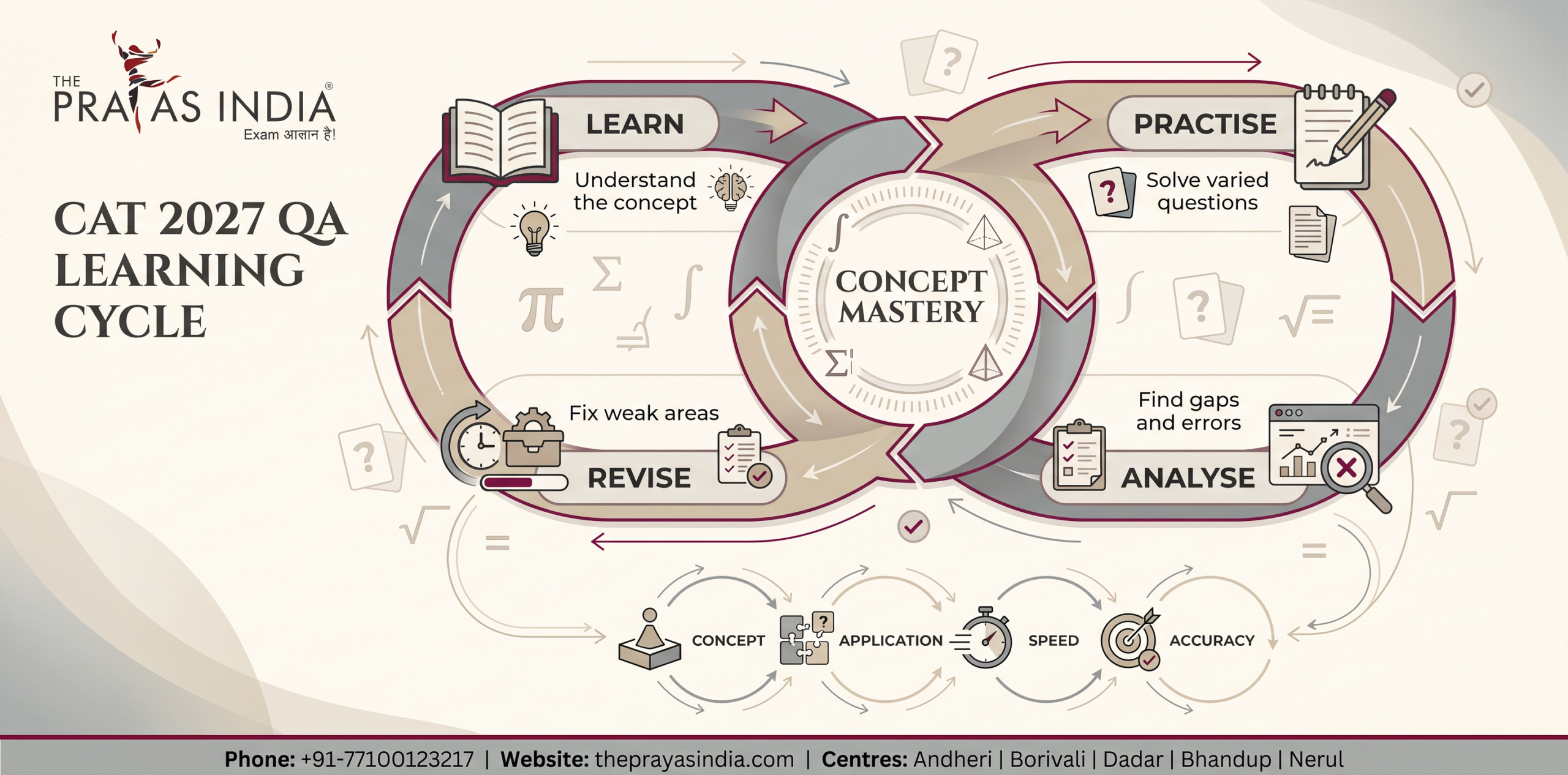
Step 7: Use the Learn → Practise → Analyse → Revise Cycle
Instead of studying a chapter once and moving on, create a continuous learning cycle.
Learn
Understand the concept and basic methods.
Practise
Solve questions in increasing difficulty.
Analyse
Identify why you got questions wrong or took too long.
Revise
Return to the concept, method or calculation weakness.
Then repeat.
This cycle prevents passive preparation.
Watching a lecture does not automatically mean you have mastered the topic. Solving 30 questions does not automatically mean you understand it either.
Mastery becomes more visible when you can solve unfamiliar questions with reasonable consistency.
How Beginners Should Approach CAT Quant Preparation
If your mathematics fundamentals are weak, do not compare your preparation with someone who has been solving CAT-level questions for months.
Your first target should be comfort with mathematics, not speed.
A beginner can divide preparation into three stages.
Stage 1: Foundation
Focus on basic concepts, formulas, arithmetic operations and easy questions.
The objective is to remove fear and confusion.
Stage 2: Application
Move towards moderate questions and mixed applications.
The objective is to understand how concepts change when the question is presented differently.
Stage 3: CAT-Level Practice
Start solving previous CAT questions and quality mock-level questions.
The objective is to improve selection, reasoning, speed and accuracy.
Trying to jump directly to Stage 3 without completing Stage 1 and Stage 2 often creates the feeling that Quant is “too difficult”.
In reality, the problem may simply be a mismatch between preparation level and question difficulty.
How Intermediate Aspirants Should Strengthen QA
Intermediate aspirants often have a different problem.
They know the concepts but performance is inconsistent.
For such students, repeating basic lectures may not be the best use of time.
Instead, analyse your existing performance.
Ask:
- Which topics have low accuracy?
- Which questions take too much time?
- Which concepts do I forget repeatedly?
- Do I make calculation errors?
- Do I choose inefficient methods?
- Do I spend too long on difficult questions?
- Do I fail to recognise easy questions quickly?
- Are my mistakes concentrated around certain chapters?
Suppose your arithmetic accuracy is 80% but algebra accuracy is 55%. Your preparation should not give equal time to both areas.
Similarly, if you can solve a question correctly but require three times as long as expected, the issue is not necessarily conceptual. You may need method comparison and timed practice.
This is where performance analysis becomes more useful than simply increasing question volume.
Topic-Wise Strategy for Building QA Fundamentals
Percentages
Do not restrict yourself to direct percentage questions.
Understand:
- Percentage increase and decrease
- Successive changes
- Reverse percentage
- Percentage comparison
- Population and growth-based applications
- Profit, loss and discount connections
Percentages should become a flexible tool rather than a chapter you finish and forget.
Ratio and Proportion
Focus on understanding relationships between quantities.
Practise:
- Direct ratios
- Equivalent ratios
- Proportional relationships
- Distribution
- Mixtures
- Partnership
- Work-based applications
The ability to move comfortably between fractions, ratios and percentages is especially useful.
Averages
Understand the concept of an average as a balancing point rather than simply memorising:
Average = Sum / Number of observations.
Practise replacement questions, combined averages and changes in group composition.
Time, Speed and Distance
Build the relationship:
Distance = Speed × Time
Then move towards:
- Relative speed
- Meeting and crossing
- Average speed
- Changing speeds
- Unit conversion
- Race-based questions
Do not memorise individual tricks before understanding the basic relationship.
Time and Work
Begin with the idea of work rate.
If one person completes a task in a certain number of days, understand what fraction of the work is completed per day.
Then gradually move to:
- Combined work
- Efficiency
- Work and wages
- Pipes and cisterns
- Changing workforce
This approach is more reliable than memorising isolated shortcuts.
Algebra
Start with equations and identities before moving to advanced applications.
Your progression can be:
Expressions → Equations → Inequalities → Quadratics → Functions → Advanced Applications
Focus on manipulation and interpretation.
Geometry
Geometry should be visual.
Draw figures.
Mark known angles.
Identify equal sides.
Look for triangles.
Check whether similarity or proportionality is present.
The more comfortably you can translate a diagram into mathematical relationships, the easier geometry becomes.
How Many Questions Should You Solve Every Day?
There is no universal number that guarantees CAT Quant improvement.
A student solving 20 questions thoughtfully can learn more than a student mechanically solving 80 questions.
Instead of setting only a volume target, use a quality target.
For every practice session, track:
- Questions attempted
- Questions correct
- Questions incorrect
- Questions left unsolved
- Time taken
- Concept involved
- Reason for error
- Better method, if available
For beginners, even a relatively small number of carefully analysed questions can be productive.
As your fundamentals improve, increase difficulty and introduce timed sets.
Build an Error Log That Actually Helps
An error log should not simply say:
“Wrong answer — revise chapter.”
That does not tell you what went wrong.
Instead, classify the mistake.
Concept Error
You did not understand the underlying concept.
Application Error
You knew the concept but could not identify how to use it.
Calculation Error
Your method was correct but the arithmetic went wrong.
Interpretation Error
You misunderstood what the question was asking.
Selection Error
You chose a question that was too time-consuming relative to its value.
Execution Error
You knew how to solve it but made an avoidable mistake under time pressure.
This classification helps you identify the real source of performance problems.
Speed Should Come After Conceptual Stability
Many CAT aspirants start timing themselves too early.
They attempt to solve basic questions at maximum speed, make repeated mistakes and then conclude that they are “weak in Quant”.
The better sequence is:
Understand → Solve Correctly → Solve Efficiently → Solve Under Time Pressure
You should first know that your method works.
Then improve the method.
Then introduce timing.
This does not mean you should avoid timed practice for months. It means timing should be introduced progressively instead of becoming the primary objective from Day 1.
How to Improve QA Accuracy
Accuracy is not only about knowing mathematics.
It also depends on reading and execution.
Before finalising an answer, develop the habit of checking:
- Did I use the correct value?
- Did I read the condition correctly?
- Did I confuse percentage increase with percentage-point increase?
- Did I use the correct unit?
- Did I make an arithmetic mistake?
- Did I answer what the question actually asked?
For easy questions, avoid unnecessary overthinking.
For difficult questions, avoid blind calculation.
The aim is controlled solving.
Use Previous CAT Questions to Understand Question Design
Once your fundamentals are stable, previous CAT questions become extremely valuable.
Do not use them only as a source of practice questions.
Study them to understand how concepts are tested.
For every question, ask:
What concept is being tested?
What information is important?
What information can be ignored?
What is the shortest reasonable approach?
Could another method work?
Why might an aspirant get trapped here?
This changes PYQ practice from simple question solving into question-pattern learning.

How to Create a Daily CAT 2027 Quant Routine
A strong QA routine does not need to consume your entire day.
If you are preparing alongside college or work, consistency matters more than occasional long study sessions.
A practical daily structure can look like this:
Concept Session
Spend time learning or revising one concept.
Practice Session
Solve a focused set of questions from that concept.
Analysis Session
Review mistakes and slow questions.
Revision Session
Write down formulas, methods and mistakes that need another look.
For example:
Concept Learning → 45–60 minutes
Focused Practice → 45–60 minutes
Error Analysis → 20–30 minutes
Revision → 10–15 minutes
The exact duration can vary according to your schedule and preparation stage.
The important thing is that every study day should contain some combination of learning, solving and analysis.
Weekly QA Strategy for CAT 2027
A weekly plan can prevent preparation from becoming chapter-driven and disconnected.
A sample structure could be:
| Day | Primary Focus |
|---|---|
| Monday | Arithmetic concept + practice |
| Tuesday | Arithmetic application + revision |
| Wednesday | Algebra concept + practice |
| Thursday | Algebra application + mixed questions |
| Friday | Number System / Geometry |
| Saturday | Mixed QA timed practice |
| Sunday | Revision + error-log analysis |
This is only a framework. Students should adapt it according to their strengths and weaknesses.
As preparation progresses, mixed practice should occupy a larger portion of the week because the actual challenge is not merely knowing chapters. It is recognising which concept applies when the chapter is not explicitly mentioned.
When Should You Start Mock Tests?
Do not wait until the final stage of preparation to experience timed testing.
However, there is also little benefit in repeatedly taking full-length mocks when you do not yet have sufficient conceptual coverage.
A balanced approach is to move through:
Topic Tests → Sectional Tests → Mixed QA Sets → Full-Length Mocks
Early in preparation, topic-level and sectional practice can provide more useful feedback.
As your preparation matures, full-length mocks become increasingly important for testing question selection, time allocation and decision-making.
Most importantly, never treat the mock score as the end of the process.
The real learning begins during analysis.
How to Analyse a CAT Quant Mock
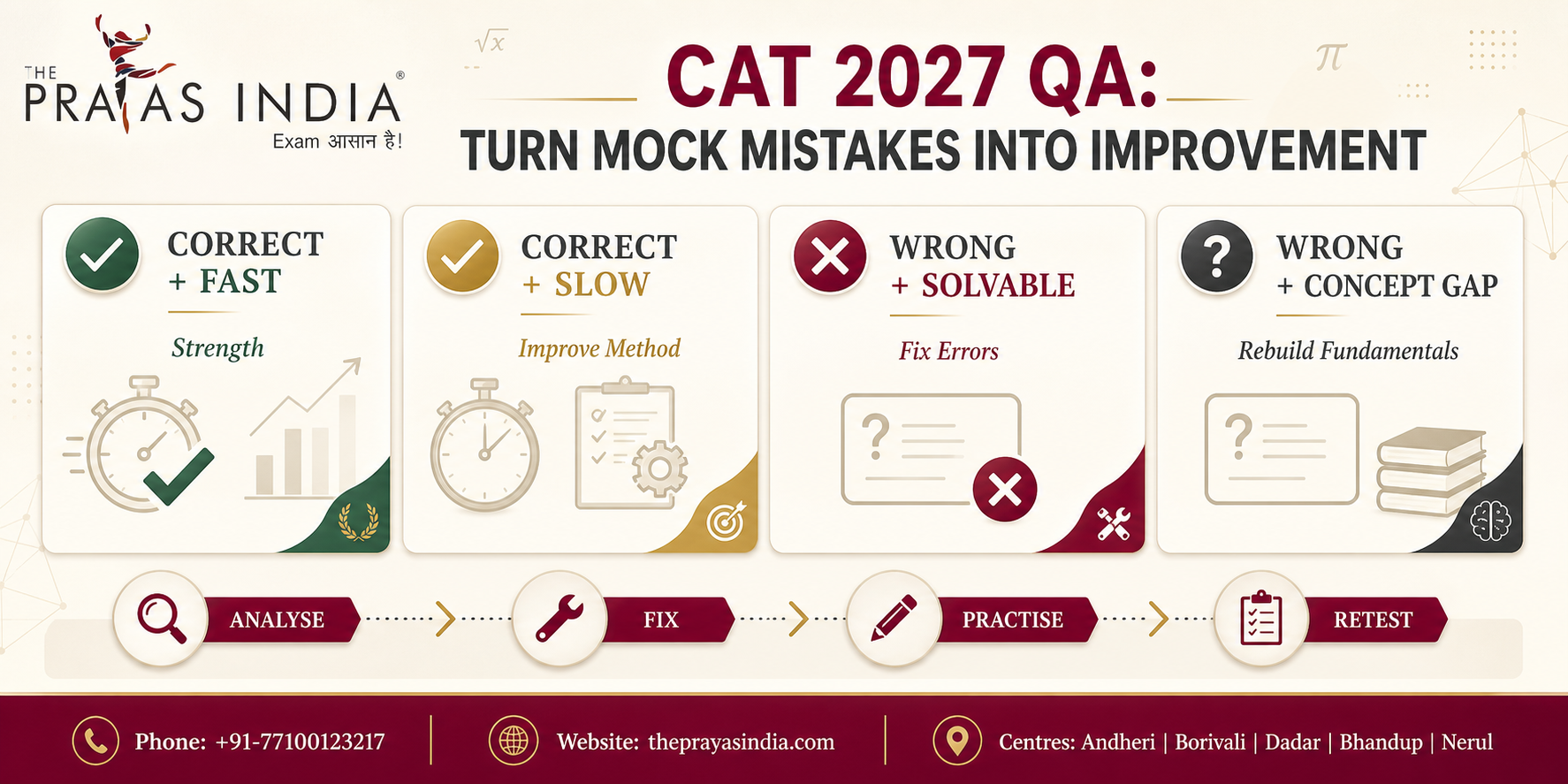
After every mock or sectional test, classify your questions.
Correct + Fast
These are your strengths.
Correct + Slow
You understand the concept but need better execution.
Wrong + Solvable
This is often the highest-value improvement area.
Wrong + Conceptually Weak
Return to the fundamentals.
Left + Could Have Solved
Work on question identification and confidence.
Left + Too Difficult
Do not automatically treat this as a weakness. CAT preparation also requires knowing which questions not to spend excessive time on.
This analysis gives you a more useful picture than simply looking at your overall score.
Common Quant Preparation Mistakes to Avoid
1. Starting With Difficult Questions
If your basics are weak, difficult questions can create frustration without building the required foundation.
Build difficulty gradually.
2. Memorising Without Understanding
A formula is useful only when you know when and why to use it.
3. Studying Only One Topic for Too Long
Deep chapter study is useful initially, but eventually you need mixed practice.
4. Ignoring Calculation Errors
Repeated calculation mistakes can silently reduce your QA performance.
5. Chasing Speed Too Early
Accuracy and method should come before aggressive speed targets.
6. Solving Without Analysis
If you keep solving new questions without understanding old mistakes, the same weaknesses may continue.
7. Comparing Your Progress With Other Aspirants
Different students begin with different mathematics backgrounds.
Your objective should be to improve your own accuracy, conceptual coverage, solving efficiency and question selection.
CAT 2027 Quant Preparation Roadmap
A long-term preparation plan can be divided into four broad phases.
Phase 1: Foundation Building
Focus on:
- Basic mathematics
- Arithmetic
- Algebra fundamentals
- Number properties
- Core geometry
- Calculation skills
Goal:
Understand the language of Quant.
Phase 2: Concept Application
Focus on:
- Moderate questions
- Different question formats
- Topic-wise practice
- Previous CAT questions
- Error analysis
Goal:
Convert concepts into problem-solving ability.
Phase 3: Mixed and Timed Practice
Focus on:
- Mixed QA sets
- Sectional tests
- Time management
- Question selection
- Calculation efficiency
- Accuracy under pressure
Goal:
Convert problem-solving ability into exam performance.
Phase 4: Mock and Refinement
Focus on:
- Full-length mocks
- QA sectional performance
- Error logs
- Weak-topic revision
- Question selection
- Speed-accuracy balance
Goal:
Build consistency.
A Simple QA Decision Framework for Every Question
When you see a Quant question, develop this mental sequence:
1. What is the question asking?
Do not start calculating immediately.
2. What information is actually relevant?
Ignore unnecessary details.
3. Which concept or relationship is involved?
Identify the mathematical structure.
4. What methods are available?
Think briefly before committing.
5. Which method is efficient?
Choose the simplest reliable approach.
6. Should I solve or skip?
If the question is consuming disproportionate time, move on and return later if appropriate.
This six-step process gradually improves both mathematical thinking and test-taking judgment.
How The Prayas India Can Support Your CAT 2027 Quant Preparation
Building strong Quant fundamentals is easier when preparation has structure and regular feedback.
For beginners, structured guidance can help establish the right sequence of concepts instead of jumping randomly between chapters. For intermediate aspirants, regular practice, doubt resolution, test analysis and performance tracking can help identify where improvement is actually needed.
The Prayas India provides CAT preparation support through online and offline coaching, structured learning, practice, mock tests and guidance designed around the needs of MBA entrance aspirants.
The objective should not be to simply complete the Quant syllabus.
It should be to reach a stage where you can look at a question, understand what it is testing, choose an appropriate method and execute it with confidence.
CAT 2027 Quant Preparation Checklist
Before moving into advanced-level preparation, ask yourself:
- Have I covered the major arithmetic concepts?
- Can I solve basic percentage and ratio questions comfortably?
- Do I understand equations rather than only memorising formulas?
- Can I identify common number-system properties?
- Can I draw and interpret basic geometry figures?
- Do I maintain an error log?
- Do I analyse slow questions?
- Can I explain why my solution method works?
- Am I gradually introducing mixed practice?
- Am I improving calculation accuracy?
- Am I using previous CAT questions intelligently?
- Am I taking sectional tests at the appropriate stage?
- Do I review my tests instead of focusing only on scores?
- Do I know which topics require further revision?
If several answers are “no”, that does not mean your CAT preparation is failing. It simply tells you where the next stage of your preparation should focus.
Final Takeaway
A strong CAT 2027 Quant preparation strategy does not begin with shortcuts, advanced questions or aggressive speed targets.
It begins with fundamentals.
Understand the concept. Learn how the concept behaves in different situations. Practise questions progressively. Analyse mistakes. Improve calculations. Introduce timing gradually. Then use mixed practice and mock tests to develop selection and execution skills.
For beginners, the biggest priority should be building mathematical confidence and conceptual clarity.
For intermediate aspirants, the priority should gradually shift towards application, efficiency, accuracy and question selection.
The most useful mindset is simple:
Do not measure your QA preparation only by how many questions you solve. Measure it by how clearly you understand them, how consistently you solve them and how intelligently you learn from your mistakes.
That is how strong QA fundamentals become strong CAT performance.
FAQs: CAT 2027 Quant Preparation Strategy
1. How should a beginner start CAT 2027 Quant preparation?
A beginner should first assess their mathematics fundamentals and then start with core concepts, particularly Arithmetic, before gradually moving towards Algebra, Number System and Geometry. Focus on understanding concepts before attempting difficult CAT-level questions. At The Prayas India, we guide beginners step-by-step from zero-level math to elite competitive application.
2. Is CAT Quant difficult for students who are weak in mathematics?
It can feel difficult initially, particularly when school-level concepts are rusty. However, systematic preparation can help rebuild the required foundation. Start with basic concepts, practise progressively and analyse mistakes regularly. Our premium CAT training batches offer absolute foundation-building support to eliminate the fear of Quant.
3. Which Quant topics should I study first for CAT 2027?
A practical starting point is Arithmetic (Percentages, Profit & Loss, Ratios, Averages, TSD, Time & Work), followed by Algebra and Number System, while gradually introducing Geometry and other areas. The exact sequence can be adjusted according to your diagnostic assessment. Our mentors build customized study timelines based on your strengths.
4. Should I memorise all Quant formulas?
No. Formula familiarity is useful, but understanding when and why a formula works is more important. Try to understand concepts and relationships rather than memorising formulas in isolation. The Prayas India emphasizes conceptual derivation and logic-driven frameworks rather than rote memorization.
5. How can I improve my Quant calculation speed?
Practise common fraction-percentage conversions, multiplication tables, squares, cubes, approximation and basic mental calculations. Improve speed gradually while maintaining accuracy. We host exclusive Vedic Maths shortcut drills to dramatically slash calculation latency.
6. How many Quant questions should I solve every day?
There is no fixed number that works for every aspirant. Quality matters more than volume. A smaller set of questions followed by detailed analysis can be more useful than a large number of mechanically solved questions. Quality control is built straight into our assignment modules.
7. When should I start solving CAT previous-year questions?
Once you have built sufficient conceptual understanding of a topic, start using previous CAT questions to understand how the concept is tested. Do not reserve all PYQs for the final stage. The Prayas India integrates topic-wise historical questions right after the completion of each classroom chapter.
8. When should I start taking Quant sectional tests?
Topic tests and sectional tests can be introduced as your conceptual coverage increases. The frequency should gradually increase as you become more comfortable with mixed questions and timed solving. Our dynamic national mock test engine lets you build accuracy under absolute time boundaries.
9. Why am I getting Quant questions correct but taking too much time?
This usually indicates an efficiency issue rather than a complete conceptual weakness. Compare different solution methods, identify unnecessary calculations and practise timed sets. Our expert faculty will help you discover faster substitution and option-elimination frameworks.
10. How can I reduce repeated mistakes in Quant?
Maintain an error log and classify mistakes into conceptual, application, calculation, interpretation, selection and execution errors. Then revise according to the category rather than simply re-solving the question. Our mentorship framework helps streamline your error notebooks to boost precision.
11. Should I focus on speed or accuracy first?
Accuracy and conceptual stability should generally come before aggressive speed improvement. Once your method becomes reliable, timed practice can help improve efficiency. We balance both parameters via milestone-based preparation assessments.
12. Can working professionals prepare for CAT 2027 Quant from scratch?
Yes, with a structured and realistic schedule. Working professionals should focus on consistent study sessions, prioritise high-impact fundamentals and use weekends for longer practice and analysis sessions. The Prayas India provides flexible offline classroom locations across Mumbai hubs (Andheri, Borivali, Dadar, Nerul, Bhandup) alongside comprehensive live digital setups. Admissions are now open for fresh premium exam-oriented batches!
Master CAT 2027 Quant from Scratch! New Batches Admissions Open
Securing a 99+ percentile in Quantitative Aptitude requires rock-solid concepts, speed-building tricks, and advanced problem-solving methodologies. Join the premium classroom batches at The Prayas India and learn elite shortcut workflows under the guidance of top Quant experts to clear your target IIM cutoff.
Official Website: theprayasindia.com
Visit Our Mumbai Centres:
Andheri | Borivali | Dadar | Nerul | Bhandup