CAT 2027: Self-Study vs Coaching — What Should You Choose?
Preparing for CAT 2027 gives aspirants something many short-term exam candidates do not have: time to build the right preparation system before the examination becomes an immediate deadline. But having time does not automatically make the preparation easier. One of the first decisions students face is whether to prepare entirely through self-study or join a coaching institute.
This decision is more complicated than simply asking, “Is coaching necessary for CAT?”
The better question is:
“Which preparation system will help me learn concepts, practise consistently, identify my weaknesses, analyse my performance and stay on track?”
Some students are highly comfortable studying independently. They can identify reliable resources, create a realistic timetable, learn difficult concepts without external explanation, practise regularly and analyse their own mistakes. For such students, self-study can be a meaningful part of CAT preparation.
Other aspirants understand concepts but struggle with consistency, resource selection, difficult questions, mock analysis or deciding what to study next. For them, structured coaching can provide a framework that reduces preparation uncertainty.
There is also a third approach that students often overlook: a combination of coaching and self-study. Coaching can provide direction, teaching, testing and mentorship, while self-study remains essential for practice, revision and improvement.
So, instead of treating self-study and coaching as completely opposite choices, CAT 2027 aspirants should understand what each model actually requires.
⚠️
Important CAT 2027 Note
CAT 2027-specific examination details should be checked against the official CAT website when the relevant notification is released. This article focuses on the preparation skills and decision factors rather than assuming that the future exam will exactly follow the current CAT framework.
What Does CAT Preparation Actually Require?
Before deciding between self-study and coaching, understand what CAT preparation involves.
CAT preparation is not simply about completing Quantitative Aptitude, Data Interpretation & Logical Reasoning, and Verbal Ability & Reading Comprehension.
A serious preparation cycle generally involves several interconnected activities:
- Understanding concepts
- Solving progressively difficult questions
- Developing problem-solving approaches
- Practising reading comprehension
- Solving DILR sets
- Improving calculation efficiency
- Learning question selection
- Taking sectional tests
- Taking full-length mocks
- Analysing mistakes
- Revising weak areas
- Managing preparation time
- Improving speed without sacrificing accuracy
- Adapting strategy based on performance
This distinction matters because students sometimes compare self-study and coaching only on the basis of “Who will teach me the concepts?”
But teaching is only one component of CAT preparation.
The bigger question is whether your chosen preparation system helps you manage the entire learning-practice-analysis-revision cycle.
Self-Study for CAT 2027: What Does It Really Mean?
Self-study does not simply mean watching free lectures and solving questions whenever you have time.
Effective self-study requires you to become responsible for almost every component of your preparation.
You need to decide what to study, which resources to use, how much time to spend on each topic, which questions to practise, when to take tests, how to analyse mistakes and when to revise.
This can be extremely effective for a disciplined aspirant.
However, it also demands considerable decision-making ability.
A self-study aspirant may start the preparation with a simple plan:
Quant in the morning → DILR in the afternoon → VARC in the evening.
After a few weeks, the situation may become more complicated.
Should you finish all of Arithmetic before starting Algebra? Should you solve more DILR sets or take sectional tests? Which YouTube teacher should you follow? How many books should you use? When should you start mocks? Why are your mock scores not improving despite solving hundreds of questions?
These questions are where the difference between studying independently and preparing independently without a system becomes important.
When Can Self-Study Work Well?
Self-study can work well when an aspirant has several qualities.
1. You Can Build Your Own Study Plan
You should be able to divide the CAT syllabus into manageable stages and decide what needs to be completed first.
You should also be capable of adjusting the plan when a particular topic takes longer than expected.
2. You Can Learn Difficult Concepts Independently
CAT preparation will inevitably contain topics and question types that require multiple explanations.
If you can identify where your understanding is weak, find an appropriate explanation, practise the concept and verify your understanding independently, self-study becomes more practical.
3. You Are Consistent Without External Accountability
This is one of the biggest factors.
Studying for CAT for three days with extreme intensity is not particularly useful if the next four days disappear.
Self-study requires you to follow your schedule even when motivation is low.
4. You Can Analyse Your Own Performance
Taking a mock is only the beginning.
You need to understand:
- Which questions you should have attempted
- Which questions consumed excessive time
- Which mistakes were conceptual
- Which mistakes were avoidable
- Which section affected your overall performance
- Whether your strategy needs modification
If you can perform this analysis honestly, self-study becomes significantly stronger.
5. You Know How to Select Resources
More resources do not automatically mean better preparation.
A self-study aspirant must be able to avoid constantly switching between teachers, books, Telegram groups, websites, PDFs and video courses.
A limited but reliable resource set is generally easier to revise and track.
When Does Self-Study Start Becoming Difficult?
The problem is usually not that self-study is impossible.
The problem is that unstructured self-study can become inefficient.
Consider a student who spends three months preparing Quant but still cannot determine whether the problem is conceptual weakness, lack of practice or poor question selection.
Another student may solve hundreds of DILR sets but never analyse why certain set types repeatedly cause difficulty.
Someone else may read editorials and solve RCs regularly but have no method for tracking accuracy and time.
These students are studying.
But they may not have a reliable feedback system.
That is where structured guidance can become useful.
Coaching for CAT 2027: What Are You Actually Paying For?
Students sometimes assume coaching means paying someone to teach the syllabus.
That is only one part of the equation.
A structured CAT coaching program can potentially provide:
- A planned syllabus
- Faculty-led concept building
- Topic-wise practice
- Structured assignments
- Doubt support
- Sectional tests
- Full-length mocks
- Performance analysis
- Mentorship
- Time-management guidance
- Revision planning
- Peer learning environment
- Regular accountability
The value of coaching therefore depends heavily on what happens beyond the classroom.
An institute that only provides lectures may not solve all preparation problems.
A stronger preparation ecosystem combines learning with practice, testing, analysis and feedback.
The Prayas India currently describes its CAT preparation approach around structured learning, expert faculty, mock tests, performance tracking, personalised mentorship and classroom/online learning options.
Looking for the Right CAT 2027 Coaching Institute? → Read Our Complete Guide
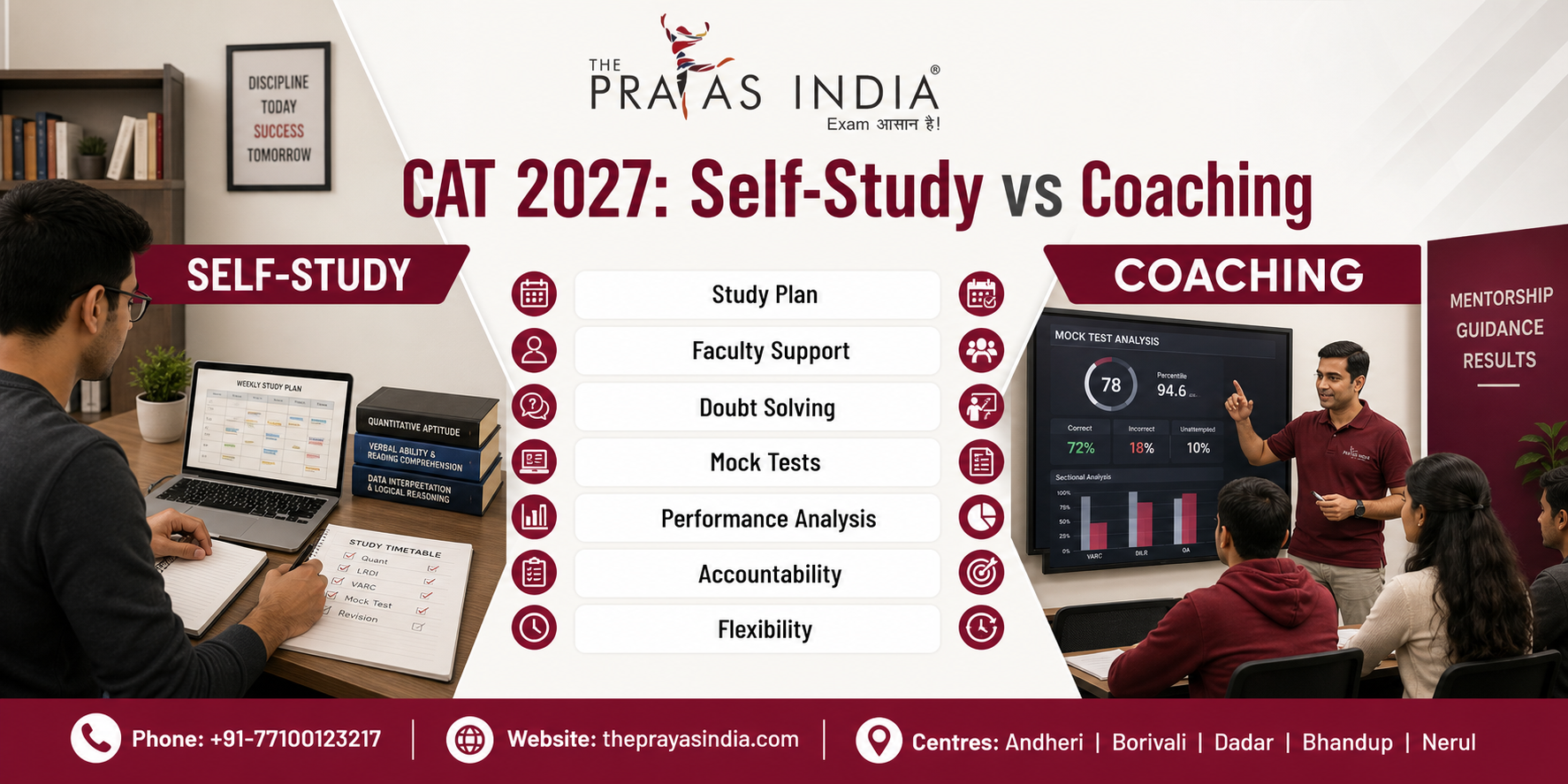
Self-Study vs Coaching: The Real Comparison
| Preparation Factor | Self-Study | Coaching |
|---|---|---|
| Study plan | Created by student | Usually structured by institute |
| Concept learning | Independent resources | Faculty-led learning |
| Doubt solving | Student manages it | Faculty/support available |
| Practice | Self-managed | Structured assignments and practice |
| Mock tests | Student must organise | Usually integrated into program |
| Performance analysis | Self-analysis | Faculty/institute support may be available |
| Accountability | Mostly self-driven | Regular classes and testing provide structure |
| Resource selection | Student responsibility | Institute provides defined resources |
| Flexibility | Very high | Depends on batch format |
| Peer environment | Limited | Available in classroom settings |
| Personalisation | Entirely self-managed | Depends on mentorship system |
| Cost | Generally lower | Higher financial investment |
| Discipline requirement | Very high | Still high, but more structured |
The table should not be interpreted as saying that one method automatically works for everyone.
The better choice depends on your starting level, discipline, learning style, available time and ability to analyse your own preparation.
The Biggest Advantage of Self-Study: Flexibility
One of the strongest reasons students choose self-study is flexibility.
If you understand Arithmetic quickly, you can move ahead.
If Algebra takes longer, you can spend additional time there.
You can study early morning, late night or around college and work schedules.
This flexibility can be particularly useful for working professionals and students with unpredictable schedules.
But flexibility has another side.
Without a fixed structure, it can become easy to postpone difficult areas.
You may repeatedly say:
“I’ll start DILR tomorrow.”
Or:
“I’ll take the mock next Sunday.”
Or:
“I’ll revise this chapter later.”
Eventually, the flexible schedule becomes an inconsistent schedule.
The Biggest Advantage of Coaching: Structure
A structured program removes some of these decisions.
Instead of repeatedly asking what to study next, students can follow an academic roadmap.
Instead of postponing tests indefinitely, regular testing creates deadlines.
Instead of spending weeks searching for resources, students can work with a defined preparation set.
The Prayas India describes its CAT ecosystem around structured preparation, mock tests, performance tracking and personalised guidance rather than classroom teaching alone.
What Makes The Prayas India Different For CAT Coaching? → Read Our Complete Guide
This can be especially useful for students who know what they want, but struggle with how to organise the journey.
Who Should Seriously Consider CAT Coaching?
Coaching may be worth considering if several of the following statements describe you.
You are starting from scratch
If CAT concepts are unfamiliar and you do not know where to begin, a structured foundation can reduce the initial confusion.
Your Quant fundamentals are weak
If basic mathematics itself takes significant effort, faculty-led concept building can provide a more systematic progression.
You struggle with DILR selection
DILR is not simply about solving sets. Deciding which set deserves your time is an important test-taking skill.
Structured practice and discussion can help expose students to different approaches.
Your VARC preparation lacks feedback
Reading regularly is useful, but understanding why an RC option is correct or incorrect can require deeper analysis.
You cannot maintain consistency
If your study plan repeatedly breaks down, external structure and scheduled tests may help create accountability.
You do not know how to analyse mocks
This is one of the strongest reasons to seek guidance.
A mock score tells you what happened.
Analysis should help you understand why it happened.
Who May Prefer Primarily Self-Study?
Self-study can be appropriate when you already have a strong preparation system.
You may be comfortable with self-study if:
- You have a clear CAT roadmap.
- You understand your strengths and weaknesses.
- You can study consistently without external pressure.
- You know how to select quality resources.
- You can learn concepts independently.
- You regularly practise questions.
- You take sectional and full-length tests.
- You analyse your mistakes seriously.
- You can adjust your strategy based on performance.
- You do not constantly switch resources.
If most of these statements describe you, you may not need a traditional classroom-heavy approach.
However, even self-study aspirants can benefit from mock tests, test series, expert evaluation or occasional mentorship.
The Third Option: Coaching + Self-Study
For many aspirants, the choice does not have to be:
Self-study OR coaching.
It can be:
Coaching for direction + self-study for mastery.
This is an important distinction.
A faculty member can explain a concept, demonstrate approaches and identify common mistakes.
But you still need to practise.
A mentor can analyse your mock.
But you still need to take the mock.
A coaching institute can provide a timetable.
But you still need to follow it.
Ultimately, CAT preparation remains an individual effort even when you have guidance.
The strongest use of coaching is therefore not to replace self-study but to make self-study more focused and accountable.
How to Decide Whether You Need Coaching
Instead of asking whether coaching is “worth it” in general, conduct a personal preparation audit.
Give yourself one point for every statement that is true.
Preparation Audit
1. I can create a realistic CAT study plan.
2. I know which topics I need to study first.
3. I can learn difficult concepts independently.
4. I can maintain my preparation consistently.
5. I know which resources I should use.
6. I can analyse my mock-test performance objectively.
7. I can identify the reason behind my mistakes.
8. I can decide which questions to attempt and which to leave.
9. I can maintain revision without external accountability.
10. I can measure whether my preparation is actually improving.
If you can confidently manage most of these areas, self-study may be workable.
If several areas remain unclear, structured guidance may reduce the uncertainty.
And if you are somewhere in the middle, a hybrid model involving classes, test series and self-study may be worth exploring.

Coaching Should Be Evaluated Before You Enrol
Choosing coaching simply because an institute is popular can be risky.
Before enrolling, ask practical questions.
1. Who will teach you?
Faculty quality matters because CAT requires conceptual understanding and application rather than simple memorisation.
2. What does the study material include?
Look for structured concepts, practice questions, previous-year questions and revision resources.
3. How are mocks conducted?
Ask about sectional tests, full-length mocks, frequency and analysis.
4. Is performance tracked?
Testing becomes much more valuable when students understand their progress over time.
5. Is mentorship actually available?
There is a difference between saying “mentorship available” and having a system through which students can actually discuss preparation problems.
6. What happens when you fall behind?
This is particularly important for long-term CAT preparation.
A good system should help students identify where they are falling behind and what needs to be prioritised.
7. Are online and classroom options available?
Your learning mode should fit your college, job and personal schedule.
The Prayas India currently presents both classroom and online CAT learning options, alongside structured preparation, mocks, performance tracking and mentorship.
Why Starting CAT 2027 Preparation Early Changes the Decision
Students who begin early have a major advantage: they have time to experiment before performance pressure becomes intense.
You can begin with a self-study phase and assess yourself.
You can attend a demo or counselling session and understand where your preparation stands.
You can take diagnostic tests.
You can identify whether Quant, DILR or VARC requires additional support.
You can then decide how much external guidance you actually need.
This is much better than waiting until preparation becomes overwhelming and then trying to solve everything simultaneously.
Early preparation also allows students to move through multiple stages:
Foundation → Concept Application → Sectional Practice → Mock Tests → Analysis → Revision → Exam Strategy
That progression is much easier to manage when you are not constantly racing against the calendar.
Don’t Choose Coaching Because Everyone Else Is Joining
Peer pressure can be a poor basis for a preparation decision.
One student may perform extremely well through self-study.
Another may require structured classes.
A working professional may need flexible online support.
A college student may benefit from classroom discipline.
A student with strong Quant but weak VARC may need a different support system from someone with the opposite profile.
Your preparation model should therefore be based on your actual requirements, not simply on what your friends are doing.
Don’t Reject Coaching Merely Because You Can Find Free Resources
The internet has made learning resources widely accessible.
That is undoubtedly useful.
But access to information and access to a preparation system are different things.
You can find hundreds of Quant videos.
You can find thousands of RCs.
You can find DILR sets.
You can find mock tests.
You can find strategy videos.
The challenge is deciding:
Which ones should I use?
In what order?
How much is enough?
What should I do after completing them?
Why am I still making the same mistakes?
This is where structured guidance can have practical value.
How The Prayas India Can Fit Into Your CAT 2027 Preparation
For students who decide that they need structured guidance, The Prayas India positions its CAT preparation around more than classroom lectures.
Its current CAT-focused content highlights:
- Structured preparation roadmap
- Experienced faculty
- Concept building
- Regular practice
- Sectional and full-length mocks
- Performance analysis
- Personalised mentorship
- Doubt support
- Classroom and online learning
- Preparation strategy
- Interview preparation support
The institute also specifically discusses helping aspirants evaluate coaching based on faculty, study material, mocks, mentoring, flexibility and performance tracking.
This is important because students should not enrol simply to “attend CAT classes.”
The objective should be to build a preparation ecosystem where every stage of the journey has a purpose.
What Students Should Ask Before Joining The Prayas India
If you are considering CAT 2027 coaching, don’t simply ask about fees.
Ask:
What will my preparation roadmap look like?
How will my current level be assessed?
How frequently will I be tested?
How will my mock performance be analysed?
How will my weak areas be addressed?
What happens if I fall behind?
What mentorship support is available?
Which learning mode fits my schedule?
These questions will help you understand whether the program actually matches your needs.
You can also enquire about the current CAT 2027 batches, available learning modes, schedules, course structure and admission process before making your decision.

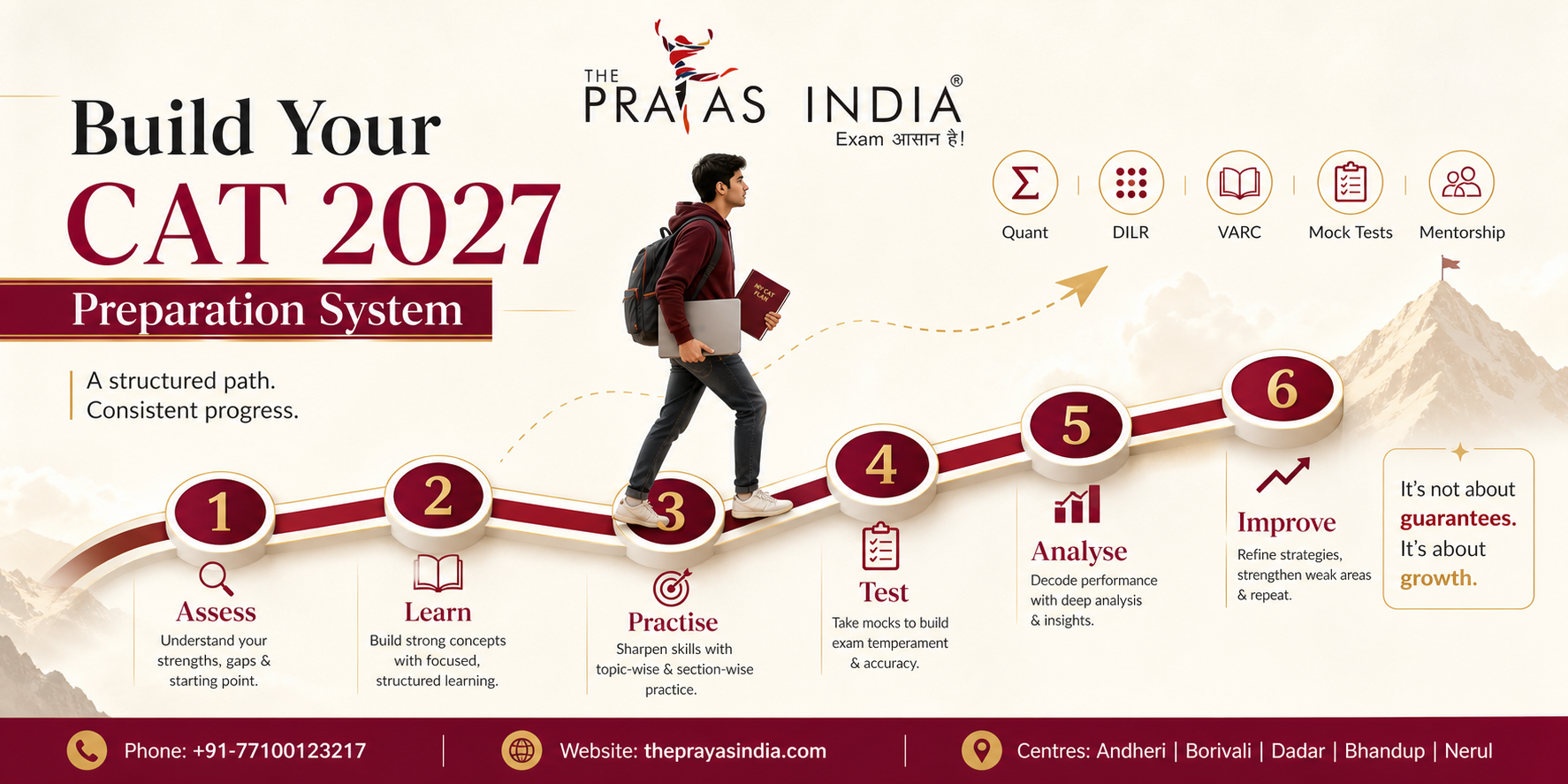
A Practical CAT 2027 Preparation Model
If you are still undecided, consider this approach.
Stage 1: Assess Yourself
Take diagnostic tests and identify your current level in Quant, DILR and VARC.
Do not judge yourself only by your raw score.
Look at accuracy, time taken and question selection.
Stage 2: Identify Your Preparation Gaps
Ask whether your problem is:
- Conceptual understanding
- Practice
- Speed
- Accuracy
- Question selection
- Consistency
- Mock analysis
- Revision
Stage 3: Decide Your Support Level
If you can independently handle most areas, self-study may remain your primary model.
If only certain areas are weak, targeted support may be sufficient.
If planning, consistency, testing and analysis are all difficult, a structured coaching program may make more sense.
Stage 4: Build a Long-Term System
Whichever model you choose, your preparation should eventually include:
Learn → Practise → Test → Analyse → Revise → Repeat
This cycle is more important than the label attached to your preparation method.
The Cost of Choosing the Wrong Preparation System
The financial cost of coaching is easy to calculate.
The cost of an unstructured preparation year is harder to see.
It can include:
- Months spent on low-value resources
- Repeatedly studying the same concepts
- Delayed mock practice
- Poor revision
- Unidentified weaknesses
- Lack of accountability
- Constant switching between strategies
- Preparation fatigue
This does not mean coaching automatically prevents these problems.
It means that students should consider the value of structure versus the cost of managing everything independently.
Similarly, self-study should not be rejected simply because coaching exists.
The right question is whether the support you are paying for solves problems that you genuinely have.
Self-Study + Coaching: A Smart Middle Ground
One of the most practical approaches for CAT 2027 aspirants is to combine both.
Use faculty support to understand difficult concepts.
Use your own study hours for practice.
Use institute tests to measure performance.
Use your own error log to track mistakes.
Use mentorship to adjust strategy.
Use revision sessions to consolidate learning.
This creates a system where coaching provides direction, while self-study provides depth and repetition.
And remember: even after enrolling in coaching, the majority of improvement still comes from what you do outside the classroom.
Final Takeaway: Don’t Choose Between Self-Study and Coaching Too Quickly
There is no universal preparation model that every CAT 2027 aspirant must follow.
Self-study can be effective when a student has discipline, resource awareness, conceptual clarity and the ability to analyse performance independently.
Coaching can be valuable when an aspirant needs structured learning, faculty guidance, regular testing, mentorship, accountability and a defined preparation roadmap.
For many students, the most practical approach may be a combination of both.
The decision should ultimately come down to one question:
“What kind of preparation system will help me improve consistently?”
If you are already disciplined and know exactly how to prepare, self-study can be a serious option.
If you repeatedly struggle with planning, concepts, consistency, mocks or performance analysis, structured guidance deserves serious consideration.
And if you are not sure which category you fall into, that itself is a reason to speak to a CAT mentor before making the decision.
Instead of enrolling blindly, get your preparation level assessed, understand your gaps and then decide what kind of support you actually need.
For aspirants considering structured CAT 2027 preparation, The Prayas India currently offers CAT-focused learning support with faculty guidance, mock testing, performance analysis, mentorship and classroom/online options.
Your CAT preparation does not become serious when you buy a course. It becomes serious when you build a system that you can follow consistently.
Frequently Asked Questions (FAQs): CAT 2027 Self-Study vs Coaching
1. Is self-study enough for CAT 2027?
Self-study can work for students who are disciplined, understand how to plan their preparation, can select reliable resources and are capable of analysing their mock-test performance independently. Students who struggle with consistency, strategy or performance analysis may benefit from structured guidance.
2. Is coaching necessary for CAT 2027 preparation?
Coaching is not compulsory for every CAT aspirant. The decision depends on your preparation level, learning style, discipline, available time and ability to manage concepts, practice, testing and analysis independently.
3. Can I combine CAT coaching with self-study?
Yes. Coaching can provide structured learning, faculty guidance, tests and mentorship, while self-study remains essential for practice, revision and improving weak areas. This combination can create a more complete preparation system.
4. Who should consider joining CAT coaching?
Students who need help with planning, concept building, consistency, mock-test analysis, time management, question selection or regular mentorship may find structured CAT coaching useful.
5. What are the advantages of CAT coaching?
Depending on the institute and course, coaching can provide a structured preparation roadmap, faculty-led concept learning, study material, regular practice, sectional tests, full-length mocks, performance analysis, doubt support and mentorship.
6. Can working professionals prepare for CAT 2027 with coaching?
Yes. Working professionals can consider structured or flexible learning options that fit around their work schedule. The key is maintaining consistent study hours, practice and testing rather than relying on occasional long study sessions.
7. How should I choose a CAT coaching institute?
Evaluate faculty, course structure, study material, mock tests, performance analysis, doubt support, mentorship, batch format, learning mode and the level of academic support available before enrolling.
8. Does The Prayas India provide CAT coaching for 2027 aspirants?
The Prayas India currently provides CAT-focused preparation with structured learning, faculty guidance, mock testing, performance analysis, mentorship and classroom/online learning options. Students should enquire about the latest CAT 2027 batch structure, schedule and admission details.
9. When should I start CAT 2027 preparation?
Starting early gives you more time to build fundamentals, practise progressively, take diagnostic tests, identify weak areas and develop a sustainable preparation routine before intensive mock-test preparation begins.
10. How can I find out whether CAT coaching is right for me?
Start by assessing your current Quant, DILR and VARC level, study discipline, preparation strategy and ability to analyse tests. You can also speak with a CAT mentor or counsellor to understand which level of structured support matches your requirements.
Not Sure Whether You Need CAT Coaching?
Don’t make your CAT 2027 preparation decision based only on what others are doing. Get your preparation level assessed, understand your strengths and gaps, and explore a structured preparation plan that fits your goals, schedule and learning style.
CAT 2027 Admissions Open
Explore structured CAT preparation with expert faculty guidance, practice, mock tests, performance analysis and mentorship. Choose the learning format that works for you and start preparing with greater clarity.
📍 Centres: Andheri | Borivali | Dadar | Nerul | Bhandup
Enquire today about the latest CAT 2027 batches, course structure, learning mode and admission process.