CAT 2027 VARC Preparation: Why Reading Alone Is Not Enough | The Prayas India
For many CAT 2027 aspirants, Reading Comprehension and Verbal Ability appear to be the easiest parts of preparation to start. There is no complicated formula sheet, no long list of mathematical concepts to memorise, and no shortage of reading material available online. As a result, many students begin their VARC preparation by reading newspapers, editorials, magazines, essays and articles for several hours every week.
Yet an important problem soon appears: they are reading more, but their VARC scores are not improving proportionately.
A student may read every day and still struggle to identify the author’s central argument. Another may understand an entire passage but repeatedly select the wrong answer in Reading Comprehension. Someone else may perform well while practising individual questions but lose accuracy when attempting a complete VARC section under time pressure.
This happens because reading is an input activity, while CAT VARC preparation requires a complete performance system.
Reading can improve familiarity with language, ideas, vocabulary and different writing styles. However, CAT preparation also requires you to understand arguments, identify the role of information, distinguish between closely related options, eliminate distractors, manage time and make decisions under pressure.
For CAT 2027 aspirants who want to prepare seriously, the question therefore should not be, “How much do I read every day?”
The more useful question is:
“How effectively can I convert what I read into CAT-level comprehension and question-solving ability?”
That difference is where structured preparation can become valuable.
Important Note for CAT 2027 Aspirants
Specific CAT 2027 dates, registration details, examination pattern, section structure, marking scheme and other official information should be checked against the official CAT website and notification when released. This article focuses on VARC preparation strategy and does not assume unannounced CAT 2027-specific details.
Why Reading Is Important for CAT VARC Preparation
Reading should absolutely be part of your CAT 2027 preparation.
The problem is not reading itself. The problem begins when students assume that reading alone automatically develops CAT-solving ability.
Regular reading can expose you to unfamiliar subjects, complex arguments, different writing styles and a wider range of vocabulary. It can also help you become more comfortable with dense passages and reduce the mental resistance that many students experience when they encounter difficult prose.
This foundation matters because CAT VARC requires candidates to engage with written material efficiently. Official CAT materials identify Verbal Ability and Reading Comprehension as one of the examination sections.
But there is a significant difference between reading an article because you are interested in its subject and reading a passage with the analytical mindset required for a competitive aptitude examination.
When you read casually, you may remember the broad topic.
When you prepare for CAT, you need to understand why the author has written the passage, what the central argument is, how different ideas are connected, and what conclusions are actually supported by the passage.
That is why reading should be treated as the foundation of VARC preparation—not the entire preparation strategy.
Reading More Does Not Automatically Mean Scoring More
One of the most common mistakes among CAT aspirants is measuring preparation through hours spent reading.
A student may say:
“I read for one hour every day.”
That sounds productive, but it does not tell us whether the student’s VARC ability is improving.
A better evaluation would ask:
- Can the student identify the main idea quickly?
- Can the student distinguish the author’s argument from supporting examples?
- Can the student identify the tone of the passage?
- Can the student understand why a particular option is correct?
- Can the student eliminate options that are partially correct but not fully supported?
- Can the student maintain accuracy while working under time pressure?
- Can the student identify which questions should be attempted and which should be left?
These are performance questions.
Therefore, a student who reads for 30 minutes with active analysis may sometimes gain more useful preparation experience than a student who reads for two hours passively.
The objective is not simply to increase reading volume.
The objective is to improve reading quality and convert it into question-solving accuracy.
The First Gap: Passive Reading vs Active Reading
There is a major difference between passive and active reading.
Passive reading means consuming information.
Active reading means interacting with the information.
Suppose you are reading a passage about technological change and employment.
A passive reader may understand that the passage discusses automation and jobs.
An active reader may ask:
- What is the author’s primary argument?
- Is the author supporting or challenging a commonly accepted view?
- Which point is presented as evidence?
- What assumptions does the argument make?
- Why has the author included this example?
- What conclusion can logically be drawn?
- Which statements are directly supported?
- Which ideas are merely implied?
The second approach develops a much stronger connection between reading and CAT-style comprehension.
This is particularly important for students who feel that they understand passages but still make mistakes in RC questions.
The issue may not be basic comprehension.
The issue may be how they process the passage and evaluate answer choices.

The Second Gap: Understanding a Passage Is Not the Same as Solving It
This is where many students get confused.
They read a passage and think:
“I understood it.”
Then they attempt the questions and discover that they are still getting several answers wrong.
Why?
Because comprehension and question solving are related but different skills.
Understanding a passage means knowing what the passage is saying.
Solving a CAT-style question requires you to determine which answer is best supported by the passage and why the other options are weaker.
This distinction becomes especially important when options are deliberately designed to look attractive.
An incorrect option may contain information that appears in the passage but may change its meaning.
Another option may be broadly consistent with the passage but too extreme.
A third option may sound logical but introduce an assumption that the author never made.
The correct option may therefore not be the most impressive-looking option. It is often the option that most accurately matches the scope and meaning of the passage.
This is why VARC preparation needs option analysis, not just passage reading.
Why CAT VARC Options Can Be More Difficult Than the Passage
Many students believe difficult vocabulary is their biggest problem in Reading Comprehension.
Sometimes it is not.
A student can understand every sentence in a passage and still choose the wrong answer because of poor option evaluation.
Common distractor patterns include:
1. The Extreme Option
The passage makes a moderate argument, while the option uses words such as “always,” “never,” “completely” or “only.”
The option may sound confident but go beyond the passage.
2. The Partially Correct Option
An option contains something genuinely mentioned in the passage but does not answer the actual question.
This can be particularly dangerous because the student recognises information from the passage and immediately considers the option correct.
3. The Outside-Knowledge Option
The statement may be factually true in the real world, but the passage does not establish it.
CAT-style comprehension requires you to stay anchored to the information and reasoning available in the passage.
4. The Distorted Option
The option takes the author’s argument but changes its scope, direction or emphasis.
5. The Attractive but Unsupported Option
It sounds logical and well-written but cannot be sufficiently supported from the passage.
Learning to recognise these patterns requires deliberate practice.
Simply increasing your reading hours does not automatically develop this skill.
The Third Gap: Vocabulary Is Helpful, But Vocabulary Alone Will Not Fix VARC
Vocabulary often receives too much attention in VARC preparation.
Students make long word lists, memorise difficult words and spend hours trying to improve their vocabulary.
Vocabulary certainly helps.
If you know the meaning of words, you can process a passage more comfortably. However, CAT VARC is not simply a vocabulary test.
You can know thousands of words and still struggle with:
- identifying the central argument,
- understanding the author’s position,
- distinguishing inference from assumption,
- interpreting the role of examples,
- eliminating answer choices,
- understanding paragraph structure,
- managing time and
- maintaining accuracy.
Conversely, a student may encounter unfamiliar words and still understand the broader argument through context.
Therefore, vocabulary development should be integrated into reading and comprehension practice rather than treated as a completely separate activity.
When you encounter an unfamiliar word, ask:
What does this word mean in this sentence?
Then ask:
How does that meaning affect the author’s argument?
This creates contextual vocabulary knowledge, which is more useful than memorising isolated word lists.
Reading Different Genres Matters
Another common mistake is reading only subjects that feel comfortable.
If you enjoy business articles, you may keep reading business articles.
If you like technology, you may mostly read technology-related content.
If you enjoy current affairs, you may spend most of your time there.
This creates familiarity.
But CAT preparation benefits from exposure to unfamiliar writing styles and subjects.
A serious reading routine can include diverse areas such as:
- philosophy,
- economics,
- sociology,
- psychology,
- history,
- science,
- technology,
- culture,
- politics as an academic subject,
- environment,
- art and literature.
The objective is not to become an expert in every subject.
The objective is to become comfortable with understanding unfamiliar ideas without panicking.
When a CAT passage discusses a subject you have never studied before, you should not need prior subject expertise to begin analysing the author’s argument.
That confidence comes from repeated exposure to unfamiliar material.
The Fourth Gap: Reading Speed Without Comprehension Is Not Real Improvement
Many aspirants try to increase reading speed as quickly as possible.
They use timers and attempt to finish articles faster.
Speed matters, but increasing speed without maintaining comprehension can create another problem.
Imagine that you read a passage 20% faster but understand 20% less of it.
That is not necessarily an improvement.
For CAT preparation, the objective should be efficient comprehension.
You want to gradually improve your ability to:
- process sentences efficiently,
- recognise the structure of an argument,
- identify important information,
- avoid getting stuck on individual sentences,
- retain the central idea,
- move to questions with a clear understanding of the passage.
Your reading speed should therefore improve alongside comprehension.
This is one reason timed practice becomes increasingly important as preparation progresses.
From Reading Practice to CAT Practice: The Missing Bridge
This is where structured VARC preparation can make a substantial difference.
Instead of treating reading as one activity and mock tests as another, connect the two.
A useful progression is:
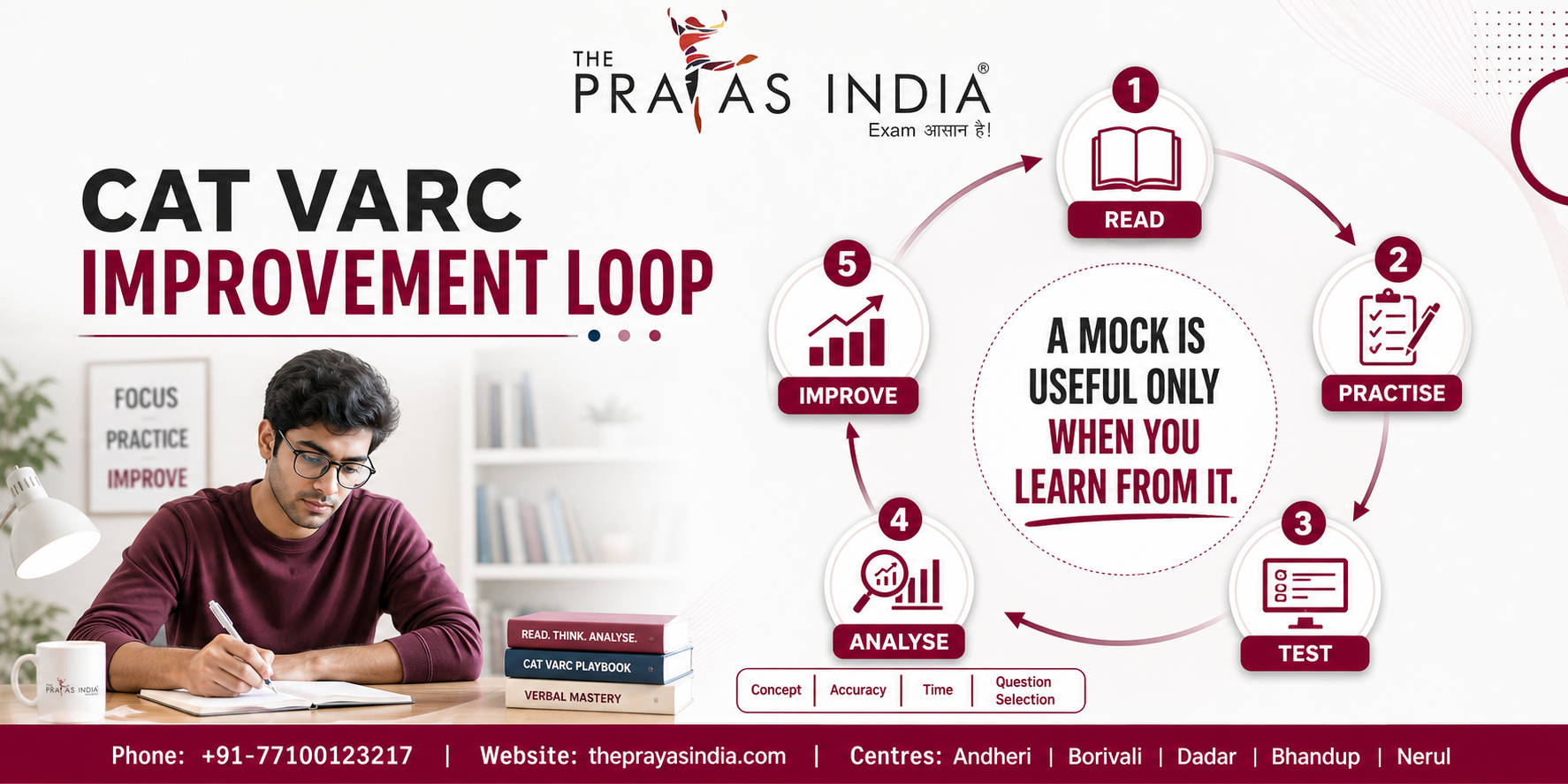
Read → Analyse → Practise → Review → Identify Errors → Repeat
For example, after reading a passage, write down its central idea in one or two sentences.
Then identify the author’s position.
Then ask yourself what evidence the author uses.
Then solve questions based on the passage.
After solving, do not stop at checking the answer.
Ask:
Why did I choose my option?
Then ask:
Why is the correct option better?
Finally:
What made the wrong option attractive?
That last question is extremely important.
If you repeatedly choose options because they sound reasonable, your preparation should specifically target option elimination and evidence-based reasoning.
Why Mock Tests Alone Are Also Not Enough
There is another side to the problem.
Some students realise that reading alone is insufficient and immediately start taking large numbers of mock tests.
But mocks without analysis can create another version of the same problem.
A mock tells you what happened.
Analysis helps you understand why it happened.
Suppose you scored poorly in VARC.
That score alone does not tell you whether the problem was:
- slow reading,
- weak comprehension,
- poor question selection,
- incorrect inference,
- careless reading,
- confusion between two options,
- lack of familiarity with a question type,
- excessive time spent on difficult questions.
Without identifying the reason, the next mock may simply reproduce the same mistakes.
A productive VARC preparation system therefore includes both testing and diagnosis.
A Better CAT 2027 VARC Reading Routine
If you currently read regularly but are not seeing improvement, you do not necessarily need to abandon your reading habit.
Instead, change how you read.
A practical routine can include three layers.
Layer 1: General Reading
Spend some time reading diverse, high-quality material.
The purpose is to build comfort with language, ideas and unfamiliar subjects.
Layer 2: Analytical Reading
Take one passage and actively identify:
- central argument,
- author’s position,
- supporting arguments,
- examples,
- contrast,
- assumptions,
- conclusion.
This converts reading into an analytical exercise.
Layer 3: Question Practice
Solve CAT-level RC and VA questions after developing the necessary comprehension foundation.
Then analyse every mistake.
This creates a connection between reading ability and examination performance.
How to Analyse an RC Passage Like a CAT Aspirant
When you finish reading a passage, avoid immediately jumping to the options.
First, try to construct a mental summary.
Ask:
What is this passage primarily about?
Then:
What is the author trying to say about it?
Then:
How does the author support that position?
Finally:
What is the overall direction of the passage?
This gives you a mental framework before you encounter the options.
It also reduces the chance of allowing the answer choices to influence your interpretation of the passage.
You should not try to memorise every sentence.
Instead, focus on the architecture of the argument.
Think of the passage as a structure:
Topic → Context → Argument → Evidence → Contrast → Conclusion
Not every passage will follow this exact structure, but recognising relationships between ideas can make dense passages easier to process.
How to Improve RC Accuracy
Accuracy should be treated as a skill that can be trained.
After each RC practice session, maintain an error log.
Your error log can include categories such as:
| Error Type | What to Record |
|---|---|
| Main Idea | Misunderstood the central argument |
| Inference | Chose an option that went beyond the passage |
| Detail | Misread a specific statement |
| Tone | Misidentified author’s attitude |
| Elimination | Could not distinguish between two options |
| Vocabulary | Misunderstood a key word |
| Time | Spent too long on one passage |
| Selection | Attempted an unsuitable question |
Over time, patterns will emerge.
You may discover that you are not actually weak in reading comprehension.
Perhaps 70% of your mistakes happen because you select overly broad options.
Or perhaps you understand the passage but spend too much time on difficult questions.
That diagnosis changes the preparation strategy.
The Importance of Question Selection in VARC
One of the biggest differences between casual practice and competitive exam preparation is decision-making.
You do not need to prove that you can solve every question.
You need to build the ability to identify where your time and effort are most likely to produce useful results.
During practice, ask:
- Which passage appears more approachable?
- Which question can I solve confidently?
- Which question requires excessive interpretation?
- When should I move on?
- Am I spending too much time trying to force an answer?
This is why timed sectional practice should eventually become part of CAT preparation.
The purpose is not simply to make you faster.
It is to make your decisions more efficient under constraints.
Why VARC Preparation Often Stalls
If your VARC score has remained around the same level for several weeks, look beyond the number.
Ask whether your preparation has become repetitive.
For example:
Reading → Reading → Reading → More Reading
may create familiarity but not necessarily measurable improvement.
Similarly:
RC questions → Check answers → Move on
does not create enough learning from mistakes.
And:
Mock → Score → Start next mock
can result in repeated errors.
A stronger cycle is:
Learn → Practise → Test → Analyse → Correct → Retest
This is where structured preparation can help students who struggle to design and maintain their own preparation system.
When Should You Consider CAT Coaching for VARC?
Not every student requires coaching in the same way.
Some aspirants can build a strong self-study routine, identify their weaknesses independently and maintain consistency over a long preparation period.
Others may benefit from structured guidance.
Consider seeking professional preparation support if you regularly face problems such as:
- You read extensively but cannot identify your weaknesses.
- Your RC accuracy remains inconsistent.
- You frequently get stuck between two options.
- Your mock scores fluctuate significantly.
- You do not know how to analyse your mistakes.
- You struggle to maintain a study schedule.
- You are unsure which resources to use.
- You spend a lot of time preparing but lack measurable progress.
- You need regular testing and performance feedback.
- You want a structured preparation environment rather than completely independent study.
The purpose of coaching should not simply be to provide more study material.
The real value can come from structure, explanation, practice, feedback and accountability.
What to Look for in CAT 2027 Coaching for VARC
If you are considering joining a CAT coaching programme, do not evaluate an institute only by the number of books or videos included.
Look at the learning system.
1. Conceptual Explanation
Does the programme explain why an answer is correct rather than simply provide the answer?
2. Quality RC Practice
Are students exposed to diverse passages and different question styles?
3. Option Analysis
Does the teaching focus on eliminating distractors and identifying the best-supported option?
4. Regular Testing
Are there sufficient sectional tests and mock-test opportunities?
5. Test Analysis
Does the programme help students understand why they made mistakes?
6. Performance Tracking
Can students identify improvement areas over time?
7. Faculty Guidance
Can students clarify difficult concepts and discuss individual problems?
8. Structured Schedule
Does the programme create a realistic preparation routine rather than leaving students to decide everything themselves?
These factors can make the difference between simply collecting preparation material and actually following a preparation system.
Why Structured CAT Preparation Can Help
A structured CAT preparation programme can bring together several elements that are often difficult to maintain independently.
Instead of asking yourself every week:
“What should I study today?”
you can work within a defined framework.
A structured programme can help you move through:
Concept Building → Guided Practice → Sectional Tests → Mock Tests → Analysis → Revision
This can be especially useful for students who understand that they need improvement but are unsure where to begin.
For VARC specifically, structured guidance can help connect reading habits with exam-oriented skills such as comprehension, inference, elimination, accuracy and time management.
Why The Prayas India Can Be Part of Your CAT 2027 Preparation Journey
For CAT 2027 aspirants, preparation is not only about studying harder. It is about developing the right skills systematically and knowing where your preparation currently stands.
The Prayas India can support aspirants looking for a structured CAT preparation environment with guided learning, practice and performance-oriented preparation.
For a student struggling specifically with VARC, the goal should be to move beyond simply recommending more reading.
The focus should be on helping the aspirant understand:
What am I reading?
How am I interpreting it?
Why am I choosing this answer?
Why am I rejecting the correct answer?
What pattern is visible in my mistakes?
What should I change in my next practice session?
That feedback loop is what can gradually turn reading into measurable exam preparation.

A Practical CAT 2027 VARC Reset Plan
If you currently feel that your VARC preparation is stuck, you do not necessarily need to completely restart.
You may need to restructure it.
Step 1: Audit Your Current Reading Habit
Ask yourself what you actually read and whether you actively analyse it.
If most of your reading is passive, introduce analytical reading.
Step 2: Identify Your Weakness
Take a few quality RC and VA practice sets.
Record exactly where you lose marks.
Step 3: Categorise Your Mistakes
Do not simply write “wrong answer.”
Write:
Inference error.
Tone error.
Option elimination error.
Time-management error.
Question-selection error.
Step 4: Build Targeted Practice
If inference is weak, practise inference.
If elimination is weak, analyse options.
If reading speed is the problem, practise timed reading while maintaining comprehension.
Step 5: Introduce Sectional Testing
Once the foundation improves, add timed sectional practice.
Step 6: Analyse Every Test
Spend enough time understanding your mistakes.
Step 7: Retest
Return to the same skill after a period of practice and check whether the error rate has changed.
This transforms preparation from an activity into a measurable process.
What CAT 2027 Aspirants Should Remember
Reading is not wasted effort.
In fact, it can be one of the most valuable habits for VARC preparation.
But reading should not become an excuse for avoiding actual CAT practice.
If you spend months reading articles but never analyse RC questions, your preparation remains incomplete.
If you solve hundreds of RC questions without analysing why your options are wrong, your preparation also remains incomplete.
If you take mocks without reviewing your errors, the score may tell you where you stand but not necessarily how to move forward.
The strongest approach connects all three:
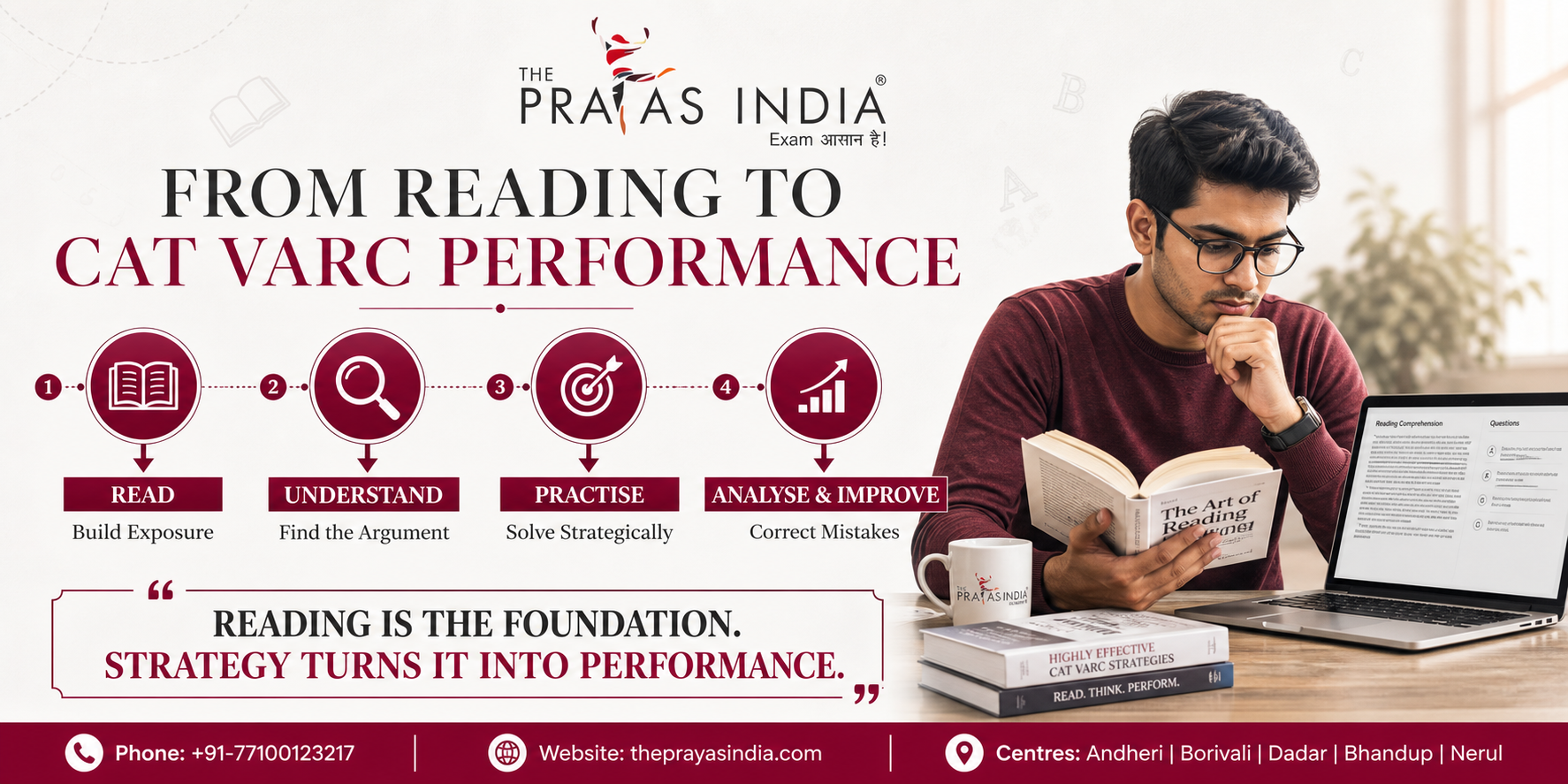
Read better.
Solve smarter.
Analyse deeply.
Improve systematically.
That is the difference between simply preparing for VARC and building a genuine CAT VARC preparation strategy.
Final Thoughts: Reading Is the Beginning, Not the Finish Line
CAT 2027 VARC preparation should not be reduced to the number of articles you read every week.
Reading develops the foundation, but performance requires much more.
You need to understand arguments, identify central ideas, interpret tone, make valid inferences, eliminate distractors, manage time and learn from mistakes.
Most importantly, you need to know why your preparation is or is not producing improvement.
If you are already reading regularly but your VARC performance is not moving forward, do not automatically conclude that you need to read more.
First diagnose the gap.
Perhaps you need more active reading.
Perhaps you need better RC practice.
Perhaps your option elimination needs work.
Perhaps your mock analysis is insufficient.
Or perhaps you need a structured preparation system with regular guidance and feedback.
For serious CAT 2027 aspirants, the objective should not simply be to become someone who reads a lot.
The objective should be to become someone who can read efficiently, understand deeply, solve strategically and make better decisions under exam conditions.
And that is why, for CAT VARC, reading alone is not enough.
Frequently Asked Questions – CAT 2027 VARC Preparation
Is reading important for CAT 2027 VARC preparation?
Yes. Regular reading can improve familiarity with different writing styles, subjects, vocabulary and complex arguments. However, reading should be combined with RC practice, question analysis, timed practice and mock-test review.
Why am I getting RC questions wrong even after reading regularly?
You may understand the passage but struggle with inference, option elimination, tone, question interpretation or identifying the answer best supported by the passage. Analysing your errors can help identify the specific issue.
Is vocabulary the most important part of VARC?
Vocabulary is useful, but VARC preparation involves much more than knowing difficult words. Comprehension, inference, reasoning, option elimination and time management are also important.
How can I improve my RC accuracy?
Identify the type of mistake you make, such as main idea, inference, tone, detail, elimination, vocabulary, time or question selection. Targeted practice based on this diagnosis is more useful than simply solving more questions.
Should I take CAT VARC sectional tests?
Yes. Timed sectional practice can help evaluate comprehension, accuracy, question selection and time management. However, analysing the test afterwards is just as important as taking it.
Can I prepare for CAT VARC through self-study?
Yes. Self-study can work for students who can maintain consistency, select appropriate resources, analyse mistakes and track their progress independently. Students who need more structure and regular feedback may prefer guided preparation.
What should I look for in CAT coaching for VARC?
Look for quality teaching, diverse RC practice, option analysis, regular sectional tests, mock-test analysis, performance tracking and access to faculty guidance. The focus should be on developing skills rather than simply collecting study material.
Preparing for CAT 2027? Build Your Preparation with the Right Guidance
Reading is only the beginning of CAT VARC preparation. If you want structured learning, regular practice, mock-test analysis and expert guidance, connect with The Prayas India and understand the right preparation approach for your CAT 2027 journey.
Enquire Now | Get Preparation Guidance | Begin With Clarity
Visit Our Centres:
Andheri | Borivali | Dadar | Nerul | Bhandup