
CAT Preparation After Graduation: A Complete Guide for Borivali Students
Introduction
Graduation is an important turning point in a student’s academic and professional journey. Once you complete your bachelor’s degree, you may start exploring different career opportunities, consider pursuing higher education or look for ways to improve your professional qualifications. For students interested in business, leadership, finance, marketing, consulting and entrepreneurship, an MBA can be a valuable option to explore.
One of the most recognised entrance examinations for postgraduate management programmes in India is the Common Admission Test (CAT). Conducted by the Indian Institutes of Management (IIMs), CAT is accepted by the IIMs and several other management institutes for their admission processes.
However, preparing for CAT after graduation is not always straightforward. Some students begin preparation immediately after completing their degree, while others first gain work experience. There are also candidates who prepare while working full-time or managing other responsibilities.
If you are a graduate from Borivali or a nearby Mumbai locality and want to understand how to begin, this guide will help you plan your preparation systematically.
From understanding eligibility and choosing the right preparation timeline to studying VARC, DILR and Quantitative Aptitude, attempting mock tests and shortlisting management institutes, this article explains the important steps involved in CAT preparation after graduation.
Why Consider CAT Preparation After Graduation?
Completing graduation gives you an opportunity to evaluate your long-term career goals. If you are interested in developing business knowledge, strengthening leadership abilities or exploring professional opportunities across industries, management education may be worth considering.
An MBA or PGDM programme can expose students to areas such as:
- Marketing and brand management
- Finance and financial analysis
- Human resource management
- Operations and supply chain management
- Business analytics
- Consulting and strategy
- Entrepreneurship and business development
- Product and project management
The value of a management qualification depends on several factors, including the institution, programme structure, specialisation, industry exposure, individual performance and career goals.
CAT preparation after graduation can be useful because you can focus on the entrance examination with a clearer understanding of your academic background and professional interests.
Advantages of starting CAT preparation after graduation
More clarity about career interests: After completing your degree, you may have a better understanding of the subjects and professional fields that interest you.
Dedicated preparation time: Students who are not working full-time may be able to create a more flexible study schedule.
Opportunity to build additional skills: Alongside CAT preparation, graduates can improve communication, computer literacy, business awareness and analytical thinking.
Time to research MBA programmes: You can compare institutes, specialisations, admission requirements and financial commitments before applying.
However, completing graduation does not mean that you must immediately pursue an MBA. Take time to understand whether management education matches your career objectives.
Check Your CAT Eligibility Before Starting Preparation
Before investing time and money in preparation, understand the examination’s eligibility requirements.
According to the CAT 2026 information bulletin, the broad educational eligibility requirements include:
| Candidate category | Minimum graduation marks |
|---|---|
| General, EWS and NC-OBC | 50% or equivalent CGPA |
| SC, ST and PwD | 45% or equivalent CGPA |
Candidates appearing in the final year of their bachelor’s degree or awaiting results may also apply, subject to the conditions specified in the official notification and the admission requirements of the respective institutes.
Important points to remember
- Your bachelor’s degree should meet the recognition requirements mentioned in the notification.
- Equivalent qualifications may be accepted subject to the applicable rules.
- Final-year candidates must fulfil the required conditions at the time of admission.
- Individual management institutes may have additional selection criteria.
- Work experience is not a universal prerequisite for appearing in CAT.
Does your graduation stream matter?
CAT preparation is open to graduates from different academic backgrounds, subject to the official eligibility requirements. You do not necessarily need a BBA, BCom or Economics degree to pursue an MBA.
For example:
- BCom graduates may be interested in finance, accounting or business management.
- Engineering graduates may explore operations, analytics, technology management or consulting.
- Arts graduates may consider marketing, human resources, strategy or other management fields.
- Science graduates may explore analytics, operations, research-oriented business roles and general management.
Your academic background may influence your interests and preparation needs, but it does not automatically determine your future MBA specialisation.
Understand the CAT Exam Pattern Before Making a Study Plan
CAT preparation becomes more organised when you understand the examination structure.
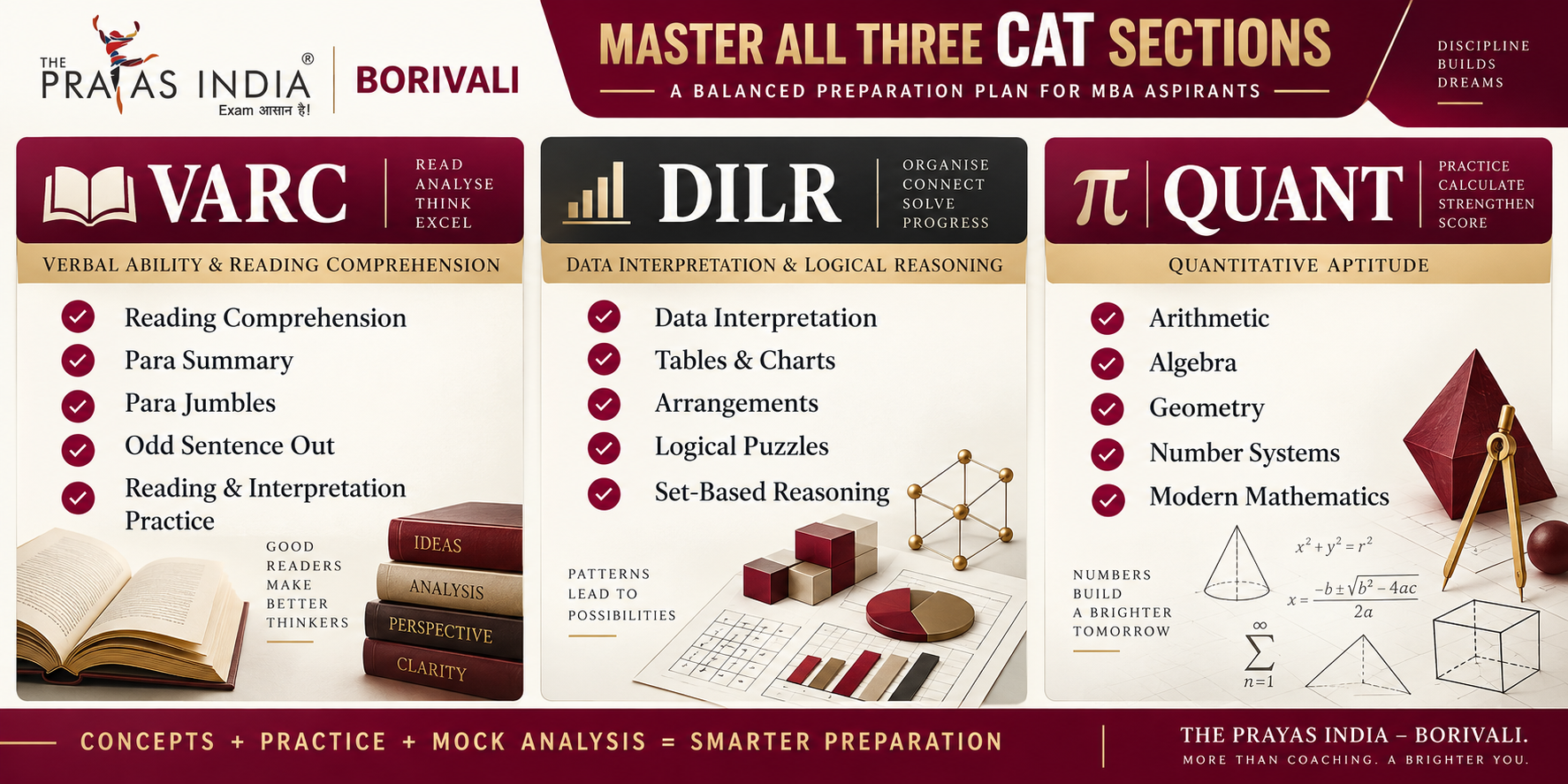
CAT consists of three major sections:
- Verbal Ability and Reading Comprehension (VARC)
- Data Interpretation and Logical Reasoning (DILR)
- Quantitative Aptitude (QA)
The CAT 2026 examination structure comprises 68 questions and a total duration of 120 minutes, divided into three sections with 40 minutes allotted to each. The reported distribution is 24 questions in VARC, 22 in DILR and 22 in Quantitative Aptitude. Candidates cannot switch between sections during their allotted sectional time.
| Section | Questions in CAT 2026 | Time |
|---|---|---|
| VARC | 24 | 40 minutes |
| DILR | 22 | 40 minutes |
| Quantitative Aptitude | 22 | 40 minutes |
| Total | 68 | 120 minutes |
The marking scheme reported for CAT 2026 awards three marks for a correct response and deducts one mark for an incorrect MCQ response. Incorrect non-MCQ (TITA) responses do not attract negative marking under the reported pattern. Always verify the relevant examination year’s official instructions before applying.
Why is understanding the pattern important?
A student may be strong in mathematics but struggle with reading comprehension. Another candidate may understand English well but find DILR sets difficult.
Knowing the structure helps you:
- Identify your strongest and weakest sections.
- Divide preparation time sensibly.
- Understand sectional time pressure.
- Practise different question formats.
- Build a mock-test strategy.
Do not begin by trying to solve every available question. First understand what each section tests and assess your current level.
Know What to Study in Each CAT Section
CAT preparation should cover all three sections. Focusing exclusively on Quantitative Aptitude or English can create an imbalance in your overall preparation.
A. VARC – Verbal Ability and Reading Comprehension
VARC evaluates your ability to understand written information, interpret arguments and identify relationships between ideas.
Important preparation areas include:
- Reading comprehension
- Para summaries
- Para jumbles
- Odd sentence out
- Understanding the central idea of a passage
- Identifying tone, purpose and logical arguments
How should graduates prepare for VARC?
Start reading regularly. Choose editorials, business articles, long-form journalism, essays and analytical writing from reliable publications.
After reading a passage, ask yourself:
- What is the central argument?
- What is the author’s main purpose?
- Which statements support the argument?
- Does the author express a positive, negative or neutral view?
- Can I summarise the passage without changing its meaning?
Reading without analysing what you have read may not be sufficient. Practise understanding the structure and reasoning behind a passage.
DILR – Data Interpretation and Logical Reasoning
DILR tests how effectively you analyse information, identify patterns and solve structured problems.
Common preparation areas include:
- Tables and charts
- Bar graphs and line graphs
- Caselets
- Arrangements
- Selection and distribution
- Games and tournaments
- Scheduling
- Logical conditions
- Set-based problems
How should graduates prepare for DILR?
Begin with manageable sets and gradually increase the complexity.
Do not rush to solve a set immediately. First understand the information, identify the variables and organise the conditions.
For example, a scheduling set may involve several people, different days and restrictions on who can attend an event. Creating a table or structured representation can make the relationships easier to understand.
Practise identifying which sets are manageable within the available time. In CAT, selecting the right set can be as important as solving it correctly.
Quantitative Aptitude
Quantitative Aptitude evaluates mathematical understanding, numerical reasoning and the ability to solve problems efficiently.
Common preparation areas include:
| Topic area | Important concepts |
|---|---|
| Arithmetic | Percentages, ratios, averages, profit and loss, time and work, time-speed-distance |
| Algebra | Equations, inequalities, functions and progressions |
| Geometry | Triangles, circles, quadrilaterals and mensuration |
| Number Systems | Factors, multiples, divisibility and remainders |
| Modern Mathematics | Probability, permutations and combinations, set theory |
The IIMs do not provide a rigid chapter-by-chapter CAT syllabus in the same way as many school examinations. These topics are commonly used as preparation areas based on previous papers and established CAT practice. Use official sample material and previous examination papers to understand the question style.
How should graduates prepare for Quantitative Aptitude?
If you have not studied mathematics recently, begin with fundamentals. Revise fractions, percentages, ratios, equations and basic geometry before attempting difficult questions.
Focus on understanding the method rather than memorising shortcuts. As your concepts improve, introduce timed practice to develop calculation speed and accuracy.
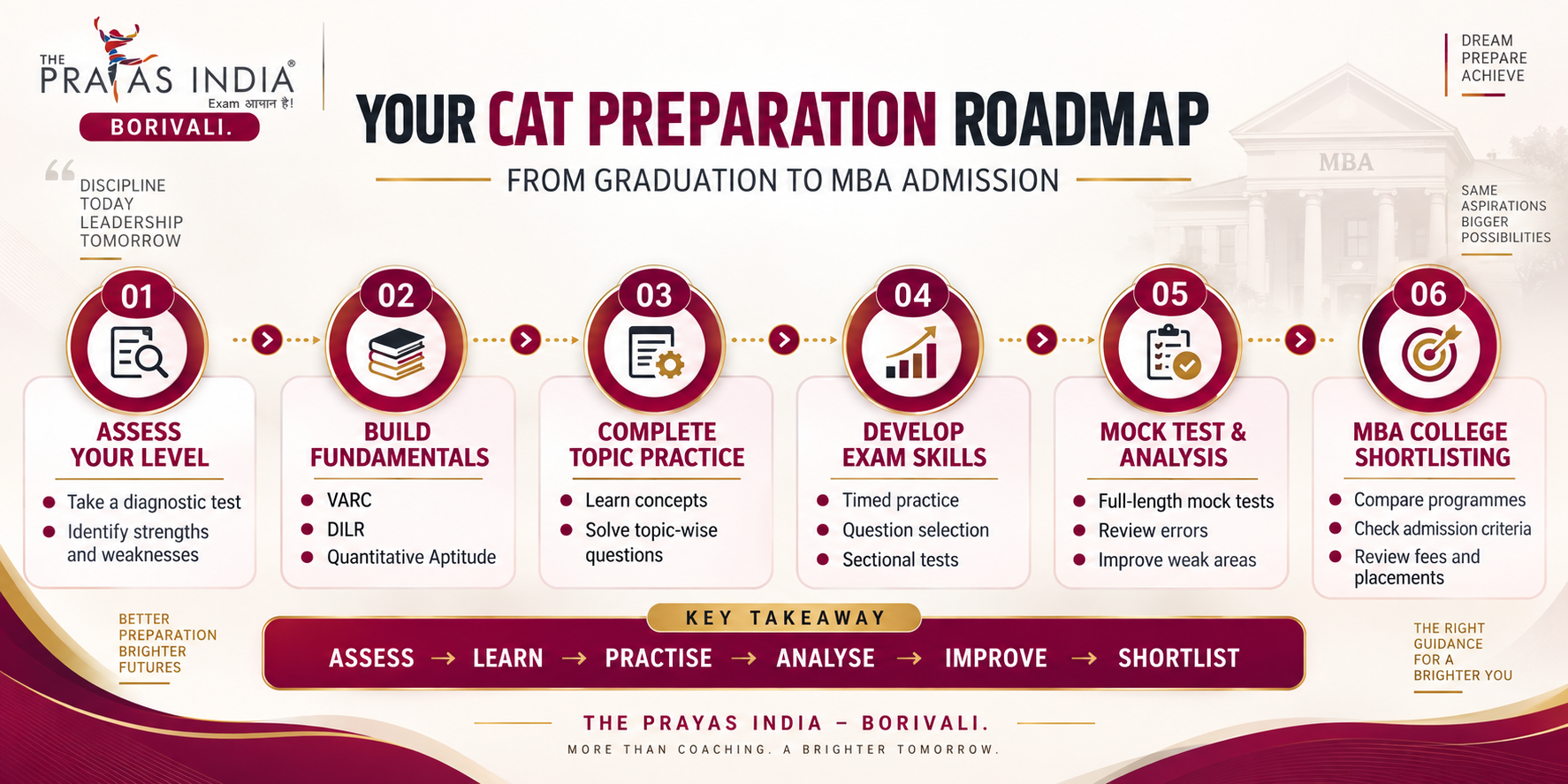
Create a Realistic CAT Preparation Timeline After Graduation
One of the first questions graduates ask is: How much time is required to prepare for CAT?
There is no single preparation duration that works for everyone. Your timeline depends on your current academic foundation, available study hours, target examination cycle and performance in diagnostic tests.
Here is an illustrative six-month preparation framework.
| Preparation phase | Main focus | Suggested activities |
|---|---|---|
| Month 1 | Assessment and fundamentals | Diagnostic test, basic concepts and reading habit |
| Month 2 | Concept development | Arithmetic, algebra, VARC practice and basic DILR |
| Month 3 | Topic coverage | Geometry, number systems, reading comprehension and mixed DILR sets |
| Month 4 | Application | Timed topic tests, sectional practice and revision |
| Month 5 | Mock-test development | Full-length mocks, analysis and weak-area improvement |
| Month 6 | Exam readiness | Revision, mock analysis, question selection and time management |
This is a planning example, not a guaranteed preparation formula. Some candidates may need more time, while those with strong fundamentals may be able to follow a shorter schedule.
What if you have only three months?
If your preparation window is limited, avoid attempting to study every topic in excessive detail without assessing your current ability.
Instead:
- Take a diagnostic mock test.
- Identify the most significant weaknesses.
- Strengthen important concepts in all three sections.
- Practise manageable questions under time limits.
- Attempt sectional tests regularly.
- Analyse mock tests carefully.
- Revise rather than continuously adding new material.
A shorter timeline requires disciplined prioritisation. It should not be treated as a promise of a particular percentile or admission result.
Should You Prepare for CAT Immediately After Graduation or Gain Work Experience First?
Both options can be valid. Your decision should depend on your professional goals and personal circumstances.
Option 1: Prepare immediately after graduation
This route may suit students who:
- Have already decided to pursue management education.
- Can dedicate sufficient time to preparation.
- Want to continue their academic journey.
- Have a clear understanding of their preferred MBA programmes.
- Are financially prepared for the admission process and education costs.
The main advantage is that you can focus on entrance preparation without balancing a full-time job.
However, you should still explore internships, practical projects, certifications and other ways to understand professional environments.
Option 2: Gain work experience before pursuing an MBA
Some graduates prefer to work before applying to management programmes.
This may help them:
- Understand how organisations operate.
- Develop workplace communication skills.
- Discover their professional interests.
- Gain exposure to business problems.
- Understand which MBA specialisation may suit them.
Work experience can be relevant to the selection criteria of certain institutes and may contribute to classroom discussions. However, its weightage and importance vary across admission processes.
Which option should you choose?
| Factor | Immediate CAT preparation | Work experience first |
|---|---|---|
| Primary focus | Entrance preparation | Professional development and preparation |
| Daily schedule | May be more flexible | Must balance job and study |
| Industry exposure | May be limited initially | Can develop through work |
| Financial position | Depends on personal support | May provide employment income |
| Career clarity | Can develop through research | May improve through workplace experience |
Neither route is automatically superior. Choose the one that makes sense for your circumstances.
How to Prepare for CAT While Working After Graduation
If you have already started working, you do not necessarily need to postpone CAT preparation. You need a timetable that fits your actual routine.
A working professional should avoid copying a full-time student’s study schedule.
An illustrative weekday routine
| Activity | Time |
|---|---|
| Reading comprehension or VARC | 30 minutes |
| Quantitative Aptitude practice | 40 minutes |
| DILR practice | 30 minutes |
| Revision and error analysis | 20 minutes |
| Total | 2 hours |
You can divide these sessions across the day according to your work schedule.
Weekend preparation
Use weekends for activities that require longer uninterrupted sessions:
- One full-length mock test when appropriate.
- Detailed mock analysis.
- Revision of weak topics.
- Practice of difficult DILR sets.
- Review of formulae and reading notes.
- Planning the following week’s preparation.
If your working hours are unpredictable, set weekly targets instead of depending entirely on a fixed daily timetable.
The goal is to build a routine you can maintain for months.
Understand the Importance of Mock Tests and Performance Analysis
Mock tests are an important part of CAT preparation, but simply attempting more tests does not guarantee improvement.
The real benefit comes from analysing your performance.
After every mock test, review the following:
VARC analysis
- Which reading comprehension passages were difficult?
- Did you misunderstand the central argument?
- Were your mistakes caused by incorrect interpretation or rushed reading?
DILR analysis
- Did you select the right sets?
- Did you understand all the conditions?
- Did you spend too long on one set?
- Could a table or diagram have simplified the problem?
Quantitative Aptitude analysis
- Which concepts caused difficulty?
- Were the calculations unnecessarily lengthy?
- Did you make avoidable errors?
- Did you attempt questions that should have been skipped?
Maintain a mock-test analysis sheet
| Performance parameter | What to record |
|---|---|
| Attempts | Number of questions attempted |
| Correct answers | Number of accurate responses |
| Incorrect answers | Number of wrong responses |
| Time management | Questions or sets that consumed excessive time |
| Weak topics | Concepts that need revision |
| Improvement action | What you will change before the next mock |
Avoid judging your preparation using only one mock-test score. Look for patterns across multiple tests and compare performance over time.
How to Choose MBA Colleges After CAT
CAT is an entrance examination, not an admission guarantee. A good CAT preparation strategy should also include research about the management institutes you may want to apply to.
Instead of selecting colleges based only on reputation, compare them using relevant factors.
Factors to consider while shortlisting institutes
1. Programme and specialisation
Understand whether the curriculum supports your interests in finance, marketing, operations, analytics, consulting, human resources or general management.
2. Total programme cost
Consider tuition fees, accommodation, living expenses, loan requirements and other costs.
3. Placement information
Read official placement reports. Look at median compensation, role distribution, participating recruiters and the methodology used in the report. Do not depend only on the highest salary figure.
4. Admission requirements
Each institute may use different criteria, such as CAT score, academic performance, work experience, written assessments and interviews.
5. Location and industry exposure
Consider the institute’s location, internship opportunities, industry connections and learning environment.
6. Alumni and career support
Explore alumni networks, career services, mentorship and professional development opportunities.
Create three categories for your college list
- Ambitious options: Institutes where admission may be highly competitive based on your profile.
- Target options: Institutes where your expected performance and profile may be reasonably aligned.
- Additional options: Other programmes that fit your educational goals, budget and career plans.
These categories should be reviewed using current admission criteria and reliable information, not assumed cut-offs.
Common Mistakes Graduates Should Avoid During CAT Preparation
Mistake 1: Starting without a diagnostic assessment
Some graduates begin solving difficult questions without understanding their current level.
Better approach: Attempt an initial diagnostic test and identify your strengths and weaknesses.
Mistake 2: Focusing on only one section
A candidate who spends all preparation time on mathematics may neglect VARC or DILR.
Better approach: Maintain regular preparation across all three sections.
Mistake 3: Collecting too many study materials
Using multiple books, websites and question banks without a plan can create confusion.
Better approach: Follow a limited set of reliable resources and complete them systematically.
Mistake 4: Ignoring mock-test analysis
Attempting a mock test and immediately moving to another one does not help identify recurring mistakes.
Better approach: Spend sufficient time reviewing the questions, solutions and time allocation.
Mistake 5: Choosing an MBA only for salary expectations
An MBA is a significant educational and financial commitment.
Better approach: Research specialisations, programme quality, roles and realistic career opportunities.
Mistake 6: Comparing preparation progress with friends
Different candidates have different academic backgrounds, study hours and learning speeds.
Better approach: Track your own performance and focus on measurable improvement.
Mistake 7: Ignoring the admission process after CAT
A good entrance examination performance is only one part of the admission journey.
Better approach: Understand the application and selection requirements of each shortlisted institute.
A Practical Weekly CAT Preparation Plan for Graduates
The following schedule is an example for candidates who can dedicate approximately three hours per day. Modify it based on your preparation stage and available time.
| Day | VARC | DILR | Quantitative Aptitude |
|---|---|---|---|
| Monday | Reading comprehension | Tables and charts | Arithmetic |
| Tuesday | Para-based questions | Arrangements | Algebra |
| Wednesday | Reading comprehension | Caselets | Geometry |
| Thursday | Verbal ability | Games and tournaments | Number Systems |
| Friday | Mixed VARC practice | Mixed DILR sets | Modern Mathematics |
| Saturday | Sectional practice | Sectional practice | Sectional practice |
| Sunday | Mock test and complete analysis | Mock test and complete analysis | Mock test and complete analysis |
A full-length mock should be attempted when your preparation has progressed sufficiently to make the exercise useful. Early-stage candidates can initially use topic tests and sectional tests.
Weekly progress review
At the end of each week, ask yourself:
- Did I complete the planned topics?
- Which concepts remain unclear?
- Did my accuracy improve?
- Which section consumed the most time?
- What mistakes did I repeat?
- What should be my priority next week?
This simple review makes preparation more structured and prevents you from studying without a clear direction.
CAT Preparation Guidance for Students in Borivali
Students living in Borivali may have different preparation requirements depending on their academic background, work schedule and current level.
Some graduates may prefer self-study, while others may benefit from structured classes, regular practice sessions, doubt resolution and guidance with mock-test analysis.
Before choosing CAT coaching classes in Borivali, consider the following:
- Does the preparation approach cover all three CAT sections?
- Is there a clear progression from fundamentals to advanced questions?
- Are students encouraged to analyse mock-test performance?
- Is there a suitable system for doubt resolution?
- Are revision and practice included in the preparation plan?
- Do class timings suit graduates and working professionals?
- Are course details, fees and current batch availability communicated clearly?
Do not select an institute only because of advertising claims or promises of a particular percentile. Understand the actual teaching approach and the support available before enrolling.
Explore CAT preparation at The Prayas India – Borivali
Graduates from Borivali West, Borivali East, Mhatre Wadi, IC Colony, Gorai, Eksar, Dahisar, Kandivali and nearby areas who are exploring structured CAT preparation can contact THE PRAYAS INDIA – BORIVALI for information about current preparation options.
The centre’s address is:
Orchid Plaza, 205, Swami Vivekanand Rd, behind Gokul Shopping Complex, Meghdoot, Mhatre Wadi, Borivali West, Mumbai, Maharashtra 400092.
Before joining, enquire about the current course structure, faculty arrangements, batch schedule, fees and available preparation support.
Call: 077100 13217
Your CAT Preparation Roadmap: Final Self-Assessment
Before moving ahead with your CAT preparation journey, use this checklist to evaluate your readiness, study plan and preparation strategy.
YOUR PREPARATION CHECKLIST
PLAN SMARTER • PREPARE CONSISTENTLY • MOVE CLOSER TO YOUR MBA GOALS
Conclusion
CAT preparation after graduation can be a structured step towards exploring management education and future professional opportunities. However, success requires more than collecting study materials or attempting a large number of mock tests.
Start by understanding your eligibility, evaluating your current level and learning the requirements of VARC, DILR and Quantitative Aptitude. Build a practical timetable, practise consistently, analyse mistakes and research MBA programmes before making admission decisions.
If you are preparing from Borivali, choose a study routine that fits your academic background, daily schedule and career goals. Whether you decide to prepare independently or explore structured coaching, focus on consistency, conceptual clarity and measurable progress.
For CAT preparation enquiries in Borivali, you can contact The Prayas India – Borivali and ask about the currently available preparation options.
Call Now: 077100 13217
Your graduation is the beginning of another career decision. Use this opportunity to plan your next academic step carefully.
Frequently Asked Questions
1. Can I prepare for CAT immediately after graduation?
Yes. Graduates who meet the eligibility requirements can prepare for CAT immediately after completing their bachelor’s degree. A structured timetable covering VARC, DILR and Quantitative Aptitude can help organise preparation.
2. What is the minimum graduation percentage required for CAT?
As per the CAT 2026 eligibility criteria, candidates generally require at least 50% graduation marks or equivalent CGPA. The requirement is 45% for SC, ST and PwD candidates. Always check the latest official notification for the relevant examination year.
3. How many months are required to prepare for CAT after graduation?
Preparation time depends on your mathematical fundamentals, reading ability, logical reasoning skills and available study hours. Some candidates may follow a six-month plan, while others may require a longer preparation period.
4. Can I prepare for CAT while working after graduation?
Yes. Working professionals can prepare through a realistic timetable that includes daily practice, weekend revision, sectional tests and mock-test analysis. Consistency is more important than following an unrealistic study schedule.
5. Which subjects should I study for CAT?
CAT preparation covers three sections: Verbal Ability and Reading Comprehension (VARC), Data Interpretation and Logical Reasoning (DILR), and Quantitative Aptitude (QA). Candidates should practise all three sections regularly.
6. Is work experience compulsory for CAT?
No. Work experience is not a universal requirement for appearing in CAT. However, individual management institutes may consider work experience as part of their admission and selection criteria.
7. Where can I enquire about CAT preparation in Borivali?
You can contact The Prayas India – Borivali at 077100 13217 to enquire about current CAT preparation options, course details, batch schedules and fees. The centre is located at Orchid Plaza, Mhatre Wadi, Borivali West, Mumbai.
Start Your CAT Preparation After Graduation
Looking for CAT preparation guidance in Borivali? Contact The Prayas India – Borivali to enquire about current preparation options, course details and batch information.
THE PRAYAS INDIA – BORIVALI
Orchid Plaza, 205, Swami Vivekanand Rd, behind Gokul Shopping Complex, Meghdoot, Mhatre Wadi, Borivali West, Mumbai, Maharashtra 400092.
Call: 077100 13217
Website: theprayasindia.com