CAT Quant for Non-Maths Students: How to Build Confidence From Scratch | The Prayas India
For many CAT aspirants, Quantitative Aptitude is the section that creates the most anxiety. This becomes even more common among students who come from non-mathematics backgrounds or have not studied mathematics seriously since school.
The problem is often not that these students are incapable of solving Quant questions. In many cases, the bigger issue is confidence. Seeing equations, percentages, algebraic expressions or geometry-based questions can immediately create the feeling that Quant is difficult. That mindset can affect preparation before the actual learning has even begun.
The good news is that CAT Quant does not require you to be a mathematics expert. What it demands is a strong understanding of fundamental concepts, regular practice, logical thinking and the ability to identify the right approach to a problem.
For a non-maths student, the objective should not be to become a mathematician. The objective should be to become comfortable enough with numbers and concepts to solve CAT-level questions accurately and efficiently.
This article explains how non-maths students can build their Quant preparation from scratch, overcome fear and develop a practical preparation strategy for CAT 2026.
Why CAT Quant Feels Difficult for Non-Maths Students
The first challenge is usually psychological.
If you have spent several years away from mathematics, even basic concepts may feel unfamiliar. A question involving ratios or equations can look complicated simply because you have not practised that type of problem recently.
There is also a major difference between knowing a formula and knowing when to use it.
A student may remember the formula for average but still struggle to identify how it should be applied to a CAT question. Similarly, knowing the formula for speed does not automatically mean you can solve a complicated Time, Speed and Distance problem.
This is why CAT Quant preparation should begin with conceptual familiarity rather than difficulty.
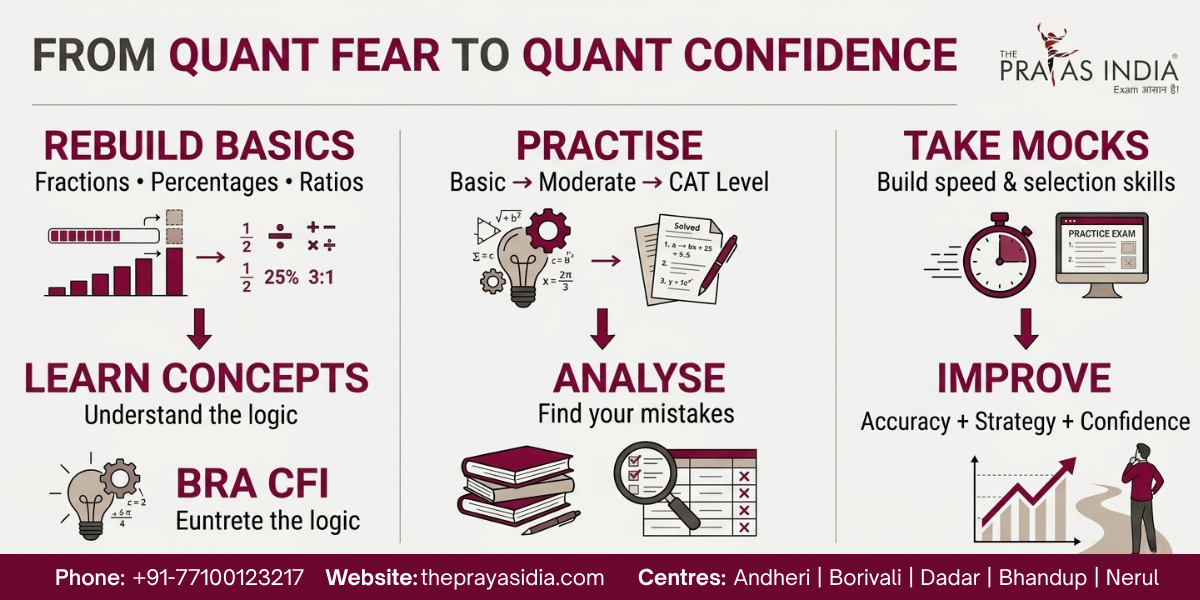
For non-maths students, the early stage should focus on:
- Rebuilding basic mathematical concepts.
- Understanding why formulas work instead of memorising them blindly.
- Solving simple questions before moving to CAT-level difficulty.
- Developing calculation confidence through regular practice.
- Learning common approaches used in CAT questions.
- Gradually increasing the difficulty of questions.
The purpose of this stage is to remove the feeling that mathematics is an unfamiliar subject.
You Do Not Need Advanced Mathematics to Start CAT Quant
One of the biggest misconceptions among non-maths students is that CAT Quant requires advanced mathematics.
The CAT Quant section primarily tests your ability to apply mathematical concepts to solve problems. You are not expected to perform university-level mathematics.
A large part of the preparation revolves around fundamental areas such as arithmetic, algebra, geometry and numbers.
This is good news for students who are starting from scratch.
Instead of thinking:
“I am weak in mathematics, so I cannot score well in Quant.”
change the approach to:
“I need to rebuild my fundamentals and practise applying them.”
That change in mindset can make preparation much more manageable.
Start With Arithmetic Before Moving to Advanced Topics
For a student who is uncomfortable with mathematics, starting with difficult algebra or geometry can create unnecessary frustration.
Arithmetic is generally a more comfortable starting point because many concepts are connected to everyday calculations.
Begin by strengthening topics such as:
- Percentages
- Profit and Loss
- Ratio and Proportion
- Averages
- Simple and Compound Interest
- Time, Speed and Distance
- Time and Work
- Mixtures and Alligation
These topics also have strong practical connections with other areas of Quant.
For example, percentages can help you understand profit and loss, interest and data interpretation. Ratios are useful in mixtures, averages and various word problems.
Therefore, building arithmetic fundamentals can create a strong foundation for the rest of your preparation.
The Right Order of CAT Quant Preparation Matters
Non-maths students often make the mistake of opening the entire Quant syllabus and trying to study everything simultaneously.
That approach can quickly become overwhelming.
A better strategy is to move from familiar concepts to unfamiliar concepts, while gradually increasing difficulty.
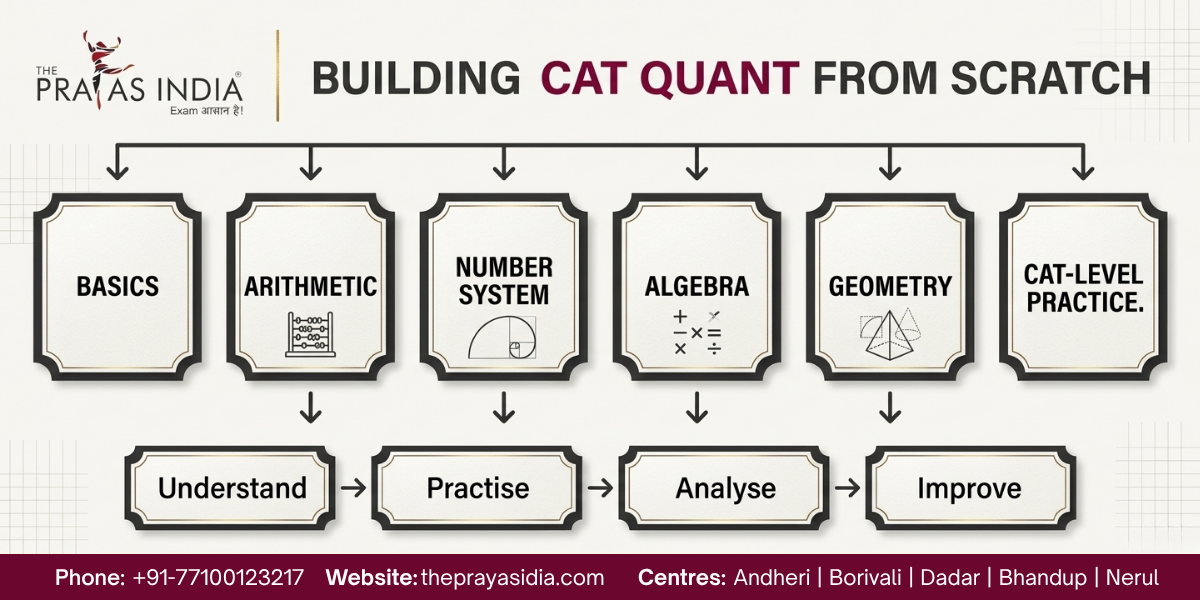
A possible progression is:
Stage 1: Basic Arithmetic
Start with percentages, ratios, averages and basic applications.
Stage 2: Applied Arithmetic
Move towards profit and loss, mixtures, time and work, and time-speed-distance.
Stage 3: Number System
Build familiarity with divisibility, factors, remainders and number properties.
Stage 4: Algebra
Introduce equations, inequalities, functions and other important concepts.
Stage 5: Geometry
Gradually develop understanding of lines, angles, triangles, circles and other geometric concepts.
Stage 6: Mixed CAT-Level Practice
Once individual concepts are comfortable, start solving mixed-topic questions.
This progression allows confidence to develop gradually rather than forcing the student into difficult problems immediately.
Build Your Foundation Before Chasing Speed
Speed is important in CAT.
However, speed should not be your first target.
A non-maths student who tries to solve questions quickly without understanding the underlying concept may develop incorrect shortcuts or make repeated mistakes.
The initial goal should be:
Understand → Solve → Repeat → Improve Speed
Suppose you are learning percentages.
During your first few practice sessions, don’t worry if a question takes several minutes. Focus on understanding how the problem is structured.
After solving multiple questions of the same type, patterns start becoming familiar.
Eventually, you will recognise common approaches and your solving time will naturally decrease.
This is much more sustainable than trying to force speed from day one.
Learn Concepts Through Questions, Not Just Notes
Reading a chapter or watching a lecture can give you the feeling that you understand a topic.
But CAT preparation requires application.
After learning a concept, immediately move towards practice.
A useful learning cycle is:
Concept → Basic Questions → Moderate Questions → CAT-Level Questions → Analysis
For example, after learning percentages, don’t simply move to the next chapter.
Spend enough time solving different types of percentage problems so that you understand how the concept behaves when the question changes.
This is especially important for non-maths students because repeated application helps convert theoretical knowledge into practical confidence.
Don’t Memorise Every Formula Blindly
Formula sheets can be useful, but they should not become the foundation of your preparation.
If you memorise a formula without understanding its meaning, you may struggle when the CAT question is presented differently.
Instead, try to understand:
- What does the formula represent?
- Why does it work?
- In which situations can it be used?
- What information does the question provide?
- What is the question actually asking?
Once you understand the concept, formulas become much easier to remember.
You may also discover that certain questions can be solved through logic or alternative methods without directly applying a standard formula.
That flexibility becomes valuable in CAT.
Make Calculation Practice a Daily Habit
Non-maths students often lose confidence because basic calculations take too much time.
The solution is not to avoid calculations.
It is to practise them regularly.
Spend a small amount of time every day working on:
- Fractions and percentages.
- Squares and cubes of commonly used numbers.
- Multiplication and division.
- Approximation.
- Ratio conversions.
- Percentage-to-fraction relationships.
- Basic mental calculations.
The purpose is not to perform complicated calculations mentally.
The purpose is to reduce hesitation.
When basic calculations become familiar, more mental energy can be spent understanding the actual question.
Build a Personal Quant Notebook
Instead of maintaining only a formula notebook, create a Quant learning notebook.
Divide it into sections for:
Concepts
Write important ideas in your own words rather than copying textbook definitions.
Mistakes
Record questions where you made a conceptual or calculation error.
Shortcuts
Write down useful approaches only after understanding the underlying method.
Difficult Questions
Maintain examples of questions that initially confused you but became clear after analysis.
Revision Points
Keep a concise list of concepts that require regular revision.
This notebook can become extremely valuable during the final months of preparation.
How Non-Maths Students Should Approach Arithmetic
Arithmetic should become the foundation of your Quant preparation.
But don’t study it as a list of unrelated chapters.
Understand the relationships between concepts.
For example, percentages appear in several different contexts. Once you become comfortable converting percentages into fractions and understanding percentage changes, many other topics become easier.
Similarly, ratios are not limited to one chapter. They can appear in mixtures, partnerships, averages and other applications.
A good arithmetic preparation strategy should therefore focus on connections between concepts.
Percentages: Your First Confidence-Building Topic
Percentages are among the most useful concepts for CAT Quant preparation.
If percentages feel difficult initially, start with very basic relationships.
For example:
- Convert common fractions into percentages.
- Convert percentages into fractions.
- Understand percentage increase and decrease.
- Learn successive percentage changes.
- Practise finding percentages of quantities.
- Understand the difference between percentage change and percentage-point change.
Once these basics become comfortable, move towards CAT-level applications.
The objective is to reach a stage where seeing a percentage-based question does not create hesitation.
Ratios and Proportions
Ratios can initially look abstract, but they become easier when you connect them to quantities.
Suppose two quantities are in the ratio 2:3.
Instead of thinking of the ratio as a complicated mathematical expression, think of the quantities as:
2 parts and 3 parts.
This way of interpreting ratios can make many questions more intuitive.
Once the basic idea is clear, gradually move towards:
- Direct proportion.
- Inverse proportion.
- Ratio comparison.
- Distribution problems.
- Mixtures.
- Partnership-based applications.
The more variations you practise, the easier it becomes to recognise the structure of a problem.
Averages
Average is another topic where understanding the underlying logic is more useful than memorising formulas.
Start with the basic relationship:
Average = Total / Number of Items
Then understand what happens when:
- A new value is added.
- A value is removed.
- One value is replaced.
- The average changes.
- Two groups are combined.
Once these patterns become familiar, many CAT-level average questions become easier to approach.
Profit, Loss and Interest
These topics can be approached after building confidence with percentages.
Focus on understanding relationships between:
- Cost Price
- Selling Price
- Marked Price
- Discount
- Profit
- Loss
- Simple Interest
- Compound Interest
Don’t try to memorise every possible case.
Understand the basic relationships first, then solve variations.
Time, Speed and Distance
This topic often appears difficult because questions can become lengthy.
Begin with the fundamental relationship:
Distance = Speed × Time
Then gradually work with:
- Relative speed.
- Average speed.
- Trains.
- Boats and streams.
- Races.
- Circular tracks.
Start with straightforward problems and gradually move towards mixed applications.
If you struggle initially, don’t interpret that as evidence that you are “bad at maths.”
It simply means the concept needs more exposure.
Time and Work
Time and Work questions become easier once you stop thinking only in terms of days.
Think in terms of work rate.
Understand:
- Individual efficiency.
- Combined work.
- Work completed in a given time.
- Efficiency ratios.
- Men and machines.
- Pipes and tanks.
Once the basic framework is understood, many seemingly complicated questions become structured problems.
When Should You Move to Algebra?
You don’t need to master every arithmetic topic before touching algebra.
However, non-maths students generally benefit from gaining some numerical confidence first.
Begin algebra with simple concepts:
- Linear equations.
- Quadratic equations.
- Inequalities.
- Algebraic identities.
- Functions.
- Basic sequences and progressions.
The focus should initially be on understanding what the mathematical expressions represent.
Avoid jumping immediately into difficult CAT-level algebra questions.
Build familiarity first.
How to Stop Being Afraid of Difficult Questions
You will encounter questions that you cannot solve.
That is normal.
Even strong CAT aspirants leave many questions unanswered.
The problem begins when a difficult question affects your confidence for the rest of the preparation.
Instead of thinking:
“I couldn’t solve this, so my Quant is weak.”
ask:
“Why couldn’t I solve this?”
There can be several reasons:
- You didn’t know the concept.
- You knew the concept but couldn’t identify it.
- You made a calculation error.
- You used an inefficient method.
- You misunderstood the question.
- You spent too much time.
- The question was simply not worth attempting.
Each reason requires a different solution.
That is why analysis is more valuable than frustration.
Don’t Try to Solve Every CAT Question
This is particularly important for non-maths students.
Your goal is not to prove that you can solve every difficult Quant problem.
CAT rewards effective decision-making.
During preparation, learn to classify questions into:
Comfortable
Questions you can solve confidently.
Solvable With Thought
Questions requiring some calculation or reasoning.
Time-Consuming
Questions that may be possible but require too much time.
Unfamiliar
Questions where you don’t understand the approach.
Low-Priority
Questions where the expected effort is not worth the potential benefit.
This classification will eventually help you develop better question-selection skills.
Confidence Comes From Evidence
Motivation alone cannot create Quant confidence.
Confidence develops when you have evidence that you are improving.
For example:
Week 1: 10 questions attempted, 5 correct.
Week 3: 15 attempted, 10 correct.
Week 6: 20 attempted, 16 correct.
That progression is evidence.
Similarly, if a question type that once took five minutes now takes two minutes, that is evidence.
Keep track of these improvements.
They help you recognise progress that may otherwise go unnoticed.
Don’t Compare Your Quant Journey With Maths Students
This comparison can become particularly damaging.
A student who studied mathematics until graduation may initially solve certain Quant topics faster than someone from a non-maths background.
That does not determine the final CAT outcome.
Your preparation journey is different.
Instead of asking:
“Why can they solve this faster?”
ask:
“What can I improve this week?”
CAT preparation is ultimately about your performance on the examination—not your academic background.
The Role of Structured CAT Coaching for Non-Maths Students
Self-study can work for non-maths students, particularly when they have strong discipline and access to reliable material.
However, starting Quant from scratch can sometimes leave students unsure about whether they are studying the right concepts in the right order.
This is where structured CAT Coaching Mumbai can provide additional value.
A good coaching environment can help students:
- Build concepts systematically.
- Learn different solving approaches.
- Ask questions when fundamentals are unclear.
- Practise questions according to difficulty.
- Identify recurring mistakes.
- Take regular tests.
- Understand their performance.
- Develop examination strategy.
For a student who lacks confidence, having a structured learning environment can make the preparation journey considerably less confusing.
Why The Prayas India Can Be Useful for Non-Maths CAT Aspirants
For students exploring Best CAT Coaching in Mumbai, one important factor is whether the learning approach is suitable for students with different academic backgrounds.
A non-maths student should not feel that the classroom is designed only for students who already have strong mathematical fundamentals.
The preparation should allow students to build their understanding progressively.
At The Prayas India, the focus is on creating a structured preparation journey where students can move from concept clarity to application and then to CAT-level problem solving.
The objective is not simply to teach formulas.
It is to help students understand how to approach questions.
What You Should Do If Your Quant Basics Are Extremely Weak
If you genuinely feel that your mathematics foundation is weak, don’t immediately jump into full-length CAT Quant practice.
Spend time rebuilding your basics.
A practical starting sequence can be:
- Revise basic arithmetic operations.
- Relearn fractions, decimals and percentages.
- Build ratio and proportion fundamentals.
- Strengthen averages.
- Move into profit and loss.
- Learn time, speed and distance.
- Practise time and work.
- Start number-system fundamentals.
- Introduce algebra gradually.
- Begin mixed CAT-level practice.
The timeline will vary from student to student.
The important point is to build upward rather than trying to skip the foundation.
Takeaway
Being a non-maths student does not automatically put you at a disadvantage in CAT Quant.
Your first objective should be to remove the fear surrounding mathematics.
Start with fundamentals.
Build arithmetic confidence.
Practise consistently.
Analyse mistakes.
Increase difficulty gradually.
And most importantly, don’t measure your ability by the number of questions you cannot solve today.
Measure it by how many questions you can solve better than you could last month.
Create a Quant Routine You Can Actually Follow
One of the biggest mistakes students make is creating an unrealistic timetable.
Studying Quant for six or seven hours on one day and then avoiding it for the next three days will not create consistency.
Instead, create a routine that you can maintain for several months.
A practical daily Quant session can include:
- Concept learning: Spend time understanding one specific concept instead of trying to finish an entire chapter.
- Basic practice: Solve straightforward questions to make the concept familiar.
- Application practice: Move towards questions that require multiple steps or different approaches.
- Error analysis: Review the questions you got wrong instead of immediately moving to new questions.
- Revision: Revisit formulas, approaches and previously difficult questions regularly.
The exact number of hours depends on your overall CAT preparation schedule. What matters more is regular exposure to Quant.
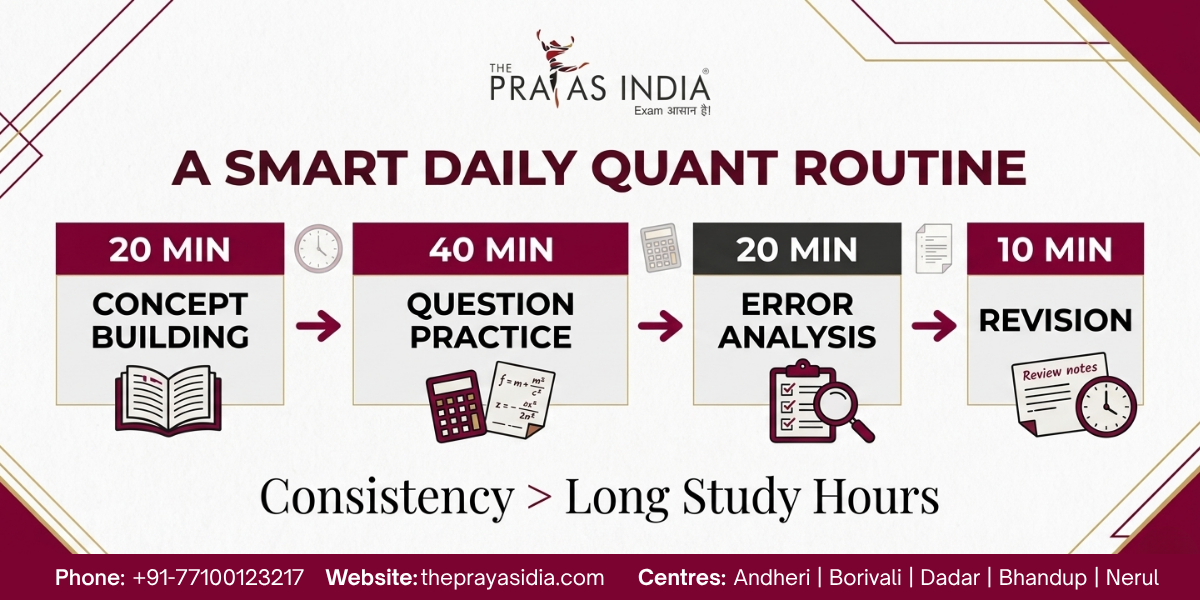
A Simple 90-Minute Quant Session
Students who are preparing alongside college or work may not have unlimited study hours.
A focused 90-minute session can still be productive.
First 20 Minutes — Concept Building
Choose one topic and understand its fundamental ideas. If the topic is percentages, for example, focus on percentage change, conversions and basic applications.
Next 40 Minutes — Practice
Solve questions starting from easy or moderate difficulty. The objective is to understand how the concept is applied in different situations.
Next 20 Minutes — Analysis
Review incorrect questions and questions that took too long. Identify whether the problem was conceptual, calculation-related or caused by poor question selection.
Final 10 Minutes — Revision
Quickly revise important formulas, approaches and mistakes from previous sessions.
This structure prevents your preparation from becoming nothing more than question-solving without learning.
Use a Topic-Wise Approach Before Starting Mixed Practice
When you are still developing your Quant foundation, solving random questions from the entire syllabus can be confusing.
Suppose you are learning Time and Work today.
Spend enough time solving different variations of that topic before immediately moving into mixed questions.
This helps you identify recurring patterns.
For example, you may notice that many Time and Work questions are built around:
- Individual work rates.
- Combined efficiency.
- Work completed in a particular period.
- Efficiency comparisons.
- Changes in the workforce.
Once you start recognising these structures, your solving process becomes faster.
After completing the topic, introduce mixed practice.
This transition is important because CAT does not tell you which chapter a question belongs to.
When Should You Start CAT-Level Questions?
Don’t wait until you finish the entire syllabus.
At the same time, don’t start with the hardest questions on Day 1.
A gradual progression works better:
Level 1 → Basic Concept Questions
These establish whether you understand the fundamentals.
Level 2 → Application Questions
These test whether you can use the concept in unfamiliar situations.
Level 3 → CAT-Level Questions
These introduce the kind of reasoning and calculation expected in the actual examination.
Level 4 → Mixed Sets
These test your ability to identify which concept is required without being told the topic.
This progression is particularly useful for students who haven’t been comfortable with mathematics for several years.
Don’t Ignore Previous CAT Questions
Previous CAT questions are among the most valuable resources for understanding the examination.
They show you how concepts are actually tested.
While practising previous questions, don’t focus only on whether you got the answer right.
Analyse:
- Why was this concept used?
- Was there a shorter approach?
- Did I spend too much time?
- Could I have eliminated options?
- Was the calculation unnecessarily complicated?
- Would I attempt this question in the actual CAT?
- What made the question difficult?
This kind of analysis gradually develops CAT-specific thinking.
Learn From the Options
Non-maths students often assume that every Quant question has to be solved through lengthy calculations.
That isn’t always true.
In an objective examination, the options themselves can sometimes provide useful information.
Depending on the question, you may be able to use:
- Option elimination.
- Substitution.
- Approximation.
- Back-solving.
- Testing convenient values.
- Comparing options.
- Logical estimation.
However, these techniques should not replace conceptual understanding.
First understand the conventional method. Then learn when an alternative approach can save time.
Develop Approximation Skills
Calculation speed does not always mean performing everything precisely.
Sometimes, approximation is sufficient.
Suppose the options are widely separated. In such situations, calculating an answer to several decimal places may waste valuable time.
Learn to recognise when precision is necessary and when an approximate calculation is enough.
Practise:
- Fraction approximations.
- Percentage estimation.
- Multiplication shortcuts.
- Division estimation.
- Comparing numerical values.
- Eliminating clearly incorrect options.
This can significantly improve efficiency during timed practice.
Keep an Error Log
One of the simplest ways to improve Quant performance is to maintain an error log.
Every time you make a meaningful mistake, record it.
Your error log can have four categories:
Concept Error
You didn’t understand the underlying concept.
Application Error
You knew the concept but couldn’t identify how to apply it.
Calculation Error
Your approach was correct but you made a numerical mistake.
Decision Error
You spent too much time on a question or attempted a question that should have been skipped.
This classification makes your revision much more effective.
If most of your mistakes are calculation errors, you need calculation practice.
If most are concept errors, revising formulas alone won’t solve the problem—you need to revisit the underlying concept.
How to Use Mock Tests for Quant Improvement
Mock tests should not be treated only as score-generating exercises.
For a non-maths student, mocks can become a powerful learning tool.
Initially, your Quant score may be disappointing.
That is perfectly normal.
Instead of judging your preparation based only on the score, analyse the paper carefully.
Divide the questions into:
Attempted Correctly
These indicate your current strengths.
Attempted Incorrectly
These reveal areas that need attention.
Not Attempted but Solvable
These are extremely important because they represent potential marks you are currently leaving behind.
Not Attempted and Difficult
These should not become your immediate priority.
This analysis gives you a much clearer picture of your actual Quant level.
Don’t Take Full-Length Mocks Too Early
Full-length mocks are important, but they should be introduced strategically.
If you have not built basic concepts yet, taking multiple full-length CAT mocks every week may not provide much value.
Your preparation can progress through:
Concept Practice → Topic Tests → Sectional Tests → Full-Length Mocks
As your syllabus and confidence improve, increase your exposure to timed tests.
This allows you to work on both knowledge and examination temperament.
How to Balance Quant With VARC and DILR
CAT is not a Quant examination.
A student cannot compensate for weak VARC and DILR simply by spending all their time on Quant.
Your preparation should therefore maintain a balance between all three sections.
A typical weekly structure can include:
- Regular Quant concept and practice sessions.
- Dedicated VARC reading and question practice.
- DILR sets several times a week.
- Regular sectional tests.
- Mock-test analysis.
- Revision of weak areas.
If Quant is your weakest section, you can give it additional time initially.
But don’t completely neglect the other two sections.
Your ultimate goal is to build a competitive overall CAT score.
A Practical Weekly Quant Structure
You can organise your Quant preparation around specific objectives rather than randomly selecting chapters.
Monday — Concept Day
Learn a new topic and solve basic questions.
Tuesday — Application Day
Continue the topic with moderate-level problems.
Wednesday — Practice Day
Solve a larger set and identify recurring question types.
Thursday — New Concept
Start the next topic while revising the previous one.
Friday — Mixed Practice
Combine questions from topics already covered.
Saturday — Timed Practice
Attempt a timed Quant sectional or topic-based test.
Sunday — Analysis and Revision
Review mistakes and revise weak concepts.
The exact schedule can be adjusted according to your college, job or other commitments.
The important principle is to combine learning, practice, testing and analysis.
How Long Does It Take to Become Comfortable With Quant?
There is no fixed timeline.
A student with a weak mathematical foundation may need more time initially, while someone who studied mathematics recently may progress faster.
Instead of asking:
“How many days will it take me to become good at Quant?”
track measurable progress.
For example:
- Are you making fewer calculation errors?
- Are you identifying concepts faster?
- Are you solving more questions within the same time?
- Are your sectional scores improving?
- Are you leaving fewer easy questions?
- Are you spending less time on questions you eventually skip?
These indicators tell you much more about your progress than the number of chapters completed.
Common Mistakes Non-Maths Students Should Avoid
1. Avoiding Quant Completely
Ignoring Quant because it feels difficult only increases the problem.
Regular practice is necessary to remove the fear.
2. Starting With Advanced Questions
Difficult questions can damage confidence when fundamentals are still weak.
Build difficulty gradually.
3. Memorising Shortcuts Without Understanding Them
A shortcut is useful only when you know when and why to apply it.
4. Watching Too Many Lectures
Watching classes is not the same as preparing.
Learning must be followed by question-solving.
5. Solving Questions Without Analysis
If you repeatedly make the same mistake without analysing it, additional practice may not fix the underlying issue.
6. Comparing Yourself With Mathematics Students
Your academic background does not determine your CAT score.
7. Ignoring Revision
Concepts that are not revised regularly can become rusty.
8. Chasing Attempts Instead of Accuracy
Attempting more questions isn’t automatically better.
Your objective should be to maximise accurate and efficient attempts.
How Coaching Can Help Non-Maths Students
For students searching for Best CAT Coaching in Mumbai, the quality of academic support matters particularly when Quant fundamentals are weak.
A structured coaching programme can provide a defined learning sequence rather than leaving students to decide what to study next.
It can also provide:
- Structured concept classes.
- Topic-wise practice material.
- Doubt-solving support.
- Sectional tests.
- Full-length CAT mocks.
- Performance analysis.
- Regular revision.
- Guidance on question selection.
- A competitive preparation environment.
For a student who is starting Quant from scratch, this structure can reduce uncertainty and allow more time to be spent actually learning.
Why The Prayas India Can Be a Strong Choice for CAT Preparation
Choosing a coaching institute should not be based only on the number of classes or the volume of study material.
Students should look for an environment that helps them understand how to prepare, how to practise and how to evaluate their performance.
The Prayas India focuses on a structured CAT preparation approach covering concepts, practice, tests and analysis.
For non-maths students, this approach can be particularly useful because Quant preparation needs to progress from fundamentals to application rather than immediately focusing on difficult questions.
Students considering CAT Coaching Mumbai can evaluate the learning approach, faculty support, study material, mock-test ecosystem and overall preparation structure before making an admission decision.
The 3-Phase CAT Quant Strategy
A simple way to organise your overall Quant journey is to divide it into three phases.
Phase 1: Foundation
The objective is to become comfortable with fundamental mathematics.
Focus on:
- Arithmetic fundamentals.
- Basic algebra.
- Number-system concepts.
- Basic geometry.
- Calculation practice.
Don’t worry excessively about speed during this phase.
Phase 2: Application
Once the fundamentals are reasonably strong, shift towards CAT-level application.
Focus on:
- Previous CAT questions.
- Moderate and difficult problems.
- Mixed-topic practice.
- Alternative solving methods.
- Timed practice.
- Error analysis.
This phase transforms knowledge into problem-solving ability.
Phase 3: Examination Strategy
The final stage is about converting preparation into performance.
Focus on:
- Full-length CAT mocks.
- Sectional tests.
- Question selection.
- Time management.
- Accuracy.
- Mock analysis.
- Revision of weak areas.
At this stage, you should be thinking less about completing new concepts and more about maximising your score from the concepts you already know.
Your Quant Preparation Should Not Stop at Syllabus Completion
Completing the Quant syllabus is not the same as being CAT-ready.
You may have studied percentages, algebra and geometry, but the real test is whether you can recognise those concepts when they appear inside unfamiliar questions.
This is why the final stage should include extensive mixed practice.
Instead of being told:
“This is a percentage question.”
you should eventually be able to look at a question and determine:
“This can be approached through percentage change.”
That recognition comes through practice.
What a Non-Maths Student Should Aim for in CAT Quant
Your goal should not necessarily be to solve the maximum number of questions.
Your goal should be to develop the ability to:
Identify → Select → Solve → Verify → Move On
That is the essence of efficient CAT Quant preparation.
A student who can confidently identify five highly solvable questions may perform better than someone who attempts ten questions but spends too much time on difficult problems.
This is why strategy becomes increasingly important as you move closer to the examination.
How to Know That Your Quant Preparation Is Working
Progress isn’t always visible through mock scores immediately.
Look for smaller improvements.
You are moving in the right direction when:
- Basic calculations feel more natural.
- You recognise familiar question structures.
- You require fewer hints.
- You make fewer repeated mistakes.
- You can eliminate questions quickly.
- You understand why your wrong answers were wrong.
- Your sectional accuracy improves.
- Your solving time gradually decreases.
These improvements eventually translate into better mock performance.
The Right Mindset for Non-Maths CAT Aspirants
Quant confidence does not appear overnight.
There will be days when a topic feels easy and days when the same topic feels difficult.
There will be questions that you solve quickly and others that seem impossible.
That is part of the process.
The important thing is to avoid turning temporary difficulty into a permanent belief about your ability.
You don’t need to love mathematics.
You need to become comfortable enough with mathematics to use it effectively in CAT.
With systematic preparation, regular practice and proper analysis, a non-maths student can build a strong Quant foundation.
Final Word: Start Small, Build Consistency
If Quant is currently your weakest CAT section, don’t wait until you feel confident before starting.
Start to become confident.
Begin with fundamentals. Move towards arithmetic. Practise consistently. Introduce CAT-level questions gradually. Analyse every meaningful mistake. Use mocks to understand your performance rather than simply judging yourself by the score.
And if you are looking for structured guidance, compare coaching institutes based on the quality of their teaching, practice ecosystem, mock tests, doubt support and overall preparation strategy.
For aspirants exploring Best CAT Coaching in Mumbai or CAT Coaching in Mumbai, The Prayas India can be considered as part of that evaluation.
The right preparation environment can help you move from:
“I am weak in maths.”
to:
“I know how to approach this question.”
That shift is where genuine Quant confidence begins.
Conclusion
CAT Quant can look intimidating when you are starting without a strong mathematics background, but that does not mean you cannot build the required skills.
The most effective approach is to stop treating Quant as a subject that you are either naturally good or bad at. Treat it as a skill that can be developed through structured learning and deliberate practice.
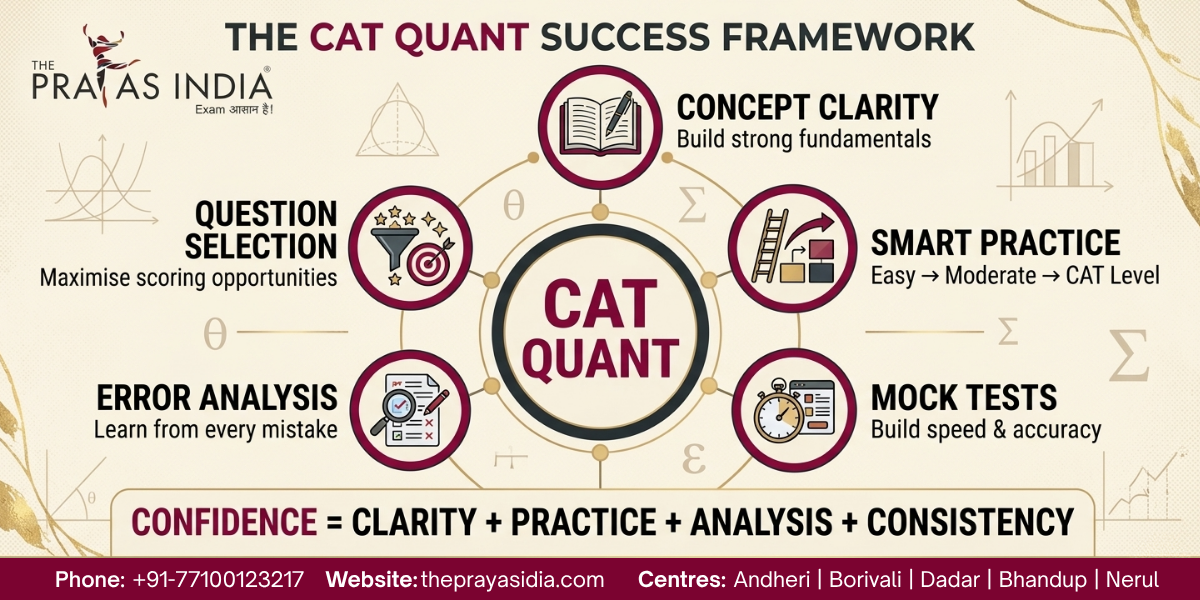
Start with fundamentals, strengthen arithmetic, gradually introduce algebra and geometry, practise CAT-level questions, analyse your mistakes and use mock tests to develop decision-making skills.
Most importantly, give yourself enough time to improve.
If you are serious about CAT 2026 and want structured guidance for Quant as well as VARC and DILR, exploring a suitable CAT Coaching in Mumbai can help you create a more organised preparation journey.
The Prayas India aims to support aspirants through structured learning, practice, testing and performance analysis so that preparation becomes less confusing and more focused.
Your academic background may influence where you begin.
It does not have to decide where you finish.
Contact Us
📞 Call Now: +91-77100 13217
🌐 Website: theprayasindia.com