Common Mistakes That Reduce SBI Clerk Prelims Scores | Best Bank Coaching in Mumbai | The Prayas India
SBI Clerk Prelims is often considered a manageable examination because the syllabus is familiar and the questions are generally designed to test speed, accuracy and basic aptitude. However, many candidates who have prepared the required concepts still fail to achieve the score they expect. The problem is not always a lack of knowledge. In many cases, small but repeated mistakes in question selection, time management, calculation, mock-test analysis and examination strategy reduce the final score.
A candidate may know how to solve a particular question but spend too much time on it. Another candidate may attempt a large number of questions but lose marks because of careless errors. Some aspirants repeatedly take mock tests without analysing why they are making mistakes, while others keep changing their strategy after every test.
For SBI Clerk Prelims, preparation should therefore focus not only on learning concepts but also on avoiding the mistakes that prevent you from converting your preparation into marks. Understanding these mistakes early can help you develop a more reliable strategy and improve your performance before the examination.
Mistake 1: Focusing Only on the Number of Attempts
One of the most common mistakes among SBI Clerk aspirants is treating the number of attempts as the primary indicator of preparation. Candidates often compare their attempts with those of friends, classmates or other aspirants and conclude that they need to attempt significantly more questions.
However, attempts have meaning only when considered alongside accuracy. If you attempt more questions but make several avoidable mistakes, the additional attempts may not improve your score. In fact, they can create a negative impact when incorrect answers are involved.
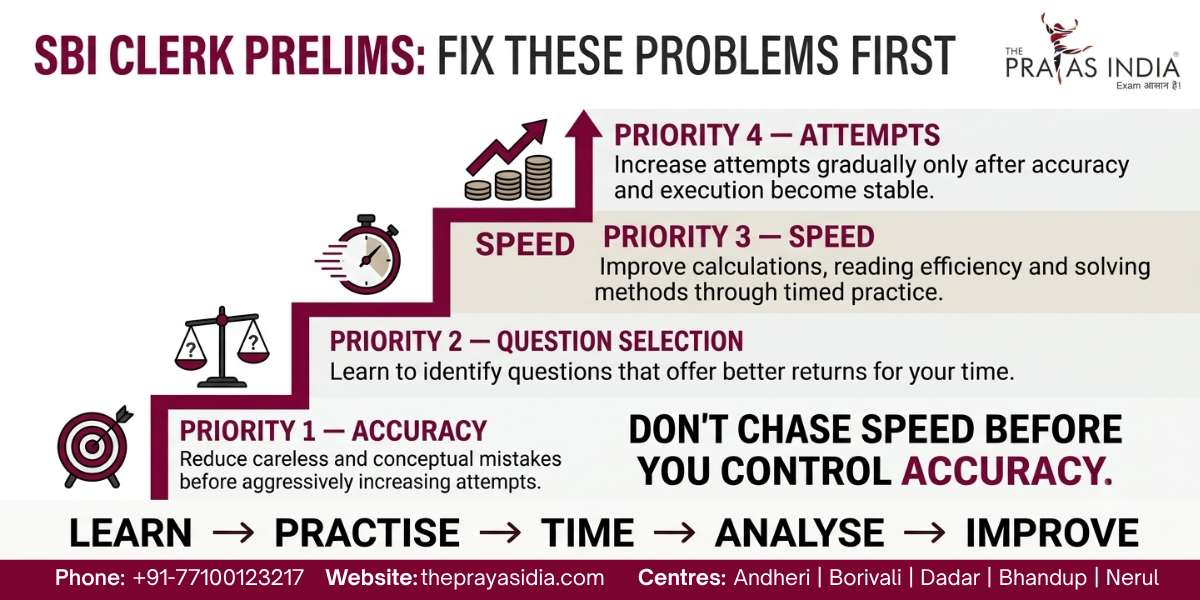
The better approach is to track productive attempts. These are questions that you can solve correctly within a reasonable amount of time. If your accuracy is currently inconsistent, first work on reducing mistakes. Once you become more confident and accurate, gradually increase your attempts through timed practice.
Your objective should not be to become the fastest candidate in the examination. It should be to make the best possible use of your available time while maintaining a dependable level of accuracy.
Mistake 2: Spending Too Much Time on One Difficult Question
A difficult question can consume much more time than expected, particularly when you are close to finding the solution. Candidates often continue working because they have already invested two or three minutes and do not want that time to feel wasted.
This mindset can become expensive in a time-bound examination.
The time already spent on a question cannot be recovered, but you can prevent additional time from being lost. If the solution path is not becoming clearer after reasonable effort, move ahead and look for another question that offers a better opportunity to score.
This is particularly important in Reasoning, where a complicated puzzle or seating arrangement can occupy several minutes. The same principle applies to Quantitative Aptitude when a calculation becomes unexpectedly lengthy.
Learning to leave a question temporarily is not the same as giving up. It is a strategic decision that allows you to protect your remaining examination time.
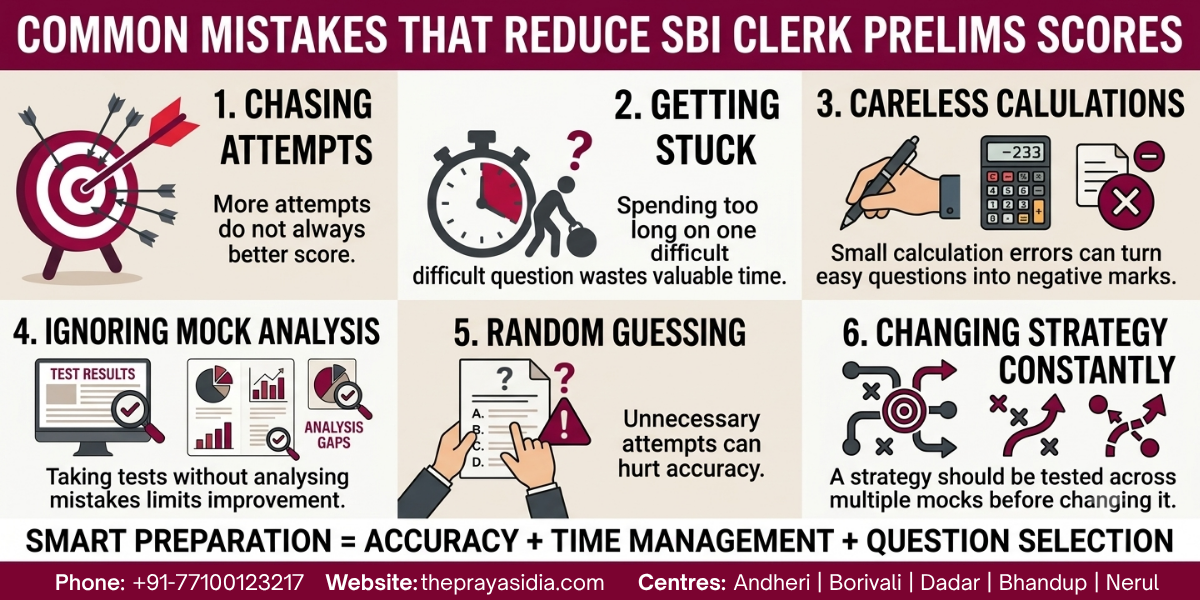
Mistake 3: Ignoring Careless Errors in Easy Questions
Not every wrong answer indicates a conceptual weakness. Some of the most frustrating mistakes happen in questions that a candidate actually knows how to solve.
A calculation is copied incorrectly, a negative sign is missed, an option is marked without reading the complete question, or a sentence is interpreted too quickly. These mistakes may look small, but when they happen repeatedly across mock tests, they can significantly affect your score.
The solution is not to become excessively slow. Instead, develop a controlled checking habit. Before submitting an answer, quickly verify the calculation or the specific requirement of the question when necessary. The amount of checking should depend on the nature of the question.
During mock analysis, maintain a separate record of careless mistakes. If you notice that the same type of error keeps appearing, address it deliberately during practice. A candidate who reduces five recurring careless errors can sometimes improve the score without learning any new topic.
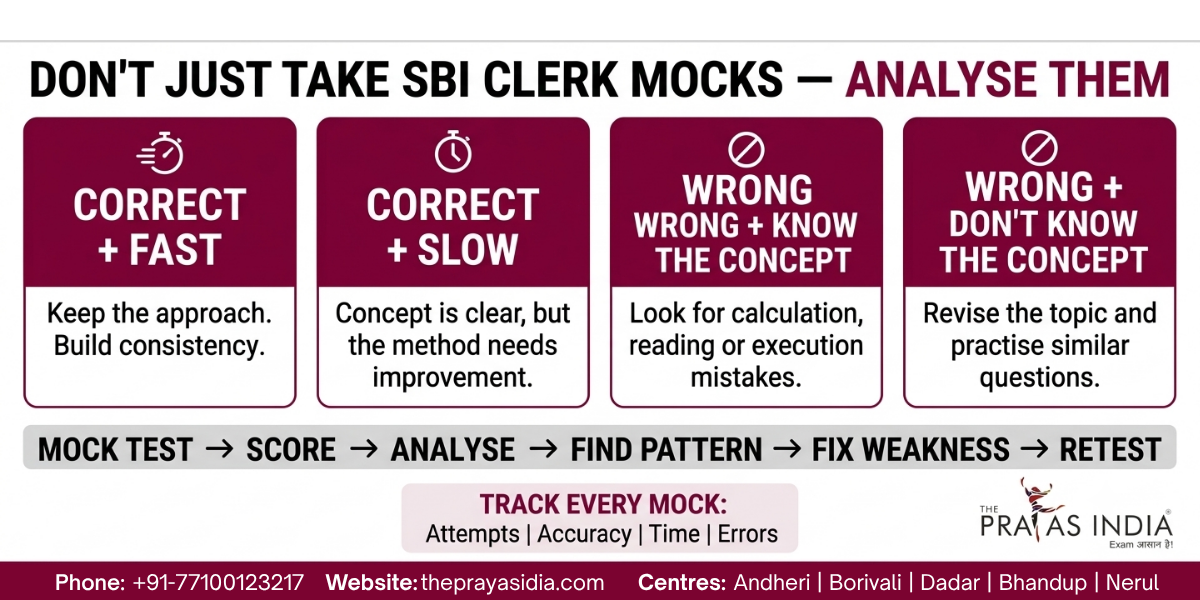
Mistake 4: Taking Mock Tests Without Analysing Them
Mock tests are valuable only when they provide information about your preparation. Taking one mock after another and looking only at the final score does not tell you what actually needs improvement.
After completing a mock, review the questions you got wrong, the questions you solved correctly but took too long to answer, and the questions you left unattempted. Each category provides different information.
Incorrect questions may indicate a conceptual gap or careless execution. Slow but correct questions may reveal inefficient methods. Unattempted questions may show either genuine difficulty or poor time allocation.
Your mock analysis should therefore answer questions such as: Where did I lose time? Which mistakes are recurring? Which question types are giving me the best returns? Which questions should I have attempted but missed?
This turns mock testing into a structured improvement process rather than simply a way of measuring your current score.
Mistake 5: Practising Without a Time Limit
Untimed practice is useful during the initial learning stage because it allows you to understand concepts and methods. But if most of your preparation remains untimed, you may find it difficult to reproduce the same performance under examination pressure.
SBI Clerk Prelims requires you to make decisions within strict sectional time constraints. You therefore need to gradually introduce timed practice once your basic concepts are comfortable.
Start with short timed sets and then progress towards sectional tests. This helps you understand how your solving speed changes when a clock is running. It also exposes problems that may not appear during relaxed practice.
The purpose of timed practice is not to create unnecessary pressure. It is to train your brain to make faster and more reliable decisions while maintaining accuracy.
Mistake 6: Trying to Attempt Every Question
The SBI Clerk Prelims paper contains questions of different difficulty levels. Treating every question as equally important can lead to inefficient time usage.
The right strategy is to identify questions that match your strengths and solve them first. This does not mean you should permanently avoid difficult questions. It means you should avoid allowing one difficult question to determine how the rest of your section goes.
For example, if you encounter a puzzle that requires several cases while there are simpler reasoning questions available, it may be sensible to secure the easier questions first. Similarly, in Quantitative Aptitude, a lengthy arithmetic question should not automatically receive priority over shorter questions that you can solve confidently.
Question selection becomes increasingly important as your preparation progresses because it allows you to convert the same level of knowledge into a better score.
Mistake 7: Guessing Questions Under Pressure
When candidates see the clock moving towards the end of a section, they may start attempting questions simply because they do not want to leave them unanswered. This can lead to impulsive decisions and unnecessary errors.
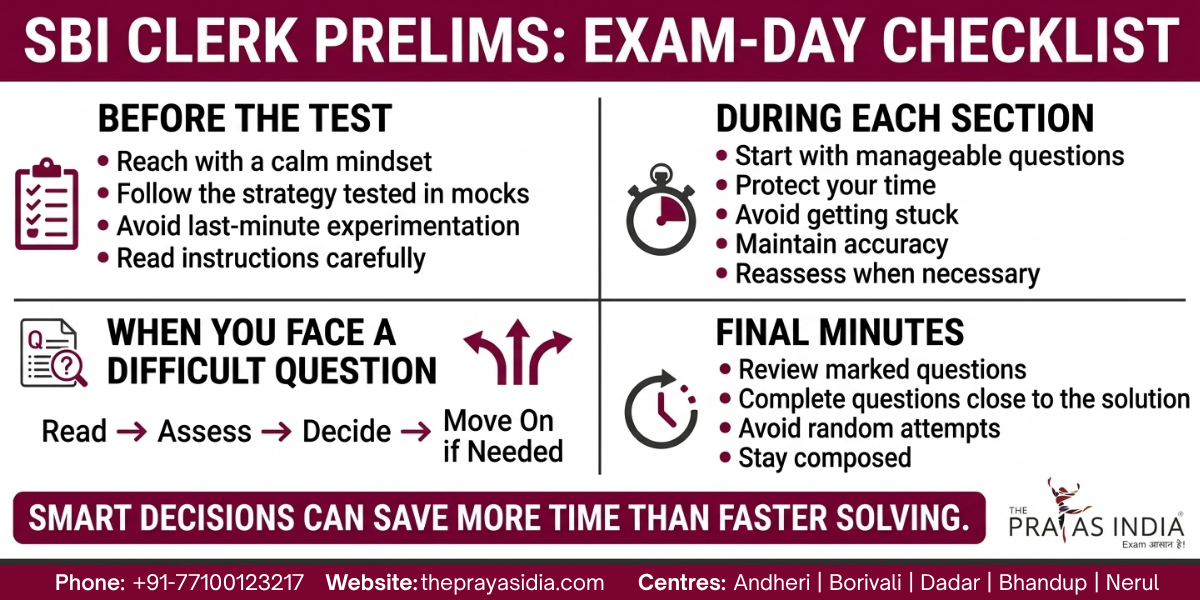
The final few minutes should not become a period of random guessing. Instead, use this time strategically. Review questions where you have a reasonable level of confidence, complete any unfinished calculations that are close to the solution and revisit questions that you deliberately postponed.
Developing a clear decision rule during mocks can help. If you cannot understand the question, have no reliable approach and are simply choosing an option based on intuition, the potential benefit may not justify the risk.
A disciplined approach under pressure is one of the major differences between practice performance and actual examination performance.
Mistake 8: Ignoring Weak Topics Because Strong Topics Feel Comfortable
Candidates naturally prefer studying subjects and question types they already understand. Solving familiar questions creates confidence, but spending most of your preparation time on strong areas can create an imbalance.
Suppose your English performance is already consistent but your Quantitative Aptitude accuracy remains weak in certain arithmetic topics. Spending another large block of time on comfortable English questions may not improve your overall performance as much as targeted Quant practice would.
This does not mean you should completely abandon your strengths. Maintain them through regular revision while allocating focused practice time to the weaknesses that are repeatedly affecting your mock scores.
Your preparation should gradually move from comfort-based practice to performance-based practice.
Mistake 9: Changing Your Strategy After Every Mock
One difficult mock can make candidates doubt everything they have been doing. They may suddenly change their section order, attempt strategy, question selection rules or time allocation.
This can create inconsistency rather than improvement.
A strategy should be judged across multiple mocks. If your approach works reasonably well in several tests but fails in one particularly difficult paper, analyse the paper before changing everything. On the other hand, if the same weakness appears repeatedly, that is a stronger indication that something needs to change.
The objective is to develop a strategy that is stable enough to follow under pressure but flexible enough to improve when evidence shows that a change is required.
Mistake 10: Comparing Your Score With Everyone Else
Competition is an unavoidable part of competitive examinations, but constantly comparing your mock score with other candidates can distract you from the areas that actually need improvement.
Different candidates may be using different test series, preparation levels and strategies. One candidate may have completed several months of preparation while another may be taking their first mock.
Instead of asking whether someone else attempted more questions, ask whether your own performance is improving. Are your careless mistakes decreasing? Are you solving familiar questions faster? Is your accuracy becoming more stable? Are you making better decisions about which questions to leave?
These are more useful indicators of progress.
Mistake 11: Neglecting Revision After Learning New Concepts
Learning a topic once does not guarantee that you will remember the method during a timed examination. Without revision, concepts that initially seemed clear can become less accessible, especially when the paper contains multiple sections and you are under pressure.
Revision should therefore be integrated into your preparation instead of being postponed until the final few days. Maintain concise notes for formulas, recurring concepts, common errors and methods that you frequently forget.
Your revision should also include questions you previously got wrong. Revisiting a mistake after some time can help ensure that the same problem does not appear again in a future mock.
Mistake 12: Not Having a Clear Examination-Day Strategy
Preparation becomes more effective when you have already decided how you want to approach the paper. Going into the examination without a clear strategy can result in unnecessary hesitation during the first few minutes.
Your strategy should cover question selection, time allocation, handling difficult questions and what you will do if a section appears unexpectedly difficult.
Do not create an overly rigid plan that depends on the paper being exactly as expected. Instead, develop a flexible framework that allows you to adapt while maintaining control.
The most important objective is to avoid panic when you encounter an unfamiliar question or a difficult set. Your preparation should have taught you that leaving one question does not mean losing the examination.
How The Prayas India Can Support Your SBI Clerk Preparation
Avoiding mistakes becomes easier when you have a preparation system that continuously identifies and addresses them. A structured coaching environment can provide regular practice, mock tests, performance analysis and guidance on how to approach different sections of the examination.
For aspirants preparing for SBI Clerk and other bank examinations in Mumbai, The Prayas India provides structured preparation support designed around competitive-exam requirements. Instead of relying only on repeated practice, students can work on conceptual clarity, question-solving techniques, time management and mock-test performance.
The right coaching approach should not simply tell you to study harder. It should help you understand where your preparation is losing marks and what you need to change.
Aspirants looking for Bank Exam Coaching in Mumbai can explore The Prayas India centres at Andheri, Borivali, Dadar, Bhandup and Nerul.
For admission-related information, contact +91-77100 13217.
Final Takeaway
SBI Clerk Prelims scores are often reduced not by one major mistake but by several small mistakes repeated throughout the paper. Spending too long on difficult questions, making careless calculations, chasing attempts, guessing under pressure, ignoring mock analysis and constantly changing strategies can all prevent your preparation from producing the score you expect.
The solution is to make your preparation more performance-oriented. Track your attempts, accuracy and time, but also pay attention to the questions that consume your time and the mistakes that appear repeatedly. Use mocks to identify patterns rather than simply collecting scores.
As your preparation progresses, aim to become better at three things: selecting the right questions, solving them efficiently and avoiding unnecessary errors. Once these skills become consistent, your speed and score can improve together.
For candidates seeking Best Bank Coaching in Mumbai, The Prayas India offers structured preparation and guidance.
Contact Us
📞 Call Now: +91-77100 13217
🌐 Website: theprayasindia.com
📍 Centres: Andheri | Borivali | Dadar | Nerul | Bhandup
FAQs
1. What are the most common mistakes in SBI Clerk Prelims?
Common mistakes include spending too much time on difficult questions, making careless calculations, blindly increasing attempts, guessing under pressure, ignoring mock-test analysis and changing strategies too frequently.
2. How can I avoid careless mistakes in SBI Clerk Prelims?
Analyse every incorrect answer and identify whether it was caused by calculation, misreading, rushing or incorrect interpretation. Maintain an error log and practise the specific mistake patterns repeatedly.
3. Should I attempt every question in SBI Clerk Prelims?
No. Your objective should be to maximise correct and productive attempts rather than attempting every question. Question selection and time management are important parts of the examination strategy.
4. Why is mock-test analysis important for SBI Clerk preparation?
Mock analysis helps you understand why you are losing marks. It can reveal conceptual gaps, careless errors, slow-solving areas, poor question selection and inefficient time management.
5. How can I improve my SBI Clerk Prelims score without increasing attempts significantly?
Start by reducing avoidable mistakes and improving the efficiency of questions you already attempt. Better accuracy, faster calculations and improved question selection can increase your score without requiring a dramatic increase in attempts.
6. Is coaching useful for SBI Clerk preparation in Mumbai?
Structured coaching can help aspirants follow a planned preparation schedule, practise regularly, take mock tests and receive guidance on performance improvement. The Prayas India offers bank exam coaching at Andheri, Borivali, Dadar, Bhandup and Nerul.