How to Build a Daily Practice Routine for MBA CET Logical Reasoning | Best MBA CET Coaching in Mumbai | The Prayas India
Logical Reasoning can become one of the most rewarding areas of MBA CET preparation when practice is consistent and purposeful. Unlike a subject that can be prepared effectively through reading alone, Logical Reasoning improves significantly when you repeatedly expose yourself to different question patterns, learn to identify relationships quickly and review the mistakes you make during practice. For MBA CET aspirants, the challenge is not simply knowing how to solve a particular reasoning question. It is developing the ability to understand a problem quickly, select the right approach and arrive at an answer without wasting valuable examination time.
This is why a daily practice routine for MBA CET Logical Reasoning should be designed differently from a conventional study timetable. Solving hundreds of questions without analysing them may give you the feeling that you are working hard, but it does not necessarily improve your performance. A better routine combines concept revision, focused question practice, timed drills and error analysis. Over time, this creates familiarity with common reasoning patterns and helps make the solving process more natural.
For students preparing for MBA CET, daily practice is particularly important because the examination demands both speed and accuracy. You may understand the logic behind a question perfectly and still lose marks if you take too long to solve it. Your preparation therefore needs to develop two abilities together: the ability to solve correctly and the ability to solve efficiently.
Why a Daily Reasoning Routine Matters for MBA CET
One of the biggest problems with irregular preparation is that reasoning skills can become inconsistent. An aspirant may solve several sets on one day, take a long break and then return to Logical Reasoning several days later. While the concepts may still be familiar, the speed of recognition and decision-making can decline.
Daily practice creates continuity. Even a relatively short reasoning session can keep your mind engaged with the patterns and structures that frequently appear in aptitude examinations. As you practise regularly, you begin to recognise familiar formats faster instead of approaching every question as a completely new problem.
However, daily practice does not mean spending several hours on Logical Reasoning every day. Your MBA CET preparation also needs time for Quantitative Aptitude, Verbal Ability and other areas. The objective is to create a focused and sustainable reasoning practice block that fits into your larger preparation schedule.
For most aspirants, the quality of the practice session matters more than its duration. A focused session in which you solve questions carefully, track your timing and analyse mistakes can be more useful than a much longer session of random question-solving.
Start With a Fixed Daily Practice Window
The first step in building a routine is to decide when Logical Reasoning will become part of your daily schedule. Keeping the timing relatively consistent can make it easier to turn practice into a habit.
You do not need to select a time simply because someone else studies reasoning at that hour. Choose a period during which you can concentrate without frequent interruptions. If you are most alert in the morning, you can use that period for more demanding reasoning practice. If your academic or work schedule makes evenings more practical, create your reasoning block then.
The important thing is consistency.
Instead of deciding every day whether you will practise reasoning, make it a fixed part of your routine. Once the habit is established, you spend less mental energy deciding what to do and more energy actually doing it.
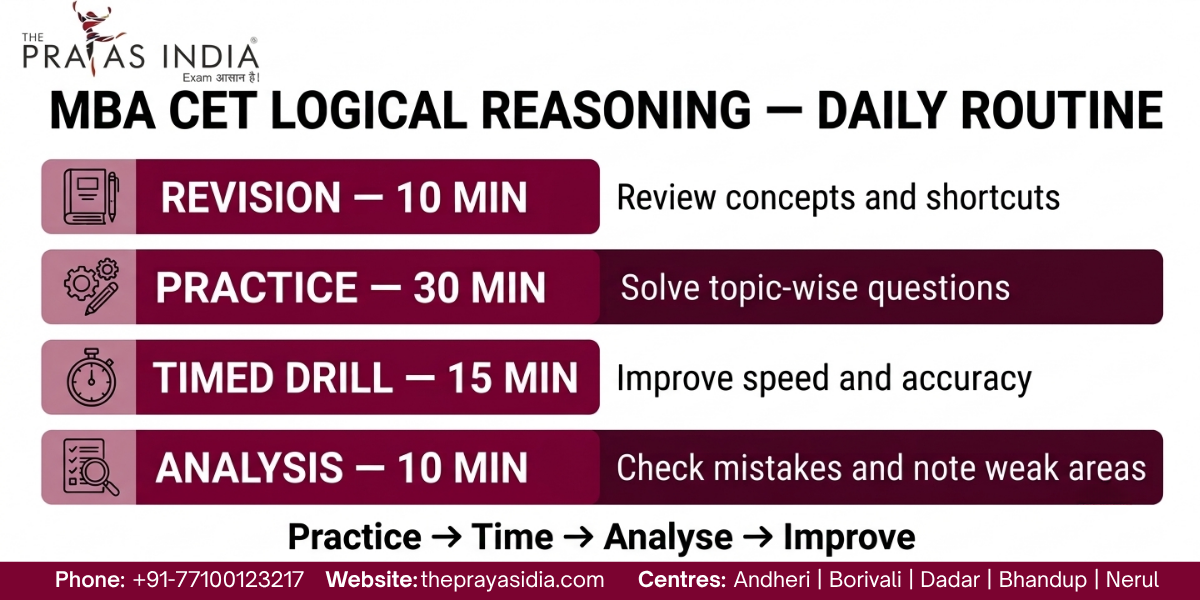
A useful daily session can contain three components: short revision, focused practice and review. The exact duration can change according to your preparation stage, but the structure should remain broadly consistent.
Divide Practice Into Small, Manageable Blocks
Trying to solve every type of reasoning question in a single session can make practice unnecessarily tiring. A more efficient approach is to divide your daily session according to the objective.
For example, one part of the session can be used for a particular reasoning topic, while another can focus on mixed questions. A short timed drill can then test how quickly you can apply what you have practised.
This approach also makes it easier to identify specific weaknesses. If your entire session consists of mixed questions, you may know that your overall performance is weak but not immediately understand why. Topic-focused practice provides clearer feedback.
As your preparation progresses, the balance can gradually shift. Early preparation can give more importance to topic-based learning, while later preparation can increasingly include mixed and timed practice.
Choose Topics Based on Your Current Preparation Stage
Your daily practice routine should evolve as your preparation progresses. A beginner should not follow exactly the same practice structure as someone who has already completed the MBA CET syllabus.
During the initial stage, focus more heavily on understanding individual question types. This is the period when you should become comfortable with topics such as series, coding-decoding, blood relations, direction sense, syllogisms, statement-based reasoning, arrangements and other logical reasoning formats relevant to your preparation.
Once the fundamentals become stronger, introduce mixed practice. Mixed sets are useful because they remove the comfort of knowing which method you are expected to use. In the actual examination, you do not receive a label telling you whether the next question requires a particular approach. You have to recognise the structure yourself.
At the advanced stage, timed practice should become increasingly important. Your objective should be to reproduce examination conditions while maintaining accuracy.
This progression can be summarised as:
Learn the pattern → Practise the pattern → Mix the patterns → Time the practice → Analyse performance.
Do Not Chase Question Quantity
A common mistake among MBA CET aspirants is measuring preparation by the number of questions completed.
There is nothing inherently wrong with solving a large number of questions, but quantity becomes less meaningful when you do not understand why you are getting questions right or wrong. Solving 100 questions without reviewing your mistakes may be less productive than solving 40 questions carefully and analysing the errors afterwards.
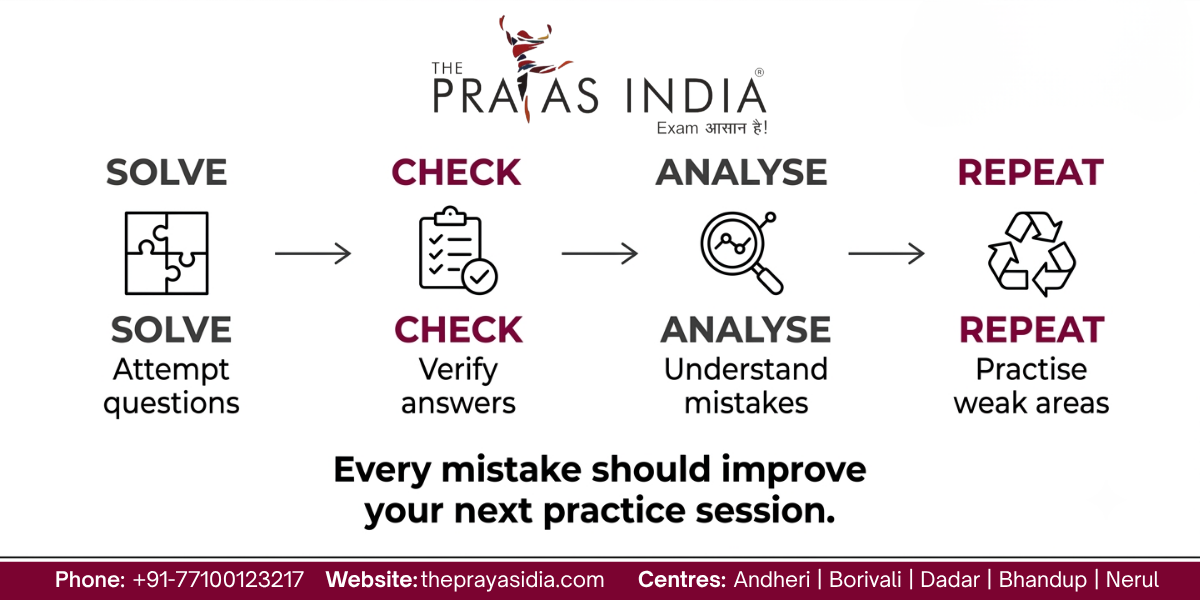
Every practice session should provide some information about your preparation.
If you repeatedly make mistakes in one type of question, that is useful information. If you solve a topic accurately but slowly, that is also useful information. If you notice that you are making mistakes because you misread conditions, that tells you what needs to change.
The purpose of practice is therefore not simply to increase the number of questions you have seen. It is to gradually improve your accuracy, recognition speed and solving efficiency.
Build a Mistake Log for Logical Reasoning
A simple mistake log can become one of the most useful parts of your daily reasoning routine. Whenever you make an avoidable mistake, record the question type and the reason behind the error.
You do not need to copy entire questions into a notebook. A short description is enough. You might note that you missed a condition in an arrangement, incorrectly interpreted a relationship, rushed through the options or spent too much time using an inefficient approach.
After a few weeks, review these entries. Repeated patterns will become visible.
For example, if several mistakes come from misreading conditions, you need to improve reading discipline. If your errors are concentrated in one topic, that topic needs targeted revision. If your accuracy is good but your timing is poor, the problem is likely more related to solving efficiency than conceptual understanding.
This transforms mistakes from something negative into a personal preparation database.
Learn to Recognise the Question Before Solving It
One of the most effective ways to improve reasoning speed is to spend less time figuring out what kind of problem you are looking at.
When you encounter a question, first identify its structure. Is it asking you to establish a relationship? Arrange information? Identify a pattern? Draw a conclusion? Compare statements? Determine a sequence?
This small recognition step can prevent you from immediately trying random approaches.
Experienced aptitude candidates often appear fast because they are not necessarily performing every logical operation faster than everyone else. They have become familiar with recurring structures and can quickly narrow down the appropriate method.
This ability develops through exposure. That is why your daily practice should include sufficient variety rather than repeatedly solving the same format.
Practise With a Timer, But Do Not Rush
Timed practice is essential for MBA CET, but introducing a timer too aggressively can create another problem. If you are still learning a topic, focusing heavily on speed may encourage careless solving and prevent you from understanding the underlying logic.
Begin with accuracy. Once you can solve the question type consistently, introduce a reasonable time target.
For example, if you currently take too long on a particular type of question, do not immediately try to cut the time dramatically. First examine the solving process. Perhaps you are writing unnecessary steps, checking the same information multiple times or using a longer method.
Once the inefficient steps are removed, speed often improves naturally.
The objective is not to become fast by rushing. It is to become fast because your method has become efficient.
Make Mixed Practice a Regular Part of Your Routine
Topic-wise practice is excellent for building fundamentals, but mixed practice is necessary for developing examination readiness.
When questions are mixed, you cannot predict the solving method in advance. You have to identify the question type from the information presented and decide whether it is worth attempting.
This develops the decision-making skills required in a competitive examination.
A useful weekly structure could therefore include several topic-focused sessions combined with regular mixed sets. As the examination approaches, the proportion of mixed and timed practice can increase.
This also helps prevent overconfidence. A candidate may perform extremely well when practising only one familiar topic but struggle when different question types appear together. Mixed practice reveals whether the skill has actually transferred into a broader examination environment.
Key Takeaway
A strong daily practice routine for MBA CET Logical Reasoning should not be built around the idea of solving as many questions as possible. It should be designed to steadily improve your ability to recognise question patterns, apply the correct approach, maintain accuracy and manage time.
Start by creating a fixed daily practice window and divide it into manageable activities such as revision, focused practice, timed drills and analysis. Gradually move from topic-based questions to mixed sets as your understanding improves.
Keep a mistake log and use it actively. Every recurring error should tell you something about your preparation. At the same time, avoid rushing simply because a timer is running. First develop an efficient method and then work on reducing the time required to execute it.
With consistent practice, Logical Reasoning can become a more predictable and manageable component of your MBA CET preparation.
Create a Weekly Logical Reasoning Practice Structure
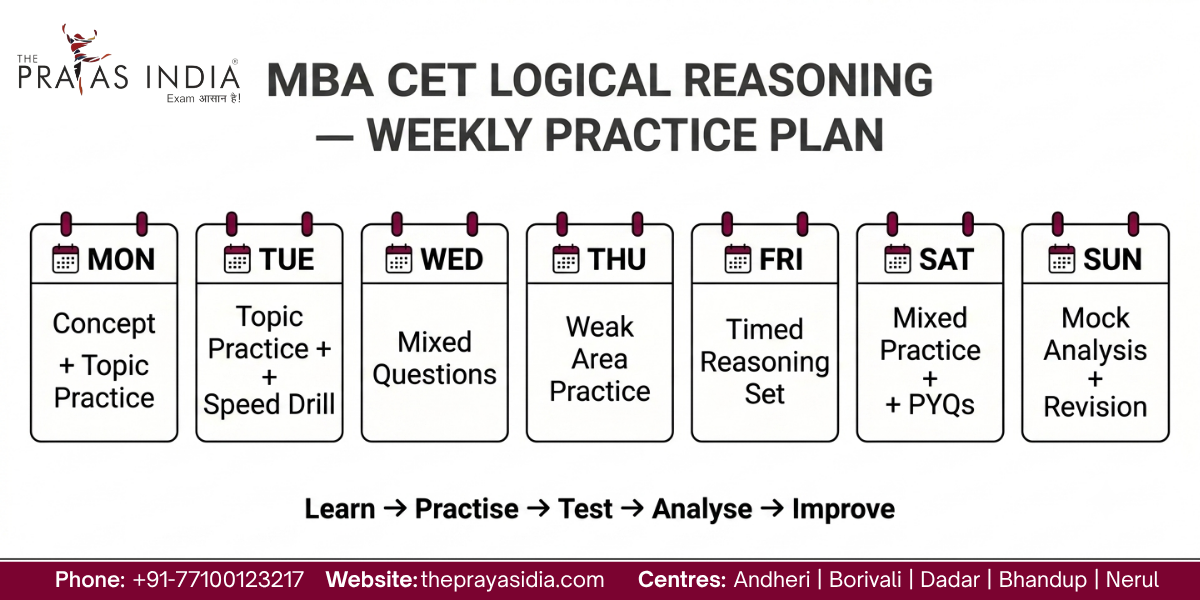
A weekly plan can help you distribute different types of reasoning practice without making every day feel identical. Instead of attempting random questions whenever you find time, decide in advance what each practice session is supposed to achieve.
For example, some days can focus on individual reasoning topics, while another session can be dedicated to mixed questions. You can also reserve a specific day for a timed sectional drill and use the final session of the week to review mistakes and revise weak areas.
This structure creates a natural progression throughout the week. You learn, practise, test and then review.
The exact number of questions or hours will vary according to your preparation level, but the principle remains the same: every practice session should have a clear purpose.
Balance Individual Questions With Longer Reasoning Sets
MBA CET Logical Reasoning preparation should not focus exclusively on lengthy sets. While arrangement-based and multi-condition questions can test several reasoning skills together, individual questions can help you develop faster recognition and decision-making.
A balanced routine should therefore include both.
Individual questions are useful for improving your response time on familiar patterns. Longer sets help you develop the ability to organise information, track multiple conditions and maintain accuracy over several deductions.
If you spend all your preparation time on lengthy sets, you may become comfortable with complex problems but lose speed on simpler questions. Conversely, if you practise only short questions, you may struggle when faced with a more involved reasoning set.
The ideal routine exposes you to both types and gradually teaches you when each deserves your attention.
Learn When to Leave a Question
Improving reasoning speed is not only about solving faster. It is also about making better decisions about which questions deserve your time.
During practice, notice how long you spend on questions that ultimately produce little value. Sometimes you may understand the problem but realise that the available information requires too many deductions. In another question, the options may make the solution relatively straightforward.
Learning this distinction takes practice.
When a question is consuming substantially more time than expected and you are not making meaningful progress, mark it and move ahead. Returning to it later may be more productive than allowing one difficult question to affect the rest of your attempt.
This habit is particularly important in a speed-oriented examination such as MBA CET because time saved on one difficult question can be used to attempt multiple manageable questions.
Use Previous-Year Questions to Understand Exam Behaviour
Previous-year questions are valuable because they help you move beyond theoretical preparation. They show how concepts are converted into actual examination questions and help you understand the level of reasoning expected.
Do not treat previous-year questions simply as another question bank. Analyse them.
Look for recurring formats, familiar structures and question types that repeatedly require similar approaches. Pay attention to the wording of the questions and the type of information provided.
Once you identify patterns, include those patterns in your regular practice.
However, avoid memorising previous questions. The purpose is to understand the underlying structure so that you can solve a new question built around the same reasoning principle.
Use Mocks to Test Your Daily Practice
Daily practice builds individual skills, but mock tests reveal whether those skills work under pressure.
A candidate may perform extremely well during an untimed topic session but struggle to maintain the same accuracy when several question types appear together. Mock tests help identify this gap.
After completing a mock, do not stop at checking your score. Divide your reasoning performance into categories such as:
Correct and Fast: Your approach is working well.
Correct but Slow: You need efficiency improvement.
Incorrect but Solvable: You need better accuracy or attention.
Incorrect Due to Concept Gap: You need revision.
Skipped but Solvable: You need better question recognition or selection.
This classification gives you much more useful information than the overall score alone.

Increase Difficulty Gradually
Your daily practice should become more challenging as your ability improves. Starting with difficult questions before understanding the fundamentals can create unnecessary frustration, while remaining with very easy questions for too long can create false confidence.
A sensible progression is to begin with basic and moderate questions, develop consistency and then introduce more complex sets and tighter time limits.
You should also change the type of challenge. Sometimes the difficulty should come from the complexity of the logic. At other times, the questions can remain moderate but the time available can be reduced.
This helps you develop both problem-solving ability and examination speed.
The objective is not to make every practice session difficult. It is to make sure that your preparation keeps moving forward.
Improve Speed Without Sacrificing Accuracy
Speed and accuracy should not be treated as competing goals. In a competitive examination, speed without accuracy can result in a poor score, while perfect accuracy achieved at an extremely slow pace can leave many questions unattempted.
The solution is to develop speed gradually while maintaining a reliable accuracy level.
If your accuracy drops sharply whenever you increase your speed, do not immediately push yourself harder. Analyse the reason. Perhaps you are skipping important conditions, rushing through the question statement or selecting options without sufficient verification.
Once you identify the problem, correct the process and then introduce time pressure again.
A useful principle is:
First become consistently correct. Then become consistently faster.
Avoid Changing Your Strategy Every Few Days
MBA CET preparation can involve a large amount of online advice, preparation techniques and study recommendations. One candidate may suggest solving a particular number of questions, another may recommend a completely different routine, and a new strategy can appear every time you search for preparation tips.
Constantly changing your routine can prevent you from accurately evaluating whether your current approach is working.
Give your practice structure enough time to generate meaningful data. Track your performance over multiple sessions rather than judging your progress from one difficult day.
If you discover a genuine weakness, make a targeted adjustment instead of completely rebuilding your preparation.
Consistency becomes much easier when your routine is stable.
Keep One Day for Review and Adjustment
A weekly review is useful because it allows you to step back from daily practice and examine the larger picture.
Look at the topics you covered, the questions you solved, the mistakes you made and the amount of time you spent on different areas. Then identify the two or three changes that would have the greatest impact on the following week.
Do not create a long list of corrections. Too many changes can make the next week’s routine unnecessarily complicated.
For example, if your biggest issue is slow arrangement solving, allocate additional targeted practice to arrangements. If your accuracy is falling because of careless reading, focus on question interpretation. If your performance is generally strong but your timing is weak, increase timed mixed practice.
A weekly review should produce clear actions, not additional stress.
Build a Routine That Fits Your Overall MBA CET Preparation
Logical Reasoning is only one part of MBA CET preparation. Your daily routine should therefore fit into the larger preparation schedule rather than consume disproportionate time.
If you spend most of your available study time on reasoning, you may create gaps in Quantitative Aptitude or Verbal Ability. On the other hand, giving reasoning too little attention can prevent the development of speed and familiarity.
The right balance depends on your current strengths and weaknesses.
A candidate who is already strong in reasoning may need shorter maintenance sessions and more time for weaker areas. Someone who struggles with reasoning may temporarily allocate more practice time to it before gradually balancing the schedule.
Your routine should therefore be personalised according to performance rather than copied directly from someone else’s timetable.
How Structured MBA CET Coaching Can Support Your Preparation
A daily practice routine is easier to follow when you have clarity about what to practise, how to measure improvement and how to correct mistakes. This is one area where structured coaching can provide an advantage.
For aspirants preparing for MBA CET, MBA CET Coaching in Mumbai can offer an organised preparation environment where concepts, practice, tests and performance analysis are integrated into a broader plan.
Instead of spending excessive time deciding which questions to practise next or repeatedly changing resources, students can follow a more structured path. Regular tests can also provide benchmarks that help identify whether speed and accuracy are improving.
At The Prayas India, MBA CET aspirants can work towards their examination goals through structured preparation, guided practice and a focused approach to competitive-exam performance.
The purpose of coaching should ultimately be to help students become more independent and exam-ready, not simply to increase the number of classes they attend.
A Practical Daily Routine You Can Follow
Once your preparation has progressed beyond the basic learning stage, a daily Logical Reasoning session can follow a simple structure.
Begin with a short review of concepts or previously identified weak areas. Move into focused question practice where the objective is accuracy and method. Follow this with a short timed drill to develop speed. Finally, spend a few minutes reviewing errors and noting anything that needs to be revisited.
The routine does not need to be extremely long to be effective.
What matters is that you repeat the cycle consistently and gradually increase the quality of the practice.
Over several weeks, the cumulative effect can be significant. Question patterns become easier to recognise, solving approaches become more familiar and the amount of time required to make decisions can gradually decrease.
Final Takeaway
Building a daily practice routine for MBA CET Logical Reasoning is ultimately about creating structured repetition with continuous feedback.
A good routine should not simply tell you how many questions to solve. It should help you understand what you are practising, how quickly you are solving it, why mistakes are happening and what you need to change next.
Begin with topic-focused practice to strengthen fundamentals. Introduce mixed sets to improve question recognition, use previous-year questions to understand examination patterns and add timed drills as your preparation progresses. Use mock tests to evaluate your performance under pressure and analyse your mistakes rather than focusing exclusively on your score.
Most importantly, do not confuse a busy schedule with effective preparation. A manageable routine that you can follow consistently is more valuable than an aggressive timetable that becomes difficult to sustain.
For aspirants looking for MBA CET Coaching in Mumbai, structured guidance can help bring concepts, practice, mock tests and analysis together within a more organised preparation framework.
With the right routine, Logical Reasoning can gradually move from a subject that requires conscious effort to an area where recognition, decision-making and solving become faster and more natural.
Contact Us
📞 Call Now: +91-77100 13217
🌐 Website: theprayasindia.com
📍 Centres: Andheri | Borivali | Dadar | Nerul | Bhandup
FAQs
1. How much time should I spend on Logical Reasoning every day for MBA CET?
The ideal duration depends on your preparation level and overall schedule. A focused daily session covering practice, timed questions and analysis is generally more useful than spending long hours solving questions without reviewing your performance.
2. Should I practise MBA CET Logical Reasoning every day?
Regular practice is beneficial because it helps maintain familiarity with question patterns and improves recognition speed. Even when you have limited time, a short but focused reasoning session can help maintain consistency.
3. Should I solve topic-wise questions or mixed questions first?
Topic-wise practice is more useful when you are learning a concept or strengthening a weak area. Once your fundamentals improve, introduce mixed sets so that you learn to identify the appropriate approach without knowing the topic beforehand.
4. How can I improve speed in MBA CET Logical Reasoning?
Work on question recognition, practise efficient solving methods, use timed drills and analyse questions that take too long. Speed should be developed gradually without allowing accuracy to decline significantly.
5. Are previous-year questions useful for MBA CET Logical Reasoning preparation?
Yes. Previous-year questions can help you understand the types of reasoning structures and question formats that have appeared in the examination. They should be analysed for patterns rather than memorised.
6. How can MBA CET coaching help with Logical Reasoning preparation?
Structured MBA CET coaching can provide organised practice, regular tests, performance feedback and guidance on how to balance concepts, speed, accuracy and revision within the overall preparation plan.