How The Prayas India Helps Students Prepare for SBI and IBPS Exams | Best Banking Coaching in Mumbai
Banking examinations such as SBI Clerk, SBI PO, IBPS Clerk and IBPS PO continue to attract a large number of graduates looking for stable and growth-oriented career opportunities in the banking sector. However, the increasing competition means that simply completing the syllabus is no longer enough. Aspirants need a preparation system that helps them understand concepts, practise consistently, improve speed and accuracy, evaluate their performance and remain prepared for different stages of the examination.
This is where structured coaching can make a meaningful difference. Many students begin bank exam preparation with online resources, books and free practice material, but eventually face questions about what to study first, how much to practise, which topics require greater attention and how to evaluate whether their preparation is actually improving. Without a clear framework, preparation can easily become a collection of disconnected study sessions.
The Prayas India approaches bank exam preparation with a structured learning process designed to help students work towards their examination goals systematically. Instead of treating preparation as simply finishing chapters, the focus is on creating a process where learning, practice, testing and improvement work together.
For students searching for Banking Coaching in Mumbai, the decision should therefore not be based only on the number of classes or study material provided. The more important question is whether the coaching environment helps an aspirant build the skills required to perform effectively in the actual examination.
The Reality of SBI and IBPS Bank Exam Preparation
Bank examinations may appear straightforward when viewed only through their syllabus. The actual challenge begins when candidates have to solve questions accurately within strict time constraints.
A student may know how to solve a particular Quantitative Aptitude question but still lose marks because the calculation takes too long. Another student may understand a reasoning concept but spend excessive time on a puzzle. Someone else may have reasonable English skills but struggle with reading comprehension under pressure.
This is why bank exam preparation requires more than subject knowledge.
The preparation process needs to develop several abilities simultaneously: conceptual understanding, question recognition, speed, accuracy, time management and examination decision-making. These skills are developed through repeated exposure to different types of questions and regular evaluation.
At The Prayas India, students can approach this process in a more organised manner rather than trying to figure out every stage independently. The purpose of coaching is not to eliminate self-study but to give self-study a clearer direction.
Starting With the Right Preparation Roadmap
One of the first challenges faced by a bank exam aspirant is deciding where to begin.
A beginner may find the syllabus overwhelming because every section contains multiple topics. If the student starts randomly, some chapters may receive excessive attention while important areas remain untouched.
A structured roadmap solves this problem by breaking preparation into manageable stages.
The first stage is generally about understanding the fundamentals. Students need to become comfortable with the concepts and question formats that form the foundation of the respective sections. Once these fundamentals are reasonably clear, preparation can move towards topic-wise practice and increasingly varied questions.
The next stage should focus on timed solving. This is where students begin learning how to apply their knowledge efficiently rather than simply demonstrating that they understand a concept.
As the examination approaches, the focus naturally shifts towards sectional tests, full-length mocks, revision and performance analysis.
This progression gives students a sense of direction. Instead of asking, “What should I study today?”, they can understand where today’s work fits into the larger preparation plan.
Building Strong Foundations in Quantitative Aptitude
Quantitative Aptitude is often one of the sections where students have very different starting points.
Some aspirants have strong mathematical fundamentals and mainly need speed and accuracy. Others may carry weaknesses from school-level mathematics and require more time to develop confidence.
A good preparation strategy should recognise this difference rather than expecting every student to progress at exactly the same pace.
At The Prayas India, students preparing for SBI and IBPS examinations can work on Quantitative Aptitude through a combination of conceptual learning and question practice. The objective is to make students comfortable with the logic behind different question types before expecting them to solve them rapidly.
Topics such as simplification, number series, arithmetic, data interpretation, percentages, profit and loss, averages, ratios and other relevant areas require repeated application. Merely reading formulas is unlikely to create examination readiness.
Students need to solve questions, identify inefficient methods and gradually improve their calculation speed.
The long-term objective is to reach a stage where a candidate can recognise the nature of a question quickly and select an appropriate approach without unnecessary hesitation.
Developing Reasoning Through Structured Practice
Reasoning Ability can become a strong scoring area, but only when students learn how to approach different question structures efficiently.
Questions involving inequalities, syllogisms, coding-decoding, blood relations and direction sense often require a clear understanding of the underlying logic. Puzzles and seating arrangements, on the other hand, demand the ability to organise multiple conditions and identify relationships between different pieces of information.
Random practice may provide exposure, but structured practice can make the learning process more efficient.
Students should gradually move from basic questions to mixed practice and then to timed sets. This progression helps develop both conceptual understanding and decision-making.
Another important aspect is learning when not to spend too much time on a particular puzzle or question. In an examination where every minute matters, question selection becomes an important component of reasoning strategy.
Coaching can help students identify these patterns earlier by exposing them to a broader range of question types and providing structured feedback during preparation.
Improving English for SBI and IBPS Examinations
English preparation requires a different kind of consistency.
Unlike topics where students can sometimes improve through memorising formulas or procedures, language skills develop through regular exposure and practice. Reading comprehension, error detection, cloze tests, para jumbles and vocabulary-based questions require candidates to understand how language is being used.
This is why English preparation should not be limited to solving questions immediately before a test.
Regular reading can help students become more comfortable with different writing styles and unfamiliar subjects. Alongside reading, targeted question practice can help identify specific weaknesses in grammar, comprehension or question interpretation.
Students should also analyse incorrect answers rather than simply checking the correct option. Understanding why an option was incorrect can improve future decision-making.
A structured preparation environment can help maintain this consistency because English practice becomes part of the overall study plan rather than something students postpone until the examination approaches.
Preparing for Both Prelims and Mains
One of the important advantages of planning your bank exam preparation early is that you can avoid treating Prelims and Mains as completely separate examinations.
Prelims generally requires strong performance in areas such as English, Numerical Ability and Reasoning, while Mains introduces additional areas and demands a broader level of preparation depending on the examination.
Students who focus exclusively on clearing Prelims may later find themselves under pressure when they have limited time to prepare for Mains.
A more effective approach is to build the fundamentals required for Prelims while gradually developing awareness and skills needed for the next stage.
This does not mean studying every Mains topic intensively from the beginning. Instead, it means maintaining awareness of the complete examination journey and using the preparation period intelligently.
For aspirants targeting multiple bank examinations, this approach can also make preparation more efficient because several core subjects overlap across SBI and IBPS exams.
Why Practice Material Alone Is Not Enough
The availability of online resources has made study material easier to access than ever before. Students can find videos, PDFs, question banks and mock tests within minutes.
However, more material does not necessarily mean better preparation.
In fact, having too many resources can create another problem: students keep switching between sources without completing a structured practice cycle.
A well-designed preparation system should help students determine what to study, when to practise it and how to evaluate the outcome.
This is one area where classroom or guided coaching can be useful. Instead of continuously searching for new material, students can work through a defined learning path and use additional resources selectively when required.
The objective should not be to collect the largest possible amount of content. It should be to extract maximum learning from the material you actually use.
The Role of Regular Tests in Bank Exam Preparation
Tests should not be introduced only when the examination date is approaching.
Regular testing provides an objective measure of preparation.
A topic test can show whether a particular concept has been understood. A sectional test can reveal whether the student can maintain performance across multiple question types. A full-length mock can show how effectively the candidate manages time and decision-making across the entire paper.
The important part comes after the test.
A score by itself does not explain why performance improved or declined. Students need to examine the questions they attempted, the questions they left, the questions they got wrong and the amount of time spent on different sections.
This analysis can then influence the next stage of preparation.
For example, if a candidate’s reasoning accuracy is strong but puzzle-solving consumes excessive time, the next practice cycle should focus more heavily on timed puzzle sets and question selection.
This creates a continuous feedback loop between preparation and performance.
Key Takeaway
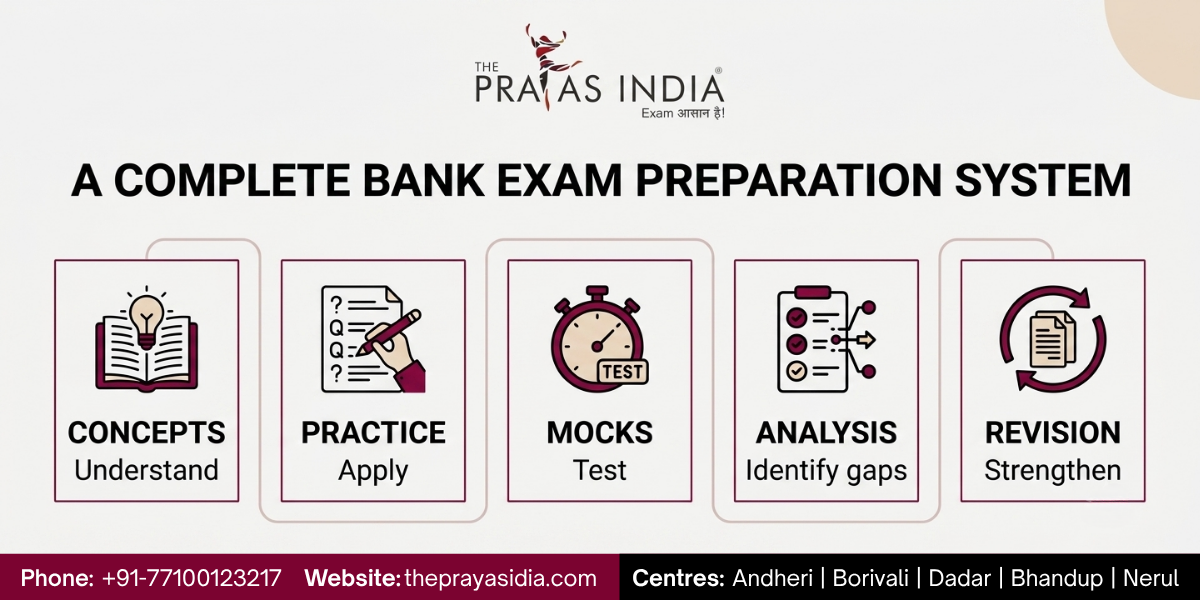
Preparing for SBI and IBPS bank examinations becomes more manageable when students have a clear preparation structure instead of relying on random practice. The role of a good coaching institute is not simply to deliver lectures. It should help students create a roadmap, understand concepts, practise effectively, test their preparation and identify areas that require improvement.
The Prayas India aims to provide this structured environment for aspirants preparing for banking examinations. By combining subject preparation with practice and evaluation, students can work towards developing the skills required to perform under actual examination conditions.
However, coaching alone does not determine the outcome. Students still need consistent self-study, revision, practice and honest performance analysis. The strongest preparation happens when classroom guidance and individual effort work together.
For an aspirant considering Banking Coaching in Mumbai, the right institute should therefore be evaluated by the quality of its preparation ecosystem rather than by a single feature. Concept clarity, practice resources, tests, feedback, doubt support and a structured learning process all contribute to making preparation more purposeful.
Turning Mock Tests Into a Preparation Tool
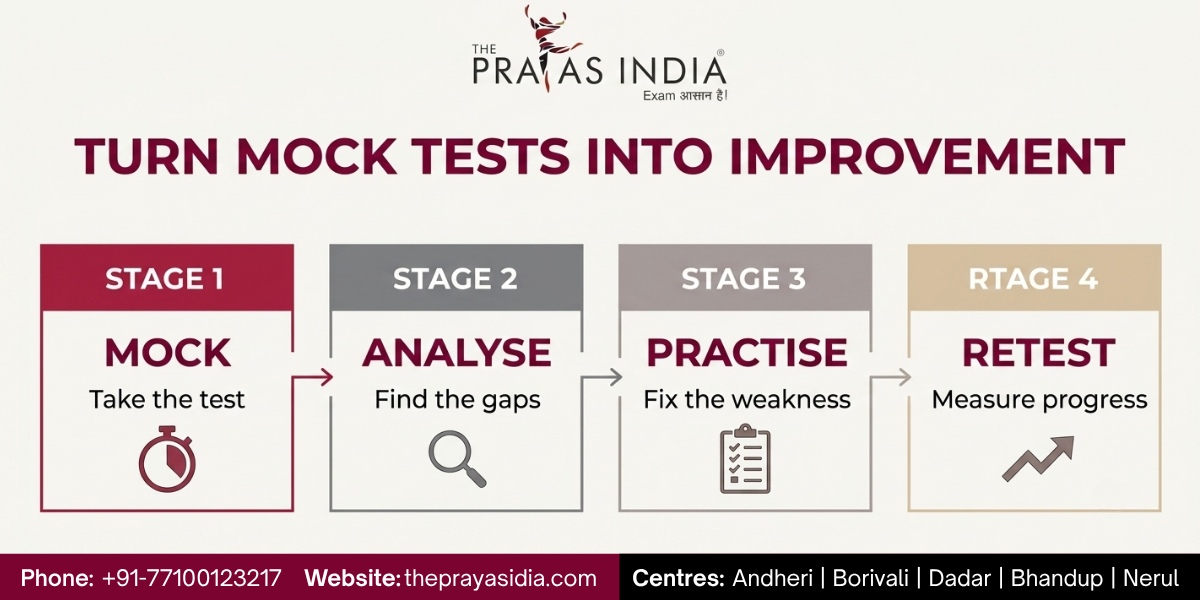
Mock tests become truly valuable when students stop treating them as examinations and start treating them as diagnostic tools.
A low score in a mock does not necessarily mean that the entire preparation is weak. It may indicate a specific problem with time management, question selection, accuracy or a particular topic.
Similarly, a high score does not automatically mean that preparation is complete. Students should still examine whether they relied on a favourable question set, spent too much time on certain areas or made avoidable errors.
At The Prayas India, regular testing can help students understand their performance from a broader perspective. The important objective is to create a habit of evaluating performance instead of simply recording marks.
After every test, students should ask:
- Which topics produced the most errors?
- Which questions consumed excessive time?
- Which questions should have been attempted but were skipped?
- Which mistakes were avoidable?
- Which sections required better time allocation?
- Did accuracy change when solving under pressure?
These questions turn a mock test into a learning exercise.
Learning From the Difference Between Practice and Performance
One of the most useful insights that a student can gain from regular tests is the difference between performance during practice and performance under examination conditions.
A candidate may solve Quant questions comfortably without a time limit but struggle when a clock is running. Another may perform well in individual reasoning topics but lose accuracy when several topics are mixed together.
These differences need to be identified before the actual examination.
This is why students should not judge their readiness only by how comfortable they feel while studying. Performance under timed conditions provides a more realistic indication of examination readiness.
Structured coaching can help students make this transition gradually. Instead of suddenly moving from chapter-wise practice to full-length examination pressure, preparation can progress through topic tests, sectional tests and eventually complete mocks.
Doubt Resolution Should Be Part of Preparation
A doubt that remains unresolved can affect several subsequent topics.
This is especially true in Quantitative Aptitude and Reasoning, where concepts are often interconnected. If a student develops an incorrect understanding of one method and continues practising with it, the mistake can become a habit.
A structured doubt-resolution system allows students to address these problems before they become deeply embedded.
The value of doubt support is not limited to receiving the correct answer. Students should understand why their approach failed and how to identify a similar situation in the future.
For example, if a student repeatedly uses an inefficient method for a particular Quant topic, simply providing the final answer will not solve the underlying problem. The student needs to understand the reasoning behind a better approach and then apply it independently.
This is one area where guided learning can complement self-study effectively.
Personalised Improvement Matters
Not every banking aspirant begins from the same level.
A student with a strong mathematical background may need more focus on reasoning puzzles and English comprehension. Another student may be comfortable with English but require additional work on arithmetic and calculation speed.
Following exactly the same study distribution throughout preparation can therefore be inefficient.
Students should periodically evaluate their own performance and adjust the amount of time given to different sections.
A structured coaching environment can make this process easier by giving students access to tests and performance information that helps reveal their strengths and weaknesses.
The goal should not be to spend equal time on every subject. The goal should be to spend appropriate time on the areas that need improvement while maintaining the sections that are already performing well.
Revision: The Step That Keeps Preparation From Slipping
As the syllabus expands, students often move continuously towards new topics and unintentionally leave older topics behind.
This creates a common problem. A student may perform well immediately after completing a chapter but struggle to recall the same method several weeks later.
Regular revision prevents this gap.
Revision does not necessarily mean rereading an entire chapter. It can involve reviewing formulas, revisiting previously incorrect questions, solving a small set of representative problems or going through important concepts that have not been practised recently.
For reasoning, revision can include revisiting puzzle structures, common question patterns and mistakes from previous tests. For English, it can involve reviewing grammar rules and previously misunderstood questions. For Quant, formulas, calculation methods and recurring errors can be revisited.
The important principle is to keep previously learned material active while new topics are being introduced.
Time Management Should Be Practised Before the Exam
Many aspirants start thinking about time management only when the examination is close.
By then, it can be difficult to change habits.
Time management should develop naturally through timed practice.
Students need to learn how much time they typically require for different types of questions and where they tend to lose time. This allows them to create a realistic strategy rather than copying someone else’s attempt pattern.
For example, one candidate may be comfortable beginning with Reasoning, while another may perform better when starting with Quant. There is no universally correct order.
The better approach is to test different strategies during mocks and identify the sequence that provides the best combination of confidence, speed and accuracy.
The same principle applies to individual sections. If a puzzle is consuming too much time, the student should learn to recognise the point at which moving to another question becomes more beneficial.
Creating a Consistent Study Schedule
Consistency is often more important than occasional bursts of extremely long study sessions.
A practical schedule should divide preparation into manageable blocks and give each section regular attention.
For a student preparing alongside college or work, the schedule may contain shorter weekday sessions and longer weekend practice blocks. A full-time aspirant may be able to dedicate more hours each day, but even then the routine should include breaks, revision and analysis.
A useful weekly structure could look like this:
| Day | Primary Focus | Supporting Work |
|---|---|---|
| Monday | Quant Concepts | Reasoning Practice + Reading |
| Tuesday | Reasoning | Quant Revision + English |
| Wednesday | English | Quant Practice + Reasoning |
| Thursday | Quant Practice | Reasoning Set + Revision |
| Friday | Reasoning & English | Quant Practice |
| Saturday | Sectional Tests | Error Analysis |
| Sunday | Full/Combined Mock | Detailed Analysis & Revision |
This is only a framework. Students should modify the distribution according to their individual strengths, weaknesses and examination timelines.
The important part is maintaining regular contact with every major section while giving additional attention to areas that require improvement.
Building Confidence Through Measurable Progress
Confidence in competitive exam preparation should come from evidence rather than assumptions.
Telling yourself that you are improving is useful, but measurable progress provides stronger reassurance.
If your mock accuracy has increased, your average solving time has reduced or you are now able to solve question types that previously seemed difficult, these are meaningful indicators.
A coaching environment can help make this progress easier to monitor through regular tests and structured practice.
At The Prayas India, students can use these performance indicators to understand where they stand and what needs further attention. The purpose is not to compare every student with everyone else. It is to help each aspirant understand their own preparation trajectory.
This is particularly important because bank exam preparation can extend over several months, and visible progress can help students remain focused during periods when improvement appears slow.
Choosing the Right Banking Coaching in Mumbai
Choosing a coaching institute is an important decision because the preparation environment can influence how consistently an aspirant follows the study plan.
Students should look beyond promotional claims and evaluate the actual preparation system.
Before joining a banking coaching institute, consider whether it provides a structured curriculum, regular practice, relevant study material, mock tests and meaningful performance analysis. Faculty accessibility and doubt resolution are also important, particularly for students who are building their fundamentals.
Another factor is whether the institute understands the difference between various banking examinations. SBI and IBPS exams may share several core areas, but their examination requirements, stages and question patterns can differ.
A suitable coaching programme should help students prepare for these differences while also taking advantage of the common syllabus.
For aspirants in Mumbai, location and schedule can also matter because a coaching programme that is difficult to attend consistently may become less useful regardless of its other strengths.
How The Prayas India Supports a Structured Preparation Journey
The Prayas India focuses on creating a preparation ecosystem in which students can work on the different stages of bank exam preparation instead of studying each component in isolation.
The process begins with understanding concepts and building the necessary foundation. Students then need regular opportunities to apply those concepts through questions and topic-based practice.
As preparation progresses, testing becomes increasingly important. Sectional and full-length practice can help students understand how effectively they are performing under time constraints.
The next stage is analysis. Rather than treating a test score as the final outcome, students can use performance data to identify areas that require additional work.
This creates a cycle:
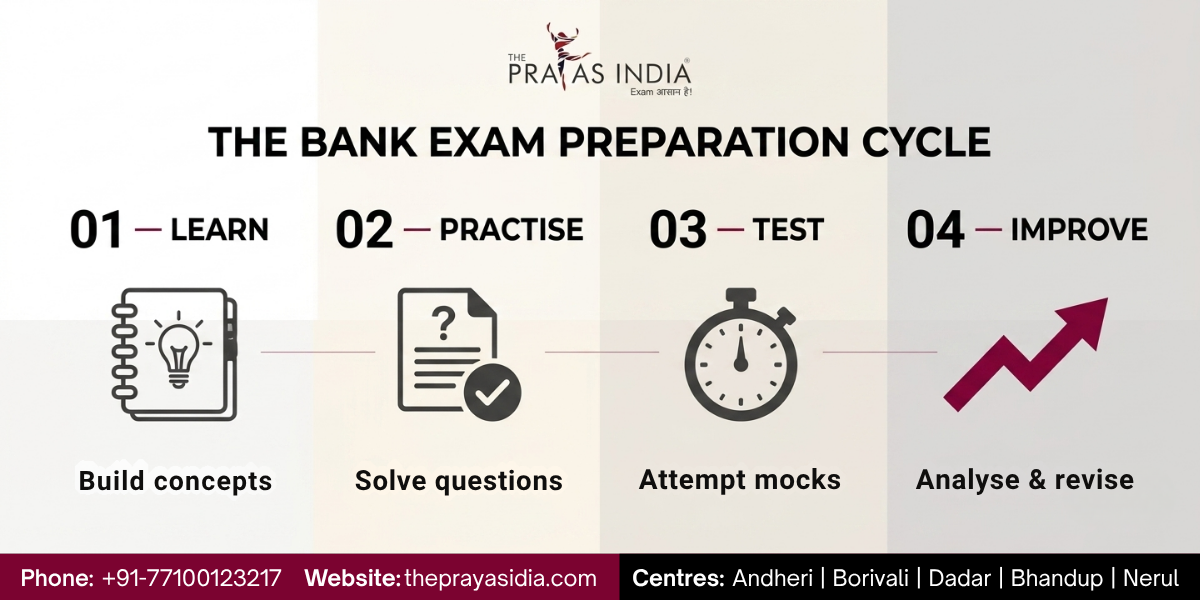
Learn → Practise → Test → Analyse → Improve → Revise
The cycle can then be repeated as preparation develops.
For students preparing for SBI Clerk, IBPS Clerk, SBI PO, IBPS PO and other banking examinations, this structured approach can provide a clearer framework for managing a large syllabus and maintaining consistency.
Coaching and Self-Study Should Work Together
Professional coaching should not be viewed as a replacement for individual effort.
Even the best classroom guidance cannot substitute for personal practice.
Students need to revise what they learn, solve questions independently, take tests seriously and analyse their own performance. Coaching can provide direction and resources, but the student has to convert that direction into daily action.
The most productive approach is therefore a combination of guided learning and disciplined self-study.
Classroom sessions can help clarify concepts and methods. Practice sessions can strengthen application. Mock tests can reveal weaknesses. Self-study can then be used to address those weaknesses.
This makes the preparation process more active and personalised.
Preparing With a Long-Term Career Perspective
Bank examinations are not merely academic tests. For many aspirants, clearing SBI or IBPS examinations represents an important step towards entering the banking sector.
That is why preparation should be approached with seriousness from the beginning.
Instead of focusing only on clearing the next test, students can use the preparation period to develop habits that support competitive examination success more broadly—structured study, time management, analytical thinking, accuracy and disciplined revision.
A good preparation system should help students become more confident and independent as they move closer to the examination.
The role of The Prayas India is therefore not limited to helping students complete a syllabus. The broader objective is to support aspirants in building an examination-oriented preparation process that they can follow consistently.
Final Takeaway
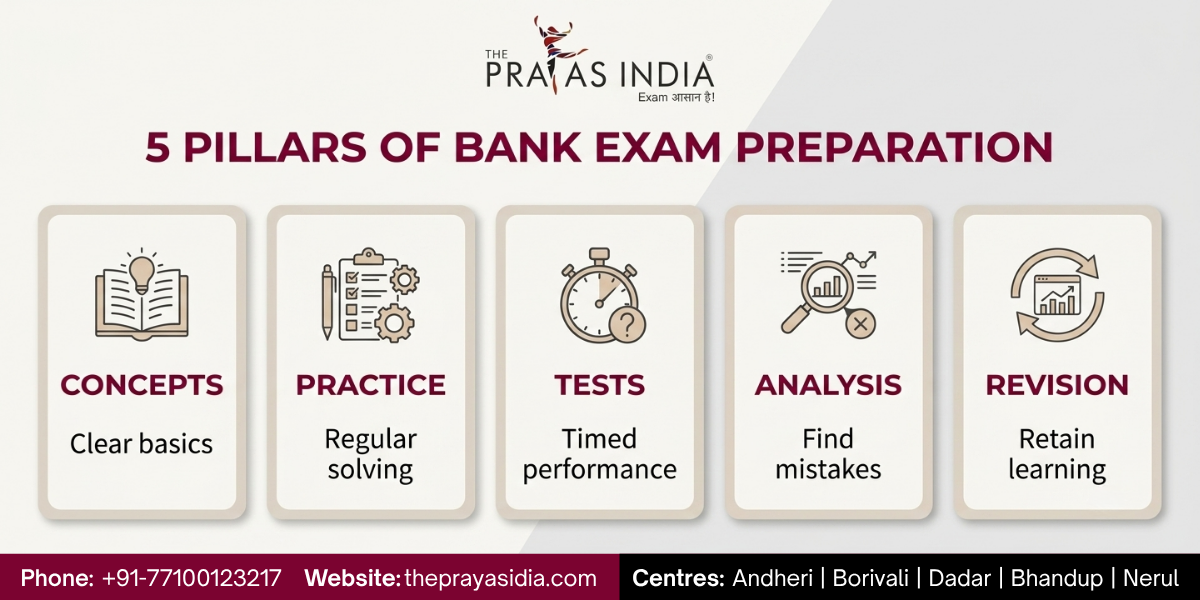
Preparing for SBI and IBPS bank exams requires a combination of clear concepts, consistent practice, regular testing, detailed analysis and disciplined revision. The challenge is not simply knowing what to study but knowing how to organise preparation so that every stage contributes to measurable improvement.
The Prayas India can support this process by providing a structured learning environment where students can work on concepts, practise different question types, evaluate their performance and identify areas requiring additional attention.
For students considering Banking Coaching in Mumbai, the right institute should be one that supports the complete preparation journey rather than focusing only on classroom lectures. Study material, practice, tests, doubt support, performance analysis and revision all have a role to play.
Ultimately, coaching can provide direction, but consistent student effort remains the foundation of success. When structured guidance and disciplined self-study work together, aspirants can approach SBI and IBPS examinations with greater clarity, better preparation and a more informed strategy.
Contact Us
📞 Call Now: +91-77100 13217
🌐 Website: theprayasindia.com
📍 Centres: Andheri | Borivali | Dadar | Nerul | Bhandup
FAQs
1. How does The Prayas India help students prepare for SBI and IBPS exams?
The Prayas India follows a structured preparation approach covering concepts, practice, testing, performance analysis and revision. The objective is to help students develop the skills required to handle different stages of banking examinations.
2. Does The Prayas India provide preparation for both SBI and IBPS exams?
The preparation framework is designed around major banking examinations, including SBI and IBPS exams. Students can build common foundational skills while preparing for the specific requirements of individual examinations.
3. Why are mock tests important for SBI and IBPS preparation?
Mock tests help students understand their performance under timed conditions. More importantly, analysing the mock can reveal weaknesses in accuracy, time management, question selection and topic-wise preparation.
4. Can beginners join banking coaching in Mumbai?
Yes. Beginners can benefit from a structured preparation programme because it can provide a clear sequence for learning concepts, practising questions and gradually moving towards examination-level tests.
5. Is self-study still necessary after joining banking coaching?
Yes. Coaching provides guidance and structure, but individual practice, revision, mock analysis and consistent study are essential for converting classroom learning into examination performance.
6. How should I choose the best banking coaching in Mumbai?
Compare institutes based on faculty quality, course structure, study material, practice resources, mock tests, doubt support, performance analysis and the overall learning environment. The most suitable institute is one that matches your preparation level and study requirements.
8. How long should I prepare for SBI and IBPS bank exams?
The ideal preparation period varies according to your starting level, target examination and available study time. Rather than focusing only on the number of months, create a structured plan that includes fundamentals, practice, mocks, analysis and revision.