How to Analyse IBPS Clerk Mock Tests for Better Scores | Best Bank Coaching in Mumbai | The Prayas India
Introduction: Taking Mock Tests Is Not Enough
Mock tests are an essential part of IBPS Clerk preparation, but simply taking one mock after another does not automatically improve your score. Many aspirants complete a test, check their marks and immediately move on to the next one. If the score increases, they feel encouraged. If it decreases, they become anxious and start changing their preparation strategy.
This approach misses the most valuable part of a mock test: analysis.
A mock test should tell you more than how many questions you answered correctly. It should show you where you are losing marks, which topics are consuming too much time, whether your attempts are appropriately selected and whether your accuracy is improving.
For an IBPS Clerk aspirant, the real benefit of a mock test begins after the test is submitted.
A candidate who scores 65 but carefully analyses every mistake can improve faster than someone who scores 75 but never examines why the remaining questions went wrong. The objective is not to collect mock-test scores. It is to turn every mock into a learning exercise.
For students preparing for banking examinations in Mumbai, structured guidance can make this process more systematic. The Prayas India provides bank exam coaching through its centres in Andheri, Borivali, Dadar, Bhandup and Nerul, helping aspirants build preparation strategies around concepts, practice, mock tests and performance analysis.
What Does IBPS Clerk Mock Test Analysis Actually Mean?
Mock-test analysis means going beyond checking the answer key.
After completing an IBPS Clerk mock, you should examine your performance question by question and identify the reason behind every wrong, skipped and time-consuming attempt.
Consider three candidates who each score 70.
The first candidate attempted 80 questions with 10 incorrect answers. The second attempted 73 questions with only three incorrect answers. The third attempted 75 questions but spent too much time on a few difficult questions.
Although their scores may look similar, their preparation problems are completely different.
The first candidate may need to improve accuracy.
The second candidate may need to improve speed and attempt selection.
The third candidate may need better time management.
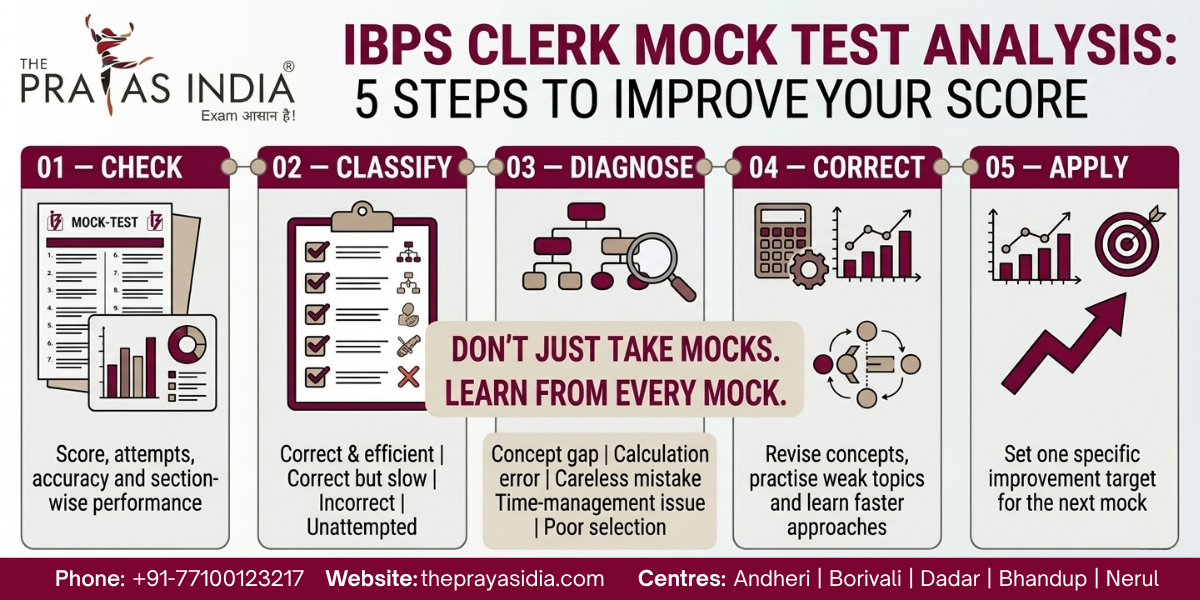
Therefore, mock analysis should answer five fundamental questions:
- What did I get wrong?
- Why did I get it wrong?
- Which questions consumed too much time?
- Which questions should I have attempted but skipped?
- What specific change will I make in the next mock?
Without these answers, taking another mock often means repeating the same mistakes.
Start With More Than Your Overall Score
The overall score is useful, but it should be the starting point of analysis rather than the final conclusion.
For IBPS Clerk preparation, examine your performance across the different sections of the mock.
Depending on the test pattern being followed, analyse areas such as:
- English Language
- Numerical Ability
- Reasoning Ability
- General/Financial Awareness and other relevant areas in the applicable examination stage
For each section, record:
| Performance Area | What to Check |
|---|---|
| Attempts | How many questions did you try? |
| Correct | How many were answered correctly? |
| Incorrect | How many marks were lost through wrong attempts? |
| Accuracy | What percentage of attempts were correct? |
| Time | How much time did the section consume? |
| Unattempted | Which questions were left despite being manageable? |
| Difficult Questions | How much time was spent on low-probability questions? |
| Easy Questions Missed | Which scoring opportunities were overlooked? |
This gives you a much clearer picture than the total score alone.
Suppose your Quantitative Aptitude score is low. That does not necessarily mean you need to study the entire Quant syllabus again.
Your analysis might reveal that you knew the concepts but spent too much time on lengthy calculations.
Similarly, a low Reasoning score might not indicate weak reasoning ability. You may simply be spending too much time on one puzzle while missing easier questions from other topics.
The diagnosis determines the solution.
The Four Categories Every Question Should Go Into
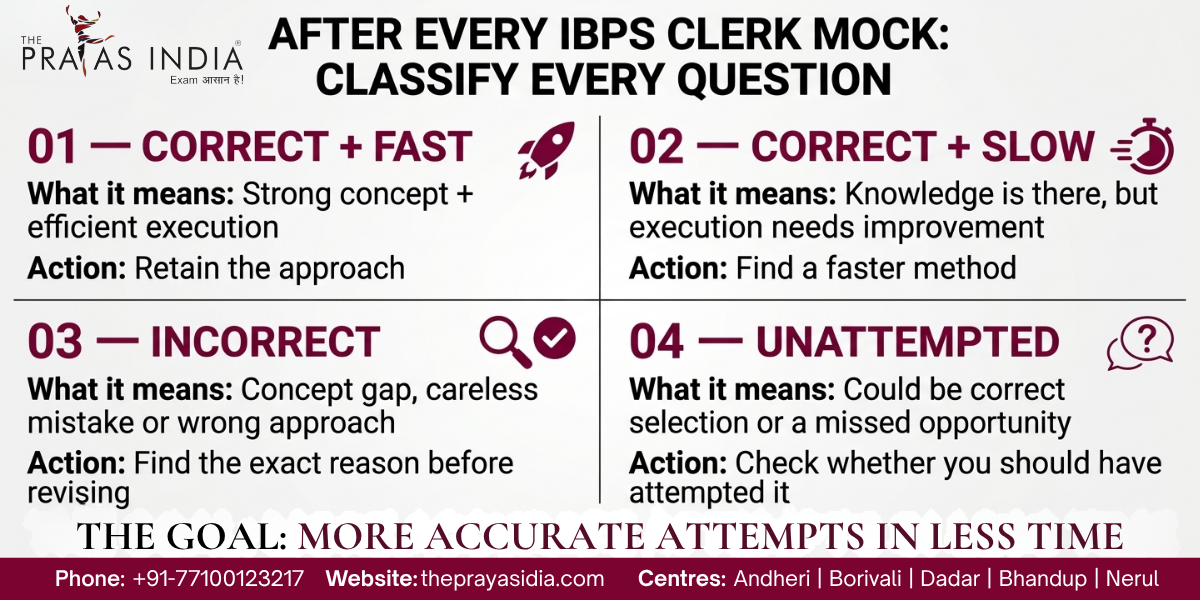
One of the most effective ways to analyse an IBPS Clerk mock is to classify every question you encounter.
Category 1: Correct and Efficient
These are questions you answered correctly within a reasonable amount of time.
They represent your current strengths.
However, do not ignore them completely. Identify what made them efficient. Was the concept familiar? Did you recognise the question type immediately? Did you use a short method?
These are approaches worth retaining.
Category 2: Correct but Time-Consuming
This category is extremely important.
You reached the correct answer, so it is tempting to consider the question successful. But if you spent considerably more time than necessary, it may still be a problem in a time-bound examination.
Look for alternative methods, faster calculations or better question-selection decisions.
A correct answer is not always an efficient answer.
Category 3: Incorrect but Conceptually Familiar
These mistakes often indicate careless execution.
You knew the underlying concept but made an error because of:
- Misreading the question
- Calculation mistakes
- Incorrect application
- Rushing
- Selecting the wrong option
- Missing a condition
- Marking the wrong answer
These errors can often be reduced relatively quickly if you identify the recurring pattern.
Category 4: Incorrect Because of a Concept Gap
This is where actual learning is required.
If you did not understand the concept or could not determine the correct method, mark the topic for revision.
Do not simply memorise the answer.
Return to the concept, solve a few basic questions and then attempt similar questions again.
Why “Wrong Answer” Is Not a Good Enough Diagnosis
Suppose you answered a percentage question incorrectly.
Writing “Percentage – wrong” in your notebook does not tell you anything useful.
Instead, identify the actual reason.
Maybe you:
- Forgot the formula.
- Misunderstood the percentage change.
- Made a calculation error.
- Used an unnecessarily complicated method.
- Ran out of time.
- Guessed because you were unsure.
- Misread what the question was asking.
Each problem requires a different solution.
If the issue is conceptual, revise the topic.
If the issue is calculation, practise calculations.
If the issue is time, improve your approach.
If the issue is question selection, work on mock strategy.
This is why detailed analysis can have a greater impact than simply increasing the number of mocks.
Analyse the Questions You Did Not Attempt
A common mistake is to analyse only the questions you answered.
The unattempted questions can contain valuable information.
After completing your mock, go through the questions you left and divide them into two groups.
Questions You Correctly Skipped
These were questions that were too difficult, too time-consuming or unsuitable for your strategy.
Your decision to leave them was reasonable.
Questions You Should Have Attempted
These were manageable questions that you skipped because you did not recognise them, did not have enough time or spent your time elsewhere.
This second category can reveal major weaknesses in your mock strategy.
For example, suppose you skipped five easy questions because you spent eight minutes on a difficult puzzle. Your problem is not necessarily that you need more practice. Your problem is that you need better time allocation and question selection.
That is an important distinction.
The Most Valuable Question After Every Mock
After analysing the test, ask yourself:
“If I took the same mock again today, what would I do differently?”
Your answer should be specific.
Avoid statements such as:
“I need to study harder.”
That is too general.
Instead, write:
“I will not spend more than a few minutes trying to force a difficult reasoning puzzle when easier questions remain.”
Or:
“I will revise percentage and ratio questions because two incorrect answers came from the same conceptual gap.”
Or:
“I need to reduce calculation time in Numerical Ability through daily speed practice.”
A useful analysis should always end with an action.
Build a Mock Analysis Sheet
Maintaining a simple mock analysis sheet can help you identify patterns across multiple tests.
Your sheet can include:
| Mock | Score | Attempts | Accuracy | Section Weakness | Time Issue | Major Mistake | Action for Next Mock |
|---|---|---|---|---|---|---|---|
| Mock 1 | — | — | — | — | — | — | — |
| Mock 2 | — | — | — | — | — | — | — |
| Mock 3 | — | — | — | — | — | — | — |
| Mock 4 | — | — | — | — | — | — | — |
The purpose is not to create complicated statistics.
The purpose is to identify trends.
If three consecutive mocks show that your accuracy in English is high but your attempts are low, your next step should focus on speed and question selection rather than basic grammar revision.
If Quant accuracy remains low, look for the specific topics responsible.
If Reasoning performance fluctuates dramatically, analyse whether the variation comes from puzzle selection.
Your preparation becomes much more precise once these patterns are visible.
Mock Analysis Should Change as the Exam Approaches
The way you analyse mocks should evolve during your IBPS Clerk preparation.
Early Preparation
In the beginning, focus heavily on concepts and accuracy.
Do not panic if your mock score is low.
Use the mock to discover your weak areas.
Middle Phase
Once your basic concepts are stronger, begin focusing on speed, question selection and section-wise time management.
Your analysis should increasingly examine how efficiently you are converting knowledge into attempts.
Final Phase
Closer to the examination, your analysis should become heavily exam-oriented.
Focus on:
- Attempt strategy
- Accuracy
- Time allocation
- Question selection
- Sectional performance
- Repeated mistakes
- Mock-to-mock consistency
At this stage, avoid making major changes based on one unusually difficult or unusually easy mock.
Look for patterns across several tests.
Do Not Chase a Higher Mock Score at Any Cost
One of the biggest psychological traps in competitive exam preparation is becoming obsessed with increasing the score in every mock.
Mock scores naturally fluctuate.
One test may contain topics that suit your strengths. Another may contain a higher proportion of questions that expose your weaknesses.
Instead of asking whether Mock 8 is higher than Mock 7, look at whether your underlying performance is improving.
For example:
- Is your accuracy improving?
- Are you making fewer careless mistakes?
- Are you identifying easy questions faster?
- Are you leaving difficult questions sooner?
- Are you completing sections more comfortably?
- Are repeated mistakes becoming less frequent?
These improvements can eventually translate into a stronger examination score.
Turn Mock-Test Analysis Into a Score Improvement System
The real value of mock tests appears when you begin using the information from one test to improve the next.
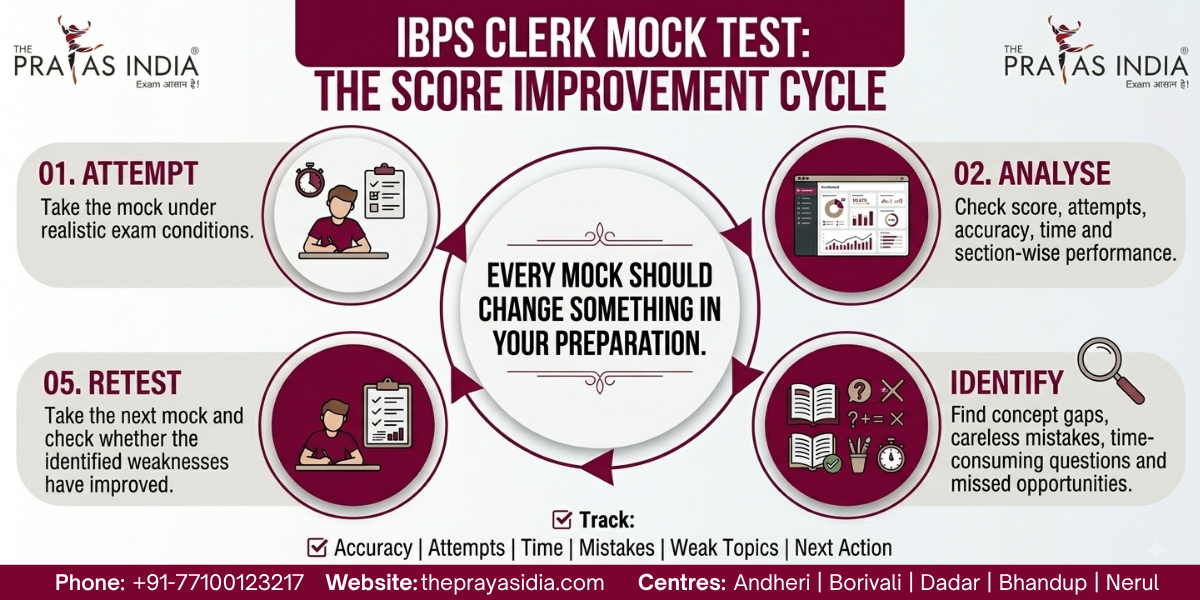
A mock should not exist as an isolated event. It should become part of a continuous cycle:
Attempt → Analyse → Identify → Correct → Practise → Reattempt → Measure
If your mock scores are not improving, the answer is not always to take more tests. Sometimes you need to spend more time analysing the tests you have already taken.
For example, if you repeatedly make errors in simplification, taking five additional mocks may not solve the problem. You need targeted practice in simplification, followed by another test to determine whether the weakness has actually improved.
This approach transforms mock tests from assessment tools into preparation tools.
Analyse IBPS Clerk English Performance Beyond the Score
English can sometimes create a misleading picture because candidates may have reasonable accuracy but low attempts, or high attempts but too many incorrect answers.
Start by separating your English performance into question types.
Look at areas such as:
- Reading Comprehension
- Cloze Test
- Error Detection
- Fill in the Blanks
- Sentence Rearrangement
- Phrase Replacement
- Vocabulary-based questions
- Grammar-based questions
Then identify where your errors are concentrated.
If you consistently perform well in grammar but struggle with Reading Comprehension, spending additional hours revising grammar may not produce a significant improvement.
Similarly, if your accuracy is good but you leave too many easy questions because you read slowly, your priority should be reading speed and question selection.
The purpose of analysis is to make your preparation specific.
Analyse IBPS Clerk Numerical Ability for Speed and Accuracy
Numerical Ability often exposes the difference between knowing a concept and executing it efficiently.
A candidate may understand percentages, profit and loss, averages, ratio, simplification and data interpretation but still lose marks because calculations take too long.
During mock analysis, identify:
- Which topics produced incorrect answers?
- Which calculations consumed excessive time?
- Did you use the shortest available method?
- Did you spend too long on one Data Interpretation set?
- Were mistakes caused by calculation or concept?
- Did you leave easier arithmetic questions because of time pressure?
Create a separate list of questions that you solved correctly but slowly.
These questions can be just as important as incorrect questions.
If a question takes substantially longer than the expected time, ask whether you should have attempted it in the first place or whether there was a faster method.
Analyse IBPS Clerk Reasoning the Right Way
Reasoning performance often depends heavily on question selection.
A difficult-looking puzzle may consume several minutes before you even begin solving the actual questions. Meanwhile, simpler topics such as inequality, syllogism, coding-decoding, direction sense or blood relations may remain untouched.
After a mock, revisit the complete Reasoning section.
Mark:
Easy questions you missed
These indicate potential opportunities lost due to poor time management or selection.
Questions you solved efficiently
These represent your strengths.
Questions you solved but spent too much time on
These require method improvement.
Questions that completely stalled you
These may require concept or puzzle-approach revision.
Over time, this analysis can help you develop a more efficient order of attempts.
Attempt Strategy: Are You Solving the Right Questions?
A higher attempt count does not automatically mean a better performance.
Suppose one candidate attempts 78 questions with 15 incorrect answers, while another attempts 70 questions with only five incorrect answers. The second candidate may be in a stronger position despite having fewer attempts.
This is why you should track attempt quality, not just attempt quantity.
A useful way to evaluate your performance is:
Attempt Quality = Appropriate Selection + Accuracy + Time Efficiency
During mock analysis, identify whether you are:
- Attempting questions simply because they appear familiar.
- Spending too much time on difficult questions.
- Guessing when uncertain.
- Missing easy questions while solving complex ones.
- Changing answers unnecessarily.
- Rushing towards the end of a section.
Your objective should be to develop a reliable attempt strategy that you can reproduce under examination pressure.
Accuracy vs Speed: Which One Should You Fix First?
This depends on the nature of your mistakes.
If your accuracy is poor, increasing speed may actually make the problem worse.
If your accuracy is already strong but attempts are low, then speed and selection deserve more attention.
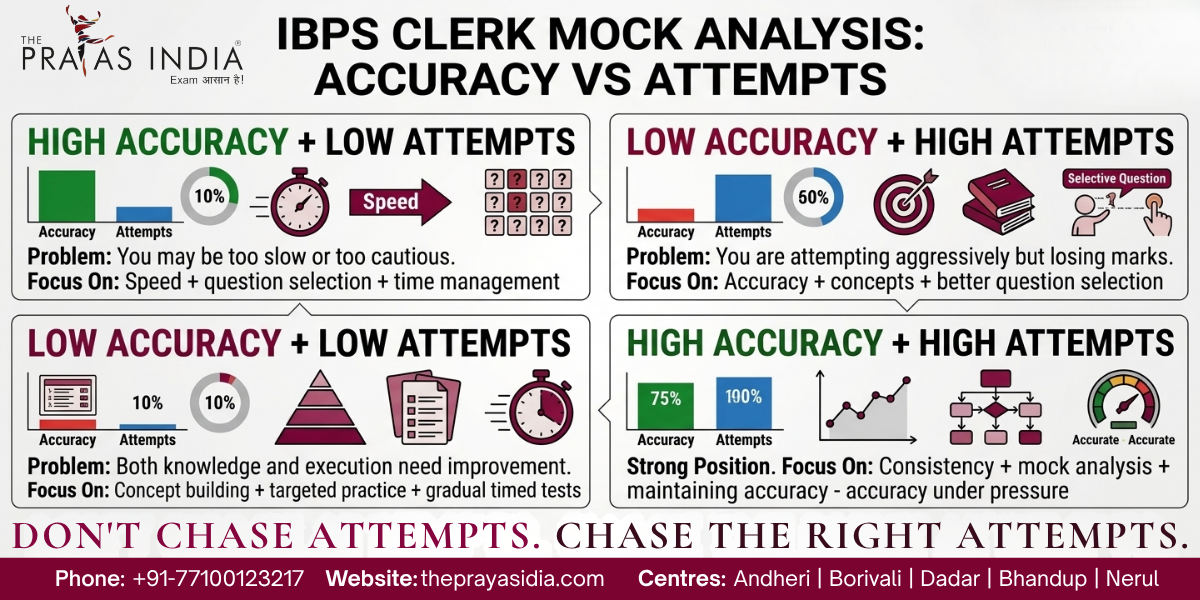
Consider these situations.
High Accuracy + Low Attempts
Your concepts may be strong, but you are either slow or too conservative.
Focus: Speed, question selection and time allocation.
Low Accuracy + High Attempts
You are attempting aggressively but making too many errors.
Focus: Accuracy, question selection and conceptual clarity.
Low Accuracy + Low Attempts
You may have both conceptual and execution weaknesses.
Focus: Foundation, targeted practice and gradual timed testing.
High Accuracy + High Attempts
This is the ideal direction, but consistency still matters.
Focus: Maintaining performance across different mock difficulties.
This type of diagnosis is much more useful than simply saying, “My score is low.”
How to Analyse Time Management in an IBPS Clerk Mock
Time management should be analysed at two levels.
The first is section-level time management.
Ask whether you spent too much time in one section at the expense of another.
The second is question-level time management.
Ask which individual questions consumed disproportionate amounts of time.
For example, suppose you spent several minutes on a difficult puzzle and then rushed through simpler reasoning questions. The problem was not necessarily that you lacked reasoning ability. Your time allocation was inefficient.
Similarly, if you spent too long on one lengthy Quant question and had to leave several easier questions at the end, your analysis should focus on opportunity cost.
A simple post-mock question is extremely useful:
“Which five minutes of my test produced the least value?”
Find those five minutes.
Then work on preventing the same loss in your next mock.
How Often Should You Take IBPS Clerk Mock Tests?
There is no single ideal number of mocks for every aspirant.
The correct frequency depends on your preparation stage.
During Early Preparation
Use mocks primarily as diagnostic tools.
You do not need to take a full mock every day. Your priority should be strengthening concepts and understanding your current level.
During the Middle Phase
Increase mock frequency as your syllabus coverage improves.
Sectional tests can be particularly useful because they allow you to diagnose individual subjects without the complexity of a full-length examination.
During the Final Phase
Full-length mocks should become a regular part of your preparation.
However, avoid taking a new mock simply because you finished the previous one.
Give yourself enough time to analyse the test and correct the identified weaknesses.
A useful principle is:
One well-analysed mock is more valuable than several poorly analysed mocks.
The 24-Hour Rule for Mock Analysis
Try to analyse a mock soon after taking it.
The longer you wait, the harder it can become to remember why you made particular decisions.
Ideally, divide your analysis into three stages.
First Review: Immediate Performance
Look at your score, attempts, accuracy and section-wise performance.
Second Review: Question Analysis
Review wrong, skipped and time-consuming questions.
Third Review: Action Plan
Write down the specific topics or skills that need attention before the next mock.
Your action plan should remain small and practical.
For example:
Before Mock 2:
Revise percentages, practise calculation speed and review two reasoning puzzle types.
This is more useful than writing:
“Improve Quant and Reasoning.”
Create a “Repeat Mistakes” List
Some mistakes disappear after one analysis.
Others keep returning.
These recurring mistakes deserve special attention.
Create a separate list titled:
Mistakes I Keep Repeating
It could include:
- Misreading questions
- Calculation errors
- Forgetting a condition
- Spending too long on puzzles
- Attempting questions without sufficient confidence
- Changing correct answers
- Missing easy questions
- Poor time allocation
- Confusion between similar concepts
Review this list before every mock.
The objective is simple: do not allow the same mistake to remain invisible across multiple tests.
If a mistake appears repeatedly, it has become a preparation problem rather than an isolated error.
What If Your Mock Scores Are Not Improving?
This is one of the most common concerns among banking-exam aspirants.
Sometimes students take several mocks and see almost no movement in their scores.
Before changing your entire strategy, examine what is actually happening.
Your score may remain similar while your accuracy improves.
Or your attempts may increase while careless mistakes decrease.
Or your section-wise performance may be becoming more balanced.
These are positive developments even if the overall score has not yet moved significantly.
However, if the same weaknesses continue across several mocks, you need targeted intervention.
For example:
Repeated Quant calculation errors
→ Add daily calculation practice.
Repeated Reasoning puzzle time loss
→ Practise puzzle selection and structured solving.
Repeated English accuracy issues
→ Identify the specific grammar, comprehension or vocabulary weakness.
Repeated low attempts despite strong accuracy
→ Focus on speed and question selection.
The solution should match the problem.
When Structured Bank Coaching Can Improve Mock Performance
Many aspirants believe that coaching is primarily useful for learning concepts.
For competitive banking examinations, structured guidance can also be valuable during the practice and testing stages.
A coaching programme can provide a systematic sequence of:
Concept Building → Topic Practice → Sectional Tests → Full-Length Mocks → Performance Analysis → Targeted Improvement
This can be particularly helpful for students who struggle to determine what to do after a disappointing mock score.
Instead of repeatedly taking tests without understanding the reason behind the result, students can use structured feedback to identify their weak areas and plan the next stage of preparation.
When choosing the best bank coaching in Mumbai, aspirants should therefore look beyond the number of classes or study materials.
Consider whether the institute provides:
- Quality mock tests
- Detailed performance analysis
- Section-wise evaluation
- Faculty guidance
- Doubt-solving support
- Structured revision
- Regular practice
- Individual performance feedback
- A systematic preparation plan
For students preparing for IBPS Clerk and other banking examinations in Mumbai, The Prayas India has centres in Andheri, Borivali, Dadar, Bhandup and Nerul.
The objective of structured coaching should not simply be to make students take more tests. It should help them understand what each test reveals about their preparation and how to use that information to improve.
A Practical Weekly Mock-Test Analysis Routine
A simple weekly system can make your preparation more organised.
Start with a full-length or sectional mock according to your preparation stage.
After the test, record your score, attempts and accuracy.
Then review every incorrect answer and identify its exact cause.
Next, review the questions you skipped. Separate the ones you correctly avoided from the ones you should have attempted.
After that, review time-consuming questions and look for alternate approaches.
Finally, create a short action plan for the coming week.
Your plan could include:
- One weak Quant topic for revision
- One Reasoning area for additional practice
- One English area requiring improvement
- Daily calculation or speed practice
- A specific attempt-selection target
- The date of the next mock
This keeps the process manageable.
You do not need to fix everything simultaneously.
Don’t Let Mock Tests Become a Source of Stress
Mock tests are supposed to expose weaknesses before the actual examination.
That means mistakes are not necessarily bad news.
If a mock reveals that you are spending too much time on Reasoning puzzles, it has given you useful information.
If it shows that your Quant accuracy falls under time pressure, you now know what to practise.
If you discover that you are leaving easy English questions, you have identified a strategy problem.
The purpose of a mock is not to prove that you are already ready.
It is to show you what needs to change before the examination.
Once you start viewing mocks this way, a low score becomes information rather than a verdict.
The Right Way to Think About IBPS Clerk Mock Tests
The strongest mock-test strategy is not:
Take Mock → Check Score → Take Next Mock
It is:
Take Mock → Analyse Performance → Find Mistakes → Identify Patterns → Practise Weak Areas → Change Strategy → Take Next Mock
That additional analysis stage is where much of the improvement happens.
For an IBPS Clerk aspirant, the goal should be to make every mock slightly more informative than the previous one.
Over time, you should know:
- Which questions to attempt first
- Which questions to postpone
- Which topics require revision
- Where you lose time
- What mistakes you repeatedly make
- How much risk you can take
- Which section requires the most attention
That level of self-awareness can make your preparation significantly more efficient.
Final Takeaway: Your Mock Score Is Feedback, Not a Final Result
A mock-test score is simply a snapshot of your current preparation.
The real question is what you do with that snapshot.
If you analyse your mistakes, identify recurring patterns, improve your weak areas and adjust your attempt strategy, every mock can contribute to your preparation.
If you simply record the score and move on, you may end up repeating the same mistakes across ten different tests.
For students preparing for IBPS Clerk 2026 and looking for structured bank exam preparation in Mumbai, The Prayas India offers coaching support across Andheri, Borivali, Dadar, Bhandup and Nerul.
Address / Centre Locations: The Prayas India — Andheri | Borivali | Dadar | Bhandup | Nerul, Mumbai
Phone: +91-77100123217
Website: theprayasidia.com
If your mock scores are not where you want them to be, do not immediately assume that you need to study everything again. Start by understanding exactly where your marks are being lost.
The next mock should not simply be another test.
It should be the result of what you learned from the previous one.
Contact Us
📞 Call Now: +91-77100 13217
🌐 Website: theprayasindia.com