How to Analyse RRB NTPC Mock Tests for Better Scores? | Best RRB Coaching in Mumbai | The Prayas India
Taking mock tests is an important part of RRB NTPC preparation, but a mock test becomes truly useful only when you understand what the result is telling you. Many aspirants finish a test, check their score and immediately move on to the next one. This may give them more practice, but it does not necessarily solve the problems that caused them to lose marks.
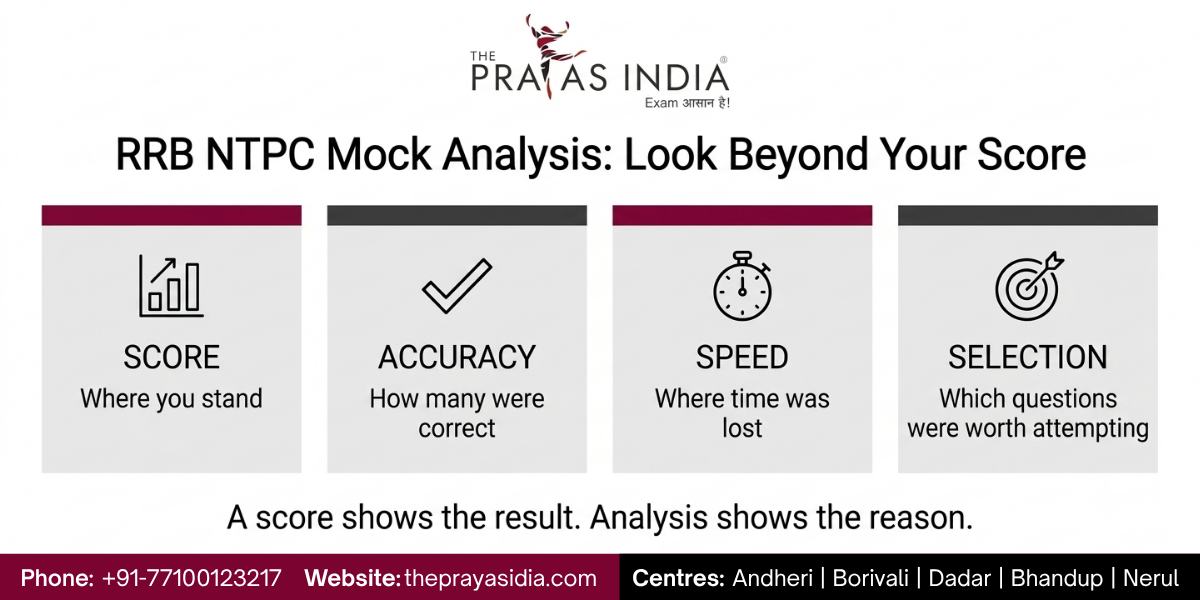
For RRB NTPC aspirants, mock-test analysis should be treated as a learning activity rather than a score-checking exercise. Your score tells you where you stand at a particular moment, while your analysis tells you what needs to change before the next test. A candidate who consistently analyses mistakes can gradually improve accuracy, speed, question selection and time management.
This becomes particularly important when preparation enters the mock-test phase. At this stage, simply increasing the number of tests may not be enough. If the same mistakes keep appearing in every test, taking more mocks without understanding the underlying problem can result in repeated errors.
A better approach is to ask four basic questions after every RRB NTPC mock: What did I get wrong? Why did I get it wrong? Which questions consumed too much time? What should I change before my next test? The answers to these questions can turn an ordinary mock into a personalised preparation tool.
Your Mock Score Is Only the Starting Point
The final score is the most visible part of a mock test, but it is not the complete picture. Two students can achieve the same score while having completely different performance profiles.
One candidate may have excellent accuracy but attempt too few questions because of slow speed. Another may attempt a large number of questions but lose marks because of careless mistakes. A third candidate may have reasonable speed and accuracy but spend too much time on questions that should have been skipped.
Therefore, don’t judge a mock only by whether your score went up or down.
Look at the quality of your attempts. How many questions did you attempt? How many were correct? How many were incorrect? How many did you leave even though you could have solved them? How much time did you spend on questions that ultimately produced no marks?
These details provide a much clearer picture of your preparation.
Analyse the Mock When Your Mind Is Still Fresh
The best time to analyse a mock is soon after completing it. You still remember which questions felt difficult, where you became confused and which questions consumed unusual amounts of time.
Start by recording your overall score and section-wise performance. Then revisit the paper without immediately looking at the solutions.
Mark questions into a few simple categories: correct and confident, correct but time-consuming, incorrect due to a mistake, incorrect due to lack of knowledge, skipped but solvable, and genuinely difficult.
This classification helps you understand that not every wrong answer represents the same problem.
For example, an incorrect answer caused by a calculation error needs a different solution from an incorrect answer caused by not knowing the underlying concept. Similarly, a question that you skipped because you could not identify the correct approach may require more practice with that particular question type.
Separate Conceptual Mistakes From Careless Mistakes
One of the most useful parts of mock analysis is identifying the reason behind an incorrect answer.
A conceptual mistake means you did not understand the underlying concept or did not know the appropriate method. This requires revision and additional practice.
A careless mistake is different. You may have known exactly how to solve the problem but made an arithmetic error, selected the wrong option, missed a keyword or misunderstood the question.
These mistakes can be particularly frustrating because the knowledge was already there. However, repeatedly making them can have a significant impact on your score.
When analysing your RRB NTPC mocks, don’t simply write “wrong answer” in your notes. Write why it was wrong. Over several tests, you may discover that a large portion of your lost marks comes from one recurring behaviour.
Identify Questions That Took Too Long
A question does not have to be incorrect to be a problem.
Suppose you spend several minutes solving a question and eventually get the correct answer. On paper, that looks like a successful attempt. But in a competitive examination, the time spent may have prevented you from attempting two easier questions.
This is why time analysis should be an important part of RRB NTPC mock analysis.
After the test, identify questions that consumed significantly more time than they were worth. Ask yourself whether you should have recognised the question type earlier, used a shorter method or moved on sooner.
Over time, this can help you develop a more efficient attempt strategy.
The objective is not to solve every question quickly. It is to identify which questions deserve your time.
Question Selection Can Change Your Score
RRB NTPC preparation is not only about knowing how to solve questions. It is also about knowing which questions to solve first.
During a mock, you may encounter a question that looks familiar but becomes complicated after you start solving it. If you continue because you have already invested time in it, you may fall into a common trap.
Mock analysis allows you to revisit these decisions without examination pressure.
Look at the questions where you spent too much time. Were they genuinely worth attempting? Could you have recognised earlier that another question was easier? Did you continue solving because you were close to an answer, even though the question was consuming too much time?
This analysis gradually develops the ability to make better decisions during the actual RRB NTPC examination.
Use a Mistake Log Instead of Simply Checking Solutions
Once you have identified your incorrect questions, create a short mistake log. The purpose of this log is not to copy every question you got wrong. It should capture the lesson behind the mistake.
For example, instead of writing:
“Wrong question — Percentage.”
Write:
“Percentage — confused successive percentage change with simple addition.”
This makes the note much more useful when you revise it later.
Similarly, if you make a reasoning mistake because you overlooked a condition, record that specific issue. If an English question goes wrong because you misunderstood the sentence, note the pattern.
Your mistake log should gradually become a record of your personal weaknesses.
When the same type of mistake appears again, you can immediately recognise it and take corrective action.
Track Your Mock Performance Over Time
One mock cannot accurately define your preparation. Your performance should be viewed as a trend.
Create a simple record containing your mock number, overall score, accuracy, attempted questions, incorrect questions and major observations. You can also record section-wise scores if that helps you identify patterns.
After five or ten mocks, look back at the data.
Perhaps your score is improving slowly but your accuracy remains inconsistent. Maybe your accuracy is strong but your attempts are too low. You might discover that one section has improved significantly while another has remained stagnant.
This information allows you to make decisions based on evidence instead of assumptions.
Don’t Chase Scores After Every Mock
A low mock score can be disappointing, especially when you have invested considerable time in preparation. However, reacting emotionally to every score can make your preparation unstable.
One difficult mock does not necessarily mean that your preparation has failed. Similarly, one high score does not mean that every weakness has disappeared.
Instead of asking only, “Did my score increase?”, ask whether something improved.
Did you make fewer careless mistakes? Did you save time in a section? Did you recognise difficult questions earlier? Did your accuracy improve? Did you avoid a mistake that appeared in your previous test?
These smaller improvements eventually contribute to stronger scores.
Analyse Each Section Separately
RRB NTPC mock analysis becomes more meaningful when you examine each section independently.
For General Awareness, identify whether incorrect answers are coming from insufficient knowledge, weak retention or confusion between similar facts. Revision frequency may need to increase if you repeatedly forget information you have already studied.
For Mathematics, check whether the problem is conceptual understanding, calculation speed, formula recall or lengthy approaches. A candidate who knows the concepts but spends too much time calculating may need timed practice rather than more theory.
For General Intelligence and Reasoning, examine whether the problem comes from recognising patterns, understanding conditions or spending too long on complex questions. Question selection can have a significant impact here.
The objective is to understand the specific reason behind section-wise performance rather than simply labelling a section as weak.
Use Your Mock to Plan the Next Week
The final step of mock analysis is perhaps the most important: convert observations into action.
If your mock shows that arithmetic questions are taking too long, schedule targeted arithmetic practice during the following week.
If you are repeatedly making mistakes in a particular Reasoning topic, revise the concept and solve a focused set.
If General Awareness mistakes are mainly due to poor retention, introduce shorter and more frequent revision sessions.
If your accuracy is good but attempts are low, incorporate timed practice and question-selection exercises.
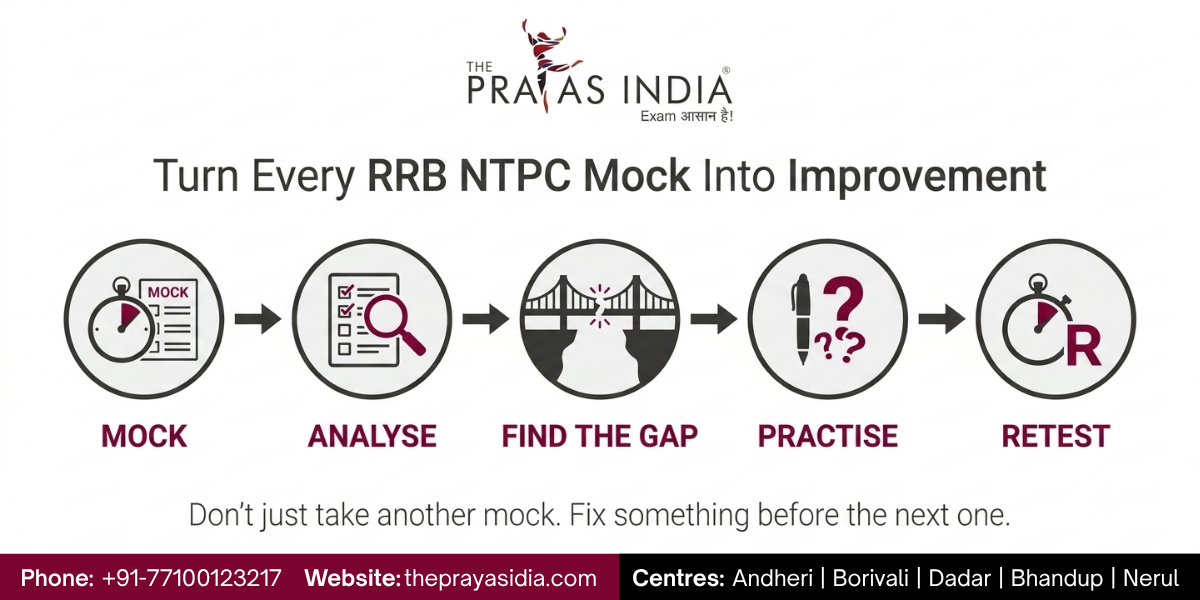
This creates a continuous preparation cycle:
Mock → Analysis → Diagnosis → Targeted Practice → Next Mock
Without the practice stage, analysis remains only an observation.
Key Takeaway
An RRB NTPC mock test should never end when the timer reaches zero. That is when the most valuable part of the process begins.
Your score tells you the outcome, but your analysis tells you what produced that outcome. By examining accuracy, speed, question selection, conceptual gaps and recurring mistakes, you can turn every mock into a source of preparation feedback.
The most effective aspirants are not necessarily those who take the highest number of mocks. They are the ones who learn something from each test and apply that learning to the next one.
A productive mock-test cycle can be kept simple:
Take the Mock → Analyse Performance → Identify the Problem → Practise the Weak Area → Take the Next Mock
With consistency, this process can help improve both preparation quality and exam readiness.
Create an RRB NTPC Mock Analysis Sheet
Maintaining a mock analysis sheet is one of the easiest ways to track progress. After every test, record the basic details instead of relying on memory.
Your sheet can include the mock number, date, total score, attempted questions, correct answers, incorrect answers, accuracy, section-wise performance and the major mistakes identified during analysis.
You can also add a short column titled “Action Before Next Mock.” This is particularly useful because it forces you to convert analysis into a practical task.
For example, if you discover that you lost marks because of calculation errors, your next action could be a 30-minute calculation practice session. If you spent too much time on a particular reasoning topic, your action could be solving a timed set of similar questions.
This turns your mock sheet from a record of scores into a personalised preparation dashboard.
A Simple Mock Analysis Format
| Area | What to Record | What It Tells You |
|---|---|---|
| Total Score | Overall marks | Current performance |
| Attempts | Questions attempted | Attempt volume |
| Accuracy | Correct vs incorrect | Quality of attempts |
| Time | Section/question timing | Speed issues |
| Concept Errors | Topics not understood | Revision needs |
| Careless Errors | Avoidable mistakes | Accuracy issues |
| Skipped Questions | Solvable but unattempted | Selection gap |
| Action Point | Next practice task | Improvement plan |
You do not need complicated software or an elaborate spreadsheet. Even a simple notebook or digital table can work if you update it consistently.
The value comes from using the information, not from how sophisticated the tracking system looks.
Understand the Difference Between Score and Potential
Sometimes your mock score may not accurately represent your actual potential.
Imagine that you attempted 70 questions and got 60 correct, while another candidate attempted 80 and got 63 correct. Your score may be lower, but your accuracy may be significantly better.
This tells you that the two candidates need different strategies.
The first candidate may need to improve speed and attempt more questions without damaging accuracy. The second may need to control careless errors.
Therefore, don’t blindly copy another aspirant’s attempt strategy. Your mock analysis should help you develop a strategy that matches your own strengths, weaknesses and solving behaviour.
Section-Wise Analysis: Mathematics
In Mathematics, the most important things to examine are conceptual clarity, calculation speed, formula application and question selection.
If you repeatedly get questions wrong because you do not understand the method, revisit the concept before attempting another large question set.
If your concepts are clear but you take too long, focus on timed practice. Look for shorter approaches and practise calculations regularly.
Another useful exercise is to revisit questions that you solved correctly but very slowly. These questions often reveal hidden inefficiencies in your approach.
The objective is not simply to increase the number of questions you solve. It is to increase the number of questions you can solve accurately within a reasonable time.
Section-Wise Analysis: General Intelligence and Reasoning
Reasoning performance often depends heavily on recognising question patterns.
During analysis, check whether you failed because you did not understand the pattern, missed an important condition or spent too much time trying to solve a difficult arrangement or puzzle.
Also examine the questions you skipped. Some questions may initially appear difficult but become manageable once you recognise the correct approach.
Over multiple mocks, you will start noticing which question types are consistently comfortable for you and which ones consume disproportionate time.
This can help you create a more efficient attempt order.
Section-Wise Analysis: General Awareness
General Awareness requires a slightly different approach because incorrect answers may reflect either a knowledge gap or a retention problem.
If you genuinely did not know the information, add it to your revision material. If you had studied the topic but could not recall it during the test, the issue is different.
In that case, increase the frequency of revision and use active recall.
Avoid turning your mistake notebook into a massive collection of facts. Record information selectively and focus on topics that repeatedly affect your mock performance.
The goal is to make your revision targeted rather than endless.
Section-Wise Analysis: General Science and Other Relevant Areas
For science-related questions, identify whether your errors are concentrated around factual knowledge, basic concepts or interpretation.
If you notice a recurring topic, revise that area and then solve a focused set of questions. Don’t immediately return to full-length mocks without addressing the identified weakness.
This approach saves time because you are correcting the problem at its source.
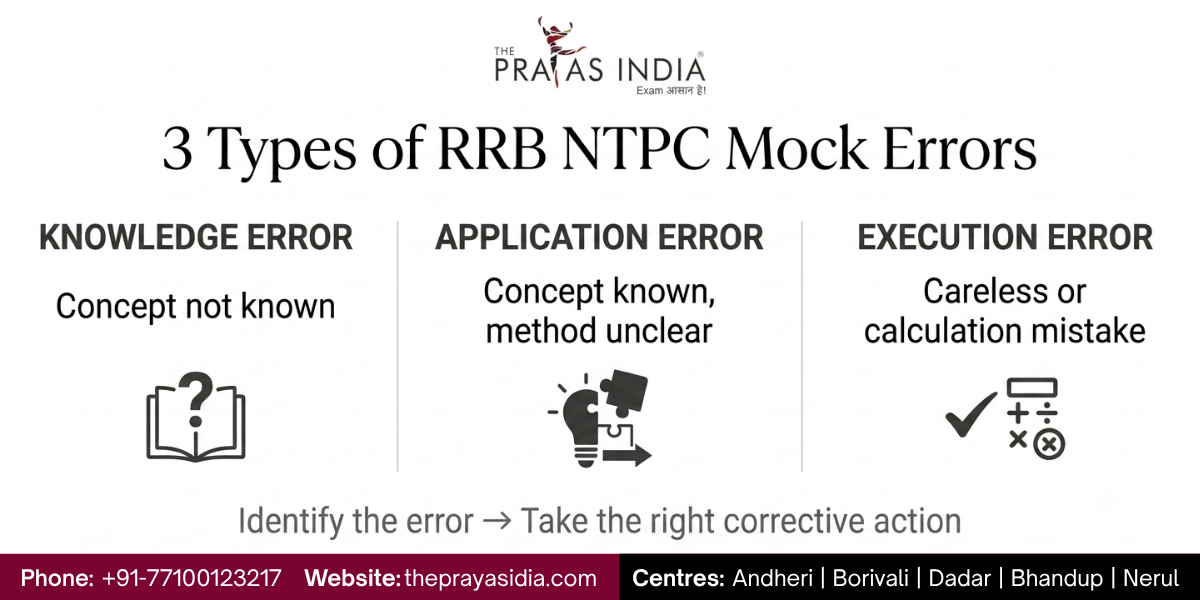
Use the “Three-Level Error” System
A simple three-level classification can make your analysis much easier.
Level 1: Knowledge Error
You did not know the concept, formula or information required to solve the question.
Action: Revise the concept and practise similar questions.
Level 2: Application Error
You knew the concept but could not apply it correctly.
Action: Solve more examples and understand different question formats.
Level 3: Execution Error
You knew the concept and approach but made a careless mistake, calculation error or misread the question.
Action: Improve checking habits, concentration and timed practice.
This system prevents you from treating every incorrect answer as the same type of problem.
How Often Should You Take RRB NTPC Mock Tests?
The ideal mock-test frequency depends on your preparation stage.
If you are still building concepts, taking too many full-length mocks can reduce the time available for learning and topic-wise practice. At this stage, sectional tests and shorter practice sets may be more useful.
Once your syllabus is substantially covered, you can gradually increase full-length mock frequency.
In the final preparation phase, mocks can become more regular, but every test should still be followed by meaningful analysis.
There is no advantage in taking one mock every day if you spend only a few minutes analysing it.
A better rule is:
Take the next mock only after you have extracted useful lessons from the previous one.
Don’t Try to Fix Everything After One Mock
A common mistake is to identify ten weaknesses after a mock and create a huge list of topics to study.
This often creates another problem: lack of focus.
Instead, identify the two or three issues that are having the greatest impact on your score.
For example, if your mock reveals:
- Five careless mistakes
- Slow calculation
- Weak General Awareness retention
- Poor question selection
- Difficulty with one Reasoning topic
You don’t necessarily need to fix everything immediately.
Start with the issues that can produce the biggest improvement. Once those improve, move to the next set of weaknesses.
This makes the preparation process more manageable.
Compare Your Mocks, Not Just Your Scores
One of the strongest benefits of maintaining mock records is that you can compare tests over time.
Suppose your scores are:
Mock 1 → 62
Mock 2 → 67
Mock 3 → 65
Mock 4 → 72
The fluctuation itself is not necessarily a concern. Look deeper.
Perhaps your accuracy improved from 78% to 86%. Maybe your attempts increased without a major increase in incorrect answers. Perhaps your time management became more balanced.
These improvements matter even if the score does not increase linearly.
Your objective should be to build a positive performance trend, not to demand a higher score from every individual mock.
Use Previous Mocks for Revision
Your old mocks are valuable study material.
After a few weeks, revisit questions you previously got wrong. Try solving them again without looking at the solution.
If you can solve them confidently now, the revision worked.
If you still struggle, the underlying problem may require deeper attention.
You can also revisit questions that took too much time and attempt to solve them using a more efficient method.
This turns previous mocks into a reusable question bank based entirely on your own performance.
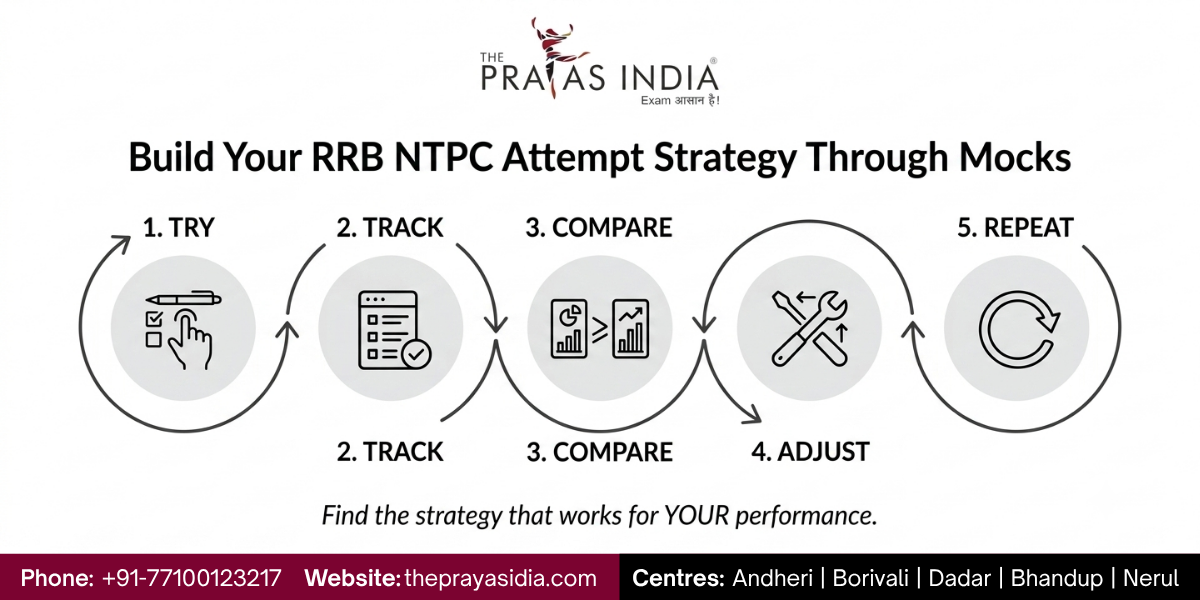
Build Your Personal Attempt Strategy
There is no single attempt order that works equally well for every RRB NTPC aspirant.
Your mock tests should help you discover your own optimal strategy.
You may find that beginning with your strongest section helps you build confidence. Another student may prefer starting with easier questions across sections before moving to moderate ones.
The important thing is to test different approaches during mocks and compare the results.
For example, try one attempt strategy in Mock 1 and another in Mock 2. Compare accuracy, attempts, time usage and overall score.
Eventually, you should enter the actual examination with a tested strategy rather than an untested assumption.
Common Mistakes Students Make While Analysing RRB NTPC Mocks
Looking Only at the Final Score
A score does not explain why marks were lost. Always examine accuracy, attempts, timing and mistakes.
Checking Solutions Without Understanding the Mistake
Reading the correct solution is not enough. Identify what caused your original error.
Ignoring Correct but Slow Questions
A correct answer can still reveal a time-management problem if it took too long.
Repeating the Same Mock Strategy
If your attempt order consistently produces poor results, experiment with a different approach during the next test.
Taking Too Many Mocks
Quantity without analysis can create the illusion of preparation without meaningful improvement.
Making an Extremely Long Mistake Notebook
Your notes should be concise. Record useful lessons rather than copying complete questions and solutions.
Comparing Yourself Constantly With Other Aspirants
Your mock data should primarily be compared with your own previous performance. Your goal is measurable personal improvement.
How The Prayas India Can Help With RRB NTPC Preparation
For many aspirants, the challenge is not simply finding study material. It is creating a structured preparation system where learning, practice, testing and improvement happen consistently.
A structured coaching environment can provide a clearer preparation path by combining concept-focused learning with practice sessions, mock tests and performance analysis.
For students preparing for RRB NTPC in Mumbai, guidance can also help them understand how to approach different sections, manage time and identify the areas that need additional attention.
At The Prayas India, aspirants can work towards a structured exam-preparation process rather than preparing randomly from multiple sources.
The objective is to help students move beyond simply taking tests and learn how to use every test as feedback for improvement.
Choosing the Right RRB Coaching in Mumbai
When selecting RRB coaching, aspirants should look beyond advertisements and focus on the preparation system offered by the institute.
Consider whether the programme provides structured classes, relevant study material, regular tests, doubt-solving support and a meaningful approach to performance analysis.
Mock tests are particularly valuable when students receive guidance on how to interpret their results and correct their weaknesses.
A good coaching environment should help you understand not just what to study, but also how to practise, test and improve.
For an aspirant preparing seriously for RRB NTPC, this complete preparation cycle can make the journey more organised and focused.
FAQs
1. How should I analyse my RRB NTPC mock test?
Start with your score, attempts and accuracy. Then analyse incorrect, skipped and time-consuming questions to identify conceptual, application and execution errors.
2. Should I analyse every question after an RRB NTPC mock?
You should review every incorrect question and important skipped questions. Correct questions that took unusually long should also be analysed for efficiency.
3. How many RRB NTPC mocks should I take?
There is no fixed number. The quality of analysis is more important than simply increasing the number of tests. Take enough mocks to develop speed, accuracy and a reliable attempt strategy.
4. Why is my RRB NTPC mock score not improving?
Your score may remain stagnant because of repeated mistakes, poor question selection, low accuracy, slow solving speed or insufficient revision. Mock analysis can help identify the specific reason.
5. How can I improve accuracy in RRB NTPC mocks?
Identify recurring careless mistakes, understand why they happen and practise similar questions under timed conditions. Improving question selection can also reduce unnecessary negative marks.
6. How can I improve my speed for RRB NTPC?
Use timed sectional practice, improve calculation efficiency and learn to move away from questions that consume disproportionate time.
7. Should I maintain an RRB NTPC mock-test analysis sheet?
Yes. Tracking scores, attempts, accuracy, mistakes and action points makes it easier to identify long-term performance trends.
8. What should I do after a low mock-test score?
Do not immediately take another mock. First identify the reasons behind the low score, select the most important weaknesses and work on them before your next test.
9. Can mock tests improve my RRB NTPC time management?
Yes. Regular mocks combined with timing analysis can help you understand where you spend too much time and improve your question-selection strategy.
10. Should I repeat questions from previous RRB NTPC mocks?
Yes. Revisiting previously incorrect or time-consuming questions can help determine whether the underlying weakness has actually been corrected.
11. When should I start taking full-length RRB NTPC mocks?
Full-length mocks become more useful once you have covered a substantial portion of the syllabus. Earlier in preparation, sectional tests and topic-wise practice can be more appropriate.
12. Is RRB NTPC coaching useful for mock-test preparation?
Structured coaching can help students follow a planned testing schedule, understand performance gaps and receive guidance on improving weak areas and exam strategy.
Final Takeaway
A mock test should never be treated as just another question paper. It is a performance report that shows how effectively your preparation is translating into exam performance.
The most useful question after a mock is not:
“What score did I get?”
It is:
“What can I change before my next test?”
Track your attempts, accuracy, speed and mistakes. Separate knowledge gaps from careless errors. Identify questions that consumed too much time. Revisit previous mistakes and create targeted action points.
Most importantly, maintain a continuous cycle:
MOCK → ANALYSE → IDENTIFY → PRACTISE → IMPROVE → RETEST
With consistent analysis, every mock can become more than a test—it can become a step towards a better score.
For aspirants looking for structured RRB coaching in Mumbai, The Prayas India can help create a preparation environment where learning, practice, testing and improvement work together.
Contact Us
- Call Now: +91-77100 13217
- Website: theprayasindia.com
- Centres: Andheri | Borivali | Dadar | Nerul | Bhandup