How to Analyse SSC CGL Mock Tests for Better Scores | Best SSC Coaching in Mumbai | The Prayas India
SSC CGL preparation often reaches a point where simply taking more mock tests stops producing meaningful improvement. A candidate may attempt one mock after another, notice that the score fluctuates, and then move directly to the next test without understanding why marks were lost. This approach can create the illusion of regular practice without addressing the actual weaknesses that are keeping the score from improving.
A mock test should not be treated merely as a prediction of your SSC CGL performance. It is a diagnostic tool that shows how effectively you are applying your preparation under time pressure. Your score tells you where you currently stand, but the detailed analysis of that score tells you what needs to change.
For an SSC CGL aspirant, the real value of a mock begins after the test is submitted. The incorrect questions, skipped questions, questions that took too long, careless mistakes and even questions answered correctly through guesswork can provide useful information about your preparation.
If mock-test analysis becomes a regular part of your study routine, you can gradually improve accuracy, speed, question selection and section-wise performance instead of repeatedly making the same mistakes.
Why Taking More Mocks Does Not Automatically Improve Your Score
There is a common assumption among aspirants that the number of mocks taken directly determines improvement. While regular mock practice is important, the number of tests alone is not enough.
Consider two candidates who take twenty mock tests. The first candidate takes each test, checks the score, looks at the correct answers and immediately starts preparing for the next test. The second candidate spends meaningful time analysing every incorrect, skipped and time-consuming question before modifying their preparation strategy.
Even though both candidates have taken the same number of mocks, their learning from those tests is very different.
The first candidate is primarily measuring performance. The second candidate is using performance data to improve performance.
This distinction is particularly important in SSC CGL because a small improvement in accuracy or time management across several questions can have a meaningful impact on the overall score. Mock analysis helps you identify those small but repeated losses.
What Should You Analyse After an SSC CGL Mock?
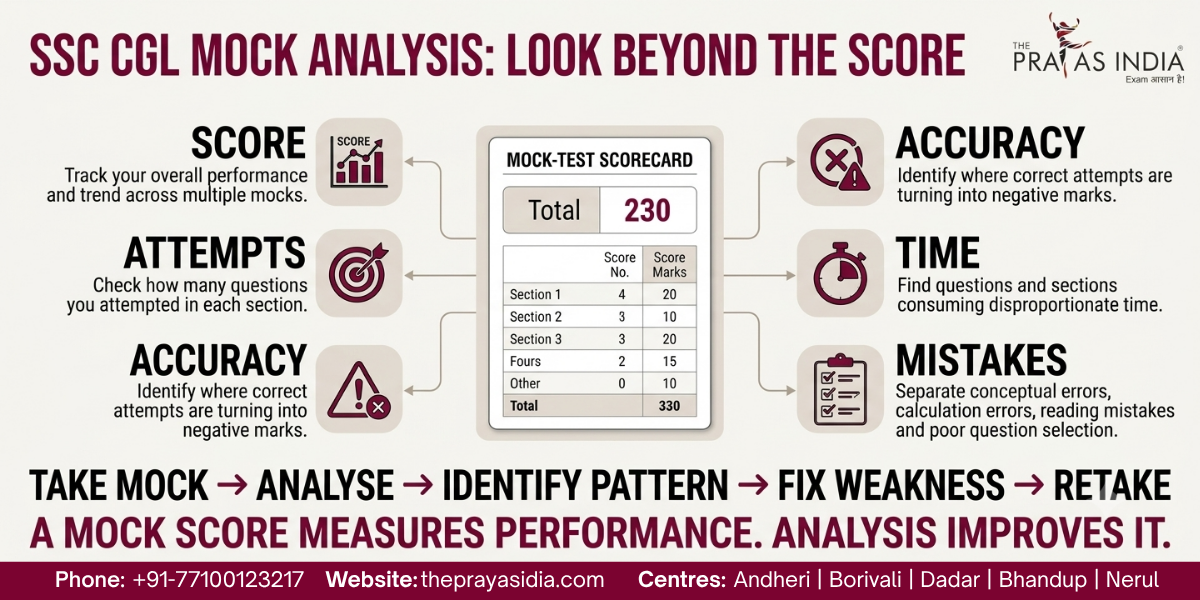
A useful mock-test analysis should go beyond checking which questions were marked wrong. Your performance can be divided into several categories, and each category tells you something different about your preparation.
After every mock, examine:
- Questions answered incorrectly
- Questions left unattempted
- Questions that consumed excessive time
- Questions answered correctly but with low confidence
- Questions where you made a calculation or reading error
- Questions where the concept itself was unclear
- Questions where you knew the concept but could not apply it
- Questions where you changed a correct answer to an incorrect one
- Section-wise attempts and accuracy
- Overall time distribution
This broader analysis helps you distinguish between knowledge gaps and execution problems.
For example, if you repeatedly answer percentage questions incorrectly because you do not understand the underlying concept, more mock tests will not solve the issue. You need targeted concept revision.
On the other hand, if you know the concept but make errors because you rush through calculations, the solution is different. You need controlled practice focused on accuracy and calculation discipline.
Start With Your Overall Mock Score, But Do Not Stop There
The first number most candidates look at after a mock is the overall score. It is useful, but it should be treated as a starting point rather than the complete picture.
Record your score after every mock and observe the broader trend. One unusually low score does not necessarily indicate that your preparation has deteriorated, just as one exceptionally high score does not automatically mean that you have solved all your weaknesses.
Look for patterns across several tests.
If your score is gradually increasing, your preparation strategy may be working. If your score remains within a narrow range for several weeks, it may indicate that you have reached a plateau and need to identify the specific areas preventing further improvement.
The most useful question after seeing your score is not “How many marks did I get?” but “Why did I get this score?”
Analyse Attempts and Accuracy Together
Attempts and accuracy should always be studied together. A candidate who attempts a large number of questions but makes many errors may not be performing better than someone with fewer attempts and stronger accuracy.
For example, suppose your attempts increase significantly between two mocks, but your accuracy falls sharply. The additional attempts may not have helped your score because you are taking too many uncertain questions.
Similarly, if your accuracy is excellent but your attempts are very low, the issue may be excessive caution or inefficient time management.
Your objective should be to find a productive balance between attempts, accuracy and available time.
Instead of chasing an arbitrary attempt number, ask yourself whether the questions you are attempting are genuinely worth attempting based on your confidence, time requirement and probability of getting them correct.
Categorise Your Mistakes Instead of Calling Everything a “Silly Mistake”
One of the most useful habits in mock analysis is to classify mistakes. Simply writing “silly mistake” next to every incorrect question does not tell you how to prevent it from happening again.
A better approach is to identify the actual reason.
Conceptual Mistake
You did not understand the underlying concept or formula. This requires focused revision and additional practice.
Application Mistake
You knew the concept but could not identify how to apply it to the particular question. You need more varied practice rather than simply rereading theory.
Calculation Mistake
Your approach was correct but an arithmetic or calculation error caused the wrong answer. This indicates a need for more controlled solving and checking habits.
Reading Mistake
You misunderstood the question, missed a keyword or incorrectly interpreted the information provided. Slowing down slightly during question reading can be more useful than simply trying to solve faster.
Question Selection Mistake
You chose a question that was too lengthy, unfamiliar or uncertain when better opportunities were available elsewhere.
Time-Management Mistake
You spent too much time on one question or section and lost the opportunity to attempt easier questions later.
This classification turns mock analysis into an actionable process. Once you know the type of mistake, you can decide what kind of practice is required.
Revisit Every Incorrect Question
Do not rely only on the answer key or explanation provided after the mock. Try to understand the question yourself.
For every incorrect question, ask:
Why did I choose this option?
This question is more important than simply asking why the correct option is right.
Perhaps you misunderstood a statement. Maybe you applied the wrong formula. Perhaps two options looked similar and you eliminated the correct one incorrectly. Or maybe you rushed because you were aware of the time pressure.
Understanding your own decision-making process helps prevent the same mistake in future tests.
After reviewing your approach, compare it with the correct method. If the solution uses a shorter or more efficient method, add that technique to your revision notes.
Do Not Ignore Questions You Did Not Attempt
Unattempted questions can contain some of the most useful information in your mock analysis.
A question left unanswered can represent several different situations. You may not have known the concept, you may have understood the question but lacked confidence, you may have run out of time, or you may have deliberately skipped it because the question was too risky.
These situations require different solutions.
If you skipped a question because you did not know the concept, revise that topic.
If you skipped it because you were unsure between two options, work on conceptual clarity and elimination techniques.
If you skipped it because you ran out of time, the problem is likely related to pacing or section management.
Therefore, unattempted does not automatically mean weak. You need to understand why it was unattempted.
Look at Questions That Took Too Long
A question can be correct and still represent a problem if it consumed too much time.
This is particularly important for SSC CGL, where efficient question selection and time management can significantly influence how many questions you are able to attempt.
Suppose you solved a question correctly but spent several times longer than the expected time for that type of question. If you encounter a similar question in the actual examination, the same approach may prevent you from reaching easier questions.
Mark such questions during analysis and compare your method with alternative solutions. Look for shortcuts, standard approaches or simpler ways of recognising the structure of the problem.
The objective is not to rush every question. It is to recognise which questions deserve your time and which do not.
Analyse Section-Wise Performance
Your overall score can hide significant differences between sections.
You might perform strongly in English but lose marks in General Intelligence and Reasoning. Your Quantitative Aptitude accuracy might be good but your attempts may remain low. General Awareness may have high variation because of the nature of the questions.
Therefore, analyse each section separately.
For every section, record:
- Number of attempts
- Number of correct answers
- Number of incorrect answers
- Accuracy percentage
- Approximate time spent
- Topics responsible for most errors
- Questions skipped despite being potentially manageable
This gives you a clearer picture of where your score is actually being lost.
Maintain a Dedicated SSC CGL Mock Analysis Record
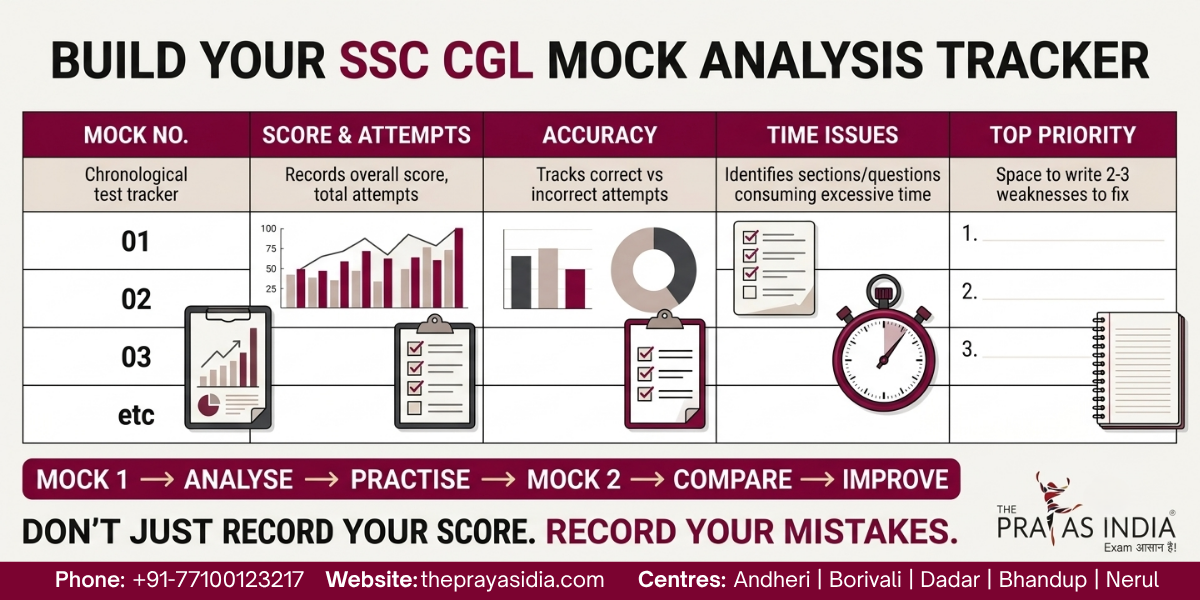
Keeping your mock results in one place makes it easier to identify patterns over time. You do not need an elaborate system. A simple notebook, spreadsheet or digital tracker can be enough as long as you update it consistently.
For every mock, record your overall score, section-wise performance, attempts, accuracy and major mistakes. More importantly, write down the recurring issues that need attention before the next test.
For example, if Quant repeatedly shows calculation errors in percentage, ratio and average-based questions, this should become a targeted practice area. If Reasoning consistently loses time because of lengthy arrangements, your practice should focus on recognising when such questions are worth attempting and when they should be postponed.
The purpose of maintaining this record is to prevent your preparation from becoming random. Every mock should influence what you study next.
How to Analyse the English Language Section
English can sometimes appear easy because many questions are familiar in format. However, careless reading, vocabulary gaps and overconfidence can affect accuracy.
During mock analysis, look beyond the total number of incorrect answers. Identify whether your mistakes are concentrated in areas such as vocabulary, grammar, reading comprehension, sentence improvement, error detection or contextual usage.
If you repeatedly make grammar-based mistakes, revisit the relevant rules and then solve targeted questions. If vocabulary is the issue, focus on contextual learning rather than trying to memorise isolated word lists without usage.
For reading comprehension, analyse whether your mistake came from misunderstanding the passage, rushing through the question or selecting an option that was only partially supported by the passage.
The objective is to understand what caused the error, not simply remember the correct option from one mock.
How to Analyse General Intelligence and Reasoning
Reasoning performance is closely connected to question selection and speed. Some questions can be solved quickly with familiarity and practice, while others may consume considerably more time.
After your mock, identify the question types where you consistently lose time or accuracy. These may include analogy, classification, series, coding-decoding, syllogism, blood relations, directions, Venn diagrams or other reasoning formats.
If you understand the concept but take too long to recognise the pattern, you need more timed practice. If you repeatedly use a complicated approach when a simpler method exists, compare your solution with alternative approaches.
Also review the questions you skipped. Sometimes the problem is not lack of ability but failure to recognise that a particular question was actually manageable.
How to Analyse Quantitative Aptitude
Quantitative Aptitude requires particularly detailed analysis because a single error can originate from several different sources.
You may know the formula but apply it incorrectly. You may understand the approach but make a calculation error. You may solve correctly but take too long. Or you may avoid the question because you lack confidence in the topic.
Break your mistakes into categories such as concept, calculation, application and time.
Then identify topic-level patterns. If several errors come from arithmetic, algebra, geometry or data interpretation, prioritise those areas in your next study cycle.
Do not simply solve more random questions. Target the exact weakness revealed by the mock.
How to Analyse General Awareness
General Awareness requires a somewhat different mock-analysis approach because the solution to an incorrect question is not always more question practice.
If you do not know the answer to a factual question, identify the subject area and revise it through your regular study material. Maintain concise revision notes for recurring areas and important facts.
However, do not spend excessive time trying to memorise every question you encountered in one mock. The purpose of analysis is to identify broader knowledge gaps and revision requirements.
You should also distinguish between questions you genuinely knew and questions you guessed correctly. A correct answer based purely on guesswork should not automatically be considered a strength.
Correct Answers Can Also Need Analysis
A common mistake is to analyse only incorrect answers. Correct answers can also reveal weaknesses.
Suppose you answered a question correctly but were unsure between two options. If you guessed correctly, the result should not be treated the same way as a confident, conceptually sound answer.
Similarly, if you solved a Quant question correctly but used a very lengthy method, the question reveals an opportunity for improvement even though no marks were lost.
Classify correct answers into categories such as:
Confident and efficient: Keep the approach.
Confident but slow: Improve speed.
Correct but uncertain: Strengthen the concept.
Correct through guessing: Review the underlying topic.
This approach makes mock analysis more honest and useful.
Improve Accuracy Without Destroying Your Attempts
Aspirants sometimes react to low accuracy by becoming extremely cautious. They begin skipping too many questions, which may improve the accuracy percentage but reduce the overall score.
The goal is not to maximise accuracy in isolation. You need to build a combination of reasonable attempts and sustainable accuracy.
Start by identifying the types of questions where you make avoidable mistakes. Improve those areas first rather than simply reducing attempts.
For example, if you frequently make calculation errors in questions that you otherwise understand, more disciplined calculation practice can improve accuracy without forcing you to skip those questions in the future.
Similarly, if your mistakes come from selecting questions that are too lengthy, improve your question-selection strategy rather than becoming hesitant about attempting unfamiliar questions altogether.
Use Mock Tests to Improve Question Selection
SSC CGL preparation is not only about knowing how to solve questions. It is also about recognising which questions should receive your time.
During mock analysis, look for questions that you attempted but should probably have skipped or postponed. Ask whether the question appeared lengthy, involved complicated calculations, required multiple steps or had a high uncertainty level.
Then look at questions you skipped that were actually manageable.
This comparison can reveal whether your problem is aggressive question selection or excessive caution.
With repeated analysis, you can develop a more reliable decision-making process that helps you identify high-value questions more quickly.
How Often Should You Take SSC CGL Mock Tests?
The ideal frequency depends on your preparation stage.
During the initial phase, topic-wise and sectional tests may be more useful because you are still building concepts. Full-length mocks can gradually become more frequent as your syllabus coverage improves.
Closer to the examination, regular full-length mock tests can help you become comfortable with the actual pressure of completing the paper within the available time.
However, taking a new mock immediately after every test without analysing the previous one can reduce the value of both tests.
A useful principle is:
Take a mock → analyse it properly → work on identified weaknesses → then take the next mock.
The exact number of mocks matters less than the quality of learning you extract from each one.
Don’t Make These Mock Analysis Mistakes
Mock analysis itself can become ineffective if you approach it incorrectly. Several habits can prevent you from getting the full benefit of your tests.
Checking Only the Score
Your score is useful for tracking progress, but it does not explain the reason behind your performance. Always go deeper into section-wise attempts, accuracy and mistakes.
Reading Solutions Without Reviewing Your Approach
Do not immediately look at the explanation for every incorrect question. First reconstruct your own thinking and identify where your approach went wrong.
Marking Everything as a Silly Mistake
If you repeatedly make the same “silly” mistake, it is no longer random. It has become a pattern that needs a specific solution.
Ignoring Time-Consuming Correct Questions
A correct answer that consumes excessive time may still indicate an inefficient approach.
Taking Too Many Mocks
More tests are not automatically better. Without analysis and targeted improvement, additional mocks can simply repeat the same weaknesses.
Changing Strategy After Every Mock
A single unusually difficult paper should not make you completely change your preparation strategy. Look for patterns across multiple tests before making major changes.
How to Turn Mock Analysis Into Your Next Study Plan
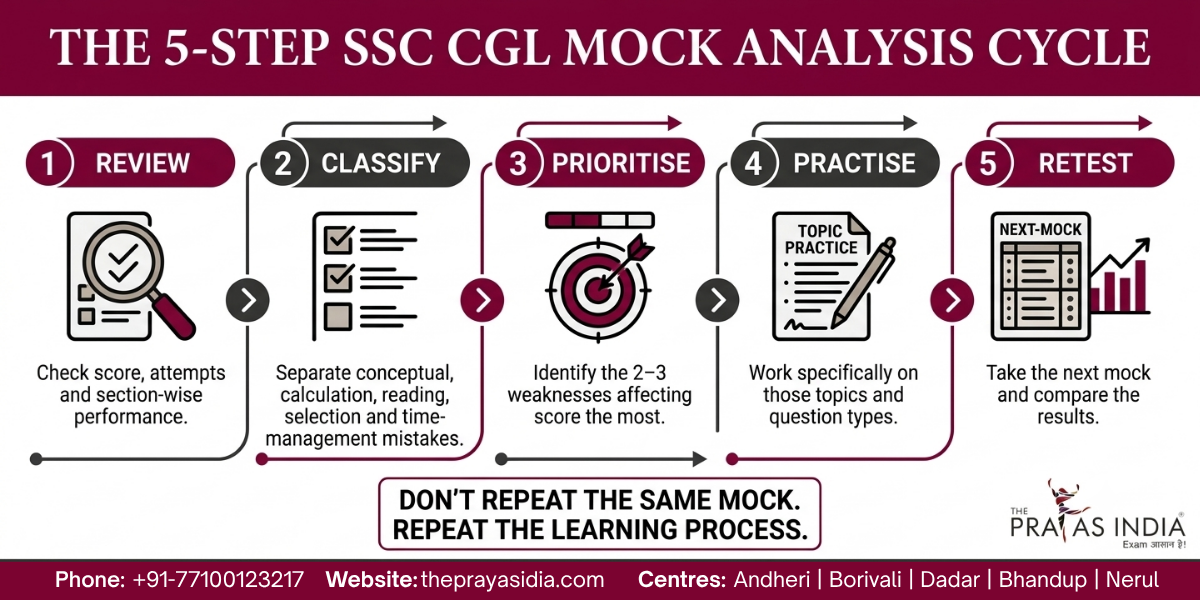
Mock analysis becomes truly valuable when it directly influences what you do after the test.
Suppose your analysis shows that your Quant score is affected by repeated mistakes in percentages and ratios. Your next study sessions should include targeted revision and practice for those topics.
If Reasoning is strong in accuracy but slow in execution, focus on timed sets and question selection.
If English has strong attempts but several avoidable errors, spend time identifying the specific error patterns rather than simply attempting more questions.
This creates a feedback loop where every mock influences the next phase of preparation.
Instead of following the same timetable regardless of performance, your preparation becomes responsive to your actual needs.
A Practical Post-Mock Routine
You do not need to analyse a mock randomly. Follow a consistent sequence every time.
Start by recording your score and section-wise performance. Then review incorrect questions without immediately checking the explanation. Identify why each answer went wrong and classify the mistake.
Next, review unattempted questions and determine whether they were skipped because of knowledge gaps, uncertainty or lack of time. Then examine questions that consumed excessive time, including those you eventually answered correctly.
Finally, identify the most important recurring weaknesses and decide what you will practise before taking the next mock.
This routine ensures that mock analysis ends with a clear action plan rather than just a collection of explanations.
When Should You Retake a Similar Question?
If you encounter a question type that exposed a conceptual weakness, do not simply read the solution and move on.
After revising the concept, solve several similar questions without looking at the method. The objective is to confirm that you can apply the learning independently.
For calculation or speed-related mistakes, timed practice can be useful. For conceptual mistakes, untimed accuracy-first practice may be more appropriate initially.
Once the weakness improves, introduce time pressure again and test whether the improvement survives under realistic conditions.
This progression helps prevent the common situation where a candidate understands the solution immediately after the mock but makes the same mistake in the next test.
Use Trends Instead of Individual Mock Scores
Your performance should be judged through trends rather than isolated numbers.
A single mock can be unusually easy, difficult or simply different from the types of questions you have recently practised. Therefore, do not panic after one poor score or become overconfident after one excellent score.
Compare several mocks and look for changes in:
- Overall score
- Section-wise accuracy
- Number of attempts
- Negative marks
- Time distribution
- Recurring topics
- Question-selection decisions
If accuracy is gradually improving while attempts remain stable, that is useful progress. If attempts are increasing but negative marks are also rising, you need to work on question selection.
The trend provides a much more reliable picture of your preparation than one test.
How The Prayas India Can Help With SSC CGL Preparation
SSC CGL preparation requires a combination of conceptual clarity, regular practice, mock testing and performance analysis. Aspirants need to understand not only the syllabus but also how to manage time, select questions and maintain accuracy under examination conditions.
For students looking for SSC Coaching in Mumbai, The Prayas India provides structured preparation support designed around the requirements of competitive government examinations. Regular practice and performance evaluation can help aspirants identify their weak areas and work systematically towards improvement.
The Prayas India has centres across Andheri, Borivali, Dadar, Bhandup and Nerul, making structured SSC preparation accessible to aspirants across Mumbai.
Students interested in SSC CGL preparation and admissions can contact +91-77100 13217 for further information.
The Right Way to Use Mock Tests for SSC CGL
A mock test should never be the end of a study session. It should become the starting point for the next stage of preparation.
When you analyse a mock properly, every wrong answer can teach you something. Every unattempted question can reveal a gap in confidence, knowledge or time management. Every time-consuming question can show you where your approach needs improvement. Even a correct answer can expose inefficient methods or unnecessary guesswork.
The most effective SSC CGL aspirants therefore do not simply ask, “What was my score?” They ask more useful questions: “Where did I lose marks? Why did I lose them? What will I change before the next mock?”
That mindset turns mock tests from simple score-generating exercises into a structured performance-improvement system.
Final Takeaway
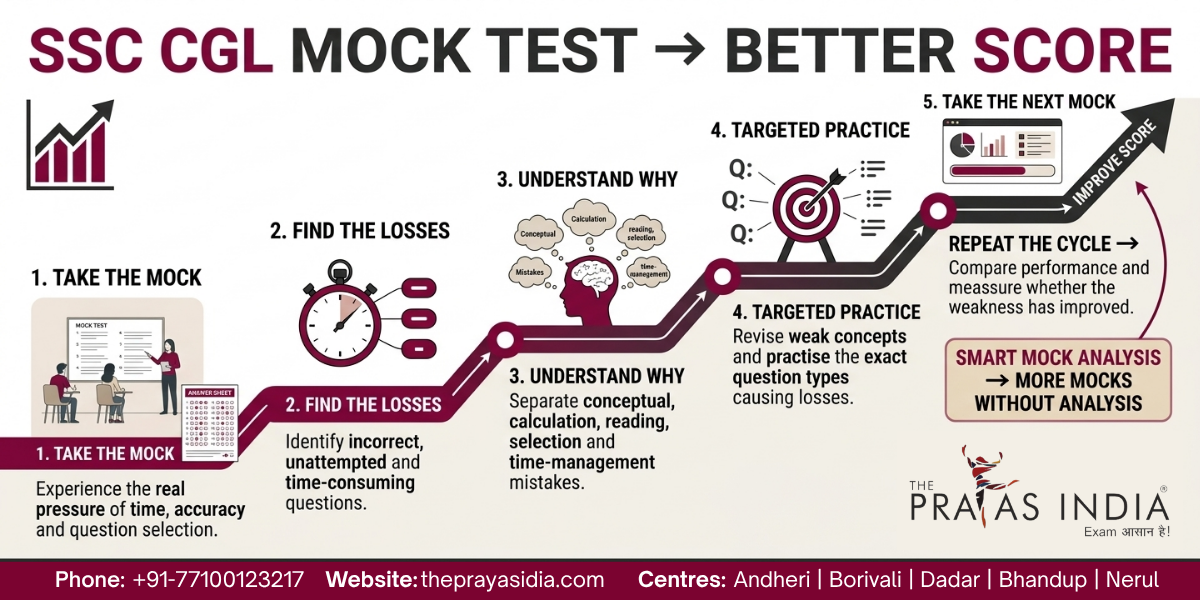
SSC CGL mock tests are most useful when they become part of a continuous test–analyse–improve–retest cycle. Taking a large number of mocks without understanding your mistakes can create activity without meaningful progress.
A better strategy is to study every mock as a performance report. Analyse your score, attempts, accuracy, time usage and question selection. Then classify your mistakes and identify the areas that are repeatedly affecting your performance.
Once the pattern becomes clear, adjust your preparation accordingly. Revise the concepts responsible for errors, practise similar questions, work on speed where necessary and improve your selection strategy through repeated timed practice.
Over time, this process can help you move beyond simply taking mocks to using mocks as a tool for score improvement.
For aspirants preparing for SSC CGL in Mumbai, structured guidance, regular testing and consistent performance analysis can make the preparation process more focused and measurable. The Prayas India supports SSC aspirants through its centres in Andheri, Borivali, Dadar, Bhandup and Nerul.
Contact Us
📞 Call Now: +91-77100 13217
🌐 Website: theprayasindia.com
📍 Centres: Andheri | Borivali | Dadar | Nerul | Bhandup
FAQs
1. How should I analyse my SSC CGL mock test?
Start by checking your score, attempts and accuracy. Then review incorrect, unattempted and time-consuming questions. Identify the reason behind each mistake and create a targeted plan for improvement.
2. Should I analyse correct answers in SSC CGL mocks?
Yes. Correct answers can still reveal inefficient methods, excessive time consumption or guesswork. Reviewing these questions can help improve both speed and confidence.
3. Why is my SSC CGL mock score not improving?
A stagnant score can result from repeatedly making the same conceptual, calculation, accuracy or time-management mistakes. Detailed mock analysis helps identify the specific weakness responsible for the plateau.
4. How can mock tests improve SSC CGL accuracy?
Mock tests expose recurring mistakes under time pressure. When you classify those mistakes and practise the underlying concepts or question types, you can gradually reduce avoidable errors.
5. How many SSC CGL mocks should I take?
There is no single ideal number every aspirant. The focus should be on taking mocks regularly according to your preparation stage and analysing each test properly before moving to the next one.
6. Is mock-test analysis more important than taking more mocks?
Both are important, but taking more mocks without analysing them limits their value. A properly analysed mock can identify weaknesses that should guide your preparation before the next test.