How to Avoid Burnout During Long-Term SSC Exam Preparation | Best SSC Coaching in Mumbai | The Prayas India
Preparing for an SSC examination is rarely a short journey. Whether you are targeting SSC CGL, SSC CHSL, SSC MTS or another major SSC recruitment examination, the preparation process can extend over several months and may involve repeated cycles of learning, revision, mock tests and performance analysis. In the beginning, the excitement of starting a new preparation plan can make it easy to study for long hours every day. However, maintaining the same intensity for months without proper recovery can gradually lead to exhaustion, reduced concentration and loss of consistency.
This is where burnout during SSC preparation becomes a serious concern. Burnout is not simply feeling tired after a long study session. It can develop when the pressure to keep performing remains high while adequate physical and mental recovery is missing. A student may continue sitting at the study table for many hours but find it increasingly difficult to concentrate, retain information or solve questions accurately. The result is often a frustrating cycle in which longer study hours produce less productive preparation.
For SSC aspirants, avoiding burnout does not mean studying less seriously. It means creating a preparation system that can be sustained over the long term. The objective should be to maintain a healthy balance between study intensity, revision, practice, mock tests and recovery so that preparation remains productive throughout the examination journey.
Long-Term SSC Preparation Requires a Sustainable Strategy
One of the most common mistakes aspirants make is treating every day as if it were the final week before the examination. They create extremely demanding schedules, attempt to study for ten or twelve hours from the first day and expect themselves to maintain maximum productivity continuously.
Such a routine may work temporarily, but it becomes difficult to sustain. Once the initial motivation declines, the candidate may begin missing study targets, feel guilty about unfinished work and respond by creating an even more aggressive schedule. Over time, this can damage both productivity and confidence.
A better approach is to distinguish between intensive preparation periods and sustainable daily preparation. There will certainly be phases when you need to increase mock-test frequency, revise extensively or focus heavily on weak areas. However, your regular study routine should remain realistic enough to follow for months.
A sustainable schedule does not ask, “How much can I study today?” It asks, “What level of preparation can I consistently maintain without losing effectiveness?”
This change in mindset can make a significant difference in long-term SSC preparation.
Recognise the Difference Between Normal Tiredness and Burnout
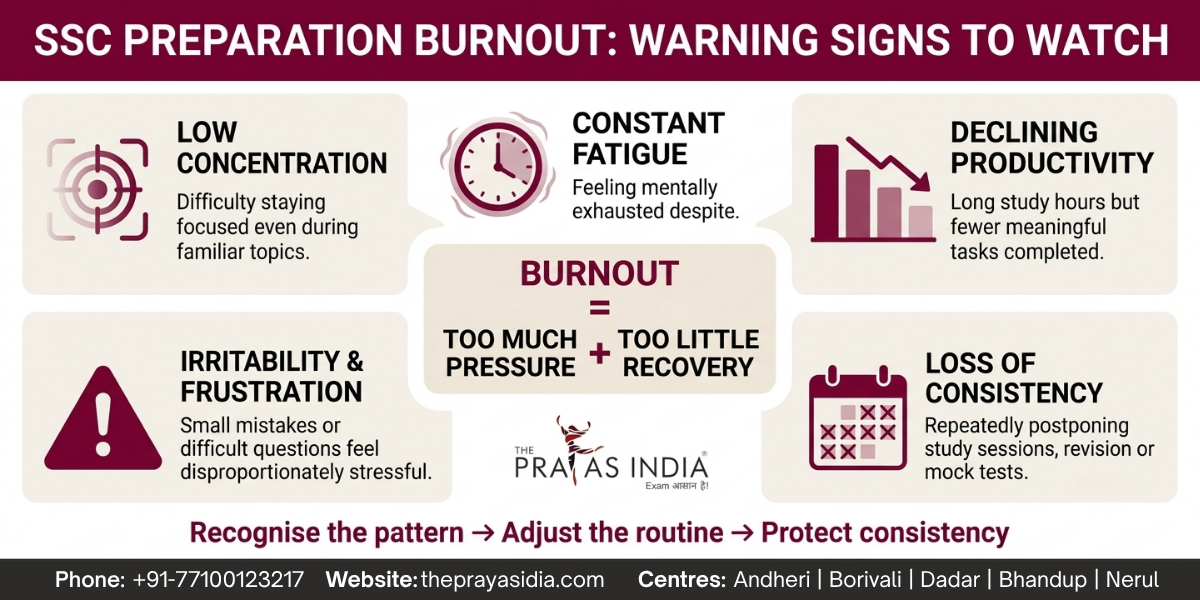
Feeling tired after studying is normal. Competitive-exam preparation requires sustained mental effort, and occasional low-energy days are unavoidable. The problem begins when exhaustion becomes persistent and starts affecting the quality of your preparation.
A candidate experiencing prolonged study fatigue may notice that previously manageable topics are becoming difficult to concentrate on. They may repeatedly read the same material without absorbing it, postpone mock tests because they feel mentally drained, become unusually frustrated by mistakes or lose interest in activities that previously helped them relax.
Another warning sign is the feeling that no amount of studying is enough. Even after completing a productive session, the candidate may feel guilty about not doing more. This mindset can encourage unnecessarily long study hours and reduce the quality of the following day’s preparation.
The solution is not to ignore these signals. Instead, use them as information about whether your current routine needs adjustment.
Stop Measuring Preparation Only by Study Hours
Study hours are easy to count, which is why many candidates use them as their primary measure of progress. However, hours spent at a desk do not necessarily represent productive learning.
Suppose one aspirant studies for eight hours but spends several of those hours passively reading notes, checking the phone or repeatedly revisiting familiar topics. Another candidate studies for six focused hours, completes a revision target, solves a sectional test and analyses mistakes. The second candidate may have achieved more meaningful progress despite spending fewer hours.
This is why SSC aspirants should track output rather than only input.
Instead of recording only “I studied for seven hours,” record what you actually accomplished. You might have completed two Quantitative Aptitude topics, revised a General Awareness section, solved a Reasoning set and analysed an English sectional test.
This approach makes preparation more measurable and reduces the pressure to sit at the desk simply to increase the number of study hours.
Set Daily Targets That Are Challenging but Realistic
An unrealistic timetable is one of the easiest ways to create long-term frustration.
If your schedule contains fifteen separate tasks every day, even a productive study session may end with several unfinished items. Repeatedly carrying unfinished tasks into the next day creates a feeling that you are always behind.
Instead, identify the most important tasks for the day and assign realistic time blocks to them. Your daily plan should account for the fact that some topics require more concentration than others and that unexpected interruptions may occasionally occur.
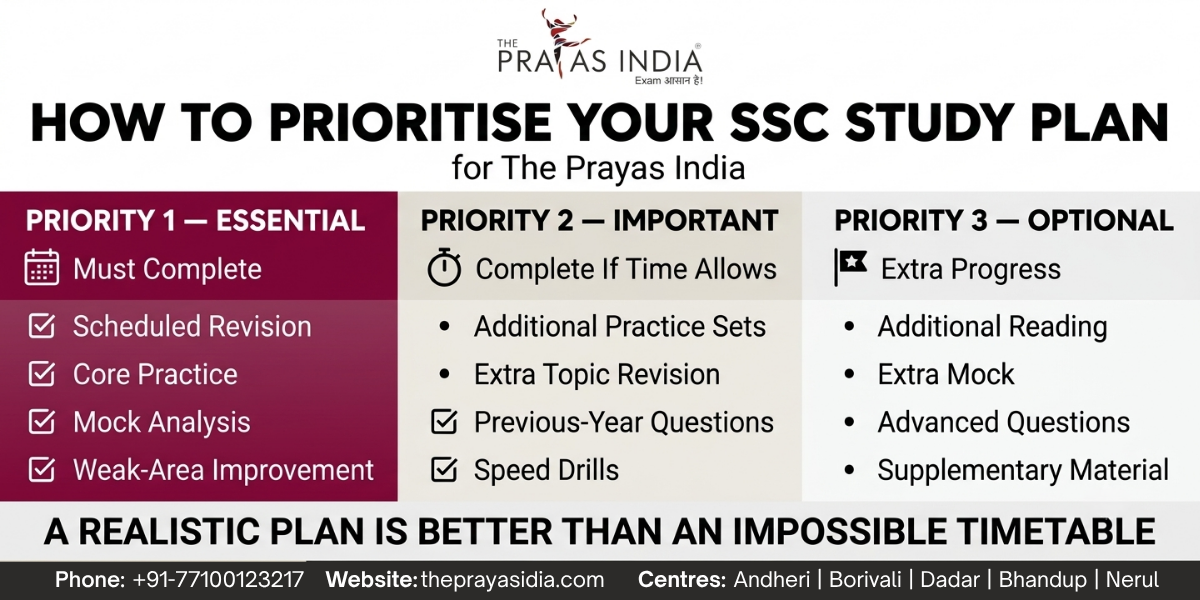
A good SSC study plan should have priority tasks, secondary tasks and flexible revision time. If everything is labelled urgent, nothing is actually prioritised.
For example, completing a difficult Quantitative Aptitude chapter and analysing a full mock test may deserve more attention than attempting to complete several small revision tasks simply to make the timetable look full.
Avoid the “Zero Day” Mindset
Long-term preparation becomes psychologically difficult when candidates believe that every day must be perfect.
If you miss one study session because of an unexpected situation, you may feel that the entire day has been wasted. Some aspirants then postpone preparation until the next morning, turning one missed session into several missed days.
A better approach is to maintain continuity even when the full routine is not possible.
If you cannot complete your normal study schedule, complete a smaller but meaningful task. Revise formulas, review vocabulary, solve a short reasoning set or analyse a few previously attempted questions. The goal is not to maintain maximum intensity every day; it is to prevent occasional disruptions from becoming prolonged breaks.
Consistency is built over months, not judged by whether every single day was perfect.
Build Breaks Into Your Study Schedule
Breaks should not be treated as evidence of poor discipline. They are part of an effective long-term study routine.
When you study continuously for extended periods, concentration can decline even if you remain physically seated at your desk. A planned short break can allow you to return to the next session with better attention.
The important distinction is between planned recovery and unplanned distraction.
A planned break might involve walking around, having a meal, stretching or simply stepping away from the study material for a short period. An unplanned break can easily turn into extended social-media browsing or unrelated online activity.
Your break should therefore help you disconnect from intense academic concentration without replacing it with another source of constant stimulation.
Protect Your Sleep During SSC Preparation
Sleep is often one of the first things candidates sacrifice when they feel behind in their preparation. They study late into the night, wake up early and gradually accumulate fatigue.
This can become counterproductive because effective learning depends not only on how long you study but also on your ability to concentrate and retain information. If insufficient rest consistently reduces your attention, additional study hours may produce diminishing returns.
A sustainable SSC preparation routine should therefore protect adequate sleep and maintain a reasonably consistent sleep schedule. Instead of repeatedly extending late-night study sessions, identify inefficient parts of your timetable and improve them.
The goal is to arrive at your study sessions with enough mental energy to actually process the material.
Make Your Study Routine More Active
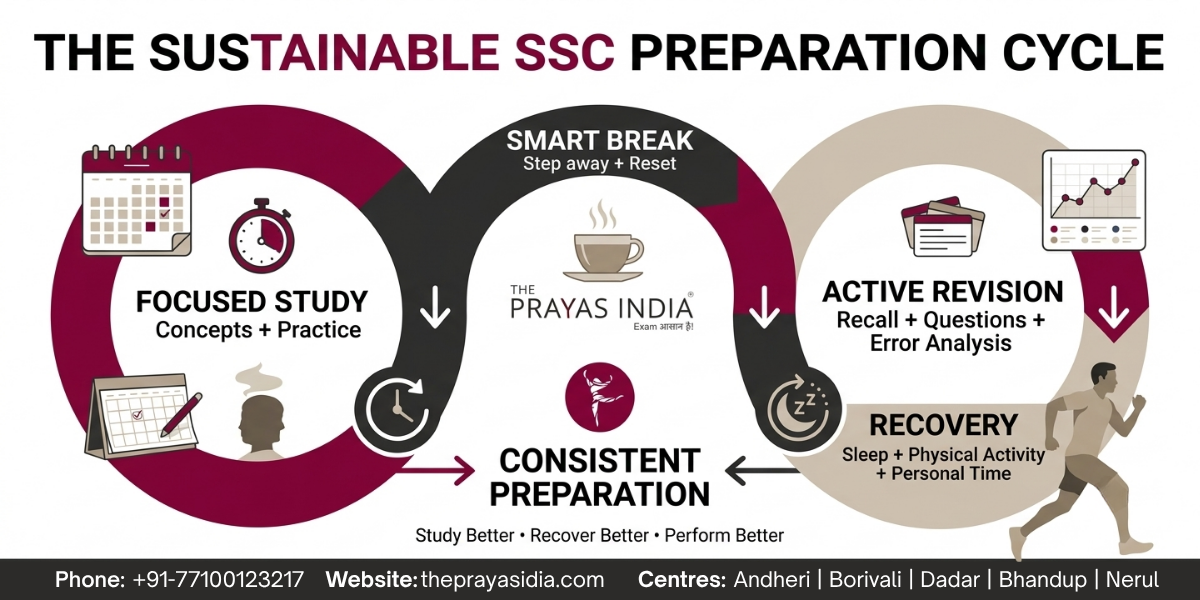
Passive study can contribute to mental fatigue because it often requires prolonged attention without much interaction with the material.
SSC preparation becomes more engaging when you alternate between different forms of learning. Read a concept, solve questions based on it, explain the approach in your own words, revise from short notes and then test yourself.
For example, after studying a Quantitative Aptitude concept, immediately solve a few questions instead of reading another chapter. After revising General Awareness, use active recall to test what you remember. After studying an English topic, practise questions rather than continuing to read theory.
This creates a more dynamic study cycle and gives you frequent evidence of progress.
Do Not Change Your Entire Strategy After One Bad Mock
Mock tests are an essential part of SSC preparation, but they can also become a source of unnecessary stress when candidates interpret every score as a final judgement of their ability.
A low score should be treated as performance data, not as a verdict on your preparation.
If your score falls in one mock, analyse the reasons before changing your entire strategy. Perhaps the paper contained topics you had not revised recently. Perhaps you spent too much time on one section. Maybe several errors were caused by careless calculations rather than conceptual gaps.
The correct response is to identify the underlying issue and make a targeted adjustment.
Constantly changing books, timetables, teachers, test series and preparation strategies based on every fluctuation can create mental overload. Give a reasonable strategy enough time to produce results before deciding whether it needs major changes.
Separate Preparation Problems From Personal Self-Worth
Competitive examinations naturally involve comparison. You may see someone scoring significantly higher in a mock test or hear about another aspirant studying for extremely long hours.
Such comparisons can become harmful when they turn performance into a judgement about your personal ability.
A mock score tells you how you performed on a particular test at a particular point in your preparation. It does not define your potential.
Instead of asking, “Why am I not as good as that candidate?” ask more useful questions: Which area is limiting my score? What can I improve this week? Which mistakes am I repeating?
This shifts your attention from comparison to controllable actions.
Long-term SSC preparation requires patience because improvement is rarely perfectly linear. There may be periods of rapid progress followed by plateaus. The important thing is to continue identifying weaknesses and improving the preparation process.
Key Takeaway
Avoiding burnout during long-term SSC exam preparation is ultimately about creating a routine that you can sustain, measure and adjust. Studying harder is not always the answer when productivity begins to decline. In many cases, the better solution is to improve the quality of study, introduce planned breaks, protect recovery time and set realistic daily priorities.
Start by understanding your own preparation pattern. If long study hours are producing declining concentration, repeated mistakes or constant frustration, do not simply increase the workload. Examine the routine itself.
A sustainable preparation strategy should include focused study sessions, active practice, revision, mock-test analysis and adequate recovery. It should also allow occasional disruptions without turning them into long breaks.
Most importantly, remember that SSC preparation is a long-term process rather than a daily competition to see who can study the most hours. Your goal is to remain mentally and academically prepared until the examination, not merely to survive the first few months of preparation.
Build a Timetable Around Your Energy, Not Just Available Hours
A timetable should not simply divide the day into empty blocks and fill every block with a subject. Your concentration level changes throughout the day, and your most demanding tasks should ideally be placed when you are mentally capable of handling them effectively.
If Quantitative Aptitude requires significant concentration for you, it may be better to schedule difficult problem-solving during your strongest study period. Topics requiring lighter revision can be placed in periods when your energy is comparatively lower. Similarly, mock-test analysis may require a different kind of attention from learning a new concept.
This approach makes the timetable more realistic because it recognises that not every study hour has the same value.
A good routine should also include some flexibility. If you plan every minute of the day, a small delay can disturb the entire schedule and create unnecessary frustration. Leave reasonable buffers between major study blocks so that your timetable can absorb occasional changes without collapsing.
Use a Three-Level Priority System
One effective way to reduce preparation pressure is to divide your daily work into three categories: essential, important and optional.
Essential tasks are the activities that should be completed even on a difficult day. These may include a scheduled revision session, a set of practice questions or analysis of a previously attempted mock.
Important tasks contribute meaningfully to your progress but can be shifted if necessary. Optional tasks are useful additions that you can complete when you have sufficient time and energy.
This system prevents the common problem of having a timetable where every task feels equally urgent.
For example, if you have planned a full mock test, two chapters of Quantitative Aptitude, three General Awareness topics and extensive English practice on the same day, failing to complete one item may make the entire day feel unsuccessful. A priority system allows you to recognise that completing the mock and analysing it may have greater value than simply ticking every task on the list.
Balance All SSC Subjects Without Overloading Yourself
SSC preparation involves multiple subjects, and giving disproportionate attention to one subject can create both academic gaps and mental fatigue. If you spend several consecutive hours on the same type of problem, your concentration may decline even if the subject is important.
Subject rotation can help make long study days more sustainable. Instead of spending an entire day on Quantitative Aptitude, you can combine intensive problem-solving with English practice, General Awareness revision and Reasoning questions.
The purpose of rotation is not to constantly switch tasks. Excessive switching can itself become distracting. Instead, create meaningful study blocks where you remain focused on one subject before moving to another.
For example, a candidate might use the first major session for Quantitative Aptitude, the next for English, another session for Reasoning and a shorter evening block for General Awareness revision. The exact structure should depend on individual strengths, weaknesses and available time.
Schedule Recovery Like You Schedule Study
Many aspirants plan their study sessions carefully but leave recovery completely unplanned. When the schedule becomes busy, rest is usually the first activity to be sacrificed.
A more sustainable approach is to treat recovery as part of the preparation system. Short breaks between study blocks, regular physical movement, sufficient sleep and some personal time can help prevent the accumulation of mental fatigue.
Recovery does not necessarily mean taking an entire day away from preparation. It can involve smaller activities integrated into the routine. A short walk after a long study session, time away from screens or a relaxed evening activity can provide a mental reset.
The important point is to avoid feeling guilty about every minute that is not spent studying. A candidate who never allows the mind to recover may eventually lose the ability to study effectively.
Use Mock Tests as Diagnostic Tools
Mock tests can become stressful when candidates use them only to judge whether they are “good enough.” Instead, treat each mock as a diagnostic exercise.
Your score is important, but the information behind that score is even more valuable.
After every mock, analyse questions that were incorrect, questions that took too long, questions that you guessed, questions that you skipped despite knowing the concept and questions where you made avoidable errors.
This analysis can reveal whether your problem is conceptual knowledge, speed, accuracy, question selection or examination pressure.
For instance, if you consistently solve a particular Quantitative Aptitude topic correctly during practice but make mistakes under time pressure, the issue may not be conceptual. You may need more timed practice rather than another round of basic theory.
This prevents you from repeatedly studying topics you already understand while ignoring the actual reason behind your performance gap.
Don’t Let Mock Scores Control Your Entire Week
One poor mock can affect an aspirant’s confidence far more than it should. A candidate may score below expectations and spend the next several days changing books, searching for new strategies or comparing scores with others.
This reaction can increase stress without solving the underlying problem.
Instead, give yourself a fixed analysis window. Identify the major causes of the score, choose two or three corrective actions and return to your regular preparation.
Similarly, a very high score should not automatically lead to complacency. It is useful evidence that your preparation is moving in the right direction, but continued practice is still necessary.
The most productive attitude is to treat mock tests as feedback loops rather than emotional events.
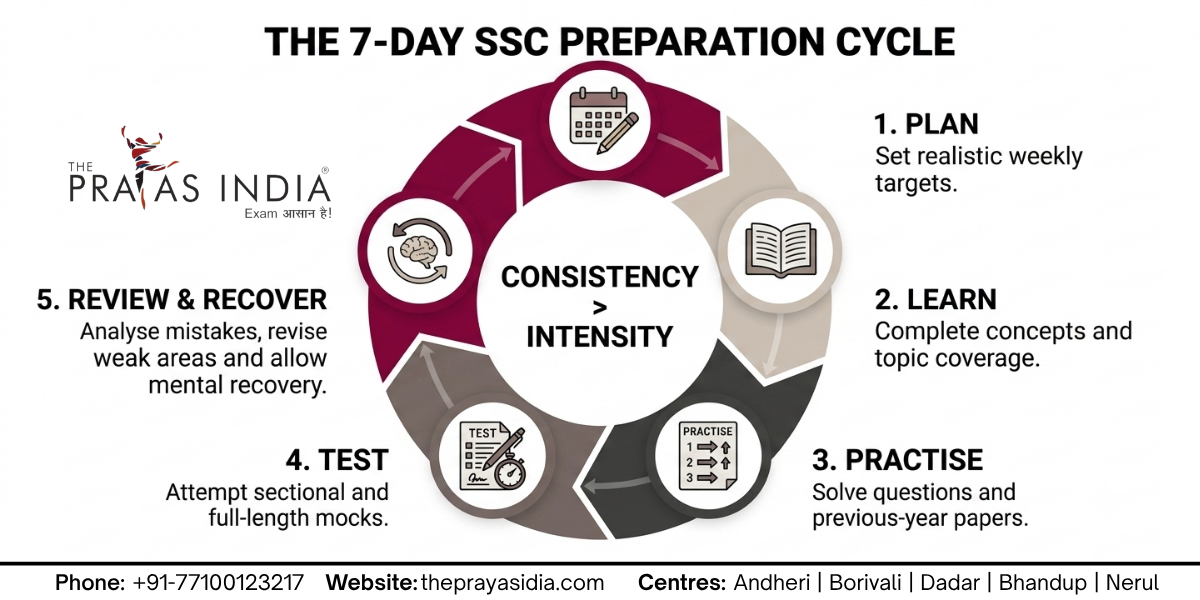
Build a Weekly Recovery and Review Day
A weekly review can prevent small preparation problems from becoming major sources of stress.
At the end of each week, examine what you planned, what you completed and where you fell behind. Identify whether the reason was unrealistic scheduling, weak concepts, excessive distractions or insufficient recovery.
You can then adjust the following week’s plan instead of carrying the same problems forward.
This review should not become another lengthy study session. Its purpose is to evaluate the system.
Ask yourself:
- Which topics improved this week?
- Which topics still require attention?
- Which mistakes appeared repeatedly?
- Was the study schedule realistic?
- Did I take sufficient breaks?
- Which tasks should be prioritised next week?
A weekly review creates a sense of control and can reduce the anxiety that comes from feeling that preparation is happening without direction.
What to Do When You Have a Bad Preparation Day
Even a well-designed timetable cannot eliminate unproductive days. There may be days when concentration is poor, a mock score falls unexpectedly or an important personal responsibility interrupts your routine.
The biggest mistake is turning one difficult day into a negative conclusion about your entire preparation.
Instead of trying to compensate by studying extremely late or doubling the next day’s workload, return to the routine as quickly as possible. Identify whether the problem was temporary or whether something in the schedule needs to change.
If you were simply tired, adequate recovery may be enough. If you repeatedly struggle with the same subject, you may need to change the way you are studying it. If distractions are responsible, modify your study environment.
The objective is to correct the system rather than punish yourself.
Avoid Excessive Resource Switching
Another hidden source of preparation burnout is constantly searching for new resources.
One teacher explains a topic differently, another book contains additional questions and another test series promises better results. Aspirants may keep collecting materials without completing what they already have.
This creates cognitive overload. Instead of focusing on learning, you spend mental energy deciding what to study next.
Choose reliable resources and give them sufficient time. Once you have a structured source for concepts, a suitable question bank and a useful mock-test series, your priority should be execution rather than continuous resource hunting.
More material does not automatically mean better preparation.
Create a Distraction-Free Study Environment
Burnout is not always caused by studying too much. Sometimes it develops because study sessions are repeatedly interrupted, forcing the mind to restart concentration again and again.
Phone notifications, social-media checking, unnecessary browsing and frequent switching between applications can make a two-hour study session feel much more exhausting than it should.
Create clear boundaries around focused study periods. Keep unnecessary notifications away and decide in advance when you will check messages or social media.
The aim is not to eliminate every distraction from your life. It is to prevent distractions from repeatedly breaking your concentration.
A focused two-hour session can often be more productive than several hours of fragmented studying.
Use Structured Guidance When Self-Study Becomes Difficult to Manage
Self-study can work extremely well, but it requires candidates to manage several responsibilities simultaneously: deciding what to study, selecting resources, planning revision, tracking performance, identifying weaknesses and maintaining consistency.
For some aspirants, managing all these components independently becomes stressful, particularly when preparation extends over several months.
This is where structured SSC Coaching in Mumbai can provide value. A well-organised coaching environment can give aspirants a defined preparation framework, regular practice opportunities, mock tests, performance feedback and guidance on how to approach different sections of the examination.
The purpose of coaching should not be to make students dependent on a timetable created by someone else. Instead, it should help them develop a more organised preparation process and avoid unnecessary trial and error.
At The Prayas India, aspirants preparing for SSC examinations can access structured guidance designed around competitive-exam preparation, regular practice and performance improvement.
Build a Preparation System You Can Continue Until the Exam
The most effective SSC preparation routine is not necessarily the one that looks the most impressive on paper. It is the one you can continue when motivation is high as well as when motivation is low.
A sustainable system should allow you to study consistently, revise what you have learned, practise questions, analyse mocks and recover sufficiently between demanding sessions.
Think of preparation as a long cycle rather than a race against the calendar. Some days will be highly productive. Some will be average. Occasionally, a day may not go according to plan at all. What matters is whether your overall system continues moving forward.
If your routine regularly leaves you exhausted, do not automatically conclude that you need more discipline. First ask whether the system itself is realistic.
Final Takeaway
Avoiding burnout during long-term SSC exam preparation is not about reducing ambition. It is about protecting the consistency required to achieve that ambition.
Aspirants often focus heavily on syllabus completion, mock scores and study hours while overlooking the sustainability of their routine. But SSC preparation can extend over a long period, and the ability to maintain focused preparation over those months can become just as important as the number of topics you complete.
Build a timetable around realistic priorities. Rotate subjects intelligently. Use mock tests as diagnostic tools rather than emotional scorecards. Analyse your mistakes instead of repeatedly repeating the same practice. Protect sleep and recovery, and avoid unnecessary resource switching.
Most importantly, do not measure your preparation only by how many hours you sit at your desk. Measure it through what you learn, what you retain, what you practise, what you improve and how consistently you can continue.
For aspirants looking for structured SSC Coaching in Mumbai, The Prayas India can be part of a preparation system that combines guidance, practice and exam-focused learning.
The ultimate goal is not to study at maximum intensity for a few weeks. It is to remain focused, consistent and exam-ready throughout the entire preparation journey.
Contact Us
📞 Call Now: +91-77100 13217
🌐 Website: theprayasindia.com
📍 Centres: Andheri | Borivali | Dadar | Nerul | Bhandup
FAQs
1. How can I avoid burnout during SSC exam preparation?
Create a sustainable study routine with realistic targets, planned breaks, adequate sleep, regular revision and mock-test analysis. Avoid trying to maintain maximum study intensity every day.
2. How many hours should I study for SSC exams?
There is no universal number of hours that works for every aspirant. Focus on productive study time, realistic daily targets and consistency rather than simply increasing the number of hours.
3. How should I deal with a low score in an SSC mock test?
Analyse the mock instead of reacting emotionally. Identify whether the score was affected by conceptual gaps, careless mistakes, poor time management or question selection, and then work specifically on those areas.
4. Can taking breaks affect SSC preparation?
Planned breaks can actually support sustainable preparation by helping you maintain concentration across longer study periods. The key is to keep breaks controlled and avoid turning them into prolonged distractions.
5. Is SSC coaching useful for long-term preparation?
Structured coaching can help aspirants with study planning, practice, mock tests, performance analysis and consistent exam-focused preparation, particularly when managing the entire preparation process independently becomes difficult.
6. How can I stay consistent during long SSC preparation?
Set realistic weekly goals, prioritise important tasks, track your progress and avoid treating occasional unproductive days as failures. Consistency becomes easier when your preparation system is realistic enough to maintain over several months.