How to Build a Daily SSC CGL Study Routine | Best SSC Coaching in Mumbai | The Prayas India
Introduction
Preparing for SSC CGL is not simply about studying for a large number of hours every day. The real challenge is creating a routine that allows you to cover multiple subjects consistently, revise what you have already learned, practise enough questions and regularly evaluate your performance. Since SSC CGL preparation involves Quantitative Aptitude, General Intelligence and Reasoning, English Comprehension and General Awareness, an unplanned schedule can quickly turn into an uneven preparation strategy where some subjects receive excessive attention while others are repeatedly postponed.
A daily routine becomes particularly important when preparation continues for several months. Motivation can help you start strongly, but it cannot be the foundation of a long-term study plan. A well-designed routine creates a system that tells you what to study, when to practise, when to revise and when to analyse your mistakes. This makes preparation more predictable and reduces the amount of time wasted deciding what to do every day.
For aspirants looking for SSC coaching in Mumbai, building this discipline alongside structured classroom preparation can make the process considerably more organised. The Prayas India focuses on exam-oriented preparation, helping aspirants develop their concepts, practise questions and gradually adapt their preparation according to their performance.
Your SSC CGL Routine Should Be Built Around the Examination
Before creating a timetable, understand what the SSC CGL examination actually demands from you. A routine should not be designed around how many hours you want to study. It should be designed around the skills you need to develop.
SSC CGL preparation requires a combination of conceptual understanding, speed, accuracy, memory, comprehension and question-solving ability. These skills do not develop through one type of study activity. Reading theory for several hours may improve your understanding, but it will not automatically improve your speed. Solving hundreds of questions without reviewing mistakes may increase your practice volume without addressing conceptual weaknesses.
A productive daily routine therefore needs different kinds of study sessions.
Your preparation should regularly include:
- Concept learning and revision
- Topic-wise question practice
- Timed sectional practice
- General Awareness revision
- Vocabulary and reading practice
- Previous-year question solving
- Mock tests
- Mock-test analysis
- Revision of mistakes
The exact duration of each activity can vary according to your current level. What matters most is that every major requirement of the examination receives consistent attention.
Don’t Copy Someone Else’s Timetable
One of the most common mistakes among SSC CGL aspirants is copying a timetable created by another student or a popular online educator.
A schedule that works for a candidate who studies full-time may not work for someone managing college, work or other responsibilities. Similarly, a student with strong Quant fundamentals may need significantly less concept-building time than someone starting mathematics from the basics.
Your routine should therefore begin with an honest assessment of your current preparation.
Ask yourself:
- Which subjects are currently strong?
- Which subjects require conceptual rebuilding?
- How much time can I realistically study every day?
- When am I most focused?
- How much time do I spend travelling or attending other commitments?
- How many questions can I solve accurately within a fixed period?
- How regularly am I revising?
- Am I analysing my mistakes?
The answers will help you create a routine that is realistic rather than impressive.
A timetable that you can follow for six months is much more valuable than a twelve-hour schedule that collapses after a week.
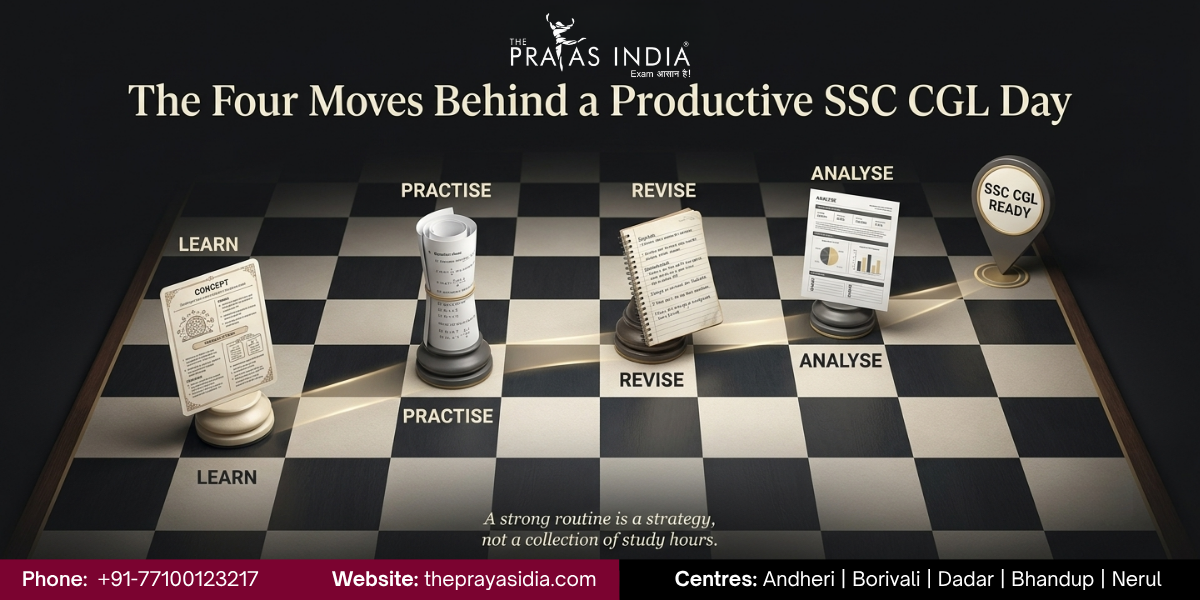
The Four-Part Structure of an Effective SSC CGL Day
Instead of dividing the entire day into rigid hourly slots, think of your preparation as four connected stages.
1. Learn
Use your high-focus period for learning concepts and understanding methods. This is where you build the foundation.
2. Practise
Convert concepts into skills by solving questions. Practice should gradually move from basic to exam-level difficulty.
3. Revise
Return to previously studied concepts, formulas, vocabulary and General Awareness. Revision prevents older preparation from disappearing while you move towards new topics.
4. Analyse
Use sectional tests, previous-year questions and mocks to identify weaknesses. Analysis should determine what you study next.
This structure is more flexible than a rigid timetable because it focuses on the purpose of each study session.
How Much Time Should You Study for SSC CGL?
There is no universal number of hours that guarantees success in SSC CGL. The more important question is whether your available study time is being converted into measurable improvement.
For a full-time aspirant, several focused study blocks distributed throughout the day may be effective. For a working professional or college student, even a smaller number of highly productive hours can create meaningful progress if the routine is followed consistently.
The important distinction is between time spent studying and effective study time.
If you spend three hours watching lectures but do not solve questions afterwards, the learning cycle remains incomplete. Similarly, spending two hours solving questions without analysing errors may not provide as much improvement as a shorter but carefully reviewed practice session.
A good routine should therefore contain measurable outcomes rather than only time targets.
Instead of writing:
“Study Quant for 3 hours.”
set a more useful target such as:
“Complete Percentage concepts + solve 40 exam-level questions + review mistakes.”
This makes your daily progress easier to evaluate.
Morning Study: Use Your Best Focus for Difficult Subjects
For many aspirants, the first major study session of the day is the most productive. If your schedule allows it, use this period for subjects that require greater concentration.
Quantitative Aptitude can be placed here if mathematics requires significant conceptual work. Alternatively, Reasoning can occupy this slot if complex problem-solving is one of your weaker areas.
The idea is not that Quant must always be studied in the morning. The important principle is to place your most demanding academic task during your personal peak concentration period.
Avoid spending your highest-energy hours on passive activities such as repeatedly reading notes that you already understand.
Use them for learning difficult concepts, solving unfamiliar questions and tackling areas where you currently struggle.
Build Quantitative Aptitude Into Your Daily Routine
Quant should not be treated as a subject that can be mastered through occasional long practice sessions.
Regular exposure is important because SSC CGL Quant requires both conceptual understanding and calculation efficiency. If you study mathematics intensively one day and then leave it untouched for several days, your speed and familiarity can decline.
Your daily Quant session can combine three activities:
- Brief formula or concept revision
- Topic-wise problem solving
- Timed practice
For example, after learning or revising a topic such as Profit and Loss, you should solve questions that progressively increase in difficulty. Once the concept becomes comfortable, introduce timed sets to develop speed.
Over time, your routine should move from learning the method to recognising the method quickly.
That distinction is important in SSC CGL because the examination rewards candidates who can identify and apply familiar concepts efficiently under time pressure.
Don’t Turn Reasoning Into a Weekend Subject
Reasoning can sometimes feel easier than Quant, which leads candidates to reduce the frequency of practice.
This can be counterproductive.
Reasoning improves through familiarity with patterns and repeated exposure to different question types. Daily or near-daily practice can help you recognise structures faster and reduce the amount of time required to understand a problem.
Your routine should include a mixture of:
- Analogy
- Classification
- Series
- Coding-Decoding
- Blood Relations
- Direction Sense
- Syllogism
- Venn Diagrams
- Statement-based reasoning
- Non-verbal reasoning
- Previous-year questions
You do not need to study every topic every day. Rotate topics while ensuring that important areas are revisited regularly.
English Preparation Should Run in the Background Every Day
English is another area where consistency can provide a significant advantage.
Rather than dedicating one large block to English only a few times a week, build smaller English activities into your daily routine. Reading, vocabulary revision, grammar practice and previous-year questions can be distributed across the day.
For example, vocabulary revision can be completed during a short break, while reading comprehension can be handled during a focused study block.
This approach makes English feel less like a separate burden and more like a continuous part of your preparation.
A daily English routine can include:
- Vocabulary revision
- Grammar concepts
- Reading comprehension
- Error detection
- Cloze tests
- Previous-year questions
- Sentence improvement
The focus should gradually shift from learning rules to applying them accurately.
General Awareness Needs Consistency More Than Long Hours
General Awareness can become difficult when candidates try to compensate for months of neglect with last-minute preparation.
The better approach is to study it regularly in manageable portions.
You do not necessarily need to spend several hours on GA every day. A consistent daily session combined with scheduled revision can be more sustainable.
Current affairs, static GK and important recurring areas should be revised systematically. Maintain concise notes rather than creating extremely long notebooks that become difficult to revise later.
The purpose of your GA routine should be to create repeated exposure and retention, not simply to increase the number of pages you have read.
Use Short Revision Sessions Throughout the Day
Revision does not always require a separate three-hour block.
Small revision windows can be extremely useful when used intelligently.
You can revise formulas, vocabulary, facts or previously incorrect questions during shorter breaks between major study sessions.
This creates multiple points of exposure to information during the day.
However, short revision should supplement—not replace—dedicated revision sessions.
A useful system is to maintain three categories:
Today’s Learning: What you studied recently.
Weekly Revision: Topics covered during the previous week.
Weak-Area Revision: Concepts and questions you repeatedly get wrong.
This prevents your preparation from becoming entirely focused on new topics.
Your Daily Routine Should Include Previous-Year Questions
Previous-year questions should not be saved only for the final stage of preparation.
They can help you understand the actual style of SSC CGL questions while you are learning individual topics.
After completing a topic, solve relevant previous-year questions and observe how the concept appears in the examination.
This provides a useful reality check.
You may discover that a topic you considered difficult has a predictable question pattern, while another topic that seemed easy produces more complicated applications than expected.
Previous-year questions therefore help connect concept preparation with examination preparation.
Make Mock Tests Part of the Routine
Mock tests should not suddenly appear in your schedule only when the examination is approaching.
Initially, topic-wise and sectional tests can help you understand your performance. As your syllabus coverage increases, gradually introduce full-length mock tests under realistic time conditions.
The most important part, however, begins after the mock.
Do not simply record your score and move on.
Spend time understanding:
- Which questions were incorrect?
- Which questions consumed too much time?
- Which concepts caused repeated mistakes?
- Which questions should have been skipped?
- Did your accuracy fall towards the end?
- Which section affected your overall performance?
Mock analysis should directly influence your next day’s routine.
If you repeatedly make mistakes in percentage-based questions, your next revision block should address percentages. If English errors are recurring, increase grammar or comprehension practice. If you consistently spend too much time on a particular reasoning pattern, practise that pattern separately.
This creates a feedback loop where testing improves your study plan.
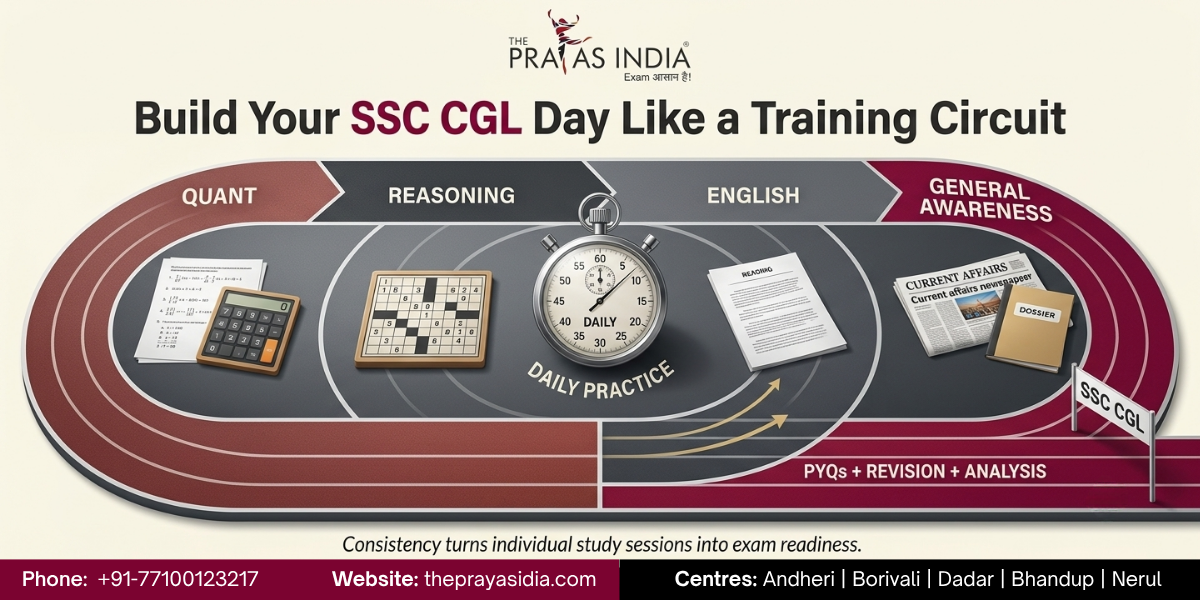
A Sample Daily Framework for SSC CGL Aspirants
A routine can be structured around study blocks rather than rigid hourly commitments.
Block 1 — Concept Building
Start with a difficult or high-priority topic while your concentration is strong. Use this session for Quant, Reasoning or another subject requiring deeper attention.
Block 2 — Question Practice
Convert learning into application by solving topic-wise and previous-year questions. Keep track of accuracy and time.
Block 3 — English + General Awareness
Use a separate study window for English practice and daily GA. This prevents these subjects from continuously getting postponed.
Block 4 — Revision + Error Analysis
End the major study cycle by revising what you learned and reviewing mistakes from practice sessions.
Block 5 — Timed Practice
Depending on your preparation stage, include a short sectional test, mixed question set or mock test.
This framework can be adjusted around your classes, work, college and personal commitments.
The purpose is not to create a timetable that looks perfect. The purpose is to create a repeatable system that produces improvement.
The Prayas India: Structured SSC CGL Preparation in Mumbai
For many aspirants, maintaining a daily routine becomes easier when preparation has an external structure. Regular classes, planned study material, practice schedules, mock tests and faculty guidance can reduce the uncertainty of deciding what to study every day.
This is one of the reasons aspirants exploring SSC coaching in Mumbai often consider structured coaching alongside self-study.
At The Prayas India, candidates preparing for SSC examinations can build their preparation around systematic learning and exam-oriented practice. The objective is not simply to complete the syllabus but to help students develop the ability to apply concepts under examination conditions.
For an aspirant considering admission, the important factors should include the quality of teaching, faculty support, study material, practice ecosystem, mock-test approach, doubt resolution and how effectively the programme supports consistent preparation.
Key Takeaway
A successful SSC CGL routine does not need to be complicated.
It needs to be balanced, realistic and repeatable.
Your daily preparation should bring together learning, practice, revision and analysis. Quant and Reasoning need regular problem-solving exposure. English benefits from continuous reading and application. General Awareness requires consistent revision. Previous-year questions should guide your understanding of the examination, while mock tests should help you identify exactly where your strategy needs improvement.
Most importantly, don’t build your routine around the number of hours you can claim to study. Build it around the improvement you want to see.
A candidate who consistently completes meaningful study targets, reviews mistakes and adjusts the next day’s preparation is likely to make better use of their available time than someone following an exhausting timetable without measuring results.
Move From a Timetable to a Study System
A timetable tells you when to study, but a study system tells you how to make that time productive. This distinction becomes increasingly important as SSC CGL preparation progresses. Many aspirants create detailed schedules with separate slots for every subject, but the schedule often fails because there is no mechanism to measure whether those study hours are actually improving performance.
A better approach is to connect every major study session with a measurable outcome. If you spend time studying Algebra, the target should not simply be “study Algebra.” It could be to revise a specific concept, solve a set of previous-year questions and identify the mistakes made during practice. This makes your preparation more objective and helps you understand whether a topic is genuinely improving.
Your daily routine should therefore work as a continuous cycle:
Learn → Practise → Test → Analyse → Revise → Improve
Once this cycle becomes habitual, you are no longer simply following a timetable. You are building an examination-oriented preparation system.
Give Each Subject a Specific Role in Your Routine
One of the easiest ways to make a daily routine sustainable is to stop treating every subject in exactly the same way. Quantitative Aptitude, Reasoning, English and General Awareness have different preparation requirements, so the time and method assigned to each should reflect that.
Quant generally requires a combination of concept building, calculation practice and timed problem solving. Reasoning requires regular exposure to different question patterns and the ability to identify efficient approaches. English benefits from continuous reading, vocabulary development and grammar application. General Awareness, meanwhile, requires frequent study and repeated revision because information can be forgotten quickly.
A balanced routine should therefore distribute subjects according to both exam requirements and personal weaknesses.
If Quant is your weakest area, it may deserve additional daily practice. If English is already strong, maintaining it through shorter but regular sessions may be sufficient. This flexible approach is more effective than forcing equal study time for every subject.
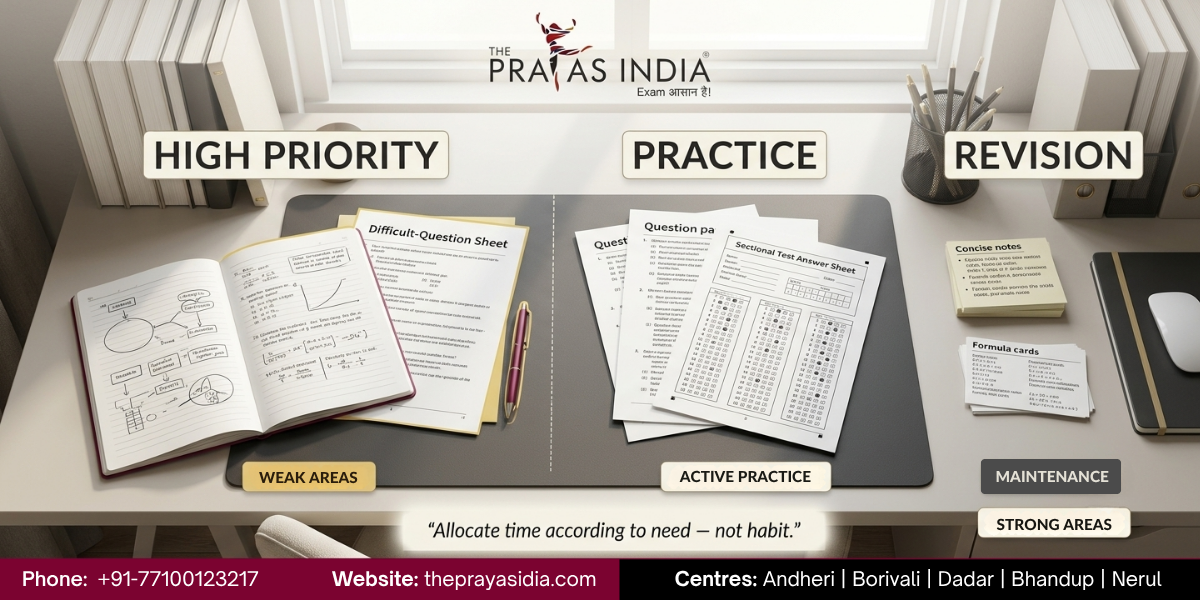
Use a Priority-Based Daily Schedule
Not every topic deserves the same amount of attention every day. A priority-based system helps you make better use of limited preparation time.
At the beginning of each day, divide your tasks into three categories:
High Priority
Topics that are weak, frequently tested or currently being learned.
Medium Priority
Topics that you understand but still need additional practice.
Maintenance
Topics that are already strong and only require revision or occasional testing.
This system prevents a common problem in competitive-exam preparation: repeatedly studying subjects you already enjoy while avoiding the areas that actually need improvement.
Your strongest subjects should maintain their position, but your routine should create deliberate opportunities to improve weak areas.
Create a Weekly Revision Architecture
Daily study helps you move forward, but weekly revision ensures that previous preparation does not disappear.
At the end of each week, reserve time to revisit the major topics covered during the previous six or seven days. This does not mean rereading every chapter from the beginning. Instead, use your notes, formulas, error log and marked questions to identify what requires another round of attention.
A weekly review should also include a performance check. Look at the questions you solved during the week and identify recurring mistakes. If the same type of error appears repeatedly, it should become a priority for the following week.
This makes your preparation dynamic.
Instead of following the same timetable every week regardless of performance, you allow your results to determine the next stage of your preparation.
Maintain an Error Log
An error log can become one of the most valuable resources during SSC CGL preparation.
Whenever you make a significant mistake, record the question or concept along with the reason behind the mistake. The purpose is not to create another huge notebook. Keep the record concise and useful.
Your mistakes can broadly fall into categories such as:
- Conceptual mistake
- Calculation mistake
- Misreading the question
- Incorrect approach
- Guessing error
- Time-pressure mistake
- Lack of revision
This classification is useful because different mistakes require different solutions.
If the issue is conceptual, revisit the topic. If the issue is calculation, practise calculations. If you repeatedly misread questions, slow down slightly during practice and improve comprehension. If time pressure causes mistakes, introduce more timed practice.
The error log should therefore influence your routine instead of simply becoming another notebook that remains untouched.
How Working Aspirants Can Build an SSC CGL Routine
Not every SSC CGL aspirant has an entire day available for preparation. Students attending college, working professionals and candidates managing family responsibilities may have significantly less study time.
For such aspirants, consistency becomes even more important.
Instead of trying to imitate a full-time aspirant’s schedule, divide your available time into focused blocks. A shorter weekday routine can be supported by longer weekend sessions for mocks, revision and difficult topics.
For example, a working candidate might use shorter sessions for vocabulary, current affairs and formula revision during available breaks, while reserving focused evening time for Quant or Reasoning. Weekends can then be used for full-length tests, detailed analysis and larger revision cycles.
The objective is not to study all day. It is to make every available study window purposeful.
Don’t Allow One Bad Day to Break Your Routine
Long-term preparation will inevitably contain unproductive days.
There may be days when you are tired, distracted or unable to complete the planned targets. The biggest mistake is turning one missed day into several missed days.
A practical routine should include flexibility.
If you cannot complete the entire schedule, complete the highest-priority task. If you miss an evening session, avoid trying to compensate by studying excessively late at night. Adjust the next day’s plan and continue.
Consistency is not the absence of disruption. It is the ability to return to the routine after disruption.
This mindset can make a significant difference during a long SSC CGL preparation cycle.
Avoid Overloading Your Daily Timetable
A common timetable mistake is attempting to study every subject extensively every day.
This often creates a schedule with too many transitions. You may spend considerable time moving from one subject to another without achieving sufficient depth in any of them.
Instead, maintain a few focused blocks.
For example, a day might include a major Quant session, a Reasoning practice block, an English/GA session and a final revision or analysis block. The exact distribution can change according to your preparation stage.
A simpler schedule that you actually follow is more useful than a highly detailed schedule that constantly needs to be rearranged.
Build a Dedicated Mock-Test Routine
As your syllabus coverage improves, mock tests should occupy a defined position in your weekly schedule.
However, don’t measure progress only by the number of mocks completed.
A useful mock-test cycle can look like this:
Mock → Analysis → Error Identification → Targeted Practice → Re-test
This is much more powerful than:
Mock → Score → Next Mock
The first system uses the test as a diagnostic tool. The second treats it merely as an examination.
For SSC CGL aspirants, the objective of repeated testing should be to improve speed, accuracy, question selection and confidence under time pressure.
Use Previous-Year Questions as a Reality Check
Previous-year questions should remain a recurring component of your routine throughout preparation.
They help you understand how concepts are actually tested and prevent your preparation from becoming overly theoretical.
After completing a topic, compare your practice performance with relevant previous-year questions. If you are comfortable with textbook-level questions but struggle with actual examination questions, your preparation needs to become more application-oriented.
This is also where structured coaching can provide value. Faculty guidance can help identify whether a problem originates from conceptual weakness, an inefficient solving method or inadequate practice.
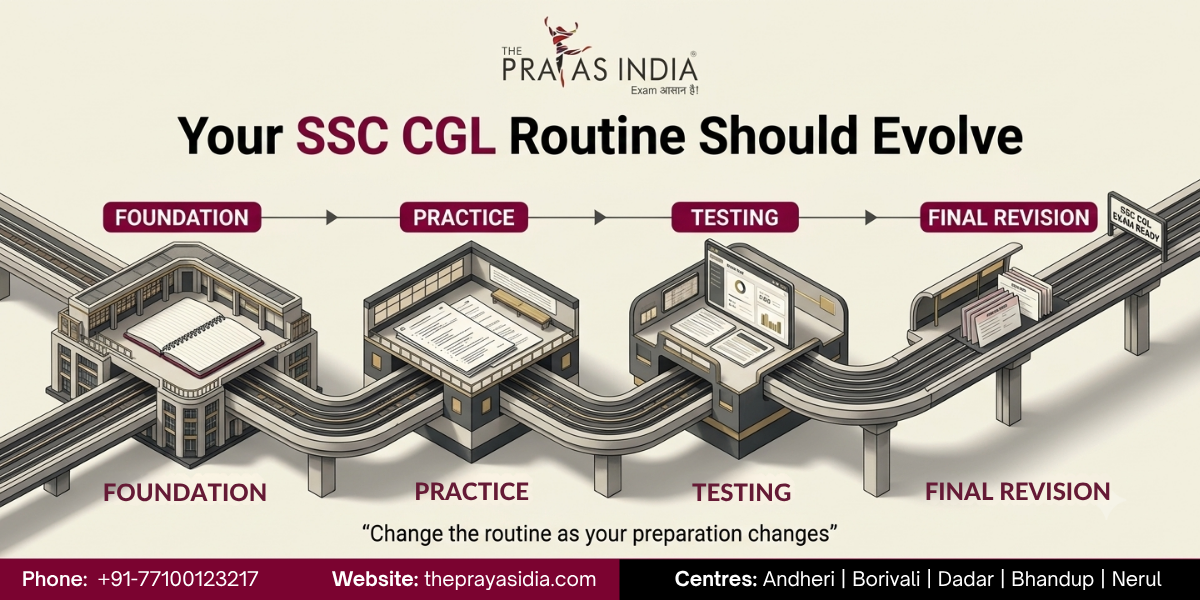
Build a Routine Around Your Preparation Stage
Your routine should not remain identical from the first month until the examination.
Early Preparation
Focus more heavily on concepts and fundamentals. Give yourself enough time to understand topics properly before worrying excessively about speed.
Mid-Stage Preparation
Increase topic-wise practice, previous-year questions and sectional tests. Begin measuring time and accuracy more seriously.
Advanced Preparation
Shift towards mixed practice, full-length mocks, revision and performance analysis. Weak areas should receive targeted attention rather than broad, unfocused study.
Final Phase
Prioritise revision, mock analysis, high-frequency concepts and maintaining examination temperament. Avoid introducing too many new resources.
The strongest routines evolve as the candidate evolves.
How Coaching Can Support a Consistent SSC CGL Routine
Self-study remains an important part of SSC CGL preparation, but many aspirants struggle with consistency because they have to make every preparation decision independently. They need to decide which topics to study, which material to follow, how much practice is enough and whether their performance is actually improving.
A structured coaching environment can reduce some of this uncertainty.
For students considering the best SSC coaching in Mumbai, factors such as faculty guidance, structured classes, study material, regular tests, doubt-solving support and performance analysis should be evaluated carefully. The purpose of coaching should not be to make students dependent on classes. Instead, it should help them develop a stronger independent preparation system.
At The Prayas India, the focus is on creating an organised preparation environment where aspirants can work systematically towards competitive examinations. Students preparing for SSC CGL can use structured learning, practice and testing to complement their individual study routine.
For an aspirant considering admission, the right coaching programme should fit into their daily schedule rather than make the schedule unnecessarily complicated. The goal is to create a preparation ecosystem where classroom learning and self-study support each other.
A Practical SSC CGL Daily Routine Template
There is no single timetable that every aspirant should copy. However, a broad structure can help you create your own schedule.
Morning / First Focus Block
Use your strongest concentration period for a difficult subject such as Quant or Reasoning. Focus on concepts followed by problem-solving.
Second Study Block
Work on another core subject and solve a meaningful set of questions. Include previous-year questions wherever possible.
Short Revision Window
Revise formulas, vocabulary, current affairs or previously marked mistakes.
Evening / Third Major Block
Focus on English and General Awareness or return to a weaker subject depending on your performance.
Final Review
Spend a short period reviewing what you completed during the day. Record important mistakes and decide the first priority for the following session.
The important part is not the exact timing. The important part is ensuring that your day contains learning, practice and review.
What a Successful SSC CGL Routine Ultimately Looks Like
A successful routine does not necessarily look intense from the outside.
It may involve a few focused study blocks, consistent question practice, regular revision and disciplined mock analysis. The difference comes from repetition.
When the same process is followed for months, small improvements begin to accumulate. Concepts become familiar, calculations become faster, question patterns become easier to recognise and mistakes become more predictable.
That is the real purpose of a daily study routine.
You are not simply organising your day. You are gradually training yourself to perform under the conditions of the SSC CGL examination.
For aspirants preparing independently or through SSC coaching in Mumbai, the best routine is ultimately the one that can be followed consistently, measured honestly and adjusted according to performance.
Contact Us
- Call Now: +91-77100 13217
- Website: theprayasindia.com
- Centres: Andheri | Borivali | Dadar | Nerul | Bhandup
Frequently Asked Questions
1. How many hours should I study daily for SSC CGL?
There is no fixed number of hours that guarantees success. Your study time should depend on your preparation level, available schedule and examination timeline. Focus on productive study hours and measurable outcomes rather than simply increasing the number of hours.
2. Should I study all four SSC CGL subjects every day?
Not necessarily. Some subjects, particularly Quant, Reasoning and English, benefit from regular exposure, while General Awareness needs consistent study and revision. You can rotate the intensity of different subjects according to your strengths and weaknesses.
3. What should I study first in my daily SSC CGL routine?
Use your highest-focus period for a subject or topic requiring the greatest concentration. For many aspirants, this may be Quant or Reasoning, but your personal performance should determine the choice.
4. How important are previous-year questions for SSC CGL?
Previous-year questions are extremely useful for understanding the actual examination style, recurring concepts and difficulty level. They should be incorporated into preparation rather than being reserved only for the final stage.
5. When should I start taking SSC CGL mock tests?
You can begin with topic-wise and sectional tests during preparation and gradually introduce full-length mocks as your syllabus coverage improves. Mock tests should become more frequent during the advanced stage.
6. How should I analyse my SSC CGL mock tests?
Don't focus only on the final score. Analyse incorrect answers, time-consuming questions, skipped questions, recurring concepts and section-wise performance. Use this information to decide what you should practise next.
7. How can I remain consistent during long SSC CGL preparation?
Create a realistic routine rather than an extremely demanding timetable. Set daily targets, track your progress, maintain an error log and allow yourself to recover from occasional unproductive days without abandoning the overall routine.
8. Can working professionals prepare for SSC CGL?
Yes. Working professionals can prepare by dividing available time into focused study blocks and using weekends for longer practice sessions, mocks and revision. The routine should be built around realistic availability.
9. Is coaching necessary for SSC CGL preparation?
Coaching is not mandatory, but structured guidance can be useful for aspirants who need faculty support, organised study material, regular testing, doubt resolution and a disciplined preparation environment.
10. Which is the best SSC coaching in Mumbai?
The right coaching institute depends on the candidate's requirements. When evaluating SSC coaching in Mumbai, consider faculty quality, teaching methodology, study material, mock-test system, doubt support, batch structure and how well the programme complements your self-study routine.