
How to Build an SSC Study Plan That Actually Works | Best SSC Coaching in Mumbai | The Prayas India
A clear plan doesn’t just save time—it multiplies your chances of cracking the SSC exam.
Every year, lakhs of aspirants begin preparing for SSC exams with great enthusiasm. They buy books, join Telegram groups, watch countless YouTube videos, and create ambitious timetables. However, after a few weeks, many lose consistency, skip revision, and feel overwhelmed by the vast syllabus.
The problem is rarely a lack of effort.
The real problem is preparing without a practical study plan.
An SSC examination doesn’t reward candidates who study the longest. It rewards those who know what to study, when to study, how to revise, and how to track their progress.
A well-designed study plan acts like a roadmap. It keeps you focused, prevents unnecessary distractions, and ensures that every hour of preparation brings you closer to your goal.
Why Most SSC Study Plans Stop Working
Many aspirants create a timetable that looks perfect on paper but becomes impossible to follow in real life.
For example, some students schedule:
- 12 hours of study every day.
- Four subjects in a single session.
- Daily mock tests from Day 1.
- Zero buffer for revision or unexpected interruptions.
Within a week, they miss one or two study sessions, lose motivation, and eventually abandon the entire plan.
An effective SSC study plan should be realistic, flexible, and sustainable.
Remember, a timetable that you can follow for six months is far more valuable than a perfect schedule that lasts only six days.
Start with Your Destination, Not Your Books
One of the biggest mistakes aspirants make is opening books before defining their target.
Ask yourself:
- Which SSC exam are you preparing for?
- How many months are left?
- How many hours can you realistically study every day?
- Which subject is your weakest?
- What score should you aim for?
These answers help you build a study plan that matches your situation, instead of copying someone else’s timetable.
Preparation becomes much easier when your goals are specific and measurable.
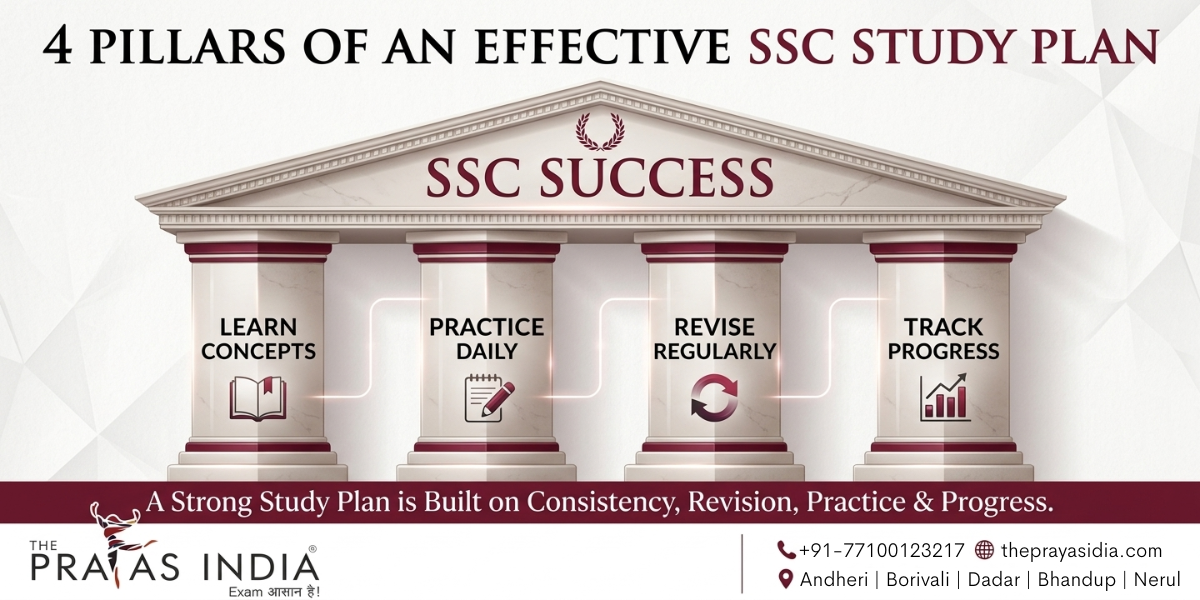
Build Your Study Plan Around Four Core Pillars
Every successful SSC preparation strategy is built on four essential components.
1. Concept Learning
Understand the fundamentals before attempting shortcuts.
2. Daily Practice
Solve questions every day to improve speed and accuracy.
3. Regular Revision
Revision transforms learning into long-term memory.
4. Performance Tracking
Measure your progress through mock tests and weekly reviews.
Ignoring even one of these pillars can reduce the effectiveness of your preparation.
Expert Guidance Makes Planning Easier
Many SSC aspirants know what to study but struggle with how to organise their preparation. Without a structured roadmap, they often spend too much time on familiar topics while neglecting weaker areas. A well-planned approach, guided by experienced mentors, helps maintain consistency and steady improvement.
At The Prayas India, students receive expert faculty guidance, structured classroom programmes, personalised study plans, comprehensive study material, regular mock tests, detailed performance analysis, revision schedules, and one-on-one mentoring that help them prepare efficiently for every stage of the SSC examination.
How to Create a Daily SSC Study Routine You Can Actually Follow
The best study plan isn’t the one that looks impressive—it’s the one you can follow consistently every day.
Many SSC aspirants spend hours designing colourful timetables but struggle to follow them after just a few days. The reason is simple—they try to study everything, every day.
A practical SSC study plan should divide your preparation into small, achievable tasks that improve your concepts, speed, revision, and confidence without causing burnout.
Instead of asking, “How many hours should I study?”, ask yourself:
- What should I complete today?
- Which subject needs more attention?
- Have I revised yesterday’s topics?
- Did I improve compared to last week?
When your focus shifts from hours to progress, preparation becomes much more effective.
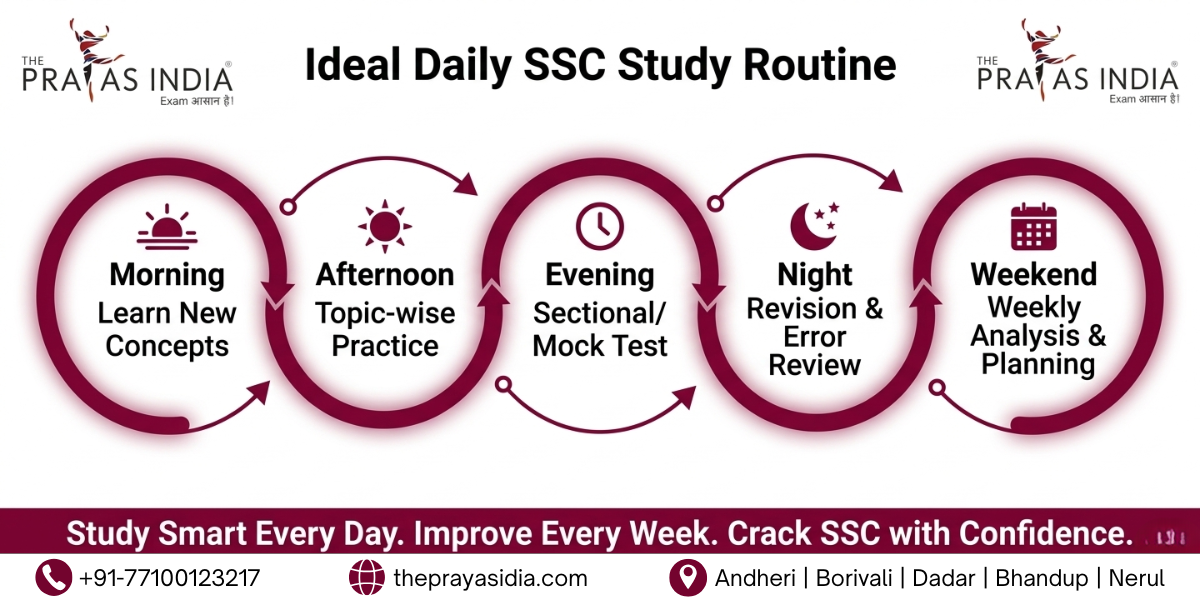
Divide Your Day into Four Study Blocks
Instead of studying one subject continuously, divide your day into dedicated sessions.
Each session should have a clear objective.
Block 1 – Concept Building
Use your most productive hours to learn new concepts.
Focus on:
- Quantitative Aptitude
- Reasoning
- English Grammar
- General Awareness basics
Avoid multitasking during this session.
Learning becomes faster when your attention is focused on one topic at a time.
Block 2 – Practice Session
Concepts become useful only when you apply them.
After learning a topic:
- Solve topic-wise questions.
- Practise under time limits.
- Improve calculation speed.
- Identify recurring mistakes.
Daily practice gradually improves both confidence and exam performance.
Block 3 – Mock Test or Sectional Test
Don’t wait until the syllabus is complete before taking mock tests.
Instead:
- Attempt one sectional test regularly.
- Take full-length mocks every week.
- Practise under actual exam conditions.
- Focus on time management.
Mock tests help you understand your current preparation level and reveal areas that need improvement.
Block 4 – Revision & Error Review
End your day by revising.
This habit strengthens long-term memory and prevents forgetting important concepts.
Spend time on:
- Formulas
- Vocabulary
- Grammar rules
- Shortcuts
- Important General Awareness notes
- Questions you answered incorrectly
Daily revision is one of the biggest differences between average and high-scoring aspirants.
Follow a Weekly Study Cycle
A successful study plan isn’t just about daily targets.
Weekly planning is equally important.
Monday to Friday
- Learn new concepts.
- Solve practice questions.
- Revise previous topics.
Saturday
- Attempt a full-length mock test.
- Analyse your performance.
- Update your error notebook.
Sunday
- Revise the entire week’s learning.
- Strengthen weak areas.
- Prepare the next week’s study goals.
This cycle helps maintain consistency throughout your preparation.
Balance All SSC Subjects
Many aspirants spend most of their time on their favourite subject while neglecting weaker areas.
This creates an imbalance that affects the final score.
An effective study plan should include all major subjects.
Every week, ensure sufficient time for:
- Quantitative Aptitude – Build concepts and calculation speed.
- Reasoning Ability – Improve logical thinking through regular practice.
- English Language – Focus on grammar, vocabulary, comprehension, and practice.
- General Awareness – Read current affairs and revise static GK consistently.
Balanced preparation increases your overall performance rather than depending on one strong subject.
Keep Your Study Plan Flexible
Life rarely goes exactly as planned.
Some days you’ll study more.
Some days you’ll study less.
Missing one session should never mean abandoning the entire timetable.
Instead:
- Shift unfinished tasks to the next day.
- Review weekly progress instead of daily perfection.
- Adjust your schedule when necessary.
- Stay consistent over months, not just a few days.
A flexible study plan is much easier to maintain than a rigid one.
Expert Guidance Helps You Stay on Track
Many SSC aspirants begin preparation with enthusiasm but lose direction because they don’t know how to balance subjects, revise effectively, or monitor their progress. A structured study plan prepared by experienced mentors removes this confusion and helps students prepare with confidence.
At The Prayas India, aspirants receive expert faculty guidance, personalised study plans, structured classroom coaching, comprehensive study material, regular sectional and full-length mock tests, detailed performance analysis, revision schedules, and one-on-one mentoring that help them stay consistent throughout their SSC preparation.
How to Track Your SSC Preparation and Keep Improving Every Week
A study plan only works when you regularly measure your progress and improve your weaknesses.
Many SSC aspirants prepare sincerely for months but never stop to evaluate whether their strategy is actually working.
They complete chapters, solve questions, and attend mock tests, but they don’t analyse their performance. As a result, the same mistakes keep appearing in every test.
The most successful SSC candidates treat preparation like a continuous improvement process. They don’t just study—they measure, review, adapt, and improve every single week.
Your study plan should evolve with your progress.
Stop Measuring Hours—Start Measuring Results
Many aspirants proudly say they studied for 8–10 hours a day.
But the more important question is:
What did you achieve during those hours?
Instead of tracking study time, track measurable outcomes such as:
- Chapters completed.
- Questions solved correctly.
- Accuracy percentage.
- Mock test scores.
- Weak topics improved.
- Revision targets achieved.
Progress-based planning keeps you motivated because you can clearly see your improvement over time.
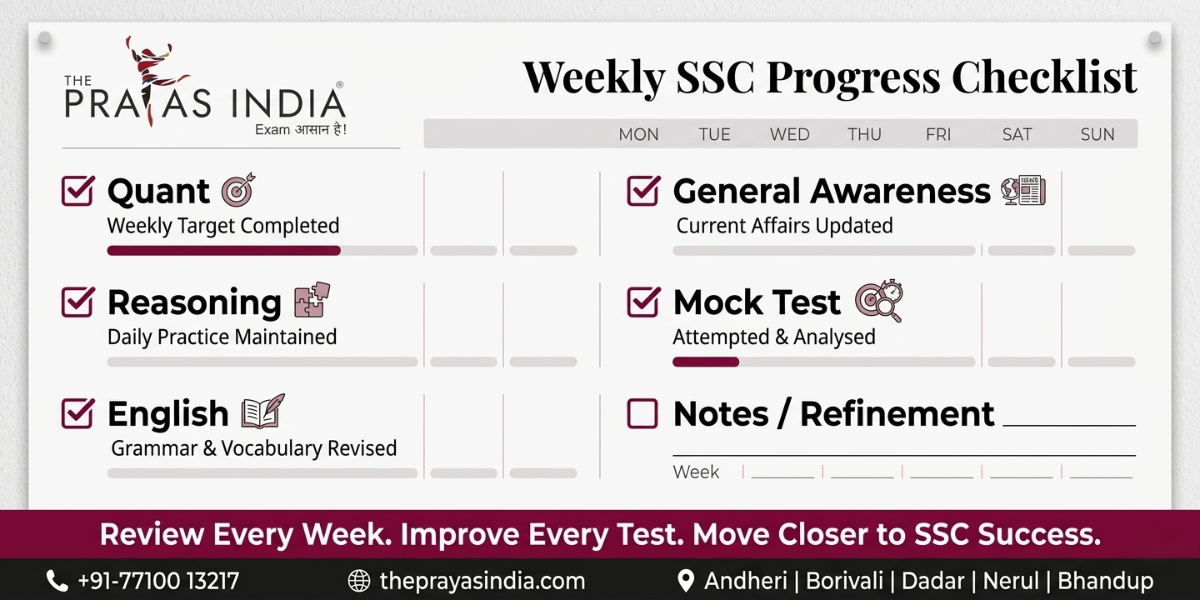
Create a Weekly Performance Dashboard
Every Sunday, spend 20–30 minutes reviewing your preparation.
A simple dashboard can include:
Learning Progress
✓ New topics completed
✓ Concepts requiring revision
Practice Performance
✓ Total questions solved
✓ Accuracy percentage
✓ Time taken per section
Mock Test Review
✓ Score improvement
✓ Strongest section
✓ Weakest section
✓ Most repeated mistakes
Next Week’s Targets
✓ Topics to revise
✓ New chapters to complete
✓ Mock tests to attempt
This habit helps you stay organised and prevents last-minute panic.
Mock Tests Are Your Best Performance Mirror
Many aspirants become discouraged after a low mock score.
Instead of feeling disappointed, treat every mock as a learning opportunity.
After each mock test, ask yourself:
- Which questions took the longest?
- Which mistakes were conceptual?
- Which mistakes were careless?
- Which topics require additional practice?
- Did I follow my time-management strategy?
Remember:
A mock test does not judge your ability.
It improves your ability.
Maintain an Error Journal
One of the simplest yet most effective habits is maintaining an Error Journal.
Every time you make a mistake, note:
- The topic.
- The correct approach.
- The reason for the mistake.
- The shortcut or concept to remember.
Before your next mock test, revise this journal.
You’ll gradually notice that repeated mistakes begin to disappear, and your confidence starts increasing.
Don’t Be Afraid to Change Your Study Plan
A study plan should guide you—not control you.
If you realise that:
- Quant needs more attention than English,
- General Awareness requires extra revision,
- Mock analysis is taking longer than expected,
then update your timetable accordingly.
The best study plans are flexible.
They adapt to your strengths, weaknesses, and progress instead of forcing you to follow a rigid routine.
Common Planning Mistakes That Slow Down Progress
Even a well-designed timetable can fail if you develop the wrong habits.
Avoid these common mistakes:
✗ Studying only your favourite subjects.
✗ Ignoring revision until the end.
✗ Attempting mock tests without analysing them.
✗ Comparing your preparation with others.
✗ Frequently changing books and resources.
✗ Expecting instant improvement after one week.
Consistency always produces better results than constantly changing your strategy.
Expert Mentorship Helps You Improve Faster
Many SSC aspirants work hard but struggle to identify why their scores remain stagnant. Without proper feedback, they continue repeating the same mistakes and fail to make meaningful progress. Expert mentoring provides a clear direction, helping students analyse their preparation scientifically and improve week after week.
At The Prayas India, aspirants receive expert faculty guidance, personalised performance reviews, structured study plans, comprehensive study material, regular sectional and full-length mock tests, detailed analytics, revision workshops, doubt-solving sessions, and one-on-one mentoring that help transform preparation into consistent improvement.
Turn Your Study Plan into SSC Success
A well-planned strategy, followed consistently, can transform your preparation into selection.
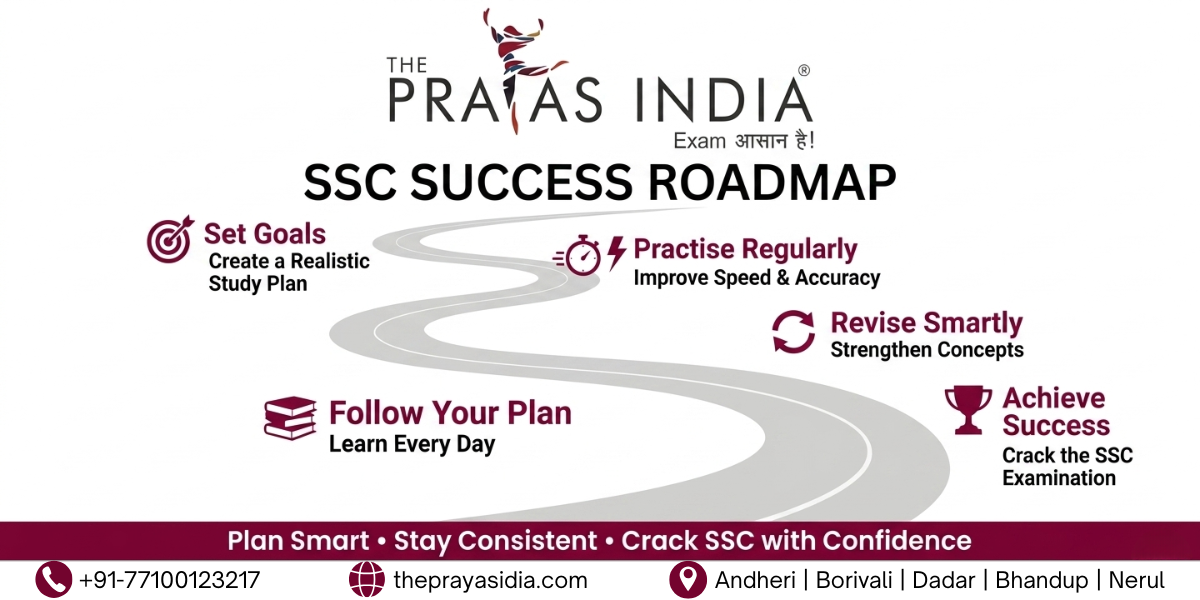
Building an SSC study plan is not about creating the perfect timetable—it is about creating a system that you can follow every single day.
Many aspirants fail because they keep changing their books, study schedules, and preparation strategies. Successful candidates, however, follow one simple principle:
Plan → Practise → Revise → Analyse → Improve
This cycle helps them build confidence, eliminate weaknesses, and stay consistent until the examination.
As your SSC exam approaches, don’t waste valuable time searching for shortcuts or copying someone else’s timetable. Focus on your own progress, refine your preparation every week, and trust the process.
Remember, consistency over several months is what ultimately leads to selection.
Complete SSC Preparation Checklist
Before appearing for your SSC examination, make sure you’ve completed the following.
Study Plan Checklist
✓ Set realistic daily and weekly goals.
✓ Divided all subjects equally.
✓ Followed a practical timetable consistently.
✓ Balanced learning, practice, and revision.
✓ Kept your study plan flexible.
Practice Checklist
✓ Solved topic-wise questions regularly.
✓ Improved calculation speed.
✓ Increased accuracy gradually.
✓ Attempted sectional tests.
✓ Practised previous year questions.
Revision Checklist
✓ Revised formulas every week.
✓ Updated General Awareness notes.
✓ Revised grammar and vocabulary.
✓ Maintained an Error Journal.
✓ Revised difficult topics multiple times.
Mock Test Checklist
✓ Attempted full-length mock tests.
✓ Analysed every mock carefully.
✓ Improved weak sections.
✓ Followed proper time management.
✓ Measured weekly progress.
If you can confidently check most of these points, your preparation is already moving in the right direction.
Frequently Asked Questions
How many hours should I study daily for SSC?
The quality of study matters more than the number of hours. A realistic, consistent schedule with focused learning, regular practice, revision, and mock test analysis is far more effective than studying long hours inconsistently.
Should I prepare all SSC subjects every day?
It is generally beneficial to maintain a balance. Your timetable should include adequate time for Quantitative Aptitude, Reasoning, English, and General Awareness while giving additional attention to weaker subjects.
When should I start attempting mock tests?
You don't need to wait until the entire syllabus is complete. Begin with sectional tests during the early stages of preparation and gradually move to full-length mock tests to improve speed, accuracy, and exam temperament.
How important are previous year questions?
Previous year questions help you understand the exam pattern, frequently asked topics, difficulty level, and question trends. They should be an important part of every SSC aspirant's preparation strategy.
Can I crack SSC with self-study?
Yes, self-study can be effective when supported by a disciplined timetable, regular revision, mock tests, and continuous performance analysis. However, many aspirants benefit from expert guidance that helps them avoid common mistakes, stay motivated, and prepare more strategically.
Why Choose The Prayas India for SSC Preparation?
A good study plan is only the beginning. To consistently improve your score, you also need expert guidance, regular evaluation, and a structured preparation strategy. The right coaching environment helps you remain disciplined, identify weaknesses early, and prepare according to the latest SSC exam pattern.
At The Prayas India, students receive a complete preparation ecosystem designed to maximise their chances of success in SSC CGL, SSC CHSL, SSC MTS, SSC CPO, SSC GD, and other SSC examinations.
What You Get
- Experienced SSC Faculty & Mentors
- Structured Classroom & Online Programmes
- Comprehensive Study Material
- Daily Practice Questions
- Previous Year Question Discussions
- Sectional & Full-Length Mock Tests
- Detailed Performance Analysis
- Shortcut Techniques & Time-Saving Methods
- Personalised Mentoring & Doubt-Solving Sessions
- Regular Revision & Strategy Workshops
Whether you’re preparing for your first SSC attempt or aiming to improve your previous score, expert guidance can help you prepare with confidence and stay ahead of the competition.
Conclusion
A successful SSC journey doesn’t begin with solving thousands of questions—it begins with having the right plan. When your preparation is structured, your revision is consistent, and your mock tests are analysed regularly, every study session brings you closer to your goal.
Avoid comparing your journey with others. Instead, focus on following a practical study plan, improving a little every day, and staying disciplined throughout your preparation.
If you’re looking for experienced mentors, structured coaching, comprehensive study material, regular mock tests, personalised guidance, and a proven preparation strategy, The Prayas India can help you prepare confidently and maximise your chances of cracking the SSC examination.
Contact Us
- 📞 Call: +91-77100 13217
- 🌐 Website: https://theprayasindia.com
- 📍 Centres: Andheri | Borivali | Dadar | Nerul | Bhandup