
How to Choose the Right DILR Sets in CAT 2026: A Strategy to Maximise Your Score
The Prayas India | Best CAT Coaching in Mumbai
For many CAT aspirants, DILR (Data Interpretation and Logical Reasoning) is the section that creates the most uncertainty.
The problem is not always that students cannot solve DILR questions. In many cases, the bigger problem is choosing the right set to solve.
CAT does not require you to solve every DILR set. It requires you to identify the sets that offer the best opportunity to score within the limited time available.
A student who spends 20 minutes struggling with a difficult set may lose the opportunity to solve an easier set elsewhere in the section. On the other hand, a student who can quickly identify a manageable set can potentially convert that decision into multiple correct answers.
This makes set selection one of the most important DILR skills for CAT 2026.
If your goal is to improve your overall CAT percentile and eventually compete for admission to leading MBA institutes, developing this decision-making ability can be just as important as learning different DILR concepts.
DILR Is Not Just About Solving Sets
A common approach to DILR preparation is:
See a set → Start solving → Continue until you finish it.
This may work during basic practice, but it is not necessarily the best approach for the actual CAT.
In the examination, you have limited time and multiple sets competing for your attention.
The real process should be:
Scan → Understand → Compare → Select → Solve → Move On
This small change in mindset can significantly improve your DILR preparation.
Think of the DILR section as a decision-making exercise.
You are not trying to prove that you can solve the hardest set.
You are trying to answer:
“Which set gives me the best chance of scoring marks with the time I have?”
That is the question a strong DILR strategy should answer.
Why Set Selection Can Make or Break Your DILR Score
Consider a hypothetical DILR section containing four sets.
Set A
Moderate difficulty
Good amount of information
Clear structure
Set B
Very lengthy
Multiple conditions
Complicated calculations
Set C
Moderate difficulty
Familiar arrangement
Questions appear approachable
Set D
Unfamiliar data representation
Requires significant interpretation
Suppose you immediately start with Set B because the topic looks familiar.
After 12 minutes, you are still trying to establish the basic framework.
You eventually realise that the set is consuming too much time.
Meanwhile, Set C could have offered several relatively manageable questions.
The issue wasn’t your DILR knowledge.
It was selection.
This is why CAT aspirants should learn to evaluate sets before committing valuable examination time.
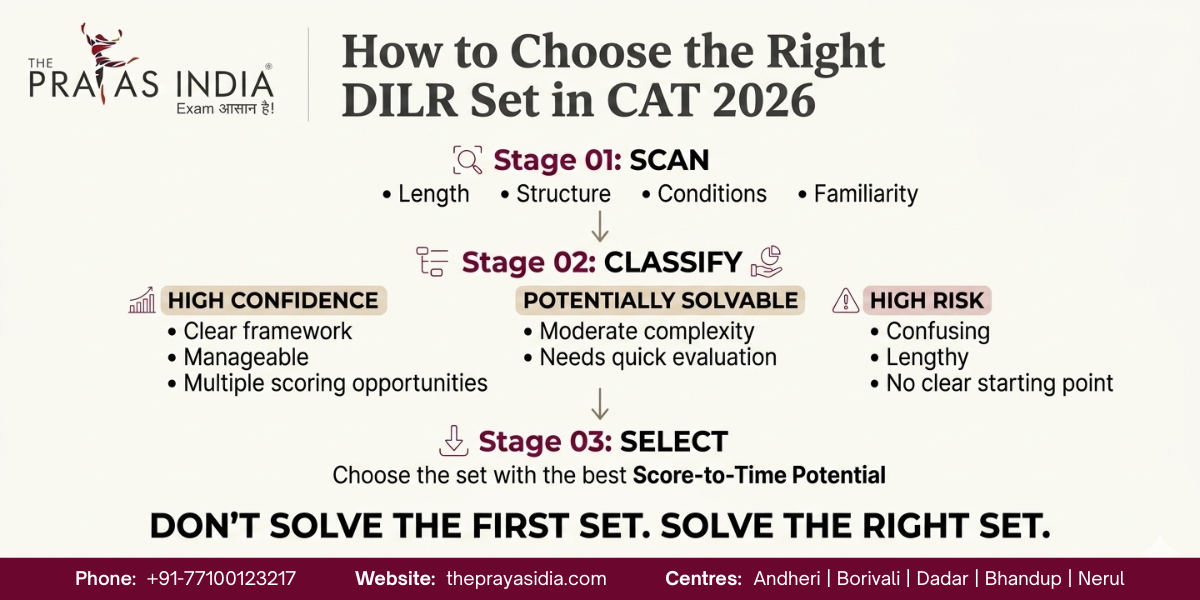
What Makes a DILR Set Worth Attempting?
There is no universal definition of an “easy” DILR set.
A set that looks easy to one student may be uncomfortable for another.
Your selection should therefore depend on both:
The difficulty of the set
and
Your familiarity with its structure.
However, some signals can help you make a faster decision.
1. A Clear Starting Point
A good set often gives you a reasonably clear way to begin.
For example, the information may provide:
- A fixed position
- A definite number
- A known relationship
- A clear table structure
- A simple distribution condition
- A strong starting constraint
If you can immediately see how to start building the framework, the set may deserve further attention.
By contrast, if you read the entire set and still cannot identify what the first meaningful step should be, be cautious.
2. Limited and Manageable Information
More information does not necessarily mean more difficulty.
But excessive information can increase the chances of confusion.
When scanning a DILR set, ask:
Can I organise this information quickly?
If the answer is yes, the set may be manageable.
For example, a simple table, ranking structure or straightforward distribution framework may be easier to work with than a long paragraph containing multiple interdependent conditions.
The visual structure of a set can therefore provide an early clue about its potential difficulty.
3. Questions With a Common Framework
Some DILR sets have several questions that depend on the same basic arrangement.
This can be advantageous.
Suppose you spend a few minutes creating the correct table or arrangement and that framework allows you to answer three or four questions.
Your initial investment of time can generate multiple scoring opportunities.
This is different from a set where every question requires a completely separate line of reasoning.
During your preparation, learn to recognise this difference.
4. Familiarity With the Set Type
You don’t need to have solved the exact same set before.
But familiarity with the underlying structure can help.
For example, you may have practised:
- Arrangements
- Scheduling
- Selection and distribution
- Games and tournaments
- Routes and networks
- Tables and charts
- Venn-based data
- Ranking problems
- Case-based logical reasoning
Repeated exposure helps you recognise patterns faster.
This is one reason why CAT DILR preparation should include variety, rather than repeatedly solving only one type of set.
The First Few Minutes Matter
The beginning of the DILR section is extremely important because it influences how you spend the remaining time.
You should resist the temptation to immediately start solving the first set you see.
Instead, use the initial period to scan the available sets.
Your objective is not to solve them completely.
Your objective is to answer:
“Which sets appear most promising?”
During this scan, look for:
- Length
- Structure
- Number of conditions
- Familiarity
- Potential calculation load
- Clarity of the questions
- Whether multiple questions seem connected
You are essentially creating a shortlist.
The 3-Level DILR Set Classification
A useful way to think about sets is to classify them into three broad categories.
🟢 Level 1 — High-Confidence Set
The set looks manageable.
You understand the basic framework.
You can identify a starting point.
The questions appear connected.
Action:
Consider attempting early.
🟡 Level 2 — Potentially Solvable Set
The set looks moderate.
You understand the basic information but may need some work before knowing whether it is worth continuing.
Action:
Attempt if your first few minutes confirm progress.
🔴 Level 3 — High-Risk Set
The set appears confusing, lengthy or calculation-heavy.
You cannot identify a clear starting point.
Your initial progress is extremely slow.
Action:
Avoid committing significant time unless you have a strong reason to continue.
This does not mean a difficult-looking set should always be skipped.
It means you should understand the risk involved before investing time.
Don’t Judge a Set Only by Its Topic
A common mistake is to decide:
“I am good at arrangements, so I’ll solve every arrangement set.”
Or:
“I am weak at games, so I’ll skip every games-based set.”
This approach is too rigid.
CAT can present familiar topics in unfamiliar formats.
A set from a topic you usually like may be unusually complicated.
Similarly, a set from a topic you don’t usually prefer may turn out to be highly manageable.
Therefore:
Judge the set in front of you—not just its topic.
Your preparation should give you enough exposure to different DILR formats so that you can make this decision objectively.
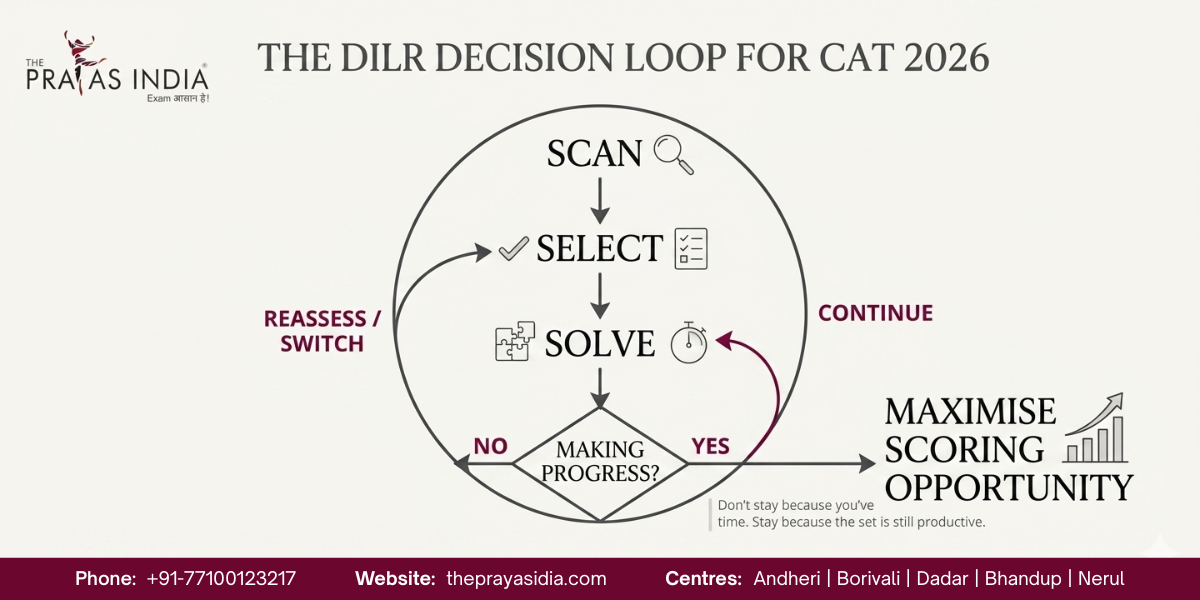
The “First 3 Minutes” Rule
During practice, experiment with giving yourself a short evaluation window.
For example:
Read the set → identify the framework → attempt the initial deductions.
Then ask:
Am I making meaningful progress?
If yes, continue.
If not, reassess.
This doesn’t mean you should literally follow a rigid three-minute rule in every CAT mock or in the actual examination.
Some sets naturally require more reading.
The point is to develop the habit of checking your progress instead of blindly continuing.
Learn to Recognise a Trap Set
A trap set is not necessarily a difficult set.
It can simply be a set that looks attractive initially but consumes disproportionate time.
You may start making progress and feel that the solution is almost there.
Then another condition appears.
Then another.
Suddenly, 15 minutes have passed.
This is dangerous because the psychological tendency is to think:
“I’ve already spent so much time. I should finish it.”
That is the sunk-cost trap.
CAT does not reward time already spent.
It rewards correct answers.
If a set stops being productive, moving away from it can be the smarter decision.
The Most Important DILR Skill: Knowing When to Leave
This is one of the hardest skills to develop.
Students are often comfortable learning how to start a set.
They are less comfortable learning how to abandon one.
But in CAT, knowing when to stop can protect your score.
Suppose:
Set 1: 10 minutes → 3 questions solved
Set 2: 15 minutes → still building the framework
At that point, continuing with Set 2 simply because you’ve already invested time may not be rational.
Ask:
“If I had not already spent 15 minutes here, would I choose this set now?”
If the answer is no, reconsider your decision.
This mindset can help you become more objective during DILR.
Practice Set Selection, Not Just Set Solving
This is an important change you should make in your CAT preparation.
When practising DILR, don’t only ask:
“Can I solve this set?”
Also ask:
“Would I have selected this set in CAT?”
After completing a set, rate it:
Difficulty
Easy / Moderate / Difficult
Your familiarity
High / Medium / Low
Time required
Low / Medium / High
Number of questions you could realistically attempt
1 / 2 / 3 / 4+
Then compare your prediction with the actual experience.
Over time, this develops your DILR selection instinct.
DILR Preparation Should Train Two Different Abilities
A strong CAT aspirant needs to develop:
Ability 1 — Set Solving
Can you understand the information and reach the answers?
Ability 2 — Set Selection
Can you identify which set is worth solving in the first place?
You can be excellent at Ability 1 and still underperform if Ability 2 is weak.
That is why your CAT DILR preparation should include both.
From Preparation to CAT Performance
As CAT 2026 approaches, DILR preparation should gradually move from:
Learning Set Types
to
Solving Mixed Sets
to
Timed Practice
to
Mock-Based Set Selection
to
Full CAT Simulation
This progression is important.
You don’t want to discover your DILR selection strategy for the first time in the actual examination.
It should already have been tested across multiple mocks.
Why Mock Tests Are Essential for DILR Set Selection
A DILR mock gives you something normal practice cannot fully replicate:
Multiple sets competing for limited time.
During ordinary practice, you may solve one set for 25 minutes without worrying about another set.
In CAT, you don’t have that luxury.
Mocks allow you to practise:
- Scanning
- Comparing sets
- Selecting
- Switching
- Managing time
- Handling pressure
- Recovering from a poor decision
After every mock, don’t just record your DILR score.
Also record:
Which set did I choose first?
Was it the right choice?
How long did I spend?
How many questions did I get?
Which set should I have chosen instead?
This information can become one of the most valuable parts of your CAT preparation.
A Better Way to Think About DILR
Don’t enter the CAT DILR section thinking:
“I have to solve four sets.”
Instead think:
“I need to maximise the marks I can obtain from the available sets.”
That change in mindset removes unnecessary pressure.
Your goal is not to demonstrate that you can solve everything.
Your goal is to make the best decisions with the time available.
And that is exactly what good DILR preparation should train you to do.
Key Takeaway
The strongest DILR aspirants are not necessarily the ones who can solve every difficult set.
They are often the ones who can quickly recognise:
Which set is worth their time.
For CAT 2026, start treating set selection as a separate skill.
Practise solving different DILR formats, analyse your mock decisions and learn to recognise when a set is giving you enough progress to justify continued investment.
Time Management, Set Switching & Mock Strategy for CAT DILR
Choosing the right DILR set is only the first step.
The next challenge is managing your time after you have selected a set.
A set that looks promising can still become a problem if you spend too long on it. Similarly, leaving a set too early can mean missing out on marks that were actually within your reach.
For CAT 2026, your DILR preparation should therefore develop three connected skills:
Set Selection → Time Management → Set Switching
Together, these can help you make better decisions during the actual examination.
How Much Time Should You Spend on One DILR Set?
There is no universal time limit that works for every set.
Some sets may take longer because they require a detailed framework. Others may become solvable quickly once the right observation is made.
Instead of following a rigid rule, think in terms of progress versus time invested.
For example:
Situation A
You spend 6 minutes and have already established the basic arrangement.
You are making progress.
Continue.
Situation B
You spend 8 minutes but still don’t know how to structure the information.
You may need to reconsider.
Situation C
You spend 12 minutes and have solved only one question, while another set appears much more approachable.
Switching may be the better decision.
The important question is not:
“How many minutes have I spent?”
It is:
“Is the time I am investing producing enough progress?”
The Progress Check
While solving a DILR set, develop the habit of periodically checking your position.
Ask yourself:
1. Have I understood the framework?
2. Am I making deductions?
3. Can I see a path towards the questions?
4. Is the set becoming easier as I work through it?
If most answers are yes, continue.
If you are repeatedly stuck without meaningful progress, reconsider the set.
This simple mental check can prevent you from becoming trapped in one difficult set.
When Should You Leave a DILR Set?
Leaving a set is not failure.
In CAT, it can be a strategic decision.
Consider moving away when:
- You cannot identify the next step.
- Your deductions keep leading to contradictions.
- The calculations are consuming excessive time.
- You are repeatedly rereading the same information.
- You have spent significantly longer than expected for very little progress.
- Another set offers a much better scoring opportunity.
However, don’t leave simply because the first few minutes feel uncomfortable.
Some good DILR sets require an initial setup period.
The key is to distinguish between:
Temporary difficulty
and
Unproductive difficulty.
The Sunk-Cost Trap in DILR
One of the most dangerous habits during a competitive exam is thinking:
“I’ve already spent 10 minutes on this, so I have to finish it.”
You don’t.
Those 10 minutes are already gone.
Your next decision should be based on the remaining opportunity, not the time already spent.
If another set can potentially produce three or four correct answers while your current set may produce only one, switching could be the smarter decision.
This is one reason why mock tests are so valuable.
They allow you to practise abandoning a poor decision without panicking.
Set Switching Is a Skill
Many students understand that they should switch sets, but struggle to actually do it.
Why?
Because leaving a set creates psychological discomfort.
You may feel:
- “I was almost there.”
- “Maybe the next step will solve it.”
- “I don’t want those 10 minutes to go to waste.”
- “What if the next set is even harder?”
The solution is to make switching part of your preparation.
During mocks, deliberately observe situations where your first choice wasn’t productive.
After the test, ask:
At what point should I have switched?
This creates a practical benchmark for future tests.
DILR Time Management Is About Opportunity Cost
Suppose you have 30 minutes left.
You have two options:
Option A
Spend 15 more minutes trying to finish a difficult set for perhaps 1–2 questions.
Option B
Move to another set where you have a reasonable chance of solving 3 questions in 10–12 minutes.
The decision is not simply about whether you can solve Option A.
It is about what you are giving up by choosing it.
This is opportunity cost.
And CAT DILR rewards aspirants who understand it.
Don’t Chase the Hardest Set
A common mistake among ambitious students is assuming that the difficult set offers greater value.
It doesn’t.
A difficult set is not worth more marks simply because it is difficult.
If an easier set allows you to answer three questions correctly with greater confidence, it may be much more valuable to your score.
Your objective is not:
Maximum Difficulty
It is:
Maximum Scoring Opportunity
Common DILR Set-Selection Mistakes
1. Starting With the First Set
The order in which sets appear does not mean they should be solved in that order.
Scan first.
Then select.
2. Choosing Only Familiar Topics
A familiar topic can still contain a difficult set.
Judge the actual set rather than its label.
3. Staying Too Long Because of Ego
Some students don’t want to leave a set because they feel they should be able to solve it.
CAT doesn’t reward ego.
It rewards marks.
4. Switching Too Frequently
The opposite mistake is also possible.
If you abandon every set after two minutes, you may never give yourself enough time to establish the framework.
Switch when there is evidence that your current approach isn’t productive.
5. Ignoring the Questions
Sometimes the questions themselves reveal whether a set is worth attempting.
If the same framework can answer multiple questions, that may increase the set’s value.
6. Not Reviewing Selection Decisions
After a mock, students often check only whether their answers were correct.
They should also check:
Was my set selection correct?
That is a separate skill.
The DILR Mock-Test Scorecard You Should Maintain
After every mock, maintain a simple record.
| Set | Selected? | Time Spent | Questions Correct | Selection Quality |
|---|---|---|---|---|
| Set 1 | Yes | 11 min | 3 | Good |
| Set 2 | Yes | 17 min | 1 | Poor |
| Set 3 | No | — | — | Should Review |
| Set 4 | No | — | — | Correctly Skipped |
The purpose isn’t to create complicated data.
It’s to identify patterns.
After 8–10 mocks, you may discover:
- You consistently choose calculation-heavy sets.
- You avoid sets that could actually be scoring.
- You stay too long in your first selection.
- You are good at arrangements but slow at interpreting data.
- Your best scores come when you solve moderate sets first.
That information can help shape your CAT 2026 strategy.
How to Improve DILR Set Selection Through Mocks
The best way to improve set selection is not by reading endless strategy articles.
It is by testing your decisions repeatedly.
After every mock, answer four questions:
Question 1
Which set did I select first?
Question 2
How many marks did it actually produce?
Question 3
Was there another set that offered a better opportunity?
Question 4
At what point should I have changed my decision?
Over multiple tests, these questions help develop judgment.
You may eventually notice that you have a personal selection pattern.
For example:
“I perform best when I start with structured arrangements and leave calculation-heavy DI sets for later.”
That’s much more valuable than simply memorising:
“Always start with arrangements.”
Your strategy should be based on your performance, not someone else’s fixed rule.
The Final 60 Days: How to Prepare DILR for CAT 2026
As CAT approaches, DILR preparation should become increasingly test-oriented.
You don’t need to spend all your time learning new set types.
Instead, focus on:
Mixed Sets + Timed Practice + Mocks + Analysis
A practical framework can look like this.
60–45 Days Before CAT
Focus on variety.
Practise different types of DILR sets and identify your strengths.
Priorities:
- Build familiarity
- Solve mixed sets
- Improve interpretation
- Start timed practice
- Take regular sectional tests
45–30 Days Before CAT
Start paying more attention to decision-making.
After every practice session, ask:
Which set would I have selected first?
Begin taking regular full-length mocks.
Priorities:
- Set selection
- Time management
- Accuracy
- Switching decisions
- Mock analysis
30–15 Days Before CAT
Your strategy should now become more stable.
You should know:
- Which sets you prefer
- Which sets you tend to avoid
- When you typically waste time
- How quickly you recognise a productive set
- How many questions you can realistically attempt
Priorities:
- Full-length mocks
- Previous CAT-level sets
- Error-log revision
- Timed DILR practice
- Strategy refinement
Final 15 Days
Don’t completely reinvent your DILR strategy.
At this stage, focus on:
- Maintaining accuracy
- Revising recurring mistakes
- Taking realistic simulations
- Reviewing mock decisions
- Staying mentally composed
The objective is stability.
You want your decision-making to feel natural rather than forced.
What If You Are Weak in DILR?
Don’t assume that being weak today means you cannot improve significantly before CAT.
DILR has an important characteristic:
Exposure can improve recognition.
The more varied sets you solve, the more comfortable you can become with:
- Structuring information
- Identifying constraints
- Finding relationships
- Testing cases
- Recognising useful deductions
But don’t solve sets randomly.
After each set, understand:
What made this set difficult?
What was the key breakthrough?
Could I have identified that breakthrough earlier?
This type of reflection can accelerate improvement.
What If You Are Already Strong in DILR?
Then your focus should shift from merely solving difficult sets to maximising your CAT score.
A strong DILR student may still lose marks through:
- Poor selection
- Over-attempting
- Spending too long on one set
- Not switching
- Careless calculations
- Overconfidence
Your goal should therefore be consistency.
A strong DILR performance in one mock is encouraging.
A strong performance across multiple mocks is much more useful.
DILR and Overall CAT Percentile
It is tempting to treat DILR as an isolated section.
But CAT is an overall competitive examination, and performance across VARC, DILR and QA contributes to your overall percentile.
For MBA aspirants targeting competitive B-schools, every section therefore deserves a strategic approach.
You don’t necessarily need to become the best DILR solver in your preparation group.
You need to build a level of DILR performance that supports your overall CAT score and admission goals.
This is where a structured preparation environment can be useful.
How The Prayas India Can Support CAT DILR Preparation
For students searching for Best CAT Coaching in Mumbai, DILR preparation should go beyond solving a large number of sets.
A structured approach should help students understand:
Which sets to solve → How to approach them → When to move on → How to analyse mistakes → How to improve through mocks
The Prayas India can position its CAT preparation around this broader approach, combining conceptual learning with practice, testing and strategy development.
For an aspirant, this can be particularly useful because DILR performance often depends on decision-making under time pressure, something that is difficult to develop through untimed practice alone.
The ultimate objective is not simply to solve more DILR sets.
It is to become better at choosing and converting the right sets.
Contact Us
📞 Call Now: +91-77100 13217
🌐 Website: theprayasindia.com
📍 Centres: Andheri | Borivali | Dadar | Nerul | Bhandup
A Simple DILR Checklist for CAT 2026
Before committing to a set, ask:
SET SELECTION
☐ Is the structure clear?
☐ Do I understand the information?
☐ Can I identify a starting point?
☐ Are multiple questions connected?
☐ Does this look manageable for me?
DURING SOLVING
☐ Am I making meaningful progress?
☐ Am I building the framework correctly?
☐ Is the time investment justified?
☐ Am I getting closer to the questions?
IF STUCK
☐ Am I genuinely close to a breakthrough?
☐ Or am I simply spending time because I already started?
☐ Is another set likely to offer a better scoring opportunity?
This checklist can become increasingly automatic with practice.
Final Takeaway
The biggest DILR mistake is thinking:
“I need to solve difficult sets.”
The better mindset is:
“I need to solve the right sets efficiently.”
CAT 2026 will test your ability to make decisions under pressure, not just your ability to work through complicated puzzles.
So build your DILR preparation around three skills:
SCAN
Understand the available sets.
SELECT
Choose the strongest scoring opportunity.
SOLVE
Convert that opportunity into accurate answers.
And if the set stops being productive, reassess and move on.
That combination of preparation and decision-making can make your DILR performance more consistent—and consistency is critical when you’re targeting a competitive CAT percentile and MBA admission.
FAQs
Look for sets with a clear structure, manageable conditions, a visible starting point and multiple connected questions. Most importantly, consider whether the set suits your own strengths.
There is no fixed time limit. Monitor your progress and compare the time you're investing with the number of questions you are likely to convert.
No. Scan the section first and choose sets based on difficulty, familiarity and scoring potential rather than their order.
Practise mixed sets under time pressure and analyse your selection decisions after every mock. Record which sets you chose, how much time you spent and how many questions you converted.
DILR difficulty can vary from one CAT paper to another. Rather than predicting difficulty, aspirants should prepare to identify manageable sets and make effective decisions under time pressure.
Yes. Structured practice, mock analysis and mentor feedback can help students identify recurring selection mistakes and develop a more personalised DILR strategy.1. How do I choose the right DILR set in CAT?
2. How much time should I spend on one DILR set?
3. Should I solve the DILR sets in order?
4. How can I improve DILR set selection?
5. Is DILR difficult for CAT 2026?
6. Can coaching help improve DILR set selection?