How to Clear SBI Clerk Prelims Without Guesswork? | Best Bank Coaching in Mumbai | The Prayas India
Clearing the SBI Clerk Prelims is not about attempting every question that appears on the screen. It is about knowing which questions to attempt, which questions to leave, how much time to invest in each section, and how to protect accuracy under pressure. For many aspirants, guesswork enters the paper when they are unsure of an answer, fall behind on time, or become overly focused on achieving a particular attempt count.
The smarter approach is to replace guesswork with a decision-making system. When preparation is structured properly, candidates can enter the examination with a clear understanding of their strengths, realistic attempt targets, time allocation and question-selection strategy.
For SBI Clerk 2026 aspirants, this is particularly relevant because the Preliminary Examination consists of English Language, Numerical Ability and Reasoning Ability, with 20 minutes separately allotted to each section. The Prelims carries 100 questions for 100 marks, making speed and accuracy equally important. The SBI recruitment notification also specifies negative marking of one-fourth of the marks assigned to a question for each wrong answer in the objective tests.
That combination creates a simple but important rule: do not guess merely because the clock is running. Instead, build the ability to recognise solvable questions quickly and make calculated decisions.
What Does “Without Guesswork” Actually Mean?
Clearing SBI Clerk Prelims without guesswork does not mean that every answer must feel obvious before you attempt it. Competitive examinations often include questions where you can eliminate one or more options, identify a pattern or use partial information to arrive at the correct answer.
There is a difference between logical elimination and blind guessing.
If you can confidently eliminate three options and the remaining option satisfies the conditions of the question, that is not random guessing. Similarly, if you understand a mathematical relationship but make a quick calculation to verify the answer, you are applying a method.
Blind guessing happens when you select an option without sufficient reasoning simply because you want to increase your attempt count.
This distinction matters because the objective of the Prelims is not to demonstrate how many questions you can touch. It is to produce a sufficiently strong score while maintaining accuracy.
A candidate attempting 85 questions with frequent errors may perform worse than a candidate attempting fewer questions with substantially higher accuracy. Therefore, your preparation should focus on quality attempts per minute, not simply total attempts.
Understand the SBI Clerk Prelims Before Building Your Strategy
Before working on speed or accuracy, candidates should understand the structure of the examination.
The SBI Clerk Preliminary Examination has three sections:
| Section | Questions | Marks | Time |
|---|---|---|---|
| English Language | 30 | 30 | 20 minutes |
| Numerical Ability | 35 | 35 | 20 minutes |
| Reasoning Ability | 35 | 35 | 20 minutes |
| Total | 100 | 100 | 60 minutes |
The sectional time limit is particularly important. You cannot simply spend 30 minutes on your strongest section and compensate by rushing through another section. Each section has its own 20-minute window.
This means that your strategy must be section-specific.
If your English is strong but your Numerical Ability is relatively slow, you cannot transfer unused English time into Quantitative Aptitude. Instead, you need to improve your performance within the prescribed time available for each section.
This is one reason why full-length mock tests alone are not enough. Candidates also need sectional tests that replicate the actual time pressure.
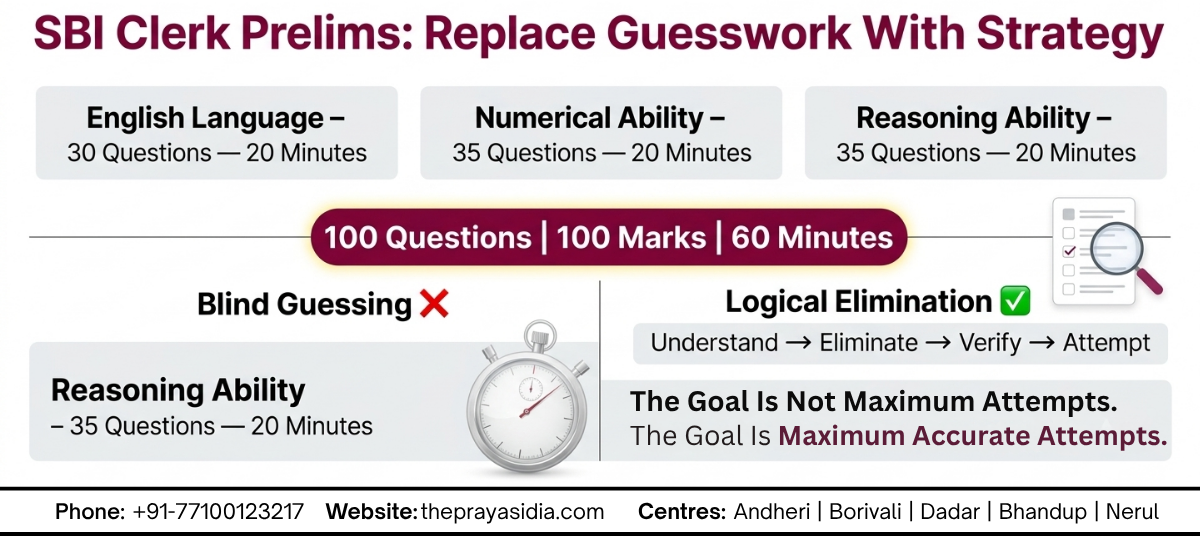
Why Blind Guessing Can Hurt Your SBI Clerk Prelims Score
When candidates feel that they are running out of time, their decision-making often changes. A question that they would normally skip suddenly appears “worth a try.” They may select an option based on intuition, a partially remembered formula or a vague familiarity with the question.
This is exactly when negative marking becomes important.
According to the SBI Junior Associate recruitment notification, a penalty of one-fourth of the marks assigned to a question is applied for every wrong answer in the objective tests.
The practical implication is not that candidates should become excessively conservative. Avoiding every uncertain question is also not a good strategy. Instead, aspirants should create categories of confidence.
Category 1: Sure-Shot Questions
You understand the question, know the method and can reasonably predict the answer.
Action: Attempt.
Category 2: Solvable With Limited Effort
You understand the question and have a clear method, but it requires a little more time or calculation.
Action: Attempt if the time investment is reasonable.
Category 3: Logical Elimination
You do not immediately know the answer, but you can eliminate options using the information provided.
Action: Attempt only when the elimination is genuinely based on logic.
Category 4: Complete Uncertainty
You do not understand the question, do not know the relevant concept and cannot eliminate meaningful options.
Action: Leave it.
This four-level framework is much better than thinking in terms of simply “attempt” or “skip.”
Build Accuracy Before You Chase High Attempts
One of the biggest mistakes in SBI Clerk preparation is attempting to increase the number of questions before establishing accuracy.
Suppose you currently attempt 65 questions with 90% accuracy. Your next objective should not necessarily be to jump to 85 attempts. Instead, first understand where the remaining errors are coming from.
Are you making calculation mistakes in Numerical Ability? Are you misreading English questions? Are you spending too much time on a puzzle in Reasoning? Are you changing an initially correct answer because of doubt?
Each problem requires a different solution.
A useful preparation progression is:
Concept Clarity → Accuracy → Speed → Question Selection → Higher Attempts
Many students try to reverse this:
Higher Attempts → Speed → Accuracy
That approach can create unnecessary pressure and reinforce careless habits.
How to Decide Whether a Question Is Worth Attempting
During the examination, every question has an opportunity cost. If one question takes three minutes, you need to consider what else you could have solved in those three minutes.
This becomes especially important in Numerical Ability and Reasoning, where certain questions can consume considerably more time than direct questions.
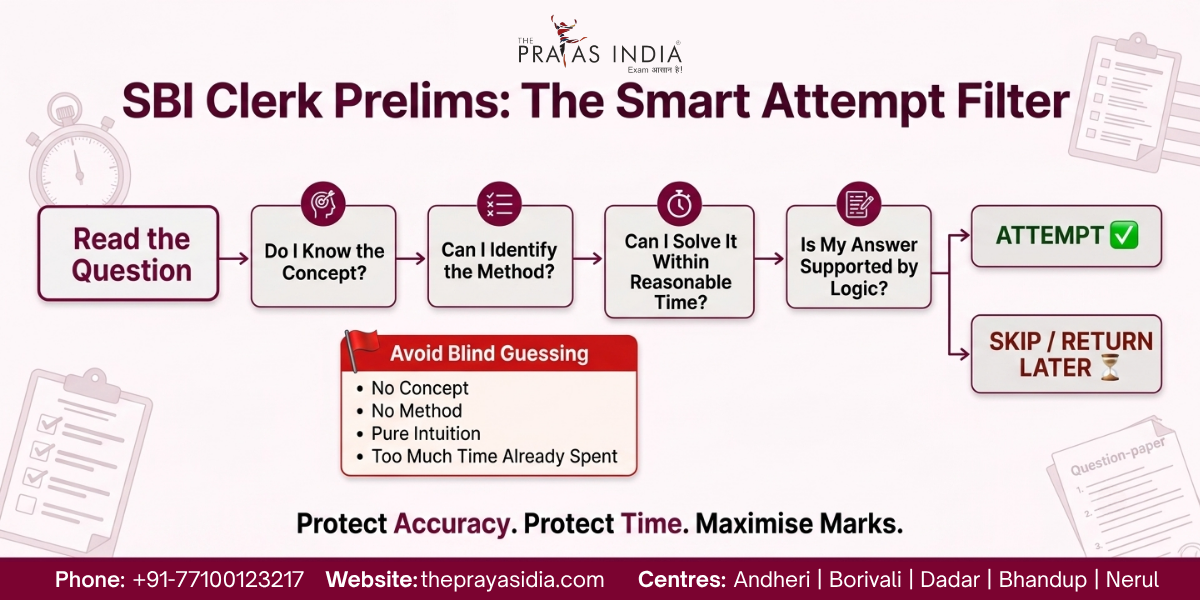
Develop a simple internal question-selection filter:
Can I identify the method?
If yes, continue.
Can I estimate the time required?
If yes, decide whether the question is worth attempting now.
Am I making progress?
If yes, continue.
Have I been stuck without meaningful progress?
If yes, move on.
This approach prevents emotional attachment to difficult questions.
A question does not become valuable merely because you have already spent one minute on it. In fact, continuing because of the time already invested is often what turns a small time loss into a major one.
Section-Wise Strategy: English Language
The English section can become a high-scoring component when candidates have strong reading speed, grammar fundamentals and familiarity with recurring question types.
The key to avoiding guesswork here is to distinguish between questions where the answer can be established from the passage or grammatical structure and questions where you are relying purely on vague intuition.
For Reading Comprehension, read with purpose rather than trying to memorise every sentence. Understand the central idea, tone, key arguments and relevant details. For vocabulary-based questions, use context wherever possible rather than selecting an option simply because it “sounds right.”
In grammar-based questions, build a strong understanding of concepts such as subject-verb agreement, tenses, articles, prepositions, pronouns, modifiers and sentence structure. The more concepts you master, the less you need to depend on guesswork.
How to Improve English Accuracy
Keep an error notebook with separate sections for:
- Vocabulary mistakes
- Grammar mistakes
- Reading comprehension errors
- Misinterpretation of questions
- Careless errors
This allows you to identify whether your mistakes come from knowledge gaps or rushed decision-making.
If the same grammar concept causes repeated errors, revising that concept will usually produce a greater benefit than solving dozens of unrelated questions.
Section-Wise Strategy: Numerical Ability
Numerical Ability is where guesswork can become particularly expensive because calculation-heavy questions can create the illusion that you are making progress even when you are consuming too much time.
The solution is to develop strong recognition of question types.
Candidates should become comfortable with topics such as:
- Simplification
- Approximation
- Number Series
- Quadratic Equations
- Data Interpretation
- Arithmetic
- Percentage
- Profit and Loss
- Ratio and Proportion
- Average
- Time, Speed and Distance
- Time and Work
Not every question deserves equal time.
If a simplification question can be solved quickly, it may be a better first choice than a lengthy arithmetic problem. Similarly, if a Data Interpretation set appears calculation-heavy, you should evaluate whether another available question can provide a better return on your time.
The aim is to develop calculation confidence and selection discipline simultaneously.
The Role of Calculation Speed
Fast calculation does not mean performing complicated mathematics mentally. It means reducing unnecessary calculation.
Learn common fraction-percentage conversions, multiplication patterns, squares, cubes and approximation techniques relevant to your preparation. Practise mental calculations where appropriate, but do not sacrifice accuracy merely to appear fast.
A reliable calculation method that takes slightly longer is preferable to a shortcut that repeatedly creates errors.
As your calculation accuracy improves, you will naturally become faster because you spend less time checking every intermediate step.
Section-Wise Strategy: Reasoning Ability
Reasoning can reward candidates who are good at recognising patterns and selecting questions efficiently. The section typically combines relatively direct questions with puzzles and arrangements that can consume considerably more time.
The first objective should be to become highly comfortable with direct topics such as inequality, syllogism, coding-decoding, blood relations, direction sense, alphanumeric series and other familiar question types.
These questions can help you build momentum. However, you should not automatically attempt every direct-looking question. Difficulty can vary even within the same topic.
Puzzles and seating arrangements require a separate approach. Before beginning a set, spend a few moments understanding its structure. Look for fixed positions, direct relationships and useful anchor clues. If the puzzle appears unusually complicated, do not let it dominate the section.
A good reasoning strategy is therefore based on selection rather than fear. Difficult questions should not intimidate you, but neither should they control your time.
Use the 20-Minute Rule During Practice
Because the SBI Clerk Prelims gives 20 minutes to each section, candidates should regularly practise under the same time constraint.
Do not wait until the final month to introduce sectional timing.
Start with topic-wise practice, then move to 10-minute mini-tests and eventually full 20-minute sectional tests.
After every sectional test, record:
| Performance Area | Question to Ask |
|---|---|
| Attempts | How many questions did I attempt? |
| Accuracy | How many were correct? |
| Time | Where did I spend the most time? |
| Selection | Which questions should I have skipped? |
| Missed Opportunities | Which easy questions did I leave? |
| Errors | Were mistakes conceptual or careless? |
This information is more useful than simply looking at the score.
Why Mock-Test Analysis Is More Important Than Taking More Mocks
Taking a mock test without analysis is similar to taking a diagnostic test and ignoring the diagnosis.
Your mock should reveal your behaviour under pressure.
For example, imagine that your Numerical Ability score is lower than expected. The solution may not be “solve more Quant questions.” Your analysis might show that you spent six minutes on one difficult Data Interpretation set and then rushed through several easier questions.
In that situation, your primary problem is question selection, not necessarily mathematical ability.
Similarly, if your Reasoning accuracy is high but your attempts are low, you may need more speed drills. If attempts are high but accuracy is poor, you need to slow down and improve decision quality.
The most useful mock analysis therefore looks beyond the score.
Create a Personal “Do Not Guess” Rulebook
Every serious SBI Clerk aspirant should create a small set of personal rules based on mock-test experience.
For example:
Rule 1: Do not attempt a question if I cannot identify the concept.
Rule 2: Do not spend several minutes trying to rescue one difficult puzzle.
Rule 3: Do not change an answer without a logical reason.
Rule 4: Do not increase attempts simply to match someone else’s mock score.
Rule 5: If I make repeated mistakes in one topic, stop and revise it before increasing question volume.
These rules reduce impulsive decisions.
Over time, you should know your own strengths and weaknesses well enough that examination decisions become almost automatic.
The Biggest Mistake: Chasing Someone Else’s Attempt Strategy
You may see candidates claiming very high attempts in SBI Clerk Prelims and feel that you must match them. This can create unnecessary pressure.
Attempt numbers are meaningful only when considered alongside paper difficulty, accuracy and individual strengths.
A candidate with exceptional calculation speed may comfortably attempt more Numerical Ability questions. Another candidate may be stronger in English and Reasoning but more cautious in Quant. Both strategies can be valid.
Your goal should be to establish your optimal attempt range, based on repeated sectional and full-length mock performance.
That range should be flexible rather than fixed. If the paper is unusually difficult, a lower number of attempts may still represent a strong performance. If the paper is easier, the expected competitive level may rise.
Therefore, do not prepare with a statement such as “I must attempt exactly X questions.” Prepare with a better statement:
“I will attempt every question that I can solve accurately within a reasonable amount of time.”
That is a much stronger examination strategy.
Building Confidence Without Guesswork
Confidence in a competitive examination does not come from attempting questions randomly. It comes from knowing that you have repeatedly performed under realistic conditions.
When you take sectional tests, practise the same time limits that you will face in the actual examination. When you analyse mistakes, record the reasons. When a topic repeatedly causes problems, fix the underlying issue.
Gradually, the examination becomes less about reacting to pressure and more about executing a familiar plan.
That is the real purpose of preparation.
The SBI Clerk Prelims does not require candidates to solve every difficult question. It requires them to make hundreds of small decisions correctly under a strict time limit.
The more systematically you practise those decisions, the less you will depend on guesswork.
Build a Section-Wise Attempt Strategy Instead of Chasing a Fixed Number
One of the biggest mistakes SBI Clerk aspirants make is preparing with a fixed attempt number in mind. Statements such as “I must attempt 80+ questions” may look motivating, but they can become counterproductive when the actual paper is difficult or when the candidate’s strengths are different from those of other aspirants.
The SBI Clerk Prelims has 100 questions divided across English Language, Numerical Ability and Reasoning Ability, with 20 minutes separately allotted to each section. The official SBI pattern also specifies negative marking for incorrect objective-test answers.
Therefore, your target should be based on accuracy, speed and question selection, not an arbitrary attempt figure.
For example, if you enter the Reasoning section and find a puzzle that appears complicated, you should not attempt it merely because you have decided beforehand to attempt a particular number of questions. Instead, assess the question and move toward the best scoring opportunities available.
A strong attempt strategy is flexible. It adapts to the difficulty of the paper while protecting your accuracy.
A Practical 20-Minute Strategy for Each Section
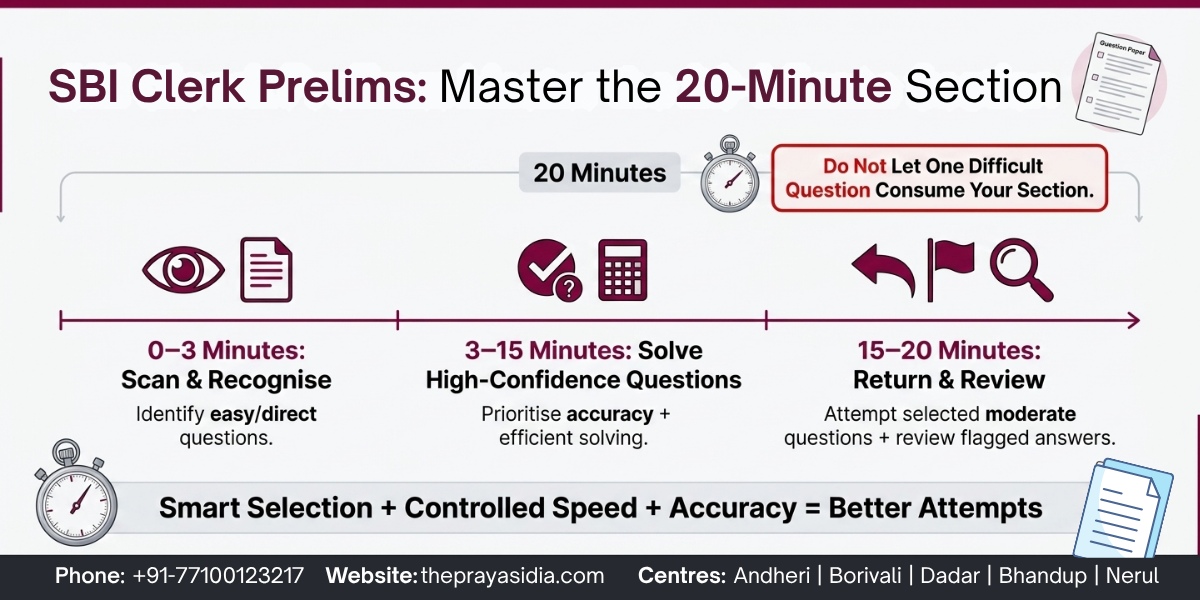
Because the SBI Clerk Prelims uses separate sectional timing, candidates should develop a strategy that works within each 20-minute window. Recent preparation guidance similarly emphasises practising topic-wise questions first, then sectional tests and full-length mocks under realistic timing.
A useful framework is:
First Phase: Scan and Recognise
Use the opening moments to identify familiar, direct and manageable questions. You do not need to solve everything immediately. The purpose is to understand where the scoring opportunities are.
Second Phase: Solve High-Confidence Questions
Move through questions where the method is clear and the expected time investment is reasonable. This helps establish momentum without taking unnecessary risks.
Third Phase: Return to Selective Questions
After collecting the easier marks, return to questions that require additional calculation or logical processing. Difficult questions should be attempted only when the remaining time justifies them.
The exact number of questions you attempt in each phase will depend on your preparation level and the difficulty of the paper.
How to Handle an Easy SBI Clerk Prelims Paper
An easy paper can be deceptively difficult because it encourages overconfidence.
When questions appear familiar, candidates often start solving faster than they should. They may skip reading a condition carefully, make an avoidable calculation error or select an option before fully verifying the question.
An easier paper can also increase the importance of accuracy because many candidates may be able to attempt a large number of questions. Your advantage should therefore come from clean execution.
When the paper feels easy:
- Do not rush unnecessarily.
- Maintain your normal solving process.
- Avoid changing correct answers without a reason.
- Use elimination only when it is logically justified.
- Keep track of time without constantly checking the clock.
- Prioritise accuracy over artificial attempt targets.
Your preparation should teach you to remain calm whether the paper is easy, moderate or difficult.
How to Handle a Difficult SBI Clerk Prelims Paper
A difficult paper requires a completely different mindset.
The first mistake candidates make is assuming that because they are struggling, everyone else must be performing much better. This can create panic and encourage blind guessing.
Instead, remember that the paper is being taken under the same conditions by everyone.
If Numerical Ability appears unusually lengthy, your objective should not be to force yourself to solve the same number of questions you practised in easy mocks. Look for manageable questions and protect accuracy.
If Reasoning contains a difficult puzzle, move toward direct questions. If English contains a complicated Reading Comprehension passage, evaluate whether other available questions offer a better use of your time.
The correct response to a difficult paper is not panic; it is recalibration.
Do Not Let Mock-Test Attempts Become Your Exam-Day Pressure
Mock tests are valuable because they help you understand your performance. However, candidates sometimes turn their mock scores into rigid expectations.
Suppose you regularly attempt 75 questions in mocks. That does not mean you must attempt 75 questions in the actual examination.
The difficulty level can change. Your mental state can change. The question mix can change.
Instead, use mocks to establish a performance range.
Track:
| Metric | What to Monitor |
|---|---|
| Attempts | Your usual attempt range |
| Accuracy | Percentage of correct answers |
| Section-wise score | Strong and weak sections |
| Time usage | Where minutes are being lost |
| Question selection | Good vs poor decisions |
| Repeated errors | Concepts or habits causing mistakes |
After several mocks, you will have a much better understanding of your actual performance than you would get from a single test.
The Three-Mock Rule for Strategy Changes
Avoid changing your entire preparation strategy after one bad mock.
One mock can be affected by an unfamiliar question set, poor concentration or an unusually difficult section. Before making a major change, look for a pattern across multiple tests.
For example, if you repeatedly spend too much time on puzzles across three or four Reasoning tests, that is a genuine pattern. You may need to work on puzzle selection.
If Quant accuracy repeatedly falls because of calculation errors, your priority should be calculation practice rather than simply taking more mocks.
This approach prevents emotional preparation.
How to Analyse an SBI Clerk Mock Test Properly
A mock test should be treated as a performance report.
Do not stop at the scorecard. Go back to the questions and classify them.
Category A: Correct and Fast
These questions represent your strongest preparation areas.
Action: Maintain them through regular revision and timed practice.
Category B: Correct but Slow
These questions are extremely important for speed improvement.
You know the concept, but your method or execution is inefficient.
Action: Re-solve them using a shorter or more structured approach.
Category C: Wrong Despite Knowing the Concept
These are often careless mistakes.
Perhaps you misread a condition, made a calculation error, clicked the wrong option or changed your answer unnecessarily.
Action: Identify the exact behavioural mistake.
Category D: Wrong Because of a Concept Gap
This indicates a genuine weakness.
Action: Relearn the concept, solve basic questions and then return to timed practice.
Category E: Skipped but Solvable
This is one of the most valuable categories.
If you discover during analysis that you could have solved the question within a reasonable amount of time, your problem may be question recognition or confidence rather than knowledge.
Action: Add similar questions to your practice sets.
This five-category analysis gives you a much clearer picture of how to improve.
The “Error Notebook” Can Reduce Repeated Guesswork
Create a simple error notebook or digital document divided into three sections:
Concept Errors
Record concepts you repeatedly misunderstand.
Execution Errors
Record calculation mistakes, incorrect diagrams, missed conditions and similar errors.
Decision Errors
Record situations where you attempted a question you should have skipped or skipped a question you could have solved.
The third category is often overlooked.
A candidate can have strong concepts and still lose marks because of poor decisions. If you repeatedly attempt lengthy questions while leaving easy ones, the solution is not another lecture on the syllabus. The solution is better exam strategy.
A 30-Day SBI Clerk Prelims Speed and Accuracy Plan
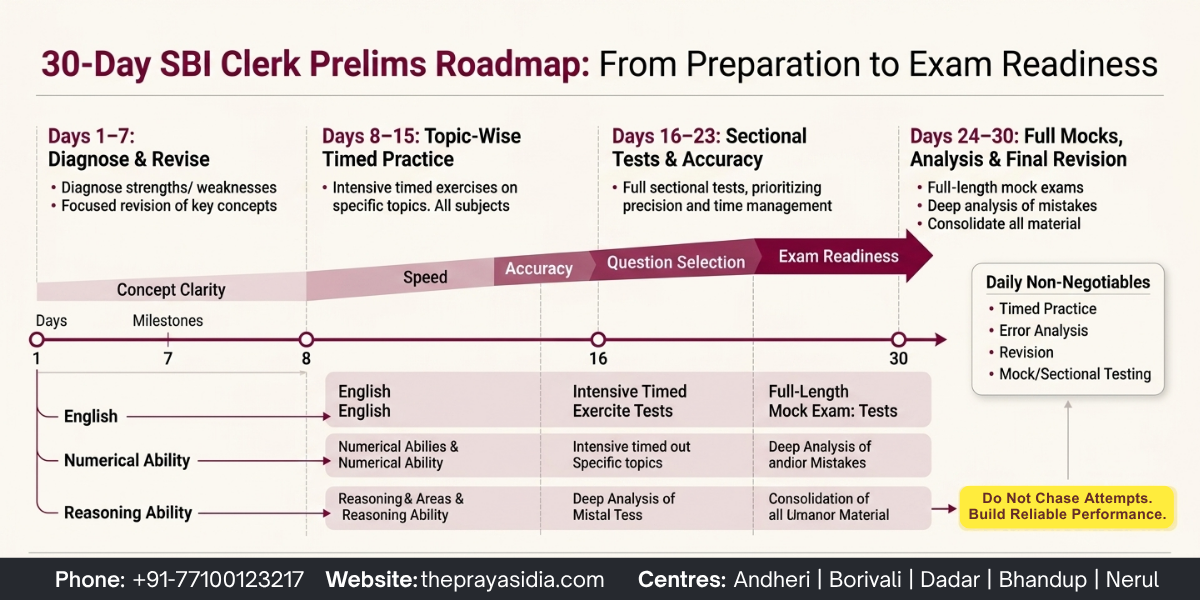
A structured 30-day plan should gradually move from revision to timed practice and then to mock-based refinement. Recent SBI Clerk preparation plans similarly recommend progressing from concept revision and topic-wise practice toward PYQs, sectional tests, full mocks and final revision.
Days 1–7: Diagnose Your Preparation
The first week should establish where you currently stand.
Revise important concepts in all three subjects and take sectional tests. Do not worry about achieving a very high score immediately. Your objective is to identify weak topics, slow question types and repeated errors.
Create your error notebook from the first week itself.
Days 8–15: Build Speed Through Topic-Wise Practice
Now introduce more timed practice.
In Quantitative Ability, work on calculation-heavy areas, simplification, approximation, number series, arithmetic and Data Interpretation according to your level.
In Reasoning, practise direct topics alongside puzzles and seating arrangements.
In English, combine grammar, vocabulary, reading comprehension and other recurring question types.
The objective is to make familiar question types increasingly automatic.
Days 16–23: Move Towards Sectional Tests
At this stage, your preparation should become more exam-oriented.
Take regular 20-minute sectional tests and analyse them carefully. Recent preparation strategies also recommend shifting toward sectional tests and mock analysis as the examination approaches.
Do not simply record the score.
Record:
What did I solve?
What did I miss?
What took too long?
What should I have skipped?
Where did I make an avoidable mistake?
Days 24–27: Full-Length Mock Practice
Now introduce full-length Prelims mocks under strict examination conditions.
Do not pause the test, check answers midway or change the timing rules.
After every mock, spend sufficient time analysing your performance.
The purpose of these tests is to finalise your decision-making strategy.
Days 28–29: Refine, Don’t Rebuild
Do not start learning a large number of new concepts at this stage.
Revise:
- Important formulas
- Grammar rules
- Vocabulary
- Reasoning patterns
- Calculation shortcuts
- Frequently repeated mistakes
- Mock-test error notebook
Take another mock if your preparation schedule permits, but focus heavily on analysis.
Day 30: Keep the Preparation Controlled
The final day should not become an information overload session.
Review your short notes, formulas and important mistakes. Avoid introducing unnecessary new material.
A calm mind is an important part of examination performance.
Why Structured Bank Coaching Can Make SBI Clerk Preparation More Effective
Self-study can work, but it requires considerable discipline. Candidates need to identify the right topics, select reliable study material, understand changing question patterns, schedule practice, analyse mocks and continuously diagnose weaknesses.
This is where structured bank coaching can provide value.
For aspirants preparing in Mumbai, an institute such as The Prayas India can provide an organised preparation environment where concepts, practice and testing are connected. Instead of treating each subject separately, students can work toward the larger objective of becoming examination-ready.
For SBI Clerk, this means learning not only how to solve a question but also how to solve it within the available time, whether it is worth attempting and how to avoid repeated errors.
Guidance becomes particularly useful for candidates who struggle to create a consistent study schedule, are unsure about question selection or repeatedly take mocks without understanding why their scores are not improving.
What Aspirants Should Look for in SBI Clerk Coaching
Choosing a bank coaching institute should not be based only on the number of classes or promotional claims. Aspirants should evaluate whether the preparation system addresses the skills actually required in the examination.
Look for:
- Concept-focused teaching
- Regular topic-wise practice
- Sectional tests with realistic timing
- Full-length SBI Clerk mocks
- Detailed mock analysis
- Doubt resolution
- Revision support
- Exam-oriented study material
- Personal performance tracking
- Guidance on time management and question selection
The best coaching environment should help students become progressively more independent. The ultimate objective is not to make students dependent on shortcuts or predictions but to equip them with a reliable method for approaching the actual examination.
How The Prayas India Can Support Your SBI Clerk Preparation
For aspirants looking for bank coaching in Mumbai, The Prayas India offers structured preparation designed around competitive banking examinations. A focused preparation system can help candidates work on the three areas that matter most in SBI Clerk Prelims: concept clarity, speed and accuracy.
The value of coaching is not simply that someone tells you what to study. Effective guidance can help you understand why a particular approach works, identify where your preparation is falling short and develop a practical strategy for improving performance.
For an SBI Clerk aspirant, that can mean learning how to approach a puzzle without wasting time, improving calculation speed in Quantitative Ability, strengthening grammar and comprehension in English, and most importantly, developing the confidence to leave questions that do not justify the time investment.
The objective is to enter the examination with a plan rather than a collection of disconnected preparation materials.
Final Takeaway: Clear SBI Clerk Prelims With Decisions, Not Guesswork
Clearing SBI Clerk Prelims without guesswork does not mean attempting only questions whose answers appear immediately obvious. It means replacing random decisions with concept knowledge, logical elimination, time awareness and disciplined question selection.
You should know which topics are your strengths, which questions typically consume your time and where your accuracy falls under pressure.
Your preparation should progress from:
Concepts → Practice → Timed Practice → Sectional Tests → Mock Analysis → Exam Strategy
The 20-minute sectional timing makes this progression especially important.
Do not chase someone else’s attempt count. Do not let one difficult puzzle consume an entire section. Do not guess simply because the clock is moving. And do not treat a mock-test score as the final verdict on your ability.
Instead, use every practice session to make your decisions better.
When you enter the SBI Clerk Prelims knowing what to attempt, what to skip, how long to spend and how to recover when a section is difficult, you are no longer relying on guesswork.
You are relying on preparation.
That is the mindset that can make your SBI Clerk preparation more focused, disciplined and examination-ready.
Contact Us
📞 Call Now: +91-77100 13217
🌐 Website: theprayasindia.com
📍 Centres: Andheri | Borivali | Dadar | Nerul | Bhandup
Frequently Asked Questions
1. Can I clear SBI Clerk Prelims without guessing?
Yes. A strong preparation strategy can help you rely primarily on concept knowledge, logical elimination, question selection and accuracy rather than blind guessing. However, you should still remain flexible and use legitimate option elimination when the question supports it.
2. How many questions should I attempt in SBI Clerk Prelims?
There is no universal attempt number that guarantees success. Your ideal attempts depend on paper difficulty, accuracy, speed and individual strengths. Use multiple mocks to establish a realistic personal attempt range rather than blindly following someone else's target.
3. Is there negative marking in SBI Clerk Prelims?
Yes. The SBI Junior Associate examination pattern specifies a penalty of one-fourth of the marks assigned to a question for an incorrect answer in the objective tests.
4. How much time is available for each SBI Clerk Prelims section?
The Prelims has separate 20-minute timings for English Language, Numerical Ability and Reasoning Ability. Candidates cannot treat the full 60 minutes as one transferable pool of time.
5. How can I improve my SBI Clerk Prelims accuracy?
Analyse your mistakes after every sectional and full-length mock. Separate conceptual errors, careless mistakes and poor question-selection decisions. Then practise specifically around the category causing the problem.
6. Should I attempt difficult puzzles in SBI Clerk Reasoning?
Only when the puzzle appears manageable within the available time and offers a reasonable opportunity to answer its questions. If a puzzle is consuming excessive time without progress, move on and return later if possible.
7. How many mock tests should I take before SBI Clerk Prelims?
There is no fixed number that suits every candidate. The more important factor is the quality of analysis. Regular sectional tests followed by full-length mocks can help you build speed, accuracy and a reliable attempt strategy. Current preparation guidance also recommends moving progressively from topic practice to sectional tests, mocks and detailed analysis.
8. Is coaching necessary for SBI Clerk preparation?
Not necessarily. Some candidates can prepare effectively through disciplined self-study. However, structured coaching can be useful for aspirants who need organised study plans, guided concept learning, regular testing, doubt resolution and performance analysis. The right choice depends on your preparation level, consistency and learning requirements.