
How to Crack IBPS Clerk 2026 in Just 60 Days | Best IBPS Clerk Coaching in Mumbai | The Prayas India
When the Clock Starts Ticking, Strategy Matters More Than Ever.
The day the IBPS Clerk 2026 notification was released, thousands of banking aspirants experienced two completely different emotions.
For some, it felt like an opportunity they had been waiting for.
For others, it triggered panic.
“Only around two months left for Prelims… Have I already fallen behind?”
If you’ve had a similar thought, you’re not alone.
Every recruitment cycle follows the same pattern.
Students immediately begin searching for:
- Best books for IBPS Clerk
- 60-day study plans
- Daily schedules
- Topper strategies
- Last-minute tricks
- YouTube playlists
Within a few hours, they have collected dozens of preparation resources.
Ironically, the more resources they gather, the more confused they become.
The problem isn’t a shortage of information.
The problem is deciding what actually deserves your attention over the next 60 days.
This article isn’t another collection of generic study tips.
Instead, it will show you how successful aspirants use a limited preparation window to build maximum impact—without wasting time on unnecessary activities.
Because sixty days can be enough.
Provided every day has a purpose.
IBPS Clerk (CSA) 2026 Notification Out
The Biggest Advantage You Still Have
When aspirants hear the phrase “60 days left,” they immediately think about what’s missing.
“I haven’t completed Quant.”
“My English isn’t strong.”
“Reasoning still takes too much time.”
Very few students ask a more important question.
“What can I realistically improve in the next sixty days?”
Competitive examinations reward improvement—not perfection.
You don’t need to master every advanced concept.
You need to maximise marks from topics that appear regularly and can be solved accurately under time pressure.
This change in thinking makes preparation far more practical.
Instead of chasing an impossible goal, you begin building achievable progress.
Why Some Aspirants Improve Faster Than Others
Every year, two students start preparation on exactly the same day.
Both spend four to five hours daily.
Both solve practice questions.
Both attempt mock tests.
Yet after eight weeks, one consistently scores fifteen to twenty marks higher.
Why?
Not because they studied longer.
Because they studied differently.
Successful aspirants understand that the final sixty days are not about collecting knowledge.
They are about making better decisions.
They know:
- Which topics deserve priority.
- Which chapters can wait.
- Which mistakes are reducing scores.
- Which practice methods actually work.
- When to revise instead of learning something new.
Preparation becomes selective.
That selectiveness creates results.
Stop Measuring Preparation in Hours
One of the most common mistakes among IBPS Clerk aspirants is treating study hours as the only measure of progress.
Eight hours sounds impressive.
But what if those eight hours were spent switching between YouTube videos, PDFs, Telegram channels, and random quizzes?
Now compare that with someone who studies four focused hours using a structured plan.
Who is likely to improve faster?
Quality almost always defeats quantity.
Instead of asking,
“How many hours did I study today?”
Start asking,
- What new concept became clear?
- Which mistake did I eliminate?
- Did my speed improve?
- Was today’s revision effective?
These questions reveal genuine progress.
The 60-Day Window Is Smaller Than It Looks
Sixty days sounds like plenty of time.
It isn’t.
After removing:
- Weekly revision.
- Mock tests.
- Analysis sessions.
- Personal commitments.
- Unexpected interruptions.
Your actual learning time becomes much shorter.
That’s why every unnecessary distraction becomes expensive.
Many students spend the first three weeks designing the perfect timetable.
The best performers begin executing on Day One.
Planning is important.
Execution is decisive.
The First Mistake Most Aspirants Make
The notification arrives.
Motivation reaches its highest point.
Students purchase new books.
Download dozens of PDFs.
Save countless YouTube playlists.
Join multiple Telegram groups.
Within a week, preparation becomes information overload.
Instead of following one clear strategy, attention gets divided across too many sources.
This creates a dangerous illusion.
Being busy starts feeling like being productive.
They are not the same.
Focused preparation always beats scattered preparation.
Reality Check
If your study table already contains five books for one subject, the problem probably isn’t resources.
It’s prioritisation.
Choose fewer resources.
Revise them repeatedly.
Master them completely.
Depth usually beats variety.
A Different Way to Think About IBPS Clerk
Most aspirants divide preparation into subjects.
English.
Reasoning.
Quantitative Aptitude.
While that’s necessary, toppers often think differently.
They divide preparation into skills.
For example:
Skill 1 — Accuracy
Can I avoid negative marking?
Skill 2 — Speed
Can I solve familiar questions quickly?
Skill 3 — Decision-Making
Can I identify which questions deserve my time?
Skill 4 — Consistency
Can I perform well every week—not just occasionally?
When preparation is viewed as skill-building instead of chapter completion, improvement becomes much faster.
The Right Start Can Save Weeks Later
The first ten days of preparation influence the next fifty.
Students who build a structured routine early spend less time correcting mistakes later.
This is where guidance often makes a meaningful difference.
Rather than experimenting with different preparation methods every week, a structured study plan helps aspirants maintain momentum from the very beginning.
At The Prayas India, IBPS Clerk preparation is designed around this principle. Students receive experienced faculty guidance, structured study material, regular mock tests, personalised doubt-solving support, and continuous mentoring that helps them stay focused on measurable improvement instead of random preparation.
The objective is simple:
Help every aspirant make the best possible use of the next sixty days.
Key Takeaways
✓ Sixty days are enough if every day has a clear objective.
✓ Focused preparation is more effective than collecting endless resources.
✓ Progress should be measured through improvement, not study hours.
✓ Strong preparation begins with better decisions, not bigger timetables.
✓ Building the right routine in the first week saves valuable time later.
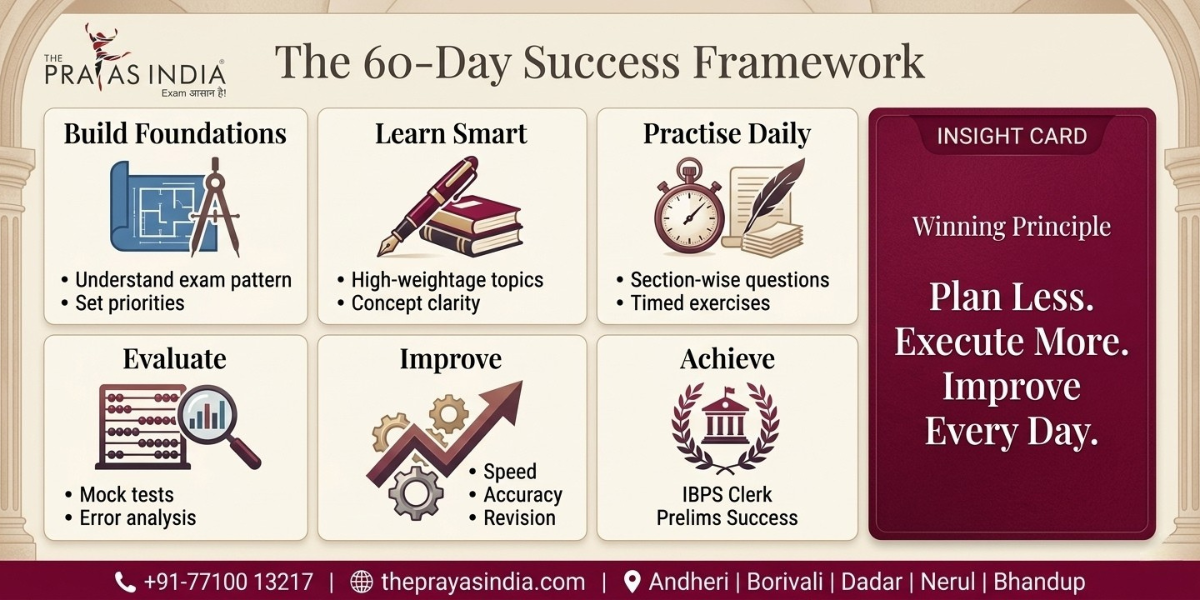
The 60-Day Blueprint
Don’t Try to Study Everything. Learn What Moves Your Score.
After understanding why strategy matters, the next question is obvious.
“What exactly should I do over the next 60 days?”
Many students expect a magical timetable.
Wake up at 5 AM.
Study 10 hours.
Complete one subject every week.
Attempt endless mock tests.
The truth is much simpler.
IBPS Clerk isn’t won by following someone else’s routine.
It is won by following a system.
A system that balances learning, practice, revision, and performance analysis.
The next sixty days should not feel like a marathon.
They should feel like a series of well-planned sprints.
The First 20 Days: Build the Foundation
Many aspirants make the mistake of attempting difficult questions from Day One.
They assume solving advanced questions means faster improvement.
Instead, it creates frustration.
The first phase should focus on becoming comfortable with the exam pattern.
Every topic should feel familiar before it becomes difficult.
Your goal during these twenty days is simple:
Understand → Practise → Repeat
Do not chase perfection.
Build confidence.
Primary Focus Areas
English Language
Strengthen the areas that appear consistently.
Focus on:
- Reading Comprehension
- Cloze Test
- Error Detection
- Sentence Improvement
- Fill in the Blanks
- Para Jumbles
- Vocabulary through daily reading
Instead of memorising hundreds of words, improve your understanding of how English is used in context.
Reasoning Ability
Reasoning rewards clarity more than speed.
Start with individual concepts before moving towards mixed practice.
Cover:
- Inequality
- Coding-Decoding
- Syllogism
- Blood Relations
- Direction Sense
- Order & Ranking
- Alphabet Test
- Seating Arrangement
- Puzzle
Don’t rush into difficult puzzles.
Master simple patterns first.
Quantitative Aptitude
Most students fear Quant because they try to solve everything.
Instead, focus on becoming accurate.
Prioritise:
- Simplification
- Approximation
- Number Series
- Quadratic Equations
- Arithmetic Basics
- Data Interpretation
Strong fundamentals reduce mistakes later.
Learn Like a Banker Thinks
IBPS Clerk is not designed to reward unnecessary complexity.
The examination values:
- Quick observation.
- Logical decision-making.
- Accuracy.
- Time awareness.
Whenever you solve a question, ask yourself:
“Could I solve this in less time?”
That mindset naturally improves speed.
The Middle 20 Days: Convert Knowledge into Performance
By this stage, most concepts should already be familiar.
Now the focus shifts.
Instead of asking,
“Can I solve this question?”
Ask,
“Can I solve it within the exam time?”
This phase introduces timed practice.
Not to create pressure.
But to create rhythm.
Daily Study Structure
A balanced study day may look like this:
Morning
- English practice
- Vocabulary revision
Afternoon
- Quantitative Aptitude concepts
- Timed calculations
Evening
- Reasoning practice
- Puzzle solving
Night
- Revision
- Error notebook
- Previous day’s mistakes
Consistency matters more than studying continuously.
Your Error Notebook Is More Valuable Than a New Book
Many students proudly maintain notebooks full of formulas.
Very few maintain notebooks full of mistakes.
That is unfortunate.
Your mistakes reveal far more than your notes.
Create a notebook divided into three sections.
Concept Errors
Questions you couldn’t understand.
Careless Mistakes
Questions you knew but answered incorrectly.
Time Management Errors
Questions that consumed unnecessary minutes.
Review this notebook every week.
It will become one of your strongest revision tools.
The Secret Behind Toppers’ Preparation
People often ask toppers,
“Which books did you study?”
A better question would be,
“How many times did you revise the same material?”
Top performers rarely study everything.
They revisit important concepts repeatedly.
They become faster because familiar questions require less thinking.
Revision is not repetition.
Revision is reinforcement.
Quick Practice Formula
Every study session should include:
✓ Learn one concept.
✓ Solve basic questions.
✓ Attempt timed practice.
✓ Review mistakes.
✓ Revise yesterday’s learning.
Five simple steps.
Repeated consistently.
The Final 20 Days: Think Like It’s the Real Exam
The last phase is not for learning new chapters.
It is for sharpening existing skills.
Every activity should resemble the examination.
Attempt:
- Full-length mock tests.
- Sectional timing practice.
- Previous-year question patterns.
- Speed improvement drills.
- Revision sessions.
Treat every mock as a dress rehearsal.
Question Selection Is a Skill
One mistake can waste five valuable minutes.
Many aspirants continue struggling with one difficult question simply because they have already invested time.
Successful candidates think differently.
They know when to move ahead.
Remember:
Not attempting one difficult question is often smarter than wasting time that could solve three easier ones.
Smart selection increases overall score.
Balance Is Better Than Burnout
As the examination approaches, many students suddenly double their study hours.
The result?
Mental fatigue.
Reduced concentration.
Poor sleep.
Lower mock scores.
Preparation should become calmer—not more chaotic.
A rested mind performs better than an exhausted one.
The Weekly Success Formula
Every Sunday, evaluate yourself.
Learning
Which topic became stronger?
Practice
How many quality questions did I solve?
Performance
Did my mock score improve?
Accuracy
Which mistakes disappeared?
Revision
Did I revise enough this week?
Planning
What deserves attention next week?
These six questions keep preparation focused.
Preparation Needs Direction, Not Guesswork
One of the biggest challenges during a 60-day preparation journey is deciding what to study next.
Students often lose valuable time switching between resources or changing strategies midway.
At The Prayas India, IBPS Clerk aspirants follow a structured preparation process supported by experienced faculty, comprehensive study material, regular mock tests, personalised doubt-solving sessions, and continuous mentorship. Instead of preparing randomly, students receive guidance that helps them prioritise topics, improve performance systematically, and stay focused throughout the preparation journey.
The goal is not simply to study more.
The goal is to ensure every study session contributes to a higher score.
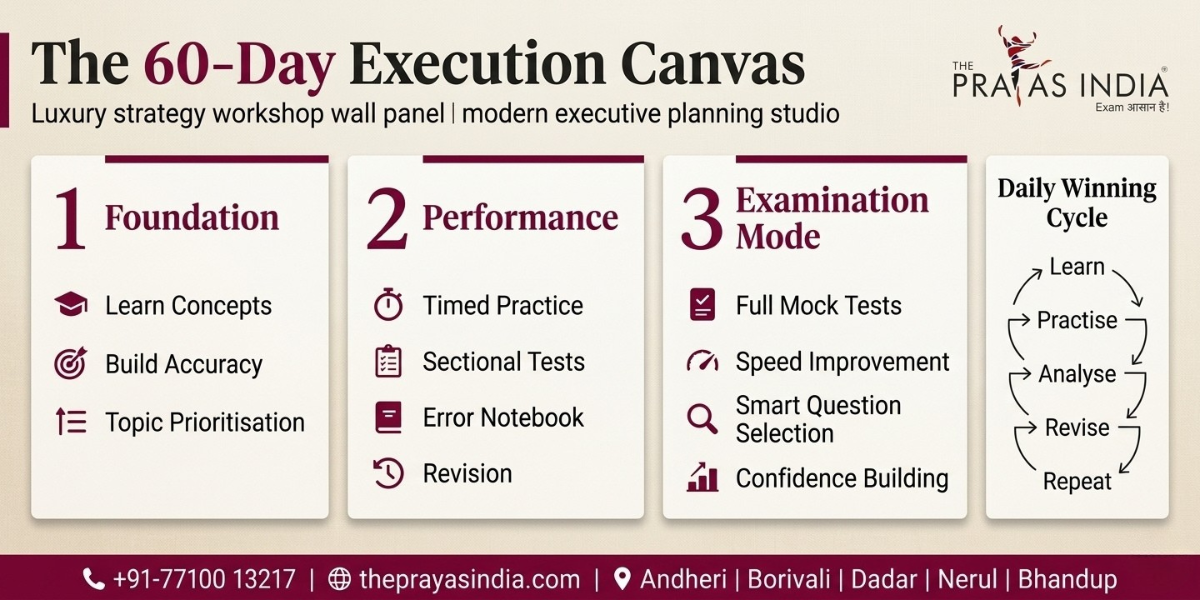
The Difference Between Attempting the Exam and Cracking It
In the Final Weeks, Performance Matters More Than Preparation.
By the time most IBPS Clerk aspirants enter the last month before the examination, an interesting shift takes place.
The syllabus is almost complete.
Practice questions have been solved.
Sectional tests have been attempted.
Yet the mock test scores remain inconsistent.
One day you score comfortably above the expected cut-off.
The next day your score drops by ten or fifteen marks.
Students usually respond by studying harder.
Successful candidates respond by studying smarter.
Because at this stage, the examination is no longer testing only your knowledge.
It is testing your ability to perform under pressure.
That is why the final phase of preparation should focus less on learning new chapters and more on improving speed, accuracy, decision-making, and confidence.
The Three Numbers That Matter
Many aspirants judge themselves using only one number.
Their total score.
Unfortunately, that number doesn’t tell the complete story.
Instead, monitor these three performance indicators every week.
1. Accuracy
How many questions did you answer correctly?
2. Speed
How quickly did you solve easy and moderate questions?
3. Selection
Did you waste time on difficult questions that should have been skipped?
When these three indicators improve together, overall marks increase automatically.
Speed Is Built Before the Exam Day
One common misunderstanding is that speed develops naturally.
It doesn’t.
Speed develops through familiarity.
The more often you solve similar question patterns, the faster your brain begins recognising them.
Think about driving a car.
Initially, every action requires conscious effort.
After months of practice, many decisions become automatic.
Competitive examinations work the same way.
Repeated exposure reduces thinking time.
That saved time becomes additional marks.
Simple Ways to Improve Speed
Instead of studying longer, improve your efficiency.
Daily habits like these make a noticeable difference.
✓ Solve twenty calculations without using a calculator.
✓ Read one English editorial every day.
✓ Practise one timed reasoning set.
✓ Revise formulas before sleeping.
✓ Attempt one mini sectional test under strict timing.
These habits appear small.
Over sixty days, they create remarkable improvement.
Accuracy Is a Bigger Advantage Than Guesswork
Many students become obsessed with attempting more questions.
However, attempting more questions only helps when accuracy remains high.
Negative marking can quietly reduce an otherwise good performance.
Imagine two candidates.
Candidate A attempts 90 questions with several guesses.
Candidate B attempts 78 carefully selected questions with excellent accuracy.
Very often, Candidate B secures the higher score.
The lesson is simple.
Attempt intelligently.
Not aggressively.
The Art of Leaving Questions
One of the hardest skills in banking examinations is knowing when not to solve a question.
Many aspirants continue struggling simply because they’ve already invested two or three minutes.
This is called the “sunk cost trap.”
Successful candidates don’t think emotionally.
They think strategically.
If a question isn’t worth your time, move ahead.
Remember:
Every difficult question skipped creates time for easier questions later.
Smart Decision Checklist
Before spending extra time on any question, ask yourself:
- Is this question genuinely difficult?
- Am I close to solving it?
- Will another minute make a difference?
- Are easier questions waiting?
Sometimes the smartest answer is moving forward.
Mock Tests Should Create Improvement, Not Anxiety
Students often react emotionally after every mock.
A high score creates excitement.
A poor score creates panic.
Neither reaction improves performance.
Treat every mock test like a laboratory experiment.
The purpose isn’t to prove your ability.
The purpose is to discover opportunities for improvement.
After every mock, divide your mistakes into four categories.
Concept Mistakes
You didn’t know the method.
Careless Errors
You knew the answer but made a simple mistake.
Time Management Problems
You solved correctly but too slowly.
Poor Decisions
You attempted questions that should have been skipped.
When mistakes are classified properly, improvement becomes systematic.
Your Weekly Performance Review
Every weekend, spend thirty minutes analysing your preparation.
Not studying.
Analysing.
Ask yourself:
English
Has my reading speed improved?
Reasoning
Am I solving puzzles faster?
Quantitative Aptitude
Which calculations still consume unnecessary time?
Overall
Is my confidence improving?
Revision
Which chapter deserves another review?
These questions gradually eliminate preparation gaps.
Exam Temperament Wins Close Competitions
Every IBPS Clerk examination has students with similar knowledge levels.
What separates them is temperament.
Some panic after one difficult section.
Others remain calm.
Some keep thinking about one mistake throughout the examination.
Others immediately focus on the next question.
Develop this habit during mock tests.
Never carry one mistake into the next question.
Each new question deserves a fresh mind.
The Final Week Strategy
The last seven days should create confidence—not confusion.
Avoid:
- Starting entirely new books.
- Watching random “last-minute tricks.”
- Comparing preparation with others.
- Solving extremely difficult questions.
Instead, focus on:
- Formula revision.
- Short notes.
- Error notebook.
- Previous mock analysis.
- Moderate-level practice.
- Proper sleep.
Your goal is to enter the examination hall mentally fresh.
Do’s & Don’ts
Do
✓ Revise daily.
✓ Analyse every mock.
✓ Improve accuracy.
✓ Maintain a healthy routine.
✓ Trust your preparation.
Don’t
✘ Keep changing study resources.
✘ Ignore previous mistakes.
✘ Study continuously without breaks.
✘ Attempt every question.
✘ Compare your journey with others.
The Last Twenty Marks Are Earned Differently
Improving from 45 to 55 marks usually requires more learning.
Improving from 75 to 85 marks often requires better judgement.
That is why the best-performing candidates don’t simply study harder.
They improve their examination behaviour.
They know:
- Which questions deserve attention.
- Which topics produce maximum returns.
- Which habits improve consistency.
- Which mistakes repeat every week.
Those small improvements eventually become selection.
Performance Grows Faster With Structured Feedback
Many aspirants continue solving hundreds of questions without understanding why their scores remain unchanged.
The missing link is often structured feedback.
At The Prayas India, students regularly review their mock test performance with experienced faculty, receive personalised guidance to improve weak areas, practise using structured study material, clarify doubts through dedicated sessions, and refine their preparation strategy with continuous mentorship. Instead of measuring success only through scores, the emphasis remains on improving every aspect of examination performance—from accuracy and speed to confidence and decision-making.
When preparation is reviewed systematically, progress becomes predictable rather than accidental.
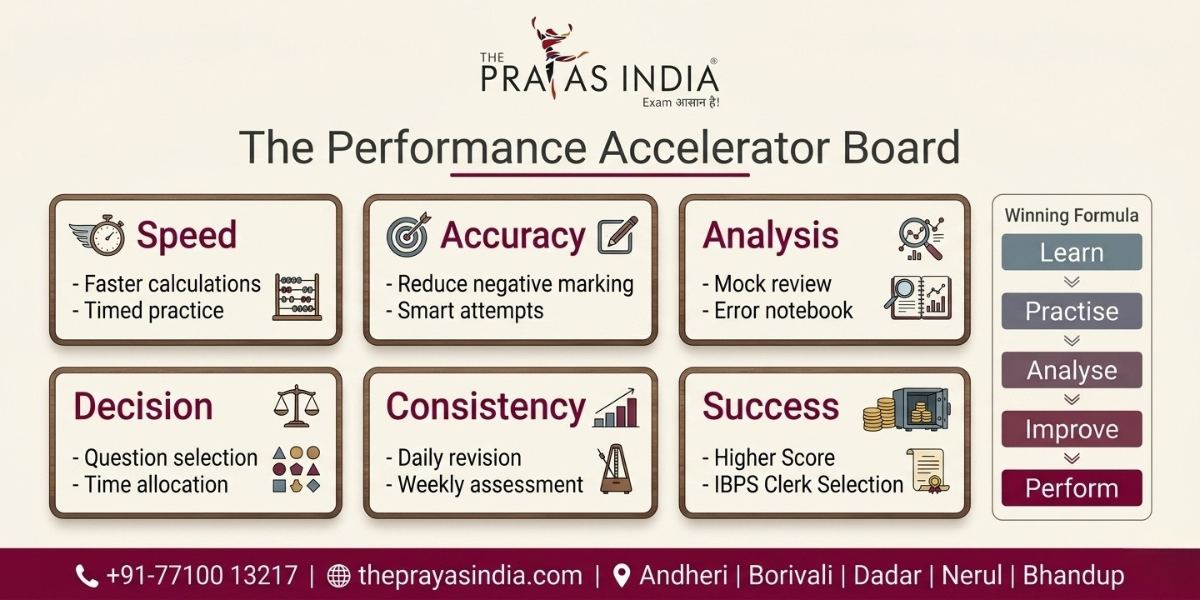
The Final Stretch
The Next 60 Days Can Change More Than Your Exam Result.
Every competitive examination reaches a stage where preparation is no longer about learning something new.
It becomes about trusting what you already know.
IBPS Clerk is no different.
By the time the examination approaches, most aspirants have already covered the syllabus, attempted multiple mock tests, and revised important topics.
Yet, this is also the phase where many students unknowingly reduce their chances of success.
Some start following random YouTube strategies.
Some buy new books.
Others compare every mock score with friends.
The result?
Confusion replaces confidence.
The final phase of preparation should feel calmer—not more stressful.
Selection is often decided by the quality of your last few weeks, not by the quantity of your last few study hours.
The Final 15-Day Approach
The last fifteen days should focus on refinement instead of expansion.
Think like an athlete before a championship.
No athlete changes technique a week before the event.
They strengthen what already works.
Your preparation should follow the same principle.
Focus on:
- Daily revision.
- Full-length mock tests.
- Previous mistakes.
- Formula revision.
- Reading practice.
- Accuracy improvement.
Avoid unnecessary experimentation.
Your Last 15-Day Priority List
Continue
✓ Daily revision.
✓ One quality mock every alternate day.
✓ Error notebook review.
✓ Vocabulary practice.
✓ Short calculation drills.
Avoid
✘ New books.
✘ Random preparation advice.
✘ Difficult questions just for confidence.
✘ Comparing scores every day.
✘ Studying continuously without breaks.
Consistency wins.
Frequently Asked Questions
Is 60 days really enough for IBPS Clerk?
Yes.
Provided those sixty days are planned properly.
Most successful candidates improve because they follow a structured strategy instead of studying randomly.
Should I attempt every mock test available online?
No.
Attempt fewer quality mock tests.
Spend more time analysing them.
Learning comes from analysis, not simply attempting another paper.
How many hours should I study daily?
There is no universal answer.
A focused five-hour study plan is often more productive than an unfocused ten-hour routine.
Measure productivity—not hours.
Can I crack IBPS Clerk on my first attempt?
Absolutely.
Thousands of candidates clear the examination every year on their first attempt through disciplined preparation, regular practice, and consistent revision.
When should I stop learning new topics?
Ideally, during the final two weeks.
That period should strengthen existing knowledge rather than introduce unnecessary pressure.
Common Myths That Slow Aspirants Down
Many misconceptions continue to circulate every recruitment cycle.
Let’s separate myths from reality.
| Myth | Reality |
|---|---|
| More books guarantee better preparation. | Better revision matters more than more resources. |
| Long study hours automatically improve scores. | Focused study is far more effective. |
| Every question should be attempted. | Smart selection increases overall marks. |
| One poor mock means poor preparation. | Mock tests are learning tools, not final results. |
| Coaching alone guarantees selection. | Guidance works only when combined with disciplined effort. |
The IBPS Clerk Success Checklist
Before the examination, ask yourself these questions honestly.
Concept Preparation
✓ English fundamentals revised.
✓ Reasoning concepts clear.
✓ Quantitative Aptitude formulas revised.
✓ Frequently asked question types practised.
Performance Preparation
✓ Multiple mock tests completed.
✓ Mock analysis notebook maintained.
✓ Accuracy consistently improving.
✓ Time management strategy finalised.
Mental Preparation
✓ Healthy sleep schedule.
✓ Examination routine practised.
✓ Confidence built through revision.
✓ Stress under control.
Revision Preparation
✓ Short notes updated.
✓ Error notebook reviewed.
✓ Important formulas revised.
✓ Previous mistakes corrected.
If you can confidently tick most of these points, your preparation is on the right path.
The Difference Guidance Makes
Most aspirants work hard.
Very few know whether they are working on the right things.
That’s where expert guidance creates a real difference.
Good mentors don’t simply explain questions.
They identify preparation gaps.
They help students prioritise.
They suggest better strategies.
They ensure that valuable study time isn’t wasted.
Most importantly, they help students remain consistent throughout the preparation journey.
Consistency is often the deciding factor between qualification and disappointment.
Why Students Choose The Prayas India
Every successful preparation journey begins with clarity.
At The Prayas India, students prepare through a structured learning approach designed specifically for competitive banking examinations. Experienced faculty simplify complex concepts, comprehensive study material ensures focused learning, regular mock tests help measure progress, personalised doubt-solving sessions strengthen conceptual understanding, and continuous mentorship enables aspirants to improve their preparation strategy throughout the journey.
Instead of following a one-size-fits-all method, every student is encouraged to prepare with discipline, analyse performance regularly, and build confidence step by step.
The focus is not merely on completing the syllabus.
It is on helping students maximise their potential before the examination.
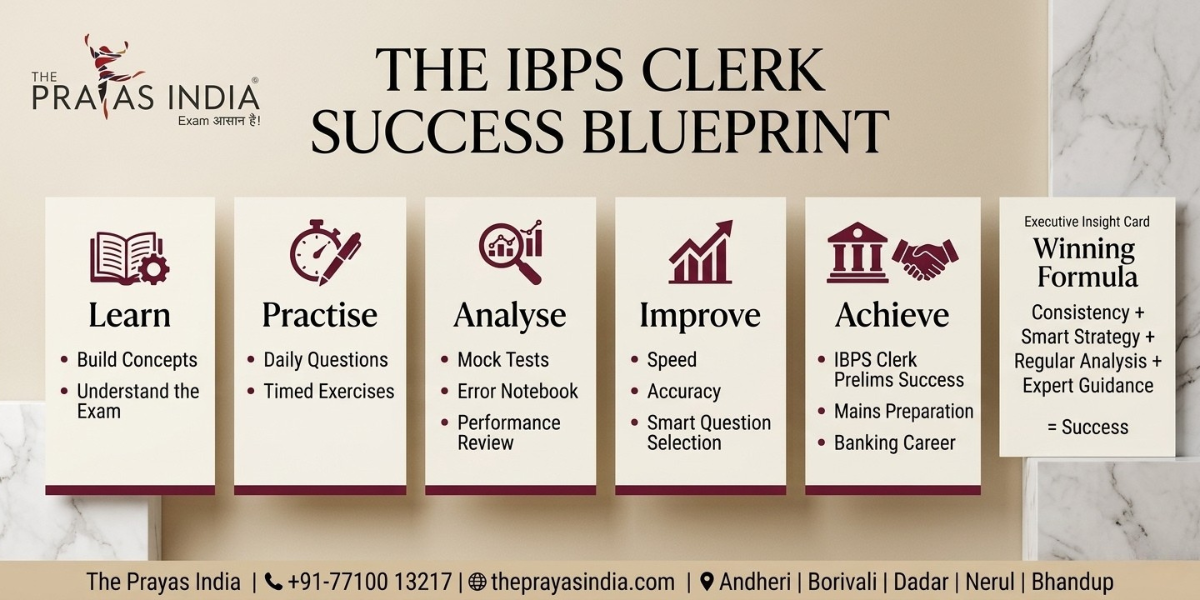
Final Thoughts
IBPS Clerk 2026 is more than another competitive examination.
For thousands of aspirants, it is the first step toward a stable and rewarding career in the banking sector.
The next sixty days will pass quickly.
The real question is not whether you have enough time.
It is whether every day is moving you closer to selection.
Study with a plan.
Practise with discipline.
Review your mistakes honestly.
Trust the process.
And whenever you feel stuck, seek the right guidance instead of changing your goal.
A well-planned sixty-day journey can become the beginning of a long and successful banking career.
Ready to begin your IBPS Clerk journey with expert guidance?
📞 Call: +91-77100 13217
🌐 Website: https://theprayasindia.com
📍 Centres: Andheri | Borivali | Dadar | Thane | Nerul | Bhandup