How to Crack RRB NTPC in the First Attempt | Best RRB Exam Coaching in Mumbai | The Prayas India
Introduction
Every year, the Railway Recruitment Board (RRB) attracts millions of aspirants through the Non-Technical Popular Categories (NTPC) examination. It is one of India’s most sought-after government recruitment exams because it offers stable employment, attractive salary packages, career progression, and the opportunity to work in one of the world’s largest railway networks.
However, while lakhs of candidates submit their applications, only a small percentage manage to secure a final selection. Interestingly, many of these successful candidates are first-time aspirants.
This naturally raises an important question:
How do some students crack RRB NTPC in their very first attempt while others continue preparing for years?
The answer is rarely about intelligence or extraordinary academic ability. More often, success depends on following the right preparation strategy from the very beginning.
Many aspirants spend months studying without a clear direction. They collect multiple books, watch countless online lectures, and attempt random mock tests. Although they remain busy throughout the preparation period, their efforts are often scattered.
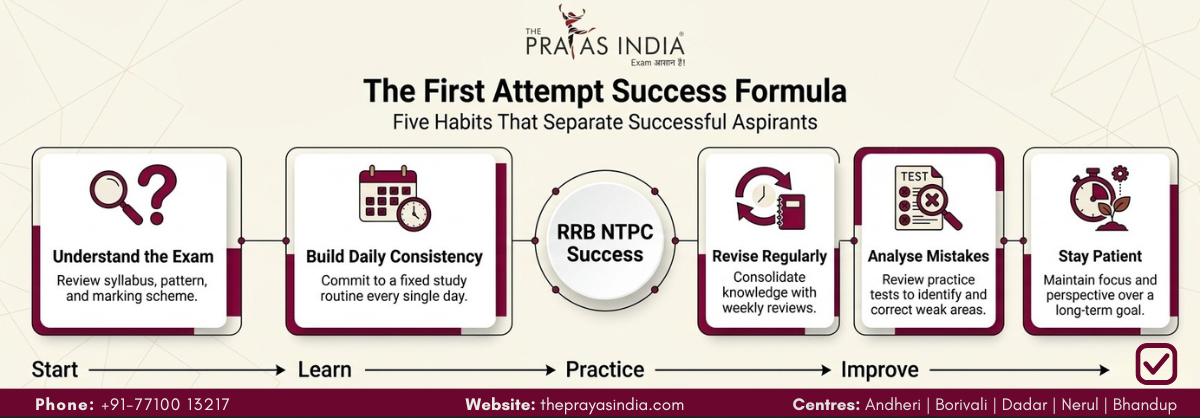
On the other hand, successful candidates usually focus on three simple principles:
- Understanding the examination before beginning preparation.
- Following a realistic study plan.
- Continuously evaluating their own progress.
This article explains how first-time aspirants can prepare more efficiently and avoid the mistakes that prevent thousands of candidates from reaching the final merit list.
The Biggest Myth About RRB NTPC Preparation
A common misconception among beginners is that success requires studying for twelve to fourteen hours every day.
In reality, long study hours without proper planning rarely produce good results.
A student who studies with complete concentration for six focused hours every day often performs better than someone who spends twelve hours switching between books without a proper strategy.
The RRB NTPC examination rewards consistency far more than occasional bursts of hard work.
Preparing a little every day, revising regularly, and analysing mistakes creates stronger long-term results than studying excessively for a few weeks before the examination.
Why First-Time Aspirants Have an Advantage
Many students assume experienced candidates always perform better.
Surprisingly, first-time aspirants often possess several advantages.
They usually begin preparation with fresh motivation.
They have fewer preconceived notions about the examination.
They are more willing to follow a structured plan.
Most importantly, they avoid repeating preparation methods that have already failed.
If guided correctly from the beginning, first-time aspirants can build efficient study habits that continue throughout the preparation journey.
Mistakes That Reduce Selection Chances
Instead of asking, “What should I study?”, aspirants should first understand “What should I avoid?”
Many unsuccessful candidates make similar mistakes.
Beginning Without Understanding the Exam
Some students immediately start solving questions without spending time understanding:
- Exam stages
- Syllabus
- Weightage of topics
- Question pattern
- Difficulty level
Preparation becomes much more effective when students first understand what the examination actually demands.
Studying Too Many Sources
Another common mistake is collecting every available book and online resource.
This creates confusion rather than clarity.
It is usually more productive to master a limited number of reliable resources than to constantly switch between different materials.
Ignoring Revision
Students often enjoy learning new topics but postpone revision.
Unfortunately, information that is never revised is quickly forgotten.
Revision should become a regular part of preparation rather than an activity reserved for the last few weeks before the examination.
Practising Without Analysis
Many aspirants attempt hundreds of questions every day but never analyse their mistakes.
Practice only becomes meaningful when students understand:
- Why an answer was incorrect.
- Whether the mistake resulted from lack of knowledge.
- Whether it was caused by poor time management.
- Whether it happened because of carelessness.
Learning from mistakes gradually improves overall performance.
Think Like a Recruiter, Not Just a Candidate
One habit shared by successful aspirants is that they prepare according to the examination’s objective rather than their personal preferences.
Instead of asking,
“Which subject do I enjoy?”
they ask,
“Which skills is the Railway Recruitment Board trying to evaluate?”
RRB NTPC primarily assesses:
- Logical thinking
- Numerical ability
- Decision-making
- Reading comprehension
- General awareness
- Accuracy under time pressure
When preparation aligns with these objectives, students naturally become more examination-ready.
Preparation Is More About Habits Than Motivation
Motivation helps students begin.
Habits help them finish.
Instead of relying on temporary enthusiasm, successful aspirants build simple daily routines.
Examples include:
- Studying at fixed hours.
- Revising previous topics before learning new ones.
- Solving a limited number of quality questions every day.
- Reading current affairs consistently.
- Reviewing mistakes after each practice session.
These habits gradually create confidence that lasts until the examination.
Stop Comparing Yourself with Others
Many students become discouraged after watching topper interviews or comparing mock test scores.
Preparation is not a race against other aspirants.
It is a process of becoming better than yesterday.
Even small daily improvements in speed, accuracy, and conceptual understanding eventually produce significant progress.
Students who remain consistent usually outperform those who constantly compare themselves with others.
The Importance of Preparing with a Roadmap
Imagine beginning a long journey without knowing the destination or route.
Preparation without planning feels exactly the same.
A roadmap provides clarity.
It answers questions such as:
- What should be completed this week?
- Which topics require additional practice?
- When should revision begin?
- How often should mock tests be attempted?
- Which areas need the most attention?
Students who prepare according to a structured roadmap generally feel less overwhelmed because every stage of preparation has a clear objective.
Quality Always Outperforms Quantity
Aspirants often measure preparation by the number of hours studied or pages completed.
However, selection depends on how effectively those hours are utilised.
For example:
Completing one topic thoroughly with revision and practice is far more valuable than superficially covering five chapters.
The objective should always be meaningful learning rather than simply finishing the syllabus.
A Different Way to Measure Progress
Instead of asking:
“How many hours did I study today?”
Ask yourself:
- Did I understand something new?
- Did I improve my speed?
- Did I reduce careless mistakes?
- Did I revise yesterday’s topics?
- Am I more confident than last week?
These questions provide a much better picture of real progress.
Build a Preparation System That Works Every Day
Most aspirants fail not because they lack potential, but because they don’t have a preparation system. They study whenever they feel motivated, switch between multiple resources, and constantly worry about how much is left to complete.
Students who crack RRB NTPC in their first attempt usually follow a completely different approach. Instead of chasing motivation, they rely on a routine that keeps them moving forward every single day.
This part focuses on creating a preparation system that is practical, sustainable, and effective.
Begin with the Syllabus, Not the Books
A common mistake among beginners is purchasing several books before understanding the syllabus.
Instead, start by printing or downloading the latest RRB NTPC syllabus and carefully reading every section.
Once you know what the examination expects, selecting the right resources becomes much easier.
The syllabus should remain your roadmap throughout the preparation journey.
Whenever you finish a topic, mark it. This simple habit gives clarity and prevents unnecessary repetition.
Divide the Syllabus into Small Targets
Looking at the complete syllabus can feel overwhelming.
Instead of treating it as one large task, divide it into manageable weekly goals.
For example:
Week 1
- Number System
- Percentage
- Basic Current Affairs
- Vocabulary Revision
Week 2
- Ratio & Proportion
- Seating Arrangement
- Reading Comprehension
- Static GK
When preparation is divided into smaller milestones, progress becomes visible and motivation naturally increases.
Focus on Progress, Not Perfection
Many students delay moving to the next topic because they want complete mastery.
Perfection is unrealistic during the first reading.
Instead, aim for gradual improvement.
A topic studied three times with revision is usually remembered far better than one topic studied perfectly only once.
Your first objective is familiarity.
Mastery comes through repeated practice.
Create Fixed Study Blocks
Long study sessions often reduce concentration.
A better approach is to divide the day into focused study blocks.
For example:
Morning
Concept learning
Afternoon
Practice questions
Evening
Revision
Night
Current Affairs and short quizzes
Changing the type of activity keeps the mind engaged and prevents mental fatigue.
Give Every Subject Its Own Space
One reason students lose confidence is that they unknowingly neglect one subject while focusing only on their favourites.
A balanced timetable ensures that every section receives regular attention.
For example:
- Quantitative Aptitude – Concept building and calculations.
- Reasoning – Pattern recognition and logical thinking.
- General Awareness – Daily updates and revision.
- English – Reading, vocabulary, grammar, and comprehension.
Even thirty to forty-five minutes of consistent practice in each subject can produce excellent long-term results.
Learn to Revise Before You Forget
Many aspirants revise only after completing the syllabus.
By then, they realise they have forgotten a significant portion of what they studied earlier.
Instead, use a simple revision cycle.
- Revise within 24 hours.
- Revise again after one week.
- Revise once more after one month.
This pattern strengthens memory and reduces last-minute pressure.
Build Your Own Error Notebook
Every incorrect answer teaches something.
Rather than forgetting mistakes, record them.
Maintain a notebook where you write:
- The question.
- The correct approach.
- The reason for your mistake.
- A short lesson to remember.
Over time, this notebook becomes one of your most valuable revision resources because it contains your personal weak areas.
Practice According to the Clock
RRB NTPC is not only a knowledge-based examination—it is also a speed-based examination.
Many students know the correct answers but cannot complete the paper within the allotted time.
Gradually introduce time limits into your daily practice.
Instead of solving twenty questions casually, try solving them within a fixed duration.
Initially, focus on maintaining accuracy.
As confidence grows, work on reducing the time taken without compromising correctness.
Learn When to Skip a Question
One overlooked skill in competitive exams is knowing when not to attempt a question.
Spending too much time on a difficult problem often results in missing several easier ones.
Develop the habit of recognising questions that deserve immediate attention and those that should be revisited later.
Smart question selection often improves scores more than attempting every question.
Reduce Digital Distractions
A well-planned study schedule loses its effectiveness if interrupted every few minutes.
During study sessions:
- Keep your phone on silent.
- Disable unnecessary notifications.
- Avoid switching between multiple apps.
- Keep only the required study material in front of you.
Even small distractions reduce concentration and increase the time required to complete a topic.
Weekly Self-Evaluation Is Essential
At the end of every week, spend some time evaluating your preparation honestly.
Ask yourself:
- Which topics improved this week?
- Which chapters still need attention?
- Did I revise consistently?
- Did I spend enough time practising?
- What should I improve next week?
This habit keeps preparation dynamic instead of mechanical.
Avoid the “Resource Collection” Trap
Students often believe that more books mean better preparation.
In reality, constantly changing resources creates confusion.
Choose a limited set of reliable resources and complete them thoroughly before looking for additional material.
Depth of understanding is always more valuable than the number of books on your table.
Consistency Beats Intensity
Many aspirants study for ten hours one day and hardly study the next.
This pattern rarely produces good results.
A student who studies with discipline every day develops stronger concepts, better retention, and greater confidence over time.
Small daily improvements accumulate into significant progress over several months.
Learn to Adapt Your Strategy
Not every study plan works forever.
If a particular approach is not producing results, change the method—not the goal.
For example:
- If lengthy notes are difficult to revise, create concise summaries.
- If speed is low, introduce timed practice sessions.
- If accuracy is poor, reduce speed temporarily and focus on understanding.
Successful aspirants continuously refine their preparation based on their performance.
Guidance Helps You Stay on the Right Path
Preparing independently is possible, but many students spend months discovering mistakes that could have been corrected much earlier.
A structured learning environment provides clarity, regular feedback, and a disciplined preparation schedule. Instead of wondering whether you are moving in the right direction, you receive continuous direction and measurable progress.
At The Prayas India, the emphasis is on helping aspirants prepare in a systematic manner so that every stage of preparation contributes meaningfully towards the final goal of clearing the RRB NTPC examination.
What Successful Aspirants Do Differently in the Last Phase of Preparation
For many aspirants, the difference between selection and rejection is not the amount they study—it is how they prepare during the final phase before the examination.
Two students may complete the same syllabus, attempt the same number of questions, and spend similar hours studying. Yet one secures a place in the merit list while the other falls short by a few marks.
The difference usually lies in decision-making, revision quality, exam temperament, and consistency.
The final phase of preparation is about converting knowledge into performance.
Stop Learning Everything. Start Strengthening What You Already Know
One of the biggest mistakes students make in the last few weeks is trying to study new topics every day.
This creates unnecessary pressure and often weakens confidence.
Instead, the final phase should focus on:
- Revising familiar concepts.
- Improving weak areas.
- Solving quality questions.
- Maintaining speed and accuracy.
- Building confidence.
Remember, an examination rewards what you can recall under pressure—not everything you have ever read.
Make Revision Active, Not Passive
Many students believe revision means reading notes repeatedly.
Unfortunately, passive reading rarely improves retention.
Active revision is much more effective.
Instead of simply reading:
- Solve questions without looking at notes.
- Explain concepts aloud in your own words.
- Create one-page summaries.
- Recall formulas before checking them.
- Revise using your error notebook.
The more your brain works during revision, the better it remembers information in the examination hall.
Identify High-Return Topics
Every chapter deserves attention, but not every chapter contributes equally to your score.
As the examination approaches, identify topics where:
- You already have a good understanding.
- Small improvements can significantly increase marks.
- Regular practice improves speed.
Strengthening these areas creates a stronger scoring base while you continue improving weaker sections.
Learn to Recover Quickly After a Bad Mock Test
Almost every successful aspirant experiences disappointing mock test scores.
The mistake is allowing one poor performance to affect future preparation.
Instead of becoming discouraged, analyse the test objectively.
Ask yourself:
- Did I misunderstand concepts?
- Was time management the problem?
- Were mistakes careless?
- Did I panic?
- Which section reduced my overall score?
Every mock test should become a learning opportunity rather than a judgement of your ability.
Avoid Information Overload
As the examination date approaches, students often receive countless recommendations from YouTube, Telegram groups, and social media.
Many suddenly change books, begin new courses, or attempt unfamiliar question banks.
This usually creates confusion.
The final phase is the time to trust your preparation, not restart it.
Stay committed to your strategy unless there is a genuine need for adjustment.
Build Examination Temperament
Knowledge alone does not guarantee success.
Students also need emotional control inside the examination hall.
Successful candidates remain calm even when they encounter difficult questions.
They understand that every paper contains challenging sections.
Instead of worrying about one difficult question, they move forward and continue scoring wherever possible.
Remaining composed often improves overall performance.
Accuracy Is More Valuable Than Blind Speed
Many first-time aspirants become obsessed with solving questions quickly.
However, incorrect answers can reduce overall performance.
A better approach is:
- Read carefully.
- Solve confidently.
- Verify mentally.
- Move to the next question.
Once accuracy becomes consistent, speed naturally improves through repeated practice.
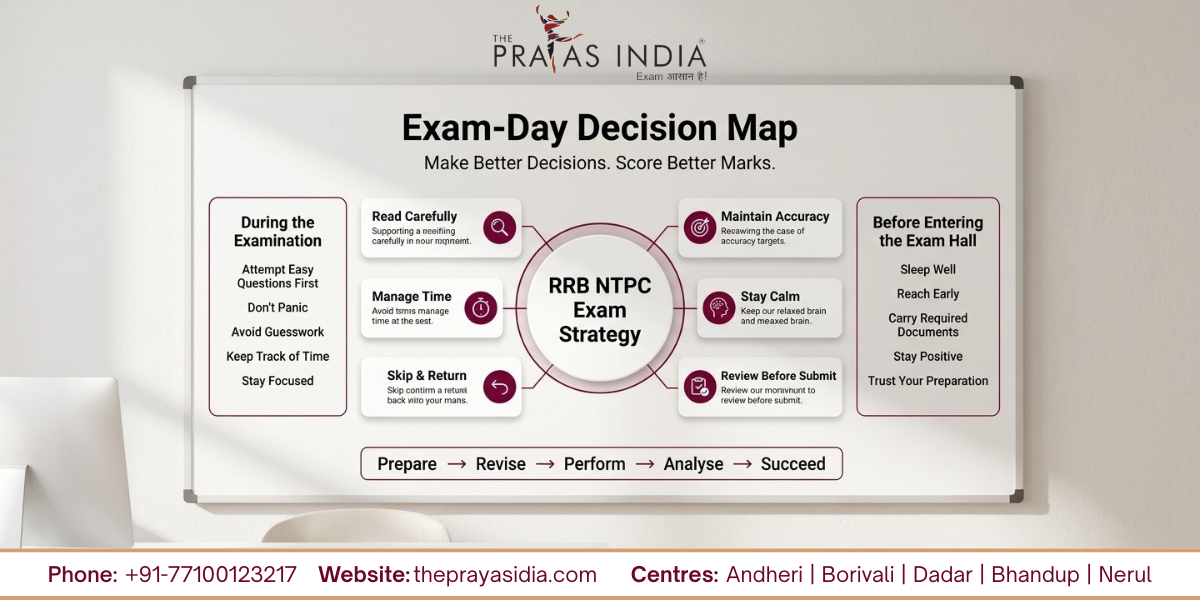
Create an Exam-Day Strategy Before the Exam
Many students prepare academically but never prepare mentally for the examination day.
A simple plan removes unnecessary uncertainty.
Decide beforehand:
- Which section will you attempt first?
- How much time will you spend on each section?
- When will you skip a difficult question?
- How will you utilise the final few minutes?
Having predetermined decisions reduces stress during the actual examination.
Sleep Is Part of Preparation
Late-night study sessions during the final week often reduce concentration.
Adequate sleep helps:
- Memory retention.
- Decision-making.
- Concentration.
- Reaction speed.
- Emotional balance.
A fresh mind performs better than an exhausted one.
Learn to Handle Pressure
Every competitive examination creates pressure.
The goal is not to eliminate pressure but to manage it.
Simple habits help:
- Follow your routine.
- Avoid comparing preparation with friends.
- Take short breaks.
- Maintain physical activity.
- Eat balanced meals.
- Stay away from unnecessary rumours about the examination.
Confidence grows when preparation remains disciplined.
Keep Measuring Improvement
Instead of asking whether you have completed the syllabus, ask whether you are becoming better every week.
Track:
- Average mock score.
- Accuracy percentage.
- Questions attempted correctly.
- Time taken per section.
- Number of careless mistakes.
Visible improvement increases motivation and keeps preparation objective.
The Final Month Is About Discipline
The last month should not feel chaotic.
It should become the most organised phase of preparation.
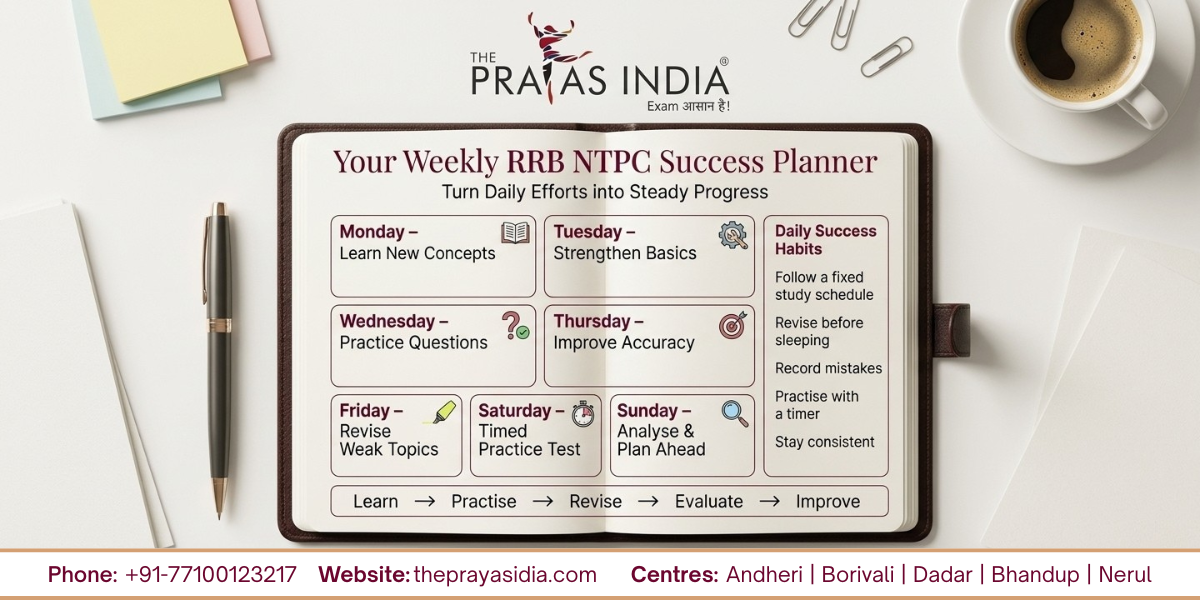
A simple weekly cycle works well:
Monday to Thursday
Concept revision and topic-wise practice.
Friday
Mixed practice sets.
Saturday
Full-length mock test.
Sunday
Performance analysis and planning for the next week.
Repeating this cycle consistently develops confidence before the examination.
Why Structured Guidance Makes a Difference
Preparing for RRB NTPC independently is certainly possible, but many aspirants lose valuable time because they are unsure whether their preparation is moving in the right direction.
A structured learning environment provides:
- A defined preparation sequence.
- Regular evaluation.
- Timely feedback.
- Consistent accountability.
- Clear academic direction.
Rather than studying randomly, students can concentrate on steady improvement and measurable progress.
At The Prayas India, preparation is designed around helping aspirants develop effective study habits, improve examination performance, and maintain consistency throughout the journey. The emphasis is on guiding students towards a preparation process that is organised, practical, and focused on achieving the best possible outcome.
Turn Your Preparation into Selection
Preparing for the RRB NTPC examination is a journey that demands patience, consistency, and smart planning. While there is no shortcut to success, there is certainly a better way to prepare.
Students who qualify in their first attempt are not necessarily the ones who study the longest. They are usually the ones who prepare with clarity, monitor their progress regularly, and remain disciplined throughout their journey.
By this stage of the article, one message should be clear—success in RRB NTPC is not built on isolated efforts. It is built on hundreds of small, consistent actions repeated every day.
A Practical Preparation Checklist
Before your examination, ask yourself the following questions.
Understanding the Examination
- Do I know the latest exam pattern?
- Have I completed the syllabus systematically?
- Do I understand the marking scheme?
- Have I identified my strongest and weakest sections?
Subject Preparation
Mathematics
- Arithmetic
- Algebra
- Geometry
- Number System
- Data Interpretation
- Simplification
Reasoning Ability
- Coding-Decoding
- Blood Relations
- Seating Arrangement
- Puzzle
- Syllogism
- Statement-Based Questions
General Awareness
- Current Affairs
- Static GK
- Indian Economy
- Geography
- History
- Polity
- Science
General Science
- Physics
- Chemistry
- Biology
General Intelligence
- Analytical Thinking
- Logical Reasoning
- Decision Making
Habits Every Serious Aspirant Should Develop
Instead of focusing only on books, develop habits that improve long-term performance.
Good preparation habits include:
- Maintaining a fixed study schedule.
- Revising every week.
- Tracking mistakes after practice sessions.
- Solving mixed-topic question sets.
- Reading newspapers or current affairs consistently.
- Taking short breaks to avoid burnout.
- Reviewing progress at the end of every week.
These habits create discipline, and discipline creates results.
Mistakes to Avoid in the Final Weeks
Many aspirants unknowingly reduce their chances of success by making avoidable mistakes during the last phase of preparation.
Avoid:
- Starting entirely new books.
- Comparing your preparation with others.
- Ignoring revision.
- Changing your strategy every few days.
- Studying without analysing your performance.
- Sacrificing sleep for extra study hours.
Your objective during the final weeks is to strengthen confidence, not create unnecessary pressure.
Frequently Asked Questions
1. Can I crack RRB NTPC in my first attempt?
Yes. With a structured preparation plan, regular revision, and disciplined practice, many aspirants successfully clear the examination in their first attempt.
2. How many hours should I study every day?
There is no fixed number. Productive and consistent study is far more effective than studying for long hours without concentration. A realistic daily routine followed consistently delivers better results.
3. Is solving previous year papers important?
Absolutely. Previous year papers help you understand question patterns, difficulty levels, and frequently asked topics while improving confidence before the examination.
4. How important is revision?
Revision is one of the most critical aspects of preparation. Without regular revision, even well-understood concepts can be forgotten over time.
5. How can I improve my speed?
Speed improves naturally through repeated practice, solving timed question sets, and analysing mistakes after every practice session.
6. Why do many aspirants fail despite studying hard?
In many cases, students lack a structured plan. They study extensively but without consistent revision, performance analysis, or a clear preparation strategy.
Why a Structured Learning Environment Helps
Preparing independently is a choice many students make, but it often comes with challenges such as uncertainty, inconsistent progress, and difficulty identifying weak areas.
A structured learning environment brings clarity to the preparation process.
Students benefit from:
- A planned study schedule instead of random preparation.
- Regular evaluation to measure improvement.
- Academic guidance when concepts become difficult.
- A disciplined learning routine that encourages consistency.
- Continuous feedback that helps refine preparation strategies.
These factors allow aspirants to spend more time improving and less time wondering whether they are preparing correctly.
Why Students Prefer The Prayas India for RRB NTPC Preparation
Every aspirant’s journey is unique, but successful preparation often requires the right balance of planning, consistency, and guidance.
At The Prayas India, the focus is on creating a preparation environment where students can progress steadily through every stage of the RRB NTPC syllabus.
Students appreciate the institute because it emphasises:
- A systematic approach to preparation.
- Well-planned classroom programmes.
- Regular assessment and progress tracking.
- Practical problem-solving sessions.
- Individual academic support whenever required.
- Preparation that remains aligned with the latest examination pattern.
Rather than encouraging students to simply complete the syllabus, the emphasis is on helping them develop the confidence and examination temperament required for competitive exams.
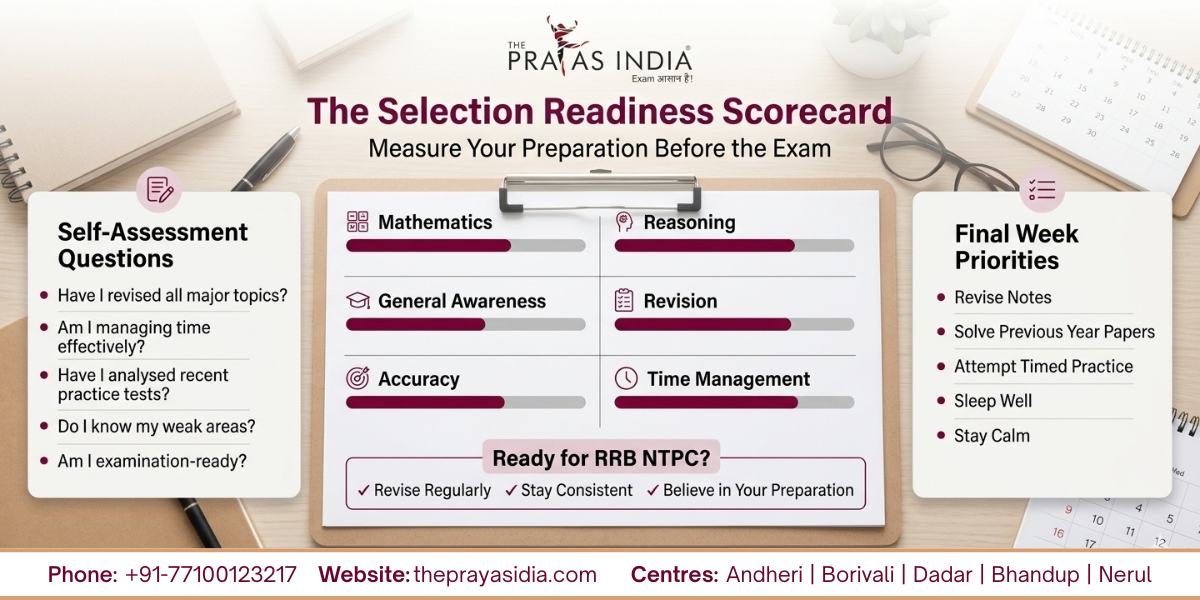
Take the Next Step Towards Your RRB Career
A government job in the Indian Railways is not achieved overnight. It is the result of careful planning, disciplined preparation, and continuous improvement.
If you are looking for the Best RRB Exam Coaching in Mumbai, choosing an institute that provides a structured preparation environment can help you prepare more efficiently and confidently.
At The Prayas India, aspirants receive organised academic guidance, systematic preparation support, and continuous performance evaluation designed to help them move steadily towards their goal.
Admissions are now open for RRB NTPC preparation. Start your journey with confidence and take the first step towards building a successful career in the Indian Railways.
Contact The Prayas India
📞 Call: +91-77100 13217
🌐 Website: theprayasindia.com
Our Centres:
Conclusion
Cracking the RRB NTPC examination in the first attempt is not about studying endlessly—it is about preparing intelligently. A clear strategy, consistent revision, disciplined practice, and regular self-evaluation can significantly improve your chances of success.
Instead of focusing only on completing the syllabus, focus on becoming a better problem solver every week. Small improvements made consistently over several months create remarkable results on examination day.
If your goal is to build a career with the Indian Railways, begin your preparation with the right mindset, follow a structured plan, and stay committed to your journey. With determination and the right guidance, your first attempt can become your successful attempt.