
How to Improve Accuracy and Speed in CAT Quantitative Aptitude: 15 Practical Strategies for MBA Aspirants
The Quantitative Aptitude section of the Common Admission Test (CAT) is not simply a test of mathematical knowledge. It evaluates how effectively a candidate understands a problem, identifies the right approach, performs calculations and reaches the correct answer within a limited time.
Many MBA aspirants understand mathematical concepts but struggle to maintain accuracy when solving questions under exam pressure. Others spend too much time on individual problems, leaving several manageable questions unanswered. These challenges make it important to develop both speed and accuracy through a structured preparation strategy.
If you are preparing for CAT, learning how to improve accuracy and speed in CAT Quantitative Aptitude should be one of your priorities. The objective is not to attempt every question as quickly as possible. Instead, you must recognise solvable questions, select efficient methods, avoid unnecessary calculations and minimise avoidable mistakes.
This guide explains practical techniques, topic-wise preparation methods, calculation shortcuts, mock-test strategies and a daily study routine to help you improve your CAT Quantitative Aptitude performance.
Whether you are preparing from Borivali West, Borivali East, Dahisar, Kandivali, Malad or another part of Mumbai, these strategies can help you build a more disciplined preparation routine.
Understand the CAT Quantitative Aptitude Section
Before working on speed and accuracy, understand the examination structure.
CAT is divided into three sections:
- Verbal Ability and Reading Comprehension (VARC)
- Data Interpretation and Logical Reasoning (DILR)
- Quantitative Aptitude (QA)
For CAT 2026, the reported examination structure includes 22 questions in Quantitative Aptitude, with 40 minutes allotted to the section. This gives an average of approximately 1 minute and 49 seconds per question if the time is divided equally. However, actual question-solving time should vary according to difficulty.
| Particular | CAT 2026 reported structure |
|---|---|
| Section | Quantitative Aptitude |
| Questions | 22 |
| Time | 40 minutes |
| Average time per question | Approximately 1 minute 49 seconds |
| Correct answer | +3 marks |
| Incorrect MCQ | -1 mark |
| Unattempted question | 0 marks |
The marking scheme rewards correct answers and penalises incorrect MCQ responses. Therefore, attempting questions without sufficient confidence can affect your score.
Important: CAT’s official examination information should be checked for the applicable year’s final instructions. Topic lists and chapter-wise weightage commonly used by coaching providers are preparation guides, not a fixed official syllabus.
Build Strong Fundamentals Before Chasing Speed
One of the most common mistakes CAT aspirants make is trying to learn shortcuts before understanding the underlying concepts.
A shortcut may help you solve a familiar question quickly, but it can become unreliable when the question is presented in a different format. Strong fundamentals allow you to identify the mathematical relationship behind unfamiliar problems.
Start by strengthening these major topic areas:
| Topic area | Important concepts to practise |
|---|---|
| Arithmetic | Percentages, ratios, averages, profit and loss, mixtures, time and work, time-speed-distance |
| Algebra | Linear equations, quadratic equations, inequalities, functions and progressions |
| Geometry | Triangles, circles, quadrilaterals, polygons and coordinate geometry |
| Number Systems | Divisibility, factors, remainders, HCF, LCM and integers |
| Modern Mathematics | Permutations and combinations, probability and set-based concepts |
How to improve conceptual understanding
- Learn the basic formula and understand why it works.
- Solve simple questions before moving to moderate and difficult problems.
- Practise different question formats from the same topic.
- Maintain a notebook of important concepts and formulae.
- Revisit concepts that repeatedly cause errors.
Suppose a product’s price increases by 20% and then decreases by 20%.
Assume the original price is ₹100.
- After a 20% increase: ₹120.
- After a 20% decrease: ₹120 × 0.80 = ₹96.
The final price is ₹96, not ₹100. This illustrates why conceptual clarity is more valuable than memorising a shortcut without understanding it.
Improve Calculation Speed Through Daily Mental Mathematics
Calculation speed is an important part of CAT Quantitative Aptitude preparation. However, faster calculations should not come at the cost of accuracy.
Many questions become easier when you can quickly work with fractions, percentages, squares, cubes and common numerical relationships.
Develop these calculation skills
1. Learn fraction-to-percentage conversions
| Fraction | Percentage |
|---|---|
| 1/2 | 50% |
| 1/3 | 33.33% |
| 1/4 | 25% |
| 1/5 | 20% |
| 1/6 | 16.67% |
| 1/8 | 12.5% |
| 1/10 | 10% |
| 1/12 | 8.33% |
2. Memorise squares and cubes
Practise squares at least up to 30 and cubes up to 15 initially. Extend the range as your preparation progresses.
3. Practise multiplication patterns
Learn to calculate common products mentally, especially numbers involving 5, 10, 25, 50, 100 and their multiples.
4. Estimate before calculating
Approximation can help eliminate clearly incorrect options. However, use it only when the question permits an approximate answer and the options are sufficiently separated.
5. Practise fraction comparison
For example, to compare 5/8 and 3/5, cross-multiply:
- 5 × 5 = 25
- 3 × 8 = 24
Therefore, 5/8 is greater than 3/5.
A practical 15-minute calculation routine
- 5 minutes: Fractions and percentage conversions.
- 5 minutes: Squares, cubes and multiplication.
- 5 minutes: Mental calculations and approximation.
Consistent short practice is often more sustainable than occasional long calculation sessions.
Learn to Identify the Right Question-Solving Approach
Speed is not only about performing calculations quickly. It also depends on choosing an efficient method.
The same CAT question may sometimes be solved using an equation, an option-based approach, substitution or a logical relationship.
Your goal should be to recognise which approach is appropriate.
Common approaches to practise
Option elimination: Use the answer choices to eliminate impossible values before performing lengthy calculations.
Substitution: Substitute convenient values when the question involves variables and the conditions allow it.
Approximation: Estimate values when exact calculations are unnecessary.
Ratio method: Use ratios to simplify comparisons involving quantities, percentages and proportions.
Equation formation: Convert word problems into mathematical relationships rather than solving them through lengthy trial and error.
Example: Choosing a faster approach
Suppose the average of five numbers is 20. Four numbers are 16, 18, 22 and 24. Find the fifth number.
Instead of trying different values:
- Total of five numbers = 5 × 20 = 100.
- Sum of four known numbers = 16 + 18 + 22 + 24 = 80.
- Fifth number = 100 − 80 = 20.
The key is to identify the relationship between average and total before starting the calculation.
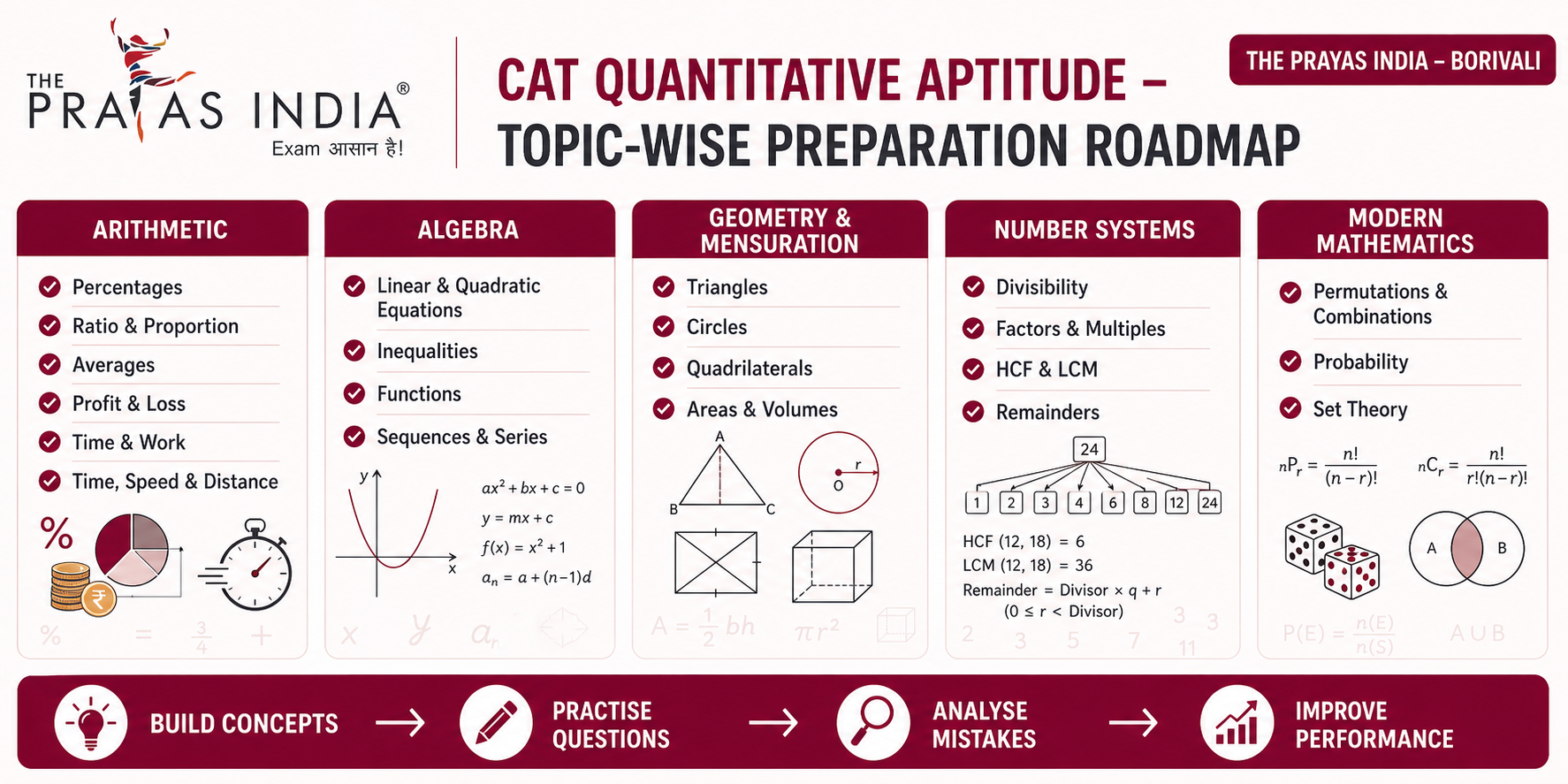
5. Follow a Topic-Wise Strategy for CAT Quantitative Aptitude
A structured topic-wise plan helps you improve accuracy without wasting time repeatedly solving questions from areas you already understand.
Arithmetic
Arithmetic is an important area of CAT preparation. Practise:
- Percentages
- Ratio and proportion
- Averages
- Profit and loss
- Simple and compound interest
- Time and work
- Time, speed and distance
- Mixtures and allegations
Preparation strategy: Understand the basic relationships first. Practise word problems in which multiple arithmetic concepts are combined.
For instance, a question involving profit and loss may also require percentage calculations and successive changes.
Algebra
Focus on:
- Linear equations
- Quadratic equations
- Inequalities
- Functions
- Sequences and series
- Algebraic expressions
Preparation strategy: Develop the ability to simplify expressions and recognise patterns. Practise translating statements into equations accurately.
Geometry and Mensuration
Focus on:
- Triangles
- Circles
- Quadrilaterals
- Polygons
- Angles
- Areas and volumes
- Coordinate geometry
Preparation strategy: Draw clear diagrams whenever necessary. Learn the properties of common geometric figures and understand how different theorems are applied.
Number Systems
Practise:
- Divisibility rules
- Prime numbers
- Factors and multiples
- Remainders
- HCF and LCM
- Integers and rational numbers
Preparation strategy: Focus on number properties and logical reasoning instead of relying only on lengthy calculations.
Modern Mathematics
Important concepts include:
- Permutations and combinations
- Probability
- Set theory
Preparation strategy: Understand the logic behind each formula. Practise identifying whether a question involves arrangement, selection, counting or probability.
Topic priorities should be based on your diagnostic tests and previous CAT papers. Do not assume that every topic will carry a fixed number of questions in the next examination.
Use the Two-Pass Question Selection Strategy
One of the most effective ways to improve your CAT Quantitative Aptitude performance is to stop treating every question as equally difficult or equally important.
During practice, train yourself to identify questions that you can solve confidently and those that require more time.
First pass: Identify manageable questions
Start with questions where:
- The concept is familiar.
- The calculation is manageable.
- The question is clearly understood.
- You can identify a logical solution path.
Second pass: Return to selected questions
After identifying and attempting manageable questions, use the remaining time for questions that require additional steps.
This strategy helps reduce the risk of spending several minutes on one difficult problem while leaving easier questions unanswered.
Remember: Question selection is a skill. It improves through timed practice and analysis, not through guesswork.
Develop a Question-Solving Time Management Strategy
In a 40-minute Quantitative Aptitude section, time management is essential.
The average time available per question is approximately 1 minute and 49 seconds for the reported 22-question CAT 2026 structure. But this does not mean every question must be completed within that exact time.
Some questions may take less than a minute, while others may require longer.
A practical approach during mock tests is:
| Question type | Suggested approach |
|---|---|
| Familiar and straightforward | Attempt early |
| Moderate calculation | Attempt if the method is clear |
| Lengthy but manageable | Revisit after easier questions |
| Unfamiliar or confusing | Consider skipping |
| Repeatedly stuck | Stop and move ahead |
These are practice guidelines, not official CAT time limits for individual questions.
Apply the 30-second decision rule during practice
When you first read a question, ask yourself:
- Do I understand what is being asked?
- Can I identify the relevant concept?
- Do I know how to begin?
- Is the calculation likely to be manageable?
If you cannot identify a reasonable approach, mark the question for review during practice and move forward.
Do not confuse persistence with efficient examination strategy.
Maintain an Error Notebook to Improve Accuracy
Solving hundreds of questions will not automatically improve your accuracy if you keep repeating the same mistakes.
An error notebook helps you identify the reasons behind incorrect answers.
After every practice session or mock test, record the following:
| Error category | Example | Improvement method |
|---|---|---|
| Conceptual error | Applying the wrong formula | Revise the underlying concept |
| Calculation error | Incorrect multiplication | Practise mental calculations |
| Reading error | Missing a condition | Underline important information |
| Formula error | Forgetting a relationship | Revise formula notes |
| Time-management error | Spending too long on one question | Practise question selection |
| Guesswork | Attempting without sufficient reasoning | Improve elimination and decision-making |
How to use your error notebook
- Record every important mistake.
- Write the correct solution in simple steps.
- Identify the exact point where your reasoning failed.
- Solve the same question again after a short interval.
- Revisit the error after a week.
The purpose is not to maintain a list of wrong answers. It is to prevent those mistakes from recurring.
Practise with Timed Sectional Tests
Untimed practice is useful when you are learning a new concept. However, it does not fully prepare you for the time pressure of CAT.
Once you understand a topic, begin solving questions within a fixed time limit.
A progressive practice method
Stage 1: Concept practice
Solve questions without worrying about speed. Focus on understanding the method.
Stage 2: Topic-wise timed practice
Set a time limit for a group of questions from one topic. Review both correct and incorrect answers.
Stage 3: Mixed-question practice
Combine arithmetic, algebra, geometry and other areas. This trains you to identify the topic without being told which concept to use.
Stage 4: Sectional tests
Attempt a complete Quantitative Aptitude section under a 40-minute time limit.
Stage 5: Full-length mock tests
Practise the entire CAT examination under realistic conditions, including sectional timing.
Do not judge improvement only by the number of questions attempted. Track accuracy, time spent, question selection and recurring mistakes.
Analyse Every Mock Test Properly
Mock tests are valuable because they reveal how you perform under time pressure. But the real improvement comes from analysing the results.
After each test, divide your questions into four categories:
- Correct and solved confidently.
- Correct but solved with excessive time.
- Incorrect despite knowing the concept.
- Not attempted or left incomplete.
This classification helps you understand whether your main problem is conceptual understanding, calculation speed, accuracy or time management.
Questions to ask after every mock test
- Which questions consumed more time than expected?
- Which mistakes were avoidable?
- Did I select the right questions to attempt?
- Did I make calculation errors?
- Which topic needs additional practice?
- Did I change correct answers unnecessarily?
- Did I spend too much time on one difficult question?
For example, suppose you attempted 15 questions and answered 10 correctly.
Your accuracy among attempted questions is:
Your accuracy among attempted questions is:

Now compare this with your next mock test. If you attempt 14 questions and answer 12 correctly, your accuracy becomes:

This indicates a meaningful improvement in answer quality, even though the number of attempts is lower.
The broader objective is to improve the combination of attempts, accuracy and time management.
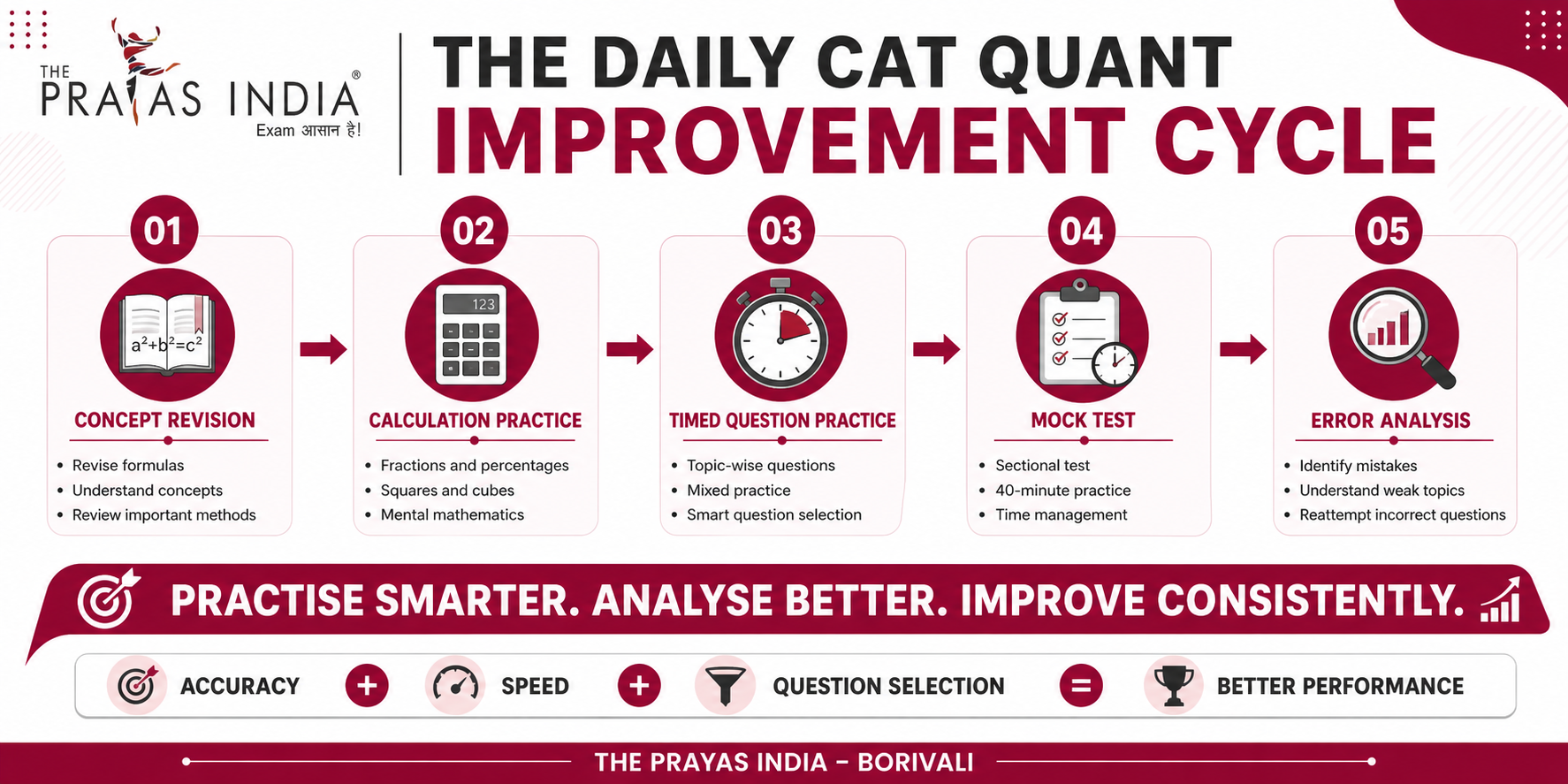
Follow a Daily Study Routine for Speed and Accuracy
A consistent routine can help you improve without making CAT Quantitative Aptitude preparation unnecessarily complicated.
The following timetable is an illustrative plan. Adjust it according to your current level, available study time and preparation stage.
| Activity | Suggested time |
|---|---|
| Formula and concept revision | 20 minutes |
| Mental calculation practice | 15 minutes |
| Topic-wise question solving | 40 minutes |
| Timed mixed-question practice | 25 minutes |
| Error analysis and revision | 20 minutes |
| Total | 120 minutes |
Weekly preparation plan
| Day | Primary focus |
|---|---|
| Monday | Arithmetic concepts and practice |
| Tuesday | Algebra and equations |
| Wednesday | Geometry and mensuration |
| Thursday | Number Systems |
| Friday | Modern Mathematics and mixed questions |
| Saturday | Timed Quantitative Aptitude sectional test |
| Sunday | Mock analysis and revision |
You can modify the schedule depending on your strengths and weaknesses. For example, if arithmetic is already strong but geometry is weak, allocate more practice time to geometry.
Common Mistakes That Reduce CAT Quantitative Aptitude Accuracy
Even well-prepared candidates sometimes lose marks because of avoidable mistakes.
Mistake 1: Solving without understanding the question
Candidates sometimes start calculating before identifying exactly what the question asks.
Solution: Read the question carefully and identify the required quantity before beginning the calculation.
Mistake 2: Memorising shortcuts without understanding them
A shortcut that works for one question may not apply to another.
Solution: Learn the concept first and use shortcuts only when you understand their limitations.
Mistake 3: Spending too much time on difficult questions
Getting stuck on one question can affect the rest of your section.
Solution: Practise recognising when to move on.
Mistake 4: Ignoring calculation practice
Knowing the formula is not enough if basic calculations take too long.
Solution: Include daily mental mathematics in your routine.
Mistake 5: Not analysing mock tests
Simply checking your score does not reveal why you lost marks.
Solution: Review every incorrect, unanswered and time-consuming question.
Mistake 6: Ignoring weak topics
Repeatedly practising comfortable topics creates an incomplete preparation strategy.
Solution: Identify weak areas through diagnostic tests and give them dedicated practice time.
Mistake 7: Making random guesses
An uncertain MCQ attempt can lead to negative marking.
Solution: Attempt questions based on a logical method, not pressure to increase the attempt count.
CAT Quantitative Aptitude Preparation for College Students
College students often have to balance lectures, assignments, examinations and CAT preparation.
Instead of waiting for long free periods, create a manageable daily routine.
- Practise mental calculations during short breaks.
- Complete one focused Quantitative Aptitude topic at a time.
- Use weekends for sectional tests and revision.
- Maintain a formula notebook.
- Review mistakes before starting new topics.
- Plan study sessions around college commitments.
Students who start early can gradually strengthen their fundamentals and develop timed-solving skills without relying entirely on last-minute preparation.
CAT Quantitative Aptitude Preparation for Working Professionals
Working professionals may have limited preparation time because of office schedules and personal responsibilities.
A practical routine is more useful than an unrealistic timetable.
Consider the following approach:
- Use 30–45 minutes before or after work for focused practice.
- Revise formulae during short breaks.
- Reserve selected weekdays for topic-wise practice.
- Attempt a sectional test on a suitable weekend.
- Analyse mistakes rather than immediately moving to another mock test.
- Keep one revision session every week.
Consistency matters more than following a timetable that cannot be maintained.
How to Balance Speed and Accuracy
Speed and accuracy should not be treated as separate goals. They need to develop together.
If you solve questions quickly but make frequent mistakes, your performance may suffer. Similarly, if you solve every question correctly but take too long, you may not use the available examination time effectively.
A useful improvement framework is:
| Preparation stage | Main objective |
|---|---|
| Beginner | Understand concepts correctly |
| Developing | Improve calculation efficiency |
| Intermediate | Solve questions under time limits |
| Advanced | Improve question selection |
| Mock-test stage | Balance attempts, accuracy and time |
Follow the 3-step improvement rule
Step 1: Accuracy first
Practise questions without rushing. Understand why each answer is correct.
Step 2: Speed second
Once your method is reliable, reduce the time gradually through timed practice.
Step 3: Efficiency third
Learn to identify questions that deserve your time and those that should be skipped or revisited later.
This approach helps you develop a more sustainable CAT preparation strategy.
How to Choose the Right CAT Preparation Guidance in Borivali
Self-study is an important part of CAT preparation, but some aspirants benefit from structured guidance, regular practice and a system for reviewing their performance.
When evaluating CAT coaching classes in Borivali, consider the following:
- Does the preparation plan cover the important Quantitative Aptitude concepts?
- Is there sufficient practice for arithmetic, algebra, geometry and other topics?
- Are students encouraged to analyse their mistakes?
- Is there a structured mock-test and revision approach?
- Can students clarify doubts and understand alternative solving methods?
- Does the schedule suit college students and working professionals?
Do not choose a coaching institute only because of advertisements or claims about results. Understand the teaching approach, course details, available support and current batch information before making a decision.
Explore CAT preparation guidance at The Prayas India – Borivali
Students looking for CAT preparation guidance in Borivali West and nearby areas can enquire with THE PRAYAS INDIA – BORIVALI to understand the available preparation options.
The centre is located at:
Orchid Plaza, 205, Swami Vivekanand Rd, behind Gokul Shopping Complex, Meghdoot, Mhatre Wadi, Borivali West, Mumbai, Maharashtra 400092.
Aspirants from Borivali East, IC Colony, Gorai, Eksar, Dahisar, Kandivali West, Kandivali East and Malad can consider contacting the centre for information.
For current CAT batch availability, course structure, timings and fees, contact the centre directly rather than assuming that a particular programme or batch is currently available.
Call: 077100 13217
Practical CAT Quantitative Aptitude Preparation Checklist
Use this checklist to track your progress throughout your preparation.
Conclusion
Improving accuracy and speed in CAT Quantitative Aptitude requires more than solving a large number of questions. It requires strong mathematical fundamentals, regular calculation practice, efficient problem-solving methods, smart question selection and detailed mock-test analysis.
Start by identifying your weak topics and improving conceptual clarity. Build calculation speed through short daily exercises, practise questions under timed conditions and maintain an error notebook to prevent repeated mistakes.
Most importantly, do not measure your preparation only by how many questions you attempt. Focus on how many you solve correctly and how efficiently you use your available time.
For aspirants exploring CAT preparation guidance in Borivali and nearby Mumbai localities, THE PRAYAS INDIA – BORIVALI can be contacted for information about current preparation options.
Call Now: 077100 13217
Frequently Asked Questions
1. How can I improve my accuracy in CAT Quantitative Aptitude?
Improve accuracy by strengthening mathematical fundamentals, reading questions carefully, practising calculations and analysing mistakes after every test. Maintain an error notebook to identify recurring problems and revise weak concepts regularly.
2. How can I increase my CAT Quantitative Aptitude calculation speed?
Practise fractions, percentages, squares, cubes, multiplication patterns and mental calculations daily. Learn efficient solving methods and use approximation when appropriate. Regular timed practice can help you become faster without compromising accuracy.
3. Which topics should I prepare for CAT Quantitative Aptitude?
Important preparation areas include Arithmetic, Algebra, Geometry, Number Systems and Modern Mathematics. Topics such as percentages, ratios, averages, equations, triangles, circles, probability and permutations and combinations are commonly included in CAT preparation resources.
4. How many hours should I study Quantitative Aptitude daily?
Study time depends on your current mathematical ability and overall CAT preparation schedule. A focused 1–2-hour daily routine can include concept revision, calculation practice, question solving and error analysis. Adjust the duration according to your needs.
5. Are mock tests important for improving CAT Quantitative Aptitude?
Yes. Sectional tests and full-length mock tests help you practise under time pressure, understand question selection and identify weak topics. Analysing every mock test is as important as attempting it.
6. How should beginners start preparing for CAT Quantitative Aptitude?
Beginners should start with basic mathematical concepts, especially arithmetic. They should gradually move to algebra, geometry, number systems and other topics. Regular revision, topic-wise practice and timed exercises help build confidence.
7. Where can I enquire about CAT preparation in Borivali?
Students can contact The Prayas India – Borivali at 077100 13217 to enquire about current CAT preparation options, course details, batch timings and fees. The centre is located at Orchid Plaza, Mhatre Wadi, Borivali West, Mumbai.
Start Your CAT Preparation Journey
Looking for CAT preparation guidance in Borivali? Contact The Prayas India – Borivali to enquire about current preparation options, course details and batch information.
THE PRAYAS INDIA – BORIVALI
Orchid Plaza, 205, Swami Vivekanand Rd, behind Gokul Shopping Complex, Meghdoot, Mhatre Wadi, Borivali West, Mumbai, Maharashtra 400092.
Call: 077100 13217
Website: theprayasindia.com