How to Improve CAT VARC Accuracy 2026 | RC Strategy & Time Management | The Prayas India
The Prayas India | Best CAT Coaching in Mumbai
For many CAT aspirants, VARC (Verbal Ability and Reading Comprehension) looks like the most approachable section. There are no lengthy calculations, formulas or complex data sets. Yet, when students start taking mocks, one problem appears repeatedly:
“I understood the passage, but my answer was still wrong.”
This is where VARC accuracy becomes important.
In CAT, simply reading quickly is not enough. You need to understand the author’s argument, distinguish between close answer choices, eliminate incorrect options and make the right decision within limited time.
For CAT 2026 aspirants, improving VARC accuracy should therefore be treated as a combination of reading ability, question selection and time management.
If you’re targeting a strong CAT percentile and eventually aiming for admission to leading MBA institutes, improving these three areas can make your VARC preparation much more effective.
Why VARC Accuracy Matters in CAT
A common mistake during CAT preparation is to focus entirely on the number of questions attempted.
Students often think:
“If I attempt more questions, my score will automatically increase.”
Not necessarily.
A higher number of attempts with poor accuracy can hurt your performance.
Consider two aspirants:
Aspirant A
Attempts more questions but makes several incorrect choices.
Aspirant B
Attempts fewer questions but maintains significantly better accuracy.
Depending on the actual questions and marking scheme, Aspirant B can potentially achieve the better score.
This is why your VARC preparation should not revolve around:
Maximum Attempts
but rather:
Maximum Correct Attempts.
That distinction becomes especially important when answer choices are deliberately designed to look similar.
The Three Pillars of CAT VARC Accuracy
A strong VARC strategy can be built around three connected skills:
1. Reading Comprehension
Understand what the passage is actually saying.
2. Question Selection
Identify which questions are worth attempting and which require more caution.
3. Time Management
Spend enough time to understand and evaluate—but not so much that one passage damages the rest of your section.
Think of it as:
READ → SELECT → SOLVE
If any one of these breaks down, accuracy can suffer.
Reading Faster Is Not the Same as Reading Better
Speed is important in CAT VARC.
But many students make the mistake of treating reading speed as the primary objective.
They start trying to read passages as quickly as possible.
The result?
They finish the passage quickly but then spend more time going back to find information.
That is not genuine speed improvement.
The objective should be:
Efficient Reading
You should understand:
- What the passage is mainly about
- What position the author is taking
- How the argument develops
- Which ideas support the central argument
- Where the author changes direction
- What conclusion or implication emerges
You don’t necessarily need to remember every sentence.
You need to understand the structure and purpose of the passage.
Build a Mental Map While Reading
Instead of trying to memorise every detail, create a simple mental map.
For example:
Paragraph 1 → Introduces the issue
Paragraph 2 → Presents an existing argument
Paragraph 3 → Challenges that argument
Paragraph 4 → Develops the author’s position
Paragraph 5 → Concludes or extends the argument
This makes it easier to return to the passage when a question asks about a specific detail.
More importantly, it helps with questions involving:
- Main idea
- Author’s argument
- Inference
- Tone
- Purpose
- Structure
Don’t Read Every Passage the Same Way
Different passages may require different levels of attention.
A passage dealing with a familiar concept may be easier to process.
Another passage may contain:
- Abstract philosophical arguments
- Dense academic language
- Multiple viewpoints
- Unfamiliar terminology
- Complex relationships between ideas
Your reading approach should adapt accordingly.
This is why CAT VARC preparation should expose you to a wide variety of reading material rather than only solving previous questions.
The goal is to become comfortable with unfamiliar ideas.
Understanding the Author Is More Important Than Memorising Details
One of the most useful questions to ask while reading an RC is:
“What is the author trying to do?”
Is the author:
- Supporting an idea?
- Criticising an existing belief?
- Comparing two perspectives?
- Explaining a phenomenon?
- Challenging an assumption?
- Presenting a nuanced position?
Once you understand the author’s purpose, many questions become easier.
For example, if the passage is primarily criticising a popular theory, an answer suggesting that the author strongly supports that theory should immediately look suspicious.
Understanding the direction of the argument helps you eliminate such options.
The CAT RC Trap: Answers That Sound Correct
CAT RC questions often become difficult because multiple options may sound reasonable.
One option may be:
Generally true
Another may be:
Consistent with the passage
But only one may accurately answer the question.
This is where students lose marks.
The correct answer is not necessarily the statement that sounds intelligent or logical.
It must be the answer that is best supported by the passage and the question asked.
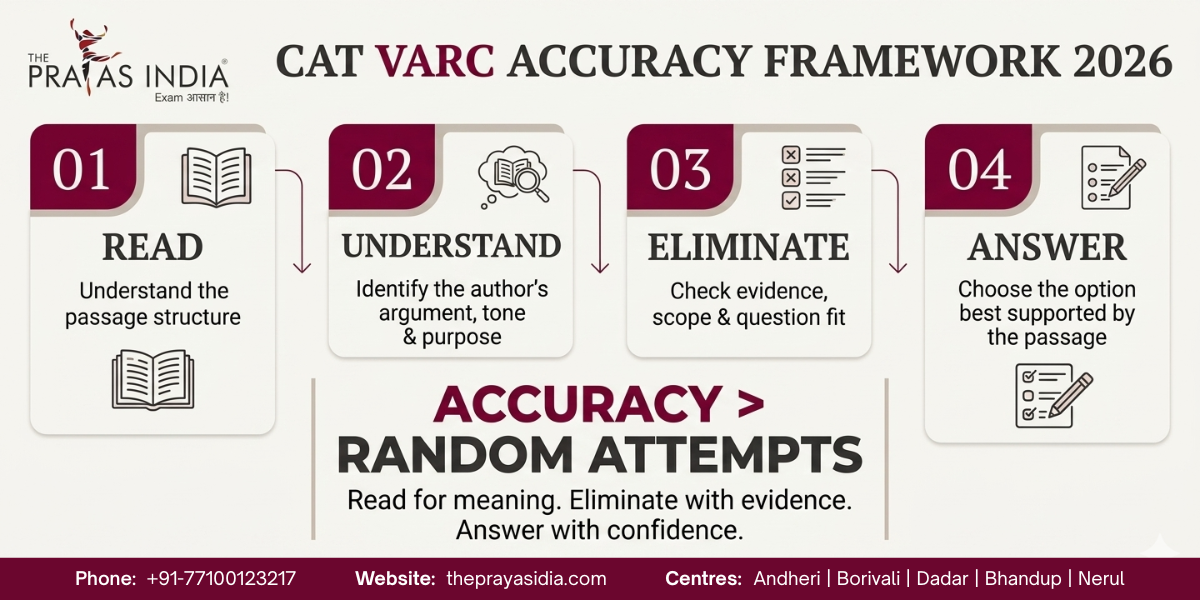
Therefore, always ask:
“Where is the evidence for this answer?”
If you cannot connect the option to the passage, be careful.
The Four-Filter Method for RC Options
When two or more options seem close, evaluate them using four filters.
Filter 1 — Passage Support
Does the passage support the option?
Filter 2 — Question Fit
Does it actually answer the question?
Filter 3 — Scope
Is it too broad or too narrow?
Filter 4 — Author’s Position
Does it match the author’s argument?
An option that fails even one of these tests may be eliminated.
This method is particularly useful for difficult inference and main-idea questions.
Question Selection Is a Separate Skill
Even if your reading ability is strong, attempting the wrong questions can reduce your VARC score.
Not every question deserves the same level of confidence.
Some questions can be answered relatively quickly because the passage provides clear evidence.
Others may involve extremely close options where you need deeper evaluation.
Therefore, don’t treat all questions equally.
During practice, learn to identify:
High-Confidence Questions
Clear evidence and familiar question structure.
Moderate Questions
Require some elimination or interpretation.
High-Risk Questions
Very close options, ambiguous-looking choices or questions where you cannot establish strong passage support.
The objective is not necessarily to avoid difficult questions forever.
It is to understand their risk before committing time.
Main Idea Questions: Don’t Choose the Broadest Option
Main idea questions are often misunderstood.
Students frequently choose the option that covers the largest number of ideas mentioned in the passage.
But the broadest option isn’t automatically the best one.
The correct main idea should represent the central argument or purpose of the passage.
Ask:
“If I had to explain this passage in one or two sentences, what would I say?”
That answer can help you identify the correct direction.
Be cautious of options that:
- Mention only one paragraph
- Focus on an example
- Introduce an idea absent from the passage
- Are broader than the author’s actual argument
- Distort the author’s position
Inference Questions: Don’t Use Your Own Knowledge
This is one of the most important VARC habits.
Suppose you know something about the topic from your own studies or general knowledge.
That knowledge can influence your answer.
But CAT RC questions generally require you to work within the information and logic of the passage.
Your question should be:
“What can reasonably be inferred from the passage?”
Not:
“What do I personally know about this topic?”
An option may be factually true in the real world and still be incorrect for the question.
The First Step Towards Better VARC Accuracy
If you want to improve VARC accuracy for CAT 2026, don’t immediately start attempting more questions.
First identify why your current answers are wrong.
After every VARC practice session or mock, classify your mistakes.
For example:
Reading Error
You misunderstood the passage.
Interpretation Error
You understood the passage but misinterpreted the question.
Elimination Error
You narrowed the options but selected the wrong one.
Evidence Error
You selected an option without sufficient passage support.
Time Pressure Error
You rushed because of limited time.
Careless Error
You knew the answer but marked incorrectly.
This classification is much more useful than simply writing:
“RC wrong.”
You need to understand the reason behind the mistake.
Build an RC Error Log
Maintain a simple error log during your CAT preparation.
| Question Type | Your Mistake | Correct Approach |
|---|---|---|
| Main Idea | Chose a narrow option | Identify central argument |
| Inference | Used outside knowledge | Stay within passage logic |
| Tone | Overinterpreted language | Look at author’s overall position |
| Detail | Misread information | Return to relevant passage |
| Para-based | Ignored structure | Track paragraph progression |
After several weeks, patterns will become visible.
You may discover that your accuracy is good in detail-based questions but weak in inference questions.
Or perhaps your actual problem isn’t comprehension—it is answer-choice elimination.
That insight should guide your next stage of preparation.
What Good VARC Preparation Should Look Like
For CAT 2026, VARC preparation should not mean solving random RCs every day without analysis.
A better cycle is:
READ
Read diverse and challenging material.
↓
PRACTISE
Solve CAT-level RCs and VA questions.
↓
ANALYSE
Understand every incorrect answer.
↓
IDENTIFY
Find recurring mistakes.
↓
IMPROVE
Target the specific weakness.
↓
RETEST
Check whether accuracy has improved.
This approach turns practice into measurable improvement.
Takeaway
Improving CAT VARC accuracy begins with changing the way you approach the section.
Don’t focus only on reading faster or attempting more questions.
Build your strategy around:
Better Reading → Better Question Selection → Better Elimination → Better Accuracy
And most importantly, analyse why you get questions wrong.
RC Selection, Question Selection & Time Management for CAT VARC
Improving VARC accuracy is not only about understanding passages better. The next challenge is deciding where to spend your limited time.
In CAT, you may encounter multiple RC passages with different levels of complexity. You don’t necessarily need to attempt every passage or every question.
The objective is to create the best possible combination of:
Passage Selection + Question Selection + Accuracy + Time Management
For CAT 2026 aspirants, this decision-making ability should become an integral part of mock-test practice.
How to Choose the Right RC Passage
One of the biggest mistakes students make is starting with the first passage automatically.
The order of the passages does not tell you which one is easiest.
Before committing significant time, spend a short period scanning the available RCs.
Look for:
- Passage length
- Topic familiarity
- Complexity of language
- Number of viewpoints
- Argument structure
- Density of information
- Your personal comfort with the subject
You are not trying to understand every passage during the scan.
You are simply trying to answer:
“Which passage gives me the best chance of accurate attempts?”
Familiarity Should Not Be the Only Factor
Suppose you see two passages.
Passage A
Topic you know well, but the author’s argument is highly abstract.
Passage B
Topic you have never studied, but the argument is clearly structured.
Many students automatically choose Passage A.
That can be a mistake.
The right passage isn’t necessarily the one whose topic you know.
It is the one whose argument you can process effectively.
This distinction is particularly important because CAT can use unfamiliar subjects to test your reading and reasoning ability.
The RC Selection Checklist
Before selecting a passage, quickly evaluate four things:
1. Structure
Can you identify how the argument is developing?
2. Language
Is the language manageable for you?
3. Density
Does every sentence introduce a new complicated idea?
4. Question Potential
Do the questions appear to offer reasonable scoring opportunities?
If a passage looks manageable on these parameters, it may deserve priority.
Don’t Judge RC Difficulty by Length Alone
A long passage isn’t automatically difficult.
A short passage isn’t automatically easy.
A lengthy passage may have:
- A clear argument
- Simple paragraph progression
- Direct questions
A short passage may contain:
- Dense philosophical ideas
- Abstract reasoning
- Multiple viewpoints
- Very close answer options
Therefore, length is only one factor.
The real question is:
“How much cognitive effort will this passage require from me?”
That is something you can learn to judge through repeated practice.
Passage Selection Should Be Personalised
There is no universal rule such as:
“Always attempt philosophical RCs first.”
Or:
“Never attempt science passages.”
Such rules can become dangerous.
A passage that is difficult for one aspirant may be comfortable for another.
Your mock-test data should tell you which types of passages work best for you.
For example, after several mocks you may find:
Economics → High accuracy
History → Moderate accuracy
Philosophy → Low accuracy
Science → High accuracy
That information is much more useful than generic advice.
Your CAT VARC strategy should gradually become personalised around your strengths and weaknesses.
Question Selection: Don’t Treat Every RC Question Equally
Once you’ve selected a passage, the next decision is which questions to attempt.
Some questions have clear evidence.
Others require more interpretation.
Some options can be eliminated quickly.
Others may require you to revisit multiple parts of the passage.
During practice, classify questions based on your confidence.
High Confidence
You can identify the evidence or reasoning quickly.
Medium Confidence
You understand the question but need careful elimination.
Low Confidence
You are uncertain between multiple options and cannot establish strong passage support.
This doesn’t mean you should permanently avoid difficult questions.
It means you should learn to recognise when a question is consuming too much time for its potential return.
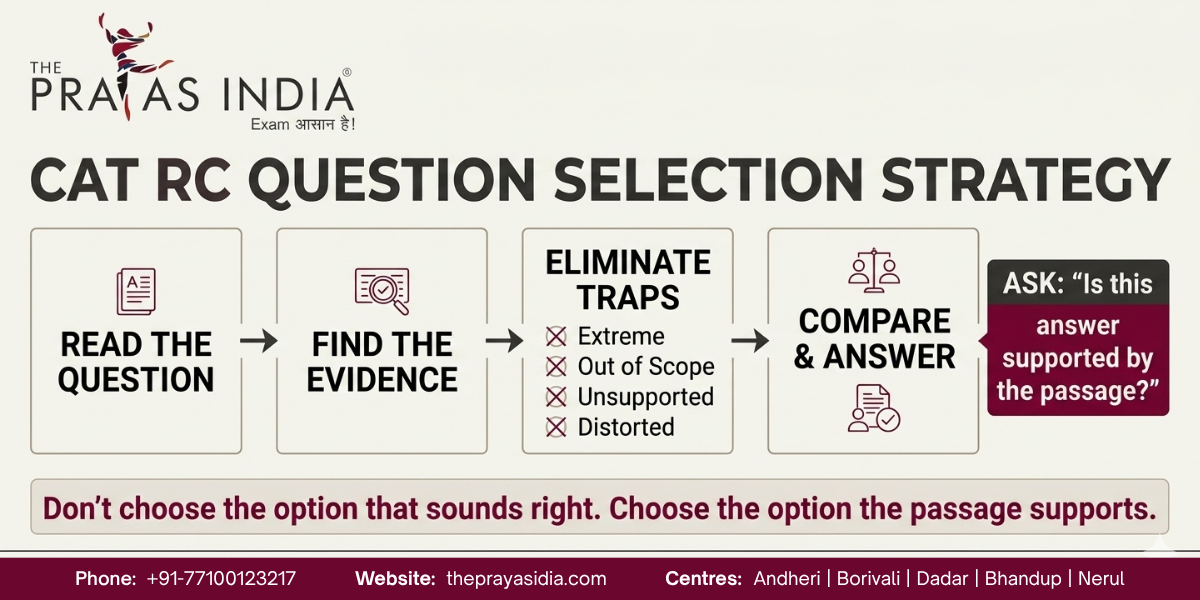
A Simple Question Selection Strategy
When you encounter an RC question:
Step 1 — Understand the Question
Don’t immediately look at the options.
Identify exactly what the question is asking.
Step 2 — Recall the Relevant Part
If the answer relates to a specific part of the passage, locate the relevant evidence.
Step 3 — Eliminate
Remove options that:
- Contradict the passage
- Go beyond the passage
- Are too extreme
- Change the author’s meaning
- Answer a different question
Step 4 — Compare the Final Options
If two options remain, compare them against the exact wording of the question.
This prevents you from selecting an option merely because it sounds intelligent.
Beware of Extreme Options
CAT answer choices often contain subtle differences.
Words such as:
- Always
- Never
- Completely
- Only
- Entirely
- All
- None
should make you pause.
This does not mean an option containing an extreme word is automatically wrong.
But it deserves closer examination.
Ask:
“Does the passage actually support this level of certainty?”
If the author makes a nuanced argument, an absolute answer may be inconsistent with the passage.
Scope Matters
Another common trap is a scope mismatch.
Suppose the passage discusses:
The impact of technology on one particular industry.
An answer saying:
“Technology has transformed every industry.”
may sound related.
But it expands the scope beyond what the passage establishes.
Similarly, an option that discusses only one small example may be too narrow to represent the author’s overall argument.
The correct option usually stays within the scope of the passage and question.
How to Manage Time Across VARC
Time management should not begin on the day of CAT.
It should be developed through repeated timed practice.
Instead of trying to follow an exact universal formula, develop a time range that works for you.
For example, you might find through mocks that:
- Some RCs take around 7–9 minutes.
- Some take 9–11 minutes.
- Some are simply not worth the time.
The exact numbers can vary.
What matters is knowing when your time investment is producing enough scoring opportunity.
Avoid Spending Too Long on One Question
One of the easiest ways to damage VARC performance is to spend several minutes fighting with one question.
You read the passage.
Read the question.
Compare two options.
Read the passage again.
Still uncertain.
Then another minute disappears.
If you cannot establish a convincing answer after reasonable analysis, mark the question for review or move forward, depending on your strategy.
Remember:
One difficult question should not consume the time required for two or three more manageable questions.
Time Management Is Also About Recovery
Sometimes your first passage selection will be wrong.
That’s okay.
The bigger mistake is allowing one poor decision to affect the entire section.
Suppose you spend too much time on an RC and realise that your pace has slowed.
Don’t panic.
Reassess the remaining passages.
Choose the most promising option available.
The ability to recover from a poor decision is an important part of exam strategy.
The “Time vs Accuracy” Balance
There are two extreme approaches.
Approach 1: Speed First
Attempt as many questions as possible.
Problem: Accuracy may fall.
Approach 2: Accuracy at Any Cost
Spend excessive time verifying every answer.
Problem: Attempt count may become too low.
The better approach is:
Controlled Accuracy
You want enough time to make an informed decision without overthinking every question.
This balance can only be developed through timed practice.
Your Mock-Test Analysis Should Go Beyond the Score
Suppose you score 28 in VARC.
The score alone doesn’t tell you enough.
After the mock, analyse:
Passage Selection
Which RCs did you attempt?
Question Selection
Which questions did you choose?
Accuracy
Where did you make mistakes?
Time
Where did you spend the most time?
Decision Quality
Which questions or passages should you have skipped?
This gives you a much clearer picture of your actual performance.
The VARC Decision Log
After every mock, maintain a simple record.
| Area | Observation | Action |
|---|---|---|
| RC Selection | Chose a difficult passage first | Scan all passages before starting |
| Accuracy | Inference questions weak | Practise inference-based RCs |
| Time | Too much time on one RC | Set progress checkpoints |
| Elimination | Fell for extreme options | Check scope and evidence |
| VA | High accuracy | Maintain regular practice |
Over time, this becomes your personal VARC strategy manual.
Reading Practice: Quality Over Quantity
Reading is important for CAT VARC.
But simply reading a large number of articles isn’t enough.
Your reading should gradually expose you to:
- Editorial writing
- Philosophy
- Economics
- Science
- History
- Sociology
- Technology
- Culture
- Psychology
The objective is not to become an expert in every topic.
It is to become comfortable processing unfamiliar arguments.
After reading something, try asking:
What is the central argument?
What is the author’s position?
Which idea is being challenged?
How does the conclusion follow?
This turns ordinary reading into CAT-relevant practice.
How to Improve Accuracy Without Reducing Attempts
A common fear is:
“If I focus on accuracy, won’t my attempts decrease?”
Initially, they might.
That’s not necessarily a problem.
During the learning phase, accuracy should take priority.
Once you understand why you’re making mistakes, you can gradually increase your attempts while maintaining control.
Think of the progression as:
Low Accuracy → Controlled Attempts → Higher Accuracy → Higher Attempts at Similar Accuracy
This is much safer than simply increasing attempts without understanding your errors.
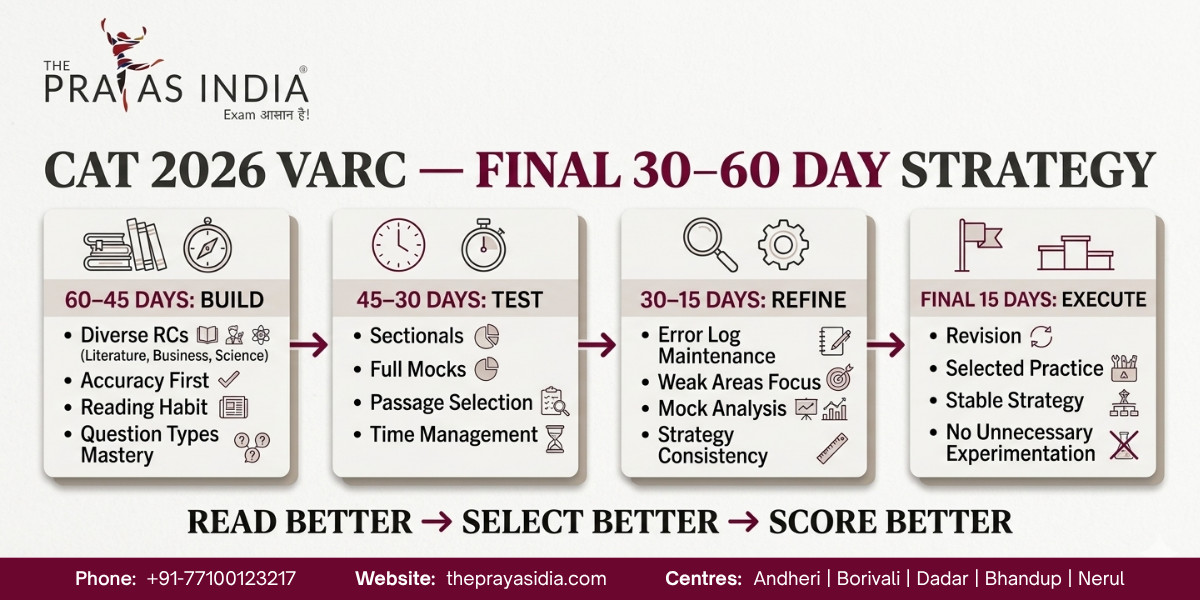
CAT VARC Preparation During the Final 60 Days
The final phase of preparation should focus heavily on application.
60–45 Days
Focus on:
- Diverse RC practice
- Question-type analysis
- Reading consistency
- Building accuracy
- Sectional tests
45–30 Days
Increase:
- Timed RC practice
- VARC sectionals
- Full-length mocks
- Error-log analysis
Start refining your passage-selection strategy.
30–15 Days
Focus on:
- CAT-level RCs
- Mock simulations
- Time management
- Accuracy under pressure
- Repeated weak areas
Final 15 Days
Avoid making major changes.
Focus on:
- Consistency
- Mock analysis
- Revision
- Maintaining reading practice
- Confidence in your established strategy
The goal is not to learn an entirely new VARC method at the last moment.
It is to make your existing method more reliable.
Don’t Ignore Verbal Ability
RC generally receives a lot of attention because it forms a major part of VARC.
But VA questions can also contribute valuable marks.
Your preparation should include practice for relevant VA question types such as:
- Para Jumbles
- Para Summary
- Odd Sentence
- Paragraph Completion or related verbal reasoning formats, depending on the CAT pattern
The exact question mix can vary.
Therefore, don’t build a strategy around assuming that only one VA format will appear.
The broader goal should be to develop logical reading and sentence-level reasoning.
Where Coaching Can Add Value
Self-study can certainly build reading ability.
But one challenge many CAT aspirants face is not knowing what to fix.
You may know that your VARC score is low.
But is the actual problem:
- Reading speed?
- Comprehension?
- Question interpretation?
- Elimination?
- Time management?
- Passage selection?
- Accuracy under pressure?
A structured CAT coaching programme can help provide:
Conceptual guidance + CAT-level practice + sectional testing + mock analysis + strategy feedback
For students targeting competitive MBA admissions, this can make preparation more systematic.
At The Prayas India, CAT preparation can be positioned around not just completing the syllabus, but helping aspirants develop the strategic skills required to perform under actual exam conditions.
Takeaway
A strong VARC score isn’t created by reading every passage or attempting every question.
It comes from making better decisions repeatedly.
Your approach should be:
SCAN
Choose the most suitable RC.
READ
Understand its structure and argument.
SELECT
Choose questions with the best scoring potential.
ELIMINATE
Use evidence, scope and logic.
MOVE
Don’t allow one difficult question to consume disproportionate time.
ANALYSE
Use every mock to improve your next decision.
CAT VARC Mock Strategy, Accuracy Improvement & Final 30-Day Plan
By now, the basic VARC framework should be clear:
Read better → Select better → Eliminate better → Manage time better.
But there is one final piece that determines whether this strategy actually works in CAT 2026:
consistent testing and analysis.
A student may know every RC strategy but still struggle in the exam because the strategy has never been tested under pressure.
This is why the final phase of CAT VARC preparation should move away from simply solving more questions and towards measuring, analysing and improving performance.
Your CAT VARC Preparation Should Have a Feedback Loop
A productive preparation cycle looks like this:
PRACTISE → TEST → ANALYSE → IDENTIFY → IMPROVE → RETEST
Every mock should tell you something about your preparation.
If your score remains unchanged despite taking multiple mocks, the problem may not be a lack of practice.
It may be that you are not learning from the practice.
For example, if you repeatedly make inference mistakes but continue solving random RCs without analysing those mistakes, your practice volume increases—but your underlying weakness remains.
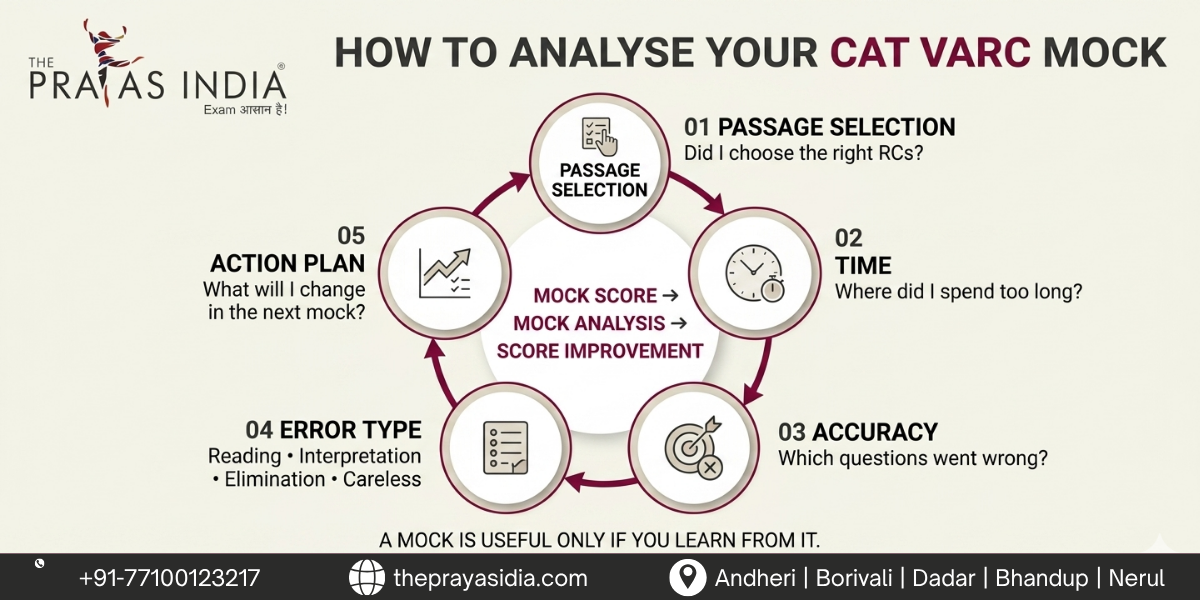
What Should You Analyse After Every VARC Mock?
Don’t stop at checking the final score.
Break the performance into different components.
1. Passage Selection
Did you choose the right RCs?
Were there passages you should have attempted earlier?
Did you spend too much time on a difficult passage?
2. Reading Efficiency
Did you understand the passage on the first reading?
Did you repeatedly return to the same paragraph?
Did you lose track of the author’s argument?
3. Question Accuracy
Which question types caused the most errors?
- Main idea
- Inference
- Tone
- Detail
- Purpose
- Vocabulary/context
- Para Summary
- Para Jumble
- Odd Sentence
4. Elimination Quality
Did you eliminate the wrong options correctly?
Did you choose an option because it “sounded right”?
Did you overlook an extreme or out-of-scope option?
5. Time Management
Where did you lose time?
A strong VARC analysis should identify where your minutes went, not simply how many questions you attempted.
Build an Accuracy Dashboard
You can maintain a simple weekly dashboard.
| Metric | Week 1 | Week 2 | Week 3 | Week 4 |
|---|---|---|---|---|
| RC Accuracy | 68% | 72% | 76% | 79% |
| VA Accuracy | 70% | 74% | 75% | 78% |
| Avg. Time/RC | 10.5 min | 10 min | 9.5 min | 9 min |
| VARC Attempts | 20 | 21 | 22 | 22 |
| Overall Accuracy | 69% | 73% | 76% | 79% |
The numbers above are only an example.
Your actual targets should depend on your current level.
The purpose of tracking is to identify direction.
You want to see whether your preparation is moving towards:
Better accuracy + controlled time + sustainable attempts.
Don’t Chase a Fixed Number of Attempts
One of the most common CAT preparation mistakes is obsessing over a particular attempt number.
For example:
“I must attempt 20 questions.”
But what if question 21 is extremely difficult?
And what if question 18 is an easy one that you haven’t reached because you spent too much time elsewhere?
A fixed attempt target can make your decision-making rigid.
Instead, develop a performance range.
Your ideal attempt count should emerge from your mock performance.
If your accuracy remains strong as attempts increase, that’s a positive sign.
If accuracy drops sharply when you increase attempts, you need to improve question selection before pushing the attempt count higher.
Accuracy Does Not Mean Overthinking
There is another trap.
Some students hear “improve accuracy” and start analysing every option excessively.
They read the passage again and again.
They keep changing answers.
They spend several minutes trying to achieve 100% certainty.
This can become counterproductive.
CAT VARC requires reasonable confidence, not absolute certainty.
Once you have:
- Understood the question
- Located relevant evidence
- Eliminated weak options
- Compared the remaining choices
you should be prepared to make the decision and move forward.
How to Handle Two Close Options
This is one of the most common VARC situations.
You eliminate two options.
Two remain.
Both sound plausible.
What should you do?
Go back to the question—not just the passage.
Ask:
Which option answers the exact question?
Then check:
Which option requires fewer assumptions?
Then:
Which option is more directly supported?
Finally:
Which option matches the scope and tone of the passage?
The correct answer often emerges through comparison, not through finding a sentence that exactly matches the option.
Don’t Change an Answer Without a Reason
During mocks, students sometimes change a correct answer because they become uncertain.
This is particularly common in RCs.
A better rule is:
Change your answer only when you identify a specific reason why the original choice is wrong.
For example:
“I originally selected B, but option B is too broad and the passage supports a narrower claim.”
That’s a valid reason.
But:
“A suddenly feels better.”
is not.
This small habit can improve decision discipline.
A Practical CAT 2026 VARC Weekly Routine
Your weekly plan should combine reading, practice and testing.
A sample structure could look like:
Monday–Tuesday
RC practice + detailed analysis
Wednesday
VA practice + error-log revision
Thursday
Timed RC/VARC sectional
Friday
Weak-area practice
Saturday
Full-length mock or CAT-level sectional simulation
Sunday
Detailed mock analysis + reading
The exact schedule can be adjusted according to your preparation stage.
The important thing is that analysis should have a fixed place in your weekly routine.
Don’t keep it as something you will do “if you have time.”
Final 30 Days: Don’t Experiment Too Much
The last month should be about refinement.
By this stage, you should have a reasonably clear understanding of:
- Which RC types work for you
- How quickly you can read
- How many questions you can attempt comfortably
- Which question types cause errors
- How much time you need for VA
- When you tend to overthink
- Which mistakes appear repeatedly
Use this information to create your final VARC strategy.
Avoid constantly changing your approach because of one bad mock.
One poor score doesn’t necessarily mean your strategy is wrong.
Look for patterns across multiple tests.
The Final 30-Day CAT VARC Strategy
Days 30–21
Focus on:
- Full-length mocks
- RC accuracy
- Question selection
- Error-log revision
- Timed VARC practice
Your priority should be identifying weaknesses.
Days 20–11
Move towards consistency.
Practise:
- Full CAT-level VARC sections
- RCs from varied topics
- Question elimination
- Time management
- Mock analysis
At this stage, you should be reducing avoidable mistakes.
Days 10–5
Don’t dramatically increase your workload.
Focus on:
- Revision
- Selected RC practice
- Previous mistakes
- Mock simulations
- Maintaining reading habits
Your strategy should now feel familiar.
Final 4 Days
The goal is not to transform your VARC ability in four days.
Focus on:
- Light revision
- Maintaining confidence
- Avoiding unnecessary experimentation
- Reviewing your key mistakes
- Keeping your reading routine comfortable
The final days should be about stability rather than panic.
The Final Day: Trust Your Process
If you have spent months preparing for CAT, the final day is not the time to learn a new RC strategy.
You already know:
How you read.
How you select.
How you eliminate.
How you manage time.
The objective is to execute that process calmly.
Four Mistakes to Avoid in CAT VARC
Mistake 1: Reading for Speed Alone
Fast reading without comprehension creates more problems than it solves.
Focus on understanding the argument.
Mistake 2: Attempting Every Question
More attempts are not automatically better.
Choose questions based on scoring potential and confidence.
Mistake 3: Ignoring Mock Analysis
A mock without analysis is only a score.
Analysis turns it into preparation.
Mistake 4: Changing Strategy After Every Bad Mock
Performance naturally fluctuates.
Look for patterns across multiple mocks before making major changes.
How The Prayas India Can Help CAT Aspirants Build a Better VARC Strategy
For students looking for CAT coaching in Mumbai, the right preparation environment should not focus only on completing the syllabus.
VARC requires continuous improvement in:
- Reading comprehension
- Logical interpretation
- Question selection
- Accuracy
- Time management
- Mock analysis
This is where structured guidance can make preparation more systematic.
At The Prayas India, CAT aspirants can work towards building a preparation process that combines concept clarity, regular practice, sectional testing and performance analysis.
For students targeting competitive MBA admissions, the objective is not simply to increase the number of questions attempted.
It is to develop the ability to make better decisions under CAT-level time pressure.
Contact Us
📞 Call Now: +91-77100 13217
🌐 Website: theprayasindia.com
📍 Centres: Andheri | Borivali | Dadar | Nerul | Bhandup
From VARC Preparation to MBA Admissions
A strong CAT score can open opportunities across several leading management institutes.
But preparation should not be viewed only as an examination exercise.
For an MBA aspirant, CAT is part of a larger admission journey involving:
CAT Score → Percentile → Shortlisting → WAT/PI or Selection Process → Final Admission
That is why serious aspirants should focus on building a preparation strategy early rather than waiting until the final weeks.
Improving VARC accuracy is one part of that larger journey.
Final Takeaway
CAT VARC is not a section where simply reading more guarantees a better score.
You need to develop the ability to:
READ
Understand the argument rather than memorising every sentence.
SELECT
Choose passages and questions that offer the best scoring opportunities.
ELIMINATE
Use evidence, scope, logic and the author’s position.
MANAGE
Protect your time and avoid getting trapped by difficult questions.
ANALYSE
Use every mock to understand exactly where your preparation needs improvement.
For CAT 2026 aspirants, the biggest improvement may not come from attempting hundreds of additional questions.
It may come from understanding why your existing attempts go wrong—and making better decisions next time.
If you’re serious about achieving a competitive CAT percentile and targeting top MBA admissions, start treating VARC accuracy as a measurable skill, not simply a matter of reading ability.
With consistent practice, detailed analysis and a structured strategy, you can gradually turn VARC from an unpredictable section into a more controlled scoring opportunity.
FAQs
1. How can I improve CAT VARC accuracy?
Focus on reading comprehension, question selection and option elimination. Analyse every incorrect answer to identify whether the mistake came from comprehension, interpretation, elimination or time pressure.
2. How important is Reading Comprehension for CAT VARC?
RC forms a major part of VARC, making reading comprehension an important area of preparation. Aspirants should practise diverse passages and learn to identify the author's argument, tone and purpose.
3. Should I attempt every VARC question?
No. The objective is not maximum attempts at any cost. Focus on attempting questions where you have a reasonable chance of arriving at the correct answer while maintaining controlled accuracy.
4. How should I analyse a CAT VARC mock?
Review passage selection, time spent, incorrect questions, question types, elimination mistakes and avoidable errors. Then create a specific action plan for the next mock.
5. How many VARC mocks should I take before CAT 2026?
There is no universally correct number. The quality of analysis matters more than simply counting mocks. Take enough full-length tests and sectionals to develop a stable strategy and identify recurring weaknesses.
6. Can CAT coaching help improve VARC?
Structured coaching can provide CAT-level practice, mock analysis, strategy guidance and feedback, which can help aspirants identify weaknesses and develop a more consistent approach.