How to Improve Speed and Accuracy for SBI Clerk Prelims | Best Banking Coaching in Mumbai | The Prayas India
The SBI Clerk Prelims is often described as a speed-based examination, but speed alone does not guarantee a good score. A candidate may attempt a large number of questions and still lose marks because of calculation errors, incorrect question selection, rushed reading, or unnecessary guesses. On the other hand, solving every question carefully without considering the clock can also leave several easy questions unanswered. For SBI Clerk aspirants, the real challenge is to develop the ability to solve the right questions quickly and accurately.
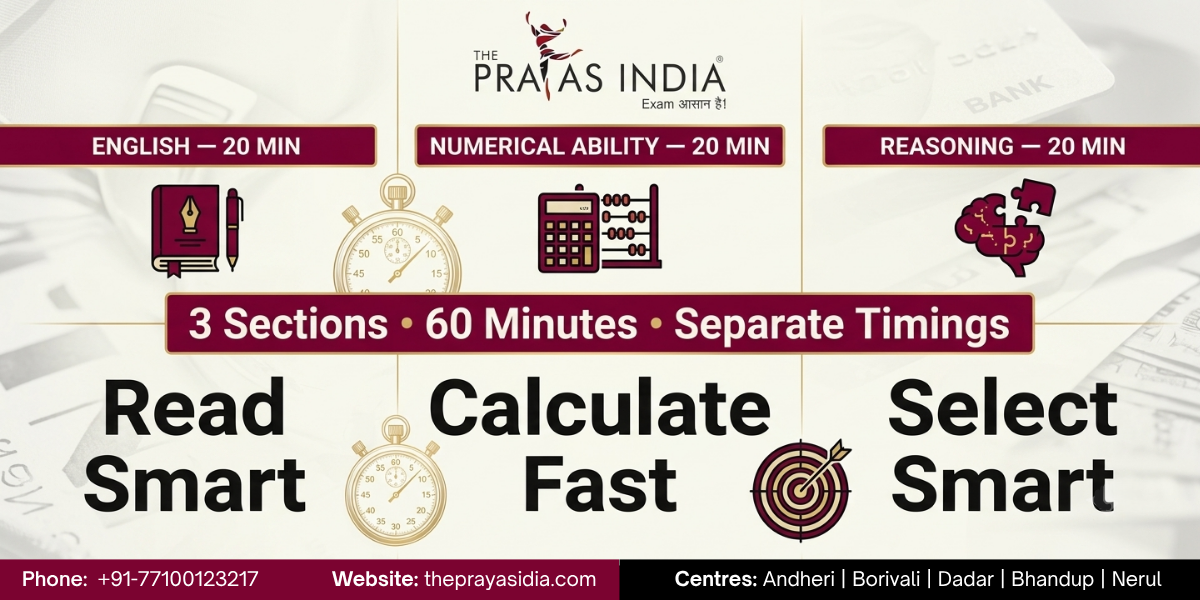
This balance becomes particularly important because the SBI Clerk Preliminary Examination is structured around three individually timed sections. As per SBI’s Junior Associate examination pattern, the Preliminary Examination carries 100 marks and consists of 30 questions in English Language, 35 questions in Numerical Ability, and 35 questions in Reasoning Ability. Each section has a separate 20-minute time limit, making time management a built-in part of the examination rather than merely a preparation technique. The examination also carries a penalty of one-fourth of the marks assigned to a question for every wrong answer.
For students preparing in Mumbai, this means that SBI Clerk preparation should go beyond completing the syllabus. A structured approach should gradually improve conceptual understanding, calculation ability, reading efficiency, question selection, mock-test performance and error control. This is where focused guidance and consistent practice at The Prayas India can help aspirants build the skills required for a competitive banking examination.
SBI Clerk Prelims Is a Speed-and-Accuracy Examination
Many aspirants make the mistake of treating SBI Clerk Prelims as a test of how many questions they can solve. In reality, it is better understood as a test of how efficiently they can convert available time into correct marks. Since all three sections have separate timings, candidates cannot compensate for poor time management in one section by freely borrowing time from another. The 20-minute window for each section makes it essential to enter the examination with a clear solving strategy.
The Numerical Ability section, for example, can contain questions that appear straightforward but consume valuable time if calculations are not efficient. Similarly, Reasoning Ability may include several quick questions along with puzzles or arrangements that require more time. English Language can reward candidates who have developed reading comprehension, grammar and vocabulary skills, but hesitation while reading passages or analysing options can quickly reduce the number of questions attempted.
This is why speed should not be developed independently of accuracy. If a candidate increases attempts by rushing through questions, the resulting mistakes can reduce the score because of negative marking. SBI’s official pattern specifies a one-fourth penalty for every incorrect answer, so random guessing is not an effective strategy.
The objective should therefore be simple: increase the number of correct attempts without allowing accuracy to fall.
At The Prayas India, this approach can be incorporated into preparation from the beginning. Instead of asking students to simply “solve faster,” the preparation process should identify where time is being lost. Is the candidate taking too long to calculate? Are they spending excessive time on difficult puzzles? Are they rereading English questions? Are careless mistakes occurring because of rushed solving? Once the actual problem is identified, speed can be improved systematically.
Understand the Difference Between Speed and Smart Speed
There is an important difference between being fast and being efficient. A candidate who solves a question in 30 seconds but makes frequent mistakes is not necessarily performing better than someone who solves it in 40 seconds with high accuracy. Similarly, spending three or four minutes on one difficult question simply because it appears solvable can prevent a candidate from attempting several easier questions.
Smart speed means knowing which questions deserve your time.
For SBI Clerk Prelims, this skill develops through repeated exposure to different question types. During practice, students should gradually learn to classify questions into three broad categories: questions that can be solved immediately, questions that require moderate calculation or reasoning, and questions that should be postponed because they are likely to consume disproportionate time.
This classification becomes especially important in Reasoning and Numerical Ability. A candidate who spends too much time trying to complete one lengthy puzzle may miss several easier questions. Similarly, in Quantitative Aptitude, an unnecessarily lengthy calculation can affect the overall attempt strategy.
The Prayas India can make this process more structured by exposing students to timed sectional practice and helping them understand not only whether an answer is correct, but also whether the amount of time spent on that question was justified.
Build Accuracy Before Trying to Increase Speed
One of the most common mistakes made by SBI Clerk aspirants is trying to improve speed too early. Students often begin using timers before they have developed sufficient command over basic concepts. This creates pressure without necessarily improving performance.
A better approach is to first establish a reliable accuracy level. During the initial stage of preparation, students should focus on understanding concepts and solving questions without excessive time pressure. Once they become comfortable with the standard question types, a timer can gradually be introduced.
For example, a candidate learning simplification should first understand the relevant calculation rules and practise different patterns. After achieving consistency, the candidate can start tracking how long a set of questions takes. The same principle applies to syllogism, inequality, coding-decoding, number series, quadratic equations, reading comprehension, cloze tests and other common areas.
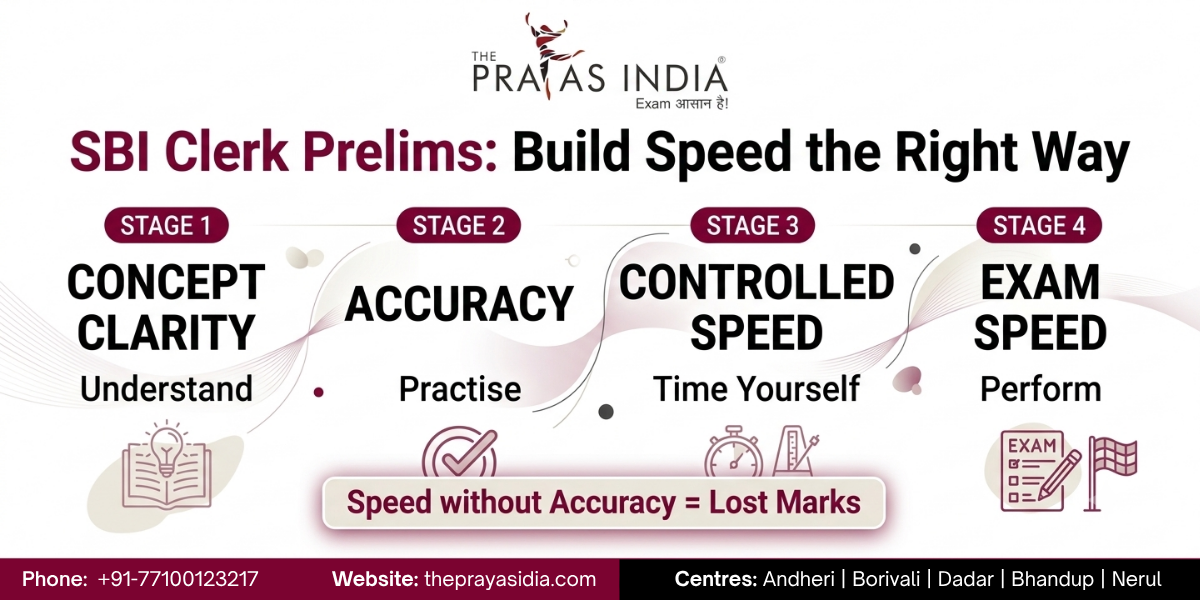
This creates a progression:
Concept Clarity → Untimed Accuracy → Controlled Speed → Sectional Timing → Full Mock Performance
Trying to skip these stages can result in what appears to be speed but is actually rushed solving.
At The Prayas India, students preparing for banking examinations can use this progression to move from basic practice toward exam-level performance. The objective is not merely to complete more questions but to develop a repeatable method that works under examination pressure.
How to Identify the Real Reason Behind Slow Solving
Before trying different speed-building techniques, an aspirant should identify exactly where time is being lost. “I am slow in Quant” or “my Reasoning takes too much time” is not enough to diagnose the problem. The underlying reason could be very different for different students.
A candidate may know the concept but take too long to perform calculations. Another may calculate quickly but spend too much time deciding which method to use. Someone else may understand the question but repeatedly make errors while copying numbers or interpreting conditions. In English, slow performance may come from weak vocabulary, poor comprehension, uncertainty about grammar rules or excessive rereading.
The first step is therefore to maintain an error and time log.
After every sectional test or mock, students should record questions that took unusually long, questions answered incorrectly, questions left unattempted despite being easy, and questions where the correct method was known but execution failed. Over several tests, patterns begin to emerge.
Suppose a student repeatedly spends more than two minutes on certain arithmetic questions. That suggests a problem with either concept application or calculation efficiency. If a student spends excessive time on puzzles but performs well on individual reasoning questions, the issue may be question selection rather than reasoning ability. If English accuracy is good but attempts remain low, reading speed may need attention.
This type of analysis is much more useful than simply looking at the final mock-test score.
Improve Calculation Speed for SBI Clerk Numerical Ability
For many SBI Clerk aspirants, Numerical Ability is one of the biggest areas where speed can improve significantly with the right practice. The goal is not to perform complicated mathematics mentally at all times. Instead, candidates should become comfortable with the basic calculations that repeatedly appear in banking examinations.
This includes multiplication, division, percentage conversions, fraction-decimal relationships, squares, cubes, approximation and basic arithmetic operations. The more familiar these calculations become, the less mental effort is required during actual questions.
A candidate who still spends several seconds calculating common percentage values or basic multiplications will gradually lose valuable time across a complete section. These small delays may appear insignificant individually, but repeated across 20 or 30 questions, they can materially affect the number of attempts.
The solution is regular, focused calculation practice rather than random repetition. Short daily calculation drills can be more effective than occasional long sessions. Students should practise calculations with accuracy first and then gradually introduce time limits.
At The Prayas India, this kind of preparation can be integrated into the broader Quantitative Aptitude strategy so that calculation speed supports question-solving speed rather than becoming an isolated activity.
Strengthen the Basics of High-Scoring Topics
Speed improves naturally when the underlying concepts become familiar. If a candidate has to reconstruct the method for every question, even an easy problem can consume valuable time. Strong fundamentals reduce this hesitation.
For SBI Clerk Numerical Ability, areas such as simplification, approximation, number series, percentage, ratio and proportion, average, profit and loss, simple and compound interest, time and work, time-speed-distance and data interpretation require regular practice. The exact question mix may vary, but familiarity with common patterns gives candidates a significant advantage in timed conditions.
Reasoning follows a similar principle. Topics such as inequality, syllogism, coding-decoding, blood relations, direction sense, alphanumeric series and other relatively direct question types can become faster with repeated exposure. Puzzles and seating arrangements require a different approach because the challenge often lies in understanding the conditions and selecting the right set.
English also benefits from familiarity. Candidates who regularly practise error detection, fillers, cloze tests, reading comprehension, para-based questions and vocabulary-related questions become less dependent on guesswork.
The important point is that speed is often the result of familiarity. When the brain recognises the structure of a problem, less time is spent deciding what to do next.
Use Topic-Wise Practice Before Full-Length Mocks
Full-length mock tests are essential, but they should not be the first tool used to improve speed. Candidates who take repeated mocks without strengthening weak topics may simply reproduce the same mistakes.
Topic-wise practice provides a controlled environment in which one specific skill can be improved. A student struggling with simplification can work on a focused set until the calculation process becomes smoother. A student struggling with syllogism can practise different statement patterns without the pressure of a complete mock. An English learner can work specifically on reading comprehension or error detection.
Once accuracy becomes stable at the topic level, sectional tests can be introduced. These tests bridge the gap between practice and the actual examination.
The progression should ideally look like this:
Topic Practice → Mixed Practice → Sectional Test → Full-Length Mock → Detailed Analysis
This progression allows students to build speed without sacrificing conceptual understanding.
For aspirants preparing through a structured banking coaching programme in Mumbai, this staged approach can also make preparation easier to monitor. Instead of relying entirely on self-assessment, students can receive feedback on their topic performance, time management and recurring mistakes.
Develop Section-Wise Speed Instead of Chasing an Overall Time
Because SBI Clerk Prelims provides separate timings for English Language, Numerical Ability and Reasoning Ability, speed must be developed independently for each section.
A student might be excellent at Reasoning but comparatively slow in Numerical Ability. Another may complete English comfortably but struggle to finish Reasoning within the allotted time. Therefore, a single “overall speed” metric does not tell the complete story.
Students should maintain separate benchmarks for each section. For example, in Numerical Ability, the focus may initially be on completing a selected set of questions with high accuracy. In Reasoning, the focus may be on faster identification of direct questions before moving to longer sets. In English, the emphasis may be on reducing reading time while maintaining comprehension.
These benchmarks should be realistic and should improve gradually. Trying to force a very high number of attempts immediately can encourage careless mistakes.
The objective is to reach a point where the candidate enters each section with a clear idea of how to use the 20-minute window effectively.
Question Selection: The Missing Skill Behind Better Speed
A large part of speed improvement comes from learning what not to solve immediately.
This may sound counterintuitive to a candidate who believes that completing more questions is always better. However, competitive banking examinations reward effective decision-making. When the clock is running, every question has an opportunity cost. Spending excessive time on one difficult question means giving up the opportunity to solve another question that may have taken only a few seconds.
Question selection should therefore become a deliberate part of SBI Clerk preparation.
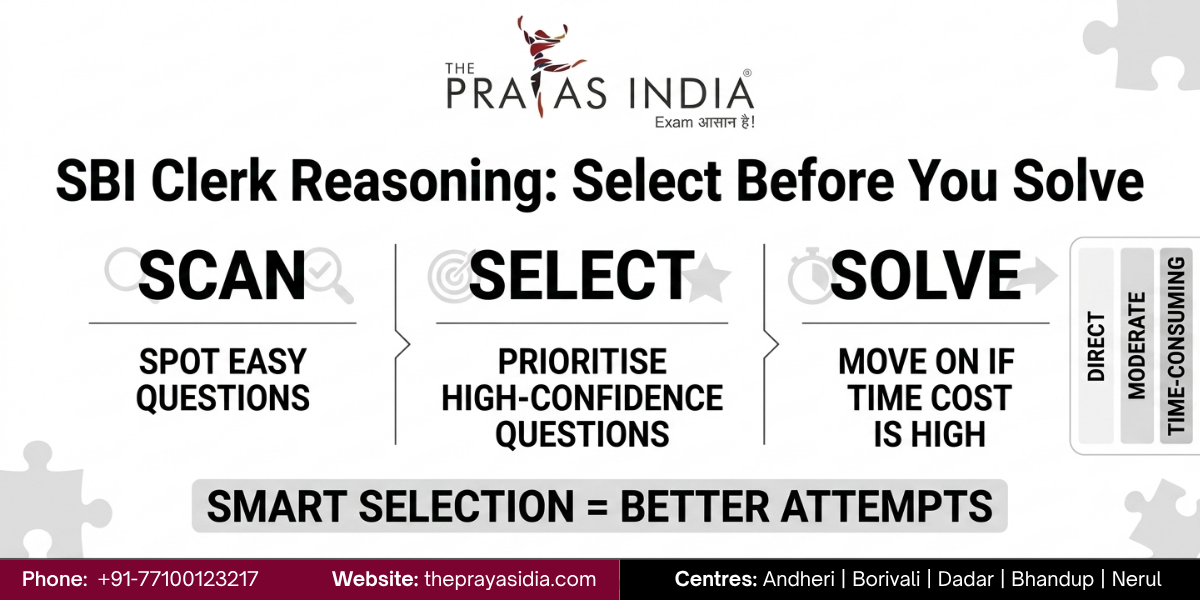
During practice, students should learn to identify direct questions, moderate questions and time-consuming questions. Direct questions should generally be handled quickly. Moderate questions can be attempted once the easier questions are under control. Lengthy or unfamiliar questions should not automatically be rejected, but candidates should learn to recognise when continuing with them is no longer efficient.
This skill cannot be developed simply by reading preparation material. It develops through timed practice and post-test analysis.
The Prayas India can incorporate this principle into banking exam preparation by helping students understand not just how to solve a question, but when to solve it and when to move ahead. That distinction becomes increasingly important as students transition from classroom learning to actual exam conditions.
Accuracy Is More Than Avoiding Silly Mistakes
When students hear the word “accuracy,” they often think only about careless mistakes. Although calculation errors, misreading and marking the wrong option are important, accuracy has a broader meaning.
Accuracy also depends on whether the candidate has correctly understood the question, selected an appropriate method and made a sound decision about attempting it. A candidate who attempts a question despite being unsure and then gets it wrong has not merely made a careless mistake; the problem may lie in question selection.
Similarly, repeatedly making errors in a particular concept indicates a conceptual weakness that needs targeted revision.
This is why accuracy should be measured in context. After every test, candidates should ask:
- Which questions did I get wrong?
- Why did I get them wrong?
- Was the concept unclear?
- Was the calculation incorrect?
- Did I misread the question?
- Did I rush because of the timer?
- Should I have skipped the question?
- Could I have solved it using a shorter method?
These questions transform mock tests from score-generating exercises into learning tools.
The Prayas India Approach to Speed and Accuracy
For banking aspirants, coaching should not end with teaching the syllabus. A useful preparation programme should help students understand how to apply that knowledge under examination conditions.
At The Prayas India, SBI Clerk preparation can be approached through a combination of conceptual learning, topic-wise practice, timed exercises, sectional tests and mock-test analysis. The purpose of this structure is to gradually move students from knowing the solution to executing the solution efficiently.
For beginners, the first priority is building strong fundamentals. As concepts become clearer, practice can become more intensive and time-bound. Students who are already comfortable with the syllabus can focus more heavily on mock analysis, question selection, speed improvement and accuracy management.
This is particularly useful for aspirants preparing for banking examinations in Mumbai, where students may be balancing preparation with college, work or other competitive examinations. A structured learning environment can provide consistency and make it easier to track progress over time.
The ultimate goal is not to turn every question into a race. It is to build the judgement required to recognise which questions deserve time, which methods are efficient and which mistakes must be eliminated before the examination.
A Practical Speed-Building Routine for SBI Clerk Aspirants
Speed improvement becomes much easier when it is integrated into the daily preparation routine rather than treated as a separate activity. A candidate can begin with a short calculation or mental-ability drill, followed by topic-wise practice in Quant, Reasoning and English. The emphasis should remain on accuracy initially.
Once the basic practice is completed, a timed set can be introduced. The candidate should then analyse both the score and the time spent. A useful routine does not end when the timer stops. The analysis that follows is equally important.
For instance, if a 20-question Quant set takes 18 minutes with 16 correct answers, the next goal should not automatically be 20 questions in 15 minutes. Instead, the candidate should examine the four incorrect or inefficient questions. If two mistakes were caused by calculation errors and two by incorrect question selection, the next practice session should specifically address those weaknesses.
Over time, this creates measurable improvement. The candidate begins to understand not just the score but the factors responsible for that score.
This is the foundation for building the kind of speed and accuracy required in SBI Clerk Prelims.
Subject-Wise Strategy to Improve SBI Clerk Prelims Speed and Accuracy
Improving speed becomes much more effective when candidates understand that every section requires a different approach. English Language, Numerical Ability and Reasoning Ability test different skills, and trying to use the same time-management method for all three can limit performance. The most effective strategy is to build section-specific habits while maintaining the same overall principle: attempt the questions you can solve confidently and efficiently, and avoid allowing difficult questions to consume disproportionate time.
Since the SBI Clerk Preliminary Examination has 100 questions for 100 marks and a total duration of one hour, with 20 minutes allocated to each section, candidates need to develop independent strategies for each 20-minute window. The official SBI Junior Associate pattern confirms the three-section structure of English Language, Numerical Ability and Reasoning Ability.
English Language: Improve Reading Efficiency and Decision-Making
English can become one of the fastest-scoring sections for a candidate who has developed familiarity with common question types. However, candidates often lose time because they read every question repeatedly, spend too long debating between two options, or attempt difficult vocabulary questions without sufficient confidence.
The first objective should be to improve reading efficiency. Reading comprehension passages should be approached with an understanding of the question rather than by trying to memorise every sentence. Candidates should also practise identifying the central idea, tone, contextual meaning and information-based answers without repeatedly returning to the passage unnecessarily.
For grammar-based questions, conceptual clarity can significantly reduce hesitation. If a candidate understands subject-verb agreement, tenses, prepositions, articles, conjunctions and common grammatical structures, many questions can be resolved quickly. Similarly, regular practice of fillers, error detection, cloze tests and sentence-based questions helps develop pattern recognition.
Accuracy should remain central. English may appear easy, but an incorrect answer caused by overlooking a single word can result in a negative mark. The objective should therefore be to combine quick reading with careful interpretation.
At The Prayas India, English preparation can be structured around concept building, regular practice and timed sectional exercises so that candidates gradually reduce the time required for familiar question types.
Numerical Ability: Turn Calculation into a Competitive Advantage
Numerical Ability is one of the clearest areas where deliberate speed training can produce measurable improvement. Candidates who understand the concepts but perform calculations slowly may struggle to complete the section comfortably.
The solution is not to rush through mathematical operations. Instead, candidates should develop familiarity with frequently used calculations and efficient solving methods. Percentage-fraction conversions, squares, multiplication patterns, approximation techniques and basic arithmetic relationships should become increasingly automatic through regular practice.
Simplification and approximation can be particularly useful for developing calculation speed because they train candidates to process numerical information quickly. Number series can similarly improve pattern recognition, while arithmetic and Data Interpretation require a combination of conceptual clarity and efficient calculation.
Candidates should also learn to recognise when a lengthy calculation is unnecessary. In competitive examinations, two correct methods may produce the same answer, but the method requiring fewer steps is often more suitable under time pressure.
The Prayas India can help students build this skill progressively by combining classroom concepts with timed calculation drills, topic-wise practice and sectional testing. The goal is to make calculations cleaner and faster without encouraging careless shortcuts.
Reasoning Ability: Master Selection Before Speed
Reasoning is often misunderstood as a section where candidates simply need to solve puzzles faster. In reality, one of the most important reasoning skills is knowing which questions to solve first.
Direct questions such as inequality, syllogism, coding-decoding, direction-based questions, blood relations or series-based questions can often be handled more quickly after sufficient practice. Puzzles and seating arrangements, on the other hand, may require more time because they involve multiple conditions and deductions.
A common mistake is to begin with a difficult puzzle simply because it appears familiar. Candidates may spend several minutes constructing the arrangement and then realise that another question set would have produced marks much faster.
The better approach is to scan intelligently. Identify manageable questions first, collect the easier marks, and then decide whether the remaining time justifies attempting a longer set.
This does not mean avoiding puzzles. Puzzles remain an important part of reasoning preparation. The key is to develop enough exposure to different patterns that candidates can quickly judge the approximate effort required.
The Most Effective Way to Use SBI Clerk Mock Tests
Mock tests should not be treated simply as a way to check whether preparation is going well. Their real value lies in revealing how a candidate behaves under examination pressure.
A candidate may perform extremely well during untimed practice but struggle in a mock because of poor question selection. Another may have good accuracy but leave too many questions unanswered because of slow execution. Someone else may attempt aggressively but lose marks through careless mistakes.
A mock test brings these issues together.
Candidates should therefore record more than the final score. After every mock, they should analyse at least four factors: attempts, accuracy, time usage and question selection. The purpose is to identify the reason behind the score rather than simply celebrate or worry about the number.
For example, suppose a candidate attempts 78 questions and gets 68 correct. The next target should not automatically be 85 attempts. If the candidate’s accuracy is already strong, the focus may be on increasing speed. But if the candidate attempts 78 and gets only 57 correct, increasing attempts could make the situation worse. Accuracy and decision-making must be corrected first.
This is why mock analysis should follow a simple cycle:
Attempt → Analyse → Identify → Correct → Retest
Regular mock analysis can gradually reveal recurring patterns. A candidate may discover that they consistently spend too much time on lengthy puzzles, make calculation errors in arithmetic or lose time while reading English passages. Once these patterns are visible, preparation becomes much more targeted.
Maintain an SBI Clerk Error Log
An error log is one of the simplest tools for improving accuracy, but many aspirants either do not maintain one or stop updating it after a few days.
The purpose of an error log is not to copy every wrong question into a notebook. It should capture the reason for the mistake.
A useful error log can divide mistakes into categories such as:
| Error Type | Example | Corrective Action |
|---|---|---|
| Conceptual | Formula or rule not understood | Revise concept |
| Calculation | Arithmetic mistake | Calculation drill |
| Reading | Missed a condition or word | Slow down selectively |
| Selection | Attempted a time-consuming question | Improve question selection |
| Memory | Forgot a rule or shortcut | Revision |
| Pressure | Rushed because of timer | More timed practice |
Over time, this becomes a personalised preparation guide. If most mistakes fall under one category, the candidate knows exactly where to focus.
At The Prayas India, this type of performance-oriented approach can make preparation more structured because students can use test performance to guide their next stage of learning instead of preparing every topic with equal intensity.
Daily Practice Routine for SBI Clerk Speed and Accuracy
Speed does not develop through occasional intense practice. It develops through consistency. A candidate who spends a manageable amount of time every day on timed practice can gradually build the mental rhythm required for the examination.
A practical routine can include three components: concept revision, focused question practice and timed testing.
During the first part of the study session, candidates can revise one or two concepts and review previously identified mistakes. The next phase should involve topic-wise questions, with particular attention to weak areas. The final phase can include a short timed set.
The duration does not have to be excessive. What matters is that the candidate tracks performance consistently.
For example, a candidate might practise calculations for 15–20 minutes, solve a focused Quant or Reasoning set, complete an English practice set and then spend time analysing errors. On alternate days, a sectional test can replace one of the topic-wise sessions.
The routine should evolve as the examination approaches. Early preparation can give more time to concepts, while later preparation should increasingly emphasise sectional tests, full-length mocks, revision and question selection.
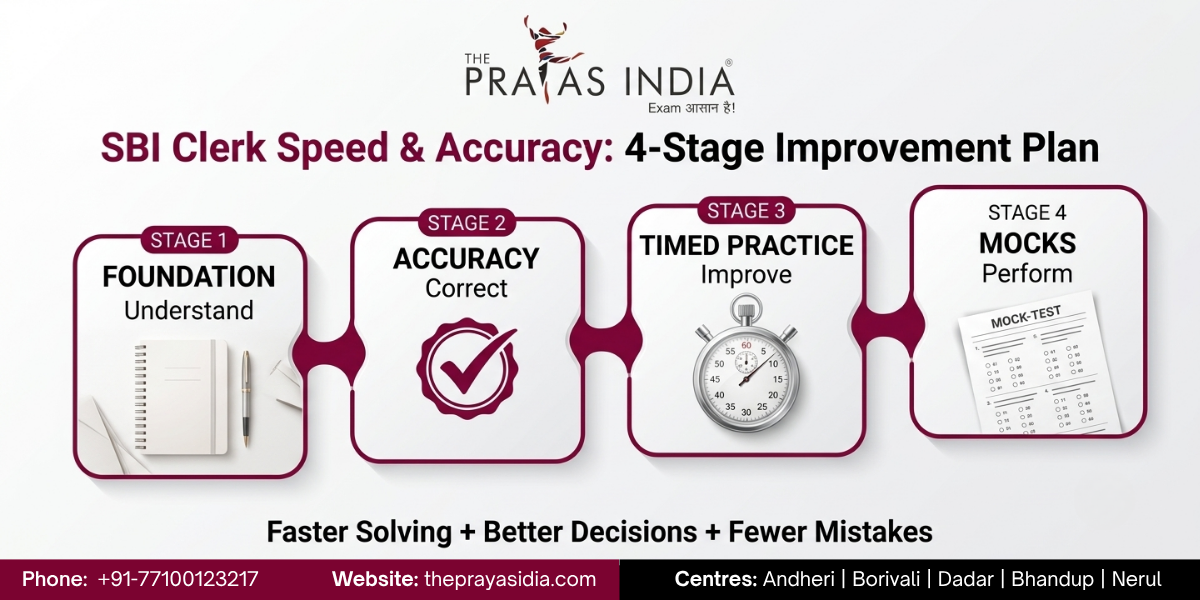
A Four-Stage Speed Improvement Plan
A structured preparation cycle can make speed improvement easier to measure.
Stage 1: Build the Foundation
At this stage, the objective is conceptual clarity. Candidates should not become overly concerned about completing every question within a strict time limit. Understanding the correct method is more important.
Stage 2: Build Accuracy
Once concepts are clear, candidates should solve mixed questions and identify recurring mistakes. Accuracy should become stable before aggressive speed targets are introduced.
Stage 3: Introduce Timed Practice
The next stage involves topic-level and sectional timers. Candidates should begin learning how quickly they can realistically solve different question types.
Stage 4: Simulate the Examination
The final stage should involve full-length mocks conducted under realistic conditions. Candidates should use the results to refine their question-selection strategy, eliminate recurring mistakes and establish a reliable section-wise approach.
This progression prevents candidates from confusing rushed solving with genuine speed improvement.
Common Mistakes That Reduce SBI Clerk Speed and Accuracy
Many candidates believe their low mock scores are caused by a lack of knowledge, when the actual problem is inefficient execution. Recognising these mistakes early can significantly improve preparation.
Trying to Attempt Every Question
The objective is not to prove that every question can be solved. Candidates should focus on maximising accurate attempts within the available time. Difficult questions can consume time that could have been used on easier ones.
Using the Same Strategy for Every Section
English, Numerical Ability and Reasoning have different demands. A strategy that works for Quant may not work for English or Reasoning. Section-specific preparation is essential.
Taking Too Many Mocks Without Analysis
A mock without analysis provides limited learning value. Candidates should spend meaningful time understanding why questions were wrong, slow or skipped.
Changing Methods Too Frequently
Constantly switching between shortcuts, teachers or solving methods can create confusion. Once a reliable method has been established, candidates should practise it until execution becomes comfortable.
Ignoring Easy Questions Because of Overconfidence
Sometimes candidates rush through simple questions because they believe they cannot make mistakes there. This can lead to avoidable errors. Easy questions still deserve careful reading.
Increasing Attempts Before Improving Accuracy
If accuracy is low, increasing attempts can increase negative marks. Candidates should first stabilise accuracy and then work on speed.
How to Improve Speed in the Final Weeks Before SBI Clerk Prelims
As the examination approaches, preparation should become more focused rather than more chaotic. This is not the stage to continuously add new study material or attempt unfamiliar methods.
Candidates should identify their strongest and weakest areas through recent mocks. Strong areas should be maintained through short practice sessions, while weak but high-potential areas should receive targeted revision.
Sectional tests become particularly valuable at this stage because they replicate the individual 20-minute pressure of the Prelims. Full-length mocks should also be included regularly so that candidates can practise switching mentally between English, Numerical Ability and Reasoning.
The final phase should also include revision of the error log. Candidates often repeat mistakes because they practise new questions but do not revisit old errors. A well-maintained mistake record can therefore become one of the most valuable resources during the final revision period.
How The Prayas India Can Support SBI Clerk Prelims Preparation
Choosing a banking coaching institute should not be based only on the number of classes or the volume of study material provided. The more important question is whether the preparation system helps students convert knowledge into exam performance.
For SBI Clerk aspirants, this means looking for a learning environment where concepts are explained clearly, doubts can be addressed, practice is regular and performance is monitored through tests. Speed and accuracy require continuous feedback because students cannot always identify their own inefficient habits.
The Prayas India can support this preparation journey through a structured banking-exam approach that combines conceptual learning with practice, timed exercises, mock tests and performance analysis. For students in Mumbai, the availability of a structured coaching environment can also help create consistency, especially for aspirants who struggle to maintain a disciplined self-study schedule.
The emphasis should remain on measurable improvement. A candidate should be able to see whether accuracy is improving, whether solving time is decreasing, whether question selection is becoming better and whether mock performance is becoming more consistent.
That is ultimately what effective banking preparation should deliver: not just more questions solved, but better decisions made under pressure.
SBI Clerk Coaching in Mumbai: What Aspirants Should Look For
Mumbai has several options for banking exam preparation, which can make the process of choosing a coaching institute difficult. Aspirants should therefore evaluate coaching on practical parameters rather than relying only on promotional claims.
The first factor is the quality of academic guidance. Banking exams require different preparation techniques for Quantitative Aptitude, Reasoning and English, so students should look for a programme that addresses the specific demands of each section.
The second factor is practice. A coaching programme should provide enough opportunities for students to apply what they learn. Regular sectional tests and mock tests are particularly important for an exam where speed and accuracy have a direct impact on performance.
The third factor is feedback. Simply receiving a score is not enough. Students need to understand where they lost marks and how to improve. A preparation system that encourages test analysis can make improvement more measurable.
The fourth factor is consistency. A strong study plan is useful only when students can follow it regularly. A structured coaching environment can help aspirants maintain a routine and remain focused throughout the preparation cycle.
For aspirants looking for banking coaching in Mumbai, The Prayas India can be considered as part of that evaluation process, particularly by students seeking structured guidance for SBI Clerk and other banking examinations.
Speed and Accuracy Should Continue Into Mains Preparation
Although this article focuses on SBI Clerk Prelims, candidates should avoid treating Prelims and Mains as completely separate preparation stages. SBI’s Junior Associate recruitment process includes a subsequent Main Examination, and the official recruitment information should remain the primary reference for the applicable cycle.
A candidate who develops disciplined preparation habits during Prelims is better positioned to transition into Mains preparation. Conceptual clarity in Quant and Reasoning, strong English fundamentals and regular test analysis remain useful beyond the first stage.
The important distinction is that Prelims demands rapid execution, while Mains requires broader preparation and deeper application. Therefore, students should use their Prelims preparation to build a strong foundation rather than focusing exclusively on short-term attempts.
Final Strategy: Make Every Minute Count
Improving SBI Clerk Prelims speed and accuracy is not about becoming unnecessarily fast. It is about becoming efficient, selective and consistent.
A candidate with strong conceptual knowledge but poor time management may not be able to convert that knowledge into marks. Similarly, a candidate who attempts quickly without sufficient accuracy may lose marks through negative marking. The ideal preparation combines both skills.
The most effective approach is therefore to build concepts first, stabilise accuracy, introduce timed practice, analyse sectional tests, develop question-selection skills and then use full-length mocks to simulate the actual examination.
Candidates should remember that improvement does not always appear as a dramatic increase in mock scores. Sometimes progress begins with fewer calculation errors, then faster completion of familiar questions, followed by better selection of questions and eventually a higher number of accurate attempts.
For SBI Clerk aspirants preparing in Mumbai, a structured coaching environment can help make this process more systematic. With consistent practice, targeted feedback and the right preparation strategy, speed and accuracy can become skills that are developed deliberately rather than qualities that candidates simply hope to possess on exam day.
The goal is simple: solve what you know, solve it correctly, solve it efficiently, and know when to move on.
Contact Us
- Call Now: +91-77100 13217
- Website: theprayasindia.com
- Centres: Andheri | Borivali | Dadar | Nerul | Bhandup
Frequently Asked Questions
1. How can I improve my speed for SBI Clerk Prelims?
Start by strengthening concepts and accuracy before introducing strict time limits. Gradually move from topic-wise practice to timed sets, sectional tests and full-length mocks. Regular analysis will help identify exactly where you are losing time.
2. How can I improve accuracy in SBI Clerk Prelims?
Maintain an error log and classify mistakes as conceptual, calculation, reading, selection or pressure-related errors. Revising recurring mistakes is more useful than simply solving increasingly large numbers of questions.
3. Which section should I attempt first in SBI Clerk Prelims?
There is no universally correct order for every candidate. Your order should be based on your strengths, confidence and mock-test performance. Practise different approaches during mocks and select the sequence that consistently produces the best accurate attempts for you.
4. Should I focus on speed or accuracy first?
Accuracy should generally come first. Once you can solve questions correctly and consistently, introduce time limits and gradually reduce the time taken.
5. How important are mock tests for SBI Clerk Prelims?
Mock tests are important because they help candidates practise under examination pressure and measure attempts, accuracy, time management and question selection. However, mock analysis is as important as taking the test itself.
6. Can coaching help improve SBI Clerk speed and accuracy?
Structured coaching can help by providing conceptual guidance, regular practice, sectional tests, mock tests and performance feedback. The effectiveness ultimately depends on how consistently the student practises and applies the feedback.
7. Is The Prayas India suitable for SBI Clerk preparation in Mumbai?
Aspirants looking for banking coaching in Mumbai can evaluate The Prayas India based on its structured preparation approach, classroom guidance, practice methodology, testing process and support for banking-exam preparation. Students should choose a programme that matches their learning requirements and preparation stage.