How to Improve Speed and Accuracy in SBI Clerk Prelims? | Best Bank Coaching in Mumbai | The Prayas India
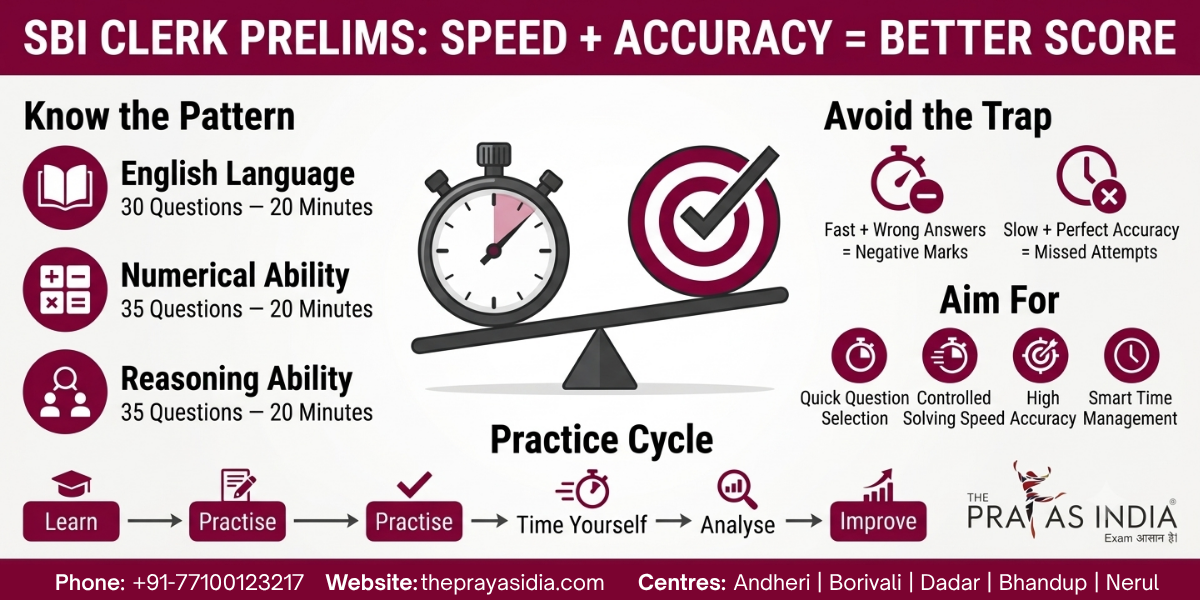
SBI Clerk Prelims is often described as an easy-to-moderate banking examination, but that description can be misleading for serious aspirants. The questions may not always be conceptually difficult, yet the limited sectional time, negative marking and competition for a strong score make speed and accuracy equally important. In the official SBI Junior Associate pattern, the Preliminary Examination consists of 100 questions for 100 marks across English Language, Numerical Ability and Reasoning Ability, with 20 minutes separately allotted to each section. There is also a penalty of one-fourth of the marks assigned to a question for an incorrect answer.
This means that preparing for SBI Clerk Prelims is not simply about learning more concepts. A candidate may know how to solve a percentage question, a puzzle or an error-detection question and still lose marks if the question takes too long or if the solution is marked incorrectly under pressure. The real challenge is to develop a system in which you can identify the right questions, solve them efficiently and avoid unnecessary mistakes.
For many aspirants, the difference between an average mock score and a competitive score does not come from studying an entirely different syllabus. It comes from improving question selection, calculation speed, familiarity with common patterns, sectional time management and post-mock analysis. This is why speed and accuracy should be developed together rather than treated as two separate goals.
Why Speed and Accuracy Both Matter in SBI Clerk Prelims
Speed without accuracy can be dangerous in an exam where wrong answers carry a penalty. If you attempt questions rapidly but make frequent calculation, reading or interpretation mistakes, your increased attempt count may not translate into a better score. On the other hand, extremely cautious solving may produce high accuracy but leave many easy questions unanswered because the sectional clock continues to run.
The objective, therefore, is not to solve every question as quickly as possible. It is to maximise the number of questions you can solve correctly within the available time.
The sectional structure makes this particularly important. You receive 20 minutes for each of the three sections, so you cannot compensate for poor time management in one section simply by using extra time from another section.
This changes the way you should practise. Instead of asking only, “How many questions did I solve?”, start asking:
- How many questions did I solve correctly?
- How much time did I spend on each type of question?
- Which questions consumed disproportionate time?
- How many mistakes were avoidable?
- Which topics give me the best return on time?
- Did I leave easy questions because I was stuck on a difficult one?
These questions help convert practice into measurable improvement.
Understand the Difference Between Learning and Performing
A common mistake in bank exam preparation is assuming that completing the syllabus automatically means becoming exam-ready. Learning a concept and performing under a 20-minute sectional clock are two different skills.
During concept learning, you may take several minutes to understand a question, test different methods and check the solution. That is completely acceptable at the learning stage. However, as you move towards the examination, the same question types must become increasingly familiar.
For example, if you are preparing simplification and approximation, your initial focus should be on understanding the concepts and calculation methods. Once the basics are clear, you should start solving sets of questions with a timer. Eventually, the calculations should become sufficiently familiar that you do not spend unnecessary time deciding which method to use.
The same principle applies to reasoning puzzles and English questions. You are not simply trying to “know” the topic. You are training yourself to recognise the pattern quickly and decide whether it is worth attempting.
The First Step to Better Speed Is Better Question Selection
Many candidates assume that speed means solving every question quickly. In reality, good question selection is one of the biggest contributors to speed.
Suppose you encounter a difficult puzzle in the first few minutes of the Reasoning section. You may be tempted to solve it because you have practised similar puzzles. But if the puzzle requires several cases and you cannot establish a clear starting point, spending five or six minutes on it could be a poor use of your limited time.
An experienced test-taker does not necessarily solve the difficult question faster. Instead, they may recognise that the question is not currently worth attempting and move to questions with a clearer solving path.
This is an important mindset shift. Your target should not be “I must solve this question.” Your target should be “I must use my time where it can generate the highest number of correct answers.”
Develop a Three-Level Question Selection System
During sectional practice, start mentally classifying questions into three broad categories.
Category A: Immediate Attempts should include questions where the concept is familiar, the required steps are clear and the expected solving time is relatively low. These questions should form the foundation of your score.
Category B: Calculated Attempts include questions that appear manageable but require a little more calculation or reasoning. Attempt these after securing the easier questions, provided the expected time investment remains reasonable.
Category C: Time-Consuming or Unclear Questions include lengthy puzzles, confusing arrangements, complicated calculations or questions where you cannot identify the solution path quickly. These should generally be postponed rather than allowed to consume your sectional time.
This classification becomes more effective with practice. Initially, you may misjudge a question and spend too long on it. Mock analysis should help you identify those patterns.
Build Speed Through Timed Practice, Not Random Practice
Speed improves when you repeatedly solve familiar question types under controlled time conditions. Simply solving hundreds of questions without a timer may improve familiarity but may not adequately develop examination speed.
Start with topic-wise timed drills. Once your basics are reasonably strong, set short time limits for specific question types. For example, you can practise a small set of simplification questions, arithmetic questions, grammar questions or reasoning questions against a fixed clock.
As your performance improves, move from topic-wise drills to mixed sectional practice. Mixed practice is important because the real examination will not tell you in advance which question should be attempted first.
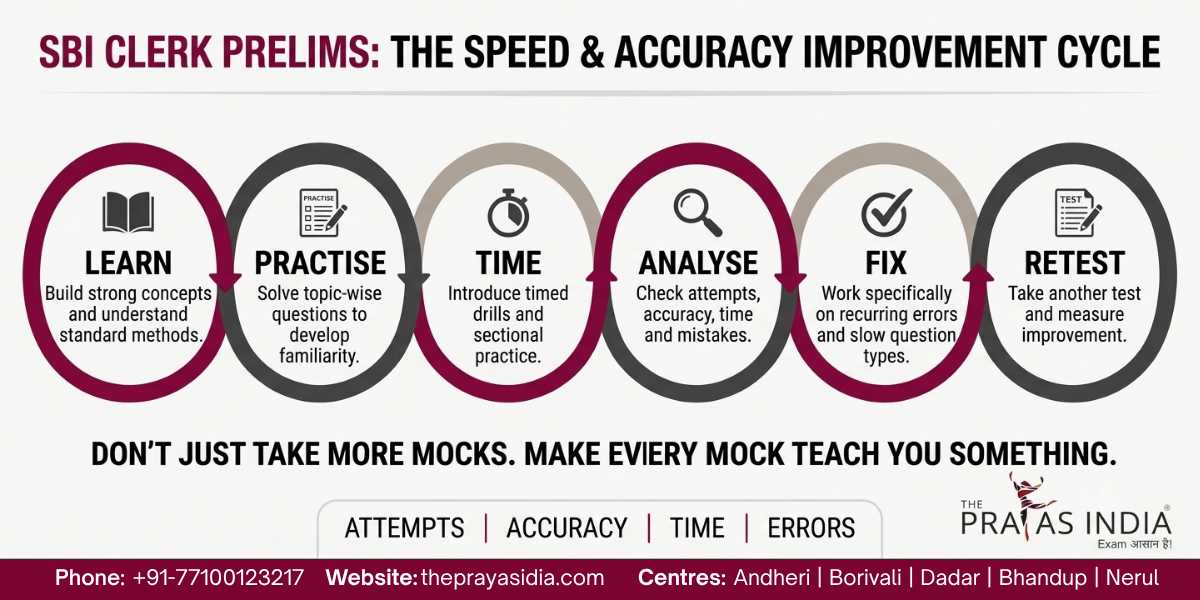
The progression should look something like this:
Concept Learning → Topic Practice → Timed Drills → Mixed Practice → Sectional Tests → Full-Length Mocks
This progression allows speed to develop without sacrificing conceptual clarity.
Accuracy Should Be Improved Before You Chase Extreme Speed
One of the biggest mistakes candidates make is trying to increase their solving speed before establishing reasonable accuracy. If you are currently making frequent mistakes, simply attempting questions faster may increase the number of errors.
Suppose you are solving 25 questions in a section but getting several of them wrong because of calculation mistakes, incorrect reading or premature guessing. Increasing your attempts to 28 without fixing those errors may not improve your actual score.
First identify the source of your mistakes. They may broadly fall into categories such as:
- Conceptual errors, where you do not understand the underlying method.
- Calculation errors, where the concept is known but arithmetic goes wrong.
- Reading errors, where you misunderstand what the question is asking.
- Application errors, where you know the concept but choose the wrong approach.
- Time-pressure errors, where you rush because the clock is running.
- Guessing errors, where you attempt a question without sufficient confidence.
Once you know the category, the solution becomes much more specific.
Create an Error Log That You Actually Use
An error notebook can be extremely useful, but only if it helps you identify patterns rather than becoming a collection of copied solutions.
After a sectional test or mock, record the questions that caused problems and classify the reason for the error. If you repeatedly make mistakes in percentage calculations, for example, revising the same formula once may not solve the problem. You may need focused calculation drills.
Similarly, if your reasoning accuracy is good but your score remains low because you spend too much time on puzzles, your problem is not necessarily reasoning ability. It may be question selection and time management.
Your error log should therefore answer three questions:
What went wrong? Why did it happen? What will I do differently next time?
That final question is the most important. Analysis should lead to a behavioural change in your next practice session.
English: Improve Speed Without Reading Carelessly
In the English section, speed often depends on familiarity with common question formats and the ability to read accurately. Candidates can lose considerable time by overthinking questions that require a relatively direct grammatical or contextual decision.
For Reading Comprehension, avoid reading mechanically just to reach the questions. Focus on understanding the central argument, tone and structure of the passage. This can make the subsequent questions easier to process.
For grammar and vocabulary-based questions, build familiarity through regular practice. When you repeatedly encounter common error patterns, sentence structures and contextual vocabulary, your decision-making becomes faster.
The aim is not to rush through English. It is to reduce unnecessary hesitation while maintaining comprehension.
Quantitative Aptitude: Calculation Speed Is a Trainable Skill
Quantitative Aptitude is one section where calculation efficiency can directly influence the number of questions you are able to attempt. A candidate who understands the concept but performs every calculation through lengthy steps may lose valuable time.
Start developing familiarity with basic arithmetic operations, percentages, fractions, ratios, squares, cubes and common calculation patterns. This does not mean memorising everything mechanically. It means reducing the amount of mental effort required for routine calculations.
At the same time, do not let calculation speed become an excuse for careless approximation. Every shortcut should be reliable enough to maintain accuracy.
Timed arithmetic drills can help you measure progress objectively. Track not only how many questions you solve but also how many are correct and how much time you require.
Reasoning: Learn When to Leave a Puzzle
Reasoning can become a major source of wasted time if you approach every puzzle as a challenge that must be completed immediately.
A better strategy is to quickly assess the structure of the puzzle. Check whether the conditions appear manageable, whether there is a clear starting point and whether the number of cases is likely to remain under control.
If the setup appears complicated and you are not making meaningful progress, move ahead. You can return later if time remains.
This does not mean avoiding difficult questions permanently. It means understanding that the examination rewards overall performance, not the completion of every difficult puzzle.
With regular practice, your ability to recognise manageable and time-consuming sets will improve.
Do Not Confuse More Attempts With Better Performance
Increasing attempts is useful only when accompanied by acceptable accuracy. A mock score should therefore be analysed through multiple metrics rather than attempts alone.
For example, imagine two candidates:
Candidate A: 75 attempts with several avoidable errors.
Candidate B: 68 attempts with substantially better accuracy.
Candidate A may appear faster at first glance, but Candidate B could produce the stronger net score depending on the actual number of correct and incorrect responses.
Because the SBI Clerk Prelims carries a penalty of one-fourth of the marks assigned to a question for an incorrect answer, accuracy must remain part of the attempt strategy.
Your personal target should therefore be based on your own mock data rather than an arbitrary number copied from someone else’s strategy.
Build Your Personal Attempt Strategy Through Mocks
There is no universal section order or fixed attempt number that will work equally well for every SBI Clerk aspirant. Your strategy should emerge from repeated testing.
Take a sectional test and note which question types you naturally solve quickly. Then observe which areas consume disproportionate time. Repeat this process across multiple tests.
For example, you may discover that your English accuracy is high but your reading speed is slow. Another candidate may have excellent Quant calculations but spend too much time on arithmetic questions. A third candidate may solve individual Reasoning questions quickly but struggle with lengthy arrangements.
These candidates should not follow exactly the same strategy.
The purpose of mock tests is therefore not just to produce a score. It is to help you discover how you perform under pressure.
Why Mock Analysis Matters More Than Simply Taking More Tests
Taking a mock test gives you one hour of examination-style practice, but analysing it can tell you much more about your preparation. Current SBI Clerk preparation guidance also emphasises mock tests as a way to identify weaknesses in speed, accuracy and question selection.
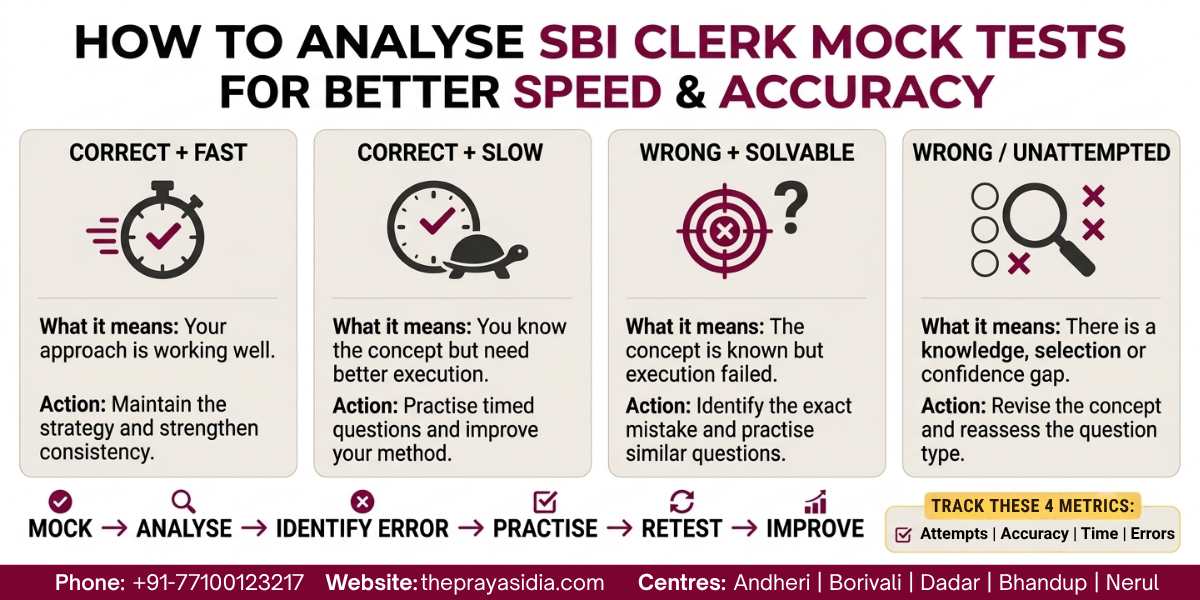
After each mock, divide your questions into four groups:
Correct and Fast: These indicate areas where your preparation is working well.
Correct but Slow: These questions reveal opportunities to improve speed.
Incorrect but Solvable: These are often the most valuable questions for improvement because the required knowledge already exists but execution failed.
Incorrect or Unattempted Due to Lack of Knowledge: These identify genuine preparation gaps that require concept revision.
This classification is much more useful than simply checking your final score and moving on to the next mock.
A Better Daily Routine for Speed and Accuracy
A balanced daily routine should combine learning, practice and analysis. Spending the entire day watching lectures may improve conceptual understanding but may not develop the speed required for Prelims.
A practical study session can include a concept-revision component followed by timed question practice. After that, spend some time reviewing mistakes. The exact number of hours will depend on your preparation stage and other commitments, but the structure should remain balanced.
For example, your daily preparation can include:
- Concept revision for weak topics.
- Timed Quant practice focused on calculations and arithmetic.
- Reasoning practice with a mixture of individual questions and sets.
- English practice covering reading, grammar and vocabulary.
- A short sectional or timed test.
- Review of incorrect and slow questions.
- Revision of recurring mistakes.
The most important part is consistency. Speed generally improves through repeated exposure and deliberate practice, not through occasional marathon study sessions.
What to Focus on Before Increasing Your Mock Frequency
Do not fall into the trap of taking multiple mocks every day simply because you believe more tests automatically mean better preparation. If your fundamentals are weak or you are not analysing your mistakes, additional mocks may simply reproduce the same errors.
Before increasing mock frequency, make sure you are:
- Comfortable with the basic syllabus.
- Practising questions with a timer.
- Reviewing incorrect answers.
- Identifying time-consuming question types.
- Tracking section-wise performance.
- Revising weak concepts.
- Developing a consistent question-selection approach.
Once these habits are established, full-length mocks become considerably more valuable.
The Real Goal: Controlled Speed
The ultimate objective of SBI Clerk Prelims preparation is not to become the fastest person in the room. It is to become a controlled and efficient test-taker.
You should be able to recognise an easy question without hesitation, solve familiar patterns efficiently, avoid unnecessary calculations, identify when a question is consuming too much time and move on without emotional attachment to it.
At the same time, your speed should not make you careless. You should read instructions properly, check calculations where necessary and avoid speculative attempts that can damage your score.
When these habits become automatic, speed and accuracy stop feeling like competing goals. They start working together.
Section-Wise Strategy for Better Speed and Accuracy
The three sections of SBI Clerk Prelims require different approaches. English Language demands reading efficiency and familiarity with common question patterns, Numerical Ability requires calculation speed and method selection, while Reasoning Ability requires logical thinking combined with efficient question selection.
Instead of following the same strategy for every section, identify the areas where you are naturally more comfortable and the question types that consistently give you better returns for the time invested. Once you know your strengths, you can build a sectional approach around them and gradually improve your weaker areas through targeted practice.
How to Improve Speed in English Language
Improving English speed does not mean reading questions carelessly. Your objective should be to understand what the question is asking without spending unnecessary time interpreting straightforward instructions or repeatedly revisiting the same sentence.
Regular practice with grammar, vocabulary, sentence-based questions and Reading Comprehension can make common patterns more familiar. As your familiarity improves, the amount of time required to make a decision generally decreases.
For Reading Comprehension, avoid trying to memorise every sentence of the passage. Focus on understanding the central idea, author’s tone, purpose and the relationship between different parts of the passage. This makes it easier to locate relevant information when answering questions.
For grammar-based questions, revise recurring concepts and practise them through questions rather than relying only on theoretical rules. The more frequently you encounter common patterns, the less time you are likely to spend analysing them during the examination.
If a particular question is taking too long because you are stuck between multiple options, consider moving ahead and returning later if time permits. Spending several minutes on one uncertain question can prevent you from attempting easier questions elsewhere in the section.
Improve Calculation Efficiency in Numerical Ability
Numerical Ability is an area where calculation efficiency can have a direct impact on your attempts. Many candidates understand the concepts but lose valuable time because they use lengthy calculation methods for questions that could be solved more efficiently.
Start by strengthening your familiarity with percentages, fractions, ratios, averages and other commonly used arithmetic relationships. Regular calculation drills can help reduce the time spent on routine operations. However, shortcuts should never come at the cost of accuracy. A method is useful only when you can apply it consistently without creating additional mistakes.
Measure both time and accuracy during your practice. If you solve 20 questions in 10 minutes with 17 correct answers, do not immediately focus on reducing the time to eight minutes. First analyse why the three questions were incorrect. Once your accuracy becomes stable, gradually work towards reducing your solving time.
This approach helps you develop controlled speed rather than rushed speed.
Puzzle Selection Is a Critical Skill in Reasoning
Reasoning Ability can become a major source of wasted time when candidates become emotionally attached to solving a particular puzzle. A puzzle may look familiar, but that does not necessarily mean it is the best question to attempt at that moment.
Before committing several minutes to a puzzle or seating arrangement, spend a short amount of time assessing its structure. Look at the number of conditions, whether there is a clear starting point and whether the arrangement appears manageable.
If you can identify a logical starting point and the conditions are relatively straightforward, proceed with the set. However, if you immediately encounter multiple possibilities and cannot establish a clear direction, it may be better to move to another question and return later.
The ability to leave a time-consuming question is not a weakness. It is an important examination skill because your objective is to maximise the number of correct answers within the available time.
Stop Measuring Preparation Only Through Attempt Numbers
A common mistake during SBI Clerk preparation is to treat attempts as the only measure of progress. Candidates often compare their attempts with those of other aspirants and assume that a higher number automatically represents better preparation.
This is not necessarily true. If one candidate attempts 75 questions with several avoidable mistakes while another attempts fewer questions with significantly stronger accuracy, the second candidate may be using the examination time more effectively.
Your own mock performance should therefore be evaluated using multiple parameters. Look at attempts, correct answers, incorrect answers, time spent and the types of questions that consumed the most time. This gives you a much clearer picture of your actual performance.
The goal is to gradually increase productive attempts, meaning questions that you can solve correctly within a reasonable amount of time.
Build an Error Log That Shows Repeated Problems
A useful error log should not simply contain screenshots or copied solutions. It should help you identify recurring patterns in your performance.
Whenever you make a mistake, record what caused it. Was it a conceptual gap, calculation error, misunderstanding of the question, incorrect option selection, rushed reading or unnecessary guessing?
After several tests, patterns will begin to emerge. You may discover that your Quant mistakes mostly come from calculation errors, while your Reasoning mistakes occur because you spend too much time on lengthy arrangements. In English, you may find that your accuracy is good but you lose time on Reading Comprehension.
Once these patterns become visible, your preparation becomes much more targeted. Instead of saying that you need to “improve Reasoning,” you can work on a specific problem such as puzzle selection or time management.
How to Increase Attempts Without Losing Accuracy
Increasing your attempts should happen gradually rather than suddenly. If you are currently attempting 60 questions with strong accuracy, trying to jump directly to 75 or 80 attempts can create unnecessary pressure and mistakes.
First identify where additional attempts can realistically come from. You may be leaving easy questions because you are spending too much time on difficult ones. You may also be losing time because of lengthy calculations or repeated checking of answers.
Fix these inefficiencies first. Once your accuracy remains stable, you can gradually increase your attempt level.
A good strategy is to set improvement targets based on your own mock data rather than following a fixed attempt number suggested by someone else.
Develop a Personal 20-Minute Sectional Strategy
Because each section has a separate time limit, your preparation should include regular 20-minute sectional tests. These tests are particularly useful because they force you to make the same decisions that you will face in the examination.
During the first few minutes, identify the questions that appear most manageable. Secure those questions before spending time on more demanding ones. Keep track of how much time you are spending on individual questions and sets.
After several sectional tests, you should have a clearer understanding of your natural solving pattern. You may find that you perform better by starting with individual questions in Reasoning before moving to puzzles. Similarly, you may discover that certain English question types should be attempted earlier because they give you faster and more consistent returns.
Do not change this strategy after every mock. Test it across multiple papers and make adjustments only when your performance data consistently suggests that a change is necessary.
A Practical Weekly Routine for Speed and Accuracy
A balanced weekly routine should include concept revision, topic practice, timed drills, sectional tests and mock analysis. Spending all your preparation time on lectures or untimed practice may build knowledge but will not necessarily develop the examination skills required for SBI Clerk Prelims.
Your weekly routine can include:
- Daily calculation practice for Numerical Ability.
- Regular individual Reasoning questions and puzzle sets.
- English reading and grammar practice.
- Topic-wise timed drills.
- Multiple 20-minute sectional tests.
- Full-length mock tests at regular intervals.
- Detailed analysis of incorrect and slow questions.
- Revision of recurring mistakes.
- Reattempting questions that previously caused problems.
The exact number of tests should depend on your preparation stage. The important thing is that every test should have a purpose and should lead to some form of improvement.
Do Not Take Multiple Mocks Without Analysing Them
Taking a mock test without analysing it is similar to checking your final score without understanding how you reached it. The score tells you the outcome, but the analysis tells you what needs to change.
After each mock, first review the questions you got wrong. Then examine the questions you solved correctly but took too long to answer. These slow-but-correct questions are important because they may contain opportunities to improve your attempt count.
After that, review the questions you skipped. Some will genuinely be difficult, but others may be questions you could have solved if you had managed your time differently.
This three-stage analysis can help you identify whether your next improvement should come from knowledge, speed, accuracy or question selection.
What to Do in the Final Weeks Before SBI Clerk Prelims
As the examination approaches, your focus should gradually move from learning large amounts of new material to improving execution. This does not mean completely stopping revision, particularly for weak areas, but your preparation should increasingly resemble the real examination.
Use timed sectional tests, analyse your mistakes and practise your personal question-selection strategy. Revise formulas, important concepts and commonly tested patterns without constantly switching between different study resources.
During this phase, small improvements can make a significant difference. Reducing a few careless mistakes, saving time on routine calculations or learning to leave one particularly time-consuming puzzle can create additional opportunities elsewhere in the section.
The objective is to enter the examination with a strategy that has already been tested repeatedly.
Avoid These Common Mistakes While Preparing for SBI Clerk
Many candidates unintentionally slow down their progress by focusing on the wrong aspects of preparation. Some spend too much time collecting study materials, while others take mock after mock without analysing their performance.
Common mistakes include:
- Trying to solve every question in a mock.
- Increasing attempts without monitoring accuracy.
- Spending too long on difficult puzzles.
- Ignoring calculation practice.
- Taking sectional tests without reviewing mistakes.
- Changing strategy after every mock.
- Comparing attempts with other candidates instead of tracking personal progress.
- Guessing questions simply to increase the attempt count.
- Avoiding weak topics instead of addressing them.
- Practising only easy questions because they feel comfortable.
Avoiding these mistakes can itself improve your performance because it prevents you from wasting valuable preparation time.
Why Structured SBI Clerk Preparation Can Make a Difference
Self-study can work well when an aspirant has a clear plan, disciplined routine and the ability to evaluate performance objectively. However, many candidates struggle not because they lack effort but because they do not know exactly where their preparation is going wrong.
Structured coaching can help provide a defined preparation framework, regular practice, mock tests, performance analysis and guidance on how to approach different sections. This can be particularly useful for aspirants who repeatedly take tests but are unable to convert their practice into consistent score improvement.
For candidates looking for Bank Exam Coaching in Mumbai, The Prayas India provides structured preparation and guidance for competitive banking examinations. Aspirants can explore the available coaching support at centres across Andheri, Borivali, Dadar, Bhandup and Nerul.
For admission-related information, contact +91-77100 13217.
Final Takeaway
Improving speed and accuracy in SBI Clerk Prelims is a gradual process. You do not need to suddenly become much faster. Instead, you need to eliminate the small inefficiencies that repeatedly consume your examination time.
Start with strong fundamentals, move towards timed practice and then use sectional tests and mocks to understand your actual performance. Analyse every mistake, identify questions that take too long and develop the confidence to move on when a question does not offer a reasonable return on time.
Most importantly, remember that speed and accuracy should develop together. Fast solving without accuracy can lead to unnecessary negative marks, while perfect accuracy at a very slow pace can leave valuable questions unanswered.
The strongest SBI Clerk aspirants develop controlled speed, reliable accuracy and disciplined question selection. With consistent practice, detailed mock analysis and structured guidance, these skills can become a natural part of your examination strategy.
For aspirants preparing for SBI Clerk and other banking examinations in Mumbai, The Prayas India offers structured coaching support across Andheri, Borivali, Dadar, Bhandup and Nerul.
Phone: +91-77100 13217
FAQs
1. How can I improve speed in SBI Clerk Prelims?
Speed improves through regular timed practice, familiarity with common question types, efficient calculation methods and better question selection. Instead of trying to solve every question faster, focus on solving the right questions efficiently.
2. How can I improve accuracy in SBI Clerk Prelims?
Analyse every mock carefully and identify whether your mistakes are caused by conceptual gaps, calculations, misreading, rushing or incorrect question selection. Targeted practice based on these patterns is more effective than simply taking more tests.
3. How important is time management in SBI Clerk Prelims?
Time management is extremely important because each section has a separate time limit. Your preparation should therefore include regular sectional tests that replicate the actual time pressure.
4. Should I increase my attempts to improve my SBI Clerk score?
Increase attempts only when your accuracy remains stable. Blindly attempting more questions can create additional errors. Focus on increasing productive attempts rather than total attempts.
5. How can I improve calculation speed for SBI Clerk Quant?
Practise basic calculations regularly under timed conditions. Focus on percentages, fractions, ratios, averages and other frequently used arithmetic operations while maintaining accuracy.
6. How can I improve Reasoning speed for SBI Clerk?
Practise individual questions as well as puzzles and seating arrangements. More importantly, learn to identify manageable sets quickly and avoid spending excessive time on questions where the solving path is unclear.
7. How can mock tests improve SBI Clerk preparation?
Mock tests provide an opportunity to practise under examination-like conditions. Their real value comes from analysing attempts, accuracy, time spent, incorrect answers and questions that were unnecessarily skipped.
8. Why am I solving questions correctly but still scoring low?
You may be spending too much time on individual questions, leaving easy questions unattempted or losing marks through avoidable errors. Analyse your mock by separating correct-fast, correct-slow, incorrect-solvable and unattempted questions.
9. Should I change my strategy after every SBI Clerk mock?
No. Test a strategy across several mocks before deciding whether it works. Changing your approach after every test can make your preparation inconsistent and prevent you from developing a reliable examination routine.
10. Can SBI Clerk coaching help improve speed and accuracy?
Structured coaching can provide a systematic preparation plan, regular practice, mock tests and performance analysis. For aspirants who struggle to identify their weaknesses or maintain consistency, this structured environment can be useful.
For Bank Exam Coaching in Mumbai, The Prayas India has centres at Andheri, Borivali, Dadar, Nerul, and Bhandup. For admission-related information, contact: +91-77100 13217