How to Know If Your SSC CGL Preparation Is on Track | Best SSC Coaching in Mumbai | The Prayas India
Preparing for SSC CGL is not simply about studying for several hours every day or completing a certain number of chapters. The more important question is whether your preparation is actually moving you closer to the level required to perform well in the examination.
Many SSC CGL aspirants study consistently but remain unsure about their progress. They complete mock tests, solve practice questions, watch classes and revise notes, yet their scores may not improve as expected. Others may feel confident because they have covered a large portion of the syllabus, only to discover during mocks that their speed, accuracy or question selection is still weak.
This is why regular self-assessment needs to become a part of SSC CGL preparation. Being “busy with preparation” and being “on the right track” are not necessarily the same thing. A candidate on the right track should be able to identify measurable improvements in conceptual understanding, accuracy, speed, mock performance and confidence under time pressure.
For aspirants preparing through coaching, this assessment becomes even more useful. A structured SSC CGL coaching programme should not only help students complete the syllabus but also provide a system through which they can identify weaknesses, analyse performance and modify their preparation strategy.
Preparation Progress Should Be Measured, Not Assumed
One of the easiest mistakes to make during SSC CGL preparation is assuming that more study automatically means more progress. Spending six or eight hours with books does not necessarily mean those hours are producing the required improvement.
The right question is not, “How many hours did I study today?” It is, “What can I do today that I could not do a few weeks ago?”
Perhaps you are solving Quantitative Aptitude questions faster. Perhaps your English accuracy has improved. Maybe you are making fewer calculation errors in mocks or completing Reasoning questions with more confidence. These are meaningful indicators because they show a change in performance rather than simply an increase in study time.
At the same time, progress does not always mean that every mock score will keep increasing. Competitive-exam performance naturally fluctuates depending on paper difficulty, question selection and the areas tested. A temporary drop should therefore not immediately be interpreted as preparation failure.
The broader trend matters more than one individual test. If your accuracy is improving, your mistakes are becoming more specific, your solving time is reducing and you are developing a clearer attempt strategy, your preparation may be progressing even when a particular mock score does not reflect it.
The First Sign: Your Concepts Are Becoming More Reliable
A strong SSC CGL preparation begins with conceptual clarity. If you are regularly memorising shortcuts without understanding the underlying concepts, your preparation may appear fast initially but become unreliable when questions are presented in unfamiliar forms.
For Quantitative Aptitude, conceptual understanding should allow you to recognise which method is appropriate for a particular question. In Reasoning, you should increasingly identify patterns rather than spending excessive time figuring out what a question is asking. In English, understanding grammar rules and contextual usage should gradually reduce dependence on guesswork.
General Awareness is somewhat different because it involves a combination of static knowledge and current or exam-relevant information. Here, being on the right track means developing a systematic learning and revision process rather than continuously collecting new facts.
A useful test of conceptual preparation is to remove your notes and attempt questions from a topic you have already studied. If you can solve a reasonable variety of questions without repeatedly checking formulas or explanations, that is a positive sign. If you understand the solution only after seeing it, the topic may require another round of concept-building.
Syllabus Completion Alone Does Not Mean You Are Ready
Many aspirants use syllabus completion as their primary measure of preparation. Statements such as “I have completed 70% of the syllabus” can sound reassuring, but syllabus percentage does not tell you how well those topics have actually been prepared.
A candidate may have completed 90% of the syllabus but still struggle with basic questions because the topics were covered only once. Another candidate may have completed 70% but have strong command over the most important areas through repeated practice and revision.
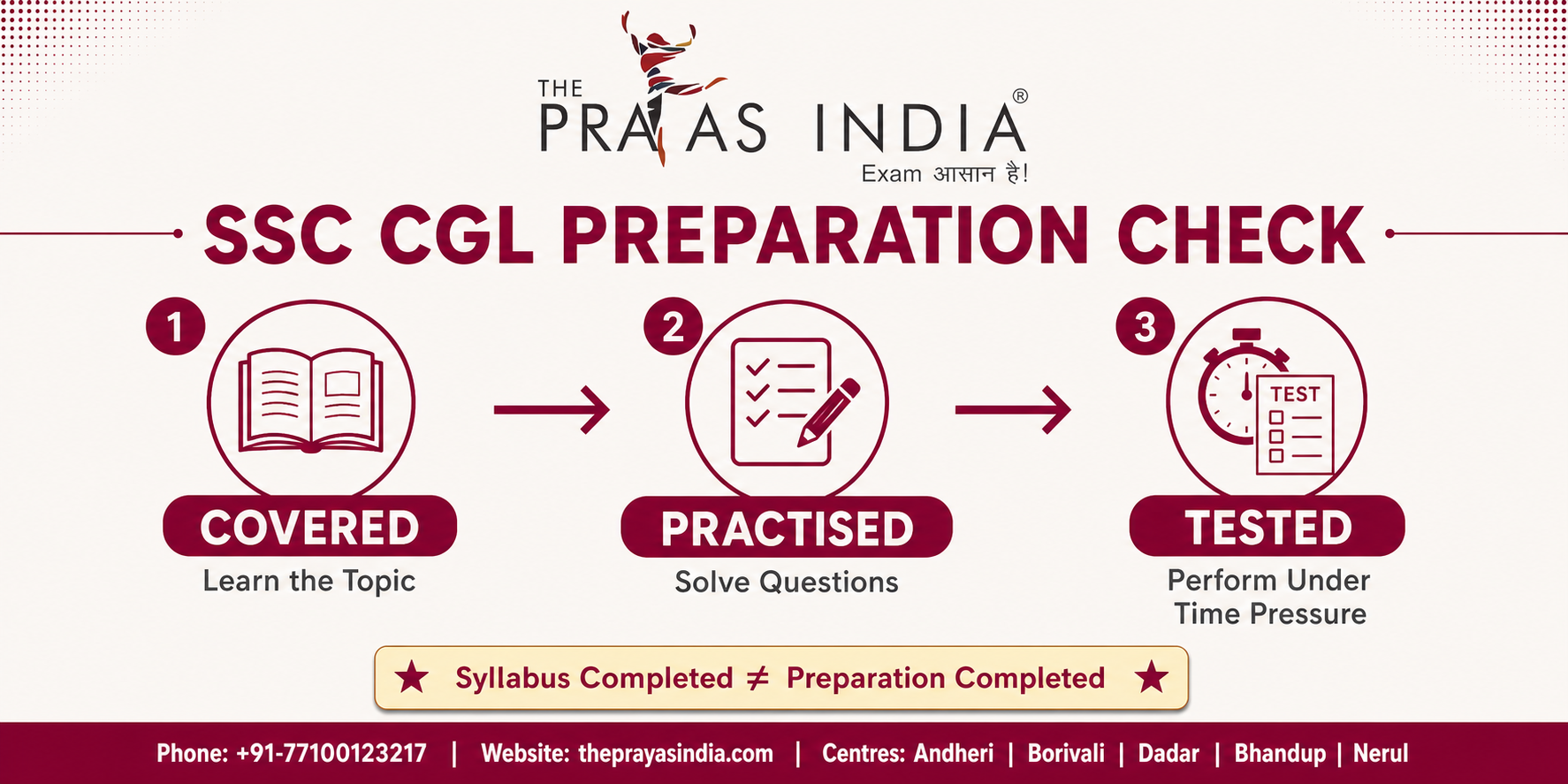
This is why syllabus tracking should have at least three levels:
Covered: You have studied the topic.
Practised: You have solved enough questions to understand how the topic behaves in an exam.
Tested: You have successfully applied the topic under time pressure.
A topic should ideally move through all three stages. Simply ticking it off after watching a lecture or reading a chapter creates a false sense of completion.
Your Mock Scores Should Show a Meaningful Trend
Mock tests are among the clearest ways to assess whether SSC CGL preparation is moving in the right direction. However, candidates should not judge their preparation only by looking at the final score or percentile after every test.
A better approach is to compare mock performance over a period of several tests. Look for patterns in your overall score, section-wise performance, accuracy, attempts and time management. If your scores are gradually becoming more stable and your weak areas are improving, that is a positive signal.
For example, suppose your first few mocks show inconsistent performance in Quantitative Aptitude. After several weeks of targeted practice, your scores may still fluctuate, but the gap between your strongest and weakest performances could become smaller. That increased consistency is itself an important sign of progress.
Similarly, if your English score has remained relatively stable while your accuracy has increased and the time taken has reduced, your preparation may be improving even if the overall score has not changed dramatically.
Mock tests should therefore be treated as a performance dashboard rather than a simple pass-or-fail report.
Accuracy Is Often a Better Signal Than Attempts
A high number of attempts can look impressive, but attempts have value only when they convert into correct answers. SSC CGL aspirants should therefore monitor accuracy alongside attempts.
If you are attempting significantly more questions but making frequent errors, increasing speed further may not be the right solution. You may need to slow down slightly and identify the source of your mistakes.
On the other hand, if your accuracy is consistently strong but your attempts are low, the issue may be speed, question selection or excessive time spent on individual questions.
This creates three broad preparation situations:
High accuracy + low attempts: Work on speed and question selection.
Low accuracy + high attempts: Work on concepts, reading and controlled solving.
High accuracy + improving attempts: Your preparation is moving in a strong direction.
These indicators should be reviewed regularly instead of relying on a single mock score.
Are You Making Fewer Repeated Mistakes?
One of the strongest indicators that preparation is working is a reduction in repeated mistakes.
Making mistakes during practice is normal. In fact, mistakes are useful because they reveal areas that need attention. The problem begins when the same mistake appears repeatedly without any change in strategy.
Maintain an error log with the reason behind each important mistake. Instead of writing only the correct answer, identify whether the error occurred because of a conceptual gap, calculation mistake, misreading, lack of attention, time pressure or incorrect question selection.
After a few weeks, review this log. If the same categories of mistakes continue appearing frequently, your preparation needs adjustment. If the number of repeated errors is declining, that is a strong sign that your practice and revision are working.
This is also where structured guidance can be useful. An experienced faculty member can sometimes identify a pattern in a student’s mistakes that the student may not notice independently.
Your Study Material Should Be Getting Simpler, Not Larger
Another important sign of healthy preparation is that your dependence on multiple resources gradually decreases.
In the early stage, students naturally explore different books, classes, question banks and study materials. But as preparation progresses, continuously adding new resources can become counterproductive.
A candidate who is on the right track should gradually develop a reliable preparation system. Notes become shorter, important formulas become easier to recall, frequently repeated concepts become familiar and revision becomes more targeted.
If you are constantly switching between teachers, books, PDFs and online sources because you feel that the previous material was insufficient, it may be time to reassess your study strategy.
The goal is not to accumulate more content. The goal is to make the content you already studied easier to recall and apply.
Your Time Management Should Improve With Practice
SSC CGL preparation is not complete when you know how to solve questions. You also need to know how to solve them within the available examination time.
During practice, start tracking the time required for different question types. This does not mean rushing through every question. Instead, learn to distinguish between questions that deserve immediate attention and questions that may consume too much time.
A candidate who is on the right track should gradually become better at recognising familiar question types, estimating the effort required and moving away from questions that are inefficient.
This improvement may initially appear small. Saving ten or fifteen seconds across several questions can eventually create enough additional time to attempt questions that would otherwise remain untouched.
Time management should therefore be developed during preparation rather than treated as a skill that will automatically appear on examination day.
Section-Wise Progress Tells You More Than Your Overall Score
An overall mock score is useful, but it does not tell you exactly where your preparation stands. Two candidates can achieve the same score while having completely different strengths and weaknesses. One may have strong English and Reasoning but struggle with Quantitative Aptitude, while another may have excellent Quant accuracy but lose marks in General Awareness.
This is why SSC CGL aspirants should maintain a section-wise performance record. The objective is not to become equally strong in every topic overnight. It is to understand where you are already competitive and where additional preparation is required.
For Quantitative Aptitude, look at accuracy, calculation time and performance across different topics. If your percentage and algebra questions are strong but arithmetic questions continue to consume too much time, your preparation plan should reflect that gap.
For Reasoning, monitor how quickly you recognise patterns and whether certain question types repeatedly cause errors. English should be evaluated through accuracy, comprehension, vocabulary and grammar-based performance, while General Awareness requires particular attention to retention and revision because simply reading information does not guarantee recall during a timed examination.
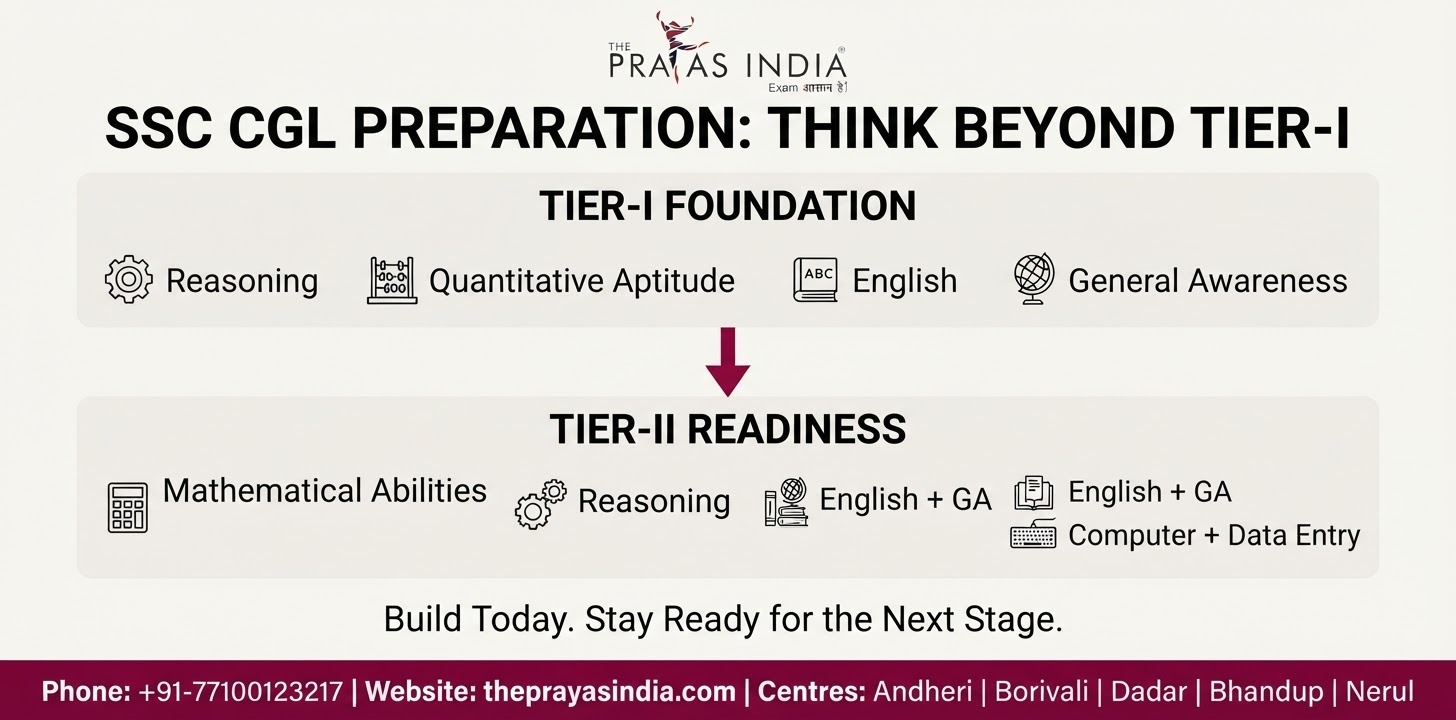
The current SSC CGL Tier-I structure gives equal weight to General Intelligence and Reasoning, General Awareness, Quantitative Aptitude and English Comprehension, with 25 questions and 50 marks for each section. The paper also carries negative marking, making accuracy an important part of preparation rather than an optional advantage.
Your Preparation Is on Track If Your Weak Areas Are Becoming Specific
Early in preparation, it is normal to feel that everything needs improvement. You may struggle with several Quant topics, make frequent English errors and find Reasoning sets slow. But as preparation progresses, these broad weaknesses should become more specific.
Instead of saying, “My Quant is weak,” you should eventually be able to say, “My arithmetic accuracy is good, but I am slow in time-and-work questions.” Instead of saying, “My English is poor,” you should know whether your main problem is vocabulary, grammar, reading comprehension or careless mistakes.
This shift from general confusion to specific diagnosis is a very positive sign.
Once weaknesses become specific, they become easier to fix. You can dedicate targeted practice sessions to those areas, take sectional tests and measure whether the problem is improving. A structured preparation system can accelerate this process because regular testing and faculty feedback can help identify gaps earlier.
You Should Be Able to Revise Without Starting From Zero
Another strong indicator of preparation quality is the effectiveness of revision. If every revision session feels like learning the topic for the first time, the original preparation may not have been deep enough.
Good revision should feel different from first-time learning. You should recognise formulas, remember important rules and understand familiar question patterns more quickly. You may still encounter difficult questions, but the basic concepts should no longer feel unfamiliar.
This is particularly important for SSC CGL because the preparation volume can become large. Trying to remember everything through repeated reading is inefficient. Instead, candidates should create concise notes, formula sheets, vocabulary lists and error logs that make revision progressively faster.
A useful test is to revisit a topic after a gap and solve a small set of questions without looking at your notes. If your recall and accuracy are better than they were earlier, your revision process is working.
Your Mock Analysis Should Change Your Next Study Session
A mock test should never end when you click “submit.” The real preparation begins when you analyse the result.
After every mock, divide your mistakes into categories. A wrong answer may have happened because you did not know the concept, misunderstood the question, made a calculation error, rushed through the question or selected a question that was not worth the time.
These reasons require different solutions.
A conceptual mistake needs study and practice. A calculation mistake may require more controlled solving. A reading mistake may require greater attention to question wording. A time-management problem requires timed practice, while poor question selection requires a change in attempt strategy.
The best sign that your preparation is on the right track is therefore not simply a higher mock score. It is that your mock analysis is actively influencing what you study next.
If you repeatedly discover that you are making the same mistakes but continue following exactly the same study routine, your preparation needs adjustment.
Watch Your Accuracy When Your Attempts Increase
As candidates become more comfortable with SSC CGL questions, their attempts usually increase. This is encouraging, but increased attempts should not be treated as progress by themselves.
Suppose you attempt 80 questions in one mock with 90% accuracy and later attempt 90 questions with 75% accuracy. The second test may show higher attempts but weaker performance quality. Increasing speed without controlling accuracy can therefore create a false sense of improvement.
Instead, aim for a gradual relationship between attempts and accuracy. As your familiarity with question types improves, you should be able to attempt more questions while maintaining reliable accuracy.
The presence of negative marking in Tier-I makes this particularly important. Your preparation should teach you not only how to solve questions but also when a question is worth attempting.
You Are Becoming Better at Question Selection
Strong SSC CGL preparation eventually changes the way you look at a question paper.
Instead of trying to solve every question in front of you, you begin to identify familiar patterns, easy conversions and questions that can consume disproportionate amounts of time. This is a sign that preparation is becoming exam-oriented.
Question selection should develop through regular timed practice and mock analysis. After each test, ask yourself whether you spent too much time on a particular question, skipped something that you could have solved quickly or attempted something despite being uncertain.
Over time, you should become increasingly comfortable leaving questions temporarily and returning to them when appropriate. This is not a sign of weak preparation. It is part of efficient exam management.
Your Tier-II Preparation Should Already Be Taking Shape
Candidates sometimes focus so heavily on Tier-I that they overlook the broader preparation required for Tier-II. This can become a problem because Tier-II demands continued preparation across multiple areas.
The current SSC CGL scheme includes Paper-I components covering Mathematical Abilities and Reasoning and General Intelligence, followed by English Language and Comprehension and General Awareness, along with Computer Knowledge and a Data Entry Speed Test component.
This does not mean that candidates should divide their preparation equally between every Tier-I and Tier-II component from the beginning. Instead, the foundation created for Tier-I should gradually support Tier-II preparation.
For example, strong Quantitative Aptitude fundamentals developed during Tier-I preparation can later support Mathematical Abilities. Similarly, consistent English preparation can serve both stages. Regular General Awareness preparation can prevent a large backlog from accumulating later.
The right approach is to think of SSC CGL preparation as one continuous journey rather than two disconnected examinations.
Warning Signs That Your SSC CGL Preparation Needs a Change
Not every difficult phase means that your preparation is failing. However, certain patterns should prompt you to reassess your strategy.
If your mock scores remain stagnant for a long period despite regular tests, you should investigate why. If you keep making the same mistakes, the issue may be insufficient revision or lack of error analysis. If you are completing a large number of questions but accuracy remains low, speed may not be your immediate priority.
Another warning sign is constantly changing your resources. Moving from one book to another, switching teachers repeatedly or collecting more PDFs every time a topic feels difficult can prevent you from developing depth.
Similarly, if you have stopped taking mocks because your scores are disappointing, the problem can become harder to diagnose. Mocks are not meant only to confirm that you are ready. They are meant to show you what still needs work.
A Simple Weekly SSC CGL Progress Check
Candidates do not need a complicated performance dashboard. A simple weekly review can reveal whether preparation is moving forward.
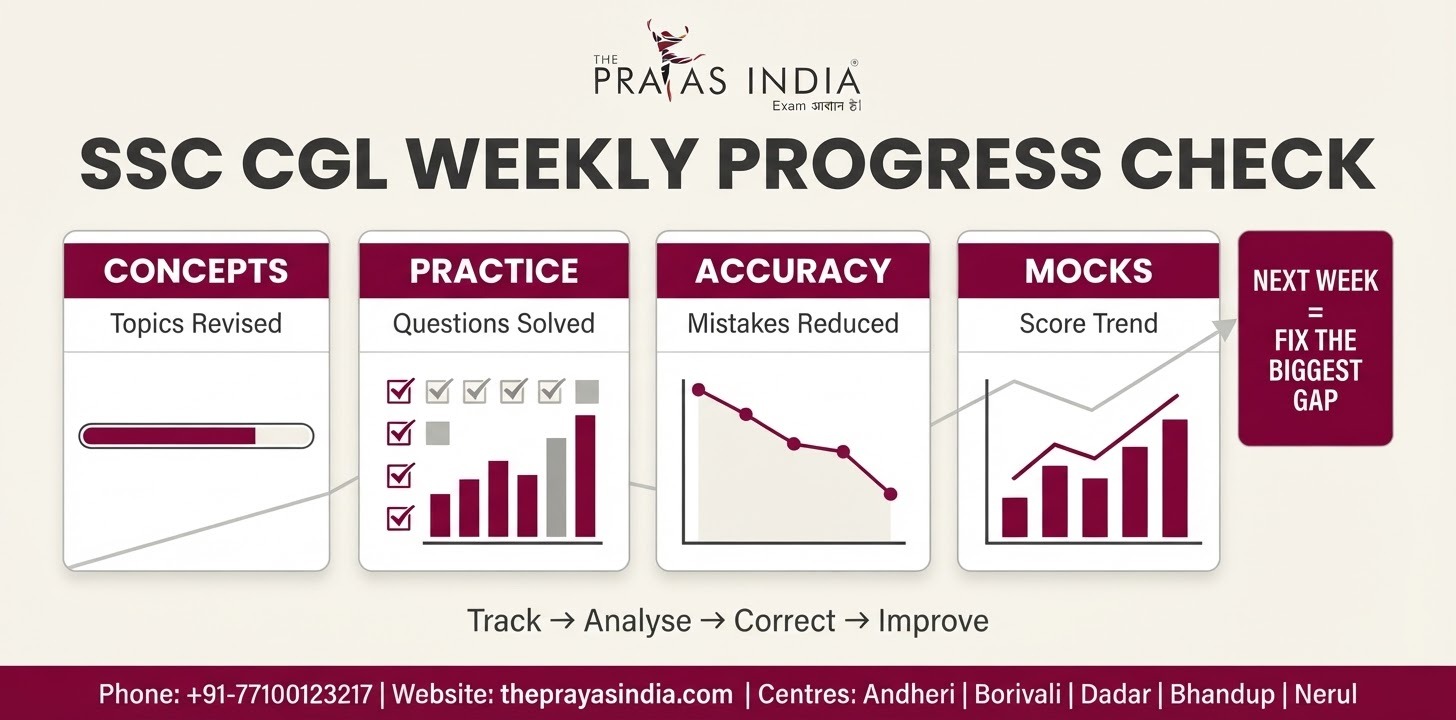
At the end of every week, review five areas:
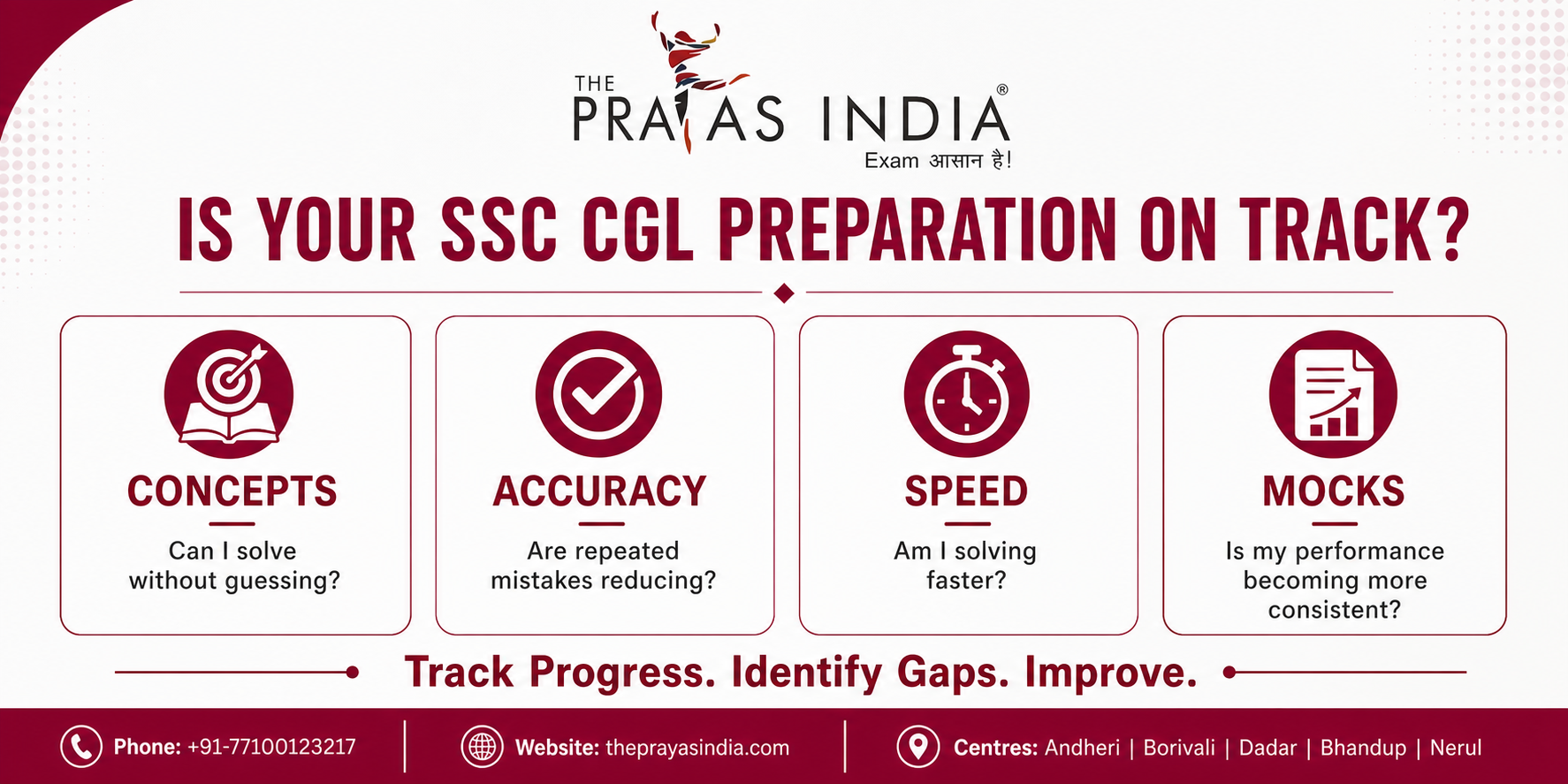
Concepts: Which topics became stronger this week?
Accuracy: Which mistakes reduced?
Speed: Which question types are becoming faster?
Mocks: Is performance becoming more consistent?
Revision: Can you recall previously studied material without relearning it?
Then compare this week’s answers with the previous week’s. The purpose is not to demand dramatic improvement every seven days. Instead, look for a gradual positive trend.
If the answer to most of these questions is yes, your preparation is likely moving in the right direction. If several answers remain no for multiple weeks, it is time to modify your study plan.
When Structured SSC CGL Coaching Can Make a Difference
Self-study can be effective, particularly for candidates who already have strong discipline and know exactly how to organise their preparation. But many aspirants struggle not because they lack effort, but because they lack a reliable system.
A structured coaching environment can help bring consistency to concept learning, practice, doubt solving, testing and revision. Instead of deciding every day what to study next, candidates can follow a defined preparation sequence and use regular tests to measure progress.
For aspirants looking for SSC CGL coaching in Mumbai, the quality of guidance matters. Students should evaluate faculty support, course structure, study material, test series, doubt-solving mechanisms, revision strategy and performance tracking before choosing an institute.
The right coaching environment should help students understand not only what to study but also how to evaluate whether the preparation is producing measurable improvement.
How The Prayas India Supports a Structured SSC CGL Preparation Approach
At The Prayas India, SSC CGL preparation can be approached as a structured process rather than a collection of disconnected classes and practice sessions. The focus should remain on building concepts, strengthening question-solving ability, testing performance and using the results to identify the next area of improvement.
This approach is particularly useful for aspirants who find it difficult to maintain consistency on their own or who struggle to understand why their mock scores are not improving despite regular study.
The value of a structured preparation environment is ultimately reflected in the student’s ability to become more independent over time. Students should gradually become better at recognising question patterns, managing time, analysing mistakes and planning their revision.
For candidates considering The Prayas India for SSC CGL preparation in Mumbai, admissions can be an opportunity to bring greater structure and accountability to the preparation journey.
The Real Test of Your Preparation
The best way to know whether your SSC CGL preparation is on the right track is to look beyond the number of chapters completed or hours studied.
Ask yourself whether your concepts are becoming stronger, whether your accuracy is improving, whether your solving speed is increasing, whether repeated mistakes are reducing and whether your mock performance is becoming more consistent.
Most importantly, check whether you know exactly what you need to improve next.
Preparation becomes much more effective when every test produces a lesson, every mistake produces an action point and every revision cycle strengthens something you already studied.
SSC CGL is a competitive examination, and being prepared means more than knowing the syllabus. It means being able to apply that knowledge accurately and efficiently under exam conditions.
If your preparation currently feels scattered, inconsistent or difficult to measure, structured guidance can help you create a clearer path. With systematic classes, regular practice, mock tests, performance analysis and revision, aspirants can work toward building the level of preparation required for the examination.
For students looking for SSC CGL coaching in Mumbai, The Prayas India provides a structured preparation environment designed to help aspirants move from learning to practice, from practice to testing and from testing to measurable improvement.
Contact Us
- Call Now: +91-77100 13217
- Website: theprayasindia.com
- Centres: Andheri | Borivali | Dadar | Nerul | Bhandup
Frequently Asked Questions
1. How do I know if my SSC CGL preparation is going well?
Look at multiple indicators rather than one score. Improving accuracy, faster solving, fewer repeated mistakes, better revision and more consistent mock performance are strong signs that preparation is progressing.
2. Is completing the SSC CGL syllabus enough?
No. Completing the syllabus is only the first step. Topics should also be practised, tested under time pressure and revised regularly. A candidate can complete the syllabus and still be underprepared for the actual examination.
3. How important are mock tests for SSC CGL preparation?
Mock tests are important because they help measure speed, accuracy, question selection and exam readiness. However, their value depends heavily on post-test analysis. Taking mocks without analysing mistakes can limit their usefulness.
4. What should I do if my SSC CGL mock scores are not improving?
Analyse your mistakes instead of simply taking more mocks. Identify whether the problem comes from concepts, accuracy, speed, question selection or revision. Then make targeted changes to your study plan and test the same areas again.
5. Should I prepare for SSC CGL Tier-I and Tier-II together?
Yes, but the intensity can vary according to the examination stage. Build a strong Tier-I foundation while keeping relevant Tier-II areas active so that you do not have to start broader preparation from zero later.
6. How can I improve my SSC CGL accuracy?
Identify the exact reason behind your errors. Conceptual mistakes require stronger fundamentals, calculation mistakes require controlled practice, while careless errors may require better reading and checking habits. Regular error analysis is essential.
7. When should I join SSC CGL coaching?
The ideal time depends on your current preparation level and study requirements. Joining early can help candidates build fundamentals and follow a structured routine, while candidates already preparing independently can also benefit from coaching for testing, guidance and performance improvement.
8. How should I choose the best SSC coaching in Mumbai?
Compare faculty experience, course structure, study material, test series, doubt-solving support, revision system and performance tracking. The best choice is the institute that matches your learning requirements and provides a structured preparation process.