How to Manage Time in IBPS Clerk Mains? | Section-Wise Time Management Strategy | Best Bank Coaching in Mumbai | The Prayas India
IBPS Clerk Mains is not only a test of how much you know. It is also a test of how efficiently you can use limited time.
Many candidates enter the Mains examination with reasonable preparation but struggle to convert their knowledge into marks because they spend too much time on a difficult puzzle, overanalyse a Quant question, or leave insufficient time for General/Financial Awareness. In a competitive exam, these small decisions can have a significant impact on the final score.
That is why time management should not be treated as something you will figure out on the exam day. It needs to become part of your preparation well before the examination.
The ideal strategy is not to divide the paper into four equal blocks of time. Instead, you should understand the nature of each section, identify your strongest areas, recognise questions that consume excessive time and create a section-wise attempt strategy.
For an IBPS Clerk aspirant, the objective should be simple:
Spend more time where marks are available and less time where the question is taking you nowhere.
Why Time Management Matters in IBPS Clerk Mains
IBPS Clerk Mains requires candidates to handle multiple sections with different question styles and difficulty levels. General/Financial Awareness tests recall and awareness, while English requires reading and interpretation. Reasoning and Quantitative Aptitude can demand considerably more time because individual questions may involve multiple steps.
This creates an important challenge.
A candidate may be strong in Reasoning but lose valuable minutes on one complicated puzzle. Another candidate may be comfortable with Quant but spend too much time trying to solve a calculation-heavy question. Someone else may attempt every English question in sequence without considering whether certain questions are consuming disproportionate time.
Therefore, time management is not simply about solving faster.
It is about:
- Choosing the right questions
- Recognising when to move on
- Allocating time according to section strengths
- Maintaining accuracy under pressure
- Avoiding unnecessary calculations
- Leaving enough time for high-confidence questions
- Practising under realistic time constraints
A good time-management strategy should eventually become automatic.
First Understand the IBPS Clerk Mains Structure
Before designing a time-management strategy, you need to understand what you are managing.
The IBPS Clerk Mains examination includes four broad areas:
| Section | Main Skill Tested |
|---|---|
| General/Financial Awareness | Knowledge & Recall |
| General English | Reading, Grammar & Language |
| Reasoning Ability & Computer Aptitude | Logic, Arrangement & Problem Solving |
| Quantitative Aptitude | Calculation, Interpretation & Mathematical Reasoning |
The examination has a fixed overall duration, but the section-wise timing and question distribution mean that candidates need to think strategically rather than treating the paper as one unlimited pool of questions.
Your personal strategy should therefore be based on question selection + accuracy + time control.
Don’t Divide Your Time Equally
One of the most common mistakes is assuming that every section deserves the same amount of time.
Suppose a candidate decides:
25% time for every section.
It looks organised, but it may not be practical.
If Reasoning is taking longer than expected, the candidate may start rushing through another section. Similarly, if General Awareness is a strong area, spending excessive time there may not provide additional marks.
Instead, think in terms of return on time.
Ask:
“If I spend another two minutes here, am I likely to gain another mark?”
If the answer is no, moving to another question may be the better decision.
Build Your Time Strategy Around Strengths
Your ideal time allocation depends partly on your individual performance.
Consider three hypothetical candidates.
Candidate A: Strong in Reasoning
This candidate may comfortably handle puzzles and logical questions but needs more time in Quant.
The strategy can allow slightly more time for Quant while protecting the candidate’s strong Reasoning performance.
Candidate B: Strong in Quant and English
This candidate may want to maximise marks in those sections while using a controlled approach to Reasoning.
Candidate C: Balanced Across Sections
This candidate may benefit from a more evenly distributed approach, while still maintaining strict limits for lengthy questions.
There is no universally perfect section order.
Your mock-test data should determine your final strategy.
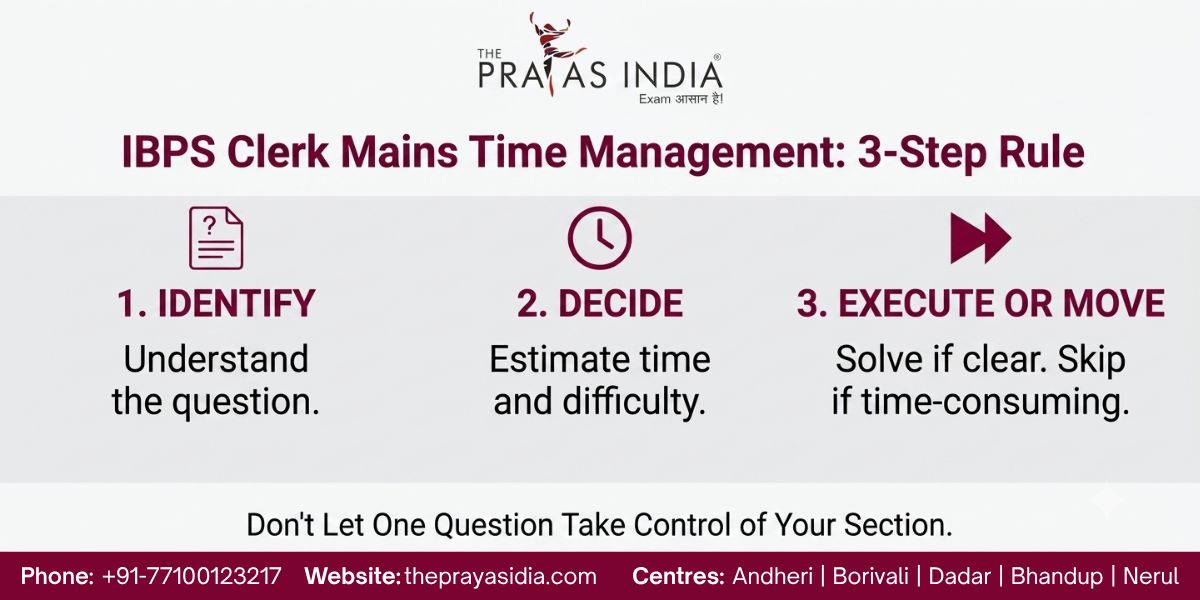
The 3-Stage Approach to Time Management
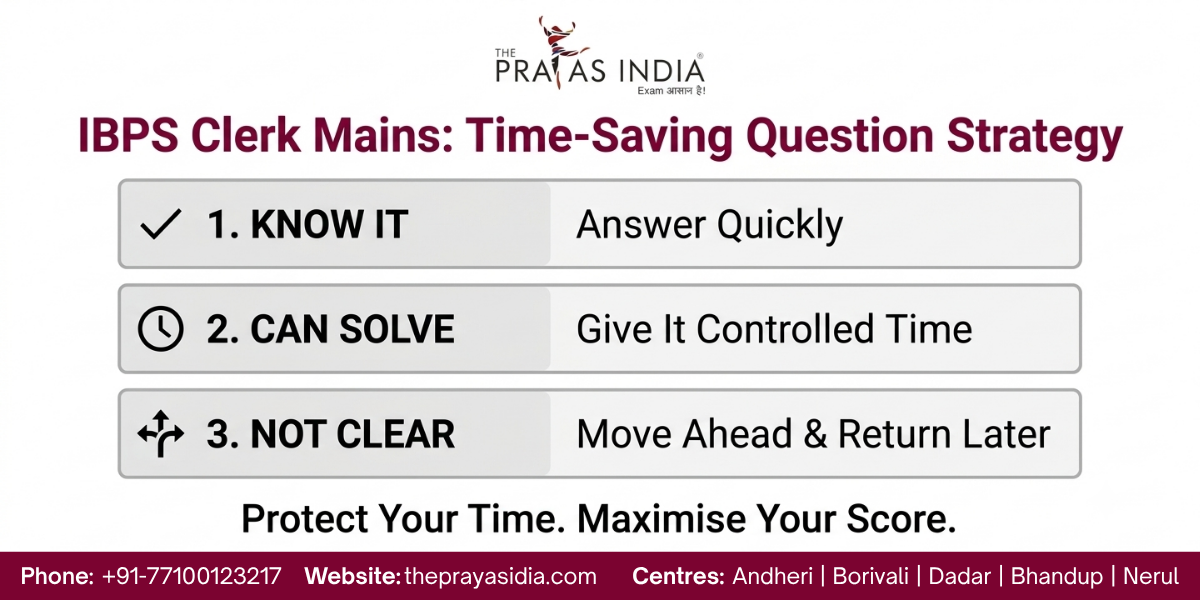
A useful way to approach each section is to divide your decision-making into three stages.
Stage 1: Identify
Look at the question and understand what it demands.
Stage 2: Decide
Estimate whether the question is worth your time.
Stage 3: Execute or Move
Solve it if the path is clear. Otherwise, move ahead.
This sounds simple, but it is one of the most important habits for competitive exams.
A question does not become worth solving merely because you have already spent 60 seconds on it.
The 30-Second Decision Rule
You should not literally use a stopwatch for every individual question during the actual exam.
However, during practice, develop a sense of how long you can afford to spend understanding a question.
If after the initial reading you cannot identify a reasonable approach, consider moving forward.
This is particularly important in:
- Puzzles
- Seating arrangements
- Lengthy DI questions
- Calculation-heavy Quant questions
- Unfamiliar reasoning questions
The purpose is not to abandon difficult questions permanently.
You can return to them if time permits.
The objective is to avoid allowing one question to control the entire section.
Section-Wise Time Management for IBPS Clerk Mains
Now comes the practical part.
Different sections require different approaches because the nature of their questions is different.
Your strategy should not be:
“I will solve every question in the order it appears.”
Instead, develop a section-specific plan.
General/Financial Awareness: Prioritise Recall and Decision Speed
General/Financial Awareness is fundamentally different from the other sections.
If you know the answer, the question may take only a few seconds.
If you do not know it, spending one or two minutes trying to remember a fact usually does not help.
This makes GA one of the sections where decision speed can be extremely valuable.
A practical approach is:
Read → Recall → Answer or Move
Do not allow one uncertain question to consume time that could be used elsewhere.
What Should You Practise?
Your preparation should cover:
- Current affairs
- Banking awareness
- Financial awareness
- Important schemes
- Banking terminology
- RBI-related developments
- Important appointments
- Reports and indices
- Economic developments
- Important national and international events
The more familiar you become with the material, the faster your actual decision-making becomes.
General English: Protect Accuracy While Maintaining Speed
English can appear easy initially, but reading-based questions can consume more time than expected.
Questions involving Reading Comprehension, para jumbles or sentence-based interpretation may require careful reading.
A common mistake is rushing through English because candidates consider it their “easy section.”
The better strategy is to maintain a balance between speed and accuracy.
For English:
Start With High-Confidence Questions
Depending on your strengths, you may first attempt questions from areas such as:
- Error detection
- Fillers
- Vocabulary
- Sentence improvement
- Phrase replacement
Then move towards questions that require more reading or interpretation.
However, the ideal order should come from your mock performance rather than someone else’s fixed sequence.
Reading Comprehension Time Management
For Reading Comprehension, avoid reading the passage without purpose.
As you read, identify:
Central idea
Author’s argument
Tone
Important relationships
Relevant details
Then approach the questions.
If the passage is unusually difficult and the questions are taking too long, consider moving ahead if the section allows it.
Your objective is not to prove that you can solve every RC.
Your objective is to maximise marks within the available time.
Quantitative Aptitude: Calculation Speed Is Only One Part
Quant time management is not simply about learning faster calculations.
It also depends on question selection.
A question can be mathematically easy but still consume considerable time because of lengthy calculations.
Similarly, a difficult-looking question may have a short solution if you recognise the right method.
Therefore, practise identifying:
Quick wins
Moderate questions
Time-consuming questions
During mocks, record which types of questions consistently take longer than expected.
This will help you create a more personalised Quant strategy.
Common Quant Areas to Prioritise
Depending on the current exam pattern and your preparation, regular practice can include:
- Simplification
- Approximation
- Number series
- Data interpretation
- Arithmetic
- Percentage
- Profit and loss
- Ratio and proportion
- Average
- Time and work
- Time, speed and distance
- Simple and compound interest
- Probability
- Permutation and combination
The objective is not to solve every topic with equal speed.
It is to identify the question types from which you can consistently generate marks.
Reasoning: The Biggest Time Trap
For many candidates, Reasoning can become the section where time disappears.
Puzzles and seating arrangements can be particularly dangerous because once you invest several minutes, you may feel psychologically compelled to continue.
This is known as the sunk-time trap.
You think:
“I have already spent three minutes on this set, so I should finish it.”
But the better question is:
“Is continuing from this point still the best use of my remaining time?”
If the puzzle is not progressing, move on.
You can always return if the test interface and remaining time permit it.
Puzzle Selection Is More Important Than Puzzle Speed
A candidate who solves puzzles quickly but chooses the wrong puzzles can still lose marks.
Before committing to a set, quickly assess:
- Number of variables
- Number of conditions
- Clarity of the information
- Whether the arrangement is familiar
- Whether multiple questions can be solved from the same setup
- How much initial work is required
If a set offers five questions but requires a long and uncertain setup, compare it with another set that may provide three or four questions with a much simpler structure.
This is where selection skill becomes a scoring advantage.
Don’t Use Someone Else’s Section Order Blindly
You may find strategies online recommending:
GA → English → Reasoning → Quant
or:
English → GA → Quant → Reasoning
or another fixed sequence.
These can be useful starting points, but they are not universal rules.
Your best order depends on:
- Your strongest section
- Your weakest section
- Your reading speed
- Your calculation speed
- Your mock-test performance
- Your accuracy
- Your ability to handle pressure
Test different orders during mocks.
For example, attempt three mocks with one sequence and three with another.
Then compare:
Score
Accuracy
Time spent
Unattempted questions
Number of rushed questions
The data should guide your final decision.
Key Takeaway
Time management in IBPS Clerk Mains is not about rushing through the paper.
It is about making better decisions with limited time.
You need to understand the nature of each section, identify your strengths, control time-consuming questions and develop a question-selection strategy.
For GA, decision speed is critical.
For English, reading efficiency and accuracy need to work together.
For Quant, calculation speed must be combined with question selection.
For Reasoning, puzzle selection can be as important as solving speed.
Most importantly, your strategy should be tested repeatedly in mocks.
The goal is to reach a stage where you do not have to consciously think about every time-management decision during the actual exam.
You should already know what to attempt, when to move and when to return.
Create Your Own Section-Wise Time Allocation
There is no single time distribution that will work equally well for every candidate. However, you can begin with a broad framework and then customise it according to your mock-test performance.
A practical approach is to think about the four sections in terms of time intensity.
| Section | Time Management Priority | Key Focus |
|---|---|---|
| General/Financial Awareness | High speed | Recall and quick decisions |
| English | Moderate | Reading + accuracy |
| Quantitative Aptitude | High control | Selection + calculation |
| Reasoning & Computer Aptitude | High control | Puzzle selection + logical solving |
The important point is that you should not automatically give the most time to your strongest section.
If a section is your strength, the objective should be to convert that strength into efficient marks, not spend excessive time chasing a perfect score.
A Practical Starting Framework
Depending on the exact exam structure and your personal strengths, you can begin experimenting with a broad time allocation such as:
General/Financial Awareness: approximately 15–20% of your available working time
English: approximately 15–20%
Quantitative Aptitude: approximately 25–30%
Reasoning & Computer Aptitude: approximately 30–35%
These are practice benchmarks, not fixed exam rules.
Your actual strategy should emerge from mock tests.
For example, if you consistently solve Reasoning accurately but require excessive time in Quant, your practice should focus on improving Quant efficiency rather than blindly copying someone else’s timing plan.
Use the First Few Minutes Intelligently
The beginning of the examination can influence your entire performance.
Do not enter the paper with the mindset:
“I have to solve everything.”
Instead, enter with:
“I have to maximise my score.”
During your practice sessions, develop the ability to quickly identify:
- Familiar question types
- Direct questions
- Questions requiring lengthy calculations
- Complex puzzles
- Questions with unclear approaches
- High-confidence scoring opportunities
This creates a mental hierarchy.
You are no longer treating every question equally.
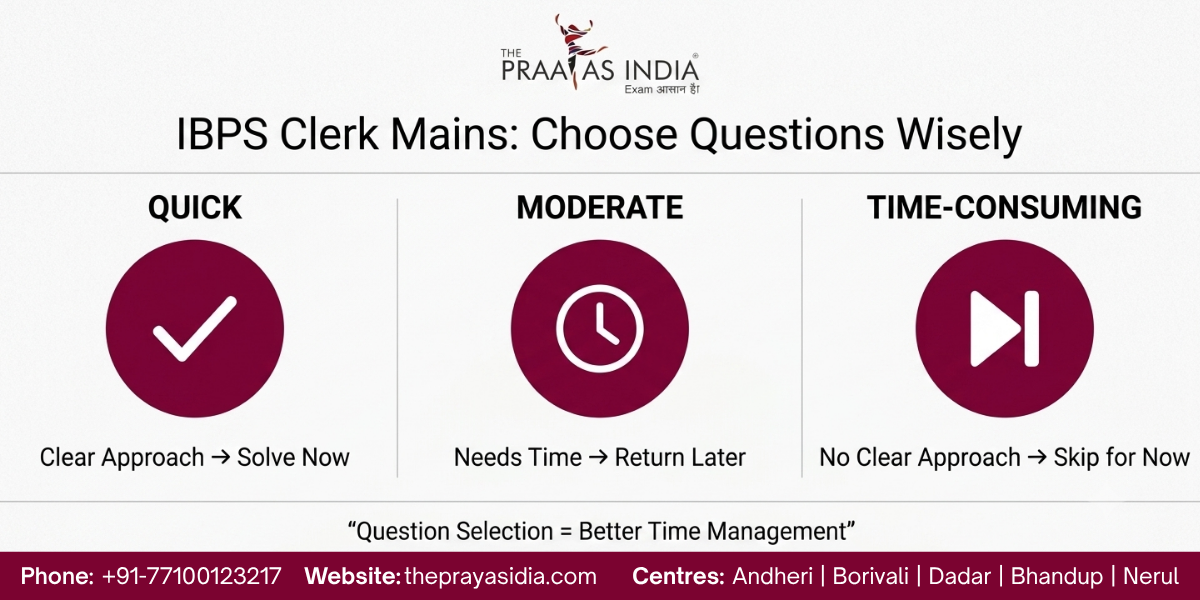
The 3-Level Question Selection System
A simple way to train your decision-making is to classify questions into three categories.
Level 1 — Quick Wins
These are questions where you immediately understand the approach.
Attempt them early.
Level 2 — Solvable With Moderate Effort
These questions require some calculation or reasoning but have a reasonably clear path.
Attempt them after securing the easier marks.
Level 3 — Time-Consuming
These involve lengthy calculations, complicated conditions or an approach you cannot identify quickly.
Leave them temporarily.
This system prevents you from spending disproportionate time on questions that may not provide a worthwhile return.
Don’t Chase a Difficult Question
One of the biggest time-management problems in competitive exams is emotional attachment to a question.
You read it.
You start solving it.
You get stuck.
Instead of moving on, you continue because you want to prove that you can solve it.
This can cost several minutes.
Imagine spending four minutes on one difficult puzzle while another candidate uses those four minutes to solve four straightforward questions.
The difference is not necessarily intelligence.
It is decision-making.
Learning to leave a question is an important examination skill.
Use the “Return Later” Strategy
Skipping a question does not necessarily mean abandoning it.
If the examination interface permits you to revisit questions, mark uncertain or time-consuming questions and return to them after completing your higher-confidence attempts.
This creates two rounds:
Round 1
Solve questions with clear approaches.
Round 2
Return to moderate or difficult questions.
This is especially useful in Quant and Reasoning.
The strategy reduces the risk of leaving easy marks because you were trapped in a difficult question.
How to Manage Reasoning Time
Reasoning often requires the most strategic decision-making.
A good practice session should train you to identify the relative difficulty of different sets.
Before starting a puzzle, quickly consider:
How many conditions are there?
Is the arrangement familiar?
Can one setup solve multiple questions?
Is there sufficient information?
Can I establish the basic structure quickly?
If the setup itself is taking too long, reconsider whether the set is worth attempting immediately.
Set-Based Reasoning Requires Different Thinking
When a puzzle contains several questions, do not evaluate every question independently.
Evaluate the entire set.
Suppose a puzzle has five questions.
If the basic arrangement can be established in a short time and four questions can then be solved quickly, the set may be highly valuable.
But if establishing the arrangement itself is extremely complicated and only one or two questions appear approachable, the opportunity cost may be too high.
This is why strong Reasoning preparation includes set selection, not just puzzle solving.
How to Manage Quantitative Aptitude Time
Quant requires a balance between conceptual understanding and calculation efficiency.
During practice, classify questions into:
Direct
Moderate
Calculation-heavy
Conceptually difficult
Direct questions should generally become your scoring foundation.
Moderate questions can follow.
Calculation-heavy or unfamiliar questions should not automatically receive priority simply because they carry the same marks.
The question’s marks are not the only consideration.
Time per mark matters.
Improve Calculation Speed Before the Exam
Calculation speed can improve significantly through regular practice.
Build familiarity with:
- Tables
- Squares
- Cubes
- Fraction-percentage conversions
- Approximation
- Multiplication patterns
- Basic arithmetic shortcuts
- Ratio relationships
- Percentage calculations
However, shortcuts should only be used when they actually save time.
Do not use a complicated shortcut for a calculation that could have been completed more quickly through a standard method.
The best shortcut is often familiarity.
Data Interpretation: Don’t Commit Too Early
DI sets can be attractive because several questions may be based on one data set.
But they can also become time traps.
Before committing to a DI set, quickly assess:
- How complicated is the data?
- Are calculations straightforward?
- How many questions can I potentially solve?
- Are the values easy to compare?
- Will the calculations consume too much time?
If the set looks calculation-heavy, consider whether another section or question offers a better return.
How to Manage English Time
English preparation should make you comfortable with different question types.
Your practice should include:
- Reading comprehension
- Cloze tests
- Error detection
- Sentence improvement
- Fillers
- Phrase replacement
- Para jumbles
- Vocabulary-based questions
The objective is to develop pattern recognition.
For example, when you repeatedly practise error detection, you become faster at recognising common grammatical structures.
Similarly, regular RC practice improves your ability to identify the main idea and locate relevant information.
Speed is often the result of familiarity.
General/Financial Awareness: Don’t Overthink
GA is one area where overthinking can be particularly expensive.
If you know the answer, respond.
If you do not know it with reasonable confidence, move ahead according to the examination’s marking rules and your risk strategy.
Do not spend excessive time trying to reconstruct an obscure current-affairs fact.
Instead, invest your preparation time beforehand in building strong recall.
A good GA revision system should include:
Daily current affairs
Weekly revision
Monthly revision
Banking awareness
Financial awareness
Static banking concepts
Repeated revision reduces the amount of time you need to recall information during the examination.
Mock Tests Are Your Time-Management Laboratory
You cannot build an effective time strategy simply by reading preparation tips.
You need data.
Mock tests provide that data.
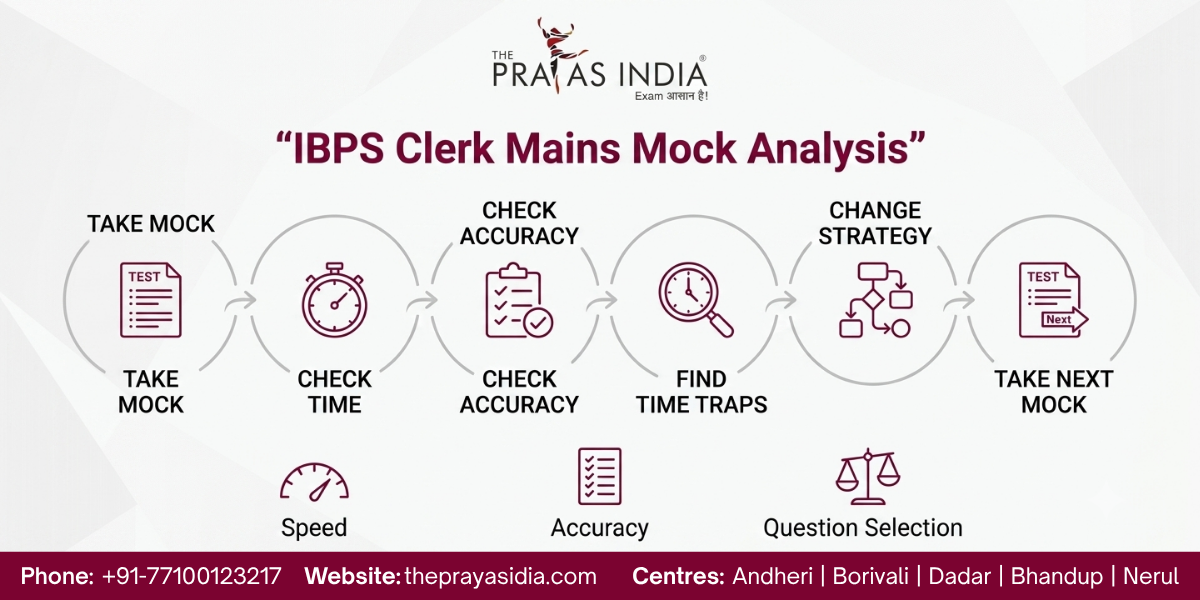
After every mock, record:
Total attempts
Correct answers
Incorrect answers
Section-wise attempts
Section-wise accuracy
Time spent per section
Questions left unattempted
Questions that consumed excessive time
This information will show you where the actual problem lies.
For example, if you attempt 35 Reasoning questions but spend a disproportionate amount of time on them, your issue may not be lack of knowledge.
It may be poor puzzle selection.
If your Quant accuracy is high but your attempts are low, your problem may be calculation speed.
If English consumes too much time, your issue may be reading efficiency.
The solution becomes much easier once the problem is identified correctly.
Maintain a Mock Analysis Sheet
After every mock, maintain a simple table.
| Parameter | Mock 1 | Mock 2 | Mock 3 |
|---|---|---|---|
| Overall Attempts | — | — | — |
| Accuracy | — | — | — |
| GA Time | — | — | — |
| English Time | — | — | — |
| Quant Time | — | — | — |
| Reasoning Time | — | — | — |
| Time Lost on Difficult Questions | — | — | — |
| Questions Left Due to Time | — | — | — |
After five or six mocks, patterns start becoming visible.
That pattern is more useful than one isolated mock score.
How to Improve Speed Without Losing Accuracy
Speed and accuracy should not be treated as enemies.
The problem occurs when candidates try to increase speed before developing sufficient command over the concepts.
A better progression is:
Concept Clarity → Untimed Practice → Controlled Timing → Sectional Tests → Full Mocks
Initially, solve questions correctly even if they take longer.
Then reduce the time gradually.
This approach builds reliable speed instead of hurried solving.
For example, if you currently solve a particular Quant question type in two minutes, do not immediately try to bring it down to 45 seconds.
First understand why it takes two minutes.
Is the calculation slow?
Is the method inefficient?
Are you forgetting a standard relationship?
Are you taking unnecessary steps?
Once the cause is identified, speed improvement becomes much easier.
Use Sectional Tests to Build Timing
Full-length mocks are essential, but sectional tests are particularly useful for improving time management.
Suppose Reasoning consistently takes too long.
Instead of waiting for the next full mock, practise several timed Reasoning sections.
Set a controlled target.
Analyse the result.
Repeat.
The same method can be used for Quant and English.
Sectional tests allow you to isolate a specific weakness without the fatigue of a complete Mains paper.
Create a Personal Time Budget
Instead of simply saying:
“I need to solve faster.”
Create measurable goals.
For example:
Reasoning: Reduce time spent on one puzzle set.
Quant: Improve calculation speed in arithmetic and DI.
English: Reduce reading time without affecting comprehension.
GA: Improve recall speed through revision.
This transforms a vague goal into something you can actually measure.
Track Time Traps
Your time traps are not necessarily the same as another candidate’s.
Some common examples include:
Puzzle Trap
Spending too long establishing a complicated arrangement.
DI Trap
Getting stuck in lengthy calculations.
RC Trap
Reading the passage repeatedly.
Calculation Trap
Using unnecessarily long methods.
Revision Trap
Overthinking answers you already know.
Ego Trap
Continuing a difficult question because you have already spent time on it.
Identify your own traps and create a rule for each.
For example:
“If I cannot establish the puzzle structure within my predetermined limit, I move ahead.”
Such rules reduce emotional decision-making during the exam.
What If Your Mock Score Is Not Improving?
A stagnant mock score does not automatically mean that you need to study more hours.
First identify the bottleneck.
If your attempts are low but accuracy is high, work on speed.
If attempts are high but accuracy is poor, work on question selection and conceptual clarity.
If both attempts and accuracy are low, revisit fundamentals.
If your section scores fluctuate heavily, work on consistency.
This is why simply taking more mocks without analysing them can produce limited improvement.
A mock test becomes valuable when its mistakes change your next preparation cycle.
Common Time-Management Mistakes in IBPS Clerk Mains
1. Trying to Attempt Everything
You do not need to solve every question.
Your goal is to maximise marks.
2. Spending Too Long on One Puzzle
A difficult puzzle can consume several minutes without guaranteeing marks.
3. Using One Fixed Strategy
Your strategy should be based on your strengths and the actual paper.
4. Ignoring Accuracy
Speed without accuracy can reduce your score.
5. Not Analysing Mocks
A mock without analysis is only a test. Analysis turns it into preparation.
6. Changing Strategy Every Day
Experiment during practice, but once your data identifies an effective approach, develop consistency.
7. Ignoring the GA Advantage
Candidates sometimes spend excessive preparation time on Quant and Reasoning while underestimating how quickly strong GA preparation can translate into marks.
How Coaching Can Improve IBPS Clerk Time Management
Self-study can help you build concepts, but many aspirants struggle with the feedback required to improve speed and selection.
This is where structured bank exam coaching can be valuable.
A good coaching programme should help you develop:
Conceptual clarity
You should know the methods before trying to make them faster.
Regular sectional practice
Frequent timed exercises help convert knowledge into exam-ready performance.
Mock-test exposure
Mocks create familiarity with pressure and time constraints.
Performance analysis
You should understand not only your score but also where your time was lost.
Mentorship
A mentor can identify patterns that are difficult to notice independently.
Revision structure
Regular revision improves recall and reduces hesitation during the examination.
For candidates searching for Bank Coaching in Mumbai, these factors should be considered before choosing an institute.
Choosing the Best Bank Coaching in Mumbai
The phrase “best bank coaching” should not be evaluated only through advertisements or infrastructure.
For an IBPS Clerk aspirant, practical questions matter more:
- Does the institute provide regular mock tests?
- Are sectional tests available?
- Is performance analysed?
- Are students given guidance on question selection?
- Does the faculty address speed and accuracy separately?
- Is current affairs preparation structured?
- Is there regular revision?
- Does the programme cover Mains-specific preparation?
- Is individual doubt-solving available?
- Does the teaching approach match the latest exam requirements?
The right coaching environment should help you turn preparation into a measurable process.
A 4-Week Time-Management Improvement Plan
If you have four weeks to improve your IBPS Clerk Mains performance, you can structure your practice around four stages.
Week 1 — Measure
Take mocks and identify where your time is going.
Do not immediately try to change everything.
Week 2 — Correct
Work on your biggest time-consuming areas.
Practise targeted sectional tests.
Week 3 — Experiment
Test different section orders and question-selection strategies.
Compare the results.
Week 4 — Stabilise
Choose the strategy that gives you the best combination of:
Attempts + Accuracy + Time Control
Then practise it repeatedly.
The final week should not be about constantly experimenting.
It should be about developing confidence in your established approach.
The Final IBPS Clerk Mains Time-Management Checklist
Before the examination, you should be able to answer these questions clearly:
Which section is my strongest?
Which section takes me the longest?
Which question types are my quick wins?
Which question types are my time traps?
Which section order works best for me?
How much time do I normally spend on each section?
When should I leave a question?
How many questions do I normally attempt?
What is my average accuracy?
What mistakes do I repeatedly make in mocks?
If you cannot answer these questions, you still have work to do on your time-management strategy.
Final Takeaway
Managing time in IBPS Clerk Mains is ultimately about making the right decision at the right moment.
You cannot control the difficulty of the paper.
You cannot control which puzzle appears.
You cannot predict whether a particular DI set will be calculation-heavy.
But you can control how quickly you recognise a time-consuming question, how confidently you move ahead and how effectively you distribute your available time.
The strongest strategy is therefore not:
“Solve faster.”
It is:
“Solve the right questions faster.”
Build your preparation around concept clarity, timed practice, sectional tests and regular mock analysis. Use your performance data to determine your section order and time allocation rather than copying another candidate’s strategy.
And remember that speed should never come at the expense of accuracy.
For aspirants preparing for banking exams in Mumbai, structured coaching can provide the regular practice, mock tests, performance analysis and mentorship needed to turn time management into a consistent examination skill.
If you are looking for Bank Coaching in Mumbai, evaluate institutes based on how effectively they can help you improve not only your knowledge, but also your speed, accuracy, question selection and exam strategy.
The objective is simple:
Know more. Choose better. Solve faster. Score smarter.
FAQs
1. How can I improve time management for IBPS Clerk Mains?
Start by taking timed sectional tests and full-length mocks. Track section-wise time, attempts, accuracy and questions that consumed excessive time. Then modify your strategy based on the data.
2. Should I attempt all questions in IBPS Clerk Mains?
No. Your objective should be to maximise your score rather than attempt every question. Difficult or time-consuming questions should be left temporarily if they are preventing you from attempting easier questions.
3. Which section should I attempt first in IBPS Clerk Mains?
There is no universally correct order. Test different section orders in mocks and choose the sequence that gives you the best combination of speed, accuracy and confidence.
4. How do I improve Reasoning speed for IBPS Clerk Mains?
Practise different puzzle and seating-arrangement types regularly. More importantly, learn to identify which sets are worth attempting and which are likely to consume excessive time.
5. How can I improve Quantitative Aptitude speed?
Build calculation fluency, strengthen basic concepts and practise timed questions. Focus particularly on recognising efficient methods and avoiding unnecessarily lengthy calculations.
6. How important are mock tests for IBPS Clerk Mains?
Mock tests are extremely useful for developing time management because they simulate the pressure of the actual examination. However, mock analysis is equally important. You should identify why time was lost and change your preparation accordingly.
7. Can coaching help improve IBPS Clerk Mains time management?
Yes. Structured bank exam coaching can provide regular sectional tests, full-length mocks, performance analysis, mentorship and targeted practice, helping candidates identify and correct time-management weaknesses.
Contact Us
📞 Call Now: +91-77100 13217
🌐 Website: theprayasindia.com