How to Manage Time in RRB NTPC Exam? | Smart Attempt Strategy | Best RRB Coaching in Mumbai | The Prayas India
Time management is one of the most important skills for any RRB NTPC aspirant because knowing the answer and being able to attempt it within the examination environment are two different things. Many candidates enter the exam with adequate subject knowledge but still leave questions unanswered because they spend too much time on a few difficult problems, hesitate over question selection or fail to maintain a steady pace. In a competitive examination, every minute has value, and an effective attempt strategy can make a significant difference to your overall performance.
For beginners as well as experienced candidates, time management should not be treated as something to learn during the final week before the examination. It should become part of the preparation process itself. Your regular practice should gradually teach you how quickly you can solve different types of questions, which questions deserve immediate attention and which ones should be postponed or skipped. By the time you appear for the RRB NTPC exam, your time strategy should feel like a natural part of your solving process rather than something you have to consciously figure out during the paper.
A smart RRB NTPC strategy is therefore not about attempting every question as quickly as possible. It is about using the available time intelligently while protecting accuracy. The candidate who can identify easy questions quickly, avoid unnecessary time-consuming problems and maintain control over the paper is often in a better position than someone who simply tries to maximise attempts from the first minute.
Understand the Exam Before Planning Your Time
The first step towards better time management is understanding the examination you are preparing for. Candidates sometimes create detailed time plans without first understanding the sections, question types and negative-marking implications applicable to the stage they are appearing for. Your strategy should always be based on the latest official RRB NTPC notification and the specific stage of the recruitment process.
For the CBT stage, candidates generally have to deal with General Awareness, Mathematics and General Intelligence & Reasoning within a fixed examination duration. The exact requirements and pattern should always be verified from the latest notification because examination details can be revised by the Railway Recruitment Boards.
Once you understand the structure, you can begin thinking about how your time should be distributed. There is no single time split that works for every candidate. A candidate with strong Mathematics may be able to complete its questions quickly, while another may require more time for calculations. Similarly, some aspirants may find General Awareness faster because it primarily involves recall, whereas others may need more time in Reasoning.
Your preparation should therefore help you discover your personal time profile rather than blindly copying someone else’s strategy.
Time Management Begins During Daily Practice
One of the biggest mistakes RRB NTPC aspirants make is practising questions without tracking the time taken to solve them. Solving twenty questions correctly is useful, but it tells you only part of the story. If those twenty questions took significantly longer than the time available in the actual exam, you still have a time-management problem to solve.
Begin introducing time awareness into your practice gradually. During the initial learning stage, focus primarily on understanding concepts and developing accuracy. Once you become comfortable with a topic, start solving a set of questions against a reasonable time limit. Record how many questions you solved, how many were correct and how much time you required.
Over several weeks, this creates a useful picture of your performance. You may discover that you are fast in Reasoning but slow in Mathematics, or that you spend excessive time on particular question types. This information is much more valuable than simply knowing your overall mock-test score.
Time management improves when you measure your performance, identify the source of time loss and deliberately work on it.
Build a Three-Level Question Selection System
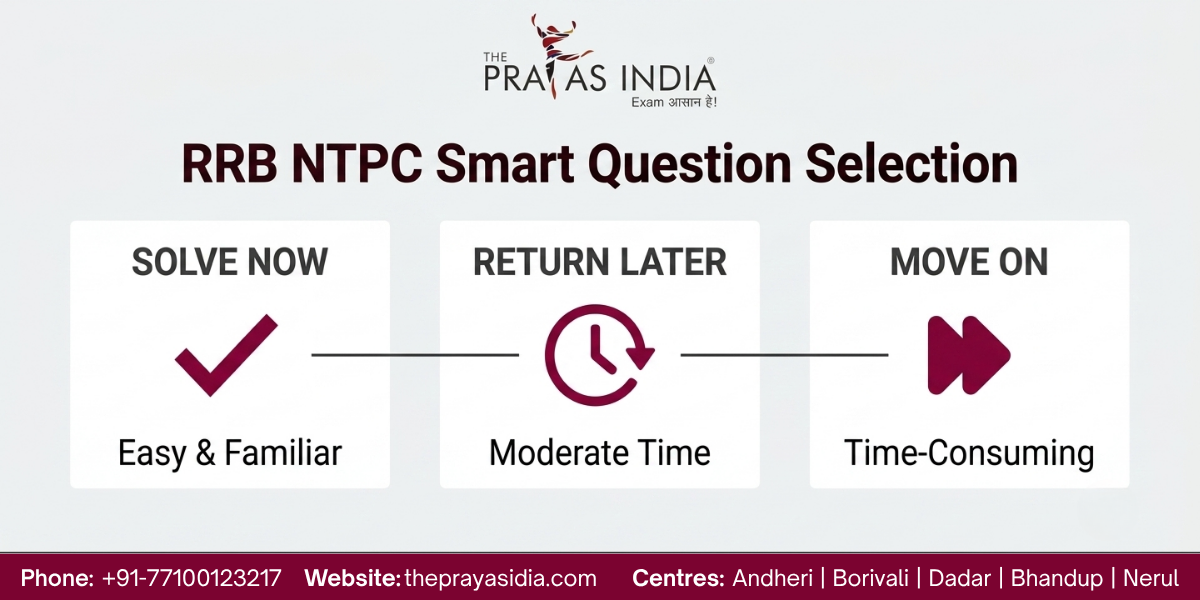
A smart attempt strategy begins with recognising that not every question deserves the same amount of time. During practice, train yourself to mentally classify questions into three broad categories: questions you can solve quickly, questions that require moderate effort and questions that are likely to consume significant time.
The first category should become your priority during the examination. These are questions where you understand the concept, recognise the approach and can reasonably expect to reach the answer without unnecessary complications. Completing these questions early helps build confidence and protects valuable time.
The second category consists of questions that you can solve but may require additional calculation or reasoning. These can be attempted after you have secured the more straightforward questions. The third category includes questions that appear lengthy, unfamiliar or unusually time-consuming. Such questions should not automatically be treated as impossible, but they should not be allowed to control your examination either.
This three-level approach creates a simple decision-making habit: attempt quickly, attempt later or move on. With enough practice, you can make these decisions within seconds rather than wasting a minute deciding what to do with every difficult question.
Avoid the “Question-by-Question Trap”
Many aspirants begin the exam with the first question and continue sequentially until the last one. While this approach may feel organised, it can become problematic when the paper contains a difficult question early in the sequence.
Suppose you encounter a complicated reasoning question at the beginning. If you spend several minutes trying to solve it simply because it appeared first, you may lose the opportunity to solve multiple easier questions later. The issue is not that the difficult question cannot be solved. The issue is that the time spent on it may not provide the best return at that particular moment.
A smarter approach is to remain flexible. If a question is taking significantly longer than expected, make a conscious decision about whether continuing is worthwhile. Mark it for review if the exam interface and rules allow it, and move to another question. Returning later with a fresh perspective can sometimes make a question much easier.
The objective is to control the paper instead of allowing the paper to control your time.
Mathematics: Control Calculation Time
Mathematics can become one of the biggest sources of time loss in RRB NTPC preparation, particularly for candidates who understand the concepts but calculate slowly. Even a straightforward question can become time-consuming when basic calculations are not efficient.
The solution is not to rush calculations. Instead, develop calculation familiarity during preparation. Work regularly on percentages, fractions, ratios, averages and other fundamental calculations that appear repeatedly in quantitative questions. Learn standard approaches where appropriate, but make sure you understand them rather than memorising shortcuts without context.
During timed practice, identify which questions consume excessive time. Sometimes the problem is not the concept but the calculation process. In such cases, targeted calculation practice can produce a significant improvement without requiring you to relearn the entire Mathematics syllabus.
At the same time, do not let the pursuit of speed reduce accuracy. A calculation performed quickly but incorrectly costs more than a few additional seconds spent checking your work.
Reasoning: Learn to Recognise Familiar Structures
Reasoning questions often reward candidates who can recognise patterns quickly. The more varied and consistent your practice, the easier it becomes to identify the structure of a question without spending too much time figuring out where to begin.
For example, when you repeatedly practise series, coding-decoding, analogy, classification, directions, blood relations, syllogism and other relevant question types, you gradually develop a mental library of common approaches. This does not mean memorising answers. It means becoming familiar with the logical processes required to reach them.
Puzzles and arrangement-based questions require a slightly different approach because their time requirements can vary significantly. During mock practice, learn to judge whether a puzzle appears manageable or likely to consume disproportionate time. If the conditions are lengthy and the solution path is not immediately clear, it may be wiser to move to other questions and return later.
The ability to recognise a good opportunity and recognise a time trap is a crucial part of Reasoning time management.
General Awareness: Use It as a Time-Saving Opportunity
General Awareness can often be approached differently from Mathematics and Reasoning because many questions depend primarily on recall. If you know the answer, the question may require only a few seconds. If you do not know it, spending a long time thinking about it usually does not improve your chances significantly.
This makes General Awareness preparation especially important for time management. Strong preparation can allow you to move through known questions quickly and preserve time for sections where calculation or logical processing is required.
However, avoid turning General Awareness into a guessing exercise. If you genuinely do not know an answer and the examination’s marking scheme makes random attempts risky, make your decision carefully. Your attempt strategy should always account for negative marking and your confidence level.
The time saved through quick handling of familiar General Awareness questions can then be used more productively elsewhere in the paper.
Create Section-Wise Time Awareness
Although there may not be a universally perfect time division for every candidate, having a broad section-wise strategy can prevent you from spending disproportionate time on one area. The purpose of a time plan is not to force yourself to stop solving a question at an arbitrary second. It is to create awareness about how much time you are spending and whether that investment is producing enough value.
For example, if Mathematics is taking most of your examination time because of lengthy calculations, you need to work on calculation efficiency and question selection during practice. If Reasoning consumes too much time because of puzzles, you should practise identifying manageable sets more quickly. If General Awareness is taking longer because you are repeatedly reconsidering answers you already know, you may need to build greater confidence through regular revision.
Your section-wise strategy should therefore be tested through mocks. Try different approaches during practice and compare the results. Over time, you will discover which sequence and time allocation allows you to perform most comfortably.
Use the First Few Minutes Wisely
The beginning of the examination can influence your entire attempt. Some candidates become anxious and start solving immediately without observing the nature of the paper. Others spend too much time worrying about their strategy instead of actually attempting questions.
A balanced approach is to settle yourself quickly and begin with the section or question types where you are most comfortable, depending on the exam interface and your chosen strategy. The objective is to build early momentum without becoming careless.
If the paper appears more difficult than your mocks, do not panic. Difficulty affects everyone taking the same paper. The important thing is to remain selective and avoid allowing one unexpected question to disrupt your entire strategy.
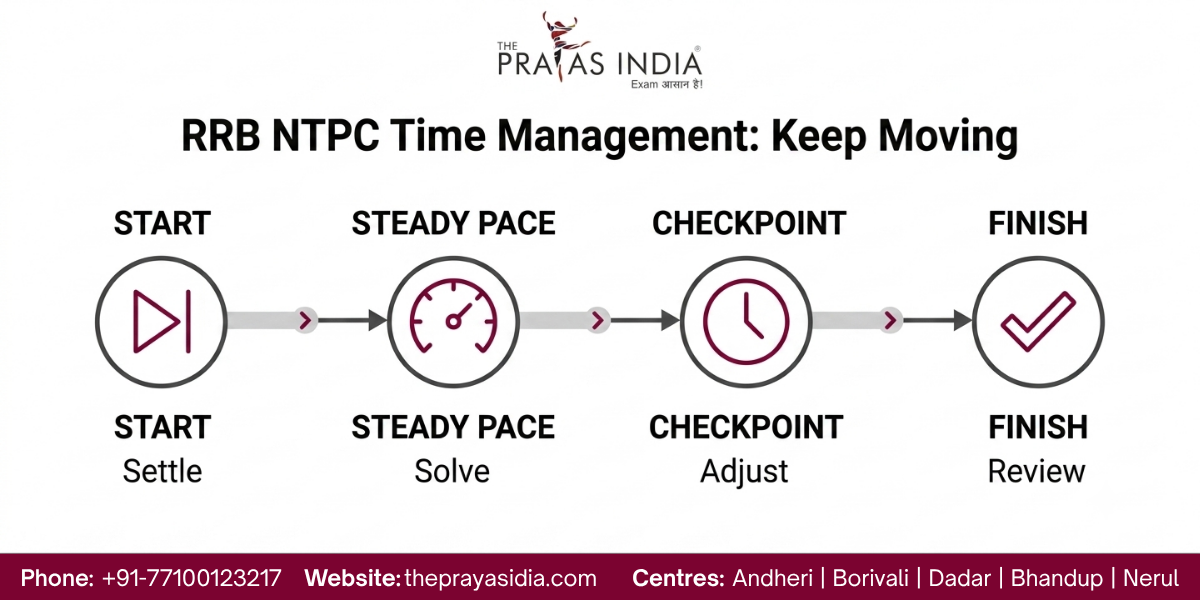
Your first few attempts should help establish rhythm. Once you settle into the paper, maintain a steady pace rather than constantly checking the clock after every question.
Don’t Keep Checking the Clock
Time awareness is useful, but excessive clock-watching can become a distraction. Some candidates look at the timer after almost every question, which increases anxiety and interrupts their concentration.
Instead, establish broad checkpoints during your mock practice. You can become familiar with where you ideally want to be at different stages of the examination. This gives you a sense of direction without requiring constant monitoring.
If you discover during a checkpoint that you are behind your intended pace, do not try to recover the entire lost time by rushing through every remaining question. Make a strategic adjustment. Reduce the time spent on lengthy questions, prioritise familiar areas and protect accuracy.
The clock should be a navigation tool, not a source of panic.
The Right Mindset for RRB NTPC Time Management
Good time management is not created by memorising a fixed number of minutes for each section. It comes from understanding your strengths, recognising time-consuming questions and repeatedly practising under realistic conditions. A candidate who has tested different strategies before the exam is much less likely to panic when the actual paper behaves differently from expectations.
The most effective preparation therefore combines conceptual learning with timed application. Learn the topic, practise it without excessive pressure, then introduce a time limit. Once you become comfortable, include the topic in mixed sets and sectional tests. Eventually, full-length mocks should test whether you can maintain your strategy across the entire examination.
Remember that the purpose of time management is not simply to finish the paper. The real objective is to maximise the number of accurate and worthwhile attempts within the available time. That requires discipline, practice and the confidence to leave a question temporarily when it is not worth your time.
For aspirants preparing for RRB NTPC in Mumbai, structured guidance can also help bring greater consistency to this process. A good RRB coaching programme in Mumbai should not only focus on completing the syllabus but also help candidates develop speed, accuracy, mock-test discipline and exam-oriented question selection.
Build Your Section-Wise Attempt Strategy
A section-wise strategy should begin with an honest assessment of your performance in mock tests. Do not decide the order of sections simply because another aspirant or teacher recommends it. Your strongest section may be the best place to build early momentum, while a weaker or calculation-heavy section may require a more controlled approach.
For example, a candidate who is comfortable with General Awareness may be able to handle known questions quickly and move forward. Another candidate may prefer Reasoning because familiar question patterns can be recognised quickly. Someone else may feel most confident beginning with Mathematics. There is no universal rule; the best sequence is the one that allows you to maximise accurate attempts without creating unnecessary pressure.
Test different sequences during full-length mocks. Compare your attempts, accuracy, time usage and comfort level. Once you identify a pattern that consistently works for you, practise it repeatedly so that it becomes automatic.
Mathematics: Prioritise Familiar Questions First
In Mathematics, time management often depends on how quickly you can identify the appropriate method. Questions based on familiar concepts should generally receive priority because they allow you to convert preparation into marks without excessive time expenditure.
Arithmetic questions can sometimes involve multiple calculations, so learn to recognise whether the calculation is manageable before committing too much time. If you understand the method but the arithmetic is becoming unusually lengthy, consider moving ahead and returning later if the examination interface permits.
Regular calculation practice can also improve your performance significantly. Work on fractions, percentages, ratios, averages and other basic calculations so that you spend less time on routine arithmetic during the actual paper.
Your goal is not to solve every Mathematics question. Your goal is to select the questions that offer the best combination of confidence, accuracy and time efficiency.
Reasoning: Don’t Let One Puzzle Consume Your Section
Reasoning can be a high-scoring area, but some question types can consume considerable time. Puzzles and arrangements are particularly important in this regard. A set may look approachable initially but become complicated once you start applying all the conditions.
During preparation, practise identifying the structure of a puzzle quickly. Ask yourself whether the information is organised clearly enough to allow you to proceed. If you cannot identify a productive starting point, do not allow the question to consume several minutes simply because you have already invested some time in reading it.
At the same time, do not become so cautious that you avoid every lengthy question. Some puzzles can produce several questions from a single setup and may therefore be worth attempting. The key is learning to judge the potential return of the question set against the time required.
This judgment improves through repeated mock analysis rather than theoretical advice alone.
General Awareness: Aim for Quick Decisions
General Awareness can be particularly useful for managing overall examination time because questions that you know can usually be handled quickly. Strong revision allows you to recognise answers without spending unnecessary time reconstructing information from memory.
If you know an answer with reasonable confidence, move forward rather than repeatedly questioning yourself. If you do not know the answer, analyse whether an informed attempt is justified according to the applicable marking scheme. Random guessing should never become a time-management strategy.
The better your General Awareness preparation, the more efficiently you can handle this part of the paper. Regular revision is therefore not only useful for improving knowledge; it can also indirectly create more time for sections that require calculations and logical reasoning.
Use Mock Tests to Build Your Personal Time Strategy
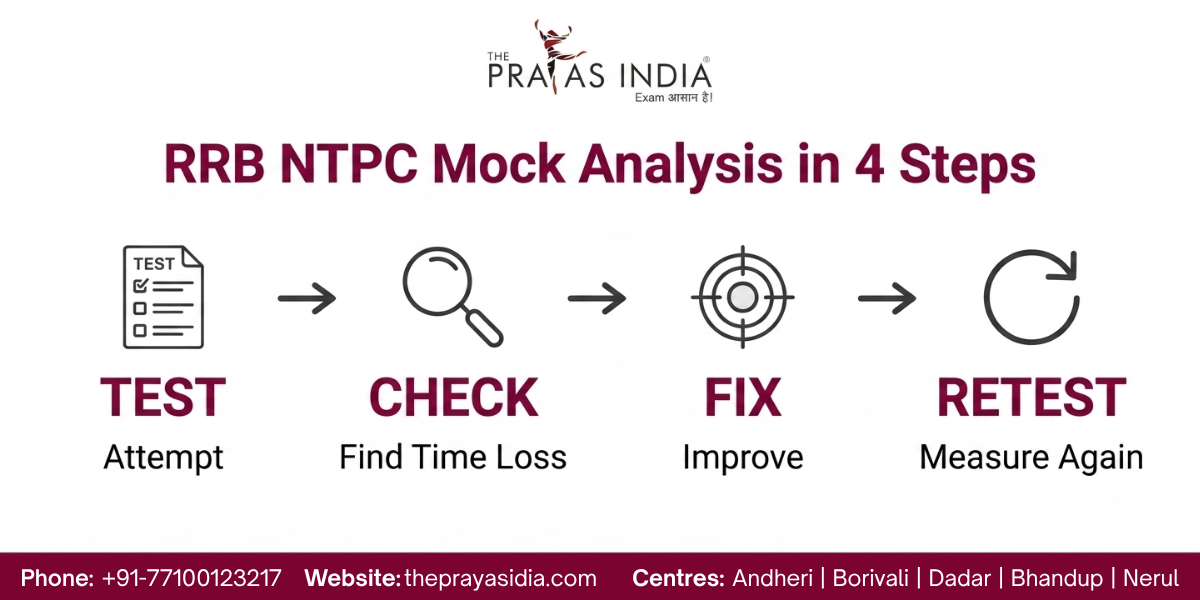
Full-length mocks are where your time-management strategy should be tested most seriously. A mock is not merely a score-generating exercise. It is a simulation through which you can discover exactly where your time is being lost.
After every mock, examine the questions that consumed too much time. Separate them into different categories. Some may have been difficult because the concept was weak. Others may have been easy but took too long because your approach was inefficient. Some may have been questions that you should have skipped earlier.
This distinction matters. If your problem is conceptual, more learning is required. If your problem is approach-related, you need targeted practice. If your problem is question selection, you need to develop better decision-making. If your problem is calculation speed, focused drills can help.
A good mock-analysis routine should therefore answer four questions:
What did I get wrong?
What took too long?
What should I have skipped?
What can I change before my next mock?
Create Time-Based Practice Sets
Before moving entirely to full-length mocks, include smaller timed sets in your preparation. These sets allow you to isolate a particular problem without the complexity of an entire examination.
For example, you can practise a short Mathematics set and focus specifically on calculation speed. On another day, you can take a Reasoning set and observe how quickly you identify suitable questions. A General Awareness revision test can help you measure recall speed, while an English or language-related section, wherever applicable to your particular RRB NTPC stage, can be used to practise reading and comprehension efficiency.
The advantage of smaller timed sets is that they allow you to correct problems quickly. You do not have to wait until the next full-length mock to discover that a particular skill is slowing you down.
Develop a “Skip Without Fear” Habit
One of the most difficult skills for competitive-exam aspirants is learning to leave a question without feeling that they are losing an opportunity. Many candidates continue working on a difficult question because they have already invested time in it. This is known as the sunk-time trap: the more time you have spent, the more reluctant you become to leave.
In an examination, however, previous time cannot be recovered. The decision should be based on the value of the remaining time. If another question can be solved confidently in a fraction of the time, moving forward may be the smarter decision.
Skipping a question temporarily is not the same as giving up on it. It is a strategic decision to protect your overall attempt. Once you have covered the easier opportunities, you can return to questions that require more thought.
The confidence to skip comes from practice. When you repeatedly experience how much time a difficult question can consume, you become better at recognising similar situations in the exam.
Protect Accuracy While Increasing Speed
Speed and accuracy should always be developed together. A candidate who solves very quickly but makes frequent mistakes may end up with fewer marks than someone who works slightly more slowly but maintains strong accuracy.
During mock analysis, therefore, do not celebrate increased attempts automatically. Check whether those additional attempts are translating into additional correct answers. If attempts rise but incorrect responses rise at an even faster rate, your strategy needs adjustment.
A useful preparation target is to gradually increase speed while keeping your accuracy stable. Once your accuracy becomes reliable, you can carefully work on reducing the time required for familiar question types.
This approach creates controlled speed, which is far more valuable than rushing.

Create a Practical Revision and Mock Calendar
Time management cannot be improved through mocks alone. You need a preparation calendar that gives enough space to learning, revision, timed practice and testing. If you take mocks continuously without addressing the weaknesses they reveal, your scores may stagnate.
A practical cycle can include concept revision, focused practice, a mock test and analysis. The next practice cycle should then be adjusted according to the results of the previous one. This creates a feedback loop in which every test contributes to the next stage of preparation.
As the examination approaches, the proportion of testing and revision can gradually increase. New learning should not disappear entirely, especially if there are remaining weak areas, but the emphasis should shift towards applying what you already know under realistic conditions.
The most useful question to ask every week is not simply, “How many chapters did I complete?” Instead ask, “Did my ability to solve the paper efficiently improve this week?”
Common Time-Management Mistakes in RRB NTPC
One of the most common mistakes is trying to solve every question. Competitive examinations reward effective attempts, not maximum effort on individual questions. Spending too much time on one difficult problem can cost several easier opportunities.
Another mistake is entering the exam without a tested section order. If you decide your sequence for the first time on examination day, an unexpected difficulty level can create confusion. Test different approaches during mocks and identify what works for you beforehand.
Ignoring mock analysis is another major problem. Candidates sometimes take one test after another but do not examine their time losses. Without analysis, repeated mistakes become habits.
Finally, many aspirants try to increase speed by rushing. This can increase calculation errors, misreading and incorrect marking. Speed should come from familiarity, efficient methods and better question selection—not panic.
Exam-Day Time Management Framework
On the actual examination day, your first objective should be to remain composed. Avoid comparing yourself with other candidates before the examination or allowing one difficult question to affect your confidence.
Start with your planned approach and remain flexible. If the paper is different from what you expected, adjust rather than panic. A difficult paper does not necessarily mean poor performance because all candidates face the same paper.
Keep an eye on broad time checkpoints rather than constantly watching the clock. If you are falling behind, become more selective. If you are progressing comfortably, do not suddenly start rushing simply because you have extra time.
During the final phase, avoid spending excessive time trying to rescue one difficult question. Use the remaining time strategically and review wherever the examination interface and rules allow.
How Coaching Can Improve RRB NTPC Time Management
Time management becomes easier when your preparation environment includes regular testing and structured feedback. Self-study can certainly help, but some candidates struggle to determine whether their strategy is actually working. They may practise extensively without knowing why their scores are not improving.
A structured RRB coaching programme in Mumbai can provide a systematic preparation environment where concepts, practice, sectional tests, full-length mocks and performance analysis are connected. The value of coaching should not be measured simply by the number of classes conducted. It should also be assessed by how effectively the programme helps you understand your mistakes and improve your examination strategy.
For aspirants considering RRB coaching in Mumbai, look for faculty support, quality study material, regular mock tests, doubt resolution, performance analysis and an approach that focuses on both conceptual clarity and examination execution.
The right guidance can help you avoid random preparation and develop a more disciplined approach to time, accuracy and question selection.
Build Your Strategy Before the Exam
There is no single formula for RRB NTPC time management that every candidate should follow. Your ideal strategy depends on your strengths, weaknesses, solving speed and comfort with different sections. What works for another aspirant may not work equally well for you.
The best approach is to experiment during preparation, collect performance data and gradually refine your method. Try different section orders, different attempt patterns and different time checkpoints in your mocks. Once you identify the strategy that consistently produces better results, repeat it until it becomes familiar.
A well-prepared candidate should enter the examination with more than subject knowledge. You should know how to start, which questions to prioritise, when to move forward, how to control your pace and how to protect your accuracy.
That is what transforms preparation into an actual smart attempt strategy.
FAQs
1. How can I improve time management for the RRB NTPC exam?
Start by tracking the time you spend on different question types during practice. Gradually introduce timed sets, sectional tests and full-length mocks. Analyse where you lose time and improve question selection, calculation speed and familiarity with recurring patterns.
2. Should I attempt every RRB NTPC question?
No. The objective should be to maximise accurate and worthwhile attempts rather than attempt every question. Difficult or time-consuming questions should be handled strategically according to the marking scheme and your confidence level.
3. Which section should I attempt first in RRB NTPC?
There is no universally correct section order. Choose the section in which you are most comfortable and can maintain good accuracy and speed. Test different sequences during mocks before finalising your approach.
4. How do I stop spending too much time on difficult questions?
Practise classifying questions as easy, moderate or time-consuming. If a question is taking substantially longer than expected without progress, move ahead and return later if appropriate. Regular mock practice helps develop this judgment.
5. How can I increase RRB NTPC Mathematics speed?
Strengthen fundamental calculations and practise frequently tested question types under time limits. Focus on improving your approach and calculation efficiency while maintaining accuracy.
6. How can I improve Reasoning speed for RRB NTPC?
Practise regularly across different reasoning topics and learn to recognise familiar structures quickly. For puzzles and arrangements, develop the ability to judge whether a set is manageable before investing significant time.
7. Are mock tests important for RRB NTPC time management?
Yes. Mock tests allow you to practise under realistic time pressure and identify problems that may not appear during untimed practice. However, mock analysis is equally important because it helps you understand and correct time-management mistakes.
8. How many RRB NTPC mocks should I take?
The exact number depends on your preparation stage. Quality matters more than simply increasing the count. Take mocks regularly, analyse them thoroughly and use the findings to improve your next attempt.
9. Should I keep checking the timer during the exam?
Check the timer at broad intervals rather than after every question. Excessive clock-watching can increase anxiety and interrupt concentration. Use checkpoints to understand whether you are broadly on schedule.
10. Can RRB coaching help improve time management?
Yes, structured coaching can help when it includes regular timed practice, sectional tests, full-length mocks, doubt solving and detailed performance analysis. The key is choosing a programme that develops examination skills along with subject knowledge.
Final Takeaway
Managing time in RRB NTPC is ultimately about making better decisions under pressure. You need to know when to solve, when to postpone and when to move on. You need enough practice to recognise familiar question structures quickly and enough discipline to avoid allowing difficult questions to consume disproportionate time.
The most effective preparation combines concept clarity, timed practice, mock tests, analysis, revision and continuous improvement. As you progress, your aim should be to increase the number of accurate attempts without sacrificing control over the paper.
Do not wait until the actual examination to discover your time-management strategy. Build it during preparation, test it repeatedly and refine it based on evidence from your own performance.
With consistent practice and the right guidance, you can enter the RRB NTPC examination with a clear plan—not just to solve questions, but to use every minute intelligently.
Contact Us
📞 Call Now: +91-77100 13217
🌐 Website: theprayasindia.com